Debriefing an Agendashift survey

I’ve done quite a few of these now, including four on consecutive days during a week-long trip to Northern Ireland last month. Here’s my basic structure:

    1. Overall and category summaries, high level narrative
    2. The best of the best – the strongest few prompts of the strongest categories
    3. Divergence – the prompts with the widest range of scores
    4. Agenda for change – the prompts that most represent priorities for change
    5. Action

Much of this depends on the facilitator having access to functionality that isn’t available to everyone. If you don’t, refer to the offer at the end of this post.

How long does it take? Well… how long do you have? I have no trouble mixing debriefing with a little training, and easily filling a whole day. On the other hand, you can cover the gist of it in a few minutes if you’re in a hurry.

1. Overall and category summaries, high level narrative

The survey owner (and other participants, if enabled by the owner) has a link from the survey page to a charts page. From there, and with the sort order set to ‘Strongest’, scroll down to these:
Screen Shot 2016-02-14 at 17.06.36

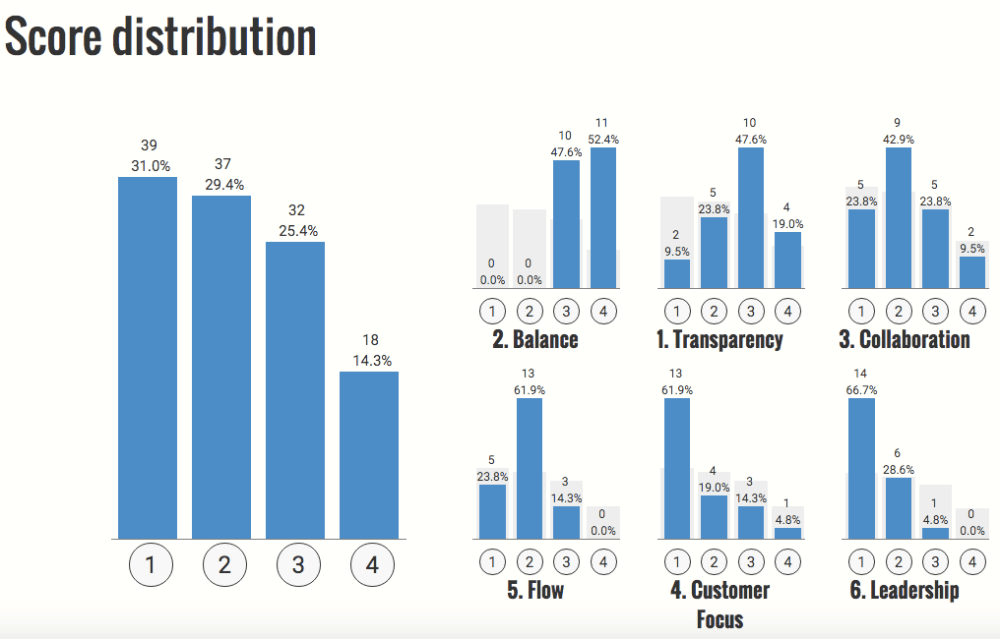
This example was taken after a Featureban game, so it should not come as a surprise that Balance comes out as the top category – very rare in real life!

I’d be asking:

  1. (Looking at the chart on the left) Don’t be too disappointed with those 1’s and 2’s (“Barely started” and “Early gains”). Our global survey shows similar results so you’re in good company!
  2. Are you pleased to see Balance, Transparency and Collaboration as your top three? Surprised? What does it say to you? How do these results relate to your organisation’s most recognised values?
  3. What about the bottom three – Flow, Customer focus, and Leadership? Could they be related? Note: I often see Balance down there with Flow and/or Collaboration; this should be easy to explain – overburdened systems don’t flow and people are spread too thinly to collaborate!

2. The best of the best

The top few prompts of the top few categories give a good opportunity to discuss what’s working and what progress has been made recently.

Screen Shot 2016-02-14 at 17.36.54

If you’re familiar with the game, you’ll know that Balance (between demand and capacity) is an area in which huge strides are made between the first and second iterations. I continue in this vein until we’re obviously looking at more mediocre or controversial scores.

3. Divergence

Often the most interesting conversations arise over the prompts over which there is the least consensus. Sorting by ‘Divergence’ highlights these:

Screen Shot 2016-02-14 at 17.08.37

There is definitely some room for debate here. Yes, we meet regularly, but are we really reviewing and improving our outputs and processes?

Note that prompt 3.1 doesn’t have a particularly wide spread, but its 1’s contribute significantly to a wide spread for the category as a whole (we’re using the “mini” template here, just 3 prompts per category).

4. Agenda for change

Looking first at the “weakest of the weak” but then more broadly, what prompts would we prioritise? Which seem the most pertinent? We try to identify a top 3 and then a top 1.

You have a couple of choices here, both of which require degree of preparation:

  1. You might already have invited people to ‘star’ categories and prompts in the ‘Agenda’ tab of the assessment tool; if this is the case you can sort the charts page by ‘Starred’
  2. Facilitate it yourself using your preferred tools (eg dot voting)

I’m not super-happy with the usability of the ‘Agenda’ tab; as discussed in the previous post, I have been known to input this data myself from my notes. More often than not I opt for the second approach.

Time permitting, you might like to facilitate the authoring of a narrative version of the agenda for change, incorporating values that categorise the chosen prompts and some statement of intent. I’d recommend doing this in small groups, potentially before the consensus priority list has been agreed.

5. Action

Now we generate actions for our prioritised prompts. I always start this silently with a two or three sticky notes per person, so that multiple ideas get generated and everyone gets a chance. Prioritise again, using your preferred tool (dot voting, Thirty-Five aka “pass the cards”, etc).

Beyond the scope of this post:

  1. How best to frame, explore, and organise actions – a key part of our 1-day training workshop, some clues here also
  2. How to ensure that actions will actually be followed through. Ironically, this a popular reason for the Leadership category to score less than it might! We touch on this in the 1-day class but it’s much more the territory of the 2-day training workshop on values-based leadership.

To repeat the offer that closed the previous post, do ask, telling me a little about your context. Agendashift is not (yet) a paid product but we do need feedback.

And do join our LinkedIn group. We’re acting on feedback and tweaking the tools constantly; it’s the best place for sharing your experiences, informing our thinking, and generally keeping track of what we’re up to!


Agendashift-cover-thumb
Blog: Monthly roundups | Classic posts

Links: 
Home | Partner programme | Resources | ContactMike
Community: Slack | LinkedIn group | Twitter
Using Agendashift as a coaching tool

We’re doing this increasingly frequently now, with some very encouraging results. With some tips learned from experience, here’s how you can use the Agendashift values-based delivery assessment in a one-on-one coaching session (some options for group work are mentioned later). The preparatory steps 1-4 should be done in advance.

  1. Get added as a beta user (see below) – if you’re not one you won’t be able to do steps 2-4 below, but do not fear, all is not lost if you aren’t one yet!
  2. From My contexts, create a context for the company, team, class, or individual you are working with
  3. From the page for that context, create a survey to represent the current point in time and the current state of their Lean-Agile transformation journey (slightly mixed metaphor there, sorry)
  4. In a private window (where you’re not already logged into Agendashift) or on your coachee’s machine, go to the address given by the long link on the survey page. For example, the 2016 global survey’s long link is https://www.agendashift.com/surveys/46/my_assessment?access_token=822933d1a042945228ecdcadad508f05bc2f290f (not that anyone needs this in order to participate in this special case)
  5. Sit beside them or share screens, with them in control
  6. Ask them to sign up (or sign in, if they’ve done this before)
  7. Explain what the Agendashift values-based delivery assessment is, observing that the assessment’s sections are named after values. Use your own judgement on how much – if any – of the origin of the model you want to explain at this point.
  8. Explain the scoring scale, noting the help icon next to it. Summary: it goes from 1 to 4; you’ll know if a 1 or a 4 is appropriate; there is no lazy middle option, and whether you’re a 2 or a 3 depends on whether you feel closer to the start or the finish.
  9. Proceed to the Transparency section and let them talk you through it. Use questions like “what do you think is the intent behind this prompt?” and “what would a 4 look like here?” if you think they’re going off track or missing something important, but otherwise take the opportunity to listen.
  10. At the end of each section (before proceeding to the next), ask them which prompts (up to three of them per category) represent areas they would prioritise for urgent attention. Note these down (keep a pen and notebook handy); there is the Agenda tab for this purpose but it’s better to keep the conversation going at this point and input the data later. Obviously, some tool changes are warranted here.
  11. Now we’re into next steps, the subject of a future post! Meanwhile, see here and here for some clues on where we’re going with that.

For groups, you can either conduct a number of these sessions (the survey nicely combines the results together for you), send out the link and let people work it out for themselves before you hold a joint debrief (more on that in a future post), or facilitate the population of a single assessment as a group exercise. That last one is my least favourite option as you’ll be able to capture only the consensus view and will lose the opportunity to visualise the range of opinion.

IMG_0522
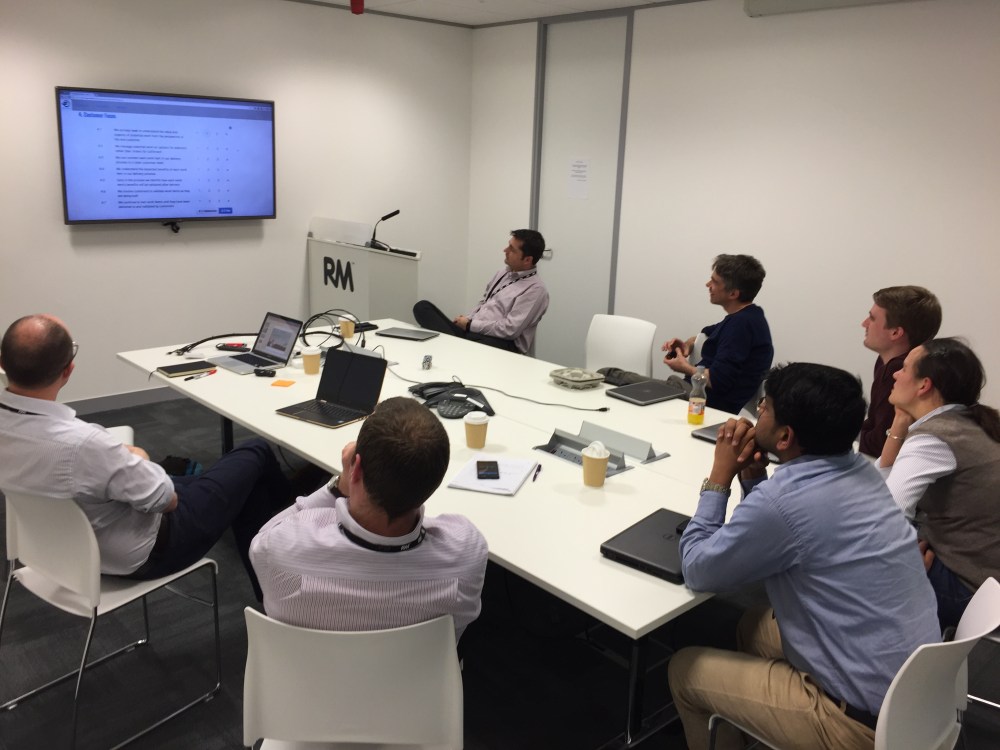
A group session facilitated by Ian Carroll

If you’re not already a beta user you have two options:

  1. Ask – telling me a little about your context. Agendashift is not (yet) a paid product but we do need feedback!
  2. Use the global survey, which uses the “mini” template – 18 prompts instead of 44. You get one assessment per signup (no ability to create contexts, surveys, etc).

Either way, I strongly recommend our LinkedIn group. We’re acting on feedback and tweaking the tools constantly; it’s the best place for sharing your experiences and keeping track!


Agendashift-cover-thumb
Blog: Monthly roundups | Classic posts

Links: 
Home | Partner programme | Resources | ContactMike
Community: Slack | LinkedIn group | Twitter
Action through values-based Servant Leadership

[First, previous in series]

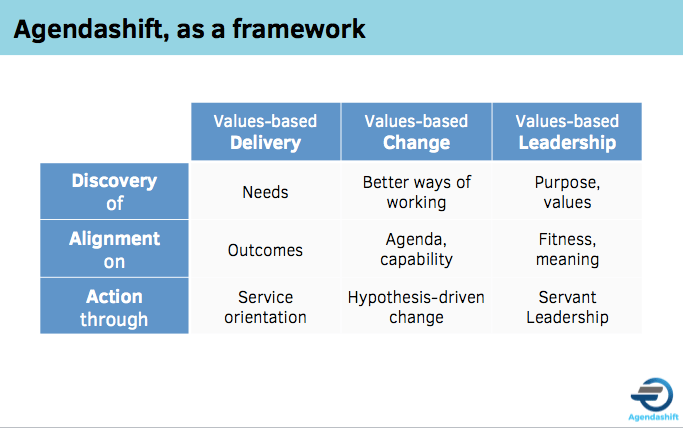
This is last in a series of nine articles exploring the matrix below (introduced here), and we’ve reached the bottom right hand corner.

Agendashift puts Servant Leadership at the intersection of “Values-based leadership” and “Action”. This is not to keep Servant Leadership in its box somehow (we’ll see that it has application right across the framework); rather it is to emphasise that it is an active thing, not just a question of style. Moreover, after reading this post you’d be forgiven for thinking that Agendashift is mostly about Servant Leadership!

Screen Shot 2016-01-05 at 19.16.55

I am on record as taking issue with the simplistic characterisation of Servant Leadership as “unblock all the things and get out of the way”. It’s not hard to guess why this gets taught, but this kind of facilitation is only the beginning of process that requires anticipation, proactivity, presence, and patience. As I wrote previously, Greanleaf’s inspiring vision of Servant Leadership is a long game:

  1. Removing impediments so that others can be successful
  2. Enabling autonomy and meaning in others as together we meet external needs in the pursuit of the organisation’s mission and purpose
  3. Developing servant leadership and servant leaders for the long term

The systems thinker will recognise that there are reinforcing loops at play here. It’s the kind of thinking that long-lived organisations have already applied – they understand that without it, their culture is unlikely to be sustained across generations. Greenleaf goes on to describe this process at the level of the individual (“The servant as leader”), the organisation and its service to society (“The institution as servant”), and the governance and stewardship that keeps it true (“Trustees as servants”). It’s stretching stuff, but still reachable.

Too hard? Too big? If you aspire to leadership, try using the Agendashift framework to give some structure to this challenge. Column-wise from the right, look for opportunities in the following:

1. Values-based leadership:

  • Facilitating exploration and agreement on the purpose and values of  your organisation (or your part thereof). Consider its service to its customers, its position in its immediate ecosystem, and its broader contribution to employees, customers and other stakeholders, even its role in society. Be ready to give due recognition to behaviours that exemplify the organisation’s shared values, and to provide appropriate challenge when gaps emerge between purpose, values, and behaviour (more on this below under Values-based delivery).
  • Pursuing fitness for purpose for the organisation and meaning for its staff. Reah a shared understanding what fitness looks like, tracking progress towards it. Recognise that competition can make this a moving target, so allow your thinking to be challenged from time to time. Encourage alignment between purpose and meaning, but have the openness to accept that people can find meaning in their work in a wide variety of ways.

2.Values-based change

3) Values-based delivery

  • Making needs a primary concern of your delivery process – a more fundamental and powerful shift than many realise
  • Aligning outcomes, not being satisfied with measuring success only in your own narrow terms
  • Organising for service, such that everyone knows what they’re delivering (not just what they do), to whom (whether internal or external), and why it matters (to the end customer most especially). But don’t rush to the big reorg! Start by organising the work and let the rest follow.

Still too big? I have three suggestions. The first could be called “Small acts of values-based leadership”. Here, each bite-sized leadership opportunity relates to one of Kanban’s values (six of the nine are represented here explicitly), and I’m quoting from my book Kanban from the Inside:

  • Transparency: In knowledge work, things don’t make themselves visible or explicit by themselves; leaders choose to make them so. This is as true in the small details—the wording of a policy, for example—as it is in the bigger things, such as institutional feedback loops.
  • Balance: Where are we overloaded, and why? Are our pain points obvious, or does the volume of work hide them? Is the mix of work right? There is leadership opportunity in asking these questions as well as in the decisions that may follow.
  • Collaboration: Making an introduction, reaching out, sharing a problem, noticing how people interact—all of these can be acts of leadership.
  • Customer focus: It takes leadership to acknowledge that the process may be ineffective at discovering and meeting real customer needs.
  • Flow: Are you seeing it? What is stuck today? Where do blockages repeatedly occur? Why is that? These are everyday questions of leadership.
  • Leadership: Encouraging leadership in others can demand real leadership on the part of the encourager. Kanban’s kind of leadership not only spreads, it reinforces itself.

My second suggestion is the Agendashift values-based delivery assessment. This has the same six categories as “Small acts of values-based leadership” above, but offers a number of specific prompts that point in the direction of mature organisational behaviour. There’s a mini 18-prompt version available to all; get in touch if you’d like access to the full 44-prompt version, perhaps for a consolidated group exercise. After taking the assessment, which prompts would you prioritise? What action would you take? What impact do you think it would have? How would you know?

My third suggestion is to get help, whether that’s from me (helping leaders engaged in Lean-Agile transformation is a large part of what I do), from someone you source locally, or from someone you already trust. When you’re playing a long game like this, it really helps have someone close by who will help you put things into words and put your challenges and frustrations into proper perspective. Input in the form of training, coaching, or consultancy can be invaluable too. You don’t need to do it on your own!

Agendashift resources

References


Agendashift-cover-thumb
Blog: Monthly roundups | Classic posts

Links: 
Home | Partner programme | Resources | ContactMike
Community: Slack | LinkedIn group | Twitter

Alignment on fitness, meaning

[First, previous, next in series]

Almost there! This is the eighth of nine articles in a series exploring the matrix below (introduced here), and we’re halfway down the right-hand column “Values-based leadership”.

Screen Shot 2016-01-05 at 19.16.55

Alignment on fitness (for purpose)

Most teams I encounter have little difficulty in articulating both their purpose (what they do and why it matters) and the purpose of their wider organisation. With some prompting, they can come up with measures of their fitness for purpose. Do they regularly explore fitness for purpose? Plan for future fitness? Often not.

Many teams ask a different set of questions: Are we on track? How do we get back on track? What are our issues? How do we resolve them? There’s a place for such questions, but they’re project-focused, doing little to drive the health and growth of the delivery system.

A powerful way to institute a more service-oriented approach is to implement effective feedback loops that explicitly address various dimensions of fitness for purpose. Kanban has an established pattern for this, the service delivery review. Here’s the regular agenda for one I introduced a few months ago:

  1. User feedback (unsolicited) and user research (solicited)
  2. Helpdesk incidents
  3. Production events – releases, incidents, etc
  4. Volumes – this week’s and projected
  5. Channel shift, marketing activity, seasonal behaviour
  6. Production metrics
  7. Delivery update – recent deliveries, lead times and delivery rate metrics

By design, it starts near the customer and works backwards. “Are we on track?” comes a long way behind “Are we set up to maintain good service?” Clearly, it’s a pivotal meeting, an ideal opportunity to maintain alignment on outcomes (the second in this series) and capability (the fifth).

Alignment on meaning

How do people find meaning in work? It’s important to understand that there are many answers to this question. Yes, there is meaning to be found in contributing to the purpose and fitness of the organisation, but it would be self-serving of managers to assume that this is the only source. People find meaning in their relationships with colleagues, their identification with team or role, their responsibilities, or the quality of their craft. Those aside, earning a crust for their families might be reason enough! Assuming that they are able to contribute (or that impediments to contribution are being addressed in good faith) I’ve come to conclusion that there are few wrong answers at the individual level.

If the team as a whole however lacks concern for purpose, fitness, its shape, the quality of its work, or its economics, there’s a problem. This is not just a coaching problem, it’s likely to be symptomatic of bigger issues – the organisation itself losing its way at some level, recruiting poorly, managing ineffectively, structured unhelpfully. Alignment on meaning is therefore part of the longer game of leadership, part of the feedback process that ensures that we’re building organisations that know what they’re about and are in it for the long term.


Agendashift-cover-thumb
Blog: Monthly roundups | Classic posts

Links: 
Home | Partner programme | Resources | ContactMike
Community: Slack | LinkedIn group | Twitter

Discovery of purpose and values

[First, previous, next in series]

This is the seventh of nine articles in a series exploring the matrix below (introduced here). For the last three articles we’ll be working our way down the right hand column.

Screen Shot 2016-01-05 at 19.16.55

Purpose

In Better ways of working, the preceding post in the series, we made reference to fitness for purpose. We’ll revisit fitness next time, but what about purpose, and why do I have it in a row labelled Discovery?

You might think that purpose is something you find within, but in our experience the most powerful statements of purpose involve some relationship to the outside world. Powerful for two reasons: (1) they articulate something motivating at the personal level, and (2) they provide a point of reference for everything that happens internally, the end point (and often the start point too) of many of the organisation’s most important workflows.

Here’s a great example (you’ll recognise it if you have read my book):

Driven by our endless curiosity and creativity we promise to make our drivers happy and proud by anticipating mobility needs of people and society ahead of time.

That “brand promise” is to be found on the wall behind the service desk of my local Toyota dealership. As an outward-looking statement of organisational purpose, its reference to people and society make it hard to beat. I love “anticipating needs … ahead of time” too (I wrote about that in 2013).

If your part of your organisation hasn’t recently articulated its purpose, I’d encourage you to give it a try as a team exercise. A good starting point is in the line “Know what you’re delivering, to whom, and why it matters“. Two-thirds of that (the “to whom” and the “why”) lie outside the team, so there’s plenty of scope here for “discovery”!

Values

Agendashift is an “opinionated framework” – it has some sensible defaults built in. Amongst these are Kanban’s nine values of transparency, balance, collaboration, customer focus, flow, leadership, understanding, agreement, and respect. (Coincidentally, I first articulated these exactly three years ago this week.)

Drilling down, the Agendashift values-based delivery assessment goes on to identify 44 key ways in which we might reasonably expect the values to be exemplified in a mature Lean-Agile implementation, whether Kanban-based or otherwise.

There’s plenty of room here for exploration, some of it challenging:

  1. How does the organisation (or part thereof) stack up against that 44-prompt model, what is the impact of any gaps, and what action should be taken?
  2. In what other ways should we expect the values to be exemplified in our context?
  3. What about other values (specific to us or borrowed from other models) that are important to us?

The existence of an off-the-shelf model should not imply just a checkbox approach. It is my sincere hope that organisations will develop values-based models of their own, and indeed our leadership workshop (developed with the kind support of Code Genesys Inc) provides significant help in that direction. What better way to understand in a deep way what Lean, Kanban and Agile are really about, and to look with fresh eyes at things your organisation has long taken for granted?


Agendashift-cover-thumb
Blog: Monthly roundups | Classic posts

Links: 
Home | Partner programme | Resources | ContactMike
Community: Slack | LinkedIn group | Twitter

Top Agendashift posts of 2015

The Agendashift blog has only been going for a few months, but already we’re up to 25 posts. Of those, the five most read articles are as follows:

  1. Featureban’s new home
  2. Agendashift in a nutshell
  3. Agendashift, meet Reverse STATIK
  4. Hypothesis-driven change
  5. Servant Leadership un-neutered

Which one is your favourite? Mine is probably the last one, and there’s more on that topic to come in January. Join our LinkedIn group to be sure of catching it.

Wishing you all the best for 2016!


Agendashift-cover-thumb
Blog: Monthly roundups | Classic posts

Links: 
Home | Partner programme | Resources | ContactMike
Community: Slack | LinkedIn group | Twitter

Better ways of working

[First, previous, next in series]

This is the sixth of nine articles in a series exploring the matrix below (introduced here):

Screen Shot 2016-01-05 at 19.16.55

“Better ways of working” tops the middle column, at the intersection of “Discovery” and “Values-based change”.

The Agile manifesto begins with these words:

We are uncovering better ways of developing software by doing it and helping others do it.

As we all know, the manifesto proceeds to outline a fundamental shift of priorities that help to separate Agile development from the slow, inflexible and process-heavy methods that preceded it.

I particularly like the open-endedness of “We are uncovering…” – no-one was trying to claim that the challenges of software development had all been addressed. It does however beg the question of what constitutes “better ways“. What’s the test? How do we know that any given “better way” is indeed an improvement over what we do now? If we aspire to more than the mediocrity that follows from merely copying other people’s solutions to other people’s problems, this is an important question.

Values certainly help. A change that aligns poorly with the manifesto, with Kanban’s values, or with the organisation’s own values should be called into question.

Drilling into the balance value in my book Kanban from the Inside, I suggest some additional tests:

Achieving a balance among the interests of different stakeholders—team members, customers, senior management, shareholders, even the wider community—can be especially challenging.

No-one has the capacity to weigh up the concerns of all of those stakeholders all of the time, but a practical policy does at least set the right tone: If a so-called improvement works at the expense of any of these groups, think again, try harder. If it feels like a zero-sum game is being played, beware. “Good for customers, for the organization, and for the people doing the work” strikes a better tone.

Improvements that don’t respect this rule often come unstuck. Customers have only limited tolerance for worsening products and services. Organizations can’t usually be expected to support changes unquestioningly, with no regard to their wider impact. People eventually walk away from worsening working environments; productivity, quality, and well being all decline in the meantime.

If you have a good idea of what fitness for purpose would feel like for each of those stakeholder groups, you can be even more specific: genuine improvements elevate fitness.

Discovering better ways of working

I’m currently reading Kuhn’s The Structure of Scientific Revolutions, the book that fifty years ago popularised the term “paradigm shift“. It describes the scientific process as one in which revolutions are rare, and most of the real work is much more mundane, devoted to incremental solutions to well-defined problems of theory, experimentation, engineering, or to articulation and socialisation.

Lean-Agile transformation is not so different. Lean and Agile bring new delivery paradigms that are still in the process of being fully embraced in the industry; it’s fair to say that this revolution is not yet complete, even if it does seem somewhat inevitable now. Lean/Kanban brings the complementary paradigm of evolutionary change, in which the organisation’s ability to change is seen as a crucial dimension of agility.

Not that these paradigms are especially difficult to explain – the harder task is to implement and then to sustain them! Accordingly, Agendashift is “opinionated” in the explicit integration of tools, mechanisms, and techniques that maintain the progress of change towards fitness, via better ways of working. Tools like the values-based delivery assessment, mechanisms for agreeing an agenda for change, and the formalism and process of hypothesis-driven change; these combine to help identify and prioritise opportunities for change and to frame and manage their respective solutions.

In the new year we’ll complete this series with three posts on Values-based leadership. Have a wonderful Christmas break meanwhile, and see you soon!


Agendashift-cover-thumb
Blog: Monthly roundups | Classic posts

Links: 
Home | Partner programme | Resources | ContactMike
Community: Slack | LinkedIn group | Twitter

Alignment on agenda and capability

[First, previous, next in series]

This is the fifth of nine articles in a series exploring the matrix below (introduced here):

Screen Shot 2016-01-05 at 19.16.55

We’re working through the middle column from bottom to top, previously covering hypothesis-driven change and now reaching the central cell “Agenda, capability”.

Capability

There is a little ambiguity here. By capability, do I refer to the existence of ability or to the level of performance? Both! In both senses of the word, do we have the capability to achieve the outcomes of the Delivery column and the fitness of the Leadership column?

Agenda

When the capability question is answered in the negative, there must be some serious work to be done. The “how” might not be well defined from the outset, but the motivation and success criteria certainly should be.

By agenda, I mean some appropriate combination of motivation for change, success criteria and narrative, perhaps unified by a pithy word or phrase (“sustainability” or “digital”, for example). An agenda might serve as the “epic” for a bunch of hypotheses, express a leadership theme, or summarise the most urgent findings of a values-based delivery assessment.

Alignment

Alignment on agenda implies agreement on what needs to be changed. Over time, alignment is maintained by feedback loops (review meetings, etc) that help to keep us on track.

Alignment on capability is a reminder that customer outcomes and organisational fitness are at stake. Change that is disconnected from these probably ought not to be done!


Agendashift-cover-thumb
Blog: Monthly roundups | Classic posts

Links: 
Home | Partner programme | Resources | ContactMike
Community: Slack | LinkedIn group | Twitter

Hypothesis-driven change

[First, previous, next in series]

This is the fourth of nine articles in a series exploring the matrix below (introduced here):

Screen Shot 2016-01-05 at 19.16.55

We’ve now reached the middle column, and we’re starting from the bottom with Hypothesis-driven change.

Back in the day, we had Plan-Do-Check-Act (PDCA) – effectively the grandaddy of all experiment-based improvement cycles. This decade, Lean Startup has made the idea sexy once again, and there’s a really nice correspondence between the kind of hypothesis-driven approaches described by (say) Ash Maurya’s Running Lean (focussed on evolving a product) and Jeff Anderson’s Lean Change Method (focussed on evolving an organisation). Learn one, and you’re halfway there with the other! It hasn’t escaped the attention of the Agile community either – see for example this 2011 Dr Dobb’s article on Hypothesis-Driven Development.

Framing

Spend any time researching “hypothesis-driven development” now, and you’ll soon find this template familiar:

We believe that <change>
will result in <outcome>.
We’ll know when that we have succeeded when <measures>.

I appreciate the humility of it; in contrast to the way change is often framed, we’re prepared to admit that we don’t yet know for sure yet how well (or even whether) we’ll succeed. It really is an experiment, and not just because of the formalism. For all but the most obvious of quick fixes the truth is that you don’t know yet, so you might as well be honest about it!

As taught in my workshop , this 21st century framing helps lead the way to some questioning:

  • How well could it turn out, and what would be required for the best case scenarios to play out? This line of questioning gets us into assumptions and dependencies, and sometimes to a whole cascade of preliminary experimentation.
  • What unintended consequences (good as well as bad) might arise? How might we nurture the potential upsides as well as prevent or mitigate the downsides?
  • Who would need to be involved?

Organising

For each individual change, Ash and Jeff have this kind of workflow in common:

  1. Prioritisation: choosing what to next, holding back changes that we shouldn’t commit to yet (there’s only so much we should do at once), and having the discipline to reject any that are unlikely to make it to the front of the queue in the foreseeable future
  2. Negotiating the nitty-gritty details (which in some cases may need to happen in parallel with prioritisation)
  3. Proving that it is as feasible, workable and usable as we thought
  4. Verifying that we’re getting the results we expected, capturing insights
  5. Either making the change permanent or reverting it

Processes such as these lend are very suited to being managed in a kanban system. There’s a nice symmetry here – your MVPs and your changes to organisation or process could easily be managed together using tools that many Agile teams would find quite familiar.

Joining the dots

To quote one recent workshop participant, this is “practical teaching which will be easily implemented in my business”. It stands very well on its own as a set of techniques, but as we further explore values-driven change we’ll see how it connects to values-based delivery (the service orientation part especially) and values-based change too.


Agendashift-cover-thumb
Blog: Monthly roundups | Classic posts

Links: 
Home | Partner programme | Resources | ContactMike
Community: Slack | LinkedIn group | Twitter

Service orientation

[First, previous, next in series]

This is the third of nine articles in a series exploring the matrix below (introduced here):

Screen Shot 2016-01-05 at 19.16.55

Previously we looked at Outcomes; today we’re finishing the left-hand column (Values-based Delivery) with Service orientation.

Service orientation might seem a rather abstract concept to place in a row labelled “Action”, but to the Kanban community (if not more widely) it means something quite specific, teachable and actionable.

Take this (from Kanban from the Inside, tweaked a little):

Know what you’re delivering, to whom, and why it matters

Understand

  • How you deliver (from the team’s perspective)
  • How well (from the customer’s)
  • How to sustain it (from the organisation’s)

Kanban has here a very good model for adopting and scaling Agile. Instead of a process-centric approach, teams begin with an external perspective as the motivation for realignment and the context into which the “how” is improved through the deliberate introduction of new tools and techniques (from Agile and Lean, from Kanban itself, and from further afield). The customer’s experience improves (as it does internally) as understanding and motivation develops not just within teams but between them and ultimately across whole product lines. Indeed, bolder implementations will have it mind to achieve end-to-end results quickly.

The “to whom, and why it matters” and the “how well” echo the Needs and Outcomes of the preceding two posts in this series. Much of the remaining six will speak to the question of how to sustain it.


Agendashift-cover-thumb
Blog: Monthly roundups | Classic posts

Links: 
Home | Partner programme | Resources | ContactMike
Community: Slack | LinkedIn group | Twitter