Towards the wholehearted organisation, outside in

It’s one of those often-cited, non-enough-read books, Christopher Alexander’s The Timeless Way of Building, the classic book on architecture and the built environment that inspired the patterns movement in software (think Gang of Four Design Patterns, PLoP, etc).

It’s a rewarding read – philosophical in a way that is both surprising and delightful, and (whether intended by the author or not) full of ideas that are just asking to be carried over to other domains. I read it with organisation design in mind.

This favourite quote isn’t specific to building but it is loaded with metaphor:

Screenshot 2018-05-26 11.52.59

It got me thinking that I would love to be known for being in the business of helping organisations to be more wholehearted – less at war with themselves, their contradictions identified and owned so that they can be resolved in some pleasing way. If squeezing out excess work-in-progress is a key strategy for improving our delivery processes, perhaps squeezing out the contradictions is the way to improve our organisations for the mutual benefit of all concerned.

In my keynote talk Inverting the pyramid, I use this quote to introduce a section on outside-in reviews – for example the strategy reviews and service delivery reviews that follow the kind of outside-in agenda as described in chapter 5 of the Agendashift book:

  1. Customer
  2. Organisation
  3. Platform
  4. Product
  5. Team

Juxtaposing these different perspectives – each one presented by the people who are best equipped represent them – increases our chances of not only bringing our inner contradictions and misalignments to the surface, but of finding better ways to meet external needs too. Within each agenda item, a right-to-left [1] structure: what we’ve recently learned about how things are, what we’re beginning to learn through experimentation, and what experiments we plan to conduct as capacity permits.

Some context and an invitation: As mentioned a few days ago, I have just begun work on my third book: a no-nonsense, leader’s guide to Lean-Agile, organised around the three themes of right to leftoutside in, and upside down. Join us in the #right-to-left channel in the Agendashift Slack to monitor progress and to discuss any of these three themes.

Related posts:

[1] Understanding Lean-Agile, right to left


Upcoming events

February

March

*TTT/F and (where shown) LIKE events include free one-year membership of the Leading with Outcomes Authorised Facilitator programme, upgradeable to Authorised Trainer at any time. Both of those include access to the video-based Leading with Outcomes training and the full range of Agendashift assessment tools.


Leading with Outcomes from the Agendashift Academy
“Leadership and strategy in the transforming organisation”

Leading with Outcomes is our modular curriculum in leadership and organisation development. Each module is available as self-paced online training or as private, instructor-led training (online or in-person). Certificates of completion or participation according to format. Its modules in the recommended order:

  1. Foundation module:
  2. Inside-out Strategy:
  3. Adaptive Organisation:
  4. Outside-in Strategy:

Individual subscriptions from £24.50 £18.40 per month after a 7-day free trial, with discounts available for employees and employers in the government, healthcare, education, and non-profit sectors. For bulk subscriptions, ask for our Agendashift for Business brochure.

To deliver Leading with Outcomes training or workshops yourself, see our Authorised Trainer and Authorised Facilitator programmes. See our events calendar for Train-the-Trainer / Facilitator (TTT/F) and Leading in a Transforming Organisation trainings.


Agendashift™: Serving the transforming organisation
Links: Home | Subscribe | Events | Media | Contact | Mike

Agendashift  Academy: Leading with Outcomes | Trainer and Facilitator Programmes | Store

At every scope and scale, developing strategy together, pursuing strategy together, outcomes before solutions, working backwards (“right to left”) from key moments of impact and learning.

Understanding Lean-Agile, right to left

Suppose you had to understand Lego – and I mean really understand it. Where do you start? With children playing, or with plastic feedstock?


Now suppose you had to understand Lean-Agile. Where do you start? With people collaborating over software that is already beginning to work for its customers, or with backlogs and projects? Working software, or JIRA?

With the Agendashift book [1] only just out of the door, I’ve begun work on the prequel, a no-nonsense guide to Lean-Agile, the kind of book you’ll give to your manager and hope that they’ll pass on to theirs. And yes, we’ll start right to left, beginning at the point where needs are met [2] and working our way upstream. We’ll describe what it’s like to have Lean and Agile already working well, and demonstrate powerful ways to understand, manage, and improve almost any kind of delivery process.

There’ll be two more themes: outside in and upside down; more on those soon. Join us meanwhile in the #right-to-left channel in the Agendashift Slack [3] if any of these themes are of interest to you. Perhaps you have relevant examples or models that support these themes, or are already beginning to wonder about how they might be applied in your current situation and have questions.

[1] Agendashift: Outcome-oriented change and continuous transformation
[2] My handy, referenceable Definition of Done
[3] Agendashift on Slack


Upcoming Agendashift workshops:


Agendashift-cover-thumbBlog: Monthly roundups | Classic posts
Links: 
Home | About | Partners | Resources | Contact | Mike
Community: Slack | LinkedIn group | Twitter

We are champions and enablers of outcome-oriented change and continuous transformation. Building from agreement on outcomes, Agendashift facilitates rapid, experiment-based emergence of process, practice, and organisation. Instead of Lean and Agile by imposition – contradictory and ultimately self-defeating – we help you keep your business vision and transformation strategy aligned with and energised by a culture of meaningful participation. More…

My handy, referenceable Definition of Done

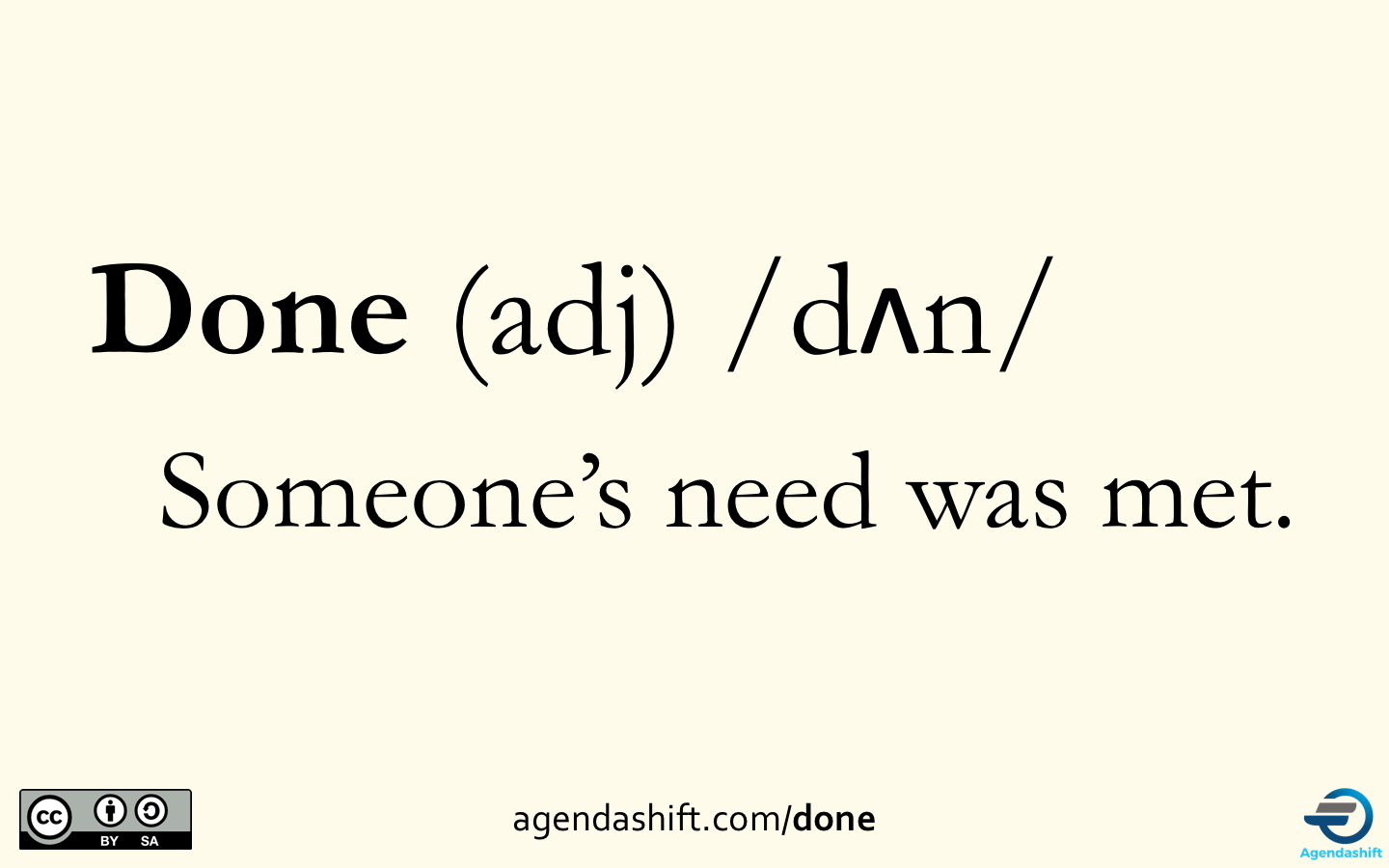
Now in handy, referenceable [1] form, my working definition of “Done” [2]:

Done

[1] agendashift.com/done
[2] A good working definition of “Done”, also Better user stories start with authentic situations of need

Handy links to closely-related resources:

  • agendashift.com/book – chapter 3 in particular
  • agendashift.com/true-north – “…needs met at just the right time”
  • agendashift.com/principles – Start with needs” is principle #1

Upcoming Agendashift workshops:


Agendashift-cover-thumbBlog: Monthly roundups | Classic posts
Links: 
Home | About | Partners | Resources | Contact | Mike
Community: Slack | LinkedIn group | Twitter

We are champions and enablers of outcome-oriented change and continuous transformation. Building from agreement on outcomes, Agendashift facilitates rapid, experiment-based emergence of process, practice, and organisation. Instead of Lean and Agile by imposition – contradictory and ultimately self-defeating – we help you keep your business vision and transformation strategy aligned with and energised by a culture of meaningful participation. More…

Emergence, Fast and Slow

One word that came up a few times in last week’s workshop (which got a 12 out of 10 by the way) was emergence. It’s a funny kind of word, one that gets some people excited and leaves others completely cold. That’s due in part to its scientific overtones, but there’s more to it than that.

In its slow form, emergence – as in emergent architecture for example – is regarded as a close cousin of evolution, a process whose results (structures, phenomena, properties) emerge from the repeated application of certain rules and constraints. Done deliberately, it looks something like this:

  1. We start where we are, with what we do now, or with a simple but probably inadequate design
  2. We wait until we’re dissatisfied somehow with the status quo
  3. Following some defined rules and keeping within certain constraints, we make what we hope turns out to be a step forward
  4. Rinse and repeat (starting with a new what we do now)

To its fans, it’s reliable way to cause a design to become increasingly fit for purpose – even when the environment around it is continually changing. Two things come with experience of the process:

  • Confidence in the outcome – the details of which aren’t planned in advance but familiar patterns and consistent properties do tend to repeat themselves
  • The realisation that the process can be guided and accelerated, for example using transparency to promote the activations of steps 2 and 4

Unfortunately, to those that haven’t experienced it, emergence and evolution can be a tough sell (which is why I don’t talk about them much). To some ears, these words evoke a process that’s highly wasteful and almost geologically slow, involving speculation, dead ends, and highly unpredictable outcomes. To others, it looks passive and directionless, change happening only in response to external pressures. No-one wants their organisation to go the way of the way of the dinosaur, and when proactivity is called for, it seems safer to stick to planned approaches with their up-front commitments and rigidly defined outputs – never mind that outputs and outcomes are two very different things!

I’ve hinted that in expert hands, emergence can be speeded up. Sometimes it can be very rapid indeed. Take for example the process we facilitate in Agendashift’s Discovery and Exploration activities through our 15-minute FOTO game:

  • Seed the process with a list of obstacles – things that block our path toward our generic True North (for Discovery), impede progress towards specific prompts prioritised from one of our assessments (for Exploration), or some other list
  • Identify the outcomes that lie immediately behind those obstacles
  • Identify the outcomes behind those outcomes, repeating through several layers, searching deeper and wider into outcome space

At Friday’s workshop we calculated that we were generating outcomes at a rate of nearly 2 per minute per table group. Two table groups were able to produce nearly 60 in just 15 minutes! As facilitator, I can’t predict what specific outcomes will be generated (I’ve stopped trying), but I’ve done it enough times to know that it’s a highly productive process, and that what emerges with the detail is a shared sense of both agreement and ambition. That’s gold!

Agendashift’s tagline is “Outcome-oriented change and continuous transformation”. With apologies to Daniel Kahneman, this is “Emergence, Fast and Slow” – the rapid emergence of agreement on outcomes and the emergence of a fitter, more adaptable organisation in the focussed follow-through. Agreement without the follow-through would of course mean the waste of a few hours or days of work. A much greater waste would be to implement change in the absence of agreed goals, the committed support of the host organisation, and the meaningful engagement of the people affected. They need each other!


Upcoming Agendashift workshops:


Agendashift-cover-thumbBlog: Monthly roundups | Classic posts
Links: 
Home | About | Partners | Resources | Contact | Mike
Community: Slack | LinkedIn group | Twitter

We are champions and enablers of outcome-oriented change and continuous transformation. Building from agreement on outcomes, Agendashift facilitates rapid, experiment-based evolution of process, practice, and organisation. Instead of Lean and Agile by imposition – contradictory and ultimately self-defeating – we help you keep your business vision and transformation strategy aligned with and energised by a culture of meaningful participation. More…

Centered and T-shaped (sub)communities

On the evening of my arrival at Raleigh, NC from across the pond, I gave a new talk on my first book Kanban from the Inside. Here’s a slide I used to explain the philosophy behind Part II, Models, addressing in particular the question of how multiple (and some would say competing) models can be used together:

Screenshot 2018-04-04 15.28.37

I’m not going to expand on bullet 1 other than to point the curious in the direction of Gall’s Law.

Bullet 2 is much more up my street, and I’ve stuck to this line consistently – it’s pretty much the definition I use for the Lean-Agile community in the Agendashift book: a community that celebrates Lean and Agile, both separately and together.

That definition describes a very broad umbrella, and there’s a wide variety of things happening beneath it. Agendashift is one of them, a community centered [1] on outcome-oriented change. Around that theme we are:

  • Running with the idea, diving deep, developing it through use, making our more successful experiments more repeatable and more easily transferable to others
  • Taking a stance against imposed change (in which we stand shoulder-to-shoulder with our friends in the OpenSpace Agility community)
  • Bringing together a range of different experiences and areas of expertise, colliding a number of models old and new, from within Lean-Agile and without
  • Expecting exciting things to happen.

It’s interesting to note that among the Agendashift community’s closest collaborators we have both Certified Scrum Trainers and Accredited Kanban Trainers, knowledgeable and experienced representatives of two great communities whose relationship hasn’t always been easy. Along with vast majority of practitioners who would be comfortable sitting under a Lean-Agile umbrella, I think I can speak for all of them when I say that each of them understands and respects the special contributions of their erstwhile antagonists. And after that, not just “Why can’t we all just get along?”, but “What can we achieve together that were weren’t achieving on our own?”

Observing this, I wonder aloud if the concept of T-shaped people [2] might extend to T-shaped subcommunities. I’m suggesting that in order to stay healthy, an ecosystem as large as Lean-Agile needs groups of people that have:

  1. The persistence to run with ideas and to see just how far they can take them (so that you don’t have to, except where there’s a genuine passion to pursue)
  2. The diversity to ensure they stay vibrantly creative
  3. Broad enough representation that their learning will diffuse and cross-pollinate via the overlaps between communities

Sometimes this will happen by accident, but I suspect that the majority of successful examples are the product of deliberate attention. Can we make it more repeatable? I don’t know, but I would certainly be interested in comparing notes with others who are doing similar things. Could conversations such as these help make Lean-Agile simultaneously more cohesive, more diverse, more respectful, and more productive? I’d like to think so…

[1] BDD is a Centered Community Rather than a Bounded Community (thepaulrayner.com)
[2] T-shaped skills (en.wikipedia.org)


Upcoming Agendashift workshops:


Agendashift-cover-thumbBlog: Monthly roundups | Classic posts
Links: 
Home | About | Partners | Resources | Contact | Mike
Community: Slack | LinkedIn group | Twitter

We are champions and enablers of outcome-oriented change and continuous transformation. Building from agreement on outcomes, Agendashift facilitates rapid, experiment-based evolution of process, practice, and organisation. Instead of Lean and Agile by imposition – contradictory and ultimately self-defeating – we help you keep your business vision and transformation strategy aligned with and energised by a culture of meaningful participation. More…

Incremental and iterative

There seem to be two schools of thought on how best to explain iterative and incremental delivery. In the interests of clarity, the “incremental versus iterative” school, represented excellently by Alistair Cockburn, seeks to keep technical definitions separate as far as possible. The “incremental and iterative” school deliberately emphasises the intertwingliness of it all (in fairness both schools I’m not including people who blur the line unthinkingly).

Just for the purposes of this post I’m in the second school. Here’s a cute, mutually recursive definition that describes a healthy delivery process:

Incremental: new goals agreed and achieved with each short iteration, building on previous work

Iterative: seeking to be objectively better with each small increment, learning from previous work

If that’s healthy, what would unhealthy look like?

  • Incremental only: big backlog up front (BBUF?), backlog-driven development (the BDD acronym is already taken), no time for learning
  • Iterative only: constant tinkering, chasing metrics, busywork, no meaningful alignment on goals

Ugh – you really do need both! If you’re big on planning, break the big rocks down into smaller rocks, and make sure you leave enough gaps between them in every iteration for learning. If you’re big on flexibility (at the extreme, on-demand scheduling), don’t settle for ad-hoc; step back regularly from your individual work items and agree on which goals you’re (self-)organising around.

Related concepts: refinement and fidelity (see this by Karl Scotland). It’s smart to start with crude solutions that kinda work, then refine them incrementally and iteratively (both at the same time):

  • Incremental refinement: make refinements you had the good sense to defer
  • Iterative refinement: make refinements based on feedback

Credits: Thanks to everyone who commented on my crude, kinda-working prototype micro posts on Slack, Twitter, LinkedIn (and LinkedIn group), also privately on Facebook. In particular: Steven Mackenzie, Roy Marriott, Karl Scotland, Sean Blezard, Ray Edgar, Graham Berrisford, Rob Ferguson, David Daly, Becky Hartman, and Lowell Lindstrom.

Related:


Upcoming workshops:


Agendashift-cover-thumbBlog: Monthly roundups | Classic posts
Links: 
Home | About | Partners | Resources | Contact | Mike
Community: Slack | LinkedIn group | Twitter

We are champions and enablers of outcome-oriented change and continuous transformation. Building from agreement on outcomes, Agendashift facilitates rapid, experiment-based evolution of process, practice, and organisation. Instead of Lean and Agile by imposition – contradictory and ultimately self-defeating – we help you keep your business vision and transformation strategy aligned with and energised by a culture of meaningful participation. More…

Inverting the pyramid, start-with-what-you-do-now style

The theory:

classic-inverted-pyramid

That’s right, the entire organisation supporting its customer-facing staff, the CEO at the bottom of the inverted pyramid. Intriguing!

Here’s my version, which you’ll find in chapter 5 of the latest revision of the Agendashift book (the last announced Leanpub revision before we go to print):

inverted-pyramid
The inverted pyramid, Agendashift-style

Key differences:

  1. Instead of the CEO and senior managers we have processes. No need to promote power hierarchies!
  2. It’s opinionated: each process begins with Discovery and ends with Validation. It’s both humbling and powerful – transformative, even – to acknowledge both that we don’t know everything, not least the eventual impact of our work.
  3. Review meetings of various unspecified kinds – service delivery reviews, capability reviews, strategy reviews, and risk reviews, even standup meetings and planning meetings
  4. Mutual accountabilities, horizontally and vertically

The lack of specificity in point 3 is deliberate: in Agile terms, we’re scaling, but we’re inviting a start with what you do now approach rather than insisting on a particular process framework. So how, exactly?

Here are three ways for you to look at your existing review meetings, three dimensions in which most such meetings can be improved:

  1. How might they be more outside-in (customer before organisation, platform, product, team, etc)? Who best represents each agenda item? In what order? Sharing what metrics (and implying what values)? What contradictions are we likely to find between these different perspectives, and are we prepared to deal with them?
  2. How might they be more right-to-left (recently-completed work first, then working backwards)? Do participants feel mutually accountable for an end-to-end process that focusses on outcomes and finishes with validation? What keeps those outcomes connected to authentic needs, and how are needs discovered and prioritised? What keeps workloads at appropriate levels?
  3. Horizontally and vertically, do your meetings together cover the organisation (or at least the part thereof that is the focus of your interest)? Horizontally, does each contributing part feel sufficiently connected, with overlapping participation across meetings? Vertically, is the organisation adequately represented so that delivery work, capability-related work, and mission can be kept in alignment?

The trick is to recognise that you don’t have to turn everything upside-down in one giant upheaval – the reorientation can start locally, and at any level. Locally doesn’t mean “timidly” though – in fact the way these strategies encourage accountability horizontally and vertically across organisational boundaries makes them both silo-busting and bubble-busting. Scary perhaps, but if you want to influence the rest of the organisation, then maybe you must be prepared to be influenced back…

More on this in my talk at London Lean Kanban Days 2018 (23-24 April) – see you there!


Upcoming Agendashift workshops (see Events ):


Agendashift-cover-thumbBlog: Monthly roundups | Classic posts
Links: 
Home | About | Partners | Resources | Contact | Mike
Community: Slack | LinkedIn group | Twitter

We are champions and enablers of outcome-oriented change and continuous transformation. Building from agreement on outcomes, Agendashift facilitates rapid, experiment-based evolution of process, practice, and organisation. Instead of Lean and Agile by imposition – contradictory and ultimately self-defeating – we help you keep your business vision and transformation strategy aligned with and energised by a culture of meaningful participation. More…

How I read the Scrum Guide

Overview:

  1. The good: Things the Scrum Guide™ reinforces that would otherwise get lost
  2. The ugly: Things that should not be accepted at face value
  3. How I approach it

I’m going to assume that you have at least a passing acquaintance with Scrum, either as it’s generally taught and discussed, or as defined in the Scrum Guide. The guide itself has been updated in the past few days, there now being a 2017 edition:

The guide is ©2017 Ken Schwaber and Jeff Sutherland. Offered for license under the Attribution Share-Alike license of Creative Commons, accessible at http://creativecommons.org/licenses/by-sa/4.0/legalcode and also described in summary form at http://creativecommons.org/licenses/by-sa/4.0/.

I haven’t checked to see when this license model was applied, but nice move.

1. The good: Things the Scrum Guide reinforces that can easily get lost

My biggest “Aha!” moment for Scrum was when I realised that it wasn’t about story points, velocity, Fibonacci numbers, and the like. Although tools like these do seem to work effectively enough for some people, others find them a recipe for (i) busywork or (ii) setting teams up for regular disappointment. Small wonder that they’re a popular target for sniping. Rightly, there is no mention of them at all in the guide.

The guide instead talks of the sprint backlog as both a set of items selected for the sprint, and – crucially – a plan for delivering them. And get this: the sprint backlog is subordinate to something else, the sprint goal:

As the Development Team works, it keeps the Sprint Goal in mind. In order to satisfy the Sprint Goal, it implements functionality and technology. If the work turns out to be different than the Development Team expected, they collaborate with the Product Owner to negotiate the scope of Sprint Backlog within the Sprint.

Imagine you’re working in an organisation that typically takes months or even years to deliver anything of note (I exaggerate not). Now give people the chance to work together on achieving a meaningful goal in a matter of days. And again. And again. That’s powerful. Could that be done without Scrum? Does it happen without Scrum? Of course it could and of course it does, but Scrum is often the vehicle by which people experience this for the first time, and that’s something to celebrate.

I also have to give credit to Ken and Jeff for being explicit about Scrum’s applicability:

Scrum (n): A framework within which people can address complex adaptive problems, while productively and creatively delivering products of the highest possible value.

I don’t highlight this quote as some kind of backhanded compliment, a way to put Scrum back into its box. The domain described here is huge! And it’s important for reasons explored in chapter 5 of the Agendashift book. To operate a Lean, Agile, or Lean-Agile process worthy of that name, you must embrace the idea that the often challenging, sometimes messy, and always necessary work of helping the organisation to change must be treated as real work, to be carried out not just alongside delivery work, but integral to it. The ‘complex adaptive’ part of that quote might be unnecessarily jargony but it refers to the inability of any linear plan to deliver this vital kind of change effectively (see my “Change in the 21st century” keynote).

Taking these together, Scrum working well means:

  1. Meaningful goals regularly met
  2. The system – the team and well beyond – evolving commensurately

That’s harder to achieve and even harder to sustain than it might sound, and the guide is honest about the level of challenge involved. What it leaves unsaid is that as soon as Scrum comes to mean ploughing through the backlog, these benefits become increasingly difficult to sustain. It’s why we find support in complementary tools such as Kanban, Lean Startup, and now Agendashift [1] when the returns from Scrum on its own begin to diminish.

2. The ugly: Things that should not be accepted at face value

The Scrum Master is responsible for promoting and supporting Scrum as defined in the Scrum Guide. Scrum Masters do this by helping everyone understand Scrum theory, practices, rules, and values.

The Scrum Master is a servant-leader for the Scrum Team. The Scrum Master helps those outside the Scrum Team understand which of their interactions with the Scrum Team are helpful and which aren’t. The Scrum Master helps everyone change these interactions to maximize the value created by the Scrum Team.

There are so many better ways in which the Scrum Master role could have been introduced, and it beggars belief that this section could be edited (yet again) in the 2017 edition and left like this. After an ugly paragraph easily construed as ‘your first responsibility is towards Scrum’ we see a very carefully circumscribed kind of servant-leadership that will surely be read in the light of what precedes it. There are more charitable interpretations, but they depend on assumptions that aren’t made explicit.

To be a true servant leader, your responsibility is towards your colleagues, your organisation, your customers, other stakeholders, even towards society. Where by-the-book Scrum helps you in those responsibilities, fantastic. Where it gets in the way, it might be time to do something not by the book. A true master at Scrum might find these situations rare, but pity the conflicted rookie! Even if only in the context of these sentences, if it doesn’t bother you that Scrum Masters are certified after just a couple of days of training, it should.

If we want our industry to do better, we have to look at its systems, ready to challenge a status quo that tends to preserve itself. Scrum has been around long enough to qualify for that kind of scrutiny and whatever their true intent, these widely-read sentences are too open to a cynical, self-serving interpretation.

In response to my tweet yesterday morning, Neil Killick was quick with this much better alternative:

With all due respect to Neil, that wasn’t so hard, was it?

3. How I approach it

I start from the perspective that Scrum describes some pragmatic solutions to common problems. Do you have multiple customers, far removed from the team? Then you’ll find it helpful to have a highly available Product Owner. Do you need someone to model and facilitate appropriate practices and behaviors? Then bring in a Scrum Master. Are your feedback loops too slow relative to the rate of environmental change? Then plan your work to fill short timeboxes and meet daily.

Conversely, if you don’t have all of these problems, you might not need Scrum. At the very least, tread carefully:

  • Don’t place obstacles between a team and its customers if they’re already collaborating (yay, manifesto values!)
  • Don’t add layers of process and ceremony where teams are already self organising effectively
  • Don’t allow Scrum’s timeboxes get in the way of rapid flow and rapid change – they needn’t [2], which is why I don’t present this as a technical objection to Scrum

Nice problems to have, you might argue. And well you might, which why I am significantly more pro Scrum than anti. But I don’t check in my experience, knowledge, or curiosity at the door. Where I see conflict between approaches, I dig deeper, fully expect to find agreement, and am usually rewarded handsomely.

For the most part, you can leave the self-serving stuff behind (I’ve learned to filter it out). If you are helping to bring clarity and agreement around purpose and goals (things Agendashift and the guide fully agree on), and if you start with needs, seek agreement on outcomes, and so on [3], it’s likely that you’re approaching things in a good way. As time passes you might find that things look less and less like anything you heard in class, but don’t let anyone shame you for that. Expert or rookie (and yes, tread accordingly), you’re responsible. You’re a leader!

[1] About Agendashift
[2] Scrum and Kanban revisited
[3] Agendashift in 5 principles

I’m grateful to Olivier My, Neil Killick, Johan Nordin, and Karen Beck for their valuable feedback on earlier drafts of this post.

While we here

Lean-Agile Strategy Days London (II) – 22-23 Nov, London, UK is just over a week away and there’s still time to book your place. Interested in Lean-Agile change and its relationship to strategy? You should be there! In case you can’t make both days, we’ve just added a strictly limited number of single day tickets.

5 key plays and how to accelerate them

In the context of a discussion about a scaling framework (it doesn’t matter which one), I was asked yesterday in the Agendashift Slack about recurring patterns I’ve seen or applied in my work and whether/how they’ve been affected by Agendashift.

For the sake of minimum argument, let’s say we’re already using both Scrum and Kanban at team level. Basic (and improving) processes are in place, work is visible, and teams are not massively overburdened. It’s not necessarily how I’d start but let’s call that easily-understood baseline ‘play 0’.

After that, here are five key plays from my playbook:

  1. Smooth/speed work through dev – often through managing dependencies better, identifying them before work starts, making them more visible, greatly reducing the appetite for starting work that can’t be finished
  2. Make the post-dev process more visible – make any issues there too visible to ignore
  3. Smooth/speed work through the post-dev process – better conversations at the start of the process (even before dev), better automation, better management of environments, etc
  4. Validation – retain ownership of work well past delivery, validating that the impact on user behaviour is as expected and that needs are being met
  5. Work on the team/organisation interface – risk management, change management, service delivery reviews (a favourite of mine), team sustainability (funding, recruitment, skills transfer, etc)

In what order? When do you do these things?

Of course it depends, but notice:

  • The need for plays 1-3 should become increasingly apparent to the teams themselves once play 0 has taken effect. More experienced teams are likely to notice the need for them sooner; the most experienced ones will not only contain people who know not only that bottlenecks move, but can guess in which direction (and they’re listed in the most common order). These changes happen fastest when they are encouraged and supported by people who know what to expect. An explicit drive towards continuous delivery is helpful, especially with regard to plays 2 and 3.
  • Unlike plays 1-3, plays 4-5 are unlikely to appear spontaneously through a process of introspection. They involve some important attitude changes:
    • Work is only truly ‘done’ when needs have been met (and demonstrably so)
    • It is recognised that the host organisation has needs too, and that unless you want live forever in a small Agile bubble, a certain amount (and style) of mutual accountability is healthy, not a threat.

If I’m working mainly at team level, it’s likely that the five plays will happen in roughly the order presented. Play 4 may involve developing some skills that the dev team might not have in abundance initially (user research & testing, service design, service management, etc). Play 5 may come a lot sooner if the right kind of sponsorship is in place, and it helps immensely if there are managers who can also be considered part of the team for at least these purposes (service managers, delivery managers and project managers in GDS projects, for example).

How Agendashift changes things

Let’s recast these plays as outcomes to be achieved:

  1. Work flowing smoothly through dev, dependencies managed well
  2. Effective management of the process end-to-end
  3. Good collaboration end-to-end and an effective technical platform for rapid delivery
  4. Proactive alignment of team and customer, more ‘right thing’ than ‘wrong thing righter’
  5. Proactive engagement between team and organisation, setting the tone, metrics consistent with values, better alignment overall

As soon as you have agreement on outcomes like these, the opportunity is there for the taking. Of course there are right ways and wrong ways of going about things (and Agendashift provides some help here), but as per my previous post, Getting to Agendashift’s “Why”:

Because when you have agreement on outcomes, the rest is “just” the how…

Agendashift creates the opportunities for outcomes like these to be articulated and agreed upon, even before deep-seated pain points are fully exposed, thereby accelerating the process. They can be tackled in sequence or in parallel, via off-the-shelf practice or innovation, with or without reference to frameworks. The choice is between you and those that you work with and for, defined to some degree by your role already or left open. Where choices are open, make best use of that opportunity: consider a diverse range of options and make progress by testing assumptions relentlessly (advice that works for product development too).

While we’re here

November 8th (tomorrow) is a key day:


Agendashift-cover-thumbBlog: Monthly roundups | Classic posts
Links: 
Home | About | Partners | Resources | Contact | Mike
Community: Slack | LinkedIn group | Twitter
Workshops (see Events
):
8th Nov, Cape Town, South Africa22-23 Nov, London, UK


Agile and Lean are just toolkits, right?

Agile, Lean, Kanban, Scrum, SAFe, … plenty of tools to choose from, so why does ‘toolkit’ set my teeth on edge? Perhaps it puts me in mind of the journeyman worker who knows his tools but never really excels at anything.

To be more than a mere journeyman and to progress towards mastery, you need to know more than just the distinguishing features of each tool or body of knowledge. If I were looking for expert advice or inspiration I’d want to see:

  1. Some respect for how these different schools came into being, the conditions prevailing at the time, the problems being solved
  2. An understanding of the values and principles that explain their design choices and implementation strategies (and I don’t mean just being able to parrot them; values in isolation of practice are meaningless)
  3. An ability to describe their ‘lessons’ – key takeaways that you can apply non-prescriptively, perhaps using alternative tools

Some examples of these lessons:

  1. From Agile: the power of working collaboratively in carefully controlled chunks goes way beyond what you’d learn from studying psychology or queuing theory separately. It’s not magic (it’s easy enough to explain technically and it’s not hard to bring about) and there’s a positive reinforcement feedback loop there, one in which success breeds greater success.
  2. From Lean Startup and Kanban (bedfellows almost from their respective beginnings): make the processes by which you learn about your customers, your product, and yourselves as visible as you can make them. You make rapid progress by continually testing your assumptions about all three.
  3. From Scrum: don’t underestimate the value of rhythm. It’s not just the ritual and the predictability, it’s also the opportunities to achieve something meaningful in between (see lessons 1 and 2)

I’d love to see more of these. Can you describe a ‘lesson’ non-prescriptively?

Related:


Agendashift-cover-thumbBlog: Monthly roundups | Classic posts
Links: 
Home | AboutPartners | Resources | Contact | Mike
Community: Slack | LinkedIn group | Twitter
Workshops (see Events
):
8th Nov, Cape Town, South Africa22-23 November, UK