A small departure from the book

Slightly technical, but if you’re interested in what we know to be a remarkably effective combination of Clean Language, Cynefin, and Story Mapping as practiced in most Agendashift workshops, read on…

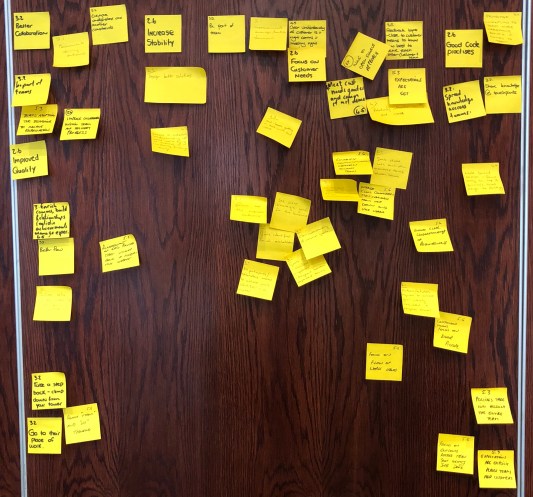
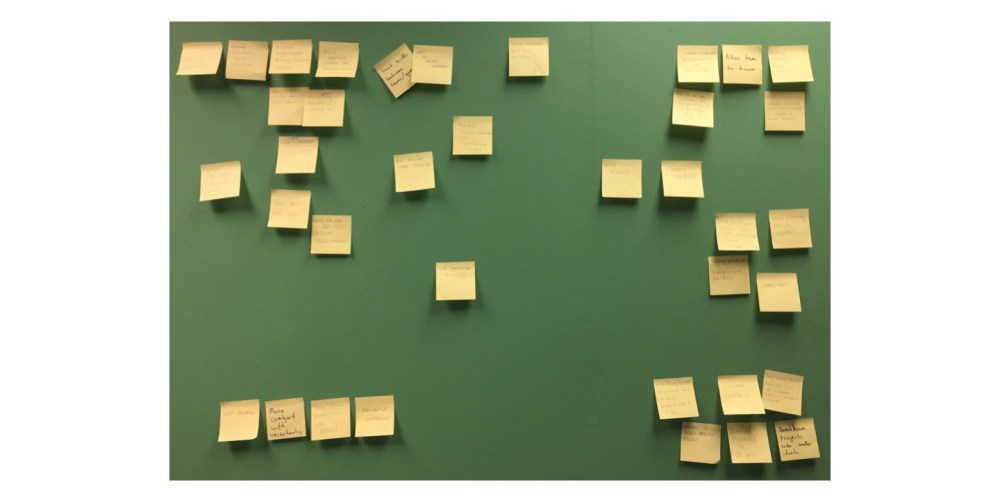
One of the notable highlights of an Agendashift workshop comes when we take the list of outcomes generated by the 15-minute FOTO game [1], transcribe them onto stickies, and organise them 4-points style [2]:
cynefin-finished-2017-12-16

Through the experience of the ‘4 points contextualisation exercise’ (to give it almost its full name), participants are slowly introduced to the Cynefin framework [3], the facilitator trying all the while to avoid naming the model or using Cynefin terminology such as ‘obvious’, ‘complicated’, ‘complex’, or ‘chaos’ (trust me, it’s hard!). For participants familiar with the model, it’s always a funny moment when the penny finally drops and the realisation dawns that Cynefin can be so much more than just a conceptual model, especially when there’s a good supply of ‘narrative fragments’ – outcomes, in our case – to play with. For those that haven’t come across it before, it’s a great opportunity to explore why different kinds of outcomes need different kinds of approaches, a lesson that’s much more meaningful when it’s learned through interacting with your own data (‘sensemaking’) than it would be as a lecture.

Up to now – and as described in the book [4] – the translation from the Cynefin representation to one based on a story map has been a 2-stage process. First, a few minutes of organised chaos as stickies are moved to under their respective headings:

Second, as much time as we want to spend – anything from a few moments to an hour or more – prioritising stickies within columns, and through that process making sure that there is a shared understanding of what each of them means and their possible dependencies on other stickies. Anyone who has done story mapping before will recognise that this can provide an important opportunity for some valuable conversations; we’ve found this to be the case even in public workshops, with ‘teachable moments’ aplenty.

A refinement

Instead of the ‘organised chaos’ followed by prioritisation, work clockwise from bottom right, prioritising as we go:

  • Starting with the ‘obviously obvious’: Sticky by sticky, check that they really are obvious (ie we can all quickly agree what needs to be done and can be pretty sure of the likely outcome), put them in their correct columns, and prioritise. Prioritisation will be easy, as there’ll be at most a few per column, a mixture of quick wins and less important items.
  • The ‘borderline complicated’: For the items on the border between obvious and complicated, explore why they were placed there, and discuss what should be done about their non-obvious aspects (perhaps there’s some important detail that someone will need to get to grips with). Prioritise them relative to the already-prioritised ‘obviously obvious’ items in their respective columns (again, this should be easy)
  • The complicated, one sticky at a time: who might be delegated to run with this item? Should we get some external help? In its appropriate column, how does it prioritise relative to the items already there?

I could at this point say “and so on through the complex and chaos” but the facilitator will flag up here that anything in or bordering on complex is likely to be a good candidate for hypothesis-based change (a session later in the day, see also [5]), and so it’s a good idea to mark each item in some way so that they can be identified easily later. And for the borderline cases:

  • ‘Borderline complex’: Are the complicated and complex parts easily separable? How will we organise this, mainly linear with some room for refinement along the way, or mainly through iteration with some expert input or planned work at the appropriate time?
  • ‘Borderline chaos’: Is it urgent to address symptoms or or attempt some diagnosis now, or can we afford to wait until we see what’s thrown up in the course of other work?

I’ll be honest: it’s still early days for this change and there’s no slideware [6] for it yet – if any is needed we’ll learn that through practice and by partner demand. That’s usually the best way!

[1] 15-minute FOTO, our Clean Language-inspired coaching game
[2] Cynefin Review Part 7 – Finding Your Place on the Framework (adventureswithagile.com)
[3] The Cynefin framework (wikipedia.org)
[4] Agendashift: Outcome-oriented change and continuous transformation, Mike Burrows (New Generation Press, 2018), chapters 2 and 3 in particular
[5] The Agendashift A3 template (and chapter 4)
[6] The Agendashift partner programme

Finally, some opportunities to experience it for yourself:


Agendashift-cover-thumbBlog: Monthly roundups | Classic posts
Links: Home | About | Partners | Resources | Contact | Mike
Community: Slack | LinkedIn group | Twitter
We are champions and enablers of outcome-oriented change and continuous transformation. Building from agreement on outcomes, Agendashift facilitates rapid, experiment-based emergence of process, practice, and organisation. Instead of Lean and Agile by imposition – contradictory and ultimately self-defeating – we help you keep your business vision and transformation strategy aligned with and energised by a culture of meaningful participation. More…

Outputs from yesterday’s Agendashift workshop

With the permission of its participants, this post is a quick tour through yesterday’s public Agendashift workshop in Cape Town, seen through the key artifacts produced by our two table groups. Sessions 1-5 are covered in detail in chapters 1-5 of the Agendashift book (all five chapters); see also the poster and about pages for a quick overview.

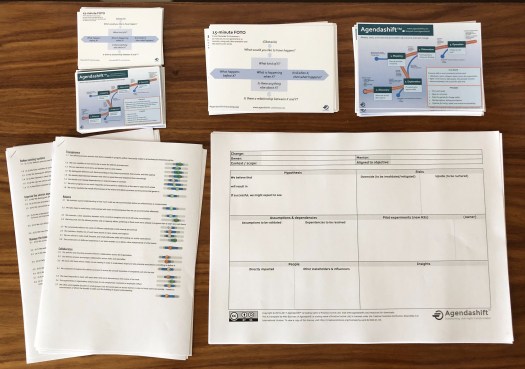
Picked up from the local printers the day before: cue cards for the 15-minute FOTO game (A6 & A5 sizes – the larger A5 size being the more popular); ‘original’ & ‘pathway’ survey reports, A3s. See resources.

2017-11-07 12.58.29-1

Session 1: Discovery

Two exercises here. The first is a getting-to-know-you “Celebration” exercise, ostensibly about a company celebration that is to take place some time in the future (it’s one of those time travel games), but in practice a nice way to make sure the workshop is grounded in organisational context and needs. To structure the output, we use the classic journalistic 5W questions: Who, What, When, Where, and Why, with the How coming later:


The second Discovery exercise involves:

  • Reflecting on our True North statement as an approach to the challenges of the first exercise, thinking about what that’s like, what’s different, and what obstacles stand in our way
  • Using our recently-open sourced coaching game 15-minute FOTO to turn that list of obstacles into outcomes
  • Organising the resulting outcomes to produce the outputs shown below


Session 2: Exploration

A few days prior to the workshop, the participants each completed an Agendashift values-based delivery assessment. The Exploration session starts with a survey debrief, the structure of which is now so well practised that the unbenchmarking report leads us through it step by step.

Then – guess what! – we generate outcomes:

  • Prioritise the survey prompts
  • Identify their respective obstacles
  • Generate outcomes using the 15-minute FOTO coaching game again (a lot easier second time round – one conversation stood out as one I’d wished I’d recorded!)

We finish the session with the exercise whose first rule is not to mention its name (see the first part of this writeup which breaks this rule, or chapter 2 of the book). The joint output of both table groups:

2017-11-08 14.29.46

Moments after this picture was taken we destroyed it (reusing the stickies) but not before identifying stickies setting towards the top left corner as being likely candidates for some hypothesis-driven change (session 4). Look out for stickies marked with asterisks in the next pic (session 3).

Session 3: Mapping

Next, the transformation map, like a user story map but where the items are outcomes rather than user stories:

2017-11-08 15.32.40

After some discussion, we concluded that the first column (Refine existing systems) was empty because the many small improvements that might have gone there were deemed insufficiently interesting on the day. Fair enough! Column 5, Address sources of dissatisfaction (etc) seems rather full; a review of the stickies shows significant scope for consolidation however.

The two stickies “above the line” were the subject of some debate. Are “Increased stability” and “Increased quality” to be treated as long-term objectives to which other yet-to-be-identified work aligns, or are they to be tackled head on? No right answers here, so long as we’re honest. Either way, I stressed that consider them to be actionable (“unactionable” and “aspirational” being trigger words of mine).

For reasons of time, we didn’t bother to prioritise within columns. There was plenty of past experience of that process in the room already.

Session 4: Elaboration

For a selected outcome per table, another generative process, that of creating options. Then:

  • Prioritisation, selected the option considered most capable of significant (“fantastic”) outperformance
  • A hypothesis, Lean Startup style
  • Further development, using our open sourced A3 template (a 20th century tool with a 21st century flavour)


It is not a mistake that both A3s have their Insights section filled in. No, we haven’t run these experiments yet, but imagining the learning we hope to capture allows us then to review our experiment design. Both tables identified gaps in their plans as a result of this tip. Result!

Session 5: Operation

As a practitioner workshop rather than a client workshop (same materials for both but different goals), we deliberately sacrificed much of this session in return for more time for reflection and discussion in sessions 1 & 2. Consequently there are no outputs to show here. With more time available, we would have added more outcomes to the transformation map, driven by an adaptability review. This process both recaps our outcome-oriented process and gets us thinking about how the decisions of the workshop will be carried forward. Our mantra here: “Treat change as real work”.

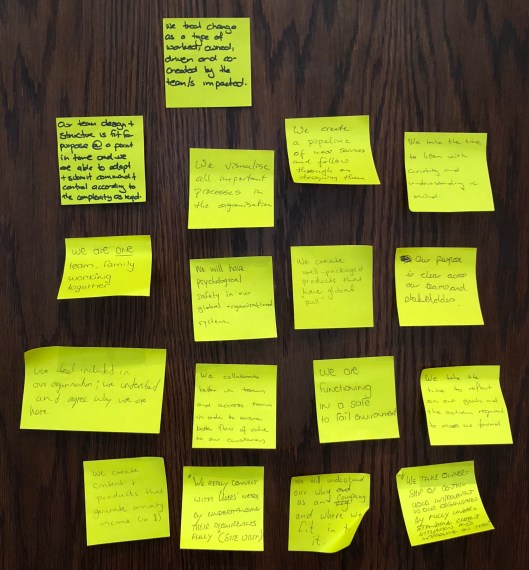
To wrap up, the Full Circle exercise, capturing outcomes using the house style of the assessment prompts – inclusive, present tense, non-prescriptive:

2017-11-08 17.00.09

The top one could almost be an advert for Agendashift (it’s not mine, honest):

We treat change as a type of work – owned, driven, and co-created by the team/s impacted

You, the outcome-oriented facilitator

If you could use some Agendashift-style outcome orientation in your coaching or consulting work, check out our partner programme. And there’s another opportunity very soon to try it all out, this time in London:

Finally, a massive thank you to all of yesterday’s participants, and also to the organisers of the Regional Scrum Gathering in South Africa who kindly invited me over for this morning’s opening keynote. Opportunities permitting, I hope to return to South Africa again soon – 6 years is too long!


Agendashift-cover-thumbBlog: Monthly roundups | Classic posts
Links: 
Home | About | Partners | Resources | Contact | Mike
Community: Slack | LinkedIn group | Twitter
Workshops (see Events
): 22-23 Nov, London, UK

Two new tools and how I’m finding them useful

I have been incorporating two new tools in my workshops: Clean Language (which could be described as a coaching tool) and the Cynefin Four Points Contextualisation exercise. Here’s how we put them to use.

Clean Language

You’re probably familiar with the idea of coaching often taking the form of identifying a goal, then helping the client focus on the process of getting there. The GROW model [1] is probably the canonical example, a conversation structured – explicitly, or implicity in the mind of one or both participants – along these easily-remembered lines:

  1. Goal
  2. Current Reality
  3. Options
  4. Way forward (or Will)

Clean Language [2, 3] covers some of the same ground, using language particularly good at (among other things) getting to outcomes (the Goal in GROW model), and doing so in a noticeably judgement-free manner.

There is some discipline involved:

  • Sticking to the the preferred prompts
  • Incorporating the client’s language
  • Note-taking

I’m not yet skilled enough myself to do all of those simultaneously and I certainly don’t expect others to do so without practice! It is however a fun and useful exercise for workshop participants to take the roles of the client (with real or imagined problems, challenges, or potential solutions to explore), coach (whose job it is to guide the exploration), and scribe (who writes down anything that sounds like an outcome).

In our exercise, the coach is allowed only these prompts (a small but important subset of the whole):

  • “What would you/X like to have happen?”
  • “(And) then what happens?”
  • ”(And) what happens before X”?
  • “What kind of X?”
  • “Is there anything else about X?”

In the context of the exercise, first two of those are the most important, taking the conversation away from problems and solutions and towards desired outcomes. The middle one has multiple applications; here it could be used when the coach does not grasp the mental leap the client has made. The last two are more exploratory, likely taking the conversation into areas more metaphorical, descriptive, or detail oriented (perhaps too much so, but that’s the choice of the coach).

No big explanation needed – we try it, and it works! We’re just dipping our toes in the water, but there’s the opportunity afterwards to explain that we have here a set of tools that could be of great value to anyone interested in further developing their coaching skills.

Four Points Contextualisation

The nuts and bolts of the Cynefin Four Points Contextualisation exercise are well described in the first part of this article from the Adventures with Agile blog: Cynefin Review Part 7 – Finding Your Place on the Framework.

More interesting to me than the mechanics have been some of the implications. This exercise powerfully illustrates some important things:

  • The importance of choosing an implementation approach that is appropriate in context, whether that’s one based on careful analysis and planning, on experimentation, or on direct action
  • The range of opinion on what’s appropriate, given any particular outcome or solution
  • The strength of our personal biases in favour of some approaches over others, making us  – myself very much included – vulnerable to blind spots and at risk of judging others quite unfairly

Interesting stuff! Here’s the output from one such exercise (on the Featureban scenario, not anything sensitive):

IMG_1523.jpg

Opportunities for you to give them a try

Both tools are now standard elements of the Agendashift debrief/action workshop, with the option to remove or gloss over them if a shorter workshop is called for. For the 1-day training workshop, they’re both optional extras – choosing them will be at the expense of other material. [Note: with some big site changes pending they’re not in the blurb yet]

There’ll be opportunity to see one or both of them in action at these upcoming events:

I’ll look into whether we can something at Lean Kanban India 2016 (9th-10th September) also.

Want to facilitate one a session yourself? Watch this space – we’ll soon be making this possible. Drop me a line your need is urgent!

References

[1] Sir John Whitmore, Coaching for Performance
[2] Lynne Cooper and Marriette Castellino, The Five Minute Coach: Improve performance – rapidly
[
3] Wendy Sullivan and Judy Rees, Clean Language: Revealing metaphors and opening minds


What if we put agreement on outcomes ahead of solutions?

Agendashift™: Serving the transforming organisation
Agendashift  Academy: Leading with OutcomesHome | Store

Links: Home | Subscribe | Become an Agendashift partner Events | Contact | Mike
Resources: Tools & Materials | Media | Books | Assessments
Blog: Monthly roundups | Classic posts
Community: Slack | LinkedIn group | Twitter