An outside-in strategy review, Agendashift style

I’ve just about finished an initial draft of the second chapter of Right to Left: The digital leader’s guide to Lean-Agile (which now has a landing page). Its three-part structure is firming up nicely as follows:

  1. Right to left (four chapters): Lean; Agile; Fundamental Lean-Agile patterns and how they combine; Scaling frameworks
  2. Outside in (one to three chapters): Strategy reviews (and related tools); Capability reviews; Feedback loops and other organisational patterns
  3. Upside down (one  to two chapters): Designing for leadership and change: Servant leadership, Leader-Leader, the inverted pyramid, engagement models (of which Agendashift is an example) and so on

The shape works, and I’m thrilled with how the well the right-to-left thing is working out – see for example last week’s post #RightToLeft works for Scrum too which is already a top 5 post for the year and is helping me find collaborators interested in giving the scaling frameworks a similar treatment.

I’ve not just been writing. Let me share four questions I posed (one at a time) at a outside-in strategy review (a private workshop):

  1. Customer: What’s happening when we’re reaching the right customers, meeting their strategic needs? (‘Strategic needs’ being the customer needs that best define our mission)
  2. Organisation: When we’re meeting those strategic needs, what kind of organisation are we?
  3. Product: Through what products and services are we meeting those strategic needs?
  4. Platform: When we’re that kind of organisation, meeting those strategic needs, delivering those products and services, what are the defining/critical capabilities that make it all possible?

(Admission: I got two of these the wrong way round in my prep last week, which changes the wording slightly. This exercise still worked great though!)

If you’re familiar with the model, you may be wondering what happened to the fifth and innermost layer, Team. This we covered not by a question, but via the Agendashift True North, focussing not on the work that teams are doing but on ways of working.

As we considered each layer, we captured some vision, then obstacles. After exploring the five layers individually, 15-minute FOTO to turn obstacles into outcomes.
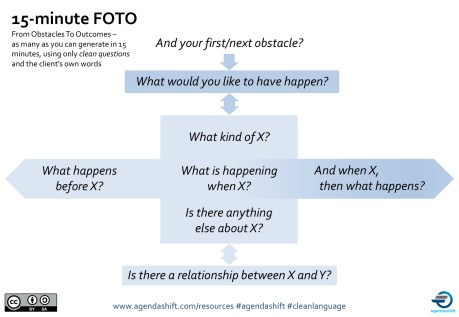
15-minute-foto-cue-card-2018-01-29 The 15-minute FOTO cue card

Precede all of that with some forward-looking context-setting and segue into hypothesis driven change and A3 (all of which are standard features of our transformation strategy workshops) and you have an outcome-oriented strategy review, done Agendashift style.

Want to explore these and other complementary strategy-related tools with us? Join myself and Karl Scotland at our Agendashift + X-Matrix Masterclass9th-11th October, Brighton, UK. Or drop us a line about private workshops. You might even facilitate one yourself – the tools and materials aren’t expensive!


What if we put agreement on outcomes ahead of solutions?

Agendashift™: Serving the transforming organisation
Agendashift  Academy: Leading with OutcomesHome | Store

Links: Home | Subscribe | Become an Agendashift partner Events | Contact | Mike
Resources: Tools & Materials | Media | Books | Assessments
Blog: Monthly roundups | Classic posts
Community: Slack | LinkedIn group | Twitter

Towards the wholehearted organisation, outside in

It’s one of those often-cited, non-enough-read books, Christopher Alexander’s The Timeless Way of Building, the classic book on architecture and the built environment that inspired the patterns movement in software (think Gang of Four Design Patterns, PLoP, etc).

It’s a rewarding read – philosophical in a way that is both surprising and delightful, and (whether intended by the author or not) full of ideas that are just asking to be carried over to other domains. I read it with organisation design in mind.

This favourite quote isn’t specific to building but it is loaded with metaphor:

Screenshot 2018-05-26 11.52.59

It got me thinking that I would love to be known for being in the business of helping organisations to be more wholehearted – less at war with themselves, their contradictions identified and owned so that they can be resolved in some pleasing way. If squeezing out excess work-in-progress is a key strategy for improving our delivery processes, perhaps squeezing out the contradictions is the way to improve our organisations for the mutual benefit of all concerned.

In my keynote talk Inverting the pyramid, I use this quote to introduce a section on outside-in reviews – for example the strategy reviews and service delivery reviews that follow the kind of outside-in agenda as described in chapter 5 of the Agendashift book:

  1. Customer
  2. Organisation
  3. Platform
  4. Product
  5. Team

Juxtaposing these different perspectives – each one presented by the people who are best equipped represent them – increases our chances of not only bringing our inner contradictions and misalignments to the surface, but of finding better ways to meet external needs too. Within each agenda item, a right-to-left [1] structure: what we’ve recently learned about how things are, what we’re beginning to learn through experimentation, and what experiments we plan to conduct as capacity permits.

Some context and an invitation: As mentioned a few days ago, I have just begun work on my third book: a no-nonsense, leader’s guide to Lean-Agile, organised around the three themes of right to leftoutside in, and upside down. Join us in the #right-to-left channel in the Agendashift Slack to monitor progress and to discuss any of these three themes.

Related posts:

[1] Understanding Lean-Agile, right to left


Upcoming events

February

March

*TTT/F and (where shown) LIKE events include free one-year membership of the Leading with Outcomes Authorised Facilitator programme, upgradeable to Authorised Trainer at any time. Both of those include access to the video-based Leading with Outcomes training and the full range of Agendashift assessment tools.


Leading with Outcomes from the Agendashift Academy
“Leadership and strategy in the transforming organisation”

Leading with Outcomes is our modular curriculum in leadership and organisation development. Each module is available as self-paced online training or as private, instructor-led training (online or in-person). Certificates of completion or participation according to format. Its modules in the recommended order:

  1. Foundation module:
  2. Inside-out Strategy:
  3. Adaptive Organisation:
  4. Outside-in Strategy:

Individual subscriptions from £24.50 £18.40 per month after a 7-day free trial, with discounts available for employees and employers in the government, healthcare, education, and non-profit sectors. For bulk subscriptions, ask for our Agendashift for Business brochure.

To deliver Leading with Outcomes training or workshops yourself, see our Authorised Trainer and Authorised Facilitator programmes. See our events calendar for Train-the-Trainer / Facilitator (TTT/F) and Leading in a Transforming Organisation trainings.


Agendashift™: Serving the transforming organisation
Links: Home | Subscribe | Events | Media | Contact | Mike

Agendashift  Academy: Leading with Outcomes | Trainer and Facilitator Programmes | Store

At every scope and scale, developing strategy together, pursuing strategy together, outcomes before solutions, working backwards (“right to left”) from key moments of impact and learning.

Inverting the pyramid, start-with-what-you-do-now style

The theory:

classic-inverted-pyramid

That’s right, the entire organisation supporting its customer-facing staff, the CEO at the bottom of the inverted pyramid. Intriguing!

Here’s my version, which you’ll find in chapter 5 of the latest revision of the Agendashift book (the last announced Leanpub revision before we go to print):

inverted-pyramid
The inverted pyramid, Agendashift-style

Key differences:

  1. Instead of the CEO and senior managers we have processes. No need to promote power hierarchies!
  2. It’s opinionated: each process begins with Discovery and ends with Validation. It’s both humbling and powerful – transformative, even – to acknowledge both that we don’t know everything, not least the eventual impact of our work.
  3. Review meetings of various unspecified kinds – service delivery reviews, capability reviews, strategy reviews, and risk reviews, even standup meetings and planning meetings
  4. Mutual accountabilities, horizontally and vertically

The lack of specificity in point 3 is deliberate: in Agile terms, we’re scaling, but we’re inviting a start with what you do now approach rather than insisting on a particular process framework. So how, exactly?

Here are three ways for you to look at your existing review meetings, three dimensions in which most such meetings can be improved:

  1. How might they be more outside-in (customer before organisation, platform, product, team, etc)? Who best represents each agenda item? In what order? Sharing what metrics (and implying what values)? What contradictions are we likely to find between these different perspectives, and are we prepared to deal with them?
  2. How might they be more right-to-left (recently-completed work first, then working backwards)? Do participants feel mutually accountable for an end-to-end process that focusses on outcomes and finishes with validation? What keeps those outcomes connected to authentic needs, and how are needs discovered and prioritised? What keeps workloads at appropriate levels?
  3. Horizontally and vertically, do your meetings together cover the organisation (or at least the part thereof that is the focus of your interest)? Horizontally, does each contributing part feel sufficiently connected, with overlapping participation across meetings? Vertically, is the organisation adequately represented so that delivery work, capability-related work, and mission can be kept in alignment?

The trick is to recognise that you don’t have to turn everything upside-down in one giant upheaval – the reorientation can start locally, and at any level. Locally doesn’t mean “timidly” though – in fact the way these strategies encourage accountability horizontally and vertically across organisational boundaries makes them both silo-busting and bubble-busting. Scary perhaps, but if you want to influence the rest of the organisation, then maybe you must be prepared to be influenced back…

More on this in my talk at London Lean Kanban Days 2018 (23-24 April) – see you there!


Upcoming Agendashift workshops (see Events ):


Agendashift-cover-thumbBlog: Monthly roundups | Classic posts
Links: 
Home | About | Partners | Resources | Contact | Mike
Community: Slack | LinkedIn group | Twitter

We are champions and enablers of outcome-oriented change and continuous transformation. Building from agreement on outcomes, Agendashift facilitates rapid, experiment-based evolution of process, practice, and organisation. Instead of Lean and Agile by imposition – contradictory and ultimately self-defeating – we help you keep your business vision and transformation strategy aligned with and energised by a culture of meaningful participation. More…