Devs not clear about strategy? It’s likely way worse than that

A quite common issue surfaced by the Agendashift Delivery Assessment is that so-called delivery teams (and I don’t just mean developers and other technologists) aren’t clear about things like vision, purpose, and strategy. Digging into what was apparently a source of real frustration at one client a few years ago, I asked a product manager what he and his colleagues in the product team were doing to keep these things at the forefront of minds and conversations in their technology team.

His answer?

“They never asked”

I was unable to stop my jaw from dropping! At my unguarded reaction he tried hastily to row back, but not very convincingly.

Show me a development team not involved in the strategy conversation and I’ll show you one that delivers code but not insights, features but not intelligence, and products that are mediocre at best, meeting the spec but failing to satisfy. You don’t want that. No strategist worth his salt wants that. No business can afford that kind of failure for long, but work in a strategy bubble and it’s what you get.

The systems theory around this issue is well known, developed since the middle of the last century. A key lesson is that if you neglect the necessary interplay between organisational processes such as strategy and delivery (to name but two), you put your independent existence – your viability – under real threat. Happily, much of the associated practice is now highly accessible to a 21st century audience – the startup community lives by it – so there’s little excuse not to be guided by the theory.

As for Agendashift, it’s built into our mission statement, right there in the middle:

wholehearted-16x10-2020-03-15

The practical side is reflected in the bottom half of the new framework overview (see the recent announcement Agendashift as framework):
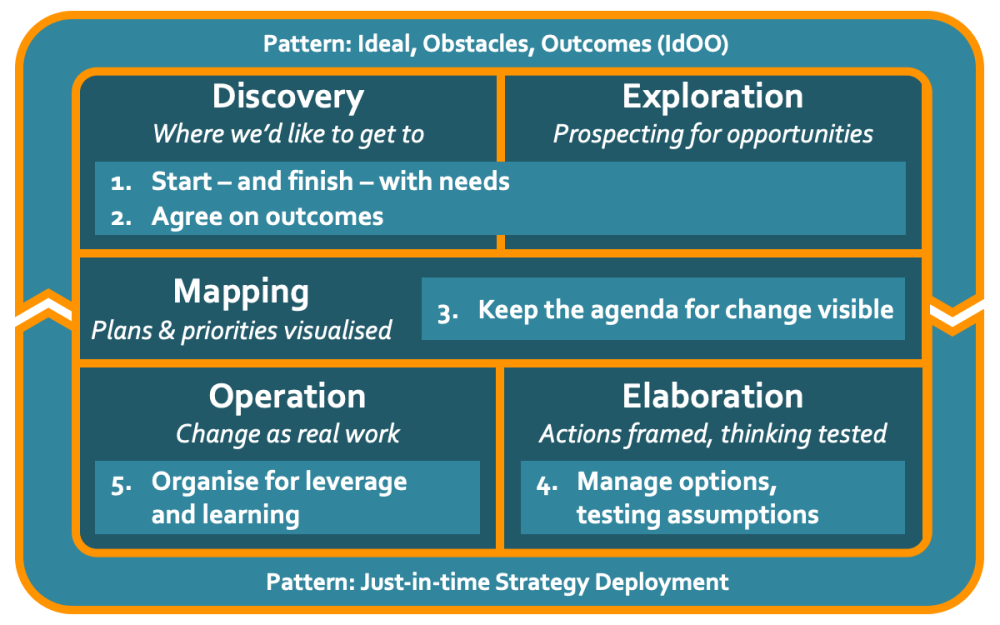
Agendashift overview 16x10 2020-04

The pattern Just-in-time (JIT) strategy deployment is the second of two key generative patterns in Agendashift, and is itself several patterns for the price of one. It describes strategy as being (and I quote):

“developed and refined collaboratively (with varying degrees of participation) over time and in response to the feedback generated through its implementation, solutions emerging from the people closest to the problem”

Agendashift has always been about strategy – whether transformation strategy specifically or strategy more broadly – but it can’t (and doesn’t) ignore delivery. If you’re struggling to connect the two adequately, read that page and take (I hope) some inspiration. And for a whole book’s worth, start with the highly accessible Right to Left: The digital leader’s guide to Lean and Agile. If you’ve not read any of my books before, this one is almost certainly the one to pick first.


Upcoming online workshops

All online, and all with your truly (Mike Burrows) unless otherwise specified:

For the latest workshop and speaking events check the Agendashift events calendar.


Links: Home | About | Our mission: Wholehearted | Become an Agendashift partner | Assessments | Books | Resources | Events | Contact | MikeSubscribe
Workshops: Transformation strategy | Transformation strategy | Short training
Blog: Monthly roundups | Classic posts
Community: Slack | LinkedIn group | Twitter
Agendashift as framework

So here it is, slowly revealing itself online over the past few weeks, and now ready for the formal announcement and some background. It’s the biggest update to Agendashift since the 2018 book and it prepares the ground for a second edition.

New &/or updated:

Previously announced, and updated again in line with the above:

The last of those is of course the basis of Agendashift’s recent rebranding:

Agendashift as framework

From the framework page:

These pages describe Agendashift – the wholehearted engagement model – as an open framework for continuous, outcome-oriented transformation.

Agendashift is primarily for use by agents of strategic change, with or without an explicit Lean-Agile agenda. It is not intended as a replacement for the likes of Scrum, Kanban, or SAFe; neither do we consider it a way to choose between them. Our clear opposition to the imposition of frameworks on the unwilling does not make us anti-framework; rather we’re pluralists, celebrating frameworks as exemplars and sources of patterns that combine in interesting ways.

We don’t however pretend to be neutral. Outcome-orientation is not a neutral stance. If these pages give you a fresh perspective on other frameworks and help you avoid yet another failed or mediocre implementation, that’s definitely for the better. Moreover, it’s not hard to see that whole system engagement and strategy deployment are useful models for delivery in complex environments.

In the past I’ve been a little reluctant to describe Agendashift as a framework, for reasons similar (I guess) to those of the Kanban community: compared to Scrum, SAFe etc, it’s not the same kind of thing at all! Then in Right to Left I made a point of always describing these as process frameworks, solving that problem. And from chapter 3, Frameworks and patterns:

 [The word ‘frameworks’] has multiple meanings. Some of them – Scrum and Lean Startup most especially – are frameworks in the sense that they provide some minimal structure into which specific practices can be introduced. Others – DevOps and Design Thinking for example – are frameworks in the different sense that they provide a particular perspective to an organisational problem and an array of techniques with which to approach it.

Within the context of change and transformation, both definitions apply to Agendashift. What makes the second one particularly interesting is that Agendashift’s needs-based and outcome-oriented perspective has an impact on how you think about and operate delivery too – certainly if you take it to the level of a resolute stance (which of course I do). You could say that this is how I went from Agendashift: Outcome-oriented change and continuous transformation (2018) to Right to Left: The digital leader’s guide to Lean and Agile (2019). Read that and you’ll never look at a process framework in quite the same way again.

Key changes

Principles

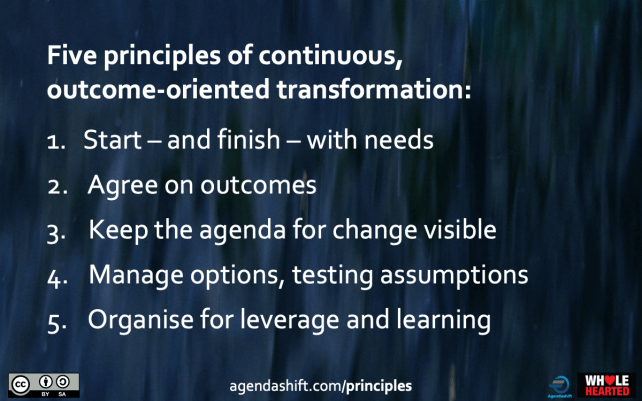
I’ve tweaked the wording of principles 1 & 5 (there’s a before & after comparison on the principles page):

principles-2020-04-04

This feels like a good place to start so I’ve made them a little more prominent.

Patterns

This is new. Agendashift can now be summarised as two generative patterns:

Understand those, how they relate to each other, and how they challenge the status quo, and you’re a long way towards understanding both how Agendashift works and why it exists.

I’m presenting the patterns ahead of the five core activities – Discovery, Exploration, Mapping, Elaboration, and Operation – a demotion for those if you like. Certainly I see this as a significant change. Although the patterns are an addition, it’s one that seems to crystallise and simplify; one of the reassuring things about Agendashift is that the more it develops, the easier it becomes.

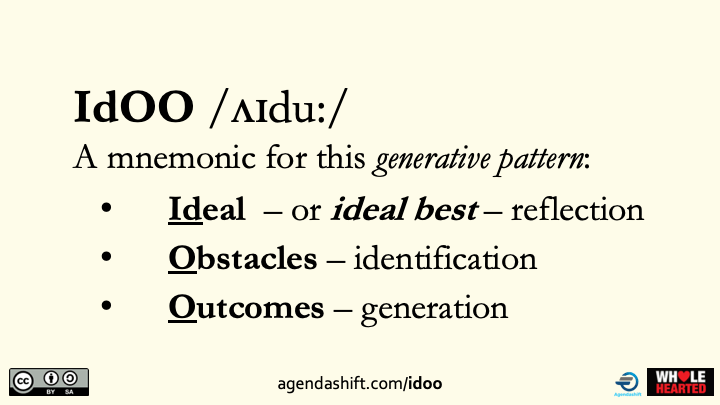
You may have noticed that I sneaked IdOO into Monday’s post Doing Agendashift online (4 of n): Ideal, Obstacles, Outcomes (IdOO). Behind the scenes there was a flurry of activity making everything ready in time!

idoo-2020-03-25

No doubt I’ll be referencing the second pattern – Just-in-time Strategy Deployment – in a later installment of the Doing Agendashift online series and I’ll keep my powder dry for now. Give it a read meanwhile!

A new overview picture

Bringing it all together:

Agendashift overview 16x10 2020-04

Don’t worry: despite appearances my long-held caveats on the subject of cycles remain. I leave you with this post-workshop tweet from friend and workshop participant Allan Kelly:


Upcoming online workshops


Agendashift, the wholehearted engagement model
Links: Home |
About | Our mission: Wholehearted | Become an Agendashift partner | Assessments | Books | Resources | Events | Contact | MikeSubscribe
Blog: Monthly roundups | Classic posts
Community: Slack | LinkedIn group | Twitter