Agendashift roundup, May 2018

In this edition:  ‘Done’ goes viral; Right to left; Reviews for Agendashift; Munich and South Wales; Tools and translations; Upcoming; Top posts

‘Done’ goes viral

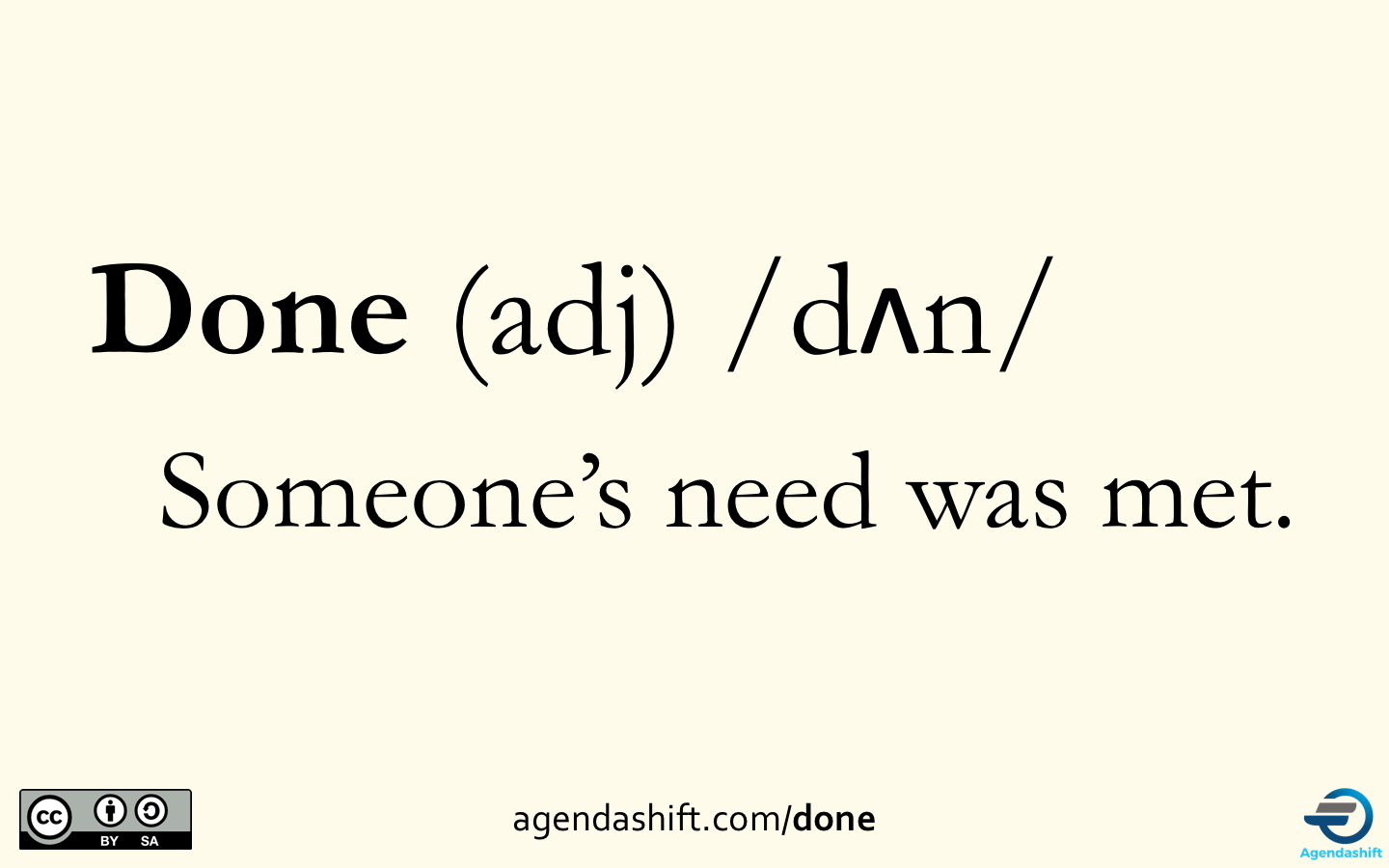
I don’t usually start with the blog, but within days of posting, My handy, referenceable Definition of Done jumped to the top of the leader board for 2018, bringing with it a linked post from 2016, Better user stories start with authentic situations of need.

Screenshot 2018-05-05 06.23.15

The reaction to this post was striking. Clearly, most people got what I was doing right away, but a few (5% maybe) seemed offended that I had dared to subvert a cherished Agile concept, the definition of done. I have absolutely no regrets on that score, and not just because it provoked a response: it’s a legitimate target that I’d be only too happy taken down and replaced with better things – definitions of ready (the obvious technical alternative), needs, outcomes, goals, validation, and so on.

Right to left

It seems slightly crazy that I’ve started work on a new book (my third) so soon after Agendashift, but I just can’t help myself!

Are you tired of introductions to Agile (and actual implementations, for that matter) that start “on the left” with projects and backlogs and work their way slowly rightwards to where the long-suffering customer patiently waits for something of value actually to happen? Well so am I, and I’m doing something about it.

My best guess is that Right to left will be available sometime in 2019, and hopefully no more than 12 months from now – let’s call it early summer ’19. There’s no landing page for it yet but there is a #right-to-left channel in the Agendashift Slack and some blog posts:

For completeness, theme 3 of 3, “upside down”, the supportive organisation, will get its own post in the next few days.

In terms of tone, I’m aiming for “a book you’ll happily give your manager and hope they’ll want to pass on to theirs” – less practitioner-focussed than KFTI and Agendashift then, but plenty for the expert to enjoy too I’m sure.

Word count so far: 2,910 (May 31st, 2018).

Reviews for Agendashift

Fewer than I’d like (to be honest I’m a little frustrated), but the reviews we do have are great, all 5-star so far. See for yourself:

Many thanks to those that have taken the trouble so far, and keep them coming!

Munich, and South Wales

For reasons we don’t fully understand, the Munich workshop didn’t quite get off the ground. There were sales, but not quite enough of them came soon enough for us to be confident of being able to give a good experience. Postponed rather than cancelled, and we may find a client organisation both to host it and to ensure numbers. That’s a model that could work in your city too; do get in touch if you have even just a small core of people interested.

Cardiff though – with DevOpsGuys as both excellent hosts and active participants – was great. Again some fantastic feedback for the 2-day Advanced workshop, and I spoke afterwards at the South Wales Agile Group.

I’ll be in South Wales again in July for Agile Cymru, where no fewer than five Agendashift partners will be speaking:  Cat SwetelJose CasalKarl ScotlandMatt Turner, and yours truly. That’s amazing! Clearly, if you want to find good people, you should check out the partner directory, and perhaps decide to join that list yourself 😉

Tools and translations

  • The 15-minute FOTO cue card is now available in German – thank you Agendashift partner Alex Pukinskis
  • Featureban is now available in Spanish – thank you Youssef Oufaska and Daniel Carroza

After a long wait, we finally got to play Changeban during the Cardiff workshop and it worked great! A new version of the deck is now available, a couple of bugs fixed (just with the deck, the game itself worked as planned). More here:

Upcoming

Speaking:

Over the summer period, the only workshops I’ll be doing will either be private or the Agendashift Studio event on July 7th (in my home studio office in Chesterfield, UK, and it’s sold out). Watch this space for an exciting autumn/winter programme.

Top posts

Recent:

From the archives:


Agendashift-cover-thumbBlog: Monthly roundups | Classic posts
Links: 
Home | About | Partners | Resources | Contact | Mike
Community: Slack | LinkedIn group | Twitter

We are champions and enablers of outcome-oriented change and continuous transformation. Building from agreement on outcomes, Agendashift facilitates rapid, experiment-based evolution of process, practice, and organisation. Instead of Lean and Agile by imposition – contradictory and ultimately self-defeating – we help you keep your business vision and transformation strategy aligned with and energised by a culture of meaningful participation. More…

Towards the wholehearted organisation, outside in

It’s one of those often-cited, non-enough-read books, Christopher Alexander’s The Timeless Way of Building, the classic book on architecture and the built environment that inspired the patterns movement in software (think Gang of Four Design Patterns, PLoP, etc).

It’s a rewarding read – philosophical in a way that is both surprising and delightful, and (whether intended by the author or not) full of ideas that are just asking to be carried over to other domains. I read it with organisation design in mind.

This favourite quote isn’t specific to building but it is loaded with metaphor:

Screenshot 2018-05-26 11.52.59

It got me thinking that I would love to be known for being in the business of helping organisations to be more wholehearted – less at war with themselves, their contradictions identified and owned so that they can be resolved in some pleasing way. If squeezing out excess work-in-progress is a key strategy for improving our delivery processes, perhaps squeezing out the contradictions is the way to improve our organisations for the mutual benefit of all concerned.

In my keynote talk Inverting the pyramid, I use this quote to introduce a section on outside-in reviews – for example the strategy reviews and service delivery reviews that follow the kind of outside-in agenda as described in chapter 5 of the Agendashift book:

  1. Customer
  2. Organisation
  3. Platform
  4. Product
  5. Team

Juxtaposing these different perspectives – each one presented by the people who are best equipped represent them – increases our chances of not only bringing our inner contradictions and misalignments to the surface, but of finding better ways to meet external needs too. Within each agenda item, a right-to-left [1] structure: what we’ve recently learned about how things are, what we’re beginning to learn through experimentation, and what experiments we plan to conduct as capacity permits.

Some context and an invitation: As mentioned a few days ago, I have just begun work on my third book: a no-nonsense, leader’s guide to Lean-Agile, organised around the three themes of right to leftoutside in, and upside down. Join us in the #right-to-left channel in the Agendashift Slack to monitor progress and to discuss any of these three themes.

Related posts:

[1] Understanding Lean-Agile, right to left


Upcoming events

February

March

*TTT/F and (where shown) LIKE events include free one-year membership of the Leading with Outcomes Authorised Facilitator programme, upgradeable to Authorised Trainer at any time. Both of those include access to the video-based Leading with Outcomes training and the full range of Agendashift assessment tools.


Leading with Outcomes from the Agendashift Academy
“Leadership and strategy in the transforming organisation”

Leading with Outcomes is our modular curriculum in leadership and organisation development. Each module is available as self-paced online training or as private, instructor-led training (online or in-person). Certificates of completion or participation according to format. Its modules in the recommended order:

  1. Foundation module:
  2. Inside-out Strategy:
  3. Adaptive Organisation:
  4. Outside-in Strategy:

Individual subscriptions from £24.50 £18.40 per month after a 7-day free trial, with discounts available for employees and employers in the government, healthcare, education, and non-profit sectors. For bulk subscriptions, ask for our Agendashift for Business brochure.

To deliver Leading with Outcomes training or workshops yourself, see our Authorised Trainer and Authorised Facilitator programmes. See our events calendar for Train-the-Trainer / Facilitator (TTT/F) and Leading in a Transforming Organisation trainings.


Agendashift™: Serving the transforming organisation
Links: Home | Subscribe | Events | Media | Contact | Mike

Agendashift  Academy: Leading with Outcomes | Trainer and Facilitator Programmes | Store

At every scope and scale, developing strategy together, pursuing strategy together, outcomes before solutions, working backwards (“right to left”) from key moments of impact and learning.

Understanding Lean-Agile, right to left

Suppose you had to understand Lego – and I mean really understand it. Where do you start? With children playing, or with plastic feedstock?


Now suppose you had to understand Lean-Agile. Where do you start? With people collaborating over software that is already beginning to work for its customers, or with backlogs and projects? Working software, or JIRA?

With the Agendashift book [1] only just out of the door, I’ve begun work on the prequel, a no-nonsense guide to Lean-Agile, the kind of book you’ll give to your manager and hope that they’ll pass on to theirs. And yes, we’ll start right to left, beginning at the point where needs are met [2] and working our way upstream. We’ll describe what it’s like to have Lean and Agile already working well, and demonstrate powerful ways to understand, manage, and improve almost any kind of delivery process.

There’ll be two more themes: outside in and upside down; more on those soon. Join us meanwhile in the #right-to-left channel in the Agendashift Slack [3] if any of these themes are of interest to you. Perhaps you have relevant examples or models that support these themes, or are already beginning to wonder about how they might be applied in your current situation and have questions.

[1] Agendashift: Outcome-oriented change and continuous transformation
[2] My handy, referenceable Definition of Done
[3] Agendashift on Slack


Upcoming Agendashift workshops:


Agendashift-cover-thumbBlog: Monthly roundups | Classic posts
Links: 
Home | About | Partners | Resources | Contact | Mike
Community: Slack | LinkedIn group | Twitter

We are champions and enablers of outcome-oriented change and continuous transformation. Building from agreement on outcomes, Agendashift facilitates rapid, experiment-based emergence of process, practice, and organisation. Instead of Lean and Agile by imposition – contradictory and ultimately self-defeating – we help you keep your business vision and transformation strategy aligned with and energised by a culture of meaningful participation. More…

My handy, referenceable Definition of Done

Now in handy, referenceable [1] form, my working definition of “Done” [2]:

Done

[1] agendashift.com/done
[2] A good working definition of “Done”, also Better user stories start with authentic situations of need

Handy links to closely-related resources:

  • agendashift.com/book – chapter 3 in particular
  • agendashift.com/true-north – “…needs met at just the right time”
  • agendashift.com/principles – Start with needs” is principle #1

Upcoming Agendashift workshops:


Agendashift-cover-thumbBlog: Monthly roundups | Classic posts
Links: 
Home | About | Partners | Resources | Contact | Mike
Community: Slack | LinkedIn group | Twitter

We are champions and enablers of outcome-oriented change and continuous transformation. Building from agreement on outcomes, Agendashift facilitates rapid, experiment-based emergence of process, practice, and organisation. Instead of Lean and Agile by imposition – contradictory and ultimately self-defeating – we help you keep your business vision and transformation strategy aligned with and energised by a culture of meaningful participation. More…

Inverting the pyramid, start-with-what-you-do-now style

The theory:

classic-inverted-pyramid

That’s right, the entire organisation supporting its customer-facing staff, the CEO at the bottom of the inverted pyramid. Intriguing!

Here’s my version, which you’ll find in chapter 5 of the latest revision of the Agendashift book (the last announced Leanpub revision before we go to print):

inverted-pyramid
The inverted pyramid, Agendashift-style

Key differences:

  1. Instead of the CEO and senior managers we have processes. No need to promote power hierarchies!
  2. It’s opinionated: each process begins with Discovery and ends with Validation. It’s both humbling and powerful – transformative, even – to acknowledge both that we don’t know everything, not least the eventual impact of our work.
  3. Review meetings of various unspecified kinds – service delivery reviews, capability reviews, strategy reviews, and risk reviews, even standup meetings and planning meetings
  4. Mutual accountabilities, horizontally and vertically

The lack of specificity in point 3 is deliberate: in Agile terms, we’re scaling, but we’re inviting a start with what you do now approach rather than insisting on a particular process framework. So how, exactly?

Here are three ways for you to look at your existing review meetings, three dimensions in which most such meetings can be improved:

  1. How might they be more outside-in (customer before organisation, platform, product, team, etc)? Who best represents each agenda item? In what order? Sharing what metrics (and implying what values)? What contradictions are we likely to find between these different perspectives, and are we prepared to deal with them?
  2. How might they be more right-to-left (recently-completed work first, then working backwards)? Do participants feel mutually accountable for an end-to-end process that focusses on outcomes and finishes with validation? What keeps those outcomes connected to authentic needs, and how are needs discovered and prioritised? What keeps workloads at appropriate levels?
  3. Horizontally and vertically, do your meetings together cover the organisation (or at least the part thereof that is the focus of your interest)? Horizontally, does each contributing part feel sufficiently connected, with overlapping participation across meetings? Vertically, is the organisation adequately represented so that delivery work, capability-related work, and mission can be kept in alignment?

The trick is to recognise that you don’t have to turn everything upside-down in one giant upheaval – the reorientation can start locally, and at any level. Locally doesn’t mean “timidly” though – in fact the way these strategies encourage accountability horizontally and vertically across organisational boundaries makes them both silo-busting and bubble-busting. Scary perhaps, but if you want to influence the rest of the organisation, then maybe you must be prepared to be influenced back…

More on this in my talk at London Lean Kanban Days 2018 (23-24 April) – see you there!


Upcoming Agendashift workshops (see Events ):


Agendashift-cover-thumbBlog: Monthly roundups | Classic posts
Links: 
Home | About | Partners | Resources | Contact | Mike
Community: Slack | LinkedIn group | Twitter
We are champions and enablers of outcome-oriented change and continuous transformation. Building from agreement on outcomes, Agendashift facilitates rapid, experiment-based evolution of process, practice, and organisation. Instead of Lean and Agile by imposition – contradictory and ultimately self-defeating – we help you keep your business vision and transformation strategy aligned with and energised by a culture of meaningful participation. More…

A good working definition of “Done”

Ever got into one of those discussions about what constitutes “done”, “done done”, or even “done DONE done done”? It’s done when it’s code complete? Tested? Deployed?

What you’re really discussing there is not the actual work, but the process and its policies. That’s not a bad thing to discuss (quite the contrary), but still it risks missing the point.

How about a definition of done that’s not about roles or activities (“code complete”, “tested”, etc)? Try this one for size:

How (if at all) does your process confirm to you that someone’s need was indeed met?

Update: How do you identify the need in the first place?


What if we put agreement on outcomes ahead of solutions?

Agendashift™: Serving the transforming organisation
Agendashift  Academy: Leading with OutcomesHome | Store

Links: Home | Subscribe | Become an Agendashift partner Events | Contact | Mike
Resources: Tools & Materials | Media | Books | Assessments
Blog: Monthly roundups | Classic posts
Community: Slack | LinkedIn group | Twitter