FOTO in 15-minuti

Quick one: Massimo Sarti has kindly translated the 15-minute FOTO cue card into Italian. Thanks to Alex Pukinskis, we have it in German also. If you’d like either one of these, just go to the 15-minute FOTO page, request the materials as usual, and mention which one you’d like.

Massimo’s translation is particularly timely: since July’s roundup we now have a booking page up for the Core Agendashift workshop Facilitating Outcome-Oriented Change in Brescia, Italy on November 9th, ahead of Italian Agile Day 2018 on the 10th. We both hope to see you there!

Screenshot 2018-08-06 12.41.25

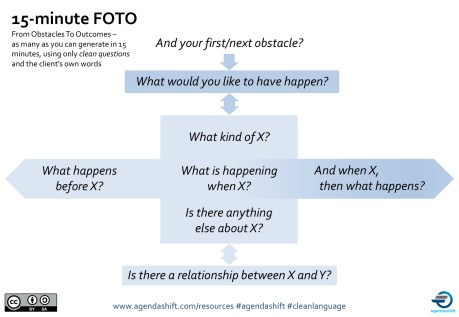
15-minute FOTO is our Clean Language-inspired coaching game, an essential and memorable component of every Agendashift workshop. We have released it under a Creative Commons with-attribution licence to enable its wider use and to encourage adaptations.

FOTO stands for “From Obstacles to Outcomes”, and you have 15 minutes to generate as many as you can, using only the questions on the cue card. An example of “generative over prescriptive” if you like.


Public workshops (US, UK, IT, DE)


Agendashift-cover-thumbBlog: Monthly roundups | Classic posts
Links: Home | About | Partners | Resources | Contact | Mike
Community: Slack | LinkedIn group | Twitter

We are champions and enablers of outcome-oriented change and continuous transformation. Building from agreement on outcomes, Agendashift facilitates rapid, experiment-based emergence of process, practice, and organisation. Instead of Lean and Agile by imposition – contradictory and ultimately self-defeating – we help you keep your business vision and transformation strategy aligned with and energised by a culture of meaningful participation. More…

An outside-in strategy review, Agendashift style

I’ve just about finished an initial draft of the second chapter of Right to Left: The digital leader’s guide to Lean-Agile (which now has a landing page). Its three-part structure is firming up nicely as follows:

  1. Right to left (four chapters): Lean; Agile; Fundamental Lean-Agile patterns and how they combine; Scaling frameworks
  2. Outside in (one to three chapters): Strategy reviews (and related tools); Capability reviews; Feedback loops and other organisational patterns
  3. Upside down (one  to two chapters): Designing for leadership and change: Servant leadership, Leader-Leader, the inverted pyramid, engagement models (of which Agendashift is an example) and so on

The shape works, and I’m thrilled with how the well the right-to-left thing is working out – see for example last week’s post #RightToLeft works for Scrum too which is already a top 5 post for the year and is helping me find collaborators interested in giving the scaling frameworks a similar treatment.

I’ve not just been writing. Let me share four questions I posed (one at a time) at a outside-in strategy review (a private workshop):

  1. Customer: What’s happening when we’re reaching the right customers, meeting their strategic needs? (‘Strategic needs’ being the customer needs that best define our mission)
  2. Organisation: When we’re meeting those strategic needs, what kind of organisation are we?
  3. Product: Through what products and services are we meeting those strategic needs?
  4. Platform: When we’re that kind of organisation, meeting those strategic needs, delivering those products and services, what are the defining/critical capabilities that make it all possible?

(Admission: I got two of these the wrong way round in my prep last week, which changes the wording slightly. This exercise still worked great though!)

If you’re familiar with the model, you may be wondering what happened to the fifth and innermost layer, Team. This we covered not by a question, but via the Agendashift True North, focussing not on the work that teams are doing but on ways of working.

As we considered each layer, we captured some vision, then obstacles. After exploring the five layers individually, 15-minute FOTO to turn obstacles into outcomes.

15-minute-foto-cue-card-2018-01-29 The 15-minute FOTO cue card

Precede all of that with some forward-looking context-setting and segue into hypothesis driven change and A3 (all of which are standard features of our transformation strategy workshops) and you have an outcome-oriented strategy review, done Agendashift style.

Want to explore these and other complementary strategy-related tools with us? Join myself and Karl Scotland at our Agendashift + X-Matrix Masterclass9th-11th October, Brighton, UK. Or drop us a line about private workshops. You might even facilitate one yourself – the tools and materials aren’t expensive!


What if we put agreement on outcomes ahead of solutions?

Agendashift™: Serving the transforming organisation
Agendashift  Academy: Leading with OutcomesHome | Store

Links: Home | Subscribe | Become an Agendashift partner Events | Contact | Mike
Resources: Tools & Materials | Media | Books | Assessments
Blog: Monthly roundups | Classic posts
Community: Slack | LinkedIn group | Twitter

Agendashift roundup, May 2018

In this edition:  ‘Done’ goes viral; Right to left; Reviews for Agendashift; Munich and South Wales; Tools and translations; Upcoming; Top posts

‘Done’ goes viral

I don’t usually start with the blog, but within days of posting, My handy, referenceable Definition of Done jumped to the top of the leader board for 2018, bringing with it a linked post from 2016, Better user stories start with authentic situations of need.

Screenshot 2018-05-05 06.23.15

The reaction to this post was striking. Clearly, most people got what I was doing right away, but a few (5% maybe) seemed offended that I had dared to subvert a cherished Agile concept, the definition of done. I have absolutely no regrets on that score, and not just because it provoked a response: it’s a legitimate target that I’d be only too happy taken down and replaced with better things – definitions of ready (the obvious technical alternative), needs, outcomes, goals, validation, and so on.

Right to left

It seems slightly crazy that I’ve started work on a new book (my third) so soon after Agendashift, but I just can’t help myself!

Are you tired of introductions to Agile (and actual implementations, for that matter) that start “on the left” with projects and backlogs and work their way slowly rightwards to where the long-suffering customer patiently waits for something of value actually to happen? Well so am I, and I’m doing something about it.

My best guess is that Right to left will be available sometime in 2019, and hopefully no more than 12 months from now – let’s call it early summer ’19. There’s no landing page for it yet but there is a #right-to-left channel in the Agendashift Slack and some blog posts:

For completeness, theme 3 of 3, “upside down”, the supportive organisation, will get its own post in the next few days.

In terms of tone, I’m aiming for “a book you’ll happily give your manager and hope they’ll want to pass on to theirs” – less practitioner-focussed than KFTI and Agendashift then, but plenty for the expert to enjoy too I’m sure.

Word count so far: 2,910 (May 31st, 2018).

Reviews for Agendashift

Fewer than I’d like (to be honest I’m a little frustrated), but the reviews we do have are great, all 5-star so far. See for yourself:

Many thanks to those that have taken the trouble so far, and keep them coming!

Munich, and South Wales

For reasons we don’t fully understand, the Munich workshop didn’t quite get off the ground. There were sales, but not quite enough of them came soon enough for us to be confident of being able to give a good experience. Postponed rather than cancelled, and we may find a client organisation both to host it and to ensure numbers. That’s a model that could work in your city too; do get in touch if you have even just a small core of people interested.

Cardiff though – with DevOpsGuys as both excellent hosts and active participants – was great. Again some fantastic feedback for the 2-day Advanced workshop, and I spoke afterwards at the South Wales Agile Group.

I’ll be in South Wales again in July for Agile Cymru, where no fewer than five Agendashift partners will be speaking:  Cat SwetelJose CasalKarl ScotlandMatt Turner, and yours truly. That’s amazing! Clearly, if you want to find good people, you should check out the partner directory, and perhaps decide to join that list yourself 😉

Tools and translations

  • The 15-minute FOTO cue card is now available in German – thank you Agendashift partner Alex Pukinskis
  • Featureban is now available in Spanish – thank you Youssef Oufaska and Daniel Carroza

After a long wait, we finally got to play Changeban during the Cardiff workshop and it worked great! A new version of the deck is now available, a couple of bugs fixed (just with the deck, the game itself worked as planned). More here:

Upcoming

Speaking:

Over the summer period, the only workshops I’ll be doing will either be private or the Agendashift Studio event on July 7th (in my home studio office in Chesterfield, UK, and it’s sold out). Watch this space for an exciting autumn/winter programme.

Top posts

Recent:

From the archives:


Agendashift-cover-thumbBlog: Monthly roundups | Classic posts
Links: 
Home | About | Partners | Resources | Contact | Mike
Community: Slack | LinkedIn group | Twitter

We are champions and enablers of outcome-oriented change and continuous transformation. Building from agreement on outcomes, Agendashift facilitates rapid, experiment-based evolution of process, practice, and organisation. Instead of Lean and Agile by imposition – contradictory and ultimately self-defeating – we help you keep your business vision and transformation strategy aligned with and energised by a culture of meaningful participation. More…

True North, tweaked – and a couple more classic posts restored

At last week’s workshop there was a brief discussion on whether the last line of the Agendashift True North – the focus of one of my favourite workshop exercises – should make explicit reference not just to needs, but to “individual needs, corporate needs, societal needs” (or something similar). These have long been in my mind as a result of my several explorations into Servant Leadership – clearly I did not stop at the neutered, team-centric version typically taught in Agile circles.

Through our discussions in Slack and LinkedIn, the more it become clear that change was justified, but not the one I proposed. Here’s that line:

Needs anticipated, met at just at the right time

A conversation with Damian Crawford quickly convinced me to leave this line alone. As currently written, this line includes a range of needs that that hadn’t necessarily occurred to me, and we concluded that it would be unfortunate to exclude them. All it takes to dig deeper here is a simple question (thanks again Damian for asking this Clean-style):

What kind of needs anticipated?

A comment from Vincent van der Lubbe meanwhile reminded me that even whole organisations don’t live in a vacuum, and we turned to this line:

Individuals, teams, between teams, across the organisation

Very easily fixed:

Individuals, teams, between teams, across the organisation, and beyond

Scaling, anyone?

In full, from agendashift.com/true-north, where I’ve updated both the image and the text:

true-north-2018-02-13

Needs anticipated

That last line also attracted comment in relation to the phrase “Needs anticipated”. I dug out a relevant quote from Kanban from the Inside (published 2014) and it was nice to remind myself to find that I’ve been been banging the drum for needs and anticipation since 2013 if not earlier. Today I restored these two classic posts from positiveincline.com (explaining the sudden flurry if you’re an email subscriber!):

Enjoy those blasts from the past!


Upcoming Agendashift workshops (see Events):


Agendashift-cover-thumbBlog: Monthly roundups | Classic posts
Links: 
Home | About | Partners | Resources | Contact | Mike
Community: Slack | LinkedIn group | Twitter

We are champions and enablers of outcome-oriented change and continuous transformation. Building from agreement on outcomes, Agendashift facilitates rapid, experiment-based evolution of process, practice, and organisation. Instead of Lean and Agile by imposition – contradictory and ultimately self-defeating – we help you keep your business vision and transformation strategy aligned with and energised by a culture of meaningful participation. More…

Outputs from yesterday’s Agendashift workshop

With the permission of its participants, this post is a quick tour through yesterday’s public Agendashift workshop in Cape Town, seen through the key artifacts produced by our two table groups. Sessions 1-5 are covered in detail in chapters 1-5 of the Agendashift book (all five chapters); see also the poster and about pages for a quick overview.

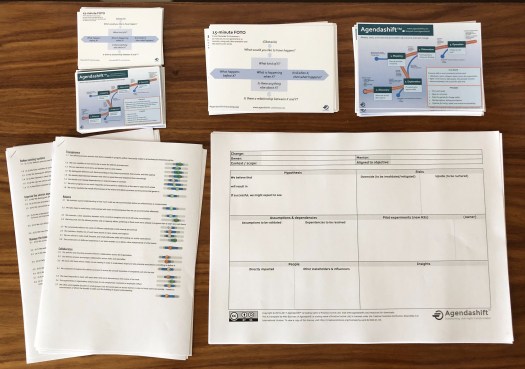
Picked up from the local printers the day before: cue cards for the 15-minute FOTO game (A6 & A5 sizes – the larger A5 size being the more popular); ‘original’ & ‘pathway’ survey reports, A3s. See resources.
2017-11-07 12.58.29-1

Session 1: Discovery

Two exercises here. The first is a getting-to-know-you “Celebration” exercise, ostensibly about a company celebration that is to take place some time in the future (it’s one of those time travel games), but in practice a nice way to make sure the workshop is grounded in organisational context and needs. To structure the output, we use the classic journalistic 5W questions: Who, What, When, Where, and Why, with the How coming later:


The second Discovery exercise involves:

  • Reflecting on our True North statement as an approach to the challenges of the first exercise, thinking about what that’s like, what’s different, and what obstacles stand in our way
  • Using our recently-open sourced coaching game 15-minute FOTO to turn that list of obstacles into outcomes
  • Organising the resulting outcomes to produce the outputs shown below


Session 2: Exploration

A few days prior to the workshop, the participants each completed an Agendashift values-based delivery assessment. The Exploration session starts with a survey debrief, the structure of which is now so well practised that the unbenchmarking report leads us through it step by step.

Then – guess what! – we generate outcomes:

  • Prioritise the survey prompts
  • Identify their respective obstacles
  • Generate outcomes using the 15-minute FOTO coaching game again (a lot easier second time round – one conversation stood out as one I’d wished I’d recorded!)

We finish the session with the exercise whose first rule is not to mention its name (see the first part of this writeup which breaks this rule, or chapter 2 of the book). The joint output of both table groups:
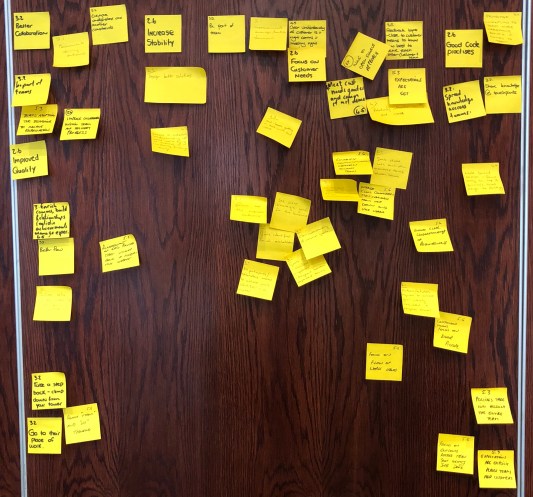
2017-11-08 14.29.46

Moments after this picture was taken we destroyed it (reusing the stickies) but not before identifying stickies setting towards the top left corner as being likely candidates for some hypothesis-driven change (session 4). Look out for stickies marked with asterisks in the next pic (session 3).

Session 3: Mapping

Next, the transformation map, like a user story map but where the items are outcomes rather than user stories:

2017-11-08 15.32.40

After some discussion, we concluded that the first column (Refine existing systems) was empty because the many small improvements that might have gone there were deemed insufficiently interesting on the day. Fair enough! Column 5, Address sources of dissatisfaction (etc) seems rather full; a review of the stickies shows significant scope for consolidation however.

The two stickies “above the line” were the subject of some debate. Are “Increased stability” and “Increased quality” to be treated as long-term objectives to which other yet-to-be-identified work aligns, or are they to be tackled head on? No right answers here, so long as we’re honest. Either way, I stressed that consider them to be actionable (“unactionable” and “aspirational” being trigger words of mine).

For reasons of time, we didn’t bother to prioritise within columns. There was plenty of past experience of that process in the room already.

Session 4: Elaboration

For a selected outcome per table, another generative process, that of creating options. Then:

  • Prioritisation, selected the option considered most capable of significant (“fantastic”) outperformance
  • A hypothesis, Lean Startup style
  • Further development, using our open sourced A3 template (a 20th century tool with a 21st century flavour)


It is not a mistake that both A3s have their Insights section filled in. No, we haven’t run these experiments yet, but imagining the learning we hope to capture allows us then to review our experiment design. Both tables identified gaps in their plans as a result of this tip. Result!

Session 5: Operation

As a practitioner workshop rather than a client workshop (same materials for both but different goals), we deliberately sacrificed much of this session in return for more time for reflection and discussion in sessions 1 & 2. Consequently there are no outputs to show here. With more time available, we would have added more outcomes to the transformation map, driven by an adaptability review. This process both recaps our outcome-oriented process and gets us thinking about how the decisions of the workshop will be carried forward. Our mantra here: “Treat change as real work”.

To wrap up, the Full Circle exercise, capturing outcomes using the house style of the assessment prompts – inclusive, present tense, non-prescriptive:
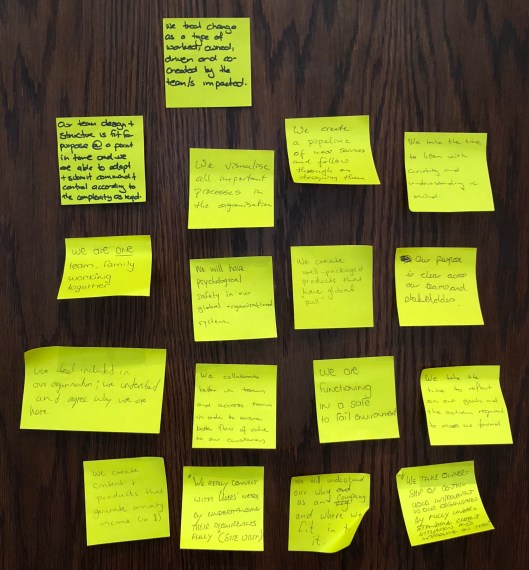
2017-11-08 17.00.09

The top one could almost be an advert for Agendashift (it’s not mine, honest):

We treat change as a type of work – owned, driven, and co-created by the team/s impacted

You, the outcome-oriented facilitator

If you could use some Agendashift-style outcome orientation in your coaching or consulting work, check out our partner programme. And there’s another opportunity very soon to try it all out, this time in London:

Finally, a massive thank you to all of yesterday’s participants, and also to the organisers of the Regional Scrum Gathering in South Africa who kindly invited me over for this morning’s opening keynote. Opportunities permitting, I hope to return to South Africa again soon – 6 years is too long!

Agendashift-cover-thumbBlog: Monthly roundups | Classic posts
Links: 
Home | About | Partners | Resources | Contact | Mike
Community: Slack | LinkedIn group | Twitter
Workshops (see Events
): 22-23 Nov, London, UK

Which workshop?

Check out these two workshop descriptions and you’ll see the same structure:

Not just the same structure, but the same materials too. What’s the difference?

The difference is context and objectives:

  • In the transformation mapping workshop, the participants share a context – their organisation – and the workshop’s objective is to formulate a response to that organisation’s needs
  • In the practitioner workshop there may be little or no shared context; participants are there to experience and practice, often building on what they may have already read (not that reading is a prerequisite)

They aren’t mutually exclusive:

  • A recent private workshop made significant progress on organisational issues in the workshop and in the period following, but many of the attendees could be described as practitioners (subsequently, one participant become an Agendashift partner and has now at his disposal all the tools and materials needed to run workshops himself)
  • A participant at a recent public practitioner workshop later invited me back to his company, shifting the focus from practice back to context

Why make the distinction? A discussion about objectives beforehand is always valuable. Expectations should clear on both sides, it’s important to get the right set of people in the room, and if it’s left to the day of the workshop to think about what happens afterwards, it may be too late.


Agendashift-cover-thumb
Blog: Monthly roundups | Classic posts

Links: 
Home | Partner programme | Resources | ContactMike
Community: Slack | LinkedIn group | Twitter

Reflections on another Agendashift Facilitator Day

Day 2 of Hamburg Flow Days was the opportunity to run another Agendashift Facilitator Day, my third. As now seems traditional,  some thoughts on updates to the material prompted by the experience.

Before that, some thanks are in in order: Susanne and Andreas for being such excellent hosts, and Patrick for day 1, centered around his Flowlab, a very flexible Kanban simulation tool. On the morning of day 1 we spent the morning having fun with scenarios not much more complicated than is typical with my own Featureban. In the afternoon we experienced the delights of Customer Kanban, CONWIP systems, and the like. Awesome, both in its own right and for setting the scene!

Day 2 takeaways and updates (already made)

  • The overall shape is solid. I don’t see the 5 main sections (Discovery, Exploration, Mapping, Elaboration, and Operation) changing anytime soon.
  • Clean Language got a lot of love in the post-event retrospective. We know how to facilitate the several exercises that use it now, a whole lot easier since creating the Clean Language cards (pic below; PDF on request).
  • Based on feedback, the deck now has much clearer signposting – no-one should ever again feel at all disoriented. If that was your experience, sorry!
  • The idea of experimentation should seem less technical and more valuable if there is a tough choice to be made between alternative ideas. Should make for a more interesting transition from Mapping to Elaboration (I’ve been guilty of rushing this).

img_1789

Interestingly, people are still taking the trouble to give feedback on the December workshop. That material seems a little ancient already, but nevertheless it’s gratifying that participants are still finding that it is speaking to them. Why the delay? There is definitely something radical about it (particularly its commitment to conversations and outcomes before solutions), and perhaps it needs time to sink in. Let’s make sure that its radical edge isn’t lost as it becomes more polished in delivery.

Here’s a comment received less than a week ago, two months after the Leeds workshop:

When I originally signed up for the Agendashift workshop I was drawn in by the promise of blending techniques like Clean Language, Cynefin and A3 thinking in an applied sense.  After the workshop what stood out for me most was how the participants started to develop a shared ownership of organisational change through shared outcomes and values.  Ramble over – what I’m trying to say is it even managed to align a bunch of completely random strangers on the day.

Thank you Tony!

Interested? Upcoming Agendashift facilitator days:

Three recent events have sold out and some of the upcoming events have early bird pricing available, so hurry, book your place now!


Agendashift-cover-thumb
Blog: Monthly roundups | Classic posts

Links: 
Home | Partner programme | Resources | ContactMike
Community: Slack | LinkedIn group | Twitter

Agendashift as coaching framework

[This is the second of a three-part series. Start from the beginning: Lean-Agile transformation as Lean-Agile process]

What with last week’s London workshop (sold out!) and work on the new book I’ve got a bit behind my usual blogging schedule. Sorry about that! Every cloud though – here’s Agendashift partner Andrea Chiou debriefing (in Slack) her appearance this week at the Agile NOVA meetup in Washington, DC:

I said, using this style of interview, you can get managers in a room learning about each other’s vision for their most pressing problems, and in doing so you can then see where there is energy, as well as where there are solutions already inherently existing within the org

And:

This differs from almost every other Agile transformation approach I know, except one (I mentioned Open Space Agility). And the reason it works is because it is values-based, and based on mutual exploration and dialogue with managers/sponsors.

I might add here that Agendashift is also about exploration and agreement with participants (not just managers and sponsors), but Andrea does a great job of explaining how Agendashift helps facilitate those early conversations.

Especially in the guise of the Agendashift facilitator day, you can view the Agendashift workshop as a demonstration of three things:

  1. The power of a values-based and outcome-centric approach
  2. How the different techniques we use integrate so pleasingly
  3. An end-to-end transformation process that mirrors (and even exemplifies) a Lean-Agile delivery process.

Part 1 in this series expanded on point 3. Today, we’ll again review the five sections of the workshop, this time as a possible structure for a coaching engagement:

  1. Discovery: Identifying the strategic goals and needs that any coaching must support, setting the right tone in terms of ambition without losing sight of where the real challenges and opportunities lie
  2. Exploration: With or without the aid of the Agendashift assessment, exploring key areas of opportunity in more detail, identifying obstacles, and from those generating a set of outcomes that represent the scope, objectives, and priorities of the engagement
  3. Mapping: Understanding the challenge in enough breadth to be sure of not missing anything important, and keeping the coaching process fed with fresh and important challenges to investigate
  4. Elaboration: Generating, framing, and develop actions
  5. Operation: Ensuring follow-through, maintaining appropriate transparency, accountability, and feedback in the relationship

Just as we discussed in the previous post, this isn’t a completely linear process, in fact much of this needs to happen on a frequent or ongoing basis. There are however some key conversations that do need to be had, and the earlier in the process, the better. A coaching engagement that stands on a platform of agreed needs, scope, and level of ambition is surely healthier than one based on the offer of technical help or of facilitating a process whose goals no-one is able to articulate.

The tools we use and demonstrate through workshops will be used more informally and naturalistically in a coaching context, but they’re still valuable. All the more so, some of them! What coach wouldn’t want to be able to ‘flip’ obstacles into outcomes, identify the drivers behind pet solutions (and thereby open up the possibility of alternative solutions), or turn the vague into something actionable? These are very teachable skills. So too are the highly reusable skills of framing hypotheses and developing actions. Many coaches will find what Agendashift says about organisational design interesting too.

Coming up in the next few weeks are opportunities to experience this for yourself, with events in Hamburg (Feb 9th & 10th), Manchester (March 23rd), Edinburgh (April 6th), and Oslo (April 21st). Don’t see one near you? Get in touch and we’ll see what we can arrange together.

This was the second of three related posts (posts 3 coming soon):

  1. Lean-Agile transformation as Lean-Agile process
  2. Agendashift as coaching framework
  3. Agendashift as Good Strategy

Agendashift-cover-thumb
Blog: Monthly roundups | Classic posts

Links: 
Home | Partner programme | Resources | ContactMike
Community: Slack | LinkedIn group | Twitter

The “obvious” question

First things first: the rename mooted in last week’s post has already been implemented. What was the “Agendashift debrief/action workshop” is now the Agendashift transformation mapping workshop. The same content in a more digestible order, with some additional and already-implemented improvements to be announced in the new year.

Anyway…

Remember this picture? It’s an example of the output from a Cynefin four points contextualisation exercise, taken from a training day earlier this year:

IMG_1523

There’s a slightly tongue-in-cheek question I like to ask when debriefing this exercise:

What’s the obvious question to ask about the items in the the Obvious corner?

The answer I’m looking for:

Why haven’t they been done already?

After the teasing comes a serious point that has become a recurring theme for my workshops: Too many organisations are full of smart people who can tell you what’s wrong and can give you a long list of sure-fire fixes, but nothing changes.

You might say that these organisations are uninterested in improvement, but I believe that in many cases it would be more constructive to say that they are incapable of following through. There is little to no visibility or accountability around anything change-related; the feedback loops (whether formal or informal) that do exist are likely to be overwhelmed with urgent delivery-related issues, with no provision for understanding and tracking improvements the systems that allow those issues to arise in the first place.

If that’s true for the Obvious corner, how will they fare in the Complex corner? If they can’t track obvious changes, how will they manage the kind of change that involves experiments – even experiments-within-experiments (pilot experiments) – and all the uncertainty that goes with that? Not well.

Conclusion? If change isn’t happening, don’t blame your staff. Instead:

  • Make sure that improvement work is treated as ‘real work’, prioritised, tracked, and rewarded as such
  • Keep it visible to any managers and other stakeholders whose commitment will be required in order for the more difficult changes to be realised
  • Provide safety, treating success and failure as near equals. Better to keep learning than never to dare anything difficult

Let me leave you with the relevant prompt from the Agendashift values-based delivery assessment:

We ensure that opportunities for improvement are recognised and systematically followed through

How well does that describe your organisation?


Agendashift-cover-thumb
Blog: Monthly roundups | Classic posts

Links: 
Home | Partner programme | Resources | ContactMike
Community: Slack | LinkedIn group | Twitter

The transformation map

Big day yesterday – it was the occasion of the very first Agendashift facilitator day, the first of many I hope! Here, in all its glory is the transformation map we produced:

transformation_map_leeds_2016_12_05

For the name transformation map we have workshop participant Tony Richards to thank. One of those things that seems obvious in retrospect (but still all credit to Tony), it’s a particular kind of story map (I described it as such), one whose ‘spine’ is a transformation journey.

The detail is driven from the 40+ prompts of the Agendashift values-based delivery assessment. Category by category (value by value or journey step by journey step) we:

  1. Prioritise prompts that represent areas of opportunity
  2. Identify obstacles that prevent the full realisation of the future reality described by the prompt
  3. “Flip” those obstacles into objectives (Clean Language provides some fun ways to do this)
  4. (Optional) Generate actions for those objectives

To set the right context for the transformation mapping process we explore existing strategic objectives and assess the current situation. This process builds agreement, creates opportunities for alignment, and ensures that the resulting transformation strategy is coherent not just by construction, but in context also.

Other learnings

Learnings for me, that is!

Between the outer wrapping of that strategic exploration and the meat of the transformation mapping exercise, most of my workshops have up until now included a series of exercises around hypothesis-driven change (HDC). Here, we take a small number of high priority outcomes, generate actions for them, and then choose just one action to reframe (Lean Startup-style) and develop (A3 style). Yesterday, the transition from this deep dive to the breadth of the mapping exercise felt difficult for some participants.

I’ve not noticed this difficulty in client workshops, but it could be that the facilitator day’s lack of a shared organisational context amplifies a problem of which I was previously unaware. Anyway, I take it seriously.

Long story short, in the next iteration of this workshop, the HDC exercises will be postponed until after the transformation mapping activity. Transformation mapping is now very much the core part of the day, to the extent that I’m very much inclined to rename the workshop as a whole after it!

This change has further significance: deferring the generation of actions makes outcomes the main unit of currency for most the day. It is often natural to use outcomes and actions somewhat interchangeably, but nevertheless I’m sure that this development is healthy, perhaps bringing our consciously non-prescriptive approach into sharper focus. Remember: inclusive • contextual • fulfilling • open!

Keep an eye on our events calendar for more of these public workshops; feel free to ask that we hold one near you (perhaps you can help us make it happen). And if you’d like me or a friendly neighbourhood Agendashift partner to assist you in building your own organisation’s transformation map, don’t hesitate to get in touch.


Agendashift-cover-thumb
Blog: Monthly roundups | Classic posts

Links: 
Home | Partner programme | Resources | ContactMike
Community: Slack | LinkedIn group | Twitter