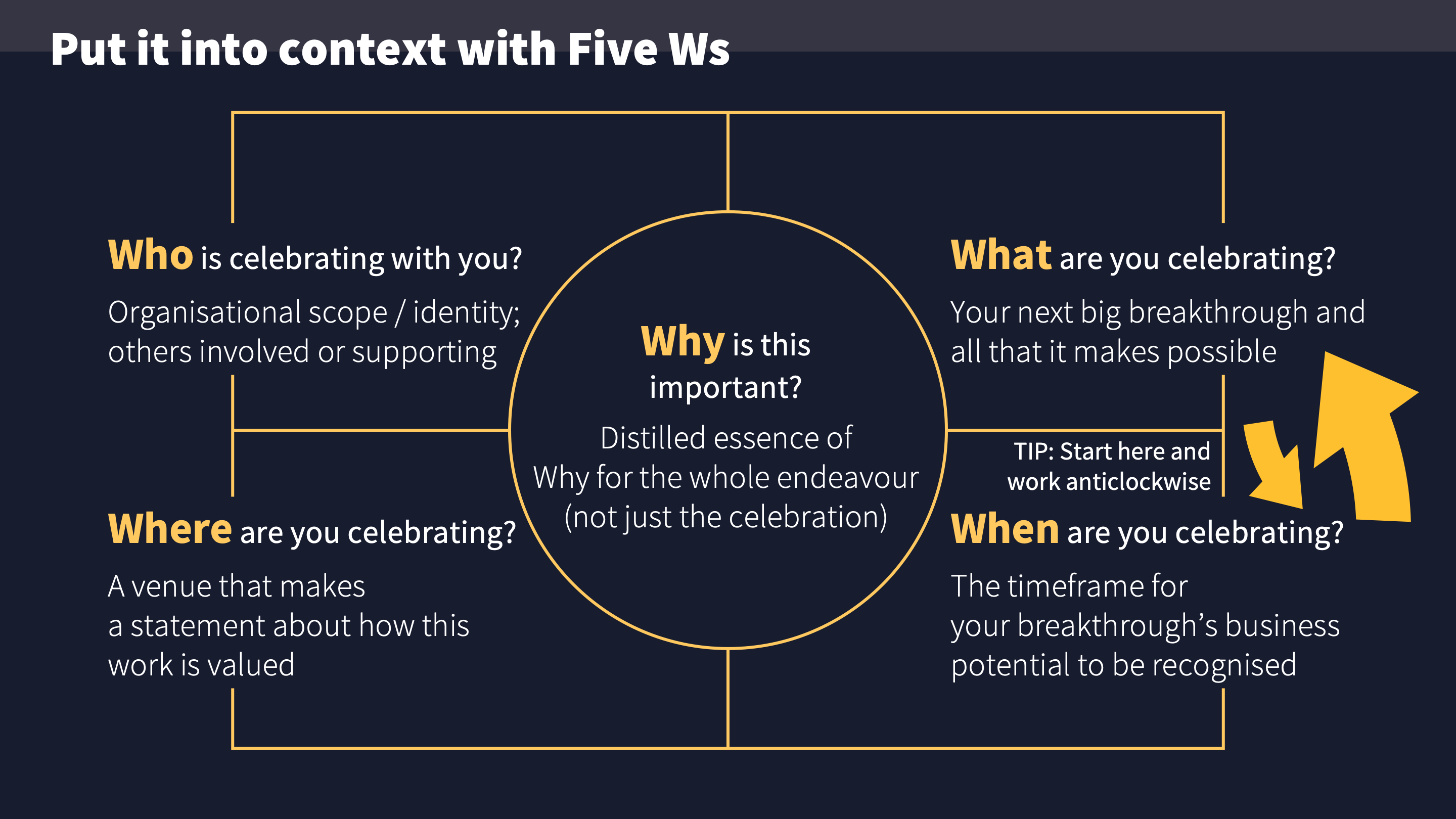
Celebration-5W is Agendashift’s trusty and energising context-capturing kickoff exercise. I say “trusty”, because I don’t think I have ever experienced a workshop that used it suffer for lack of context, and there have been times when I have regretted not using it. But could it be used inappropriately?
Before answering that question, a reminder of how it works. It’s in the genre of the time travel exercise, and its conceit is that you (by which I mean workshop participants) are using the journalistic 5W questions – Who, What, When, Where, Why – on the celebration you’re going to have when your next big breakthrough (one you haven’t made yet) is ready to be celebrated.
So, when shouldn’t you use it?
First, what is context? Here I mean it in the sense of what participants need to understand in common in order to have a productive conversation, and it lives at the intersection of situation and scope. If that is well enough established by the invitation and/or prework (an Agendashift assessment for example), you might not need it.
Then there are tradeoffs to consider. A narrower context is easier to understand, and for those for whom it is relevant, easier to engage with. The flip side of course is that for others, a narrower context can exclude people, perhaps unhelpfully. Conversely, a broader context engages more people but possibly at the cost of a more challenging experience.
Before choosing a context exercise or designing one, ask yourself the following:
- Could it be that context will be well enough established already?
- If we need to narrow (or possibly broaden) context, which dimension needs the most adjustment: scope or situation?
Perhaps to narrow the organisational scope would be to prejudge the outcome. Perhaps the situation deserves broad and diverse representation. Perhaps the same issues impact on different parts of the organisation in very different ways, but still the opportunity to explore them from different directions will be helpful. Perhaps the concept to be explored is sufficiently independent of scale that it is applicable to every scope.
“Perhaps” – several of those there! What I am learning is that the more the situation, issue, or concept at the heart of the event can be seen as scale-independent, the less you need convergence on scope. For example, if you are focussing on something as general as leadership, an exercise that could have the effect of limiting organisational scope might do more harm than good; stories of “leadership at every level” might be a much better starting point. Conversely, process and process-related issues don’t scale well, in which case an exercise like Celebration-5W should get you off to a great start. If it brings multiple scopes into play such that they can learn from each other, so much the better!
How does play out in Leading with Outcomes? Because it emphasises patterns over tools, Leading with Outcomes: Foundation doesn’t use Celebration-5W; it does however ask the question “What and who are we dealing with?”. Adaptive Organisation: Business agility at every scale doesn’t use it either, but for a very different reason: the fractal model at its heart is scale-independent, and to consider how that works at (and between) multiple scopes and scales simultaneously (“everywhere all at once”) is very much the point. Inside-out Strategy: Fit for maximum impact and Outside-in Strategy: Positioned for success do use it; if there is an inside and an outside, scope matters, and we might as well settle on it (or them) early.
Related:
- Celebration-5W, Creative Commons version (www.agendashift.com)
- Celebration-5W, Academy version (community.agendashift.com)
- Celebration-5W version 7 (January 2022)
- Agendashift Assessments (www.agendashift.com)
- White paper: Everywhere all at once: Introducing the Deliberately Adaptive Organisation, an accessible, situational, and complexity-aware presentation of the Viable System Model (www.agendashift.com)
- Talk: In times of change, what scales better than process? (www.agendashift.com)
Upcoming events
February
- 18 February, Online, 16:00 GMT, 17:00 CET, 11am ET, Agile Strategy Meetup Group:
Meet Mike Burrows on strategy - 24-27 February, four 4-hour sessions online, afternoons UK time:
Leading with Outcomes: Train-the-Trainer / Facilitator (TTT/F)*
March
- 06 March, London, UK:
Kanban Edge 2025
*TTT/F and (where shown) LIKE events include free one-year membership of the Leading with Outcomes Authorised Facilitator programme, upgradeable to Authorised Trainer at any time. Both of those include access to the video-based Leading with Outcomes training and the full range of Agendashift assessment tools.
Leading with Outcomes from the Agendashift Academy
“Leadership and strategy in the transforming organisation”
Leading with Outcomes is our modular curriculum in leadership and organisation development. Each module is available as self-paced online training or as private, instructor-led training (online or in-person). Certificates of completion or participation according to format. Its modules in the recommended order:
- Foundation module:
- Inside-out Strategy:
- Adaptive Organisation:
- Outside-in Strategy:
Individual subscriptions from £24.50 £18.40 per month after a 7-day free trial, with discounts available for employees and employers in the government, healthcare, education, and non-profit sectors. For bulk subscriptions, ask for our Agendashift for Business brochure.
To deliver Leading with Outcomes training or workshops yourself, see our Authorised Trainer and Authorised Facilitator programmes. See our events calendar for Train-the-Trainer / Facilitator (TTT/F) and Leading in a Transforming Organisation trainings.
Agendashift™: Serving the transforming organisation
Links: Home | Subscribe | Events | Media | Contact | Mike
Agendashift Academy: Leading with Outcomes | Trainer and Facilitator Programmes | Store
At every scope and scale, developing strategy together, pursuing strategy together, outcomes before solutions, working backwards (“right to left”) from key moments of impact and learning.
 Agendashift