#Right2LeftGuide is #Agendashift (outcome-orientation) for delivery

Going by chapter counts, Agendashift [1] is 80% outcome-oriented change and 20% continuous transformation. It describes an approach to Lean-Agile transformation that  rejects imposition, replacing it with meaningful agreement on outcomes, bringing together organisational ambitions and the needs of everyone who will help bring those ambitions to reality.

Can we do for delivery what Agendashift does for change? Of course we can. The only surprise it that it’s so necessary!

It has always been well understood in Lean circles that to make proper sense of a delivery process, you must start with how the thing that is being delivered creates value in the eyes of the customer, and work backwards from there. Somehow, that lesson gets forgotten in Agile circles; either Agile is all about teams (a view I can find some respect for, even if I don’t fully buy it), or we’re fed the ironically process-centric lie that teams start with backlogs and create value from there.
Screenshot 2018-05-05 06.23.15
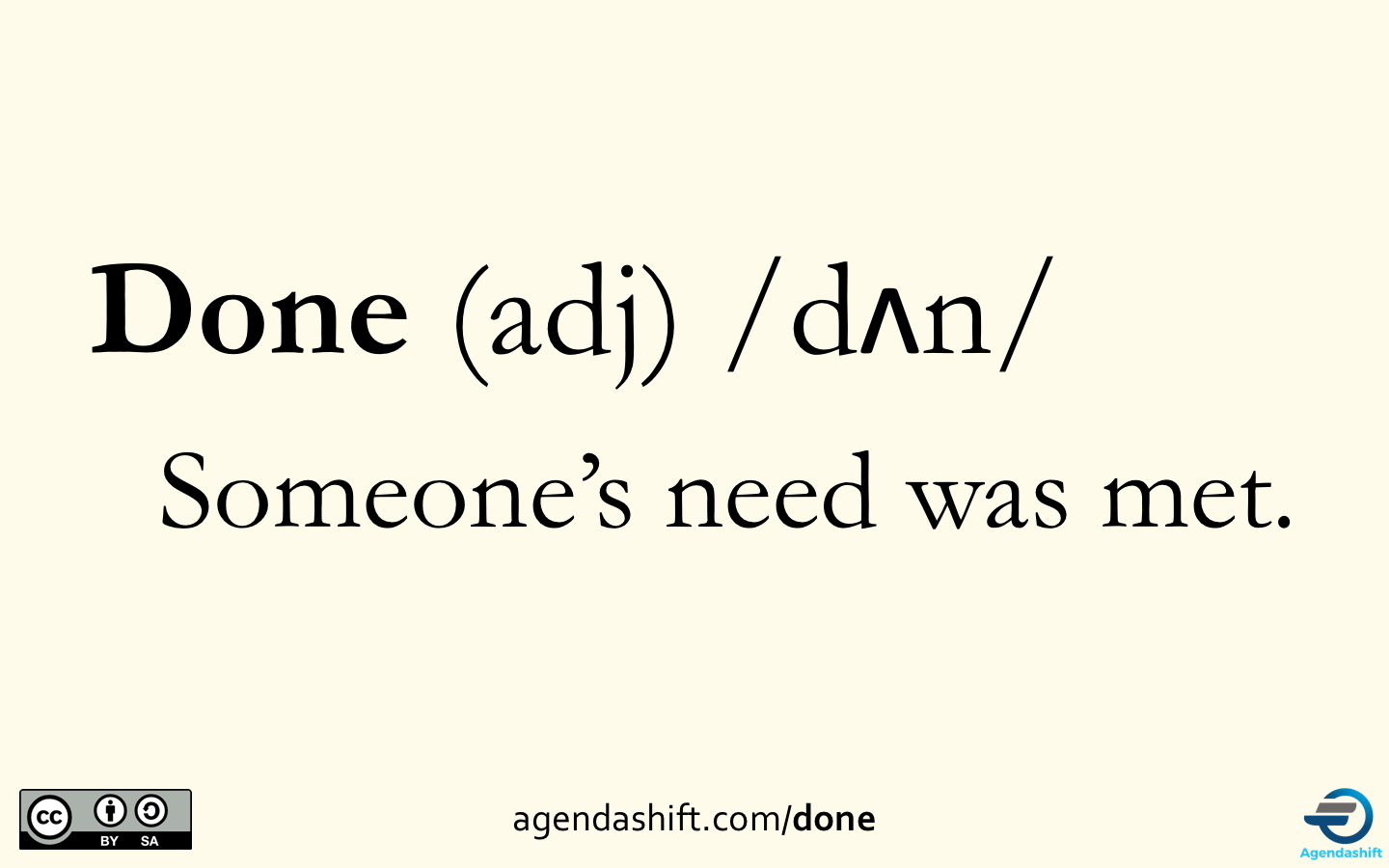
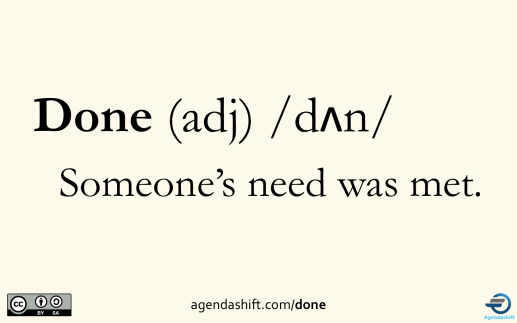
Our handy, referenceable, Definition of Done

#Right2LeftGuide is about recovering a focus on customer outcomes for Lean-Agile delivery [2], and maintaining that perspective as we work backwards through the delivery process, understanding it better, managing it better, and finding ways to do it better.

It’s a simple but surprisingly radical change of perspective. With it, it’s surprisingly easy to see that there are two Scrums [3], the mechanistic, backlog-first left-to-right version and the ‘iterated goal-seeking’ right-to-left version. It turns out that there are two versions of SAFe too; expect to see more on that soon (and not just from me). I haven’t yet established whether there are left-to-right and right-to-left versions of the other leading scaling frameworks; it would be nice to identify some that are predominantly right-to-left, but we’ll see (if you can help or just want to stay in touch with this work, join us in the #right-to-left channel in the Agendashift Slack [4]).

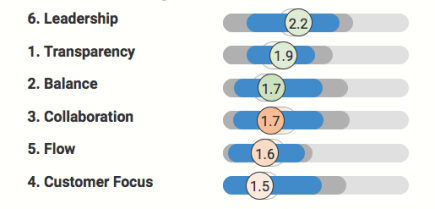
The Right to Left book [5] will come out next summer. Meanwhile, Agendashift has plenty to offer. For example, how do you explain survey results [6] like these?
Screenshot 2018-07-20 10.59.11

When I see results like these (which I do a lot), it’s all I can do to resist sarcastic lines like “Great to see all that leadership put to such good use!”. There’s some good(ish) news –transparency, balance, and collaboration are doing somewhat ok, relatively speaking (even if the numbers aren’t great in absolute terms and they’re not having the impact on flow that we would hope for), but just look at customer focus! Fortunately, I see a great appetite for doing something about this, paying more attention to needs, embracing validation, and so on.

I’ve said a few times now that I would be happy to see the rest of my career (I’m 53) being devoted to outcomes. When I first started saying it, I didn’t have #Right2LeftGuide in mind, but that’s 100% ok. Perhaps one day we’ll be describing #Agendashift as the #Right2LeftGuide for change!

[1] Agendashift (www.agendashift.com)
[2] Understanding Lean-Agile, right to left (blog.agendashift.com)
[3] #Right2LeftGuide works for Scrum too (blog.agendashift.com)
[4] Agendashift on Slack (www.agendashift.com)
[5] Right to Left: The digital leader’s guide to Lean and Agile (www.agendashift.com)
[6] Agendashift™ Assessments, also chapter 2 of the book (www.agendashift.com)


Upcoming workshops


Agendashift-cover-thumbBlog: Monthly roundups | Classic posts
Links: Home | About | Partners | Resources | Contact | Mike
Community: Slack | LinkedIn group | Twitter
We are champions and enablers of outcome-oriented change and continuous transformation. Building from agreement on outcomes, Agendashift facilitates rapid, experiment-based emergence of process, practice, and organisation. Instead of Lean and Agile by imposition – contradictory and ultimately self-defeating – we help you keep your business vision and transformation strategy aligned with and energised by a culture of meaningful participation. More…

An outside-in strategy review, Agendashift style

I’ve just about finished an initial draft of the second chapter of Right to Left: The digital leader’s guide to Lean-Agile (which now has a landing page). Its three-part structure is firming up nicely as follows:

  1. Right to left (four chapters): Lean; Agile; Fundamental Lean-Agile patterns and how they combine; Scaling frameworks
  2. Outside in (one to three chapters): Strategy reviews (and related tools); Capability reviews; Feedback loops and other organisational patterns
  3. Upside down (one  to two chapters): Designing for leadership and change: Servant leadership, Leader-Leader, the inverted pyramid, engagement models (of which Agendashift is an example) and so on

The shape works, and I’m thrilled with how the well the right-to-left thing is working out – see for example last week’s post #RightToLeft works for Scrum too which is already a top 5 post for the year and is helping me find collaborators interested in giving the scaling frameworks a similar treatment.

I’ve not just been writing. Let me share four questions I posed (one at a time) at a outside-in strategy review (a private workshop):

  1. Customer: What’s happening when we’re reaching the right customers, meeting their strategic needs? (‘Strategic needs’ being the customer needs that best define our mission)
  2. Organisation: When we’re meeting those strategic needs, what kind of organisation are we?
  3. Product: Through what products and services are we meeting those strategic needs?
  4. Platform: When we’re that kind of organisation, meeting those strategic needs, delivering those products and services, what are the defining/critical capabilities that make it all possible?

(Admission: I got two of these the wrong way round in my prep last week, which changes the wording slightly. This exercise still worked great though!)

If you’re familiar with the model, you may be wondering what happened to the fifth and innermost layer, Team. This we covered not by a question, but via the Agendashift True North, focussing not on the work that teams are doing but on ways of working.

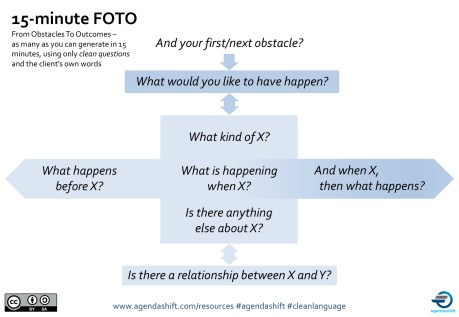
As we considered each layer, we captured some vision, then obstacles. After exploring the five layers individually, 15-minute FOTO to turn obstacles into outcomes.

15-minute-foto-cue-card-2018-01-29 The 15-minute FOTO cue card

Precede all of that with some forward-looking context-setting and segue into hypothesis driven change and A3 (all of which are standard features of our transformation strategy workshops) and you have an outcome-oriented strategy review, done Agendashift style.

Want to explore these and other complementary strategy-related tools with us? Join myself and Karl Scotland at our Agendashift + X-Matrix Masterclass9th-11th October, Brighton, UK. Or drop us a line about private workshops. You might even facilitate one yourself – the tools and materials aren’t expensive!


What if we put agreement on outcomes ahead of solutions?

Agendashift™: Serving the transforming organisation
Agendashift  Academy: Leading with OutcomesHome | Store

Links: Home | Subscribe | Become an Agendashift partner Events | Contact | Mike
Resources: Tools & Materials | Media | Books | Assessments
Blog: Monthly roundups | Classic posts
Community: Slack | LinkedIn group | Twitter

‘Right to Left’ works for Scrum too

Update: See the landing page for the forthcoming book Right to Left: The digital leader’s guide to Lean and Agile (published summer 2019, audiobook 2020)

Here’s a conventional, left-to-right [1] description of Scrum:

A Product Backlog (all the stuff we’d like to do), a Sprint Backlog (the stuff we plan to do this sprint), then a Sprint (a timebox) that culminates in a potentially shippable increment, a review, and a retrospective. Rinse and repeat.

To me, this is how NOT to describe Scrum. Is it a straw man, put up just so that I can knock it down? Hardly! Not all descriptions of Scrum follow this narrative, but it’s common enough. Complete with a video, here’s a nicely-produced example from a reliable source, the Scrum Alliance: Learn about Scrum (web.archive.org). It’s one of the first pages returned by Google in response to the question “What is Scrum?”.

The bullet points below are the first few from that page’s 30-second summary, and they’re very close to the commentary on the video:

  • A product owner creates a prioritized wish list called a product backlog.
  • During sprint planning, the team pulls a small chunk from the top of that wish list, a sprint backlog, and decides how to implement those pieces.
  • The team has a certain amount of time — a sprint (usually two to four weeks) — to complete its work, but it meets each day to assess its progress (daily Scrum).
  • Along the way, the ScrumMaster keeps the team focused on its goal.

If you wanted to describe Waterscrumfall, would you describe it any differently? Perhaps “the team is arm-twisted into pulling an implausibly large amount of work into the sprint (or the project manager helpfully does it for them)”, but little else changes.  Would it help if the process description were prefaced with mentions of agility, complexity, and so on? That must depend on the reader’s frame of reference; if they don’t share our understanding of those words, they’re just noise.

Let’s try a right-to-left description, Scrum as a pattern of iterated self-organisation around goals:

A Scrum Team moves towards its Product Vision goal by goal, the team collaborating around a shared goal for a timeboxed interval called the Sprint, at the end of which the team reflects on how well the Sprint Goal was achieved before it prepares for the next one, organising around a new goal. The team’s best understanding of the work required to achieve the Sprint Goal is represented by a Sprint Backlog; options for future sprints are maintained in a Product Backlog.

The same process, yet so different, and with much less room for misinterpretation. This – I think – is much more like the Scrum that people love. Do you agree? Would you describe it differently?

Thanks to Steve Porter and Thorbjørn Sigberg for their feedback on earlier drafts of this post.

[1] Understanding Lean-Agile, right to left

Suppose you had to understand Lego – and I mean really understand it. Where do you start? With children playing, or with plastic feedstock?


Upcoming events

February

March

*TTT/F and (where shown) LIKE events include free one-year membership of the Leading with Outcomes Authorised Facilitator programme, upgradeable to Authorised Trainer at any time. Both of those include access to the video-based Leading with Outcomes training and the full range of Agendashift assessment tools.


Leading with Outcomes from the Agendashift Academy
“Leadership and strategy in the transforming organisation”

Leading with Outcomes is our modular curriculum in leadership and organisation development. Each module is available as self-paced online training or as private, instructor-led training (online or in-person). Certificates of completion or participation according to format. Its modules in the recommended order:

  1. Foundation module:
  2. Inside-out Strategy:
  3. Adaptive Organisation:
  4. Outside-in Strategy:

Individual subscriptions from £24.50 £18.40 per month after a 7-day free trial, with discounts available for employees and employers in the government, healthcare, education, and non-profit sectors. For bulk subscriptions, ask for our Agendashift for Business brochure.

To deliver Leading with Outcomes training or workshops yourself, see our Authorised Trainer and Authorised Facilitator programmes. See our events calendar for Train-the-Trainer / Facilitator (TTT/F) and Leading in a Transforming Organisation trainings.


Agendashift™: Serving the transforming organisation
Links: Home | Subscribe | Events | Media | Contact | Mike

Agendashift  Academy: Leading with Outcomes | Trainer and Facilitator Programmes | Store

At every scope and scale, developing strategy together, pursuing strategy together, outcomes before solutions, working backwards (“right to left”) from key moments of impact and learning.

Agendashift roundup, June 2018

In this edition: Agendashift as…; A new joint 3-day workshop; Happy birthday!; Progress on Right to Left; Out and about; Top posts

Agendashift as…

In recent weeks and in weeks to come we’re pushing boundaries, getting into new areas:

  • Agendashift as an enhancement to Kanban training – using the assessment and some lightly structured “obstacles to outcomes” conversations to organise the day and help participants focus their work on things that really matter. I don’t actively seek out this kind of training opportunity but am happy to deliver an outcome-oriented experience when the call comes!
  • Agendashift as leadership development – another private workshop, helping leaders make the shift away from command and control, getting comfortable with (i) outcomes as the focus for self-organisation, and (ii) experiments as a powerful way to frame and develop actions.
  • Agendashift as business strategy development – “outcome-oriented” meets “outside-in”, the latter just a minor theme of the Agendashift book but one that will see greater prominence in the next one. Expect to hear more in the meantime as we pursue this on the ground, taking our tools of transformation strategy and adapting them for application in more general strategy work.

This October: 3-day Advanced Agendashift + X-Matrix workshop

One of my key collaborators is already very active in the strategy deployment space, and I’m delighted to announce another joint workshop with Karl Scotland. For the first time we’re bringing together the Advanced Agendashift workshop (already at least 2 days worth) and Karl’s X-Matrix workshop. You can be part of that collaboration, joining us for 3 days in Brighton ahead of the Lean Agile Brighton conference. More here:

Happy birthday!

On June 14th our Slack community celebrated its second birthday. Of all the things I’ve helped create, this is definitely one of the coolest. If you’re not participating, you’re missing out! More here about the kinds of channels on offer and how to join:

Progress on Right to Left

A quick monthly update on the third book: 7,164 words, nearing the end of chapter 2, still aiming for early summer next year. I have a ton of other people’s stuff to read and re-read; I’ll put together a new reading list soon.

A reminder meanwhile that the references for the Agendashift book make an excellent reading list:

Out and about

Next week I’m at Agile Cymru in Newport, Wales, where no fewer than 5 Agendashift partners (Jose CasalKarl ScotlandMatt TurnerCat Swetel, and myself) will be speaking! Hope to see you there. A couple of private workshops aside, the summer period will provide some space for writing and development (I don’t mind admitting that I miss programming when I haven’t done it seriously for a while).

Have a great summer (or winter, if you’re south of the equator). There probably will be July and August updates but I will allow myself at least the option of a break!

Top posts

Why a 3-day workshop?

In Brighton in October – the 9th-11th to be precise – I’ll be co-leading with Karl Scotland a special joint workshop: the Agendashift + X-Matrix Masterclass.

What is it, and why three days? Three reasons:

  • More depth: As already practiced in the 2-day Advanced Agendashift workshop, we love to create space both for underlying theory and for personal reflection on what it means to be an effective coach or leader, especially in the context of change and transformation.
  • More choice: One of the things people love about Agendashift is the quality and diversity of the of the models and tools we’ve integrated. Who’d have thought that Clean Language and Cynefin would go so well together? But for every model or tool included in our workshops and in the book, there are others we could have chosen. Karl has several!
  • More breadth: Agendashift as described in the book is mostly about transformation strategy – helping you approach organisational transformation based on a shared exploration of needs and (most especially) agreement on outcomes. But our highly participatory and fundamentally outcome-oriented approach has other applications, for example in leadership development, business strategy, and training in Lean-Agile methods.

X-Matrix more than deserves its brief mention in the book and its exercise in the Advanced workshop. In a spirit of “Core or better” (the “core” being well documented for Agendashift and the “better” determined by your context and what you have at your disposal) we’ll give it and some other complementary models and tools full prominence.

Do join us, and stay on for Lean Agile Brighton 2018 the next day! There’ll be at least three partners (Karl, myself, Jose) participating one way or another in the conference, and very likely more in attendance.

Super early bird pricing is available on a limited number of seats until the end of June and early bird until the end of July. We’re also happy to discount attendees of past workshops (you wouldn’t be the first person to attend more than one if that’s you), and employees of non-profits and public sector organisations.

masterclass 2x1.png


Agendashift-cover-thumbBlog: Monthly roundups | Classic posts
Links: 
Home | About | Partners | Resources | Contact | Mike
Community: Slack | LinkedIn group | Twitter

We are champions and enablers of outcome-oriented change and continuous transformation. Building from agreement on outcomes, Agendashift facilitates rapid, experiment-based emergence of process, practice, and organisation. Instead of Lean and Agile by imposition – contradictory and ultimately self-defeating – we help you keep your business vision and transformation strategy aligned with and energised by a culture of meaningful participation. More…

The Agendashift community on Slack is 2 today 🎉🎉

If you’re interested in outcome-oriented change, continuous transformation, and Lean-Agile generally, here’s the place to find like-minded people, have your questions answered, and engage in thoughtful discussion. If you’re putting Agendashift into practice, it’s where you’ll find support.

Two years ago today saw the birth of something really special: the Agendashift community on Slack. We’re now just a few short of 500 members, a milestone that is surely only days away.

2-today

A selection of recent activity in some of the more popular channels:

  • #assessments: enhancements to the online survey tool deployed in recent days; the wording of some of the assessment prompts
  • #bookclub: coordinating a Zoom-based discussion on 3rd volume of Gerald Weinberg’s Quality Software Management
  • #changeban: sharing the announcement of Changeban v0.3 (it’s evolving a bit faster now that we’re creating more opportunities to use it)
  • #cleanlanguage: various Clean Language-related events (some organised by channel members); a podcast featuring Caitlin Walker (author of one of the three Clean Language book in the Agendashift reading list)
  • #featureban: experience reports from Norway, Sweden, and South Africa; the Spanish translation (see the Featureban page for resources)
  • #kanban: a discussion on whether and what to document for the benefit of future joiners to a team
  • #leancoffee: organising our next meeting, probably on July 13th; a recording of our previous one
  • #right-to-left: progress on the next book
  • #workshops: transformation strategy workshops and more general business strategy workshops (mostly using Agendashift material but not exclusively); changes to the material as it evolves through use; workshop facilitation in general

If you’d like to join, just head over to agendashift.com/slack and request your invite. See you there!


Agendashift-cover-thumbBlog: Monthly roundups | Classic posts
Links: 
Home | About | Partners | Resources | Contact | Mike
Community: Slack | LinkedIn group | Twitter

We are champions and enablers of outcome-oriented change and continuous transformation. Building from agreement on outcomes, Agendashift facilitates rapid, experiment-based emergence of process, practice, and organisation. Instead of Lean and Agile by imposition – contradictory and ultimately self-defeating – we help you keep your business vision and transformation strategy aligned with and energised by a culture of meaningful participation. More…


Agendashift in the mirror universe

We had a bit of fun in the Cardiff workshop a few days ago taking a prompt from the Agendashift delivery assessment and negating it. Here’s the original:

We bring work into the delivery process only as capacity allows, preferring to finish work items already in progress than to start new work items

Via some mysterious wormhole (the details aren’t important), here’s a version that came from some negligent universe’s Agendashift assessment:

We’re happy to let work into our delivery process regardless of the consequences [on work already in progress and on potentially overburdened people]

I put the second half in brackets because the determinedly negligent (if that’s not a contradiction in terms) probably wouldn’t bother to think that hard.

From a more evil universe:

We push work into already-overburdened systems in the full knowledge of the impact it will have on people, existing work, and its customers. The power!

No-one would do that back here in the real, right?

Here are a few more. Can you guess what the original prompts look like?

We are careful to keep progress on our work to ourselves, thereby avoiding the temptation to work with others

We prefer to store up our work rather than allow it reach our customers when it is ready

Neither our decisions, our setting of customer expectations, nor our priorities for improvement have any basis whatsoever in fact

We like our assumptions untested (like our code)

Curious? You can try a mini assessment with a small subset of the full template on teams of up to 10 people by signing up to the trial and here for the unrestricted version (paid). The same 18 prompts (out of the full 43) of the mini assessment also feature in chapters 2, 3, and 5 of the Agendashift book. The place for questions, comments, experience reports, and suggested improvements is the #assessments channel in the Agendashift Slack. Enjoy!


Blog: Monthly roundups | Classic posts
Links: Home | About | Partners | Resources | Contact | Mike
Community: Slack | LinkedIn group | Twitter
We are champions and enablers of outcome-oriented change and continuous transformation. Building from agreement on outcomes, Agendashift facilitates rapid, experiment-based emergence of process, practice, and organisation. Instead of Lean and Agile by imposition – contradictory and ultimately self-defeating – we help you keep your business vision and transformation strategy aligned with and energised by a culture of meaningful participation. More…

How the Leader-Leader model turns Commander’s Intent upside down

If you’ve heard me speak in recent months, it won’t come as a surprise when I say that L. David Marquet’s Turn the ship around! [1] has become a favourite book. It’s the story of how Marquet, a US Navy captain, turned around a poor-performing nuclear submarine with its crew, taking it from “worst in fleet” to “first”. I can also recommend the audiobook, which is narrated by the author himself.

51inQ8o4t9L

Commander’s Intent [2] is an important model from the military which (rightly) receives attention in business circles. In this model, leaders make a habit of expressing objectives and the rationale for them, controlling the urge to specify in detail how that objective should be achieved. In short, the what and why, not the how. As explained in Stephen Bungay’s The Art of Action [3], it was developed in the 19th century by Carl von Clausewitz, a general in the Prussian army, and has since become firmly established in military doctrine around the world.

Marquet turns Commander’s Intent upside down, but in so doing proves its point!

Suppose now the intent is expressed not by the leader to a subordinate, but by someone under their command and in the other direction. That person is showing initiative, might even be attempting something innovative. The commander has a choice: to trust them to get on with it, to provide support, or to suggest alternative course of action. Either way, they are mutually accountable, the one for his or her actions, the other for providing an appropriate level of support (in a context in which safety is paramount). If you can establish these leader-to-leader conversations as a new habit, then through countless such encounters and through essentially unlimited opportunities for people at every level of the organisation to show leadership, the organisation grows.

Marquet’s ultimate intention was no different to Clausewitz’s – to turn an organisation stuck in the ways of the past and barely fit for the present into one capable of thinking for itself and innovating its way into the future. Understand Commander’s Intent in those terms and Marquet’s Leader-Leader makes perfect sense.

How frequent are the opportunities for statements of intent in your organisation? Do colleagues (whether seniors, peers, or otherwise) both offer appropriate support and hold each other to account when intent has been expressed? It’s a great way for people and teams alike to grow in capability and for leadership to develop.

This post is the third in a series of three, introducing three core themes to be developed in my next book (my third, out I hope about a year from now in early summer ’19) :

  1. Right to left: the effective organisation – see Understanding Lean-Agile, right to left
  2. Outside in: the wholehearted organisation – see Towards the wholehearted organisation, outside in
  3. Upside down: the supportive organisation – this post

Working title (as of this week!): Right to left: A leader’s guide to Lean-Agile.

Meanwhile, the Agendashift book [4] is a book not about Lean-Agile but about outcome-oriented change. It is steeped in those themes, but by design it assumes them more than it explains them (though they begin to become explicit in the final chapter). If you like, Right to left is Agendashift’s prequel. Join us in the #right-to-left channel in the Agendashift Slack to monitor progress and to discuss any of these three themes.

[1] L. David Marquet, Turn the ship around!: : A True Story of Building Leaders by Breaking the Rules (Portfolio Penguin, 2015)
[2] Commander’s Intent (en.wikipedia.org)
[3] Stephen Bungay, The Art of Action: How Leaders Close the Gaps between Plans, Actions and Results (Nicholas Brealey Publishing, 2010)
[4] Mike Burrows, Agendashift: Outcome-oriented change and continuous transformation (New Generation Publishing, 2018)


What if we put agreement on outcomes ahead of solutions?

Agendashift™: Serving the transforming organisation
Agendashift  Academy: Leading with OutcomesHome | Store

Links: Home | Subscribe | Become an Agendashift partner Events | Contact | Mike
Resources: Tools & Materials | Media | Books | Assessments
Blog: Monthly roundups | Classic posts
Community: Slack | LinkedIn group | Twitter

Agendashift roundup, May 2018

In this edition:  ‘Done’ goes viral; Right to left; Reviews for Agendashift; Munich and South Wales; Tools and translations; Upcoming; Top posts

‘Done’ goes viral

I don’t usually start with the blog, but within days of posting, My handy, referenceable Definition of Done jumped to the top of the leader board for 2018, bringing with it a linked post from 2016, Better user stories start with authentic situations of need.

Screenshot 2018-05-05 06.23.15

The reaction to this post was striking. Clearly, most people got what I was doing right away, but a few (5% maybe) seemed offended that I had dared to subvert a cherished Agile concept, the definition of done. I have absolutely no regrets on that score, and not just because it provoked a response: it’s a legitimate target that I’d be only too happy taken down and replaced with better things – definitions of ready (the obvious technical alternative), needs, outcomes, goals, validation, and so on.

Right to left

It seems slightly crazy that I’ve started work on a new book (my third) so soon after Agendashift, but I just can’t help myself!

Are you tired of introductions to Agile (and actual implementations, for that matter) that start “on the left” with projects and backlogs and work their way slowly rightwards to where the long-suffering customer patiently waits for something of value actually to happen? Well so am I, and I’m doing something about it.

My best guess is that Right to left will be available sometime in 2019, and hopefully no more than 12 months from now – let’s call it early summer ’19. There’s no landing page for it yet but there is a #right-to-left channel in the Agendashift Slack and some blog posts:

For completeness, theme 3 of 3, “upside down”, the supportive organisation, will get its own post in the next few days.

In terms of tone, I’m aiming for “a book you’ll happily give your manager and hope they’ll want to pass on to theirs” – less practitioner-focussed than KFTI and Agendashift then, but plenty for the expert to enjoy too I’m sure.

Word count so far: 2,910 (May 31st, 2018).

Reviews for Agendashift

Fewer than I’d like (to be honest I’m a little frustrated), but the reviews we do have are great, all 5-star so far. See for yourself:

Many thanks to those that have taken the trouble so far, and keep them coming!

Munich, and South Wales

For reasons we don’t fully understand, the Munich workshop didn’t quite get off the ground. There were sales, but not quite enough of them came soon enough for us to be confident of being able to give a good experience. Postponed rather than cancelled, and we may find a client organisation both to host it and to ensure numbers. That’s a model that could work in your city too; do get in touch if you have even just a small core of people interested.

Cardiff though – with DevOpsGuys as both excellent hosts and active participants – was great. Again some fantastic feedback for the 2-day Advanced workshop, and I spoke afterwards at the South Wales Agile Group.

I’ll be in South Wales again in July for Agile Cymru, where no fewer than five Agendashift partners will be speaking:  Cat SwetelJose CasalKarl ScotlandMatt Turner, and yours truly. That’s amazing! Clearly, if you want to find good people, you should check out the partner directory, and perhaps decide to join that list yourself 😉

Tools and translations

  • The 15-minute FOTO cue card is now available in German – thank you Agendashift partner Alex Pukinskis
  • Featureban is now available in Spanish – thank you Youssef Oufaska and Daniel Carroza

After a long wait, we finally got to play Changeban during the Cardiff workshop and it worked great! A new version of the deck is now available, a couple of bugs fixed (just with the deck, the game itself worked as planned). More here:

Upcoming

Speaking:

Over the summer period, the only workshops I’ll be doing will either be private or the Agendashift Studio event on July 7th (in my home studio office in Chesterfield, UK, and it’s sold out). Watch this space for an exciting autumn/winter programme.

Top posts

Recent:

From the archives:


Agendashift-cover-thumbBlog: Monthly roundups | Classic posts
Links: 
Home | About | Partners | Resources | Contact | Mike
Community: Slack | LinkedIn group | Twitter
We are champions and enablers of outcome-oriented change and continuous transformation. Building from agreement on outcomes, Agendashift facilitates rapid, experiment-based evolution of process, practice, and organisation. Instead of Lean and Agile by imposition – contradictory and ultimately self-defeating – we help you keep your business vision and transformation strategy aligned with and energised by a culture of meaningful participation. More…

Towards the wholehearted organisation, outside in

It’s one of those often-cited, non-enough-read books, Christopher Alexander’s The Timeless Way of Building, the classic book on architecture and the built environment that inspired the patterns movement in software (think Gang of Four Design Patterns, PLoP, etc).

It’s a rewarding read – philosophical in a way that is both surprising and delightful, and (whether intended by the author or not) full of ideas that are just asking to be carried over to other domains. I read it with organisation design in mind.

This favourite quote isn’t specific to building but it is loaded with metaphor:

Screenshot 2018-05-26 11.52.59

It got me thinking that I would love to be known for being in the business of helping organisations to be more wholehearted – less at war with themselves, their contradictions identified and owned so that they can be resolved in some pleasing way. If squeezing out excess work-in-progress is a key strategy for improving our delivery processes, perhaps squeezing out the contradictions is the way to improve our organisations for the mutual benefit of all concerned.

In my keynote talk Inverting the pyramid, I use this quote to introduce a section on outside-in reviews – for example the strategy reviews and service delivery reviews that follow the kind of outside-in agenda as described in chapter 5 of the Agendashift book:

  1. Customer
  2. Organisation
  3. Platform
  4. Product
  5. Team

Juxtaposing these different perspectives – each one presented by the people who are best equipped represent them – increases our chances of not only bringing our inner contradictions and misalignments to the surface, but of finding better ways to meet external needs too. Within each agenda item, a right-to-left [1] structure: what we’ve recently learned about how things are, what we’re beginning to learn through experimentation, and what experiments we plan to conduct as capacity permits.

Some context and an invitation: As mentioned a few days ago, I have just begun work on my third book: a no-nonsense, leader’s guide to Lean-Agile, organised around the three themes of right to leftoutside in, and upside down. Join us in the #right-to-left channel in the Agendashift Slack to monitor progress and to discuss any of these three themes.

Related posts:

[1] Understanding Lean-Agile, right to left


Upcoming events

February

March

*TTT/F and (where shown) LIKE events include free one-year membership of the Leading with Outcomes Authorised Facilitator programme, upgradeable to Authorised Trainer at any time. Both of those include access to the video-based Leading with Outcomes training and the full range of Agendashift assessment tools.


Leading with Outcomes from the Agendashift Academy
“Leadership and strategy in the transforming organisation”

Leading with Outcomes is our modular curriculum in leadership and organisation development. Each module is available as self-paced online training or as private, instructor-led training (online or in-person). Certificates of completion or participation according to format. Its modules in the recommended order:

  1. Foundation module:
  2. Inside-out Strategy:
  3. Adaptive Organisation:
  4. Outside-in Strategy:

Individual subscriptions from £24.50 £18.40 per month after a 7-day free trial, with discounts available for employees and employers in the government, healthcare, education, and non-profit sectors. For bulk subscriptions, ask for our Agendashift for Business brochure.

To deliver Leading with Outcomes training or workshops yourself, see our Authorised Trainer and Authorised Facilitator programmes. See our events calendar for Train-the-Trainer / Facilitator (TTT/F) and Leading in a Transforming Organisation trainings.


Agendashift™: Serving the transforming organisation
Links: Home | Subscribe | Events | Media | Contact | Mike

Agendashift  Academy: Leading with Outcomes | Trainer and Facilitator Programmes | Store

At every scope and scale, developing strategy together, pursuing strategy together, outcomes before solutions, working backwards (“right to left”) from key moments of impact and learning.