In this edition: Book 5 update; Heads up on some forthcoming changes; The Great Consolidation: What it means and how it went; Top posts
Book 5 update
For the uninitiated, book 5 is Wholehearted: Engaging with complexity in the Deliberately Adaptive Organisation, which I hope to publish early next year. It’s “book 5” to distinguish from “book 4” – a very different book – and their development overlapped. Again, if you missed it, book 4 is Organizing Conversations: Preparing Groups to Take On Adaptive Challenges and it’s available both in print and on Kindle.
Last month, I was pushed to the limit on completing chapter 4 as planned because I was also updating the preceding chapters to take into account the great response to this blog post:
It being the holidays (our disability-adapted accommodation on a farm in the Peak District was perfect for us, by the way), I didn’t make a firm commitment on when I would finish chapter 5 (“Organising without reorganising”, previously advertised as “Organising at human scale”). Nevertheless, there’s a decent chance that I’ll get it out to my review team today. That leaves just chapter 6 (“What Lies Beneath”) and, um, everything else. These things take time…
As mentioned last month, the blog post most relevant to chapter 5 is this one:
From networks we go to Adaptive Space (Michael Arena), Teaming (Amy Edmonsdon), Dynamic reteaming (Heidi Helfand) and more. And here’s a blog post for that final chapter, chapter 6:
in the next 10 days or so, watch out for an update on not just the calendar below but some exciting changes not only to content but also access to the assessment tools and other Agendashift / Leading with Outcomes resources. If the delay to the online TTT/F is a problem for you meanwhile, drop me a line and we’ll see what we can work out.
TTT/F and LIKE events include free one-year membership of the Leading with Outcomes Authorised Facilitator programme, upgradeable to Authorised Trainer at any time.
If you’ve attended a TTT/F before, you can re-attend the online one for free. I can’t make the same offer for in-person training, but for the Southampton one at least, there are generous discounts for past attendees of either kind of training.
There are generous discounts also for employees in the public, educational, and non-profit sectors, etc. Ping me for coupon codes!
The Great Consolidation: What it means and how it went
What it means: the Agendashift Academy is off the Kajabi platform and running completely on Circle, which has hosted most of our self-paced training content for some time now. I had a DNS-related glitch when rehearsing the move a couple of weeks prior to the main event, but everything went smoothly on the day. Old community.agendashift.com links redirect automatically to academy.agendashift.com, so there’s no great need to update your bookmarks.
For the last few months we have been using the Circle’s inbuilt subscription system, and if you have an older subscription, you can almost certainly save some money by switching. Get in touch if that might be you. And if you’re not already a subscriber, what are you waiting for? Check out (pun intended) the Store page now!
Leading with Outcomes from the Agendashift Academy “Leadership and strategy in the transforming organisation”
Leading with Outcomes is our modular curriculum in leadership and organisation development. Each module is available as self-paced online training or as private, instructor-led training (online or in-person). Certificates of completion or participation according to format. Its modules in the recommended order:
Individual subscriptions from £24.50 £18.40 per month after a 7-day free trial, with discounts available for employees and employers in the government, healthcare, education, and non-profit sectors. For bulk subscriptions, ask for our Agendashift for Business brochure.
To deliver Leading with Outcomes training or workshops yourself, see our Authorised Trainer and Authorised Facilitator programmes. See our events calendar for Train-the-Trainer / Facilitator (TTT/F) and Leading in a Transforming Organisation trainings.
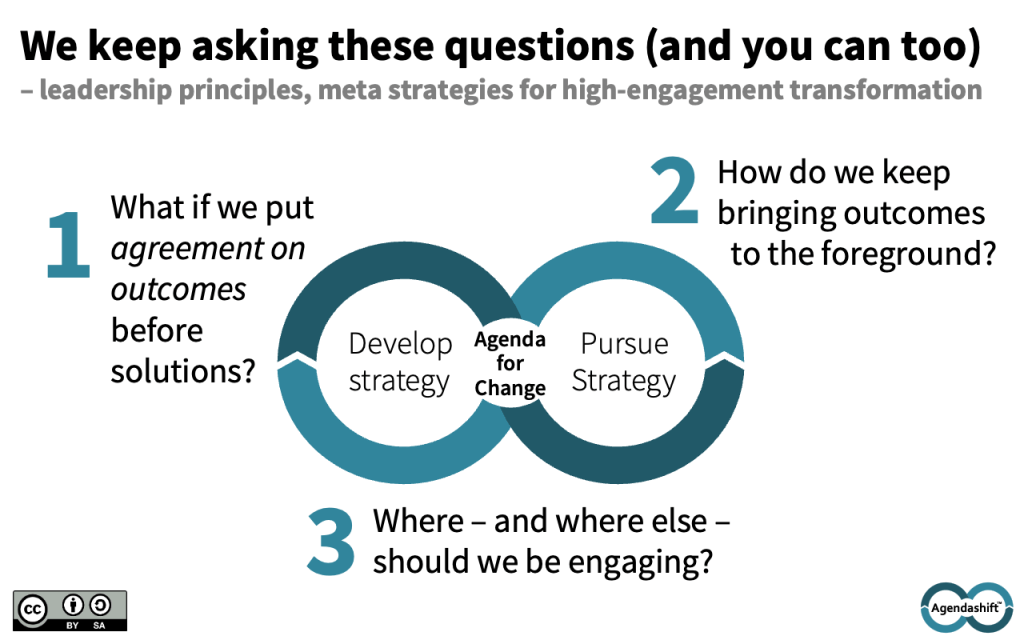
At every scope and scale, developing strategy together, pursuing strategy together, outcomes before solutions, working backwards (“right to left”) from key moments of impact and learning.
In this edition: Engage, Invite, Celebrate! Summer reading and writing; Autumn programme; The Great Consolidation
Engage, Invite, Celebrate!
When it’s your job to “create the conditions” for an adaptive, innovative, and resilient organisation, where do you start? What’s your agenda? That was the focus of this month’s big blog post and much of this month’s roundup will link back to it, so let’s start there:
The Leading in a Transforming Organisation trainings in Berlin and (especially) London last month really helped to crystallise something. It is prompting some changes in all my active projects, in particular the Leading with Outcomes training material, the writing of my next book, and the Agendashift home, Wholehearted, and (per the image below) Framework pages. Updates on some of those below, and watch this space – there’s something happening here!
Summer reading and writing
Book 4, Organizing Conversations: Preparing Groups to Take On Adaptive Challenges is of course recently out. If you haven’t yet read it, it’s short enough that you can easily add it to your summer book pile. It doesn’t have many Amazon reviews yet but at least they’re all five stars! Do please add yours!
Meanwhile this month on book 5, Wholehearted: Engaging with complexity in the Deliberately Adaptive Organisation, I have written the fourth of six chapters, The Space Between. I’m fascinated by what happens between different levels of organisation – between teams and their team-of-teams, for example – and find this space frustratingly under-explored in the literature. I can’t help thinking that many scale-related problems and, more generally, a lack of organisational agility both relate to that neglect. And process-centric approaches are ill-equipped to fix them!
As for “Engage, Invite, Celebrate”, that new chapter and, as of last week, the preceding three chapters all finish with a reflection with that title and that structure. It means that the reflective thread that already runs through the book is more explicitly anchored in the kind leadership described in my post. Definitely a change for the better.
Chapter 5 will be called Organizing at Human Scale. For an insight into where it begins, check out this post:
The language has changed a bit in the two years since that was written, but the idea stands. Then from networks of people we go to flexible webs of organisational scopes. Teaming (Edmondson), Dynamic Reteaming (Helfand), and Team Topologies (Skelton & Pais) are a selection of my references. I will enjoy dipping back into those over the summer holiday period.
Autumn programme
I mentioned that there will be changes to the Leading with Outcomes training material, and my autumn schedule makes those quite urgent. Including two conferences, here’s what my calendar looks like:
If you’ve attended a TTT/F previously, you might like to re-attend the online one for free. I can’t make the same offer for in-person training, but for the Southampton one at least, there are generous discounts not only for repeat attendees but for past TTT/F attendees also. Likewise for employees in the public sector, educational sector, non-profits, etc.
The Great Consolidation
Just a heads up: I intend to complete the consolidation of the Agendashift Academy’s two learning platforms onto the newer one next week. It will involve some downtime, tentatively scheduled for Tuesday next week. I’ll post updates while it’s happening.
That’s it for July – have a great August! We’ve found some suitably accessible accommodation equipped with the hoists & stuff our daughter needs so we’ll be taking some time away together for the first time in a long while. Can’t wait.
Leading with Outcomes from the Agendashift Academy “Leadership and strategy in the transforming organisation”
Leading with Outcomes is our modular curriculum in leadership and organisation development. Each module is available as self-paced online training or as private, instructor-led training (online or in-person). Certificates of completion or participation according to format. Its modules in the recommended order:
Individual subscriptions from £24.50 £18.40 per month after a 7-day free trial, with discounts available for employees and employers in the government, healthcare, education, and non-profit sectors. For bulk subscriptions, ask for our Agendashift for Business brochure.
To deliver Leading with Outcomes training or workshops yourself, see our Authorised Trainer and Authorised Facilitator programmes. See our events calendar for Train-the-Trainer / Facilitator (TTT/F) and Leading in a Transforming Organisation trainings.
At every scope and scale, developing strategy together, pursuing strategy together, outcomes before solutions, working backwards (“right to left”) from key moments of impact and learning.
I won’t retell all of the history of what followed, but wholehearted went on to become a key piece in both Agendashift and Leading with Outcomes. It lent its name to Agendashift’s mission statement, and in Leading with Outcomes it features in both the Foundation and Adaptive Organisation training modules. In short, it has legs! However, the way we introduce wholehearted as a model for leadership has evolved over the years, and it’s about time I shared a little of where we have got to with it.
From the Alexander quote, we picked out three words: unwhole, whole, and wholehearted. Then we asked a question: In relation to those, what expectations or responsibilities might a wholehearted organisation place on its leaders? Alternatively: By what behaviours do we recognise the leaders among us? We need leaders to be:
Engaging on the right challenges – attending to all that makes the organisation unwhole, i.e. to what makes it in any way disconnected, incomplete, unbalanced, incoherent, or otherwise dysfunctional; attending also to what might lead to a sense of unwholeness in the future – opportunities missed, for example
Inviting people to participate – not only for their perspectives and ideas but for the integration (i.e. making whole) that happens when you bring people together
Celebrating their initiative – amplifying the organisation’s capacity to innovate, not only in terms of enhanced products and services but in terms of the organisation’s own development also
Taking those first at face value, what word is better than ‘leader’ to describe people who demonstrate a commitment to engage, invite, and celebrate? Conversely, what would we think of a leader who isn’t engaging on the right issues? What would we think of a leader who is slow to invite people into the process? And what would we say of an organisation that has little progress to celebrate, or of a leader who keeps missing the opportunity?
We must recognise that leaders are human, and the organisations they work within aren’t perfect, so what stops leaders from leading more wholeheartedly, i.e. in the ways suggested? Moreover, what stops you (or leaders around you) from leading like that? Could it be that the conversation your organisation needs is the one that 1) identifies those obstacles and 2) explores what might be made possible if ways can be found around or through them?
The Foundation module of Leading with Outcomes starts with just such a conversation. Now, under the headings of Engage, Invite, and Celebrate, let’s explore how those ideas have developed.
Engage
What are the right challenges that leaders should be engaging on? Going back to the idea of unwholeness, there’s what is making the organisation unwhole now, and there’s what the organisation may come to regret if the opportunity isn’t grasped now. Bringing those together as “areas of opportunity” (actually the name of one of our exercises), Leading with Outcomes offers three main perspectives from which they can be identified:
Inside-out Strategy – an approach to strategy that begins with the internal experience of the organisation or some smaller scope thereof and its delivery capabilities, moving on to the possible consequences internal and external of developing them
Outside-in Strategy – complementary to the first perspective, this begins with customers, users, and other actors in the outside environment, considering those relationships, and works inwards to the implications for the organisation, its product, its underlying platform of technology, know-how, and so on, and its teams
Adaptive Organisation – deeply integrating the preceding into the life of an organisation in a fundamentally relational, generative, and fundamentally complexity-aware way
As my friend and collaborator Philippe Guenet observed at the London training a couple of weeks ago, Leading with Outcomes is unusual in how “three dimensional” it is, and he meant that not only about the three perspectives above. He appreciates the way we avoid letting the flow metaphor dominate to the exclusion of strategy and structure. Along with leadership, we see those not as things to roll out or to accept meekly as givens, but as aspects of organisation that interact in dynamic and complex ways with each other and the delivery flow, such that each can be seen as both products of and constraints on the others.
Accordingly, a three-dimensional set of “right challenges” to engage on might look something like the following:
Impediments to flow (it should not be taken from the preceding paragraphs that I believe flow and its impediments to be unimportant, only that other perspectives are vital too)
Obstacles that lie in the way of the organisation being where it wants to be and who it wants to be – in healthy and productive relationships with its customers, users, suppliers, and so on, and well positioned with respect to its competitors
Constraints of structure, policy, and habit that impact negatively on the organisation’s ability to deploy its decision-making, communication, and innovation capacities where they are most needed, and for those to self-organise as needed
If you were ever at a loss to know what it means for leaders to be “creating the conditions” for an adaptive, innovative, and resilient organisation, we have here the basis of a leadership agenda. By keeping focus on these things (the process never stops), more of the “right challenges” will be engaged with at every level of organisation, for as long or short a time as might be needed.
Each type of challenge applies at every level of organisation, and at each level, no leader can hope to adequately address all of those by themselves. Even the task of framing the key challenges may best be done with other people, so let’s move on to the invitation to participate.
Invite
The idea that you can expect to succeed in a complex challenge with a rollout-based approach belongs in the 1990’s. If by the time you’re inviting people into the process you’re already talking about predetermined solutions, you’ve left it far too late. Even to be inviting solution ideas is too late if you’ve missed the opportunity to explore the “challenge space” together.
Important aspects of the challenge space include 1) the obstacles that people bump up against every day, and 2) the possibilities they can envisage if only those obstacles could be dealt with in some way. If they are given the opportunity to identify and articulate those in their own words, you (together) not only obtain the raw material for a coherent strategy that is grounded in reality and contains its own measures of success, you greatly increase the strategy’s “surface area”. In it, more people at more levels of organisation will find more that they can engage with and contribute to.
To be clear, and recalling that to integrate is to make whole, what I am describing is the integration through participation of the development and pursuit of strategy. Two of Leading with Outcomes’ three main patterns fit here:
The IdOO (“I do”) pattern – Ideal, Obstacles, Outcomes
The 3M pattern – Meaning, Measure, Method
These patterns are the main focus of the Foundation module of Leading with Outcomes and much of the Agendashift1 and Organizing Conversations2 books. They translate coaching conversations to two different scales: everyday leadership routines and the structures of set-piece strategy events – workshops, training, and the like. In the latter, participants practice the former so that the experience “rubs off” to benefit of the everyday working experience.
In its typical usage, the 3M pattern incorporates the IdOO pattern (I’ve highlighted the words “ideal”, “obstacles”, and outcomes” below), so I’ll expand here just on 3M:
Meaning: for some focal challenge or outcome, what does this look like in the ideal and for whom (broadening and energising a conversation beyond the obvious), and what is the significance of the obstacles that impede the pursuit of that ideal?
Measure: not only in terms of metrics, by what observable outcomes will we know that we are being successful – behaviours and other indications that obstacles have been overcome and that people are making meaningful progress, the contexts within which they operate changed in some beneficial way
Method: generating multiple and diverse solution ideas, and for the most interesting of those, framing them as hypotheses
These generative conversations need not take long – from moments to at most minutes. Why organisations instead commit so quickly to singular, monolithic, and oversized solutions seems a mystery! Perhaps it is partly human nature (a general overconfidence in planning) and partly a vestige of the 1990s change management and project management models that business schools and senior leaders have done far too little to challenge.
Likewise, and stepping back to deeper conversations on strategy, it would seem highly sensible to invest just a few minutes or hours to avoid overcommitting to what might turn out to be many months of execution, but again, old habits die hard. There is cause for hope in modern notions of complexity and emergence, but if we are leaving leaders to interpret these rather abstract concepts in their organisational contexts and to join the dots themselves, this seems a very big ask.
Let us move on then to celebration, which hides a serious message about learning. Without the means to support it – indeed for the organisation to expect it – an innovation process is very hard to sustain.
Celebrate
The third of Leading with Outcomes’ three main patterns is Right to Left (not uncoincidentally the title of another of my books3). It refers to working backwards from two key moments, moments of impact and learning otherwise known as done and really done:
done: someone’s need was met
really done: we’ve accounted for the learning
As a coordination mechanism, the practice of reviewing work closest to completion first creates the foundations for flow. If work items are sufficiently granular, opportunities to celebrate getting them to meaningful states of done and really done should be frequent. Meaningfulness and alignment to purpose are enhanced greatly if “closest to completion” refers (as it should) to the work that is closest to making a customer impact. Add a delivery process that asks the right questions at the right time and in which everyone knows the boundaries of time and organisational scope within which the accounting will be done, a container for learning is formed.
To maximise the conditions for learning, leaders make multiple contributions. They represent and thereby reinforce those boundaries; some of them span boundaries helpfully also. They care that the right questions are asked at the right time, and not only when they themselves are the ones doing the asking. They care that at every stage of the delivery process, people have the customer and organisational context they need to make good decisions and deliver great work.
I could have added to that list, but that last responsibility says a lot about the distribution of decision-making capacity in the organisation. The need to make decisions and to find and create effective solutions does not fall only on leaders. It is characteristic of knowledge work that this is happening everywhere; the challenge for leaders is to help the combined effort keep its coherence and its senses of direction and purpose. Fortunately, they need not – and indeed cannot – do this on their own. Yes, they need to engage on the right challenges, but also they should be confident (or else working to build the confidence) that others around them are doing the same. Inviting more people into the process should be an early second step if it is not already part of the first. And let the celebrations begin! The sooner and more frequently those come, the faster the organisation delivers, learns, and adapts.
Engage, Invite, Celebrate: The call to action
Where will you start? Where is your greatest opportunity? Is it to engage on the right issues, to invite people into an integrated strategy process, or is it to celebrate their initiative, their successes, and their (everyone’s) learning? Or is it to help others around you to do the same? The choice really is yours, but you may find it helpful to work backwards – Right to Left if you like. Nothing builds trust like celebrating success. As you get better at it and learn to share the load, you create capacity. That capacity can be directed at identifying, framing, and prioritising your challenges. By the time you can anticipate celebrating your successes you will be well on your way.
Coming soonish: Wholehearted, the book
My fifth book, Wholehearted: Engaging with complexity in the Deliberately Adaptive Organisation will expand on many of the themes of this post. The Wholehearted of the title is of course a reference to the Engage, Invite, Celebrate model and the Christopher Alexander quote that inspired it. Its main focus is a deep dive into the kinds of challenges that leaders need to be engaged on, in particular to the dysfunctions that arise out of imbalances in the relationships between different aspects of the organisation. Healthy and productive relationships – for example between the work and how it is coordinated, or between delivery work and developmental work – are absolutely crucial to the effective deployment of the organisation’s decision-making capacity (and vice versa).
The book’s central model is the Deliberately Adaptive Organisation, a complexity-friendly retelling of the Viable System Model, faithful to the structure of Stafford Beer’s classic model but taking a very different approach to its application. Gone is the top-down analysis; in its place is a participatory, “everywhere all at once” approach. Going out of its way to avoid privileging any singular perspective, the goal is not to document an agreed view of the current or future state of the organisation but to identify through dialogue its challenges, underlying constraints, and possible interventions. By continuing to intervene on those constraints, the organisation works on becoming a better version of itself with a healthier and more productive relationship with its environment.
I use “constraints” here very much in the way understood in complexity science. Not just people and teams but other identifiable aspects of organisation affect each other’s behaviour not only by design but by their mere proximity. Too many and too interconnected for anyone to fully understand, let alone manage, these myriad relationships give rise to complexity, and do much to explain the poor track record of traditional approaches to organisational change. The approach here is to go with the grain of natural social processes, making it easier for desirable and ultimately rewarding interactions first to happen, and then to be repeated until they are normalised.
Yes (I’ve been told this more than once), to attempt to bring the systems and complexity worlds together like this is ambitious. It works though! The key I think is not to approach it as a problem of modelling or execution but as the kind of strategy challenge in which its development and pursuit must proceed hand-in-hand through dialogue. Organisations don’t just do stuff, they are experienced, and every experience is different. Through dialogue, and with effective frameworks for making sense of those diverse experiences, common themes emerge, and new stories are told. And so a process of generative change begins, one in which solutions emerge where they are needed.
I am not yet giving a timeframe for publication. Part I, Business Agility at Every Scale, is reviewing well, but work on Part II, Between Spaces, Scopes, and Scales, has only just begun. And majoring on the dialogic (i.e. dialogue-based) and generative aspects of organisation development (OD) I have alluded to, Organizing Conversations has only been out for a few weeks!
The abovementioned patterns – IdOO, 3M, and Right to Left – are introduced in the online self-paced training module Leading with Outcomes: Foundation, available on a subscription basis or delivered privately by an authorised trainer as a 1-day in-person or online class.
After Foundation come the Leading with Outcomes modules listed below. Although may you prefer to bring Adaptive Organisation forward or even to begin with Outside-in Strategy, the default sequence is as follows:
As with the Foundation module, all are available privately in both classroom training and online forms, also as shorter facilitated workshops. Publicly as well as privately, Leading for Innovation in the Knowledge Economy (formerly Leading in a Transforming Organisation) combines Foundation and Adaptive Organisation into a 3-day class, the next of which takes place in October. That and both online and in-person versions of Train-the-Trainer/Facilitator (TTT/F) are included in our calendar below:
At every scope and scale, developing strategy together, pursuing strategy together, outcomes before solutions, working backwards (“right to left”) from key moments of impact and learning.
My fourth book, Organizing Conversations: Preparing Groups to Take on Adaptive Challenges is now out, and it’s time to spill the beans on why a relatively short book took me so long. It wasn’t because I was working on book five at the time (hard as it was, I resisted that urge), but because my first conception of it was quite different to how it turned out.
My initial attempt was essentially a condensed version of the 2021 Agendashift 2nd edition. Series editor Gervase Bushe wasn’t satisfied with that, and to be honest, I shouldn’t have been either. What’s the point? Gervase insisted repeatedly that I had to be more up-front with my theory of action – i.e. the Why not only of the approach described in the book but that of each step in the process it describes and of the tools and techniques it employs. To do that justice, we re-framed and restructured it more than once, and I ended up adding a whole new chapter. To achieve that within the word count budget (30,000 words), swathes of less interesting material were cut. A couple of times I came close to giving up, but it is a much, much better book now.
I should have seen it coming! Here’s the beginning of an email conversation that I reproduce in the book’s introduction almost verbatim:
Gervase: I’d like to get a statement of your theory of action for creating generative conversations. Complete this sentence: In order to design events that produce generative conversations among a group of people you have to…
Mike: In order to design events that produce generative conversations among a group of people you have to sustain their motivation to ask and answer questions not previously considered in their context, and to which the answers may be both many and potentially surprising (including to the event’s designer, who neither mediates in every conversation nor prescribes their conclusions). The strength of that motivation comes from a combination of purpose, context, trust in the process on the day, and confidence (or at least hope) for what will follow.
Gervase: Interesting. Now, to sustain their motivation to ask and answer questions not previously considered in their context, you have to…
That conversation was how the book was born, and in the end I properly embraced the process. The irony is how slow I was to see that I was getting a taste of my own medicine! As well as the title of my third book, Right to Left is one of Agendashift’s and Leading with Outcomes’ core patterns. It means “working backwards from key moments of impact and learning”, where done is “someone’s need was met”, and really done is “we’ve accounted for the learning”. That learning is maximised by the way the work is framed and discussed, right from the beginning and all the way through the delivery process. In short, making explicit the theory of action of both the work and how it will be carried out is very much part of the approach.
In a similar vein, coincident with the book’s publication I’ve been fortunate to have done multiple runs of facilitation and training in quick succession. Between a private Adaptive Organisation workshop, two runs of Leading with Outcomes: Train-the-Trainer / Facilitator (TTT/F), and two runs of Leading in a Transforming Organisation, by the end of next week I will have done Foundation four times and different forms of the Adaptive Organisation material three times in the space of just a few weeks. What an opportunity for experimentation! Accordingly, next week’s training in London (see below) won’t just incorporate the usual round of small improvements I make before and after every training, it has been reworked quite substantially. Not just streamlining and mistake-proofing it, but repeatedly reinforcing the sense of where we are headed and why. Less “trust the process before we deconstruct it”, more a sense of engaging purposefully together.
Of course there’s always an element of risk when you make changes, but somehow I doubt that I will come to regret these. And let me say that just as I am grateful to Gervase for helping to make Organizing Conversations what it eventually became, I’m grateful also to Markus Hippeli, my host earlier this month in Berlin, whose thoughts prompted the latest rework. Markus, I shall let you know how we get on 🙂
June 25-27: Leading in a Transforming Organisation (London) – just a couple of places left, 15% discount applied to that link, ping me if you think may be eligible for a bigger one. Non-agilists very welcome, you won’t be alone!
I’m thrilled to announce that my fourth book, Organizing Conversations: Preparing Groups to Take on Adaptive Challenges is out on Kindle. Fingers crossed, the print version will be out in time for Friday’s monthly roundup. [Update: it was 🙂]
This shortish book (at a little over 100 pages and a shade under 30,000 words, half the length of my other books) was a commission for the Bushe-Marshak Institute’s BMI Series in Dialogic Organization Development and represents something of an endorsement by the OD community for Agendashift and Leading with Outcomes. Despite the length constraint (or was it because of it?) it took me nearly two and half years to complete, but it was worth it. More than ever before I was challenged to clarify the thinking behind the practice in a way that deepened existing commitments to participatory and generative change. Neither do I regret the delay to book 5, Wholehearted: Engaging with Complexity in the Deliberately Adaptive Organisation, but that’s for another day. Except to say that organising (a verb, and with British spelling) will be central to Wholehearted, the star of the show today is Organizing Conversations.
In OD terms, what this book does is to bridge two kinds of dialogue, inquiry and generative conversations, the latter referring to conversations in which people generate ideas on which they are motivated to act. In Leading with Outcomes terms, they correspond to the left and right sides of the picture that appears on the front cover. Inside those are Ideal, Outcomes, Outcomes – the IdOO (“I do”) pattern – and Meaning, Measure, Method, two outcome-oriented conversation patterns. Bridging them are Organise the Strategy (mapping, mostly) and Right to Left (the pattern, also the title of one of my previous books).
It might be described as combining the spirit of dialogic and generative OD with some Lean-Agile rigour, and that is what I believe prompted Gervase Bushe and Bob Marshak to invite me to write it. I started out writing a condensed version of an Agendashift 3rd edition, but with Gervase’s editorial input it ended up being much better than that, and for that I am grateful.
Watch a short conversation with Gervase recorded yesterday evening:
You can buy the Kindle version today – here are links for amazon.com, amazon.co.uk, and amazon.de – and watch this space for the print version.
Leading with Outcomes from the Agendashift Academy “Leadership and strategy in the transforming organisation”
Leading with Outcomes is our modular curriculum in leadership and organisation development. Each module is available as self-paced online training or as private, instructor-led training (online or in-person). Certificates of completion or participation according to format. Its modules in the recommended order:
Individual subscriptions from £24.50 £18.40 per month after a 7-day free trial, with discounts available for employees and employers in the government, healthcare, education, and non-profit sectors. For bulk subscriptions, ask for our Agendashift for Business brochure.
To deliver Leading with Outcomes training or workshops yourself, see our Authorised Trainer and Authorised Facilitator programmes. See our events calendar for Train-the-Trainer / Facilitator (TTT/F) and Leading in a Transforming Organisation trainings.
At every scope and scale, developing strategy together, pursuing strategy together, outcomes before solutions, working backwards (“right to left”) from key moments of impact and learning.
In this edition: Books in progress: 2; Two new videos; Upcoming: online, Berlin (SOLD OUT), London, and Southampton; Top posts
Books in progress: 2
I’m putting the final touches on Organising Conversations: Patterns of Dialog for the Transforming Organization and have a decent first draft of the first part (of two) of Wholehearted: Engaging with Complexity in the Deliberately Adaptive Organisation. Needless to say, they’re keeping me busy!
With that workload in mind and the summer approaching, I’m pausing the monthly webinars and experience/practise sessions until the autumn.
Encouragingly, an excerpt from Wholehearted is by a big margin the most-read blog post of the month (shared on LinkedIn here):
In the last (until the autumn) of our monthly webinars, we were joined this month by Karl Scotland. Here’s the recording of his excellent session, also the PDF of his slides, links, etc:
Related to the still-to-be-written Part II of Wholehearted and with a fun Q&A session (always a good sign) here’s the latest version of one of my ever-evolving keynotes:
Upcoming: online, Berlin (SOLD OUT), London, and Southampton
Yes, Berlin has sold out, but there’s still the online TTT/F and then Leading in a Transforming Organisation (London) at the end of June and another in Southampton in October:
Past (or booked) attendees of TTT/F can re-attend for free and/or attend Leading in a Transforming Organisation for less than half price. There are big discounts in the opposite direction also – ping me for coupon codes. Also significant discounts for government, healthcare, education (a number of university staff have attended in recent months), non-profits, etc. As was the case in Manchester last year, I know that London for one will have participants from outside of technology, which always makes for a more interesting experience.
If you really can’t get to any of those, don’t forget the online self-paced option: Leading with Outcomes.
Leading with Outcomes from the Agendashift Academy “Leadership and strategy in the transforming organisation”
Leading with Outcomes is our modular curriculum in leadership and organisation development. Each module is available as self-paced online training or as private, instructor-led training (online or in-person). Certificates of completion or participation according to format. Its modules in the recommended order:
Individual subscriptions from £24.50 £18.40 per month after a 7-day free trial, with discounts available for employees and employers in the government, healthcare, education, and non-profit sectors. For bulk subscriptions, ask for our Agendashift for Business brochure.
To deliver Leading with Outcomes training or workshops yourself, see our Authorised Trainer and Authorised Facilitator programmes. See our events calendar for Train-the-Trainer / Facilitator (TTT/F) and Leading in a Transforming Organisation trainings.
At every scope and scale, developing strategy together, pursuing strategy together, outcomes before solutions, working backwards (“right to left”) from key moments of impact and learning.
2024 has already started of course, and with the valued help of over 20 contributors I iterated several times over the holiday period on this article posted on the blog here yesterday:
Most pressing is the re-recording of the Inside-out and Outside-in strategy modules. Like the Adaptive Organisation module, Inside-out will be split into two, likely titles:
Inside-out Strategy (I): On the same page, with purpose
Inside-out Strategy (II): Fit for maximum impact (keeping the title of the original one-part module)
Once Inside-out and Outside-in are on the new learning management system there will be significant opportunity for rationalisation. If you’re not already on board there, check these out:
Or get in touch about holding a Leading in a Transforming Organisation training workshop near you; this covers Foundation and Adaptive Organisation, with all the benefits of an in-person experience, and some unique features too. I’m not asking anyone to take responsibility for the event (though that can be arranged); just your interest would be good to know.
Leading with Outcomes from the Agendashift Academy “Leadership and strategy in the transforming organisation”
Leading with Outcomes is our modular curriculum in leadership and organisation development. Each module is available as self-paced online training or as private, instructor-led training (online or in-person). Certificates of completion or participation according to format. Its modules in the recommended order:
Individual subscriptions from £24.50 £18.40 per month after a 7-day free trial, with discounts available for employees and employers in the government, healthcare, education, and non-profit sectors. For bulk subscriptions, ask for our Agendashift for Business brochure.
To deliver Leading with Outcomes training or workshops yourself, see our Authorised Trainer and Authorised Facilitator programmes. See our events calendar for Train-the-Trainer / Facilitator (TTT/F) and Leading in a Transforming Organisation trainings.
At every scope and scale, developing strategy together, pursuing strategy together, outcomes before solutions, working backwards (“right to left”) from key moments of impact and learning.



 Agendashift