[This post was first published on LinkedIn here – comments there welcome!]
I’m old enough to have grown up with the original BBC Radio version of Douglas Adams’ The Hitchhiker’s Guide to the Universe, and this was one of my favourite scenes (one of the several that as teenagers we would recite at school):
MARVIN: I’ve just worked out an answer to the square root of minus one.
FORD: Go and get Zaphod.
MARVIN: It’s never been worked out before. It’s always been thought impossible.
FORD: Go and get –
MARVIN: I’m going. Pausing only to reconstruct the whole infrastructure of integral mathematics in his head, he went about his humble task. Never thinking to ask for reward, recognition, or even a moment’s ease from the terrible pain in all the diodes down his left side. “Fetch Beeblebrox,” they say, and forth he goes.
“Pausing only to reconstruct the whole infrastructure of integral mathematics in his head, he went about his humble task”. That line comes to me when I think about how I first responded to John Boyd’s OODA loop, which I introduce in Chapter 2 of Wholehearted, the chapter titled “Adaptive Strategising”:
To understand my initial reaction, you need to know that before John Boyd became known as a military strategist, he was a fighter pilot. Looking at the Orient part of that picture, did he – mid combat, and before executing his next move – pause only to reconstruct the entire infrastructure of cultural traditions, genetic heritage, etc on which his performance was founded? Doing that faster than his adversary – “getting inside their OODA loop”, as the popular takeaway goes – is that what was key to his survival?
To some extent perhaps, but that is, I think, to miss the point. Acting in the moment, a highly trained pilot draws on what they know. Flashes of insight may occur, but most of the learning comes afterwards, reflecting on what happened, integrating the experience and the new information that it generated. That’s a much longer loop than the moment-to-moment decision-making of combat.
There is no adversary whose OODA loop you need to get inside!
Mercifully (and I don’t say this lightly), most of us will never experience combat. Our situations are not even best understood as adversarial. There is no adversary whose OODA loop you need to get inside! But, and paraphrasing if not directly quoting Boyd himself, we do need to “develop our capacity for independent action”. We need somehow to stay in the game when the game itself may be changing, and that Orient box – the only one that connects to all the others – is crucial.
Boyd was right: it is important to bear in mind that the understanding and the intelligence on which our strategies depend are very much products of the past – of our “tradition” and “heritage”, if you like. For your organisation, how it thinks depends very much on the path it has travelled. Moreover, its current structure and its priorities speak to how it now understands the world and its challenges. And therein lies another challenge: let it not be forgotten that they are significant constraints on what new intelligence and insights it will be capable of gathering and generating.
Effective strategising must therefore be conscious of the fact that everything that it thinks it knows is not only very incomplete, it has passed through perceptual filters that are both narrow and path-dependent. You can’t escape that, but you can act accordingly. Not as catchy as the popular takeaway, but that, for me, is the one to remember.
Wholehearted: Engaging with Complexity in the Deliberately Adaptive Organisation hit Amazon earlier this month. You can find both print and Kindle editions on amazon.co.uk, amazon.com, amazon.de and other Amazon sites around the world. The e-book is also available on LeanPub, Kobo, Apple Books, and Google Play Books.
I won’t retell all of the history of what followed, but wholehearted went on to become a key piece in both Agendashift and Leading with Outcomes. It lent its name to Agendashift’s mission statement, and in Leading with Outcomes it features in both the Foundation and Adaptive Organisation training modules. In short, it has legs! However, the way we introduce wholehearted as a model for leadership has evolved over the years, and it’s about time I shared a little of where we have got to with it.
From the Alexander quote, we picked out three words: unwhole, whole, and wholehearted. Then we asked a question: In relation to those, what expectations or responsibilities might a wholehearted organisation place on its leaders? Alternatively: By what behaviours do we recognise the leaders among us? We need leaders to be:
Engaging on the right challenges – attending to all that makes the organisation unwhole, i.e. to what makes it in any way disconnected, incomplete, unbalanced, incoherent, or otherwise dysfunctional; attending also to what might lead to a sense of unwholeness in the future – opportunities missed, for example
Inviting people to participate – not only for their perspectives and ideas but for the integration (i.e. making whole) that happens when you bring people together
Celebrating their initiative – amplifying the organisation’s capacity to innovate, not only in terms of enhanced products and services but in terms of the organisation’s own development also
Taking those first at face value, what word is better than ‘leader’ to describe people who demonstrate a commitment to engage, invite, and celebrate? Conversely, what would we think of a leader who isn’t engaging on the right issues? What would we think of a leader who is slow to invite people into the process? And what would we say of an organisation that has little progress to celebrate, or of a leader who keeps missing the opportunity?
We must recognise that leaders are human, and the organisations they work within aren’t perfect, so what stops leaders from leading more wholeheartedly, i.e. in the ways suggested? Moreover, what stops you (or leaders around you) from leading like that? Could it be that the conversation your organisation needs is the one that 1) identifies those obstacles and 2) explores what might be made possible if ways can be found around or through them?
The Foundation module of Leading with Outcomes starts with just such a conversation. Now, under the headings of Engage, Invite, and Celebrate, let’s explore how those ideas have developed.
Engage
What are the right challenges that leaders should be engaging on? Going back to the idea of unwholeness, there’s what is making the organisation unwhole now, and there’s what the organisation may come to regret if the opportunity isn’t grasped now. Bringing those together as “areas of opportunity” (actually the name of one of our exercises), Leading with Outcomes offers three main perspectives from which they can be identified:
Inside-out Strategy – an approach to strategy that begins with the internal experience of the organisation or some smaller scope thereof and its delivery capabilities, moving on to the possible consequences internal and external of developing them
Outside-in Strategy – complementary to the first perspective, this begins with customers, users, and other actors in the outside environment, considering those relationships, and works inwards to the implications for the organisation, its product, its underlying platform of technology, know-how, and so on, and its teams
Adaptive Organisation – deeply integrating the preceding into the life of an organisation in a fundamentally relational, generative, and fundamentally complexity-aware way
As my friend and collaborator Philippe Guenet observed at the London training a couple of weeks ago, Leading with Outcomes is unusual in how “three dimensional” it is, and he meant that not only about the three perspectives above. He appreciates the way we avoid letting the flow metaphor dominate to the exclusion of strategy and structure. Along with leadership, we see those not as things to roll out or to accept meekly as givens, but as aspects of organisation that interact in dynamic and complex ways with each other and the delivery flow, such that each can be seen as both products of and constraints on the others.
Accordingly, a three-dimensional set of “right challenges” to engage on might look something like the following:
Impediments to flow (it should not be taken from the preceding paragraphs that I believe flow and its impediments to be unimportant, only that other perspectives are vital too)
Obstacles that lie in the way of the organisation being where it wants to be and who it wants to be – in healthy and productive relationships with its customers, users, suppliers, and so on, and well positioned with respect to its competitors
Constraints of structure, policy, and habit that impact negatively on the organisation’s ability to deploy its decision-making, communication, and innovation capacities where they are most needed, and for those to self-organise as needed
If you were ever at a loss to know what it means for leaders to be “creating the conditions” for an adaptive, innovative, and resilient organisation, we have here the basis of a leadership agenda. By keeping focus on these things (the process never stops), more of the “right challenges” will be engaged with at every level of organisation, for as long or short a time as might be needed.
Each type of challenge applies at every level of organisation, and at each level, no leader can hope to adequately address all of those by themselves. Even the task of framing the key challenges may best be done with other people, so let’s move on to the invitation to participate.
Invite
The idea that you can expect to succeed in a complex challenge with a rollout-based approach belongs in the 1990’s. If by the time you’re inviting people into the process you’re already talking about predetermined solutions, you’ve left it far too late. Even to be inviting solution ideas is too late if you’ve missed the opportunity to explore the “challenge space” together.
Important aspects of the challenge space include 1) the obstacles that people bump up against every day, and 2) the possibilities they can envisage if only those obstacles could be dealt with in some way. If they are given the opportunity to identify and articulate those in their own words, you (together) not only obtain the raw material for a coherent strategy that is grounded in reality and contains its own measures of success, you greatly increase the strategy’s “surface area”. In it, more people at more levels of organisation will find more that they can engage with and contribute to.
To be clear, and recalling that to integrate is to make whole, what I am describing is the integration through participation of the development and pursuit of strategy. Two of Leading with Outcomes’ three main patterns fit here:
The IdOO (“I do”) pattern – Ideal, Obstacles, Outcomes
The 3M pattern – Meaning, Measure, Method
These patterns are the main focus of the Foundation module of Leading with Outcomes and much of the Agendashift1 and Organizing Conversations2 books. They translate coaching conversations to two different scales: everyday leadership routines and the structures of set-piece strategy events – workshops, training, and the like. In the latter, participants practice the former so that the experience “rubs off” to benefit of the everyday working experience.
In its typical usage, the 3M pattern incorporates the IdOO pattern (I’ve highlighted the words “ideal”, “obstacles”, and outcomes” below), so I’ll expand here just on 3M:
Meaning: for some focal challenge or outcome, what does this look like in the ideal and for whom (broadening and energising a conversation beyond the obvious), and what is the significance of the obstacles that impede the pursuit of that ideal?
Measure: not only in terms of metrics, by what observable outcomes will we know that we are being successful – behaviours and other indications that obstacles have been overcome and that people are making meaningful progress, the contexts within which they operate changed in some beneficial way
Method: generating multiple and diverse solution ideas, and for the most interesting of those, framing them as hypotheses
These generative conversations need not take long – from moments to at most minutes. Why organisations instead commit so quickly to singular, monolithic, and oversized solutions seems a mystery! Perhaps it is partly human nature (a general overconfidence in planning) and partly a vestige of the 1990s change management and project management models that business schools and senior leaders have done far too little to challenge.
Likewise, and stepping back to deeper conversations on strategy, it would seem highly sensible to invest just a few minutes or hours to avoid overcommitting to what might turn out to be many months of execution, but again, old habits die hard. There is cause for hope in modern notions of complexity and emergence, but if we are leaving leaders to interpret these rather abstract concepts in their organisational contexts and to join the dots themselves, this seems a very big ask.
Let us move on then to celebration, which hides a serious message about learning. Without the means to support it – indeed for the organisation to expect it – an innovation process is very hard to sustain.
Celebrate
The third of Leading with Outcomes’ three main patterns is Right to Left (not uncoincidentally the title of another of my books3). It refers to working backwards from two key moments, moments of impact and learning otherwise known as done and really done:
done: someone’s need was met
really done: we’ve accounted for the learning
As a coordination mechanism, the practice of reviewing work closest to completion first creates the foundations for flow. If work items are sufficiently granular, opportunities to celebrate getting them to meaningful states of done and really done should be frequent. Meaningfulness and alignment to purpose are enhanced greatly if “closest to completion” refers (as it should) to the work that is closest to making a customer impact. Add a delivery process that asks the right questions at the right time and in which everyone knows the boundaries of time and organisational scope within which the accounting will be done, a container for learning is formed.
To maximise the conditions for learning, leaders make multiple contributions. They represent and thereby reinforce those boundaries; some of them span boundaries helpfully also. They care that the right questions are asked at the right time, and not only when they themselves are the ones doing the asking. They care that at every stage of the delivery process, people have the customer and organisational context they need to make good decisions and deliver great work.
I could have added to that list, but that last responsibility says a lot about the distribution of decision-making capacity in the organisation. The need to make decisions and to find and create effective solutions does not fall only on leaders. It is characteristic of knowledge work that this is happening everywhere; the challenge for leaders is to help the combined effort keep its coherence and its senses of direction and purpose. Fortunately, they need not – and indeed cannot – do this on their own. Yes, they need to engage on the right challenges, but also they should be confident (or else working to build the confidence) that others around them are doing the same. Inviting more people into the process should be an early second step if it is not already part of the first. And let the celebrations begin! The sooner and more frequently those come, the faster the organisation delivers, learns, and adapts.
Engage, Invite, Celebrate: The call to action
Where will you start? Where is your greatest opportunity? Is it to engage on the right issues, to invite people into an integrated strategy process, or is it to celebrate their initiative, their successes, and their (everyone’s) learning? Or is it to help others around you to do the same? The choice really is yours, but you may find it helpful to work backwards – Right to Left if you like. Nothing builds trust like celebrating success. As you get better at it and learn to share the load, you create capacity. That capacity can be directed at identifying, framing, and prioritising your challenges. By the time you can anticipate celebrating your successes you will be well on your way.
Coming soonish: Wholehearted, the book
My fifth book, Wholehearted: Engaging with complexity in the Deliberately Adaptive Organisation will expand on many of the themes of this post. The Wholehearted of the title is of course a reference to the Engage, Invite, Celebrate model and the Christopher Alexander quote that inspired it. Its main focus is a deep dive into the kinds of challenges that leaders need to be engaged on, in particular to the dysfunctions that arise out of imbalances in the relationships between different aspects of the organisation. Healthy and productive relationships – for example between the work and how it is coordinated, or between delivery work and developmental work – are absolutely crucial to the effective deployment of the organisation’s decision-making capacity (and vice versa).
The book’s central model is the Deliberately Adaptive Organisation, a complexity-friendly retelling of the Viable System Model, faithful to the structure of Stafford Beer’s classic model but taking a very different approach to its application. Gone is the top-down analysis; in its place is a participatory, “everywhere all at once” approach. Going out of its way to avoid privileging any singular perspective, the goal is not to document an agreed view of the current or future state of the organisation but to identify through dialogue its challenges, underlying constraints, and possible interventions. By continuing to intervene on those constraints, the organisation works on becoming a better version of itself with a healthier and more productive relationship with its environment.
I use “constraints” here very much in the way understood in complexity science. Not just people and teams but other identifiable aspects of organisation affect each other’s behaviour not only by design but by their mere proximity. Too many and too interconnected for anyone to fully understand, let alone manage, these myriad relationships give rise to complexity, and do much to explain the poor track record of traditional approaches to organisational change. The approach here is to go with the grain of natural social processes, making it easier for desirable and ultimately rewarding interactions first to happen, and then to be repeated until they are normalised.
Yes (I’ve been told this more than once), to attempt to bring the systems and complexity worlds together like this is ambitious. It works though! The key I think is not to approach it as a problem of modelling or execution but as the kind of strategy challenge in which its development and pursuit must proceed hand-in-hand through dialogue. Organisations don’t just do stuff, they are experienced, and every experience is different. Through dialogue, and with effective frameworks for making sense of those diverse experiences, common themes emerge, and new stories are told. And so a process of generative change begins, one in which solutions emerge where they are needed.
I am not yet giving a timeframe for publication. Part I, Business Agility at Every Scale, is reviewing well, but work on Part II, Between Spaces, Scopes, and Scales, has only just begun. And majoring on the dialogic (i.e. dialogue-based) and generative aspects of organisation development (OD) I have alluded to, Organizing Conversations has only been out for a few weeks!
The abovementioned patterns – IdOO, 3M, and Right to Left – are introduced in the online self-paced training module Leading with Outcomes: Foundation, available on a subscription basis or delivered privately by an authorised trainer as a 1-day in-person or online class.
After Foundation come the Leading with Outcomes modules listed below. Although may you prefer to bring Adaptive Organisation forward or even to begin with Outside-in Strategy, the default sequence is as follows:
As with the Foundation module, all are available privately in both classroom training and online forms, also as shorter facilitated workshops. Publicly as well as privately, Leading for Innovation in the Knowledge Economy (formerly Leading in a Transforming Organisation) combines Foundation and Adaptive Organisation into a 3-day class, the next of which takes place in October. That and both online and in-person versions of Train-the-Trainer/Facilitator (TTT/F) are included in our calendar below:
At every scope and scale, developing strategy together, pursuing strategy together, outcomes before solutions, working backwards (“right to left”) from key moments of impact and learning.
2024 has already started of course, and with the valued help of over 20 contributors I iterated several times over the holiday period on this article posted on the blog here yesterday:
Most pressing is the re-recording of the Inside-out and Outside-in strategy modules. Like the Adaptive Organisation module, Inside-out will be split into two, likely titles:
Inside-out Strategy (I): On the same page, with purpose
Inside-out Strategy (II): Fit for maximum impact (keeping the title of the original one-part module)
Once Inside-out and Outside-in are on the new learning management system there will be significant opportunity for rationalisation. If you’re not already on board there, check these out:
Or get in touch about holding a Leading in a Transforming Organisation training workshop near you; this covers Foundation and Adaptive Organisation, with all the benefits of an in-person experience, and some unique features too. I’m not asking anyone to take responsibility for the event (though that can be arranged); just your interest would be good to know.
Leading with Outcomes from the Agendashift Academy “Leadership and strategy in the transforming organisation”
Leading with Outcomes is our modular curriculum in leadership and organisation development. Each module is available as self-paced online training or as private, instructor-led training (online or in-person). Certificates of completion or participation according to format. Its modules in the recommended order:
Individual subscriptions from £24.50 £18.40 per month after a 7-day free trial, with discounts available for employees and employers in the government, healthcare, education, and non-profit sectors. For bulk subscriptions, ask for our Agendashift for Business brochure.
To deliver Leading with Outcomes training or workshops yourself, see our Authorised Trainer and Authorised Facilitator programmes. See our events calendar for Train-the-Trainer / Facilitator (TTT/F) and Leading in a Transforming Organisation trainings.
At every scope and scale, developing strategy together, pursuing strategy together, outcomes before solutions, working backwards (“right to left”) from key moments of impact and learning.
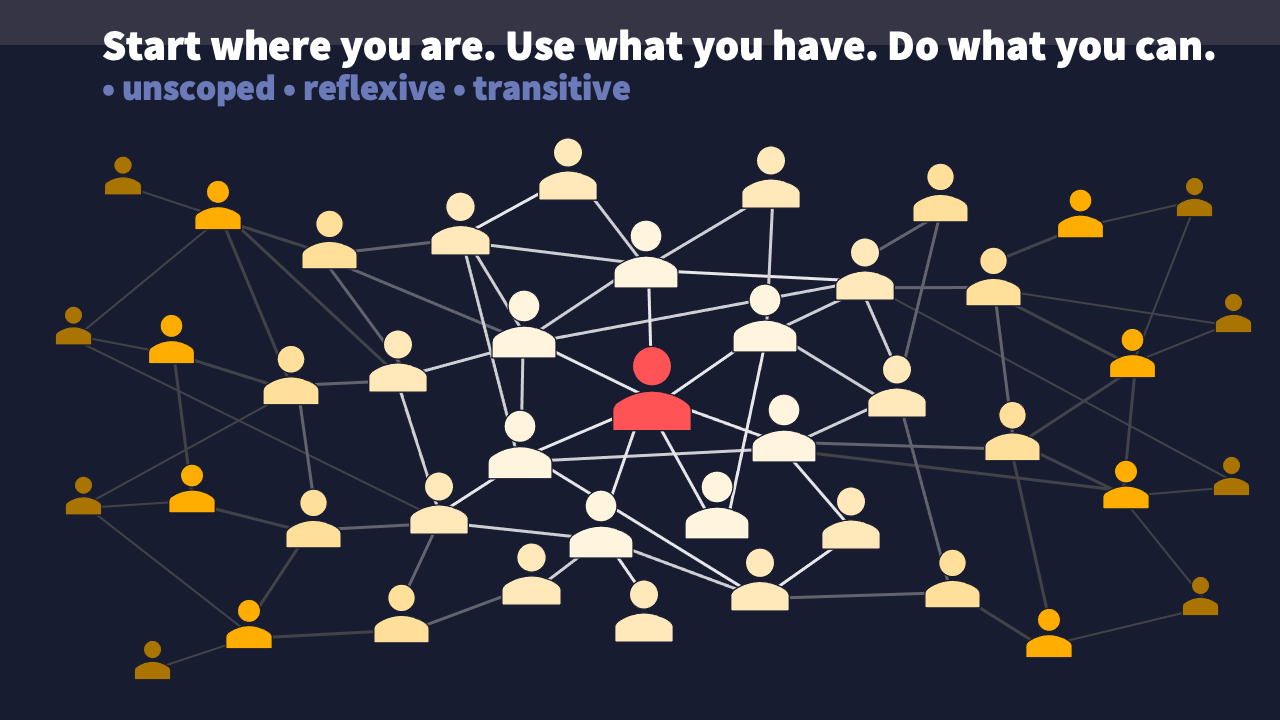
Start where you are. Use what you have. Do what you can.
Arthur Ashe
“Start where you are” doesn’t have to be about process! Try this exercise:
Disregarding organisational boundaries, and in relation to the work you are already committed to (your “organising commitments”), who do you interact with? Then reflexively: who interacts with you regarding their organising commitments? And transitively: who do they interact with, who interacts with them, and so on outwards?
Again disregarding organisational boundaries, and whether as an act of planning or of response to something unexpected, who do you consult with when your organising commitments need to change? And again reflexively and transitively: Who consults with you, who do they consult with, and so on outwards?
Now reflect on the relationships you have identified in those two networks. Whose relationships don’t you understand as well as you might? To the extent that it affects your own work, what context do you lack that others might be able to provide? Who else might be struggling for lack of context that you or someone closer to you might be able to provide? Is it time then for some trust-building conversations?
Leading with Outcomes from the Agendashift Academy “Leadership and strategy in the transforming organisation”
Leading with Outcomes is our modular curriculum in leadership and organisation development. Each module is available as self-paced online training or as private, instructor-led training (online or in-person). Certificates of completion or participation according to format. Its modules in the recommended order:
Individual subscriptions from £24.50 £18.40 per month after a 7-day free trial, with discounts available for employees and employers in the government, healthcare, education, and non-profit sectors. For bulk subscriptions, ask for our Agendashift for Business brochure.
To deliver Leading with Outcomes training or workshops yourself, see our Authorised Trainer and Authorised Facilitator programmes. See our events calendar for Train-the-Trainer / Facilitator (TTT/F) and Leading in a Transforming Organisation trainings.
At every scope and scale, developing strategy together, pursuing strategy together, outcomes before solutions, working backwards (“right to left”) from key moments of impact and learning.
Happy New Year! For me it’s a big anniversary: this time in 2013 I had spent the New Year’s break taking the principles and practices of the Kanban Method, and from them abstracting a system of nine values. Then on January 3rd, I published Introducing Kanban through its values. Kanban’s values model was born.
Nine values are quite a lot to hold in one’s head at once, so I soon learned to present them in groups:
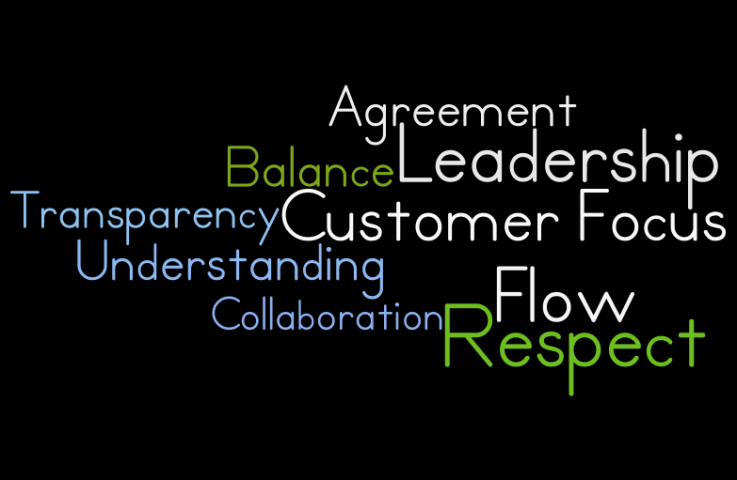
An initial six, or two groups of three: transparency, balance, and collaboration, then customer focus, flow, and leadership
Then understanding, agreement, and respect, which for reasons of brevity are often subsumed under leadership
In most of the decade since, it has been my most-read post each year. And it led to my first book, Kanban from the Inside (2014), which remains a Lean-Agile classic. Great! Now what?
I had no interest in making Kanban any more technical than it already was; if anything, the values model would always draw me in the opposite direction. Neither was I drawn to the emerging Kanban Maturity Model (or any other such model). What I did instead was to allow a common problem to bother me: why do so many people arrive at the training class not knowing why they are there? Tempting as it might have been to see that as a failure of administration or marketing, I saw it instead as a symptom that there were important organisational conversations that simply weren’t happening.
I realised quickly that this problem was far from unique to Kanban. To those that resent having had Scrum or (later) SAFe thrust upon them, the Agile manifesto’s “People and interactions over processes and tools” must ring rather hollow.
That took me away from Kanban into the realms of organisation, leadership, and strategy, to the development of Agendashift, and then sort of full circle, not back to Kanban and Lean-Agile specifically, but to business agility. Ten years on, as practice gets refined through use, as its message gets refined through the telling, and as we dig ever-deeper roots into the available theory, three main topic areas co-evolve together:
As described now in two editions of the Agendashift book (2nd ed 2021), Agendashift the engagement model (thank you Daniel Mezick for describing Agendashift as such) and dialogic/generative organisation development approach (thank you Gervase Bushe & Bob Marshak), a way for practitioners to approach organisations without prejudging what solutions they will employ(/impose/inflict) and instead to help them have those missing conversations – engaging in participatory strategy, as it turns out
The wholehearted organisation, a deliberately minimalistic values-based model of organisation and leadership, a spinoff from my third book, Right to Left: The digital leader’s guide to Lean and Agile (2019, audiobook 2020) that unexpectedly gained a life of its own
The leadership development curriculum Leading with Outcomes, which compared to Agendashift minimises detail relevant mainly to practitioners, and instead distils some easily-learned patterns, strategies, and organisational models relevant to leaders at all levels, leaders in transforming organisations most especially
Explicitly in both Agendashift and Leading with Outcomes and implicitly in wholehearted, we have doubled down on the eighth value of that initial nine-value model, namely agreement. What if we put agreement on outcomes before solutions? One way or another, I’ve been asking that question for most of the past ten years, and I have no doubt that it will keep me going for a good while yet.
I no longer identify as a Kanban guy. That separation was necessary to what followed, but all these years later I remain proud of the work I did there, of that first book, and of the blog post that started it all. Not that I’m planning on retiring anytime soon, but I have long seen it as marking the beginning of the rest of my career.
At every scope and scale, developing strategy together, pursuing strategy together, outcomes before solutions, working backwards (“right to left”) from key moments of impact and learning.
A strategy that ignores the obstacles is liable to fall at the first hurdle. That’s if it even gets that far – who will take seriously a strategy that ignores the issues? Turn those obstacles into outcomes Agendashift-style, and organise them so that you can establish a sense of direction, identify places to focus your efforts, and measure progress and success, well you’re in much better shape.
Most things Agendashift-related come with leadership lessons too, hence Leading with Outcomes. Here, in a psychologically safe environment, it must be ok to talk about obstacles. As a leader, you have a responsibility to encourage that to happen. But we can take that basic lesson further: how we talk about obstacles matters too.
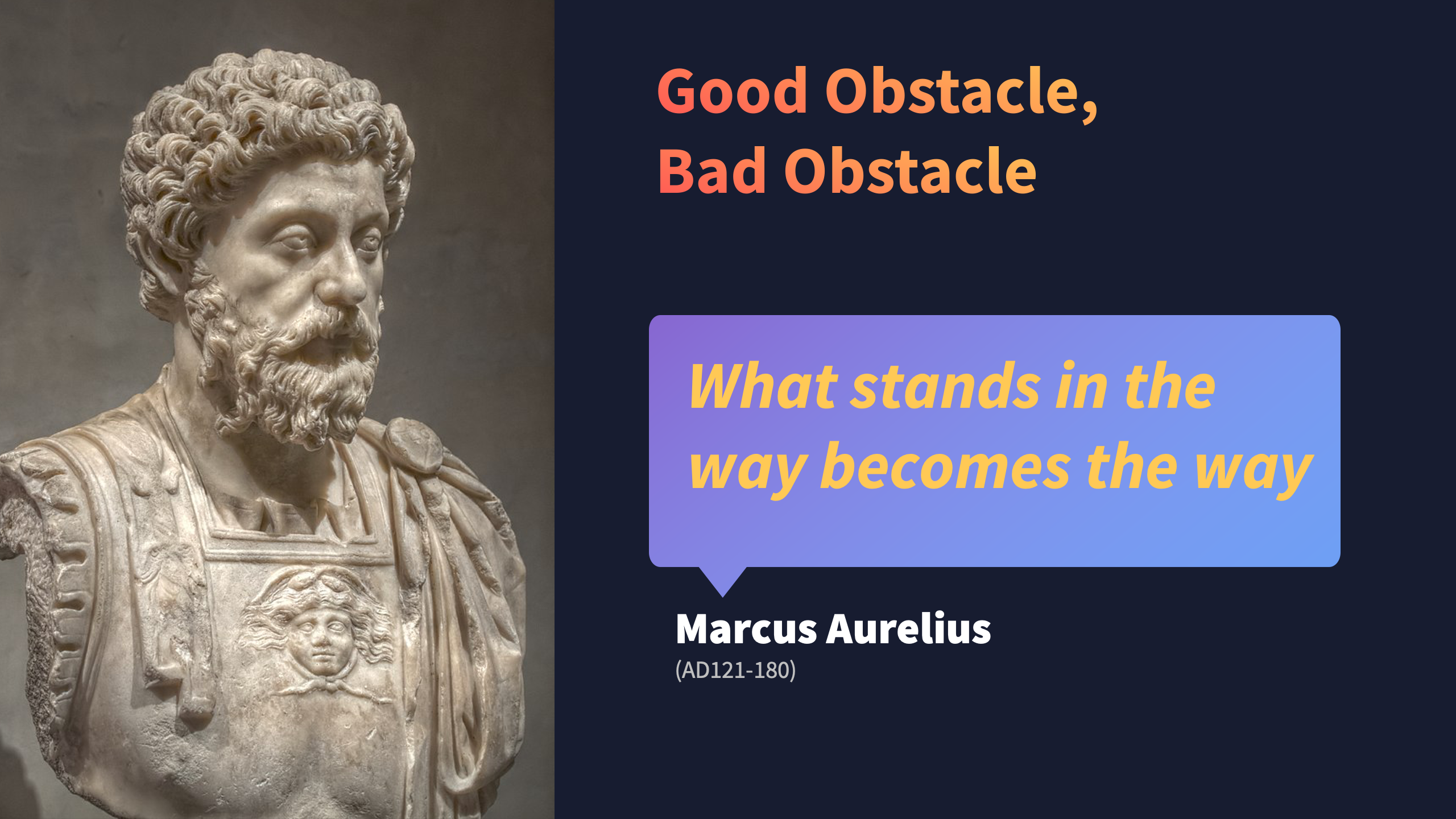
Ever since a workshop in Berlin in 2019*, we’ve paid closer attention to how obstacles are framed. What started out as an effort to debug one breakout group’s frustrating experience turned into a new exercise, Good Obstacle, Bad Obstacle (yes there’s a nod to Rumelt in the name there).
Ostensibly, the exercise’s job is to frame obstacles such that the conversations to turn them into outcomes will be productive and satisfying, even enjoyable. What we repeatedly find though is that it helps us get to deeper issues and at the same time puts a spotlight on the organisation’s discourse. A bugfix becomes a key feature!
The exercise’s goal is to produce obstacles that are real, relevant, and representative – describing things that colleagues would quickly recognise, that affect their everyday work, and worded as they might word them. As per the title of this post, the trick (if “trick” is the right word – it can take real effort) is to sell the pain, not the solution, the theory, or the blame.
Some examples of “bad” obstacles:
Lack of a knowledge management system
Lack of people, money, or time
Lack of WIP limits
Lack of the Agile mindset
Lack of leadership
Lack of quality
The problem isn’t the “lack of” language (or “scarcity language”, as I sometimes call it), though that’s a strong smell. The problem is what those obstacles are selling: solutions, theories, or blame (or a combination), all of which get in the way of agreement. They’re easily dismissed (they may exclude better solutions or theories, for example), they call for things that everyone knows are unlikely to be forthcoming, or people feel judged by them.
Instead of those “lack ofs”, tell the more interesting side of the story. Sell the pain. Identify the real issue. That way lies the path to agreement on outcomes, a more coherent and robust strategy, and a more purposeful innovation process. And if you want your organisation’s discourse to improve, try paying attention to how obstacles are articulated. The conversation to turn a bad obstacle into a good one (in your next retro, perhaps) might be more important than you might think.
*See Events below – I’ll be back in Berlin in February, my first trip outside the UK since Covid!
Leading with Outcomes from the Agendashift Academy “Leadership and strategy in the transforming organisation”
Leading with Outcomes is our modular curriculum in leadership and organisation development. Each module is available as self-paced online training or as private, instructor-led training (online or in-person). Certificates of completion or participation according to format. Its modules in the recommended order:
Individual subscriptions from £24.50 £18.40 per month after a 7-day free trial, with discounts available for employees and employers in the government, healthcare, education, and non-profit sectors. For bulk subscriptions, ask for our Agendashift for Business brochure.
To deliver Leading with Outcomes training or workshops yourself, see our Authorised Trainer and Authorised Facilitator programmes. See our events calendar for Train-the-Trainer / Facilitator (TTT/F) and Leading in a Transforming Organisation trainings.
At every scope and scale, developing strategy together, pursuing strategy together, outcomes before solutions, working backwards (“right to left”) from key moments of impact and learning.
Network #1: Your reporting network. This is just your formal structure – typically a hierarchy, perhaps with the occasional bit of dual reporting thrown in – seen here as lines of communication. Because sideways communication has to be implemented indirectly via upward and downward communication, it can be highly inefficient.
Network #2: Your delivery operations network. I am referring not to material flows or to the knowledge work equivalent, but to the interactions between people that make those flows what they are, performing as they do. In siloed organisations, the delivery operations network cuts across the reporting network, sometimes uncomfortably.
Network #3: Your strategy network. Typically richer than the reporting network, this connects everyone involved in anybody else’s strategic decision-making – any decision-making at any level of organisation that impacts on things like identity, purpose, objectives, learning, and adaptation. A more abstract and less messy version of this network connects not people but domains of responsibility at varying levels of granularity (see circular organisation).
Network #4: Your trust-building network. This is the network of all connections that are enhanced by meaningful efforts to build or maintain mutual trust. In a high-trust organisation, this can be expected to overlap significantly with the preceding three networks.
Network #5: Your social network: All the above and more – the totality of your organisation’s network of interaction and influence, covering all the conversations that contribute to making your organisation what it is and what it is becoming.
And two hypotheses (with caveats):
Hypothesis 1. The more that networks 2, 3, and 4 are healthy, the more that networks 1 and 5 look after themselves.
Hypothesis 2. The richer you can make them, the more likely is the serendipitous conversation, increasing the rate of innovation.
As rightly observed in some of the questions and comments on the first version of this post, these hypotheses are slightly in tension. Rich is good, richer would be better for many if not most organisations, and leaders within them would do well to pay attention to those networks. You can however have too much of a good thing, not to mention that some innovation happens in the darker corners, so to speak. In my use of the word “healthy” in hypothesis 1 I did intend a sense of balance, and I should have worked that sense into hypothesis 2 also. Instead though, this paragraph’s caveats 🙂
Some questions for you:
In your organisation, which network or networks dominate?
At what cost?
Given where you sit in each of these networks and the reach that they afford you, what might you do?
Your answers, questions, or feedback can go on the original post (linkedin.com).
PS The slide below is adapted from the talk I gave last week at SEACON (the Studies in Enterprise Agility Conference).
Leading with Outcomes from the Agendashift Academy “Leadership and strategy in the transforming organisation”
Leading with Outcomes is our modular curriculum in leadership and organisation development. Each module is available as self-paced online training or as private, instructor-led training (online or in-person). Certificates of completion or participation according to format. Its modules in the recommended order:
Individual subscriptions from £24.50 £18.40 per month after a 7-day free trial, with discounts available for employees and employers in the government, healthcare, education, and non-profit sectors. For bulk subscriptions, ask for our Agendashift for Business brochure.
To deliver Leading with Outcomes training or workshops yourself, see our Authorised Trainer and Authorised Facilitator programmes. See our events calendar for Train-the-Trainer / Facilitator (TTT/F) and Leading in a Transforming Organisation trainings.
At every scope and scale, developing strategy together, pursuing strategy together, outcomes before solutions, working backwards (“right to left”) from key moments of impact and learning.
Recap: Somewhat in the style of my 2013 breakthrough post Introducing Kanban through its values, here is the Deliberately Adaptive Organisation (“business agility at every scale”) introduced through a set of six commitments.
Co-creation – To keep finding better options, together
Sensemaking – To make the best sense we can of every new challenge
Trust Building – To build trust in every direction
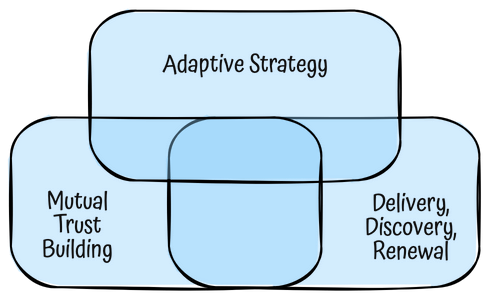
Those first three commitments correspond respectively to the three top-level components of the Deliberately Adaptive Organisation [1, 2]. These are the overlapping and deeply-connected “supersystems” of Adaptive Strategy, Production (Delivery, Discovery, and Renewal), and Mutual Trust Building.
The Deliberately Adaptive Organisation’s three “supersystems”
For this concluding part, a second group of commitments that apply right across the model:
Curiosity: To ask better questions
Generativity: To create more ideas than we consume
Consent: To celebrate the agency and ingenuity of others
As with the first three, they apply at every scale – teams, teams of teams, bigger structures, smaller structures, structures outside of any hierarchy, whole organisations. As commitments, they’re made by people, leaders taking the lead.
Commitment 4. Curiosity: To ask better questions
Much of Agendashift [3] could be described bottom-up as follows:
Questions to ask
How to recognise a good question when you see one, learning to develop your repertoire, finding and integrating relevant bodies of knowledge (Clean Language and Solutions Focus, to name two)
Patterns to organise those questions – Agendashift’s two most important being the IdOO (“I do”) pattern [4] –Ideal, Obstacles, Outcomes – and Right to Left [5], working backwards from key moments of impact and learning
The (meta-)strategies / leadership principles [6] that motivate those questions
It could also be described as the product of a question, one that has served it well over the years:
What if we put agreement on outcomes ahead of solutions?
That takes us to the role of curiosity and questioning in Adaptive Strategy. Barely scratching the surface, just a few examples:
What’s it like to be an employee of ours?
What’s it like to be a customer of ours?
What’s it like not being a customer of ours?
What’s happening when we’re reaching the right customers, meeting their strategic needs1?
Whose needs would we be meeting? What new stories could they tell?
1Strategic needs: their needs, our strategy
In Delivery too it pays to explore needs [7]. Far from being redundant, it establishes the context necessary to do a good job and sets the scene for later learning. Stepping back from individual pieces of work to the current workload as a whole, there is a whole new set of questions that apply (here’s where Right to Left really shines). And feeding back into strategy, there’s curiosity into how the work is done, the experience of doing it, and the level of capability demonstrated.
And then there’s Mutual Trust Building. Being careful with one’s assumptions is a great lesson from Clean Language (see [8]). Especially for leaders, it’s also important to remember that there are at least two sides to every conversation, and that every participant has the right to be curious. Respect for that that might be the difference between a conversation fruitful to all sides and one that generates more anxiety than insight [9].
Commitment 5. Generativity – To create more ideas than we consume
This commitment is perhaps the Why to the previous commitment’s How. We ask more and better questions because we need more and better answers – answers we didn’t already know. More and better answers means more and better intelligence, more and better insights, more and better ideas for innovation.
In a forthcoming book [10] for the BMI series on dialogic organisation development I suggest that a good working definition of generative process is one that creates more ideas than it consumes. And it’s not only about dialogic styles of strategy development – what I had in mind were the improvement cycles that so quickly run out of steam or the Lean Startup cycles that serve only to optimise the life out of once-great products.
There are technical reasons why the Delivery supersystem has a Discovery aspect to it (Adaptive Strategy relies on it for real-world intelligence), but that aside, the best delivery processes I’ve seen generated new ideas at every stage of the process. Two things enable that: they are designed for it, and their respective strategy activities make room for it, producing not plans and specifications but vision, outcomes, and the kind of challenges that people are well motivated to overcome.
Commitment 6. Consent – To celebrate the agency and ingenuity of others
It’s time to mention the two more models that the Deliberately Adaptive Organisation uses to flesh out the skeleton that the Viable System Model (VSM) provides. In the intersection between Mutual Trust Building and Delivery, Discovery, and Renewal (bottom middle in the diagram), is where the magic of production (and if you like, reproduction) happens.
Whether it’s the product of a strategy process or self-organised, if the organisation is large enough, it will have some structure. One highly flexible model – well capable of modelling dynamic, ad-hoc, and non-hierarchical structures – is given by Sociocracy [11] (aka Dynamic Governance, known also to Ackoff fans as Circular Hierarchy). It is purposeful collaboration and self-governance at every scale, and it is based on principles of consent. Each circle has its domain of responsibility over which it has authority; people join circles by mutual consent; circles make decisions by consent. People can join multiple circles; alignment across what could be called a strategy network is achieved through a combination of consent and participation, and it’s a dynamic process.
Things get interesting when there are multiple people in the intersections between circles. Having two people there gives you double linking – not only a mechanism for coordination, trust building, and resilience, but often a developmental (eg mentoring) opportunity also. As numbers there increase, so increases the possibility of a new circle, and with it a new, mini-scale Deliberately Adaptive Organisation with an identity, strategy, and purpose of its own.
The Deliberately Adaptive Organisation is also a Deliberately Developmental Organisation [12] (the naming is no coincidence), and it’s a very elegant combination. People have their own aspirations, plans, and strategies, and they’re adaptable! They’re capable of trusting and being trusted. Not only are they productive, most are interested in both their own self-development and in the renewal of the organisation. That symmetry is thanks to VSM again, and the Deliberately Developmental Organisation’s holistic and dare I say wholehearted [13] integration of personal and organisation development helps us make the most of it.
What next?
The Agendashift Academy’s self-paced training module on Adaptive Organisation [1] is in development and comes out over the autumn (probably in instalments), and after that I want to produce the next iteration of the first module, Leading with Outcomes: Foundation [14], whose slideware exists already in good time for Train-the-Trainer / Facilitator [15] next month. This year should also see the publication of my aforementioned fourth book, working title Patterns of generative conversations [10].
With all of that going on I’m having to restrain myself from starting my fifth book, working title Wholehearted: Up and down the Deliberately Adaptive Organisation, business agility at every scale. It lives rent-free in my head meanwhile, but never mind! My hopes for it are threefold:
It will help leaders at all levels better understand the relationship between organisation and business agility, and help them to identify organisational dysfunctions and impediments to business agility that they will want to address
It will give practitioners the knowledge and skills to approach the challenges of scale in ways that are both more humane and more effective than the process rollout
And for both audiences, it will be the most relevant and accessible introduction to VSM they are ever likely to read
18-26 April, Live online, 12pm-4pm EST Tuesdays and Wednesdays, April 18, 19, 25, 26 2023: Creating Generative Conversations by Leading with Outcomes – Part of the Cape Cod Institute’s BMI Series in dialogic organisation development
Somewhat in the style of what is easily my most popular post of all time – Introducing Kanban through its values (2013) – here is the Deliberately Adaptive Organisation (“business agility at every scale”) [1, 2] introduced through a set of six commitments. If this post turns out to be half as successful (and career-changing) as that one, I’d be a happy man indeed 🙂
The six commitments come in two groups. The first group is covered in this post:
Co-creation – To keep finding better options, together
Sensemaking – To make the best sense we can of every new challenge
Trust Building – To build trust in every direction
The second group will be covered in a later post:
Curiosity: To ask better questions
Generativity: To create more ideas than we consume
Consent: To celebrate the agency and ingenuity of others
What separates the two groups is that the first three commitments correspond respectively to the three top-level components of the Deliberately Adaptive Organisation. These are the overlapping and deeply-connected “supersystems” of Adaptive Strategy, Production (Delivery, Discovery, and Renewal), and Mutual Trust Building. Commitments in the second group apply everywhere. Together, the six quickly convey some of the model’s true character.
The Deliberately Adaptive Organisation’s three “supersystems”
The model works at every scale – teams, teams of teams, bigger structures, smaller structures, structures outside of any hierarchy, whole organisations. Mapping it to some part of the actual organisation, its power lies not only in what each supersystem represents, but also in the relationships between supersystems and between scales.
So to the first three commitments, co-creation, sensemaking, and trust building…
Commitment 1. Co-creation – To keep finding better options, together
This might easily have been called the participation commitment. Its inspiration comes directly from Agendashift [3]; indirectly it draws in the Generative Change Model [4] and Dialogic Organisation Development [5] more generally.
Co-creation starts with making sure you have the right people in the room when you’re doing any of the following:
Generating and organising options (outcomes primarily, solutions later)
Evaluating and re-evaluating options in the light of progress, intelligence, and insights
Updating the group’s shared understanding more broadly
Expressing intent
Making commitments
Revisiting its shared sense of identity and purpose or engaging with any challenges to those
Relative to the organisational scope in question, “the right people in the room” means people highly if not maximally representative of the following:
Those with direct, first-hand knowledge
Those with strategic context
Those best positioned to hold the detail and the whole together
Those impacted by whatever decisions might be made
The commitment to co-creation is key to the authenticity of this participation; co-created options aren’t prescribed or otherwise prejudged.
Commitment 2. Sensemaking – To make the best sense we can of every new challenge
At whatever scale we’re considering, the Deliberately Adaptive Organisation must be engaged in some kind of productive work. This includes the work of renewing the organisation; in terms of both mechanics and importance, there is enough in common between delivery and change for them to be treated the same – as “real work”. (Keeping the two in balance is an important responsibility of Adaptive Strategy.)
When we’re doing that work, let’s not underestimate the opportunity to expect the unexpected, to notice what we didn’t notice before, and to interpret what we notice in different ways. In an organisation that’s continuously transforming, those opportunities should be plentiful: often we’re doing new things or experimenting with doing old things in new ways. To miss those opportunities would be a tragic waste!
Adaptive Strategy on its own isn’t enough for the organisation to be learning. The progress, intelligence, and insights it requires all come from doing the work – engaging with the real world, not just the group’s model of it. The sensemaking [6, 7] commitment is a reminder to frame and conduct that work for maximum learning, doing that appropriately according to context and the task in hand. As any student of Cynefin [8] will tell you, there are category errors and other risks be avoided here.
Undoubtedly, to truly maximise learning over time, you need an effective process too. But this is not yet another Agile process framework! For the following reasons and more, I choose not to lead with process:
It’s table stakes. While there are enough organisations out there whose terrible processes and coordination systems compromise their viability (let alone their agility), there are multiple, complementary approaches to improving them whose effectiveness is well-proven. Moreover, the best of those aren’t prescriptive.
It’s implied. The model that underpins the Deliberately Adaptive Organisation – the Viable System Model [9] – has certain expectations about process but it too manages to avoid prescription
If you’re interested in what really scales, process is about the worst place to start
Commitment 3. Trust Building – To build trust in every direction
Organisations are built on trust. It might not always seem that way, but no organisation can afford for every task to be micro-managed, inspected, duplicated, and so on. Without at least some level of trust, very little would get done.
The trust-building commitment is however about more than reducing that delivery overhead. Even when relying heavily on participation, the Adaptive Strategy part simply does not have the cognitive or communication capacity to be into everything everywhere all the time. It has no choice but to be selective with its attention, and to use it effectively. It builds trust through a combination of where, where not, and how it chooses to direct its attention, what it communicates in those choices, and how it describes its underlying motives.
Trust-building works in other directions too. It’s a problem if commitments between peers can’t be relied upon, a problem that only gets worse if it’s hard to say no to additional commitments. It’s a problem if issues or risks aren’t shared, whether it’s because people don’t feel safe to do so, or that the need to share never occurred to them. It is wasteful to be constantly second-guessing the intentions of others. And it’s a problem if doing the right thing consumes more effort and attention than it should; trust isn’t only a question of psychology or economics – it’s an infrastructure question also.
Those first three commitments again:
Co-creation – To keep finding better options, together
Sensemaking – To make the best sense we can of every new challenge
Trust Building – To build trust in every direction
In a second post, I’ll expand on the second set of commitments, commitments that apply to every supersystem at every scale:
Curiosity: To ask better questions
Generativity: To create more ideas than we consume
Consent: To celebrate the agency and ingenuity of others
[1] Adaptive Organisation: Business agility at every scale (academy.agendashift.com) [2] Up and down the Deliberately Adaptive Organisation, business agility at every scale (deliberately-adaptive.org) [3] Agendashift: Outcome-oriented change and continuous transformation, Mike Burrows (2nd ed 2021) [4] The Dynamics of Generative Change, Gervase R. Bushe (BMI Publishing, 2020) [5] Dialogic Organization Development: The Theory and Practice of Transformational Change, Gervase R. Bushe & Robert J. Marshak (Berrett-Koehler Publishers, 2015) [6] Sensemaking in Organizations, Karl E. Weick (1995, Sage Publications) [7] Sense, make-sense, decide, act,Tom Graves (2016, weblog.tetradian.com) [8] Cynefin (cynefin.io) [9] By Stafford Beer, all published by John Wiley & Sons: Brain of the Firm (2nd ed 1981, reprinted 1995), The Heart of Enterprise (1979, reprinted 1995), Diagnosing the System for Organisations (1985, reprinted 1995). I must confess that Diagnosing did not click for me until I made a second attempt after completing the longest of the three, Heart, which remains my favourite. A thousand or so pages in total (more if you count the re-reads) and well worth the effort. For a more modern and accessible treatment I highly recommend The Fractal Organization: Creating Sustainable Organizations with the Viable System Model, Patrick Hoverstadt (John Wiley & Sons, 2008)
18-26 April, Live online, 12pm-4pm EST Tuesdays and Wednesdays, April 18, 19, 25, 26 2023: Creating Generative Conversations by Leading with Outcomes – Part of the Cape Cod Institute’s BMI Series in dialogic organisation development
Just for the months of August and September I’m opening up the Academy’s AMA sessions to all. If you have any questions at all about Leading with Outcomes, the new Trainer & Facilitator programmes (see Upcoming events below for the first TTT/F training), or anything else for that matter, join us!
If you knew about these already, please note that this week’s is pushed back to next week due to an ongoing medical thing family-wise which means that I can’t be sure to be able to make it. I am however contactable and would be glad of a catch-up if you don’t mind the possibility of life intruding a bit!
Open AMA sessions
For the Zoom link, check the email version of this post if you’re on the mailing list, the #community channel on Slack, or Public events in Circle, or ping me.
Wednesday, August 17th, 10:00 BST, 11:00 CEST (not the 10th as previously advertised)
18-26 April, Live online, 12pm-4pm EST Tuesdays and Wednesdays, April 18, 19, 25, 26 2023: Creating Generative Conversations by Leading with Outcomes – Part of the Cape Cod Institute’s BMI Series in dialogic organisation development




 Agendashift