Leadership as translating

Previously: Leadership as structuring

[This post first appeared on LinkedIn. You can comment on it here]

You don’t have to be in management for long to learn that half the job involves representing the scope for which you are responsible to those to whom you are accountable, and vice versa. Those who are successful at it are those who can speak the language of both. If you work in IT, for example, it can be good for your career to be seen as “the acceptable face of technology”, as I was once described.

It is not difficult to understand why this should be so. The boardroom and the frontline team each discuss progress, issues, and performance very differently, but somehow they are related, and thus they need to be translated through the organisation’s different levels of scale, and in both directions.

Despite the allure of the hierarchical work breakdown structure (WBS) and the all-knowing management information system (MIS), it would be a serious mistake to think that translation is equivalent to aggregation. For one thing, there is such a thing as overcommunication! The team may care little that a team member discovered and dealt with a minor issue in the course of their work. Likewise, a team-of-teams need not be informed of issues its member teams should reasonably be expected to contain, so long as its wider goals are not impacted. Does the board need visibility of every small increment of progress, every minor issue? Quite the opposite: the organisation’s capacities for communication and decision making are finite. We organise to contain what can be contained, in a sense to manage complexity so that we are not overwhelmed by it.

There is therefore a relationship between this “leadership as translating” and the topic of my previous post, Leadership as structuring. (See also [1] to explain my fondness for those ‘-ing’ words.) Structures of various kinds need to be optimised to contain that complexity – neither so flat that the centre cannot hold, nor so deep that too much gets lost in translation. At the same time, every organisational scope must learn to share appropriately. That’s another optimisation problem, and one that requires those who do the sharing to empathise with their audiences, to speak their language, even to share their goals. You leave that to your reporting system at your peril, so work on those skills!

This post was inspired by my new book, Wholehearted: Engaging with Complexity in the Deliberately Adaptive Organisation. You can find both print and Kindle editions on amazon.co.uk, amazon.com, amazon.de and other Amazon sites around the world. The e-book is also available on LeanPub, Kobo, Apple Books, and Google Play Books. Building on the organisational model developed in the first three chapters, Chapter 4, The Space Between, deals with scale-related challenges.

While we’re here, some upcoming events:

[1] Verbing the nouns of business agility (January 2025)

Previously: Wholehearted Leadership in a Complex World

[This post first appeared on LinkedIn. You can comment on it here]
Leadership as structuring

Previously: Wholehearted Leadership in a Complex World | Next: Leadership as translating

[This post first appeared on LinkedIn. You can comment on it here]

A core idea of my new book, Wholehearted, is that we – leaders, practitioners, anyone who would engage in any serious way with the organisation or would help others to do so – must pay attention to the mutual relationships that exist between different aspects of the organisation. Are those relationships healthy and productive? Where they aren’t, what stops that? What gets in the way?

That general approach begs an obvious question: which relationships, and which aspects in particular? That question may be open-ended and contextual, but the model at the book’s core, namely the VSM-inspired Deliberately Adaptive Organisation, helpfully identifies some that necessarily exist in every organisation and at every scale thereof. Rather than listing them here (see [1] for some clues), for this post I’d like to focus on four aspects that are of particular interest when considering issues of scale.

The first two:

  1. The organisation’s formal structure – i.e. how it is generally understood, which lines of accountability are most important, and so on
  2. How the organisation understands its business environment – in terms of who and where its users, customers, suppliers, and competitors are, their needs, how they change over time, and so on

The relationship between those structures is very interesting! Not only can we ask if it is healthy and productive overall, we can ask it for every substructure. For every organisational scope, formal or otherwise (in the book, we place far more emphasis on what different participants actually experience than we do on what is formally settled upon), is its respective environmental relationship healthy and productive? Whose needs does it serve? What needs? How well? How do we know? What intelligence and insights is it uniquely well-placed to gather? And looking at it from the opposite direction, are there aspects of the environment that are not well served, or as the book has it, are there “holes in the whole product”?

Both of those first two aspects can and do change over time, but they are relatively stable compared to the last two:

  1. The organisation’s commitments and their structure – plans, strategies, objectives, and so on
  2. The organisation’s challenges, most interestingly (but not limited to) those that emerge from the environment

These new aspects introduce some tension. Is the organisation structured to fit its environment or to execute its plans? Do we understand the environment in terms of what persists or what’s new?

Except perhaps the most benign of conditions, those tensions never go away. At the extreme, the issues are existential. If, in the name of responsiveness, we blow in the winds of challenge, what do we actually stand for? Why then do we exist? Conversely, what if what we stand for risks becoming irrelevant?

To lead is both to represent those structures in spite of those tensions and to engage with the paradoxes therein, knowing that there is no quick fix – no supposedly objective formula, no algorithm, no methodology – that can resolve them for you. To fail to do those things when it matters most would represent a failure of nerve [2] and therefore of leadership. But both to depersonalise the issue and to create opportunities for leadership, a deliberately adaptive organisation frequently challenges its structures, its understanding, and its commitments, and does that at every level of organisation. Embedding that discourse, learning, and meaning-making in the face of structural change is as much an act of organisation design as the structural changes themselves, more so as the latter are experienced not as imposed but as self-organised. Formal structures may remain, but do we let them get in the way of doing the right thing? Only if we let them!

This post was inspired by my new book, Wholehearted: Engaging with Complexity in the Deliberately Adaptive Organisation. You can find both print and Kindle editions on amazon.co.uk, amazon.com, amazon.de and other Amazon sites around the world. The e-book is also available on LeanPub, Kobo, Apple Books, and Google Play Books. Building on the organisational model developed in the first three chapters, Chapter 4, The Space Between, deals with scale-related challenges.

[1] Verbing the nouns of business agility (January 2025)

[2] Edwin H. Friedman, A Failure of Nerve: Leadership in the Age of the Quick Fix (1999, 2007, 2017)

Previously: Wholehearted Leadership in a Complex World | Next: Leadership as translating

[This post first appeared on LinkedIn. You can comment on it here]

Wholehearted Leadership in a Complex World

[This post first appeared on LinkedIn. You can comment on it here]

It was a great pleasure last week to join Rohit Gautam on his Curiosulus Chronicles podcast, and the episode is now available on YouTube:

We were of course focused on the recent publication of Wholehearted, and Rohit was not the first to be intrigued by Chapter 3, Mutual Trust Building, and in particular, a section titled “Models of trust-building leadership”. This section covers:

  1. The inverted pyramid, aka reverse hierachy, in which the CEO is still at the “pointy end” of the organisation, but that sits at the bottom. In this model, the job of the organisation and its leadership is to support those who serve the customer. More easily said than done!
  2. Servant Leadership, the title of Robert Greenleaf’s classic book. The metaphor doesn’t work for everyone, but I can’t fault Greenleaf’s starting point: leaders that fail to meet the needs and expectations of their staff will lose their legitimacy in that role. Seems kinda obvious now, but in the 1970s, still the era of the “job for life”, ahead of its time.
  3. Host Leadership, which I wish was the title of Mark McKergow and Helen Bailey’s Host: Six new roles of engagement for teams, organisations, communities, movements. This and the next one illustrate very well something I learned for myself as a senior manager: sometimes it’s not so much about your different competencies or the different stances you are capable of adopting, what matters is your ability to move quickly and fluently between them, even in the course of a single conversation.
  4. Clear Leadership, after Gervase Bushe‘s book of the same name, speaks to a core theme of Wholehearted, your organisation’s capacity for communication and decision making, on which are founded your organisation’s adaptive capacity and thereby its resilience and its ability to innovate. On the topic of trust, how can you expect to be trusted if you can’t even trust yourself? That requires you to be in command of yourself. That doesn’t mean emotionlessness, it means listening to and acknowledging your feelings, and as appropriate, being transparent about them and about where you’re coming from. If several of my books emphasise curiosity, it may be skilful transparency (or “descriptiveness”) that earns you that right.
  5. Intent-based models, via Stephen Bungay, L. David Marquet, and Stan McChrystal, mission command (aka commander’s intent) and some fascinating developments thereof. It manifests itself as efficient communication with just the right balance between prescription and ambiguity that leaves room for others’ expertise, autonomy, and innovation, but that’s just the beginning.

I feel the need sometimes to reiterate my belief in leadership. Self-organisation doesn’t preclude it! Wholehearted could well be described as a leadership book! Organisations need people who are engaging on the right challenges, inviting others to participate, and celebrating their successes [1]. And at any given level of organisation, absent presence, availability, a good nose for what needs attending to next, and the drive to build a more trusting and trustworthy organisation, it becomes increasingly difficult for the operational and strategic aspects of the organisation to understand each other. Sooner or later, and for lack of context, bad decisions will be made. Alongside the issues of communication and decision-making capacity, that so-called “context challenge” is a fundamental organisational constraint and one to which leaders must allocate significant personal effort. Those models aren’t the whole story – it would be foolish to think that in something as complex as an organisation that there is ever only one story – but in what is a difficult task, they do help.

Wholehearted: Engaging with Complexity in the Deliberately Adaptive Organisation hit Amazon last month. You can find both print and Kindle editions on amazon.co.uk, amazon.com, amazon.de and other Amazon sites around the world. The e-book is also available on LeanPub, Kobo, Apple Books, and Google Play Books.

[1] Engage, Invite, Celebrate: Leading “wholeheartedly” for innovation (July 2024)

Previously: Prescriptive vs descriptive

Start where you are

Start where you are. Use what you have. Do what you can.

Arthur Ashe

“Start where you are” doesn’t have to be about process! Try this exercise:

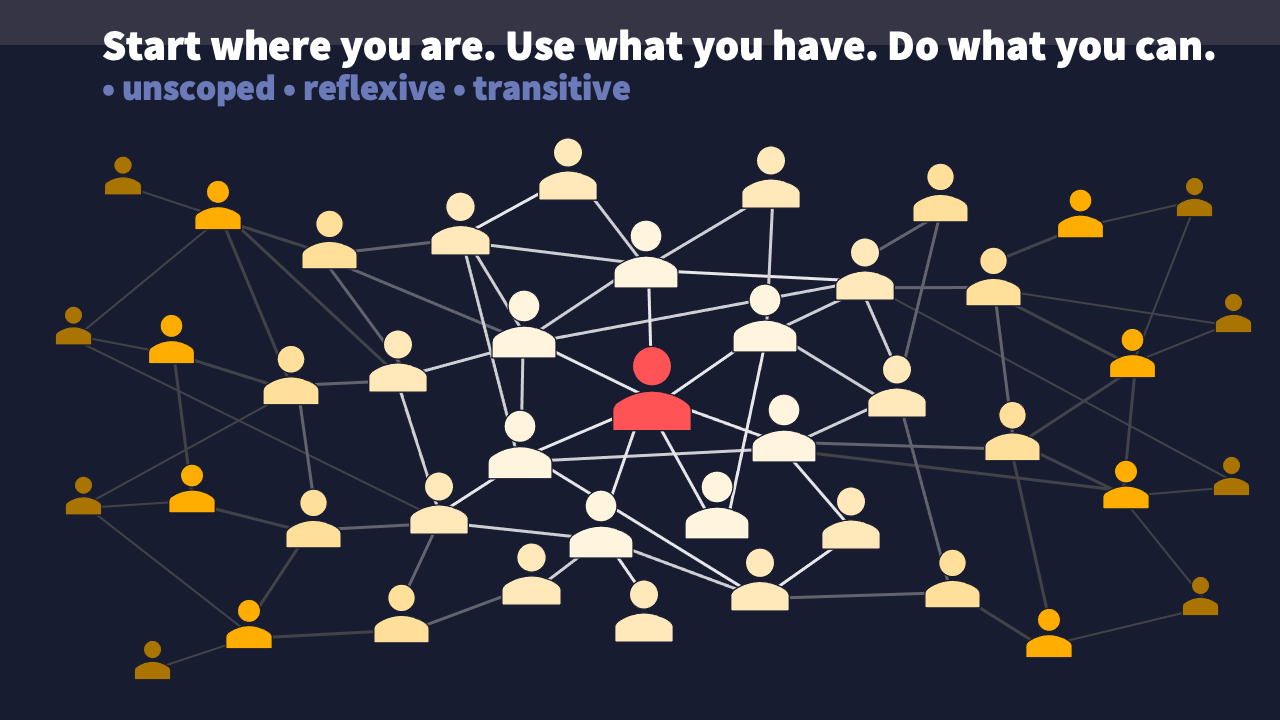
  1. Disregarding organisational boundaries, and in relation to the work you are already committed to (your “organising commitments”), who do you interact with? Then reflexively: who interacts with you regarding their organising commitments? And transitively: who do they interact with, who interacts with them, and so on outwards?
  2. Again disregarding organisational boundaries, and whether as an act of planning or of response to something unexpected, who do you consult with when your organising commitments need to change? And again reflexively and transitively: Who consults with you, who do they consult with, and so on outwards?
  3. Now reflect on the relationships you have identified in those two networks. Whose relationships don’t you understand as well as you might? To the extent that it affects your own work, what context do you lack that others might be able to provide? Who else might be struggling for lack of context that you or someone closer to you might be able to provide? Is it time then for some trust-building conversations?

Now you know where you are, start!

Related posts:

While we’re here, a couple of updates to upcoming events:

  • The next TTT/F begins in just over a week on Wednesday 15th – ping me for a coupon code if you need one
  • I’ve added the April edition of our monthly free webinar/AMA series

Upcoming events

February

March

*TTT/F and (where shown) LIKE events include free one-year membership of the Leading with Outcomes Authorised Facilitator programme, upgradeable to Authorised Trainer at any time. Both of those include access to the video-based Leading with Outcomes training and the full range of Agendashift assessment tools.


Leading with Outcomes from the Agendashift Academy
“Leadership and strategy in the transforming organisation”

Leading with Outcomes is our modular curriculum in leadership and organisation development. Each module is available as self-paced online training or as private, instructor-led training (online or in-person). Certificates of completion or participation according to format. Its modules in the recommended order:

  1. Foundation module:
  2. Inside-out Strategy:
  3. Adaptive Organisation:
  4. Outside-in Strategy:

Individual subscriptions from £24.50 £18.40 per month after a 7-day free trial, with discounts available for employees and employers in the government, healthcare, education, and non-profit sectors. For bulk subscriptions, ask for our Agendashift for Business brochure.

To deliver Leading with Outcomes training or workshops yourself, see our Authorised Trainer and Authorised Facilitator programmes. See our events calendar for Train-the-Trainer / Facilitator (TTT/F) and Leading in a Transforming Organisation trainings.


Agendashift™: Serving the transforming organisation
Links: Home | Subscribe | Events | Media | Contact | Mike

Agendashift  Academy: Leading with Outcomes | Trainer and Facilitator Programmes | Store

At every scope and scale, developing strategy together, pursuing strategy together, outcomes before solutions, working backwards (“right to left”) from key moments of impact and learning.

Start where you are. Use what you have. Do what you can. ~Arthur Ashe