From “What did you do yesterday?” to something better

Go for it! If the main purpose of your standup is to make sure that everyone is keeping themselves properly busy, then the questions “What did you do yesterday?” and “What will you do today?” are without doubt the basis of a great meeting format.

But be careful what you wish for. If your goals involve 1) the team meeting needs, and 2) learning from the process, those questions can hurt a lot more than they help. Honestly, I’m not a fan at all.

You could try these instead. Understand the pattern, and with practice, it runs itself:

  1. What are we learning from what we recently completed? And is it staying completed? Whose needs did we meet, and how do we know we met them?
  2. What can we get over the line?
  3. What is and isn’t making the expected progress? Are we clear about whose needs we’re meeting, what needs, how we’ll know, and what’s our approach?
  4. Do we have the capacity to look at what’s next, or is that enough until we next meet?

You probably won’t get to that overnight, so some things to try:

  • Instead of reviewing activities (what you did, what you’re doing, etc), try to focus the things that you as a team are trying to produce, in the context of the goals you’re pursuing
  • All else being equal (in bigger meetings, this pattern can work within other interesting ways to structure the work), try reviewing your work most-complete work first, not forgetting to start with celebrating and enquiring into work recently completed
  • Make a point of noticing how the conversations change as you work backwards, and develop your repertoire accordingly – by this stage you’ll likely be noticing not only a performance difference but a language change and changes to people’s expectations and behaviour, and you can build on that until they become habits
  • In all of the above, try keep in your mind and everyone else’s what you’re working backwards from: “someone’s need met” and “all the available learning fully accounted for” (my definitions of done and really done)

I’ve used this “right to left” technique in a range of settings, often supercharging something that really wasn’t working before – standup meetings, risk & issue review meetings, service delivery review meetings to name just three. Right to left is named after Kanban’s board review pattern (you start on the right-hand side of the board with work at or nearest completion) but it’s not hard to apply in other settings.

And it’s more than just a productivity hack. In my third book Right to Left (2019, audiobook 2020), I take that philosophy of working backwards from impact and learning and use it as a lens on the whole Lean-Agile landscape (and more). Further to it not being just a Kanban thing, the book shows how right to left fits very well with the best of Scrum. Contrast that with an all too prevalent left to right kind of Scrum that does the reputations of Scrum and Agile no favours at all, and that scales up in the worst possible way. Fortunately it’s fixable.

This post started out as a LinkedIn post, then a second:

  1. Go for it! (linkedin.com)
  2. Building on that last one… (linkedin.com)

And now a third:

    Like, comment, share!

    You can also take any questions you may have to one of the upcoming webinars – the first three (December 8th, January 12th, February 2nd) all finish with an AMA (Ask Mike Anything) session. Series link: The questions that drive us (eventbrite.co.uk).

    Related:


    Upcoming:


    Agendashift™: Serving the transforming organisation
    Agendashift  Academy: Leading with Outcomes | Facilitator and Trainer Programmes

    Links: Subscribe | Events | Contact | Mike

    We help leaders and engaged team members at every level to gain fluency in the language of outcomes – developing and pursuing strategies together, innovating, learning, and adapting as the organisation renews and transforms itself from the inside.

    Your organisation in 5 networks

    Updates: Renamed network #2, minor edits elsewhere. This model is now included in the Agendashift Academy module Adaptive Organisation (II): Between spaces, scopes, and scales and the in-person training Leading in a Transforming Organisation. Video of my SEACON keynote here.

    Expanding slightly on yesterday’s LinkedIn post (linkedin.com), your organisation in 5 networks:

    Network #1: Your reporting network. This is just your formal structure – typically a hierarchy, perhaps with the occasional bit of dual reporting thrown in – seen here as lines of communication. Because sideways communication has to be implemented indirectly via upward and downward communication, it can be highly inefficient.

    Network #2: Your delivery operations network. I am referring not to material flows or to the knowledge work equivalent, but to the interactions between people that make those flows what they are, performing as they do. In siloed organisations, the delivery operations network cuts across the reporting network, sometimes uncomfortably.

    Network #3: Your strategy network. Typically richer than the reporting network, this connects everyone involved in anybody else’s strategic decision-making – any decision-making at any level of organisation that impacts on things like identity, purpose, objectives, learning, and adaptation. A more abstract and less messy version of this network connects not people but domains of responsibility at varying levels of granularity (see circular organisation).

    Network #4: Your trust-building network. This is the network of all connections that are enhanced by meaningful efforts to build or maintain mutual trust. In a high-trust organisation, this can be expected to overlap significantly with the preceding three networks.

    Network #5: Your social network: All the above and more – the totality of your organisation’s network of interaction and influence, covering all the conversations that contribute to making your organisation what it is and what it is becoming.

    And two hypotheses (with caveats):

    Hypothesis 1. The more that networks 2, 3, and 4 are healthy, the more that networks 1 and 5 look after themselves.

    Hypothesis 2. The richer you can make them, the more likely is the serendipitous conversation, increasing the rate of innovation.

    As rightly observed in some of the questions and comments on the first version of this post, these hypotheses are slightly in tension. Rich is good, richer would be better for many if not most organisations, and​ leaders within them would do well to pay attention to those networks. You can however have too much of a good thing, not to mention that some innovation happens in the darker corners, so to speak. In my use of the word “healthy” in hypothesis 1 I did intend a sense of balance, and I should have worked that sense into hypothesis 2 also. Instead though, this paragraph’s caveats 🙂

    Some questions for you:

    1. In your organisation, which network or networks dominate?
    2. At what cost?
    3. Given where you sit in each of these networks and the reach that they afford you, what might you do?

    Your answers, questions, or feedback can go on the original post (linkedin.com).

    PS The slide below is adapted from the talk I gave last week at SEACON (the Studies in Enterprise Agility Conference).


    Upcoming events

    February

    March

    *TTT/F and (where shown) LIKE events include free one-year membership of the Leading with Outcomes Authorised Facilitator programme, upgradeable to Authorised Trainer at any time. Both of those include access to the video-based Leading with Outcomes training and the full range of Agendashift assessment tools.


    Leading with Outcomes from the Agendashift Academy
    “Leadership and strategy in the transforming organisation”

    Leading with Outcomes is our modular curriculum in leadership and organisation development. Each module is available as self-paced online training or as private, instructor-led training (online or in-person). Certificates of completion or participation according to format. Its modules in the recommended order:

    1. Foundation module:
    2. Inside-out Strategy:
    3. Adaptive Organisation:
    4. Outside-in Strategy:

    Individual subscriptions from £24.50 £18.40 per month after a 7-day free trial, with discounts available for employees and employers in the government, healthcare, education, and non-profit sectors. For bulk subscriptions, ask for our Agendashift for Business brochure.

    To deliver Leading with Outcomes training or workshops yourself, see our Authorised Trainer and Authorised Facilitator programmes. See our events calendar for Train-the-Trainer / Facilitator (TTT/F) and Leading in a Transforming Organisation trainings.


    Agendashift™: Serving the transforming organisation
    Links: Home | Subscribe | Events | Media | Contact | Mike

    Agendashift  Academy: Leading with Outcomes | Trainer and Facilitator Programmes | Store

    At every scope and scale, developing strategy together, pursuing strategy together, outcomes before solutions, working backwards (“right to left”) from key moments of impact and learning.

    Free webinar series: The questions that drive us

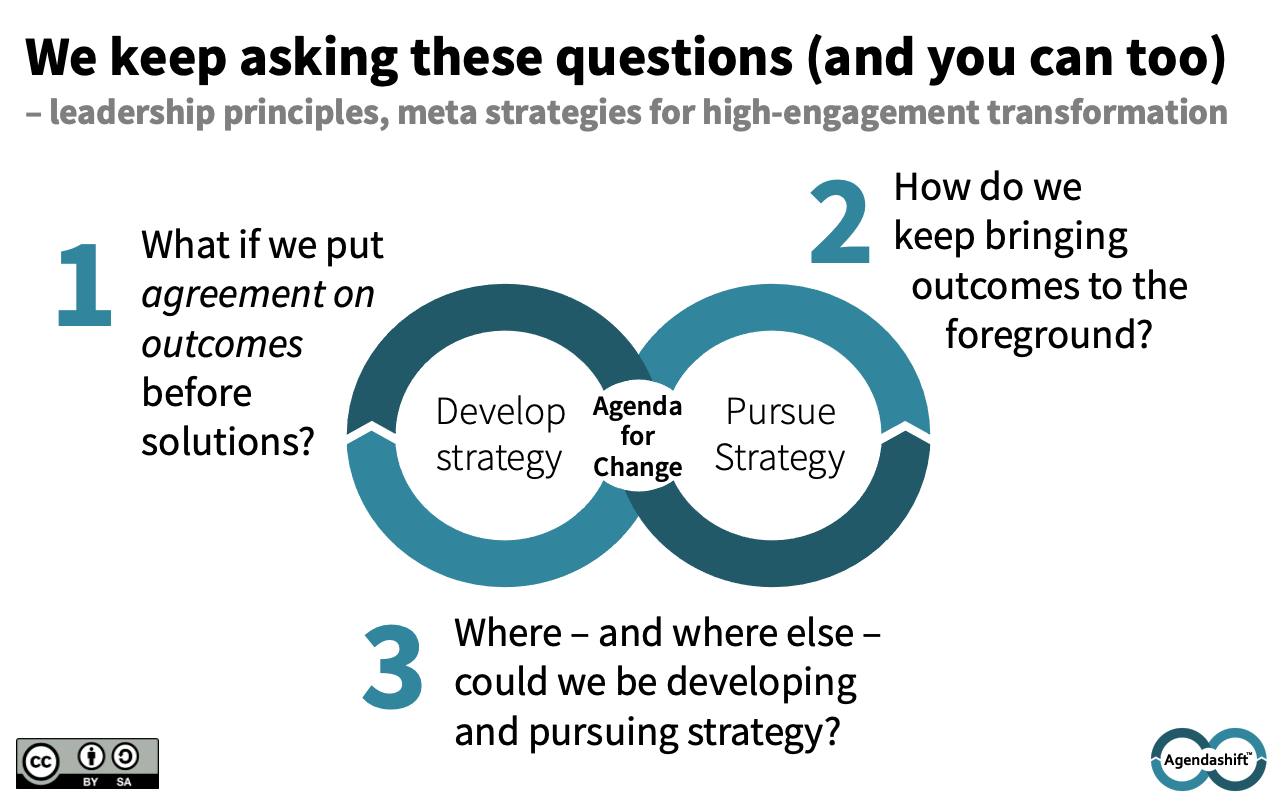
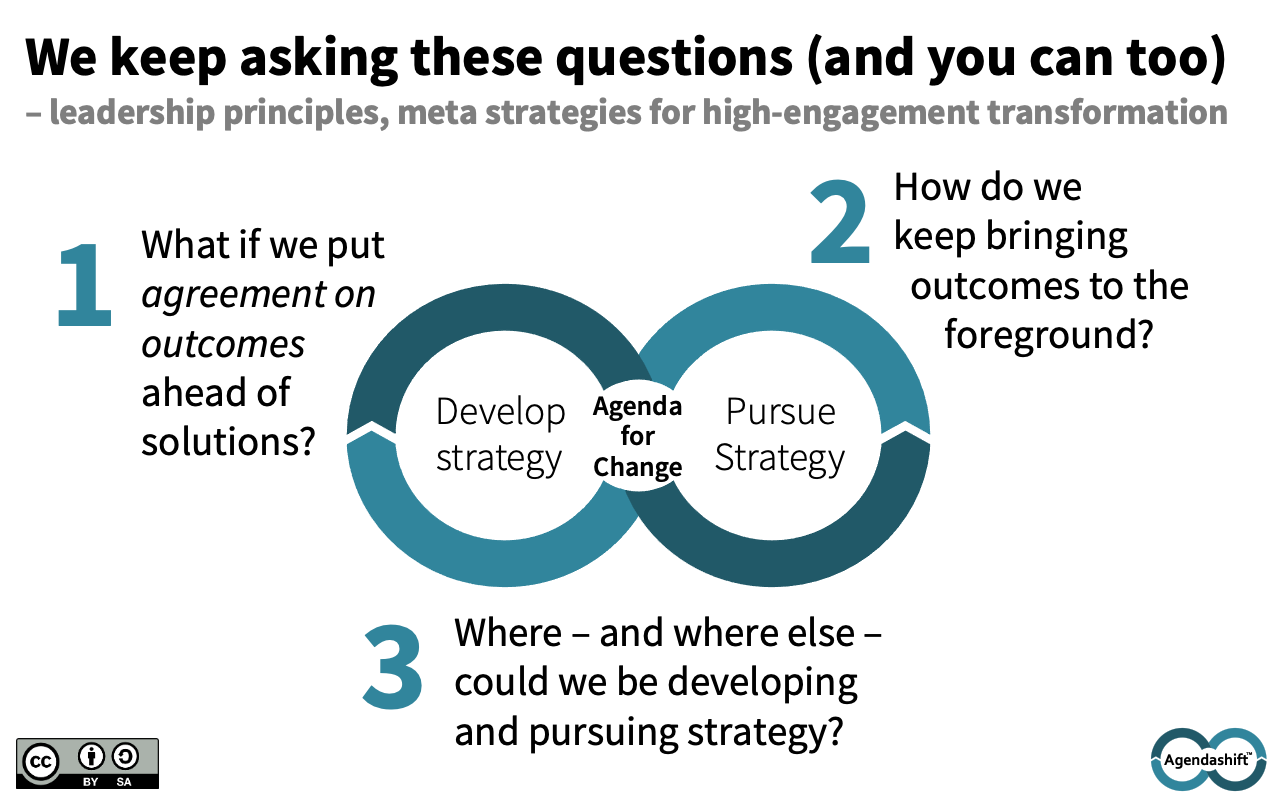
    Starting December 8th, a rolling series of free webinars, each taking on one of the three questions that drive Leading with Outcomes:

    1. Thursday 08 December, online, 15:00GMT, 16:00CET, 10am ET:
      What if we put agreement on outcomes ahead of solutions?
      Mike Burrows
    2. Thursday 12 January, online, 15:00GMT, 16:00CET, 10am ET:
      How do we keep bringing outcomes to the foreground?
      Mike Burrows
    3. Thursday 02 February, online, 15:00GMT, 16:00CET, 10am ET:
      Where – and where else – could we be doing strategy?
      Mike Burrows

    Series link: The questions that drive us (eventbrite.co.uk)

    In the absence of a featured guest, each webinar will finish with an Ask Mike Anything (AMA) session. After the initial (and relatively short) presentation, feel free to raise topics outside the session’s theme.

    In March, we cycle back to the first question, joined this time by special guests Stephen Dowling & friends. Note the change of time – our guests are dialling from Melbourne, Australia:

    1. Wednesday 08 March, online, 09:30GMT, 10:30CET, 10am ET:
      What if we put agreement on outcomes before solutions?
      Mike Burrows, Stephen Dowling & friends

    Bookmark the series link and join us when you can!


    Agendashift™: Serving the transforming organisation
    Agendashift  Academy: Leading with Outcomes | Facilitator and Trainer Programmes

    Links: Subscribe | Events | Contact | Mike

    We help organisations, leaders at every level, and engaged team members to pursue strategies developed together in the language of outcomes – and as they progress, to innovate, learn, adapt and transform.

    The new Leading with Outcomes: Foundation is out of beta

    Leading with Outcomes’ updated Foundation module is 26% shorter, much better paced, and today it leaves beta. Academy subscribers who joined before today will still have access to the old one for the next few weeks, but for most people, the new Foundation is where Leading with Outcomes starts.

    Today I recorded a new welcome video for the Leading with Outcomes: Foundation landing page (06:29):

    What’s going live today comes in the format of self-paced training. There are live, instructor-led events too (it’s not unusual for people to take Leading with Outcomes multiple times and in multiple formats):

    If you’re an Agendashift Academy subscriber, check the Welcome pages in your Academy library for your subscription plan’s coupon codes. If you’re not a subscriber, subscribe first and save some money!

    Between those two paid events, this free taster event (the first of a monthly series) is open to all:


    Agendashift™: Serving the transforming organisation
    Agendashift  Academy: Leading with Outcomes | Facilitator and Trainer Programmes

    Links: HomeSubscribe | Events | Contact | Mike
    Resources: Tools & Materials | Media | BooksAssessments 
    Blog: Monthly roundups | Classic posts
    Community: Slack | LinkedIn group | Twitter

    Agendashift roundup, October 2022

    In this edition: November is Foundation month; December is TTT/F month; The questions that drive us (free webinar series); Coming to Berlin; A quick note from the department of administrative affairs; Upcoming; Top posts

    November is Foundation month

    Leading with Outcomes: Foundation that is, and in two formats.

    The self-paced format first: Coming in at 1 hour 50 minutes in 25 short videos across three chapters, the next and greatly improved iteration of Foundation is 26% shorter, a year fresher, and much better structured than the one it replaces. It is currently in beta and goes fully live this coming Friday. If you plan to start your Academy subscription before then or you have one already don’t worry – we’d be glad to add you to the beta.

    Later in the month, we’re running it as an online event. It is already well subscribed but there are still places available:

    More:

    December is TTT/F month

    We’re running our second Train-the-Trainer / Facilitator (TTT/F) in December:

    The later timing will be more convenient for the Americas this time round. Again, it is already well subscribed but there are still places available (3 at the last count).

    The questions that drive us (free webinar series)

    Starting December 9th, we’re starting a monthly series of free webinars, open to all. Initially at least, the format will be as follows:

    1. A short presentation on one of the three questions that drive both Agendashift and Leading with Outcomes
    2. Ask Mike Anything – in addition to the Academy-only AMA sessions (two of those per month), your chance to, erm, ask me anything

    To that basic structure we will add guest appearances too in due course.

    December’s question (book your place here):

    In future months:

    • How do we keep bringing outcomes to the foreground?
    • Where – and where else – could we be developing and pursuing strategy?

    Three questions, three principles, three ways in which leaders can help themselves be more effective in a transforming organisation.

    For the big strategy occasions, for those everyday interactions, and for everything in between, we help leaders at all levels put those principles into practice:

    • Having the kinds of conversations that too often get missed, fostering authentic engagement on the issues and the opportunities
    • Helping their teams work backwards from key moments of impact and learning, innovation focussed on the right objectives, pursued in the right way
    • Engaging with their organisations in all of their complexity and potential

    Coming to Berlin

    For my first trip outside the UK since covid, I need to be in Berlin on February 9th. Thanks to my friend Markus Hipelli at Leanovate, we have a venue for a 1-day Foundation or 2-day TTT/F on the day or two immediately beforehand. If interested, let me know, and let me know which of those you’d prefer!

    A quick note from the department of administrative affairs

    Positive Incline Ltd has officially changed its name to Agendashift Ltd. The old company name is most prominent to mailing list subscribers (for annoying technical reasons it remains so for now); other details such as company number, VAT number, bank account, etc stay the same. The changes will take a while to fully work through but still it’s another nice milestone.

    Upcoming

    And as mentioned above, watch this space for a Berlin-based event in February.

    Anytime (self-paced):

    Top posts

    1. Better user stories start with authentic situations of need (October 2016)
    2. Leaders as keepers of context (September)
    3. A leaner, fitter Foundation (October)
    4. My favourite Clean Language question (January 2019)
    5. Meaningfulness, significance, and direction (October)

    Agendashift™: Serving the transforming organisation
    Agendashift  Academy: Leading with Outcomes | Facilitator and Trainer Programmes

    Links: HomeSubscribe | Events | Contact | Mike
    Resources: Tools & Materials | Media | BooksAssessments 
    Blog: Monthly roundups | Classic posts
    Community: Slack | LinkedIn group | Twitter

    Meaningfulness, significance, and direction

    As I mentioned last week, I’m busy working on a leaner, fitter version of Leading with Outcomes: Foundation. This updates the first self-paced study module at the Agendashift Academy and also makes it available in the form of interactive training, productised for use by other trainers.

    Since last week’s announcement, I have renamed the middle session (of three). On reflection, “Aspiring to performance” seemed a bit generic – clichéd even. Its replacement, “Meaningfulness, significance, and direction” emerges quite naturally from the content – not summarising it exactly, but those three qualities do correspond nicely to the Ideal, Obstacles, Outcomes model – the IdOO (“I do”) pattern that is introduced (through hands-on practice) in session 1 and further developed in chapter 2 (again through practice).

    The core of the model goes like this:

    • Ideal – envision a compelling future
    • Obstacles – identify what’s in the way of what we want
    • Outcomes – look beyond those obstacles to something better

    As you learn to move easily between those elements, properly contextualise those conversations, and organise what they produce into something coherent, you’re getting better at strategy. This can be “everyday” strategy – quick conversations to clarify the thinking around everyday bits of work – or as the overall arc of the “set piece” strategy occasion – participatory strategy reviews and the like. It’s even a model for leadership!

    And so to meaningfulness, significance, and direction. Not a new model, but capturing some of the intent behind the IdOO pattern and Agendashift more broadly:

    • Meaningfulness – outcomes not as metrics or targets, but things meaningful to us, identified and articulated through authentic dialogue. Often, we set this up in the Ideal part with stories of people making meaningful progress.
    • Significance – instead of falling into the trap of solving problems just because they are there, choosing our obstacles for what they represent and taking the trouble to frame them carefully
    • Direction – our direction is set by the outcomes we’re choosing to pursue, not by monolithic solutions (perhaps sold to us with outcomes), or by plans whose all-consuming execution comes at the expense of what’s meaningful and significant. Outcome-orientation, in other words.

    As well as re-recording the self-paced study version of Foundation, I’m also hosting it in the form of participatory online training over the 23rd, 24th, and 25th of November. All sessions 14:00-16:00GMT, over Zoom, and highly hands-on. Price: just £195 + VAT. Ping us for a discount code if:

    • You have an Academy subscription
    • You’re an Agendashift partner
    • You’re an employee of a government, educational, or non-profit organisation, or are currently unemployed – we’re glad to offer significant discounts here
    • You completed September’s TTT/F or are booked on December’s – for you it’s free

    Book here:

    And if interested in teaching it yourself or in facilitating the related workshops:


    Upcoming

    Anytime:


    Agendashift™: Serving the transforming organisation
    Agendashift  Academy: Leading with Outcomes | Facilitator and Trainer Programmes

    Links: HomeSubscribe | Events | Contact | Mike
    Resources: Tools & Materials | Media | BooksAssessments 
    Blog: Monthly roundups | Classic posts
    Community: Slack | LinkedIn group | Twitter

    A leaner, fitter Foundation

    Big news: I’m switching the Agendashift Academy’s top two priorities. Instead of recording the next self-paced training module Adaptive Organisation: Business agility at every scale, I’m postponing that in favour of a leaner, fitter Leading with Outcomes: Foundation. If you were waiting for the former, expect that now in the new year.

    In the coming weeks, as well as re-recording the self-paced study version of Foundation, I’m also hosting it in the form of participatory online training, 22-24 November, three two-hour sessions in the afternoons, UK time. The three sessions:

    1. Tuesday 22nd: Leading in a transforming organisation – introducing outcome-oriented change
    2. Wednesday 23rd: Aspiring to performance – two kinds of strategy and a virtuous circle
    3. Thursday 24th: Moving into action – ideas, experiments, feedback, and learning

    All sessions 14:00-16:00GMT, over Zoom, and highly hands-on.

    Compared to the self-paced study version, there is of course the experience of working with others in a participatory process. What makes this new version very much leaner and fitter:

    • We engage with the IdOO (“I do”) pattern (Ideal, Obstacles, Outcomes) much sooner, reducing the number of new concepts that need to be introduced as part of the bigger strategy conversations
    • We introduce inside-out and outside-in strategy together – one chapter instead of two
    • We lose the Adaptive Organisation chapter altogether; it gets a mention when the rest of the Leading with Outcomes curriculum is covered at the end

    Compared to the self-paced study version, there is the experience of working with others in a participatory process.

    The three sessions (or chapters, in the self-paced version):

    1. Leading in a transforming organisation – introducing outcome-oriented change
    2. Aspiring to performance – two kinds of strategy and a virtuous circle
    3. Moving into action – ideas, experiments, feedback, and learning

    If you can identify in any way with the Agendashift Academy’s strapline “leadership and strategy in a transforming organisation”, then this is for you. And don’t worry if you’re not sure what that means! If you can imagine making a contribution to a strategy process that invites participation – whether that’s for your first-hand experience of your organisation’s challenges, your domain expertise, your sponsorship, your ownership of the change process, or your interest in the process as a facilitator, coach, consultant, or host – you’ll fit right in. And for prospective trainers, Foundation is where Leading with Outcomes begins; it’s your chance to experience it outside of the more trainer-focussed atmosphere of TTT/F.

    Price: just £195 + VAT. Ping us for a discount code if:

    • You have an Academy subscription
    • You’re an Agendashift partner
    • You’re an employee of a government, educational, or non-profit organisation, or are currently unemployed – we’re glad to offer significant discounts here
    • You completed September’s TTT/F or are booked on December’s – for you it’s free

    Book here:

    While we’re here, yet more savings

    I’m the opening speaker at The Study of Enterprise Agility Conference (SEACON) part 2 in London on November 7th. Offers:


    Upcoming

    Anytime:


    Agendashift™: Serving the transforming organisation
    Agendashift  Academy: Leading with Outcomes | Facilitator and Trainer Programmes

    Links: HomeSubscribe | Events | Contact | Mike
    Resources: Tools & Materials | Media | BooksAssessments 
    Blog: Monthly roundups | Classic posts
    Community: Slack | LinkedIn group | Twitter

    Agendashift roundup, September 2022

    In this edition: Leaders as keepers of context; Academy update; Agendashift assessments; Patterns of Generative Conversations; Upcoming; Top posts

    Leaders as keepers of context

    In case you missed it, just to highlight what by some distance has been this month’s most-read post:

    Academy update

    Our first Leading with Outcomes Train-the-Trainer / Facilitator finished just a couple of days ago and already I’m looking forward to December’s! It was a productive time: in the first of four half-day sessions that began last week, I took the opportunity to debut a slimline 2.0 version of the Foundation module and I plan to have an even slicker 2.1 version ready for the December event.

    Availability-wise, 2.0 is available to trainers now and 2.1 will be available as soon as it is tested (ie no later than December); for Academy subscribers I’ll record the latest available version early in the new year.

    More information on the Trainer / Facilitator programmes and details of the next (more Americas-friendly) TTT/F here:

    Meanwhile, recording for the fourth Leading with Outcomes module Adaptive Organisation: Business agility at every scale has started. I don’t want to commit to a release schedule just yet but do expect visible (and consumable) progress in the coming weeks.

    Agendashift assessments

    Two things, both of them the work of Agendashift partners:

    1. Watch Agendashift Assessments (youtube.com) – Agendashift partner Steven Mackenzie interviewed by Dan Gibson for the Add Agility podcast
    2. And as translated by Caglagul Turhan, Agendashift assessments are now available in Turkish

    Grateful thanks to all concerned! As mentioned in both, you can try the mini assessments in any of the supported languages for free:

    The full version of the Delivery assessment is widely used in private workshops and coaching engagements, and it features in the following training:

    Other templates are available; the Deliberately Adaptive Organisation Assessment was tested in a beta programme with multiple organisations a few months ago and it will feature in the forthcoming Adaptive Organisation module (see the Academy update above).

    Patterns of Generative Conversations

    It’s not quite back to the drawing board, but my current writing project needs rather more rework than I had anticipated. I’ve done enough already to know that it will be worth the effort, but suffice it to say that I am not currently quoting a publication schedule for what will be my fourth book. I still aim to start my fifth earlyish next year, the book of the module Adaptive Organisation: Business agility at every scale.

    Upcoming

    Anytime:

    Top posts

    1. Leaders as keepers of context
    2. A new (alternate) Outside-in Strategy Review template (July)
    3. Agendashift assessments are now available in Turkish
    4. Six commitments: Putting the ‘Deliberate’ into the Deliberately Adaptive Organisation (August)
    5. My favourite Clean Language question (January 2019)

    Agendashift™: Serving the transforming organisation
    Agendashift  Academy: Leading with Outcomes | Facilitator and Trainer Programmes

    Links: HomeSubscribe | Events | Contact | Mike
    Resources: Tools & Materials | Media | BooksAssessments 
    Blog: Monthly roundups | Classic posts
    Community: Slack | LinkedIn group | Twitter

    Agendashift assessments are now available in Turkish

    Thanks to the translation efforts of Caglagul Turhan, the following Agendashift assessments are now available in Turkish:

    • As described chapters 2 and 3 of the Agendashift 2nd edition, the Agendashift Delivery Assessment in original, mini, and pathway variants
    • As inspired by chapters 5 and 6, the Deliberately Adaptive Organisation Assessment

    For the delivery assessment, that’s language number 14!

    You can try the mini version of the Delivery assessment in any of the supported languages for free:

    The full version of the Delivery assessment is widely used in private workshops and coaching engagements, and it features in the following training:

    The Deliberately Adaptive Organisation Assessment was tested in a beta programme with multiple organisations a few months ago and will feature in the forthcoming Leading with Outcomes module Adaptive Organisation: Business agility at every scale. Recording begins next week!


    Upcoming

    Anytime:


    Agendashift™: Serving the transforming organisation
    Agendashift  Academy: Leading with Outcomes | Facilitator and Trainer Programmes

    Links: HomeSubscribe | Events | Contact | Mike
    Resources: Tools & Materials | Media | BooksAssessments 
    Blog: Monthly roundups | Classic posts
    Community: Slack | LinkedIn group | Twitter

    Leaders as keepers of context

    [Updated 2023-04-23: Improved the image (borrowed from the latest iteration of Leading with Outcomes: Foundation; minor changes to the text]

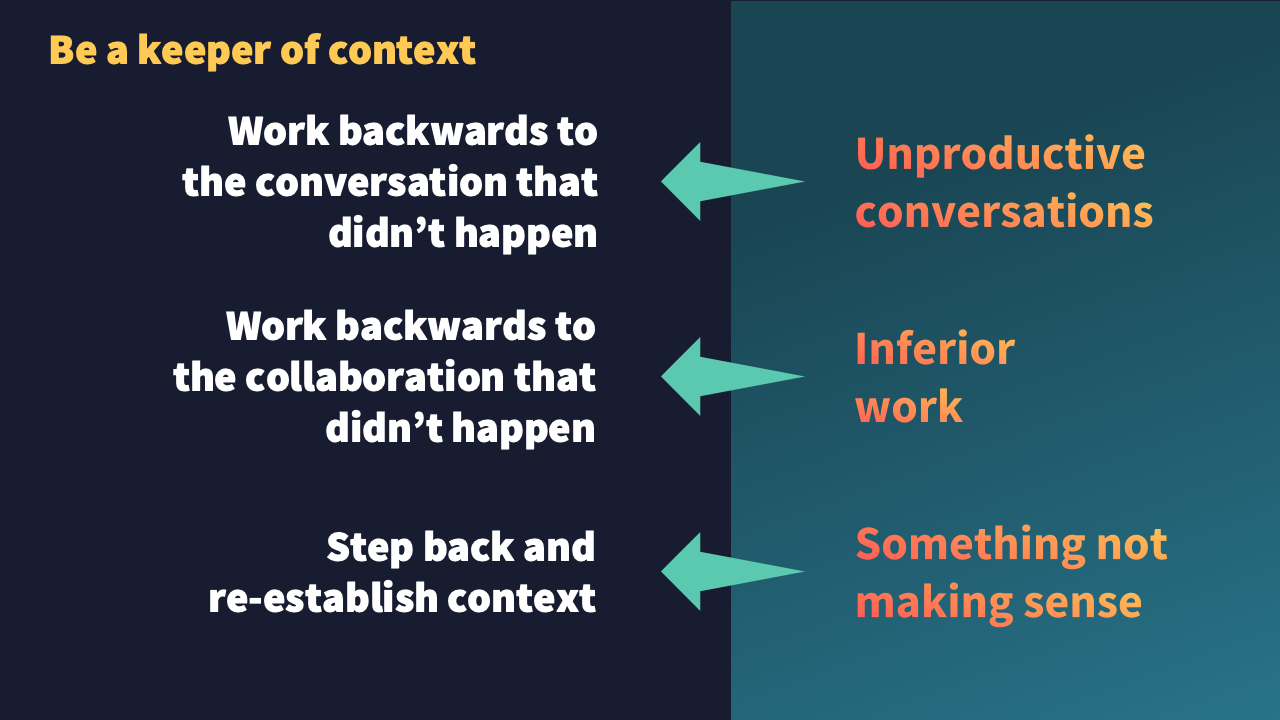
    Be a keeper of context

    What if all failures were failures of context? OK, that’s an exaggeration, but as a working default assumption, it sure beats assuming failures of competence or character. Moreover, it can be the beginning of a generative line of thinking, one that puts you in the role of keeper of context.

    Suppose that you’re a leader in a transforming organisation [1] and you witness an unproductive conversation. What is the shared context that this conversation is missing? You might intervene and provide some, but that’s not the point here. Work backwards. What was the conversation that didn’t take place, the one in which that context would have been established? Look not only at formal meetings but at how activities are sequenced, how their respective conversations happen, and their quality. What opportunities for context-creating conversations are we missing?

    Looking at your organisation’s processes, it’s easy to focus on just the formal sequence of activities and overlook the interactions that happen (or need to happen) between them, and in particular, their conversations. When each activity involves different people and the chain of activities is long, it’s not hard to see how context gets lost.

    Going deeper into organisation design and questions of meaningfulness, suppose now that you come across some work that failed to delight the customer. What went wrong? Lack of skill? Lack of commitment? These are easy conclusions to reach, but let’s try a different kind of assumption. Could this again be a failure of context? Was that work done with a deep enough appreciation of the context into which that work would be delivered? Where was the opportunity to appreciate the customer’s struggles? Where was the opportunity to explore their needs, to identify measures of customer progress, and so on? And suppose that the work had instead been successful, what kind of feedback would those involved have received? Could it be that our role definitions and process designs keep the people closest to the work insulated from the context they need?

    Finally, suppose now that you suspect you’re seeing people lose their sense of what’s important, who they are, and what their team is about. Not so surprising in a transforming organisation! When you see confusion, it doesn’t usually help to ask what people are doing or what they are thinking. Instead, go back to the beginning and let them tell the story. If it turns out that the one who was confused was you, don’t be surprised. Context really is everything.

    My perspective on these issues of context has evolved. In my first book, I suggested that you might begin with the assumption that any failures of process you encountered were rooted in failures of collaboration. If you’re looking for systemic causes – making it easier to adopt this perspective non-judgementally ­– I’ve found that this perspective can be highly productive.

    Going back a few more years to when I was a global manager of managers, I would see failures of leadership. Confrontational perhaps, but again productive when the failing collaboration involved an imbalance of power or experience, and the more senior party involved needed to understand their additional responsibility in the relationship.

    Failures of context, collaboration, or leadership: three closely related perspectives yet quite different in tone. When you’re a manager dealing with these issues daily or an external practitioner sensing one for the first time, which perspective do you choose? I remain comfortable with all three; the right one on the day is the one that leads to the insights needed via a safe and productive conversation. And if you’re not sure, you can always ask!

    [1] Leaders in transforming organisations are the Agendashift Academy’s focus; this post expands on two end-of-section reflections from Leading with Outcomes: Foundation and Inside-out Strategy: Fit for maximum impact. We return to the topic as a sensemaking and scaling issue in the final module, Adaptive Strategy: Business agility at every scale.

    Related


    Upcoming events

    February

    March

    *TTT/F and (where shown) LIKE events include free one-year membership of the Leading with Outcomes Authorised Facilitator programme, upgradeable to Authorised Trainer at any time. Both of those include access to the video-based Leading with Outcomes training and the full range of Agendashift assessment tools.


    Leading with Outcomes from the Agendashift Academy
    “Leadership and strategy in the transforming organisation”

    Leading with Outcomes is our modular curriculum in leadership and organisation development. Each module is available as self-paced online training or as private, instructor-led training (online or in-person). Certificates of completion or participation according to format. Its modules in the recommended order:

    1. Foundation module:
    2. Inside-out Strategy:
    3. Adaptive Organisation:
    4. Outside-in Strategy:

    Individual subscriptions from £24.50 £18.40 per month after a 7-day free trial, with discounts available for employees and employers in the government, healthcare, education, and non-profit sectors. For bulk subscriptions, ask for our Agendashift for Business brochure.

    To deliver Leading with Outcomes training or workshops yourself, see our Authorised Trainer and Authorised Facilitator programmes. See our events calendar for Train-the-Trainer / Facilitator (TTT/F) and Leading in a Transforming Organisation trainings.


    Agendashift™: Serving the transforming organisation
    Links: Home | Subscribe | Events | Media | Contact | Mike

    Agendashift  Academy: Leading with Outcomes | Trainer and Facilitator Programmes | Store

    At every scope and scale, developing strategy together, pursuing strategy together, outcomes before solutions, working backwards (“right to left”) from key moments of impact and learning.