Sneak peek: New chart with real data from the Leadership category

Screen Shot 2015-08-26 at 10.33.41

The blue bars are for the leadership category; the grey ones behind are for the survey as a whole (categories transparency, balance, collaboration, customer focus, flow, and leadership). A reminder of the x-axis:

Screen Shot 2015-08-24 at 08.25.26

Curious? Try the Values-based delivery assessment for yourself by participating in Depth of Kanbanland 2015.


Agendashift-cover-thumb
Blog: Monthly roundups | Classic posts

Links: 
Home | Partner programme | Resources | ContactMike
Community: Slack | LinkedIn group | Twitter

Latest Agendashift features: private surveys (in beta), usability enhancements

A few days ago we announced that we would be conducting some limited beta testing of new private survey functionality. It’s only available to our beta testers (get in touch if you have an urgent need to fulfill) but here are a few screenshots that show how it works.

If you’re enabled, you can now add new contexts, representing your team, class, coaching relationship, etc. My personal list shows the Kanbanland context that hosts the Depth of Kanbanland 2015 survey (yes, go there if you haven’t already!), plus the new option:

Screen Shot 2015-08-24 at 11.04.44

Within contexts that you own, you have the option to add new surveys:

Screen Shot 2015-08-24 at 08.21.11

As the owner of a survey, you’re given a non-guessable link you can share with your intended participants. After signing up, they’ll be taken to their assessment for your survey. Easy!

Screen Shot 2015-08-24 at 10.56.28

Other enhancements

Did you forget the scoring scale mid-assessment? No problem – there’s pop-up help for that now:

Screen Shot 2015-08-24 at 08.25.26

There’s also a “remember me” option on signing up or signing in. If you take advantage of this, your login will be saved for up to 14 days, courtesy of a secure browser cookie.

Screen Shot 2015-08-24 at 08.27.28


Agendashift-cover-thumb
Blog: Monthly roundups | Classic posts

Links: 
Home | Partner programme | Resources | ContactMike
Community: Slack | LinkedIn group | Twitter

The Values-based delivery assessment vs problems of flow

Earlier this month and twice in the same week, I found myself debriefing games of GetScrumban (for the purposes of this post we could have used getKanban or even Featureban). Both times I ditched the deck and moved to the flipchart. Much of the ensuing discussion revolved around a classification (below) of the kinds of flow problems we experienced:

  • Item-related:
    • Blocked: work is unable to proceed until some issue or dependency specific to that item is resolved
    • Stalled: work is not proceeding because attention lies elsewhere
  • People-related:
    • Starved: people have unused capacity and are left waiting for work
    • Overburdened: there is too much work relative to capacity; people feel overwhelmed and may be wasting time on context switching

Reflecting on this afterwards, I thought I ought to check what the Values-based delivery assessment template (which you can try via the Depth of Kanbanland 2015 survey) had to say about these.

Blocked

There is plenty here in categories 1 (Transparency) and 3 (Collaboration). These three prompts are directly relevant:

  • 1.3 We can see which work items are blocked and for what reason
  • 1.5 We identify dependencies between work items in good time and sequence them accordingly
  • 3.4 Throughout the delivery process we cooperate to ensure the smooth transition of completed work into live use

As identified in the last two of those, the key is preempt blockers, not just to manage them when they arise. Don’t start what you can’t finish! A further three prompts speak to how we organise ourselves in order to achieve this:

  • 1.6 We identify and manage dependencies on external teams or services
  • 3.2 Our delivery process encourages collaboration across roles and specialties
  • 3.3 We work with business stakeholders to understand, shape and size potential work ahead of it entering the delivery process

Prompt 3.2 doesn’t quite spell it out, but swarming collaboratively over a blocked item is an important tactic for dealing with blockers.

Overburden, Stalled

These problems are two sides of the same coin. We see them when supply cannot meet demand; no surprise then that the category 2 (Balance) applies here. I’ve picked out these two prompts in particular:

  • 2.3 We take care not to overburden the system with more work-in-progress than it can accommodate effectively
  • 2.4 We pull work into and across the delivery process only as capacity allows, preferring to finish work items already in progress than to start new work items

The Kanban Method’s second core practice is “Limit work-in-progress (WIP)”. Neither underestimate its power or think that it applies only to columns on kanban boards! Note also that high levels of WIP are often the result of other flow-related problems, so don’t stop there either.

Starvation

Starvation is often a side effect of blockages and other flow problems happening upstream — the problems we’ve seen already plus those induced by inattention to the size and quality of items in the pipeline. Again, prevention is better than cure:

  • 3.3 We work with business stakeholders to understand, shape and size potential work ahead of it entering the delivery process
  • 5.1 We proactively prepare work items ahead of the delivery process to maintain a strong and reliable flow of value

We’ve seen category 3 (Collaboration) before; the new one here is 5 (Flow). One of my favourite techniques though comes under 2 (Balance):

  • 2.6 We maintain a healthy mix of work items based on type, source, and urgency

Complaints of starvation will be rare if there is a supply of non-urgent but still valuable work available. Keep some in the mix!


Agendashift-cover-thumb
Blog: Monthly roundups | Classic posts

Links: 
Home | Partner programme | Resources | ContactMike
Community: Slack | LinkedIn group | Twitter

Limited private beta testing of new private survey functionality

We’ll soon be doing some limited beta testing of new functionality that will let you create your own team-specific or class-specific contexts. From there you’ll be able to create surveys using the same values-based delivery template as seen in the the public survey Depth of Kanbanland 2015. Initially, access to these will be via non-guessable links that you share outside the tool to your intended participants.

As survey administrator you will be able to review individual responses but there isn’t yet any aggregate reporting other than some JSON intended for machine consumption. Completing this aspect is of course very high on the list.

Do get in touch if this or a subsequent iteration could be of use to you. Priority access will be given to those who have already completed an assessment via the original survey and volunteered feedback or ideas. A number of people have done so but it’s not too late to catch up if you’re not one of them!

More of what’s in store is outlined on the Account plans page. For the time being though, it’s all free 🙂


Agendashift-cover-thumb
Blog: Monthly roundups | Classic posts

Links: 
Home | Partner programme | Resources | ContactMike
Community: Slack | LinkedIn group | Twitter

Sneak peek: more “early gains” than “getting there”?

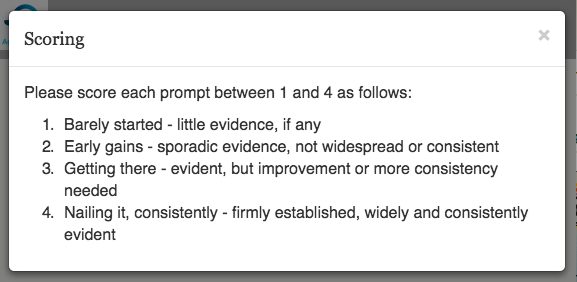
Recall Agendashift’s default scoring scale:

  1. Barely started – little evidence, if any
  2. Early gains – sporadic evidence, not widespread or consistent
  3. Getting there – evident, but improvement or more consistency needed
  4. Nailing it, consistently – firmly established, widely and consistently evident

Would it surprise you to learn that the modal (single most popular) and median (middle) scores we’ve seen so far are both 2 (“Early gains”)?

Me? I’m not at all surprised. Regularly I poll audiences at conferences and meetups in places as diverse as Singapore and Nottingham (my hosts in the past week or so), and consistently I see more responses at the lower end of the scale. Claims of 4 (“Nailing it”) are rare indeed, and all of those that do claim it would say that they still have improvements to make. The answer to my talk’s rhetorical question “Are we there yet?” is a resounding no!

If you haven’t tried the Values-based delivery assessment, do so now! Just sign up for the Depth of Kanbanland 2015 survey and take a few minutes to to score your delivery process against its 44 prompts. If you are at all interested in improving service delivery and you have even just a passing awareness of Lean, Kanban or Agile, you are well qualified to try it and we think you’ll find it helpful.


Agendashift-cover-thumb
Blog: Monthly roundups | Classic posts

Links: 
Home | Partner programme | Resources | ContactMike
Community: Slack | LinkedIn group | Twitter

Explaining our tagline: Values-based change for the evolving organisation

Let’s take a few moments to break our tagline into digestible pieces. What do we mean by “values”, “values-based change”, and “for the evolving organisation”?

Values

Some might try to dismiss values as somehow “fluffy”, but this could not be further from the truth. Values bring together all of these:

  • What we hope for
  • What we actually do, how we do it, and the things we use in order to do it
  • The results we expect

To get a sense of their power, just think of the embarrassment you feel when you let things slip and your behaviour is not in accordance with your (or your colleagues) most strongly-held values. Think also of the cynicism generated when the corporate rhetoric does not match the reality that staff observe day to day. Values really do matter!

Values-based change

Values-based change is about narrowing the gap between the values we claim (so-called espoused values) and the behaviours and results we currently observe.

Suppose for example that we claim to value transparency* but our organisation lacks effective mechanisms for generating and acting on feedback. Let’s begin to do something about that! Or perhaps we espouse balance* but we have demand and capability mismatched that individuals and teams are hopelessly overburdened? Let’s face up to that challenge!

Not that it is for some external agent (me, say) to dictate which values or prompts should receive priority — that’s a question typically best answered the people who are going to make that change happen; they can make choices based on feasibility, impact, and alignment. And who better to than them to work out the details of the specific actions that will bring the change about?

*These are the first two categories in our first template, the Values-based delivery assessment. Try it in survey form here: Depth of Kanbanland 2015.

The evolving organisation

You’ve heard it before: we live in a competitive and fast-changing world; only the fittest survive. But how many organisations invest in their their ability to change? All too often, they’re content to follow the herd or to wait until change is imposed on them. Survival tactics maybe, but hardly strategies for success!

Adaptable organisations go beyond mere words, and have in place the tools, the rhythms and the management support to ensure that change is a normal part of doing business. And not just a succession of defined projects, but something that continues to happen at every level of the organisation.

Putting the pieces together

Values-based change for the evolving organisation means deliberately and continually narrowing the gap between the values we (currently) claim and the behaviours and results we currently observe.

It is a start with what you do now* approach. It’s neither a “follow the herd” nor a “let fate decide” approach, but a determined commitment to pursue evolutionary change*. Nor is it an easy option; it’s one that both requires and develops leadership at every level*.

[*These are references to what I label the understandingagreement, and leadership principles of the Kanban Method. The fourth and final foundational principle — the respect principle — I hope goes without saying! You can learn more in our 1-day class: Values-based change with Agendashift and the Kanban Method]

Interested in applying values-based change in your organisation? Get in touch!


Agendashift-cover-thumb
Blog: Monthly roundups | Classic posts

Links: 
Home | Partner programme | Resources | ContactMike
Community: Slack | LinkedIn group | Twitter

Agendashift is live!

I’m delighted to announce that Agendashift has gone live today.

As described in our original announcement, we’re launching with a ‘Values-based delivery’ assessment adapted from my book, Kanban from the Inside. To use it you’ll be participating in our ‘Depth of Kanbanland 2015’ survey, with results to be published in the Autumn.

Try it now: Featured survey: Depth of Kanbanland 2015

We’ll be rolling out features aimed at individual, team and corporate use in the coming weeks and months. Stay in touch meanwhile – I’d be delighted to receive any feedback and you can be sure that it will be taken seriously. And do please share!


Agendashift-cover-thumb
Blog: Monthly roundups | Classic posts

Links: 
Home | Partner programme | Resources | ContactMike
Community: Slack | LinkedIn group | Twitter

Anatomy of an Agendashift template

Aside some basic text fields (name, description and so on), an assessment template in Agendashift has three main elements:

  1. A single scoring scale, applied across the whole assessment
  2. Categories
  3. For each category, a number of prompts

This simple structure has some advantages. Let’s look at those elements through a specific example, the Values-based delivery template that Agendashift will launch with.

Scoring scale

As anticipated a year ago in this personal blog post  “How deep” rebooted: values-based depth assessment, the Values-based delivery template uses a four-point scoring scale inspired by the Agile Fluency Model (Diana Larsen and James Shore). With the help of my collaborator Dragan Jojic I’ve simplified my language a bit since then. It now looks like this:

  1. Barely started – little evidence, if any
  2. Early gains – sporadic evidence, not widespread or consistent
  3. Getting there – evident, but improvement or more consistency needed
  4. Nailing it, consistently – firmly established, widely and consistently evident

Why four?

  • It’s not two, the binary “yes/no”, so allowing a stronger sense of trajectory
  • It’s not three or five, so avoiding offering a lazy middle choice
  • It allows for some qualitative description of the points on the scale
  • Small, punchy, memorable. How could you achieve that with a ten point scale?

That said, if your template needs a different scale, feel free…

Having just the one scale apply across the whole template might seem like a limitation, but it makes it much easier to aggregate and interpret results. And remember: the point of an assessment isn’t to measure precisely, it’s to help gain agreement that something isn’t yet “widespread or consistent” (for example). And if that something is also seen as both desirable and important (we’ll get to that in a future post), we have a basis for change.

Categories

In the Values-based delivery template, categories map to values (transparency, collaboration, flow, etc). Values have the very important property that “more is better” (generally speaking), so it’s very helpful if an assessment can be structured around them. However, not every template can be organised that way, so Agendashift uses the more neutral word category.

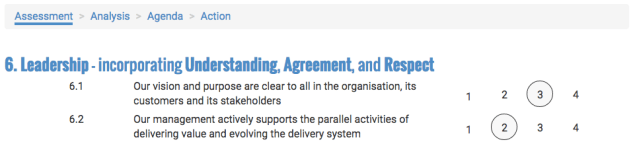
The Values-based delivery template has six categories: Transparency, Balance, Collaboration, Customer Focus, Flow, and Leadership. If you’re familiar with that model, are you wondering what has happened to Understanding, Agreement, and Respect? The truth is that I feared (with some justification I think) that a 9-page assessment would be too great a test of patience, and I have combined those last three with Leadership (readers of my book won’t be surprised by that move). There’s some special support for this in Agendashift, as illustrated in this screenshot:
Screen Shot 2015-05-28 at 07.41.16

At the time of writing it’s not possible to analyse results by those “incorporated” categories; that might come later.

Prompts

I very nearly called them “questions” but I’m glad I didn’t! I ask questions because I want answers. I give prompts in the hope that they stimulate something positive.

There’s nothing in Agendashift that requires it, but I lean towards “we” and “our” in the wording of the prompts themselves. This is no doubt partly due simply to how I tend to speak, but I do think it is helpful if the assessment can come with a sense of inclusion, ownership and teamwork. Some examples from the Values-based delivery template:

  • We meet frequently to share with each other what we’re discovering in the course of our work
  • We take care not to overburden the system with more work-in-progress than it can accommodate effectively
  • We actively seek to understand the value and urgency of potential work from the perspective of the end customer

I can imagine a “prompt of the day”. Is that a feature you’d value?

User testing has been very positive, and we’re on track for Agendashift to launch next month. To be sure of staying up to date with developments, sign up today! You can follow us on Twitter too.


Agendashift-cover-thumb
Blog: Monthly roundups | Classic posts

Links: 
Home | Partner programme | Resources | ContactMike
Community: Slack | LinkedIn group | Twitter
Agendashift’s technology stack

The obligatory tech stack post!

Front end:

Server-side:

The job of the server is mainly to serve JSON via a REST API, and much of the front end was developed before a single line of the server was written. I decided very quickly that the server’s model tier should return ‘JSON objects’ (raw dicts and arrays) rather than objects mapped by the SQLAlchemy ORM. This helps to keep logic out of the view tier and would make any future move to microservices very much more straightforward. So far I’ve not regretted this slightly unusual move one bit.

One level below that, the persistence model is “mostly relational”. Two fields are stored as JSON; later (it’s not needed quite yet) they’ll be expanded into relational tables for reporting purposes. One quite complex object—the assessment template—is kept for now in a YAML file (served as JSON) until I implement template editing.

With all that in mind, I might yet replace both Mustache and Jinja2 with Handlebars, gaining some power relative to Mustache whilst making it easier for client and server to share templates. I could go the whole hog and replace the Python with server-side Javascript, but that’s not likely to happen anytime soon – I have better things to do right now. Similarly, I’m in no hurry to go down the NoSQL route.

Basically, Python and PostgreSQL work for me just fine. You may remember that some time back I was an occasional contributor to the Pylons web framework but I never made the transition to its successor, Pyramid. I’m new to Flask but my needs are modest and it has been very easy to learn. My SQLAlchemy isn’t where it was five years ago, but it’s returning!

One likely casualty is the SVG. I have plans to replace Agendashift’s rather unique style of circular chart with regular bar charts, and I expect to be able to implement them in CSS.

Screen Shot 2015-05-20 at 08.31.46


Agendashift-cover-thumb
Blog: Monthly roundups | Classic posts

Links: 
Home | Partner programme | Resources | ContactMike
Community: Slack | LinkedIn group | Twitter

Coming soon: Agendashift

[Cross-posted from positiveincline.com]

Imagine a change process based on choice and collaboration:

  • You (an individual or team) take an assessment of your choosing, invite a coach to facilitate one with you, or opt to participate in a survey
  • You explore online an analysis of your own inputs and the aggregated inputs of your colleagues, identifying strengths, weaknesses, leading and lagging areas
  • You identify the prompts or categories that best describe your collective agenda for change
  • You track actions through to completion until it’s clear that they have taken hold and are delivering the benefits expected

No emailing of spreadsheet-based questionnaires. No being left wondering what’s happening to your inputs. No imposition of priorities from on high. No failure of ownership and follow-through. These are my “itches to scratch”. Whether you’re a consultant, a client, or managing without external support, Agendashift can help you too.

Right there are Agendashift’s four A’s: Assessment, Analysis, Agenda and Action. Of course it doesn’t have to be as linear as that: given time, Action should dominate, kept on track with periodic recalibrations from the other three.

You’ll see a free version launched in the next few weeks that anyone can try without obligation. A little after that, paid accounts will bring the ability to design new assessment templates and to manage client/team workspaces.

Agendashift will launch with a “Values-based delivery” template adapted for public consumption from my book with the help of some much-appreciated collaboration. If you have ideas for other templates (your own practice’s tools perhaps, or tools that are more explicitly Agile or Lean than mine), do get in touch.

Meanwhile, leave a comment, follow @agendashift on Twitter or sign up at agendashift.com to be sure of receiving launch news.


Agendashift-cover-thumb
Blog: Monthly roundups | Classic posts

Links: 
Home | Partner programme | Resources | ContactMike
Community: Slack | LinkedIn group | Twitter