Announcing a new Adaptive Organisation workshop (and more)

Announcing:

  1. The immediate availability of the Leading with Outcomes Adaptive Organisation workshop

And closely related to that:

  1. Adaptive Organisation (II): Between spaces, scopes and scales, v2.1 beta
  2. Updates on Leading in a Transforming Organisation, Manchester
  3. New experience/practice sessions begin next week

1. Announcing the immediate availability of the Leading with Outcomes Adaptive Organisation Workshop

This new 1-day workshop takes the two-part Adaptive Organisation training module (two days of training when done in person, three days when taken with Foundation) and dials down the training dimension to make it all about the conversations your organisation needs to have with itself.

It follows much the same structure as the training:

  1. Introduction
  2. Delivery-Discovery-Renewal – value-creating work and how it is coordinated and organised
  3. Adaptive Strategising – keeping us in the game, strategising and self-governing
  4. Mutual Trust Building – addressing the formal organisation’s deficit in information and decision-making capacity
  5. Between and Across Scales – examining the relationships between scales of organisation
  6. Organising at Human Scale – promoting adaptation, innovation, and learning at all scales
  7. What Lies Beneath – dealing with organisational constraints

Points 1-5 above each correspond to a section of the Deliberately Adaptive Organisation assessment, and we’ll be working with that, making this a thorough health-check for your organisation. Per this recent blog post, the final part of the workshop takes it all forward into action, via some very interesting new tools for identifying and visualising organisational constraints.

The material has already been made available to authorised Leading with Outcomes facilitators and trainers. For myself, I am pleased to offer it in the form of a private, 1-day, in-person workshop. I charge a fixed rate for anywhere in mainland UK, and I make things as easy as I can for European destinations easily reachable from Manchester or East Midlands airport also. Outside those parameters – further afield, online, or spread over multiple days – let’s see what we can work out.

2. Adaptive Organisation (II): Between spaces, scopes and scales, v2.1 beta

I have already mentioned the two-part Adaptive Organisation training module on which the new workshop is based. This second announcement relates to its presentation in the form of online, video-based, self-paced training at the Agendashift Academy.

Following on from Adaptive Organisation (I): Business agility at every scale (v2.0 beta), I have released the first chapter of Adaptive Organisation (II): Between spaces, scopes and scales (v2.1 beta). Still to come in part II: two more chapters and an “interlude”, one of two windows into the in-person Leading in a Transforming Organisation. The beta tag will disappear when I’ve released all the videos and done their captions (still in progress for part I) and student workbook. Part I will at some point be re-recorded at version 2.1 or later but there is no great rush to do so – the two parts remain compatible.

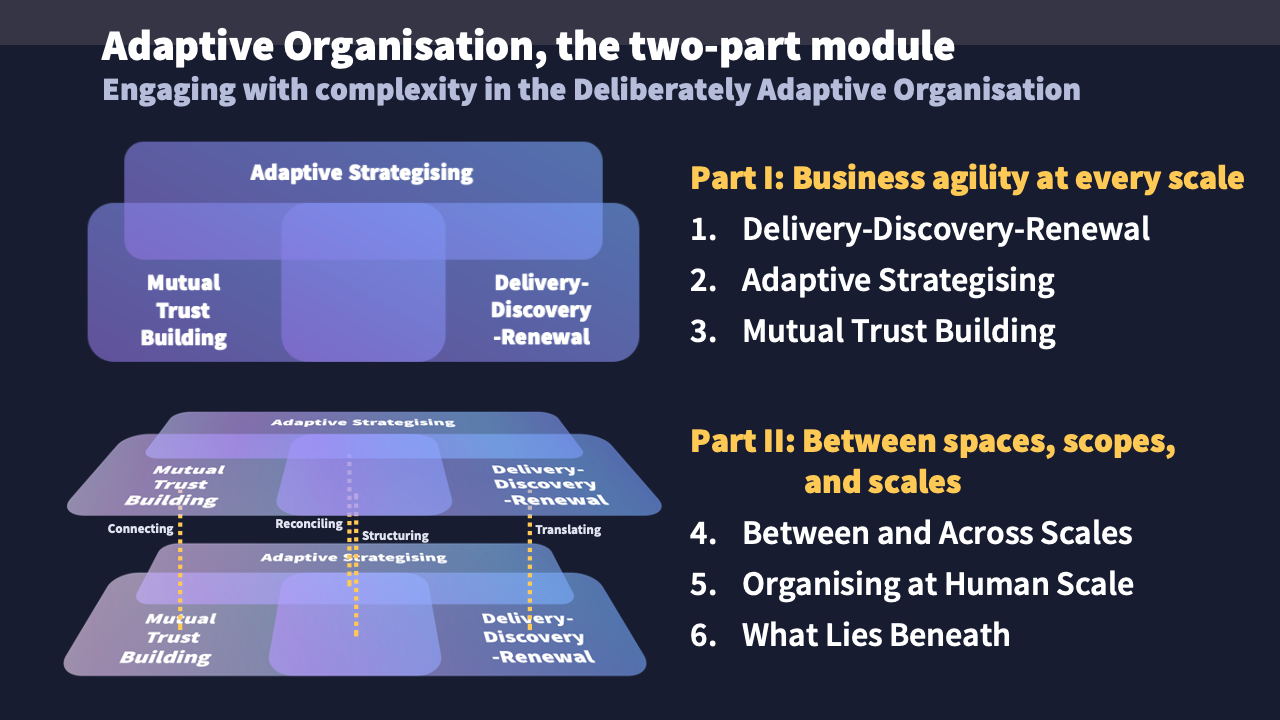
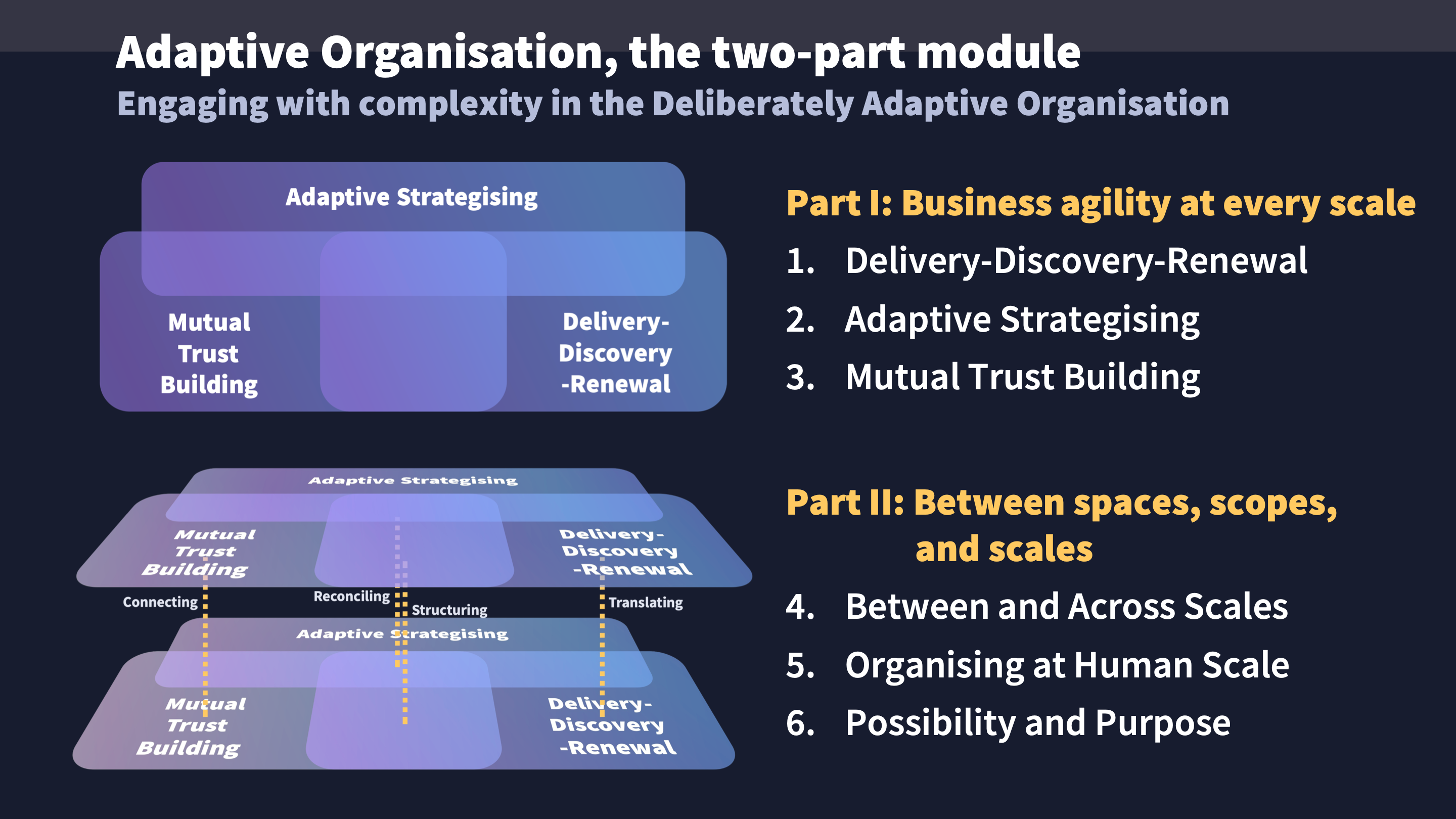
Part I develops the Deliberately Adaptive Organisation, a model to describe any organisational scope at any scale (or many/all such scopes all at once!). Part II pays attention to issues of scale:

  1. Relationships between scopes at different scales – between team and team-of-teams for example
  2. The difficulty with which organisations adapt as scale increases
  3. Identifying and managing organisational constraints
3. Updates on Leading in a Transforming Organisation: Manchester, 14-16 November

This will be my most diverse group yet at a public training. Thanks to staff from the NHS and two universities (three if you count former staff), it’s quite possible that consultants, coaches, and trainers won’t be in the majority. An experience to savour I think!

New this time: with some additional study, this event allows prospective trainers (not only facilitators) to bypass Train-the-Trainer / Facilitator (TTT/F); further information about that on the event page.

The material (shared with Adaptive Organisation parts I & II) can be considered well-tested now, even a joy to teach! Between London, Melbourne, and my preparations for Manchester, each of the two parts fits comfortably in a day, and they take things more consistently in an emergence and complexity-friendly way, which is to say bottom-up. Not that it was ever top-down, but making it more consistent has definitely added to its impact.

While still in Melbourne I wrote up two changes:

And the Manchester event itself:

4. New experience/practice sessions begin next week

Next week, the first of what will become a monthly fixture:

A different assessment tool each month, and we’re starting with the Deliberately Adaptive Organisation assessment (mini edition), a version of the one used in all the Adaptive Organisation workshop and training products mentioned in this post. A great way to get a firsthand impression of what it’s all about!


Upcoming events

February

March

*TTT/F and (where shown) LIKE events include free one-year membership of the Leading with Outcomes Authorised Facilitator programme, upgradeable to Authorised Trainer at any time. Both of those include access to the video-based Leading with Outcomes training and the full range of Agendashift assessment tools.


Leading with Outcomes from the Agendashift Academy
“Leadership and strategy in the transforming organisation”

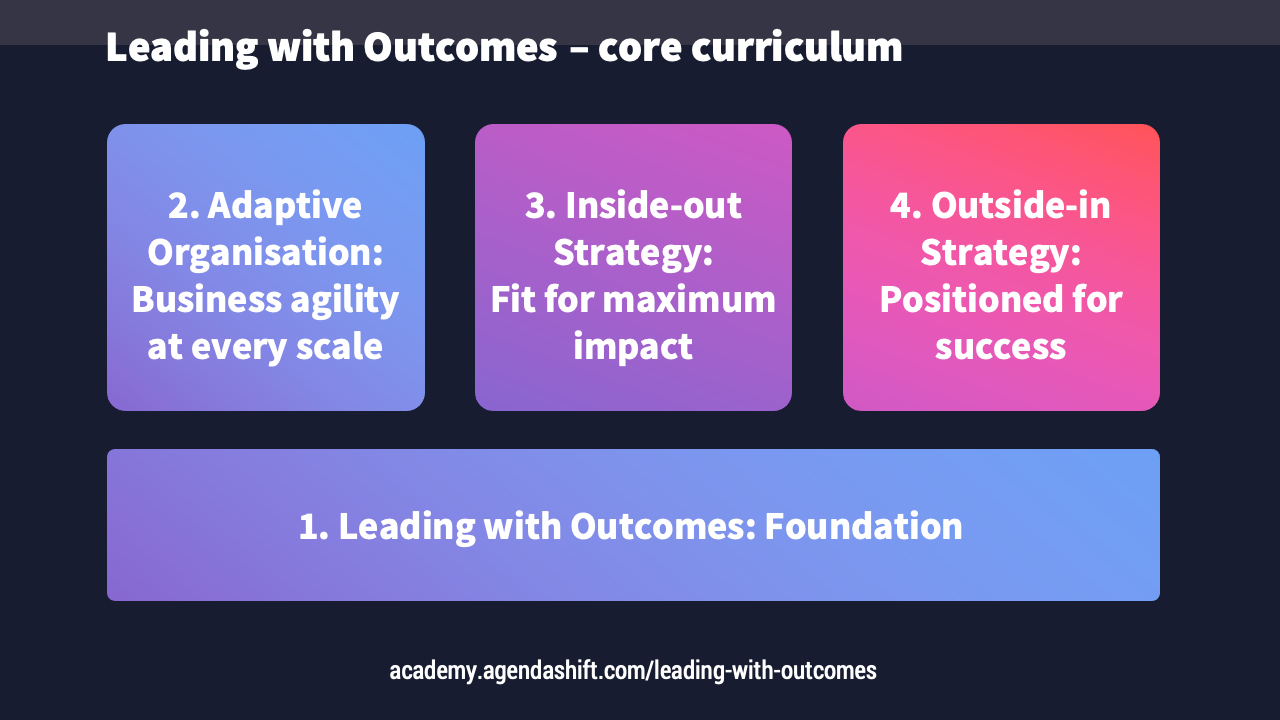
Leading with Outcomes is our modular curriculum in leadership and organisation development. Each module is available as self-paced online training or as private, instructor-led training (online or in-person). Certificates of completion or participation according to format. Its modules in the recommended order:

  1. Foundation module:
  2. Inside-out Strategy:
  3. Adaptive Organisation:
  4. Outside-in Strategy:

Individual subscriptions from £24.50 £18.40 per month after a 7-day free trial, with discounts available for employees and employers in the government, healthcare, education, and non-profit sectors. For bulk subscriptions, ask for our Agendashift for Business brochure.

To deliver Leading with Outcomes training or workshops yourself, see our Authorised Trainer and Authorised Facilitator programmes. See our events calendar for Train-the-Trainer / Facilitator (TTT/F) and Leading in a Transforming Organisation trainings.


Agendashift™: Serving the transforming organisation
Links: Home | Subscribe | Events | Media | Contact | Mike

Agendashift  Academy: Leading with Outcomes | Trainer and Facilitator Programmes | Store

At every scope and scale, developing strategy together, pursuing strategy together, outcomes before solutions, working backwards (“right to left”) from key moments of impact and learning.

What Lies Beneath (Spoiler: Constraints)

Updates

  • 2024-05-10: Minor edits for consistency, in the summary most especially
  • 2023-11-18: Improvements to the Constraints Club wording; Removed a pre-visualisation step of sorting by difficulty before sorting by energy
  • 2023-11-07: Added the question “Out of what does that emerge?” to the Constraints Club exercise

This is a writeup of What Lies Beneath, a new string of exercises that now forms the final session of the Leading with Outcomes module Adaptive Organisation (II): Between spaces, scopes, and scales, and by extension, the 3-day in-person training Leading in a Transforming Organisation. I tested it in that latter form in Melbourne, Australia last week and will be bringing it back to the UK soon (Manchester, November 14-16).

In right to left style, I will describe it backwards:

  • Premise, goals, next steps
  • Visualisation: Estuarine Framework
  • Inquiry: Constraints Club
  • Establishing context: Assessment

I will summarise the process from start to finish at the end of this post.

Premise, goals, next steps

In a complex adaptive system (CAS), lasting change is achieved in two ways:

  1. By shocking the system into finding a new configuration from which regression is unlikely
  2. By changing the constraints under which the system operates

The first has some obvious drawbacks. How can you be sure how the system will respond? Not to rule out that option entirely but coherently with goals of adaptability (more on that later), we’ll be taking the second route. Broadly, we identify constraints that are open to change and prioritise some of those for further work, doing that in such a way that participants are well motivated to find and then act on potential solutions. That “moving into action” aspect – ideation, hypotheses, experiments, and feedback – is a mature part of Agendashift / Leading with Outcomes, and it won’t be developed further here.

Visualisation: Estuarine Framework

Feeding that “moving into action” aspect is this visual organisation of constraints – constraints having been identified in a generative process to be described shortly:

This is Dave Snowden’s Estuarine Framework, which comprises an Energy/Time “affordance grid” overlaid with boundaries between four groups of constraints:

  1. Those we accept as given
  2. Those we can’t manage on our own but might engage on with others
  3. Those we can manage
  4. Those volatile or flimsy enough that we need do little more than monitor them

The significance of the colours will be explained later, in the Inquiry section.

The Estuarine Framework is the visualisation part of Dave Snowden’s Estuarine Mapping [1]. I have been guilty of confusing the two names, but to disambiguate them: Mapping here is the overall process, and Dave uses Framework consistently with something familiar to most readers of this blog, his Cynefin Framework.

Energy here refers to the amount of energy (or quantities convertible to energy) required to make a constraint no longer applicable; Time similarly. Our inquiry process (which differs from Dave’s) captures them in the form of “true and fair statements”; here we are organising them according to the energy and time required to make those statements no longer true.

Consistent with other mapping techniques in the Agendashift / Leading with Outcome repertoire we build the visualisation in stages. This is not necessarily how Dave does it, but it will feel familiar to many:

  1. Beginning with extreme examples – most and least energy requirement – arrange vertically by energy requirement, using all the available space
  2. Decide where the 0 of the energy axis sits (some constraints may have enough pent-up energy that their net energy requirement is negative)
  3. Keeping vertical positions fixed, organise horizontally by time requirement, again beginning with extreme examples so as to use all the available space
  4. Make adjustments where an energy/time tradeoff may exist
  5. Regarding constraints as affordances (ie things we can interact with in order to effect change), prioritise some for action, marking them visually in some way

In Melbourne, we built our visualisation horizontally on a tabletop, convenient in some ways but not at all conducive to photography. A photo of our work in Melbourne is available on request but it is so awful I do not include it here! That niggle aside, the feedback (linkedin.com) was enthusiastic, most notably:

“Energised by the E/T mapping exercise”

Inquiry: Constraints Club

The first rule of Constraints Club is not to mention constraints

Constraint can be a difficult word, often interpreted as something negative. But without the tendency of constraints to contain or connect, complex systems would not cohere. Although the preceding training / workshop material does deal explicitly with constraints, with that difficulty in mind we are experimenting here with identifying constraints without mentioning the term – a successful experiment, as it turns out.

In place of Estuarine Mapping’s constraint typology, a generative process:

  1. Why is that important?of a prompt, story, obstacle or outcome we have prioritised or captured
  2. How do we experience that today? What stories can we tell?
    • Short sentences, true and fair observations
    • No blaming, theorising, or selling (solutions or theories)
    • If you struggle to write something that most people would easily agree with, scope it down – independent sentences, as few as needed
  3. What makes it that way? What keeps it that way? Out of what does that emerge?
    • More true and fair observations, kept separately (or different colour)
  4. Drilling down or expanding, rinse & repeat from 3, 2, or 1

For two aspects of that process, I’m grateful to Mushon Zer-Aviv, who is also doing some Estuarine-adjacent experimentation. The first is the idea of answering with short sentences that are (in my words) “true and fair observations”. The second is the drilling down aspect, which Mushon does with multiple mapping exercises. “No blaming, theorising, or selling a solution” references the Agendashift / Leading with Outcomes exercise Good Obstacle, Bad Obstacle [2] that participants will by this time be familiar with; Mushon deals with those issues in his own way.

The idea (if not the wording) behind “scope it down” in cases of disagreement is Dave’s.

Mainly with visualisation in mind, answers to questions 2 and 3 are kept separate – in separate lists on paper or by using differently coloured stickies. This explains the two-tone colouring in the visualisation slide in the preceding section.

Establishing context: Assessment

The string of exercises we call What Lies Beneath begins with a twist or two on the long-established Agendashift Assessment Debrief. The first twist is that we’re debriefing the assessment as a whole not at the beginning of the event, but towards its end. We have however been interacting with it section by section for some time, developing all the while a model of organisation that is both relational and constraint-based, the Deliberately Adaptive Organisation [3]. This is an innovative “re-presentation” of Stafford Beer’s Viable System Model (VSM), making it more accessible and (in the modern sense) complexity-friendly.

In contrast with typical systems practice, at no point do we seek to establish system boundaries. Instead, we take a “start where you are, everywhere all at once” approach, and this is reflected in the invitation to the assessment [4]. Participants each bring their perspectives on all the organisational scopes with which they individually identify, likely at multiple scales of organisation, ranging from sub-team to whole organisation and sometimes (as was the case last week) beyond.

The full Deliberately Adaptive Organisation assessment template has 35 prompts in the following 5 sections:

  1. Delivery, Discovery, Renewal
  2. Adaptive Strategising
  3. Mutual Trust Building
  4. Between Spaces, Scopes, and Scales
  5. Organising at Human Scale

A free, 12-prompt mini template is available at [5].

Each participant scores each prompt on a four-point scale, then “stars” (ie multi-votes) prompts they would prioritise for further development. Participants may also compose their own prompts, for which purpose a style guide is provided.

The typical survey debrief proceeds as follows:

  1. Score distributions overall
  2. Areas of closest agreement
  3. Strongest
  4. Weakest
  5. Most starred (ie most votes)

The second twist is to return at the end of the debrief to step 2, Areas of closest agreement, reviewing prompts that have the strongest consensus on scores. In the first pass, we have used this page of the debrief report to build confidence in the results, spending little time on what seems uncontroversial. Second time through though, we are wondering whether something interesting might be going on. Given the range of scopes and scales considered, might this level of consensus be seen as remarkable? What might explain that? The Constraints Club exercise isn’t limited to areas of high consensus on scores (rather on the strength of desire for change), but the thought certainly carries across.

Summary: What Lies Beneath

To finish, a summary of the process, this time forwards:

  1. Assessment Debrief
    • Unconventionally, this finishes with revisiting areas of closest agreement, ie strongest consensus on scores
    • After the debrief, prioritise prompts that identify areas in which there is the strongest desire for change
  2. Constraints Club
    • Initially to those prioritised prompts, in answer to the questions How do we experience that today? What stories can we tell? and What makes it that way? What keeps it that way? Out of what does that emerge?, generate constraints in two lists (or colours)
    • Drill down and/or expand until a suitable number have been generated
  3. Estuarine Framework
    • Arrange by energy and time
    • Draw boundaries
  4. Moving Into Action
    • Prioritise constraints
    • Ideation, experimentation, feedback, etc

Acknowledgements

I wish to express my thanks to the following:

  • Dave Snowden, for the Estuarine Framework
  • Mushon Zer-Aviv, as mentioned in the Constraints Club section
  • Participants at the Melbourne Leading in a Transforming Organisation, October 2023, where the What Lies Beneath string was first tested

References

[1] Dave Snowden, Estuarine Framework (cynefin.io)
[2] Mike Burrows Good Obstacle, Bad Obstacle (agendashift.com)
[3] Mike Burrows, Everywhere all at once: Introducing the Deliberately Adaptive Organisation (docs.gogle.com)
[4] Mike Burrows, An invitation to a more thoughtful assessment, September 2023, (blog.agendashift.com)
[5] Global survey: Deliberately Adaptive Organisation, mini edition (agendashift.com)


Upcoming events

February

March

*TTT/F and (where shown) LIKE events include free one-year membership of the Leading with Outcomes Authorised Facilitator programme, upgradeable to Authorised Trainer at any time. Both of those include access to the video-based Leading with Outcomes training and the full range of Agendashift assessment tools.


Leading with Outcomes from the Agendashift Academy
“Leadership and strategy in the transforming organisation”

Leading with Outcomes is our modular curriculum in leadership and organisation development. Each module is available as self-paced online training or as private, instructor-led training (online or in-person). Certificates of completion or participation according to format. Its modules in the recommended order:

  1. Foundation module:
  2. Inside-out Strategy:
  3. Adaptive Organisation:
  4. Outside-in Strategy:

Individual subscriptions from £24.50 £18.40 per month after a 7-day free trial, with discounts available for employees and employers in the government, healthcare, education, and non-profit sectors. For bulk subscriptions, ask for our Agendashift for Business brochure.

To deliver Leading with Outcomes training or workshops yourself, see our Authorised Trainer and Authorised Facilitator programmes. See our events calendar for Train-the-Trainer / Facilitator (TTT/F) and Leading in a Transforming Organisation trainings.


Agendashift™: Serving the transforming organisation
Links: Home | Subscribe | Events | Media | Contact | Mike

Agendashift  Academy: Leading with Outcomes | Trainer and Facilitator Programmes | Store

At every scope and scale, developing strategy together, pursuing strategy together, outcomes before solutions, working backwards (“right to left”) from key moments of impact and learning.

Agendashift roundup, September 2023

In this edition: Experience/practice sessions; Leading in a Transforming Organisation; Looking ahead to December; Top posts

(New! Free!) Experience/Practice sessions

I have added two more dates to the calendar, the first experience/practice sessions of what should become a monthly fixture (series link):

They’re a chance to try one of our famously inclusive, non-prescriptive, and framework-agnostic assessments (a different template each month) and to experience with others some post-assessment conversations, Agendashift-style.

Post-debrief conversations will follow the IdOO (“I do”) pattern – Ideal, Obstacles, Outcomes, for which materials based on Leading with Outcomes: Foundation will be provided. If, within that structure, you would like to take the brief opportunity to practice our Clean Language coaching game 15-minute FOTO (Academy version here), this should be possible, numbers permitting.

These are in addition to the free monthly webinars that continue to cycle through the three “questions that drive us” (series link). The next two of those:

Leading in a Transforming Organisation: Engaging with complexity in the Deliberately Adaptive Organisation

I’m both counting down the days to Australia and looking ahead to Manchester!

This is where it’s happening in Agendashift-land right now. If you’re tired of approaches to organisational challenges that can’t see beyond process (and trust me, it’s liberating to get past that) and have little of consequence to say about complexity, get yourself to one of these if you possibly can.

I should mention that my trip to Australia – my first trip abroad since COVID – is thanks to Kanban Australia 2023. Thank you Daniel and the rest of the organising team!

Looking ahead to December

In early December I’m off to India for Kanban India and the last TTT/F of the year:

And a thank you to Noopur, Prachi, and the rest of the organising team there too!

Top posts

  1. An invitation to a more thoughtful assessment (September)
  2. My favourite Clean Language question (January 2019)
  3. What I really think about Scrum (August 2020)
  4. Your organisation in 5 networks (November 2022)
  5. From Reverse STATIK to a ‘Pathway’ for continuous transformation (October 2019)

Leading with Outcomes from the Agendashift Academy
“Leadership and strategy in the transforming organisation”

Leading with Outcomes is our modular curriculum in leadership and organisation development. Each module is available as self-paced online training or as private, instructor-led training (online or in-person). Certificates of completion or participation according to format. Its modules in the recommended order:

  1. Foundation module:
  2. Inside-out Strategy:
  3. Adaptive Organisation:
  4. Outside-in Strategy:

Individual subscriptions from £24.50 £18.40 per month after a 7-day free trial, with discounts available for employees and employers in the government, healthcare, education, and non-profit sectors. For bulk subscriptions, ask for our Agendashift for Business brochure.

To deliver Leading with Outcomes training or workshops yourself, see our Authorised Trainer and Authorised Facilitator programmes. See our events calendar for Train-the-Trainer / Facilitator (TTT/F) and Leading in a Transforming Organisation trainings.


Agendashift™: Serving the transforming organisation
Links: Home | Subscribe | Events | Media | Contact | Mike

Agendashift  Academy: Leading with Outcomes | Trainer and Facilitator Programmes | Store

At every scope and scale, developing strategy together, pursuing strategy together, outcomes before solutions, working backwards (“right to left”) from key moments of impact and learning.
An invitation to a more thoughtful assessment

All the organisational scopes you identify with

Before you begin, think about all the organisational scopes you identify with. Formally-recognised or otherwise, your scopes bring together people, their value-creating work, and a sense of shared identity. Yours might include:

  • Teams, teams-of-teams, or bigger
  • Scopes smaller than teams
  • Cross-cutting scopes that intersect with multiple other scopes

Next, two kinds of “healthy and productive”:

  1. Thinking about your scopes individually, how healthy and productive would you say they are?
  2. How healthy and productive would you say are the relationships between scopes?

To the assessment itself:

  • As you score each assessment prompt, try to choose a point on our four-point scale that’s representative of all of your scopes
  • Where that’s hard to do authentically, you can restrict yourself to the scope or scopes with which you identify you most strongly
  • Don’t worry about being inconsistent – ranges of experience, opinion, and perspective are just as interesting as consensus, and our process will make good use of both

That’s quite a change from “Choose a scope and stick to it”! Given its length, I don’t know that I would use it frequently outside the Adaptive Organisation assessment, but for that one, it’s more in keeping with the module of the same name’s “Start where you are, everywhere all at once” approach.

Experience the full version of the assessment for yourself via the Melbourne (October) or Manchester (November) editions of Leading in a Transforming Organisation, or the online module Adaptive Organisation (I): Business Agility at every scale. Or a private event! If the 3-day Leading in a Transforming Organisation would be infeasible, various shorter options are available, and a new 1-day Adaptive Organisation workshop is ready to test, and on favourable terms. If that could be of interest, get in touch.

Related


Upcoming events

February

March

*TTT/F and (where shown) LIKE events include free one-year membership of the Leading with Outcomes Authorised Facilitator programme, upgradeable to Authorised Trainer at any time. Both of those include access to the video-based Leading with Outcomes training and the full range of Agendashift assessment tools.


Leading with Outcomes from the Agendashift Academy
“Leadership and strategy in the transforming organisation”

Leading with Outcomes is our modular curriculum in leadership and organisation development. Each module is available as self-paced online training or as private, instructor-led training (online or in-person). Certificates of completion or participation according to format. Its modules in the recommended order:

  1. Foundation module:
  2. Inside-out Strategy:
  3. Adaptive Organisation:
  4. Outside-in Strategy:

Individual subscriptions from £24.50 £18.40 per month after a 7-day free trial, with discounts available for employees and employers in the government, healthcare, education, and non-profit sectors. For bulk subscriptions, ask for our Agendashift for Business brochure.

To deliver Leading with Outcomes training or workshops yourself, see our Authorised Trainer and Authorised Facilitator programmes. See our events calendar for Train-the-Trainer / Facilitator (TTT/F) and Leading in a Transforming Organisation trainings.


Agendashift™: Serving the transforming organisation
Links: Home | Subscribe | Events | Media | Contact | Mike

Agendashift  Academy: Leading with Outcomes | Trainer and Facilitator Programmes | Store

At every scope and scale, developing strategy together, pursuing strategy together, outcomes before solutions, working backwards (“right to left”) from key moments of impact and learning.
Adaptive Organisation (I): Business agility at every scale v2.0 beta

As first mentioned to Academy subscribers here, I’m delighted to announce that the videos for all three chapters of v2.0 of Adaptive Organisation (I): Business agility at every scale have been released. As done previously for the Leading with Outcomes: Foundation module, it remains in beta until I’ve released the new workbook and added captions (hand-edited) to all videos. The previous version (v1.6) remains available for the time being on the old learning management system.

Part I covers key building blocks every leader needs to know about organising for adaptability:

  • The three overlapping spaces of the Deliberately Adaptive Organisation
  • Integrating strategy, delivery, and mutual trust-building
  • Managing complexity, finding balance in these and other relationships at every scale

As well as the usual improvements in flow we’ve seen with iterations of this and other modules, these are the main changes since v1.6:

  • A greater and earlier emphasis on emergence and self-organisation
  • An earlier introduction of this modules’s complexity-friendly “start where you are, everywhere all at once” approach, seen first with the accompanying assessment
  • Better integrating the relational and constraint-based aspects of organising (we’ll build on this in some leading-edge complexity-related material in part II)
  • A new interlude between chapters 2 and 3 incorporating workshop exercises from our in-person training, Leading in a Transforming Organisation

For news on progress on both parts I and II (the latter under development as part of my preparations for my Melbourne and Manchester trainings):

*Subscriber-only. For access to these and to all the Leading with Outcomes modules, visit our Store.

Related:


Upcoming events

February

March

*TTT/F and (where shown) LIKE events include free one-year membership of the Leading with Outcomes Authorised Facilitator programme, upgradeable to Authorised Trainer at any time. Both of those include access to the video-based Leading with Outcomes training and the full range of Agendashift assessment tools.


Leading with Outcomes from the Agendashift Academy
“Leadership and strategy in the transforming organisation”

Leading with Outcomes is our modular curriculum in leadership and organisation development. Each module is available as self-paced online training or as private, instructor-led training (online or in-person). Certificates of completion or participation according to format. Its modules in the recommended order:

  1. Foundation module:
  2. Inside-out Strategy:
  3. Adaptive Organisation:
  4. Outside-in Strategy:

Individual subscriptions from £24.50 £18.40 per month after a 7-day free trial, with discounts available for employees and employers in the government, healthcare, education, and non-profit sectors. For bulk subscriptions, ask for our Agendashift for Business brochure.

To deliver Leading with Outcomes training or workshops yourself, see our Authorised Trainer and Authorised Facilitator programmes. See our events calendar for Train-the-Trainer / Facilitator (TTT/F) and Leading in a Transforming Organisation trainings.


Agendashift™: Serving the transforming organisation
Links: Home | Subscribe | Events | Media | Contact | Mike

Agendashift  Academy: Leading with Outcomes | Trainer and Facilitator Programmes | Store

At every scope and scale, developing strategy together, pursuing strategy together, outcomes before solutions, working backwards (“right to left”) from key moments of impact and learning.

Agendashift roundup, August 2023

In this late summer edition: Responding to “Scrum is cancer”; Foundation 2.8, Adaptive Organisation 2.0; Looking ahead to the autumn season; Top posts

Responding to “Scrum is cancer”

Doing the rounds on LinkedIn and X / Twitter is the abovementioned. My response here (linkedin.com).

Related:

Foundation 2.8, Adaptive Organisation 2.0

Leading with Outcomes: Foundation version 2.8 beta is now out of beta. As mentioned last month it is to be found not on the Agendashift Academy’s old learning management system (LMS) but on what until recently served only as the community platform for Academy subscribers. The latter is itself developing as an LMS and it presents therefore a consolidation opportunity.

Again as mentioned last month, of the several iterations of Foundation so far, this is the one most influenced by the experience of other authorised trainers (ie not only me) delivering it in person. It is definitely a smoother experience – 12 minutes shorter for no loss of content!

Next up for the same treatment is the two-part Adaptive Organisation module. Recording has started for the first part, Adaptive Organisation (I): Business agility at every scale. It will include some exciting new content (we’re turning up the dial on the complexity-related matters already integral to it), but not at the cost of any significant increase in length. At least that’s the plan; what I can promise is that for Academy students authorised trainers alike it will be a smoother experience.

The previous version (1.6) of Adaptive Organisation is still available meanwhile, and I dare say it remains the most refreshing treatment of its subject matter you will find anywhere. And don’t forget the Agendashift classics, Inside-out Strategy: Fit for maximum impact and Outside-in Strategy: Positioned for success.

With more about what to expect, some related posts:

If you’re not already a subscriber, sign up here.

Looking ahead to the autumn season

It being the summer here (though not where I am next headed)…

September and December bring different opportunities to do Train-the-Trainer / Facilitator (TTT/F):

Those are, respectively, the last chance to do TTT/F online this year, and the first to be held in person. Between those two, I’m doing Leading in a Transforming Organisation on opposite sides of the world:

These events are driving forward the Foundation and Adaptive Organisation modules as mentioned above (one day of the former, two days of the latter), and it has been a delight to see how well they go together – hence the abovementioned resequencing. If you have any interest in what it means to lead in an organisation that is transforming (and what organisation isn’t?), join us!

I should mention that my trips to Australia and India – my first trips abroad since COVID – are thanks to these conferences:

I’m grateful to the organisers of both. And yes, there will be some kanban content in my keynotes – I haven’t forgotten my roots!

Finally, with the end of summer approaching, there are only days to wait until the monthly webinar/AMA sessions restart:

Top posts

  1. Explaining the “unreasonable effectiveness” of Agile (July)
  2. When not to do Celebration-5W (August)
  3. My favourite Clean Language question (January 2019)
  4. Leaders as keepers of context (September 2022)
  5. Picturing Foundation (May)

Leading with Outcomes from the Agendashift Academy
“Leadership and strategy in the transforming organisation”

Leading with Outcomes is our modular curriculum in leadership and organisation development. Each module is available as self-paced online training or as private, instructor-led training (online or in-person). Certificates of completion or participation according to format. Its modules in the recommended order:

  1. Foundation module:
  2. Inside-out Strategy:
  3. Adaptive Organisation:
  4. Outside-in Strategy:

Individual subscriptions from £24.50 £18.40 per month after a 7-day free trial, with discounts available for employees and employers in the government, healthcare, education, and non-profit sectors. For bulk subscriptions, ask for our Agendashift for Business brochure.

To deliver Leading with Outcomes training or workshops yourself, see our Authorised Trainer and Authorised Facilitator programmes. See our events calendar for Train-the-Trainer / Facilitator (TTT/F) and Leading in a Transforming Organisation trainings.


Agendashift™: Serving the transforming organisation
Links: Home | Subscribe | Events | Media | Contact | Mike

Agendashift  Academy: Leading with Outcomes | Trainer and Facilitator Programmes | Store

At every scope and scale, developing strategy together, pursuing strategy together, outcomes before solutions, working backwards (“right to left”) from key moments of impact and learning.

When not to do Celebration-5W

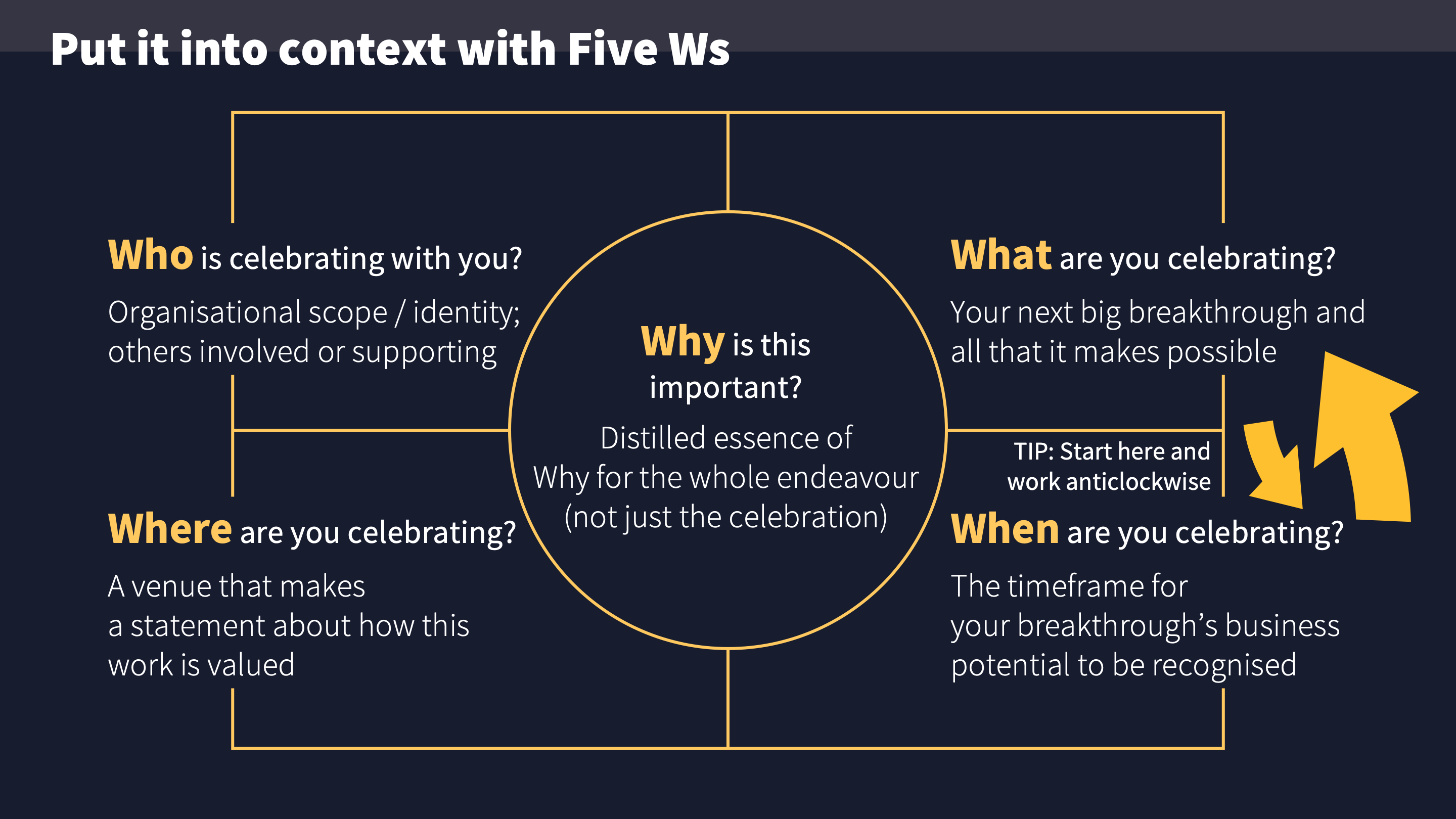
Celebration-5W is Agendashift’s trusty and energising context-capturing kickoff exercise. I say “trusty”, because I don’t think I have ever experienced a workshop that used it suffer for lack of context, and there have been times when I have regretted not using it. But could it be used inappropriately?

Before answering that question, a reminder of how it works. It’s in the genre of the time travel exercise, and its conceit is that you (by which I mean workshop participants) are using the journalistic 5W questions – Who, What, When, Where, Why – on the celebration you’re going to have when your next big breakthrough (one you haven’t made yet) is ready to be celebrated.

So, when shouldn’t you use it?

First, what is context? Here I mean it in the sense of what participants need to understand in common in order to have a productive conversation, and it lives at the intersection of situation and scope. If that is well enough established by the invitation and/or prework (an Agendashift assessment for example), you might not need it.

Then there are tradeoffs to consider. A narrower context is easier to understand, and for those for whom it is relevant, easier to engage with. The flip side of course is that for others, a narrower context can exclude people, perhaps unhelpfully. Conversely, a broader context engages more people but possibly at the cost of a more challenging experience.

Before choosing a context exercise or designing one, ask yourself the following:

  • Could it be that context will be well enough established already?
  • If we need to narrow (or possibly broaden) context, which dimension needs the most adjustment: scope or situation?

Perhaps to narrow the organisational scope would be to prejudge the outcome. Perhaps the situation deserves broad and diverse representation. Perhaps the same issues impact on different parts of the organisation in very different ways, but still the opportunity to explore them from different directions will be helpful. Perhaps the concept to be explored is sufficiently independent of scale that it is applicable to every scope.

“Perhaps” – several of those there! What I am learning is that the more the situation, issue, or concept at the heart of the event can be seen as scale-independent, the less you need convergence on scope. For example, if you are focussing on something as general as leadership, an exercise that could have the effect of limiting organisational scope might do more harm than good; stories of “leadership at every level” might be a much better starting point. Conversely, process and process-related issues don’t scale well, in which case an exercise like Celebration-5W should get you off to a great start. If it brings multiple scopes into play such that they can learn from each other, so much the better!

How does play out in Leading with Outcomes? Because it emphasises patterns over tools, Leading with Outcomes: Foundation doesn’t use Celebration-5W; it does however ask the question “What and who are we dealing with?”. Adaptive Organisation: Business agility at every scale doesn’t use it either, but for a very different reason: the fractal model at its heart is scale-independent, and to consider how that works at (and between) multiple scopes and scales simultaneously (“everywhere all at once”) is very much the point. Inside-out Strategy: Fit for maximum impact and Outside-in Strategy: Positioned for success do use it; if there is an inside and an outside, scope matters, and we might as well settle on it (or them) early.

Related:


Upcoming events

February

March

*TTT/F and (where shown) LIKE events include free one-year membership of the Leading with Outcomes Authorised Facilitator programme, upgradeable to Authorised Trainer at any time. Both of those include access to the video-based Leading with Outcomes training and the full range of Agendashift assessment tools.


Leading with Outcomes from the Agendashift Academy
“Leadership and strategy in the transforming organisation”

Leading with Outcomes is our modular curriculum in leadership and organisation development. Each module is available as self-paced online training or as private, instructor-led training (online or in-person). Certificates of completion or participation according to format. Its modules in the recommended order:

  1. Foundation module:
  2. Inside-out Strategy:
  3. Adaptive Organisation:
  4. Outside-in Strategy:

Individual subscriptions from £24.50 £18.40 per month after a 7-day free trial, with discounts available for employees and employers in the government, healthcare, education, and non-profit sectors. For bulk subscriptions, ask for our Agendashift for Business brochure.

To deliver Leading with Outcomes training or workshops yourself, see our Authorised Trainer and Authorised Facilitator programmes. See our events calendar for Train-the-Trainer / Facilitator (TTT/F) and Leading in a Transforming Organisation trainings.


Agendashift™: Serving the transforming organisation
Links: Home | Subscribe | Events | Media | Contact | Mike

Agendashift  Academy: Leading with Outcomes | Trainer and Facilitator Programmes | Store

At every scope and scale, developing strategy together, pursuing strategy together, outcomes before solutions, working backwards (“right to left”) from key moments of impact and learning.

Agendashift roundup, July 2023

In this edition: Foundation re-recorded and re-platformed; Looking ahead to the autumn season; Top posts

Foundation re-recorded and re-platformed

Leading with Outcomes: Foundation version 2.8 beta is now out on a different platform to the previously-recorded version, 2.1. As an experiment, the newer one is to be found not on the current learning management system (LMS), but on the community site for Agendashift Academy subscribers. The latter’s underlying platform is itself developing as an LMS and it presents therefore a consolidation opportunity.

Of the several iterations of Foundation so far, this is the one most influenced by the experience of trainers delivering it in person. It is definitely a smoother experience – 12 minutes shorter for no loss of content!

I’ll remove the beta tag when I have finished adding captions, which I’ll release one video at a time. AI does a decent first approximation but I still take the trouble to edit them manually.

With more about what to expect, some related posts:

And to sign up:

Looking ahead to the autumn season

September, October, November, December. Ok, December isn’t really autumn, and neither are the preceding months if you’re in the southern hemisphere (to which I am headed), but it will do!

September and December bring different opportunities to do Train-the-Trainer / Facilitator (TTT/F):

Those are, respectively, the last chance to do TTT/F online this year, and the first to be held in person. Between those two, I’m doing Leading in a Transforming Organisation on opposite sides of the world:

These events are driving forward the Foundation and Adaptive Organisation modules (one day of the former, two days of the latter), and it has been a delight to see how well they go together – hence the abovementioned resequencing. If you have any interest in what it means to lead in an organisation that is transforming (and what organisation isn’t?), join us!

While we’re here, there is no August webinar/AMA session. Not too long to wait though:

Top posts

  1. Explaining the “unreasonable effectiveness” of Agile (July)
  2. Three ways to understand the Leading with Outcomes universe (June)
  3. The wholeheartedness equation (June)
  4. My favourite Clean Language question (January 2019)
  5. Avoiding the disaster that is ‘solution-driven’ (June)

Leading with Outcomes from the Agendashift Academy
“Leadership and strategy in the transforming organisation”

Leading with Outcomes is our modular curriculum in leadership and organisation development. Each module is available as self-paced online training or as private, instructor-led training (online or in-person). Certificates of completion or participation according to format. Its modules in the recommended order:

  1. Foundation module:
  2. Inside-out Strategy:
  3. Adaptive Organisation:
  4. Outside-in Strategy:

Individual subscriptions from £24.50 £18.40 per month after a 7-day free trial, with discounts available for employees and employers in the government, healthcare, education, and non-profit sectors. For bulk subscriptions, ask for our Agendashift for Business brochure.

To deliver Leading with Outcomes training or workshops yourself, see our Authorised Trainer and Authorised Facilitator programmes. See our events calendar for Train-the-Trainer / Facilitator (TTT/F) and Leading in a Transforming Organisation trainings.


Agendashift™: Serving the transforming organisation
Links: Home | Subscribe | Events | Media | Contact | Mike

Agendashift  Academy: Leading with Outcomes | Trainer and Facilitator Programmes | Store

At every scope and scale, developing strategy together, pursuing strategy together, outcomes before solutions, working backwards (“right to left”) from key moments of impact and learning.

Resequencing Leading with Outcomes, what’s next, and how you can help

[Discuss on LinkedIn]

Following the success of June’s first 3-day Leading in a Transforming Organisation, I’m initiating a resequencing of the Leading with Outcomes curriculum. It will take a while to implement in full (in particular, re-recording video-based content takes time, and I won’t be doing that for this reason alone), but consider this now the recommended flow:

  1. Leading with Outcomes: Foundation
  2. Adaptive Organisation, two parts:
    • Part I: Business agility at every scale
    • Part II: Between spaces, scopes, and scales
  3. Inside-out Strategy: Fit for maximum impact
  4. Outside-in Strategy: Positioned for success

Basically, the Adaptive Organisation module moves up from last to second. Not only had I overestimated its reliance on Inside-out and Outside-in, I had greatly underestimated just how well Foundation and Adaptive Organisation go together. Foundation introduces the metaphor of the wholehearted organisation [1]; Adaptive Organisation provides a model [2] of how it might be pursued. Foundation introduces three key patterns [3] for the integrated development and pursuit of strategy; Adaptive Organisation builds on those, both conceptually and practically.

Viewed from the perspective of skills [4], the progression still seems natural. Adaptive Organisation does introduce some tools not seen in Foundation, but they play a supporting role, not the focal role they play in Inside-out and Outside-in. And I’m looking forward to discovering what it feels like to do (or in my case, re-record) those explicitly strategy-related modules with Adaptive Organisation as their platform.

Aside: Self-paced study or group participation?

Same excellent content, very different experiences, and not a binary choice! Subscribe to the Agendashift Academy and not only will you gain access to all four modules, but for monthly and yearly subscriptions you’ll get discounts of (respectively) 10% and 25% on the following:

These aren’t so far away, so why not use the summer for study?

What’s next, and how you can help

My next chunk of development work (internally-funded and for the benefit of all authorised facilitators, not done on the client’s clock) is to take the Adaptive Organisation training module and extract from it a 1-day workshop. Essentially a more model-driven version of the tried-and-tested Agendashift Assessment Debrief workshop, it will carry over some of the themes and purposes of the training. It will help participants to look below the surface of process and practice and to see deeper organisational relationships, the imbalances, contradictions, and other dysfunctions that plague them, and the constraints within which they operate. As well as putting things like Lean, Agile and business agility into broader organisational context – interesting in itself [5] – it will be, like everything we do, fully aligned to the following objective:

“At every scope and scale, developing strategy together, pursuing strategy together, outcomes before solutions, working backwards (“right to left”) from key moments of impact and learning.”

How you can help: With special emphasis on “the constraints within which they operate”, I would like to test this new workshop in a real-world setting, ideally before I take Leading in a Transforming Organisation to Australia in October. If it could be of interest to your organisation, you’re based anywhere in the UK or somewhere easily reachable from Manchester Airport, and you can get 6-15 people together for a day in September that works for all of us, I will be glad to facilitate the online assessment and in-person workshop at a very meaningful discount. If that’s you, get in touch.

References

[1] The wholeheartedness equation (June)
[2] Everywhere all at once: Introducing the Deliberately Adaptive Organisation, an accessible, situational, and complexity-aware presentation of the Viable System Model (agendashift.com)
[3] Picturing Foundation (May)
[4] Three ways to understand the Leading with Outcomes universe (June)
[5] Explaining the “unreasonable effectiveness” of Agile (July)

[Discuss on LinkedIn]


Upcoming events

February

March

*TTT/F and (where shown) LIKE events include free one-year membership of the Leading with Outcomes Authorised Facilitator programme, upgradeable to Authorised Trainer at any time. Both of those include access to the video-based Leading with Outcomes training and the full range of Agendashift assessment tools.


Leading with Outcomes from the Agendashift Academy
“Leadership and strategy in the transforming organisation”

Leading with Outcomes is our modular curriculum in leadership and organisation development. Each module is available as self-paced online training or as private, instructor-led training (online or in-person). Certificates of completion or participation according to format. Its modules in the recommended order:

  1. Foundation module:
  2. Inside-out Strategy:
  3. Adaptive Organisation:
  4. Outside-in Strategy:

Individual subscriptions from £24.50 £18.40 per month after a 7-day free trial, with discounts available for employees and employers in the government, healthcare, education, and non-profit sectors. For bulk subscriptions, ask for our Agendashift for Business brochure.

To deliver Leading with Outcomes training or workshops yourself, see our Authorised Trainer and Authorised Facilitator programmes. See our events calendar for Train-the-Trainer / Facilitator (TTT/F) and Leading in a Transforming Organisation trainings.


Agendashift™: Serving the transforming organisation
Links: Home | Subscribe | Events | Media | Contact | Mike

Agendashift  Academy: Leading with Outcomes | Trainer and Facilitator Programmes | Store

At every scope and scale, developing strategy together, pursuing strategy together, outcomes before solutions, working backwards (“right to left”) from key moments of impact and learning.

Explaining the “unreasonable effectiveness” of Agile

Anyone who has worked in an environment where Agile is working well will agree: when it’s great, it’s really great. However, this post is not about what separates the great from the mediocre or worse (for that I would recommend my 2019 book Right to Left), but about Agile’s impact on the organisation more broadly.

Agile’s benefits are usually touted in terms of things like these:

  • Delivery speed (“twice the work in half the time”)
  • Rate of learning, enabled by incremental and iterative delivery coupled with regular reflection
  • Ability to adapt (“responding to change over following a plan”)
  • Customer satisfaction, enabled by the above

Don’t worry, I’m not about to say that there’s anything wrong with any of these. Notice however how all but the last one are about what’s happening in the team or value stream, and as is so often the case with things Agile-related, none of them have anything at all to say about the wider organisation.

This has long bothered me, but for once I am going to be positive about that poorly understood relationship. What if Agile’s “unreasonable success” (when it happens) could be traced to organisational effects attributable to the Agile manifesto’s emphasis on “individuals and interactions”?

Starting with the team:

  • Improvements to communication and decision-making capacity at team level encourage self-organisation and other emergent behaviours (this relationship has been observed for decades)

Then the overlooked but very significant second-order benefit:

  • The decision-making burden on the surrounding organisation is thereby reduced, increasing both its available decision-making capacity and the possibility of emergent outcomes at larger scales

More succinctly: Agile increases its surrounding organisation’s decision-making capacity. What it does with that is of course down to the organisation itself, but it’s interesting that if its communication capacity is correspondingly good (or correspondingly improved), emergent outcomes are made very much more likely. Nice, and without any mention of process, not the easiest of things to scale!

A couple of parallels:

  • Channeling Modig & Åhlström’s This is Lean, we might describe Agile as “a strategy for improving an organisation’s decision-making capacity”
  • Skelton & Pais’s Team Topologies talks of “reducing cognitive load”. It’s written more with team-level benefits in mind I think, but it’s an excellent starting point

To the first of those (and perhaps the second), it wouldn’t be completely wrong to describe Lean or Lean-Agile in those terms either. But that ship has sailed, and flow remains an important concept even if waste and its elimination lack something in attractiveness if not generativity.

Happily for me, I am free (within reason) to describe the Deliberately Adaptive Organisation in whatever way I like. Already, this idea of “improving an organisation’s decision-making capacity” is one of its key concerns.

Learn more:


Upcoming events

February

March

*TTT/F and (where shown) LIKE events include free one-year membership of the Leading with Outcomes Authorised Facilitator programme, upgradeable to Authorised Trainer at any time. Both of those include access to the video-based Leading with Outcomes training and the full range of Agendashift assessment tools.


Leading with Outcomes from the Agendashift Academy
“Leadership and strategy in the transforming organisation”

Leading with Outcomes is our modular curriculum in leadership and organisation development. Each module is available as self-paced online training or as private, instructor-led training (online or in-person). Certificates of completion or participation according to format. Its modules in the recommended order:

  1. Foundation module:
  2. Inside-out Strategy:
  3. Adaptive Organisation:
  4. Outside-in Strategy:

Individual subscriptions from £24.50 £18.40 per month after a 7-day free trial, with discounts available for employees and employers in the government, healthcare, education, and non-profit sectors. For bulk subscriptions, ask for our Agendashift for Business brochure.

To deliver Leading with Outcomes training or workshops yourself, see our Authorised Trainer and Authorised Facilitator programmes. See our events calendar for Train-the-Trainer / Facilitator (TTT/F) and Leading in a Transforming Organisation trainings.


Agendashift™: Serving the transforming organisation
Links: Home | Subscribe | Events | Media | Contact | Mike

Agendashift  Academy: Leading with Outcomes | Trainer and Facilitator Programmes | Store

At every scope and scale, developing strategy together, pursuing strategy together, outcomes before solutions, working backwards (“right to left”) from key moments of impact and learning.

Developing & pursuing strategy in the language of outcomes