Excellent response to last week’s #2MBM: Meaning before Metric, Measure before Method! Before the main business of this post, a couple of updates:
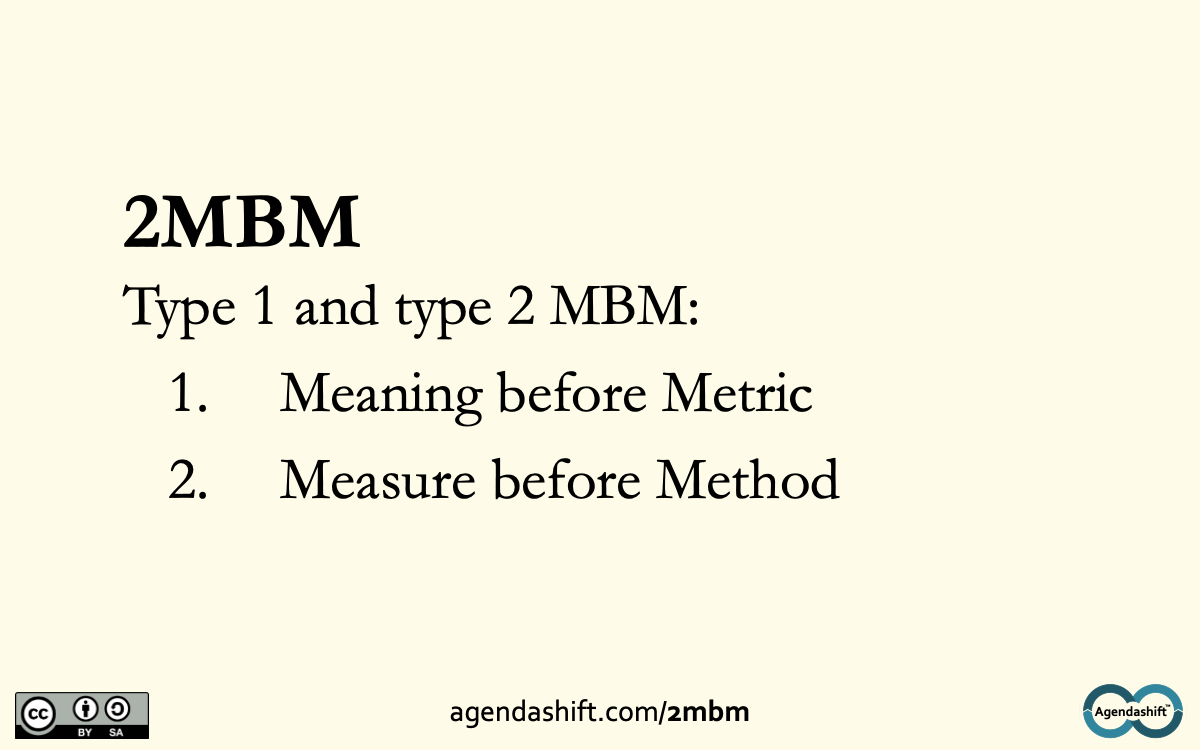
- In the interests of referenceability (if that’s a word) I’ve since given it a url: agendashift.com/2mbm (as shown in the image below) redirects to agendashift.com/frameworks/patterns/2mbm
- In the patterns pages, I’ve incorporated 2MBM into the definition of Right to Left:
Right to Left: Ends before means, outcomes before solutions, and the two MBMs – meaning before metric and measure before method (2MBM)
Last week’s post was about keeping metrics in their proper place with respect to strategy and ideation. This one is about the use of metrics as the strategy swings into action, the ideas continue to flow, and so on.
I’ve hinted already that you probably want a multiplicity of metrics. Chapter 5 of Right to Left gives some suggestions, and they’re organised by the layers of the outside-in strategy review, or OI-SR (as practiced in the Wholehearted:OKR workshop and as supported by the free OI-SR template):
- Customer: Customer satisfaction; helpdesk calls and hours spent on them; customer complaints, endorsements, and reviews; user growth and retention
- Organisation: Financial metrics, progress against relevant organisational objectives, and so on
- Product: Usage analytics; funnel metrics; market comparisons
- Platform: System performance and capacity metrics (along with plans to keep capacity ahead of anticipated demand – another good reason for the outside-in review); new capabilities and capabilities under development
- Team: Lead time distribution, throughput, and work in progress; quality metrics (defects escaped to production, for example); data on blockers and their impact; staffing levels; skill distribution and development
That’s quite a long list, beyond the capacity of most people to maintain on their own, and to be clear, they’re only suggestions. Both to make it practical and to help avoid the oppressive imposition of metrics:
- Each layer is represented by one or two people (two being preferable, creating mentoring opportunities and making it easier to broaden the range of seniorities involved in the meeting overall), each closely identified with their respective layer(s)
- The choice of which metrics will be presented is theirs (and by extension, their respective team’s¹); the meeting’s facilitator can coordinate across layers to help ensure good coverage
In the outside-in service delivery review (OI-SDR), those layers define the top-level agenda. The sequence helps to expose any misalignment between what we’re trying to achieve and the work we’re actually doing – not just within each layer but with respect to what’s been heard already. Within each layer, we go right to left:
- A narrative update that includes an affirmation of we’re trying to achieve
- What this layer’s metrics seem to be telling us
- What has been learned from our experiments completed since last time
- What experiments we currently have up and running and what we hope to learn
- What’s in the pipeline
I was asked in a meetup last night what I would do if I could implement only one thing. Five years ago, I might have answered with “Validation”; today, my answer is the OI-SDR. It’s a piece of deliberate organisation design, building in the strong organisational expectation that learning will be happening – learning about our customers and learning about ourselves. An opportunity for double loop learning. And to do it justice, you’ll soon be practicing validation anyway!
Find out more
The OI-SR and OI-SDR are described in chapter 5 of Right to Left: The digital leader’s guide to Lean and Agile. Available in the usual places and (since May) as an audiobook.
Check out the workshops pages also – not just for Wholehearted:OKR and other strategy workshops but also for Implementing your OI-SDR among the short training workshops.
¹ ‘Circle‘ might be a better word than ‘team’ here. I’m alluding to Sociocracy, and that’s covered in Right to Left chapter 6.
Related posts:
- The audiobook is out! Right to Left: The digital leader’s guide to Lean and Agile (May)
- Wholehearted:OKR (December 2019)
- It’s out! Right to Left: The digital leader’s guide to Lean and Agile
Upcoming events
February
- 18 February, Online, 16:00 GMT, 17:00 CET, 11am ET, Agile Strategy Meetup Group:
Meet Mike Burrows on strategy - 24-27 February, four 4-hour sessions online, afternoons UK time:
Leading with Outcomes: Train-the-Trainer / Facilitator (TTT/F)*
March
- 06 March, London, UK:
Kanban Edge 2025
*TTT/F and (where shown) LIKE events include free one-year membership of the Leading with Outcomes Authorised Facilitator programme, upgradeable to Authorised Trainer at any time. Both of those include access to the video-based Leading with Outcomes training and the full range of Agendashift assessment tools.
Leading with Outcomes from the Agendashift Academy
“Leadership and strategy in the transforming organisation”
Leading with Outcomes is our modular curriculum in leadership and organisation development. Each module is available as self-paced online training or as private, instructor-led training (online or in-person). Certificates of completion or participation according to format. Its modules in the recommended order:
- Foundation module:
- Inside-out Strategy:
- Adaptive Organisation:
- Outside-in Strategy:
Individual subscriptions from £24.50 £18.40 per month after a 7-day free trial, with discounts available for employees and employers in the government, healthcare, education, and non-profit sectors. For bulk subscriptions, ask for our Agendashift for Business brochure.
To deliver Leading with Outcomes training or workshops yourself, see our Authorised Trainer and Authorised Facilitator programmes. See our events calendar for Train-the-Trainer / Facilitator (TTT/F) and Leading in a Transforming Organisation trainings.
Agendashift™: Serving the transforming organisation
Links: Home | Subscribe | Events | Media | Contact | Mike
Agendashift Academy: Leading with Outcomes | Trainer and Facilitator Programmes | Store
At every scope and scale, developing strategy together, pursuing strategy together, outcomes before solutions, working backwards (“right to left”) from key moments of impact and learning.

 Agendashift