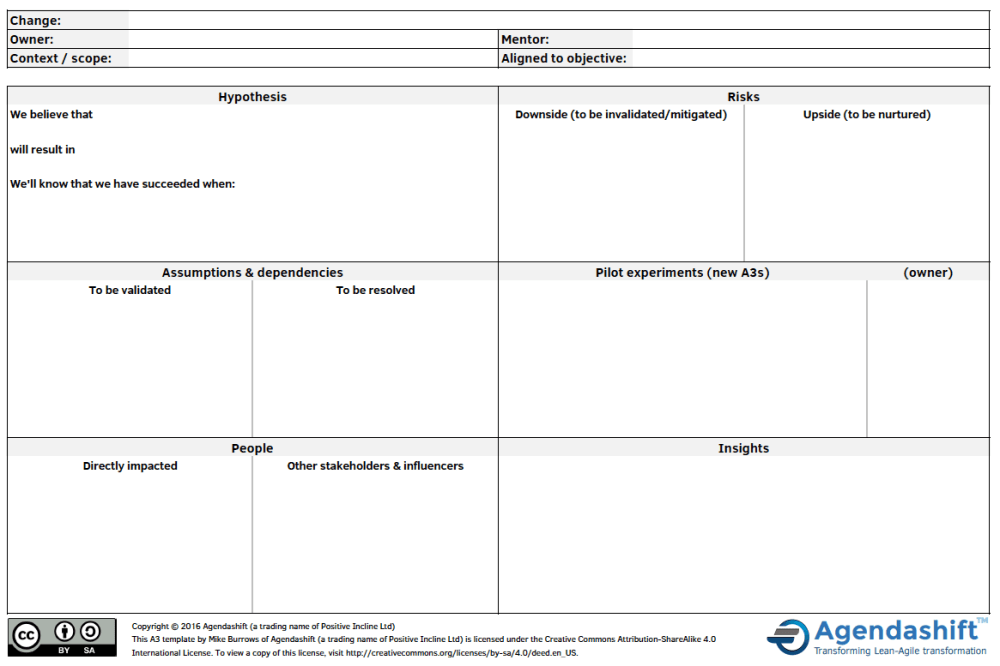
A3 template for hypothesis-driven change

[Update 23-Sep-2019: The version shown here has been updated a few times since publication. The latest version of this and several other Creative Commons resources may now be found at agendashift.com/resources; clicking on the image below now takes you to the relevant resource page]

[Update 10-Aug-2016: The latest version is still downloadable here; see Outcomes, alignment, and changes to our A3 template for a description of recent changes]

As mentioned in On not teaching PDCA, I’ve been using an A3 template in my training classes and debrief/action workshops. I’m now releasing under the same model as Featureban – I’ve given it a Creative Commons Attribution-ShareAlike license, you can download the PDF here, and drop me a line for the original .xlsx file if you want to translate it or adapt it in some other way.

I typically cover it in this order:

  1. Hypothesis
  2. Assumptions & Dependencies
  3. Pilot Experiments (potentially spawning new A3’s)
  4. Risks
  5. Pilot Experiments (again, if prompted by the risks)
  6. People
  7. Insights.

Enjoy!

Screenshot 2016-08-10 10.46.46.png


What if we put agreement on outcomes ahead of solutions?

Agendashift™: Serving the transforming organisation
Agendashift  Academy: Leading with OutcomesHome | Store

Links: Home | Subscribe | Become an Agendashift partner Events | Contact | Mike
Resources: Tools & Materials | Media | Books | Assessments
Blog: Monthly roundups | Classic posts
Community: Slack | LinkedIn group | Twitter

What does the coin represent?

We’re about to play Featureban and we’ve reached the coin slide.

coin-toss
Redwood Photography, via Flickr CC BY-ND 2.0

“Everybody needs a coin – have you got one (or access to one)?”

Inevitably, some borrowing and lending ensues. “An exercise in trust, this bit!”

“Can you think what the what your coins might represent?”

Chance, you say? Decisions?

Those are both good answers, but not precisely the one I was looking for. Apologies for using a piece of jargon (we really do try to keep that to an absolute minimum), but the coin is a source of what we call ‘variation’.

I’m sure that nothing like this never happens in your company, but let me tell you about an effect I’ve noticed elsewhere. Sometimes, a 1-day piece of work becomes a 2-day, 3-day, even 8-day piece of work. Something we thought would take a day, takes eight! Shocking, isn’t it! But you never see it here, right?

Joking aside, it should not be surprising that in our line of work we see plenty of variation. How often do we start a piece of work with just a sticky note or email’s worth of information? Does anyone really know at this stage what’s involved? Of course not. And even after we dig into it, there are always new things to discover (it’s not called ‘knowledge work’ for nothing), dependencies to manage, people changing their minds (for good reasons as well as bad), bugs, absences (planned and unplanned), and so on.

Would it not make sense then to manage our work using systems that comfortably deal with variation – embrace it even – as opposed to pretending that it doesn’t exist or unfairly blaming people when it manifests itself? That’s what we’re going to experience in our game.

Some of you will get frustrated by this variation. Use that feeling! We’ll learn how to go about doing something about it too.

Footnote

In all fairness to Mr Deming (see On not teaching PDCA for why I have some making up to do), variation is a word forever associated with the great man. “Understanding variation” is part 2 of his 4-part System of Profound Knowledge.


What if we put agreement on outcomes ahead of solutions?

Agendashift™: Serving the transforming organisation
Agendashift  Academy: Leading with OutcomesHome | Store

Links: Home | Subscribe | Become an Agendashift partner Events | Contact | Mike
Resources: Tools & Materials | Media | Books | Assessments
Blog: Monthly roundups | Classic posts
Community: Slack | LinkedIn group | Twitter

Featureban’s new home

The Featureban game – a simple, fun, and highly customisable kanban simulation game – now has its very own page on agendashift.com. Any significant updates will be posted here on the Agendashift blog; join the Agendashift LinkedIn group to be sure of not missing anything.

Last week in Moscow I facilitated six concurrent games at Lean Kanban Russia 2015. We then used the game as our base scenario for a series of exercises on hypothesis-driven change, connected by an Agendashift assessment online. The two sessions together make up the morning half of our 1-day introductory workshop in Values-based change with Agendashift and the Kanban Method. You want a quick workshop? We can do it!

Visit now: Featureban facilitation information and downloads. Not only is Featureban free, it is published under a Creative Commons license and is easily adaptable to your needs. Enjoy!


Agendashift-cover-thumb
Blog: Monthly roundups | Classic posts

Links: 
Home | Partner programme | Resources | ContactMike
Community: Slack | LinkedIn group | Twitter