In this edition: Adaptive Organisation; 15-minute FOTO; New podcast interview; More free sessions; Train-the-Trainer / Facilitator (TTT/F); Top posts
Adaptive Organisation
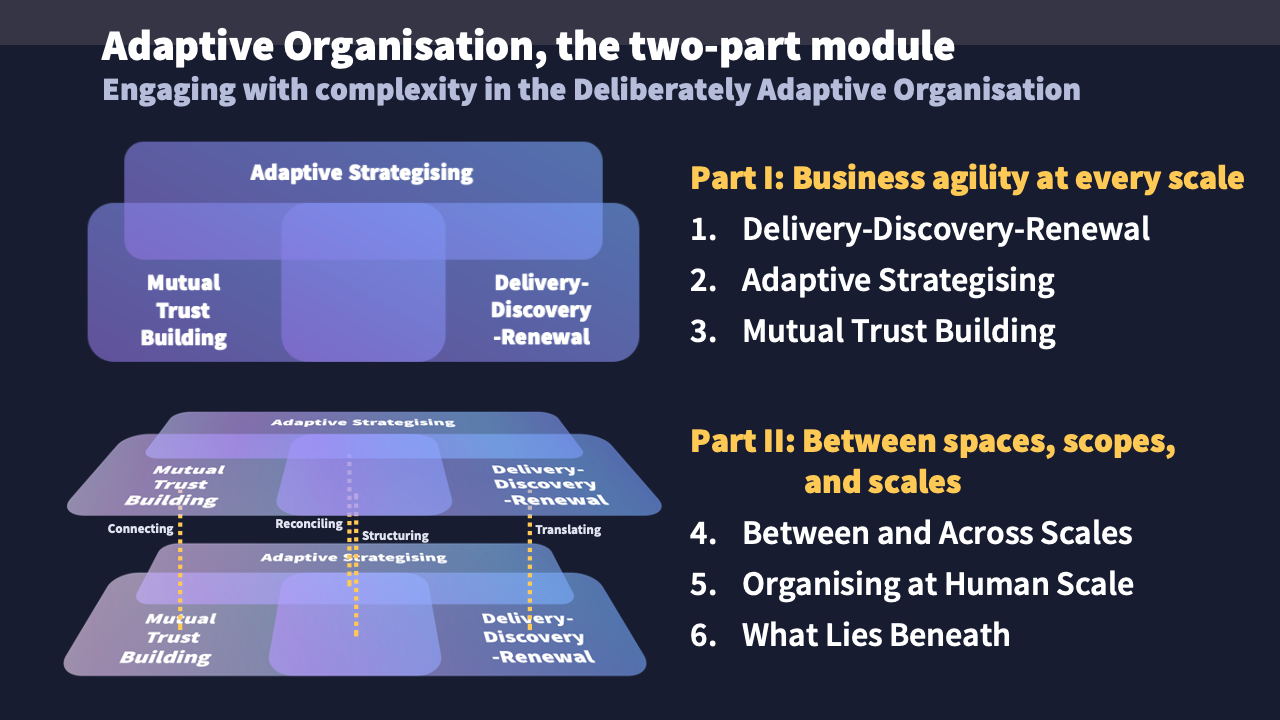
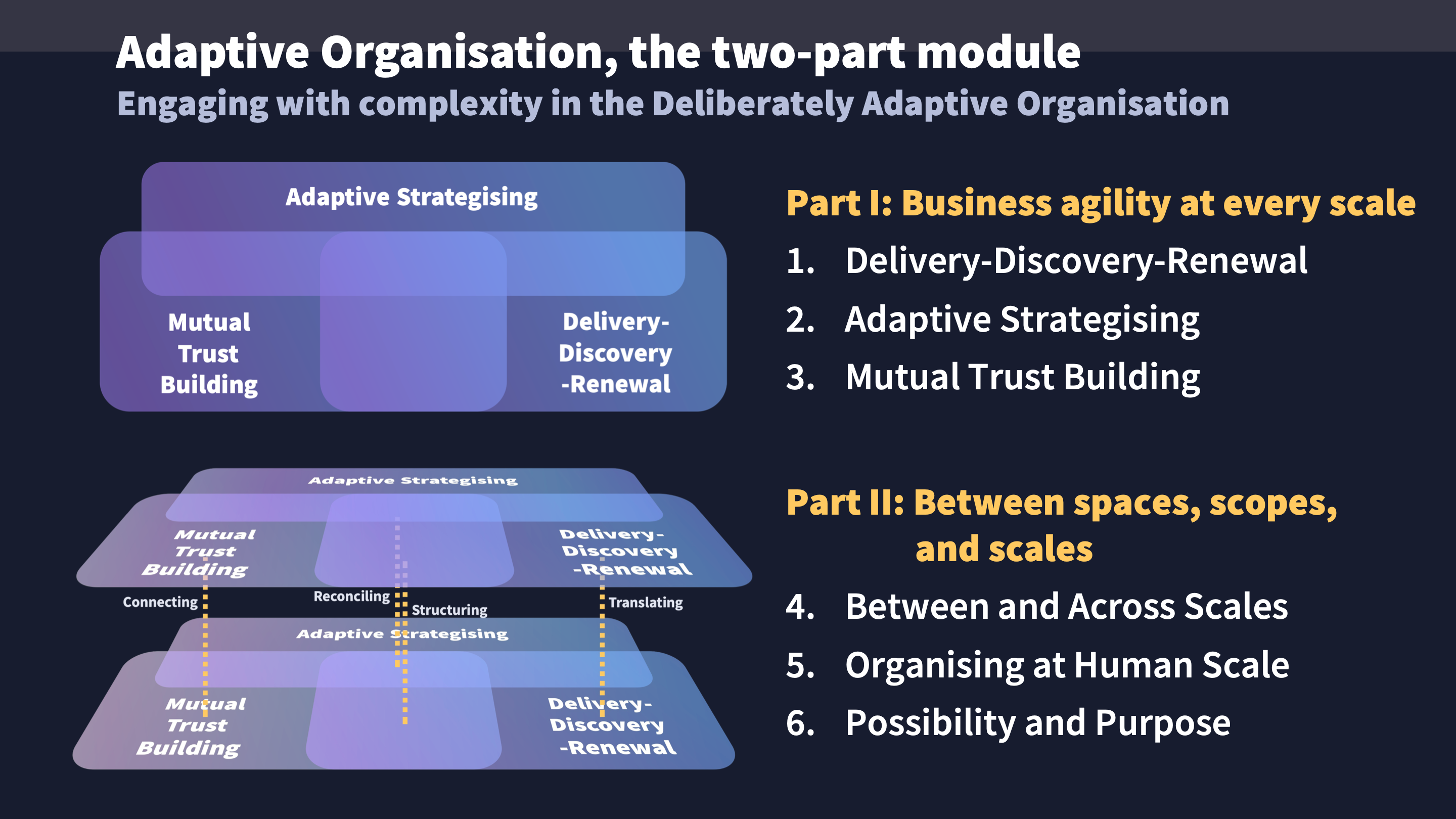
There is plenty to report here! Let’s begin with its online, self-paced version. Now that I’ve finished hand-editing the captions on all of its videos, Adaptive Organisation (II) is out of beta. That’s both parts now:
With regard to the in-person experience, the Leading in a Transforming Organisation training (Foundation and Adaptive Organisation combined) goes from strength to strength. Thought’s on this month’s training in Manchester:
Each of these events generates a further flurry of activity. Trainers now have access to post-Manchester decks and handouts for Adaptive Organisation parts I & II. For Facilitators, an update to the Adaptive Organisation workshop will follow as soon as I have synced the handout with the deck – not a huge task but I begin my travels to India shortly.
I’m looking to do at least two more of these in the UK next year, and maybe a couple of in mainland Europe also. If you have thoughts on bringing it to your city, get in touch! Similarly for the 1-day workshop (only privately for the time being, introductory pricing between now and the end of January).
15-minute FOTO
A couple of updates to our Clean Language-based coaching game 15-minute FOTO:
Gaël Mareau has kindly contributed a French language cue card – merci beaucoup Gaël!
During my trip to India I’ll be testing a number of usability improvements (none of them major, but they add up), so expect a new release in the next couple of weeks
Leading with Outcomes from the Agendashift Academy “Leadership and strategy in the transforming organisation”
Leading with Outcomes is our modular curriculum in leadership and organisation development. Each module is available as self-paced online training or as private, instructor-led training (online or in-person). Certificates of completion or participation according to format. Its modules in the recommended order:
Individual subscriptions from £24.50 £18.40 per month after a 7-day free trial, with discounts available for employees and employers in the government, healthcare, education, and non-profit sectors. For bulk subscriptions, ask for our Agendashift for Business brochure.
To deliver Leading with Outcomes training or workshops yourself, see our Authorised Trainer and Authorised Facilitator programmes. See our events calendar for Train-the-Trainer / Facilitator (TTT/F) and Leading in a Transforming Organisation trainings.
At every scope and scale, developing strategy together, pursuing strategy together, outcomes before solutions, working backwards (“right to left”) from key moments of impact and learning.
What was it? How did it go? What next? Where next?
What was it?
A three-day, in-person training, Leading in a Transforming Organisation: Engaging with complexity in the Deliberately Adaptive Organisation, which brings together roughly half of the Leading with Outcomes curriculum:
Day 1: Leading with Outcomes: Foundation – exploring what it means to lead in a transforming organisation, learning how to develop and pursue strategy in the language of outcomes and with high participation
The Deliberately Adaptive Organisation is my 21st century take on a 20th century model, Stafford Beer’s Viable System Model. Fittingly, a fractal model of organisation meets a fractal model of engagement, the former approached in a relational and constraints-based way, the latter replacing the engineering approach more typically employed. These two aspects combine to make something accessible, complexity-friendly, and practical.
For an added bonus, Leading in a Transforming Organisation has by design enough experiential content that with some additional online learning it can serve also as an alternative to Leading with Outcomes Train-the-Trainer / Facilitator (TTT/F). At least a couple of participants attended with that purpose in mind.
How did it go?
A small sample of the overwhelmingly positive feedback:
Relevant to anyone with leadership responsibilities
A helpful journey through the neglected responsibilities of leadership – with helpful tools to attend to those responsibilities
A full learning experience – relevant, effective, great to share with others
Building on a journey throughout, in a practical, visual way
Can clearly see how this would apply to our organisation
This is the Leading with Outcomes masterclass
There were things I would change – in fact on day 3 we tested an impromptu change to how we finished each “chapter”, a change that I have since made to the materials for day 2 also. Quicker, more impactful, and more clearly setting off the two “interludes”, those being the opportunities to practice classic Agendashift exercises such as Good Obstacle, Bad Obstacle, 15-minute FOTO, and various ways to (per the second slide above) “Organise the strategy”.
I was pleased that after some post-London rework, certain themes came out much more strongly:
The value in a bottom-up understanding of organising – not that it doesn’t also work top down, but a bottom-up understanding is essential if you want to go with the grain of emergence and self-organisation or to promote those at non-trivial scales
The question of How might we increase our decision-making capacity? came up repeatedly. Important again for reasons (i) of self-organisation (ref McCulloch), (ii) because the time will come when you don’t have enough of it, and (iii) because it reframes in an interesting and positive way concepts such as reducing waste (Lean) and minimising cognitive load (Team Topologies)
The importance of context – not only in the senses (i) that it is folly to impose solutions from foreign contexts unquestioningly, or (ii) that context affects relationships, but (iii) in the sense that our delivery work and our strategic decision making will both suffer for lack of it – almost inevitably if we rest more than we should on formal structure, agreed process, and established communication paths
As anticipated in previous posts, Agile coaches were very much in the minority. Our hosts were the University of Manchester (a big thank you to Andrea Place for organising), several of the participants were members of staff with leadership and/or leadership development responsibility, and on day 1 we were joined by a senior leader from another university. It was fascinating to see the models, tools, and exercises applied not to a technology organisation but to a highly respected institution that celebrates its bicentenary next year. I find it very hard to believe that a process-based approach – process meant here in the Agile or Lean sense, not the OD sense – would have been anything like as successful.
What next? Where next?
With the event still fresh in my mind I updated the materials over the weekend. There are corresponding changes to be made to the shorter Adaptive Organisation Workshop, and they include changes to the What Lies Beneath string of exercises, whose blog post I have updated for reference already.
I won’t be re-recording the two-part online Adaptive Organisation module just yet (see Leading with Outcomes from the Agendashift Academy below for links). The existing version is still quite new, none of my most recent improvements invalidate in any way what’s there, and it’s more urgent that I re-record the much older Inside-out and Outside-in modules. Not only will it be good to realign those with the newer material, it will let me retire the old learning management system and thereby improve the Academy’s onboarding experience.
I’m hoping to run the three-day in-person event at least twice publicly in the UK next year. Very likely in London, and having taken it north to Manchester, I’m also looking at doing it somewhere between Bournemouth and Brighton on the south coast. Mainland Europe would be good too – Germany and/or Scandinavia seeming the most likely destinations. If you are interested in any of these options or any other (public or private), and especially if you can help get a group together (it doesn’t have to be large), let me know.
I intend to do the abovementioned 1-day Adaptive Organisation workshop in person a few times before I offer it online, in both cases only privately. Accordingly, introductory pricing (with further discounts for public sector, non-profit, etc) remains available until the end of January, possibly for delivery at a later date if you get your order in soon enough. Unless a longer trip can be made worthwhile, I’m looking to do it in the UK or in European destinations easily reachable from Manchester or East Midlands airports. If you’re suitably located and your organisation could use an organisational strategy exercise soon, there’s an opportunity here not to be missed.
Leading with Outcomes from the Agendashift Academy “Leadership and strategy in the transforming organisation”
Leading with Outcomes is our modular curriculum in leadership and organisation development. Each module is available as self-paced online training or as private, instructor-led training (online or in-person). Certificates of completion or participation according to format. Its modules in the recommended order:
Individual subscriptions from £24.50 £18.40 per month after a 7-day free trial, with discounts available for employees and employers in the government, healthcare, education, and non-profit sectors. For bulk subscriptions, ask for our Agendashift for Business brochure.
To deliver Leading with Outcomes training or workshops yourself, see our Authorised Trainer and Authorised Facilitator programmes. See our events calendar for Train-the-Trainer / Facilitator (TTT/F) and Leading in a Transforming Organisation trainings.
At every scope and scale, developing strategy together, pursuing strategy together, outcomes before solutions, working backwards (“right to left”) from key moments of impact and learning.
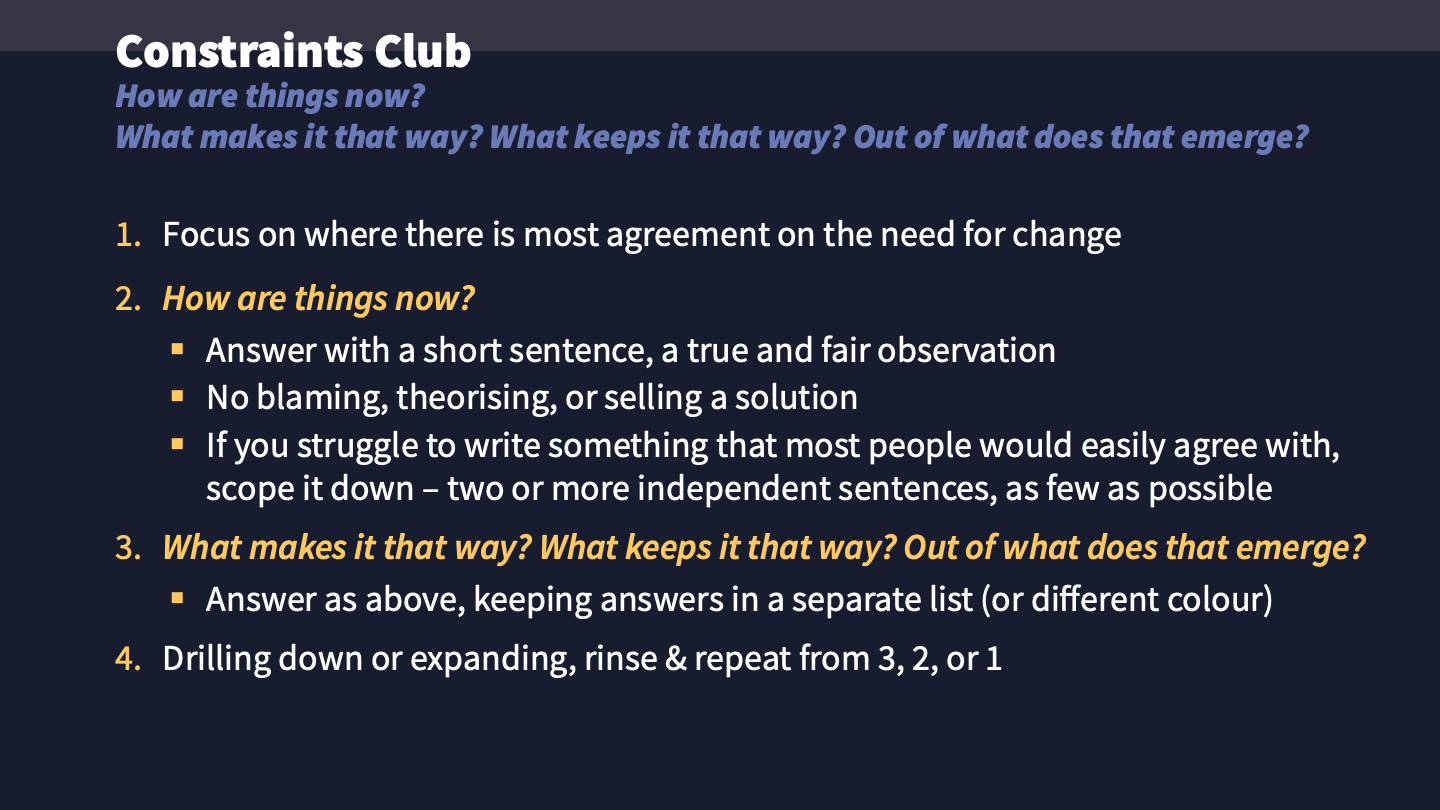
With a week to go to the Manchester training, let me mention a recent (post-Melbourne) update to the Constraints Club exercise. As you may recall, this forms part of the string of exercises described in some detail in the blog post What Lies Beneath (Spoiler: Constraints), which I have updated too.
For full context, read that post. Here though is the relevant slide, to which I have added the question “Out of what does that emerge?”:
About the Manchester training (see Upcoming events below), this is probably my last opportunity to mention the following:
1-day, 2-day and 3-day tickets available. Use BLOG20 for 20% off, and ping me if another discount might apply. There will be NHS and university staff attending – they and other public/educational/non-profit employees get at least 40% off.
It is not its primary purpose, but I should mention that as described on the event page and below, it offers a path to Authorised Leading with Outcomes Facilitator and Trainer also.
Leading with Outcomes from the Agendashift Academy “Leadership and strategy in the transforming organisation”
Leading with Outcomes is our modular curriculum in leadership and organisation development. Each module is available as self-paced online training or as private, instructor-led training (online or in-person). Certificates of completion or participation according to format. Its modules in the recommended order:
Individual subscriptions from £24.50 £18.40 per month after a 7-day free trial, with discounts available for employees and employers in the government, healthcare, education, and non-profit sectors. For bulk subscriptions, ask for our Agendashift for Business brochure.
To deliver Leading with Outcomes training or workshops yourself, see our Authorised Trainer and Authorised Facilitator programmes. See our events calendar for Train-the-Trainer / Facilitator (TTT/F) and Leading in a Transforming Organisation trainings.
At every scope and scale, developing strategy together, pursuing strategy together, outcomes before solutions, working backwards (“right to left”) from key moments of impact and learning.
In this edition: From Melbourne to Manchester; Adaptive Organisation workshops; Adaptive Organisation online; More free sessions; Train-the-Trainer / Facilitator (TTT/F) and alternatives; Top posts
From Melbourne to Manchester
It was a privilege to open the inaugural Kanban Australia – congratulations to Daniel Ploeg and the team there for putting on such a great event! The Leading in a Transforming Organisation training/workshop held the preceding week wasn’t as well attended as we might have liked, but it was highly productive nevertheless. Two blog posts describe some of what came out of it:
My eldest son moved to Sydney last year, so if anyone wants me back in Australia, count me in 🙂 Between training and conference we enjoyed the weekend together in Melbourne, and I joined him in Sydney afterwards.
Back in the UK, my youngest son lives in Manchester, and by pure coincidence that happens to be the location of the next Leading in a Transforming Organisation, which begins in two weeks on November 14th. Our hosts are the University of Manchester (thank you Andrea), and we have already the most diverse group of attendees signed up I have yet managed to assemble. There is still time to grab a place:
1-day, 2-day and 3-day tickets available. Use BLOG20 for 20% off, and ping me if another discount might apply. There will be NHS and university staff attending – they and other public/educational/non-profit employees get 40% off.
It is not its primary purpose, but I should mention that as described on the event page and below, it offers a path to Authorised Leading with Outcomes Facilitator and Trainer also.
Adaptive Organisation workshops
This new 1-day workshop takes the two-part Adaptive Organisation training module (two days of training when done in person, three days when taken with Foundation) and dials down the training dimension to make it all about the conversations your organisation needs to have with itself. Read more in the recent announcement:
For myself, I am offering this workshop only privately, initially with introductory pricing. The materials are available already to authorised Facilitators and Trainers, and if the latter want to experiment with offering it publicly, I won’t stand in their way.
Adaptive Organisation online
Quick updates on the online version of the two-part Adaptive Organisation module:
Adaptive Organisation (I): Business agility at every scale (version 2.0 beta) – all videos available, captions almost done (most are there, the last few expected today or tomorrow), workbook available in MS-Word format, Google Docs to follow
There is still some work to be done, but were you to start Foundation now, there’s a good chance that the beta tags will gone by the time you get to the above. Don’t wait for part 1 to get re-recorded as version 2.1 or later – that won’t happen until after the Inside-out and Outside-in strategy modules are re-recorded and I can retire the old learning management system, early 2024.
While we’re here, my Adaptive Organisation-related keynote gets an online airing on the 9th, courtesy Blackmetric’s BA community meetup (thank you Adrian Reed):
The first free experience/practice session took place last week. A lot to fit in the hour but we did it, just! The next of those and the existing webinar/AMA sessions, one of each per month:
Really glad to be revisiting India – I’ve been several times, thoroughly enjoyed it every time, and after Australia, it will be only my second trip abroad since covid!
I have pencilled in the next online TTT/F for February:
6-14 February, online, Tuesday & Wednesday afternoons (UK time): Train-the-Trainer / Facilitator (TTT/F) – to be confirmed
I’ll announce that separately when the booking page is up.
Together with some extra online study and an onboarding call, your alternative to TTT/F is the in-person Leading in a Transforming Organisation. If you would like me to hold one of those somewhere near you in 2024, please get in touch. I’m thinking a couple in the UK (London and perhaps the south coast) and in mainland Europe too (Germany and/or Sweden perhaps). I’m open to travelling further (ie North America and Asia) if numbers or other opportunities make the longer trip worthwhile.
Leading with Outcomes from the Agendashift Academy “Leadership and strategy in the transforming organisation”
Leading with Outcomes is our modular curriculum in leadership and organisation development. Each module is available as self-paced online training or as private, instructor-led training (online or in-person). Certificates of completion or participation according to format. Its modules in the recommended order:
Individual subscriptions from £24.50 £18.40 per month after a 7-day free trial, with discounts available for employees and employers in the government, healthcare, education, and non-profit sectors. For bulk subscriptions, ask for our Agendashift for Business brochure.
To deliver Leading with Outcomes training or workshops yourself, see our Authorised Trainer and Authorised Facilitator programmes. See our events calendar for Train-the-Trainer / Facilitator (TTT/F) and Leading in a Transforming Organisation trainings.
At every scope and scale, developing strategy together, pursuing strategy together, outcomes before solutions, working backwards (“right to left”) from key moments of impact and learning.
The immediate availability of the Leading with Outcomes Adaptive Organisation workshop
And closely related to that:
Adaptive Organisation (II): Between spaces, scopes and scales, v2.1 beta
Updates on Leading in a Transforming Organisation, Manchester
New experience/practice sessions begin next week
1. Announcing the immediate availability of the Leading with Outcomes Adaptive Organisation Workshop
This new 1-day workshop takes the two-part Adaptive Organisation training module (two days of training when done in person, three days when taken with Foundation) and dials down the training dimension to make it all about the conversations your organisation needs to have with itself.
It follows much the same structure as the training:
Introduction
Delivery-Discovery-Renewal – value-creating work and how it is coordinated and organised
Adaptive Strategising – keeping us in the game, strategising and self-governing
Mutual Trust Building – addressing the formal organisation’s deficit in information and decision-making capacity
Between and Across Scales – examining the relationships between scales of organisation
Organising at Human Scale – promoting adaptation, innovation, and learning at all scales
What Lies Beneath – dealing with organisational constraints
Points 1-5 above each correspond to a section of the Deliberately Adaptive Organisation assessment, and we’ll be working with that, making this a thorough health-check for your organisation. Per this recent blog post, the final part of the workshop takes it all forward into action, via some very interesting new tools for identifying and visualising organisational constraints.
The material has already been made available to authorised Leading with Outcomes facilitators and trainers. For myself, I am pleased to offer it in the form of a private, 1-day, in-person workshop. I charge a fixed rate for anywhere in mainland UK, and I make things as easy as I can for European destinations easily reachable from Manchester or East Midlands airport also. Outside those parameters – further afield, online, or spread over multiple days – let’s see what we can work out.
2. Adaptive Organisation (II): Between spaces, scopes and scales, v2.1 beta
I have already mentioned the two-part Adaptive Organisation training module on which the new workshop is based. This second announcement relates to its presentation in the form of online, video-based, self-paced training at the Agendashift Academy.
Following on from Adaptive Organisation (I): Business agility at every scale (v2.0 beta), I have released the first chapter of Adaptive Organisation (II): Between spaces, scopes and scales (v2.1 beta). Still to come in part II: two more chapters and an “interlude”, one of two windows into the in-person Leading in a Transforming Organisation. The beta tag will disappear when I’ve released all the videos and done their captions (still in progress for part I) and student workbook. Part I will at some point be re-recorded at version 2.1 or later but there is no great rush to do so – the two parts remain compatible.
Part I develops the Deliberately Adaptive Organisation, a model to describe any organisational scope at any scale (or many/all such scopes all at once!). Part II pays attention to issues of scale:
Relationships between scopes at different scales – between team and team-of-teams for example
The difficulty with which organisations adapt as scale increases
Identifying and managing organisational constraints
3. Updates on Leading in a Transforming Organisation: Manchester, 14-16 November
This will be my most diverse group yet at a public training. Thanks to staff from the NHS and two universities (three if you count former staff), it’s quite possible that consultants, coaches, and trainers won’t be in the majority. An experience to savour I think!
New this time: with some additional study, this event allows prospective trainers (not only facilitators) to bypass Train-the-Trainer / Facilitator (TTT/F); further information about that on the event page.
The material (shared with Adaptive Organisation parts I & II) can be considered well-tested now, even a joy to teach! Between London, Melbourne, and my preparations for Manchester, each of the two parts fits comfortably in a day, and they take things more consistently in an emergence and complexity-friendly way, which is to say bottom-up. Not that it was ever top-down, but making it more consistent has definitely added to its impact.
A different assessment tool each month, and we’re starting with the Deliberately Adaptive Organisation assessment (mini edition), a version of the one used in all the Adaptive Organisation workshop and training products mentioned in this post. A great way to get a firsthand impression of what it’s all about!
Leading with Outcomes from the Agendashift Academy “Leadership and strategy in the transforming organisation”
Leading with Outcomes is our modular curriculum in leadership and organisation development. Each module is available as self-paced online training or as private, instructor-led training (online or in-person). Certificates of completion or participation according to format. Its modules in the recommended order:
Individual subscriptions from £24.50 £18.40 per month after a 7-day free trial, with discounts available for employees and employers in the government, healthcare, education, and non-profit sectors. For bulk subscriptions, ask for our Agendashift for Business brochure.
To deliver Leading with Outcomes training or workshops yourself, see our Authorised Trainer and Authorised Facilitator programmes. See our events calendar for Train-the-Trainer / Facilitator (TTT/F) and Leading in a Transforming Organisation trainings.
At every scope and scale, developing strategy together, pursuing strategy together, outcomes before solutions, working backwards (“right to left”) from key moments of impact and learning.
2024-05-10: Minor edits for consistency, in the summary most especially
2023-11-18: Improvements to the Constraints Club wording; Removed a pre-visualisation step of sorting by difficulty before sorting by energy
2023-11-07: Added the question “Out of what does that emerge?” to the Constraints Club exercise
This is a writeup of What Lies Beneath, a new string of exercises that now forms the final session of the Leading with Outcomes module Adaptive Organisation (II): Between spaces, scopes, and scales, and by extension, the 3-day in-person training Leading in a Transforming Organisation. I tested it in that latter form in Melbourne, Australia last week and will be bringing it back to the UK soon (Manchester, November 14-16).
In right to left style, I will describe it backwards:
Premise, goals, next steps
Visualisation: Estuarine Framework
Inquiry: Constraints Club
Establishing context: Assessment
I will summarise the process from start to finish at the end of this post.
Premise, goals, next steps
In a complex adaptive system (CAS), lasting change is achieved in two ways:
By shocking the system into finding a new configuration from which regression is unlikely
By changing the constraints under which the system operates
The first has some obvious drawbacks. How can you be sure how the system will respond? Not to rule out that option entirely but coherently with goals of adaptability (more on that later), we’ll be taking the second route. Broadly, we identify constraints that are open to change and prioritise some of those for further work, doing that in such a way that participants are well motivated to find and then act on potential solutions. That “moving into action” aspect – ideation, hypotheses, experiments, and feedback – is a mature part of Agendashift / Leading with Outcomes, and it won’t be developed further here.
Visualisation: Estuarine Framework
Feeding that “moving into action” aspect is this visual organisation of constraints – constraints having been identified in a generative process to be described shortly:
This is Dave Snowden’s Estuarine Framework, which comprises an Energy/Time “affordance grid” overlaid with boundaries between four groups of constraints:
Those we accept as given
Those we can’t manage on our own but might engage on with others
Those we can manage
Those volatile or flimsy enough that we need do little more than monitor them
The significance of the colours will be explained later, in the Inquiry section.
The Estuarine Framework is the visualisation part of Dave Snowden’s Estuarine Mapping [1]. I have been guilty of confusing the two names, but to disambiguate them: Mapping here is the overall process, and Dave uses Framework consistently with something familiar to most readers of this blog, his Cynefin Framework.
Energy here refers to the amount of energy (or quantities convertible to energy) required to make a constraint no longer applicable; Time similarly. Our inquiry process (which differs from Dave’s) captures them in the form of “true and fair statements”; here we are organising them according to the energy and time required to make those statements no longer true.
Consistent with other mapping techniques in the Agendashift / Leading with Outcome repertoire we build the visualisation in stages. This is not necessarily how Dave does it, but it will feel familiar to many:
Beginning with extreme examples – most and least energy requirement – arrange vertically by energy requirement, using all the available space
Decide where the 0 of the energy axis sits (some constraints may have enough pent-up energy that their net energy requirement is negative)
Keeping vertical positions fixed, organise horizontally by time requirement, again beginning with extreme examples so as to use all the available space
Make adjustments where an energy/time tradeoff may exist
Regarding constraints as affordances (ie things we can interact with in order to effect change), prioritise some for action, marking them visually in some way
In Melbourne, we built our visualisation horizontally on a tabletop, convenient in some ways but not at all conducive to photography. A photo of our work in Melbourne is available on request but it is so awful I do not include it here! That niggle aside, the feedback (linkedin.com) was enthusiastic, most notably:
“Energised by the E/T mapping exercise”
Inquiry: Constraints Club
The first rule of Constraints Club is not to mention constraints
Constraint can be a difficult word, often interpreted as something negative. But without the tendency of constraints to contain or connect, complex systems would not cohere. Although the preceding training / workshop material does deal explicitly with constraints, with that difficulty in mind we are experimenting here with identifying constraints without mentioning the term – a successful experiment, as it turns out.
In place of Estuarine Mapping’s constraint typology, a generative process:
Why is that important? – of a prompt, story, obstacle or outcome we have prioritised or captured
How do we experience that today? What stories can we tell?
Short sentences, true and fair observations
No blaming, theorising, or selling (solutions or theories)
If you struggle to write something that most people would easily agree with, scope it down – independent sentences, as few as needed
What makes it that way? What keeps it that way? Out of what does that emerge?
More true and fair observations, kept separately (or different colour)
Drilling down or expanding, rinse & repeat from 3, 2, or 1
For two aspects of that process, I’m grateful to Mushon Zer-Aviv, who is also doing some Estuarine-adjacent experimentation. The first is the idea of answering with short sentences that are (in my words) “true and fair observations”. The second is the drilling down aspect, which Mushon does with multiple mapping exercises. “No blaming, theorising, or selling a solution” references the Agendashift / Leading with Outcomes exercise Good Obstacle, Bad Obstacle [2] that participants will by this time be familiar with; Mushon deals with those issues in his own way.
The idea (if not the wording) behind “scope it down” in cases of disagreement is Dave’s.
Mainly with visualisation in mind, answers to questions 2 and 3 are kept separate – in separate lists on paper or by using differently coloured stickies. This explains the two-tone colouring in the visualisation slide in the preceding section.
Establishing context: Assessment
The string of exercises we call What Lies Beneath begins with a twist or two on the long-established Agendashift Assessment Debrief. The first twist is that we’re debriefing the assessment as a whole not at the beginning of the event, but towards its end. We have however been interacting with it section by section for some time, developing all the while a model of organisation that is both relational and constraint-based, the Deliberately Adaptive Organisation [3]. This is an innovative “re-presentation” of Stafford Beer’s Viable System Model (VSM), making it more accessible and (in the modern sense) complexity-friendly.
In contrast with typical systems practice, at no point do we seek to establish system boundaries. Instead, we take a “start where you are, everywhere all at once” approach, and this is reflected in the invitation to the assessment [4]. Participants each bring their perspectives on all the organisational scopes with which they individually identify, likely at multiple scales of organisation, ranging from sub-team to whole organisation and sometimes (as was the case last week) beyond.
The full Deliberately Adaptive Organisation assessment template has 35 prompts in the following 5 sections:
Delivery, Discovery, Renewal
Adaptive Strategising
Mutual Trust Building
Between Spaces, Scopes, and Scales
Organising at Human Scale
A free, 12-prompt mini template is available at [5].
Each participant scores each prompt on a four-point scale, then “stars” (ie multi-votes) prompts they would prioritise for further development. Participants may also compose their own prompts, for which purpose a style guide is provided.
The typical survey debrief proceeds as follows:
Score distributions overall
Areas of closest agreement
Strongest
Weakest
Most starred (ie most votes)
The second twist is to return at the end of the debrief to step 2, Areas of closest agreement, reviewing prompts that have the strongest consensus on scores. In the first pass, we have used this page of the debrief report to build confidence in the results, spending little time on what seems uncontroversial. Second time through though, we are wondering whether something interesting might be going on. Given the range of scopes and scales considered, might this level of consensus be seen as remarkable? What might explain that? The Constraints Club exercise isn’t limited to areas of high consensus on scores (rather on the strength of desire for change), but the thought certainly carries across.
Summary: What Lies Beneath
To finish, a summary of the process, this time forwards:
Assessment Debrief
Unconventionally, this finishes with revisiting areas of closest agreement, ie strongest consensus on scores
After the debrief, prioritise prompts that identify areas in which there is the strongest desire for change
Constraints Club
Initially to those prioritised prompts, in answer to the questions “How do we experience that today? What stories can we tell?“ and “What makes it that way? What keeps it that way? Out of what does that emerge?“, generate constraints in two lists (or colours)
Drill down and/or expand until a suitable number have been generated
Estuarine Framework
Arrange by energy and time
Draw boundaries
Moving Into Action
Prioritise constraints
Ideation, experimentation, feedback, etc
Acknowledgements
I wish to express my thanks to the following:
Dave Snowden, for the Estuarine Framework
Mushon Zer-Aviv, as mentioned in the Constraints Club section
Participants at the Melbourne Leading in a Transforming Organisation, October 2023, where the What Lies Beneath string was first tested
Leading with Outcomes from the Agendashift Academy “Leadership and strategy in the transforming organisation”
Leading with Outcomes is our modular curriculum in leadership and organisation development. Each module is available as self-paced online training or as private, instructor-led training (online or in-person). Certificates of completion or participation according to format. Its modules in the recommended order:
Individual subscriptions from £24.50 £18.40 per month after a 7-day free trial, with discounts available for employees and employers in the government, healthcare, education, and non-profit sectors. For bulk subscriptions, ask for our Agendashift for Business brochure.
To deliver Leading with Outcomes training or workshops yourself, see our Authorised Trainer and Authorised Facilitator programmes. See our events calendar for Train-the-Trainer / Facilitator (TTT/F) and Leading in a Transforming Organisation trainings.
At every scope and scale, developing strategy together, pursuing strategy together, outcomes before solutions, working backwards (“right to left”) from key moments of impact and learning.
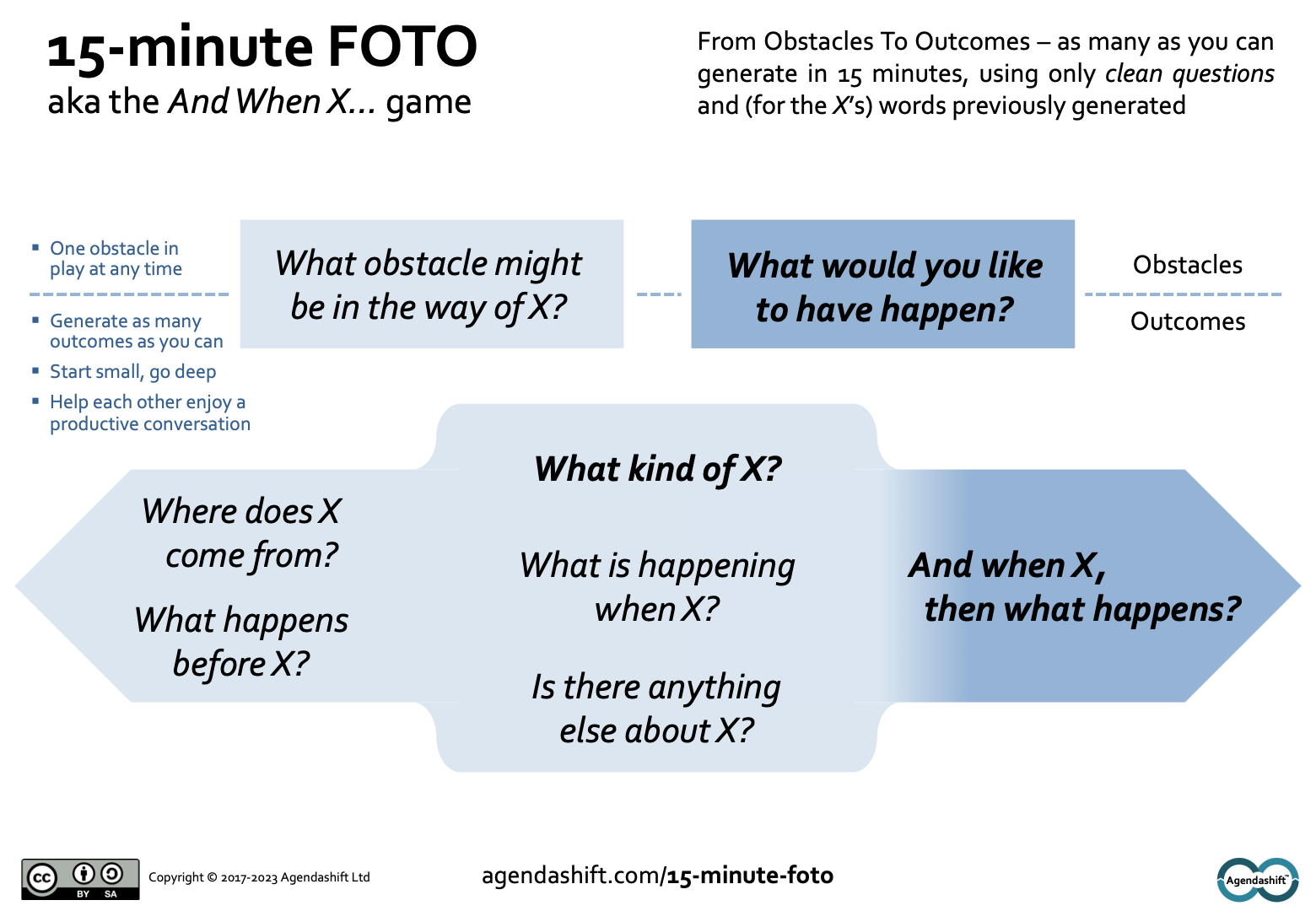
15-minute FOTO, Agendashift’s Clean Language-inspired coaching game, has a cheat mode! It’s a question that’s not on the card*:
The secret question:
Why is that important?
If you’re starting with an obstacle that seems to beg the answer to “What would you like to have happen?”, try “Why is that important?” instead. Much more interesting! Yesterday in Melbourne, it worked so well that nearly every conversation in the game began that way. You can’t be sure that what gets generated will be an obstacle or an outcome – if the answer is long, probably some of both – so listen carefully and choose your next question accordingly.
That’s not its only use. If you feel that you’ve exhausted “Then what happens?”, try “Why is that important?”. Want to go back to something mentioned earlier in the conversation? Same question, prefixing it with “And when…” to reference the thing of interest.
If “Why is that important?” works so well, why is it not on the card? Well, it’s not a canonical Clean question; it’s only “cleanish”. In the wrong context, that question can be loaded with assumption. If I ask it of (say) an obstacle that someone has taken the trouble to prioritise, refine, and so on, it’s important, no problem. But if I ask it of something whose importance isn’t established, I’m making an assumption. If our goal is to explore the model existing or being built in someone else’s mind, let’s treat it (and by implication, that other person, the client) with due respect. To bring our own assumptions into the conversation would risk tainting that model, perhaps irrecoverably. So use with care!
I have no plans to add that question (or any other – Clean or cleanish) to the cue card. I’m in no hurry to add it to the facilitation deck either. It can be our little secret 😉
You may remember that I contributed the foreword to Allan Kelly’s Succeeding with OKRs in Agile; he’s offering 20% off his Writing OKRs masterclass, also next month
Both of those links have the discounts already applied for you. For the first one, larger discounts are available for for public sector, non-profits, etc; ping me if they apply.
*Note that the card has received some minor updates recently, most notably the four bullets upper left, straddling the Obstacles/Outcomes boundary – not a replacement for the facilitation deck but a useful reminder. Grab the latest from here if you’re an Academy subscriber, from the 15-minute FOTO dropbox if you have access to that, or request access here.
Leading with Outcomes from the Agendashift Academy “Leadership and strategy in the transforming organisation”
Leading with Outcomes is our modular curriculum in leadership and organisation development. Each module is available as self-paced online training or as private, instructor-led training (online or in-person). Certificates of completion or participation according to format. Its modules in the recommended order:
Individual subscriptions from £24.50 £18.40 per month after a 7-day free trial, with discounts available for employees and employers in the government, healthcare, education, and non-profit sectors. For bulk subscriptions, ask for our Agendashift for Business brochure.
To deliver Leading with Outcomes training or workshops yourself, see our Authorised Trainer and Authorised Facilitator programmes. See our events calendar for Train-the-Trainer / Facilitator (TTT/F) and Leading in a Transforming Organisation trainings.
At every scope and scale, developing strategy together, pursuing strategy together, outcomes before solutions, working backwards (“right to left”) from key moments of impact and learning.
They’re a chance to try one of our famously inclusive, non-prescriptive, and framework-agnostic assessments (a different template each month) and to experience with others some post-assessment conversations, Agendashift-style.
Post-debrief conversations will follow the IdOO (“I do”) pattern – Ideal, Obstacles, Outcomes, for which materials based on Leading with Outcomes: Foundationwill be provided. If, within that structure, you would like to take the brief opportunity to practice our Clean Language coaching game 15-minute FOTO (Academy version here), this should be possible, numbers permitting.
These are in addition to the free monthly webinars that continue to cycle through the three “questions that drive us” (series link). The next two of those:
This is where it’s happening in Agendashift-land right now. If you’re tired of approaches to organisational challenges that can’t see beyond process (and trust me, it’s liberating to get past that) and have little of consequence to say about complexity, get yourself to one of these if you possibly can.
I should mention that my trip to Australia – my first trip abroad since COVID – is thanks to Kanban Australia 2023. Thank you Daniel and the rest of the organising team!
Looking ahead to December
In early December I’m off to India for Kanban India and the last TTT/F of the year:
Leading with Outcomes from the Agendashift Academy “Leadership and strategy in the transforming organisation”
Leading with Outcomes is our modular curriculum in leadership and organisation development. Each module is available as self-paced online training or as private, instructor-led training (online or in-person). Certificates of completion or participation according to format. Its modules in the recommended order:
Individual subscriptions from £24.50 £18.40 per month after a 7-day free trial, with discounts available for employees and employers in the government, healthcare, education, and non-profit sectors. For bulk subscriptions, ask for our Agendashift for Business brochure.
To deliver Leading with Outcomes training or workshops yourself, see our Authorised Trainer and Authorised Facilitator programmes. See our events calendar for Train-the-Trainer / Facilitator (TTT/F) and Leading in a Transforming Organisation trainings.
At every scope and scale, developing strategy together, pursuing strategy together, outcomes before solutions, working backwards (“right to left”) from key moments of impact and learning.
Before you begin, think about all the organisational scopes you identify with. Formally-recognised or otherwise, your scopes bring together people, their value-creating work, and a sense of shared identity. Yours might include:
Teams, teams-of-teams, or bigger
Scopes smaller than teams
Cross-cutting scopes that intersect with multiple other scopes
Next, two kinds of “healthy and productive”:
Thinking about your scopes individually, how healthy and productive would you say they are?
How healthy and productive would you say are the relationships between scopes?
To the assessment itself:
As you score each assessment prompt, try to choose a point on our four-point scale that’s representative of all of your scopes
Where that’s hard to do authentically, you can restrict yourself to the scope or scopes with which you identify you most strongly
Don’t worry about being inconsistent – ranges of experience, opinion, and perspective are just as interesting as consensus, and our process will make good use of both
That’s quite a change from “Choose a scope and stick to it”! Given its length, I don’t know that I would use it frequently outside the Adaptive Organisation assessment, but for that one, it’s more in keeping with the module of the same name’s “Start where you are, everywhere all at once” approach.
Experience the full version of the assessment for yourself via the Melbourne (October) or Manchester (November) editions of Leading in a Transforming Organisation, or the online module Adaptive Organisation (I): Business Agility at every scale. Or a private event! If the 3-day Leading in a Transforming Organisation would be infeasible, various shorter options are available, and a new 1-day Adaptive Organisation workshop is ready to test, and on favourable terms. If that could be of interest, get in touch.
Leading with Outcomes from the Agendashift Academy “Leadership and strategy in the transforming organisation”
Leading with Outcomes is our modular curriculum in leadership and organisation development. Each module is available as self-paced online training or as private, instructor-led training (online or in-person). Certificates of completion or participation according to format. Its modules in the recommended order:
Individual subscriptions from £24.50 £18.40 per month after a 7-day free trial, with discounts available for employees and employers in the government, healthcare, education, and non-profit sectors. For bulk subscriptions, ask for our Agendashift for Business brochure.
To deliver Leading with Outcomes training or workshops yourself, see our Authorised Trainer and Authorised Facilitator programmes. See our events calendar for Train-the-Trainer / Facilitator (TTT/F) and Leading in a Transforming Organisation trainings.
At every scope and scale, developing strategy together, pursuing strategy together, outcomes before solutions, working backwards (“right to left”) from key moments of impact and learning.
As first mentioned to Academy subscribers here, I’m delighted to announce that the videos for all three chapters of v2.0 of Adaptive Organisation (I): Business agility at every scale have been released. As done previously for the Leading with Outcomes: Foundation module, it remains in beta until I’ve released the new workbook and added captions (hand-edited) to all videos. The previous version (v1.6) remains available for the time being on the old learning management system.
Part I covers key building blocks every leader needs to know about organising for adaptability:
The three overlapping spaces of the Deliberately Adaptive Organisation
Integrating strategy, delivery, and mutual trust-building
Managing complexity, finding balance in these and other relationships at every scale
As well as the usual improvements in flow we’ve seen with iterations of this and other modules, these are the main changes since v1.6:
A greater and earlier emphasis on emergence and self-organisation
An earlier introduction of this modules’s complexity-friendly “start where you are, everywhere all at once” approach, seen first with the accompanying assessment
Better integrating the relational and constraint-based aspects of organising (we’ll build on this in some leading-edge complexity-related material in part II)
A new interlude between chapters 2 and 3 incorporating workshop exercises from our in-person training, Leading in a Transforming Organisation
For news on progress on both parts I and II (the latter under development as part of my preparations for my Melbourne and Manchester trainings):
Members: Chat for up-to-the minute updates, also informal discussion*
Leading with Outcomes from the Agendashift Academy “Leadership and strategy in the transforming organisation”
Leading with Outcomes is our modular curriculum in leadership and organisation development. Each module is available as self-paced online training or as private, instructor-led training (online or in-person). Certificates of completion or participation according to format. Its modules in the recommended order:
Individual subscriptions from £24.50 £18.40 per month after a 7-day free trial, with discounts available for employees and employers in the government, healthcare, education, and non-profit sectors. For bulk subscriptions, ask for our Agendashift for Business brochure.
To deliver Leading with Outcomes training or workshops yourself, see our Authorised Trainer and Authorised Facilitator programmes. See our events calendar for Train-the-Trainer / Facilitator (TTT/F) and Leading in a Transforming Organisation trainings.
At every scope and scale, developing strategy together, pursuing strategy together, outcomes before solutions, working backwards (“right to left”) from key moments of impact and learning.