Friday was quite a big day! Agendashift’s second birthday, plenty of attention for the article Engagement: more than a two-way street, and an Agendashift Studio*, a small-scale workshop held in my studio office.
After lunch at our local farm shop we played Changeban. Changeban is based on our popular Featureban game, with slightly different mechanics, a Lean Startup-inspired board design (below), and an introduction to hypothesis-based techniques.
It went down a treat, generating these interesting comments:
Featureban’s great but I think I will start using Changeban with my clients instead. By not simulating a software development process, people who work outside of technology will relate to it much more easily.
– Steve
Absolutely agree. Not once during playing the game did we reference or talk about anything tech-related.
– Karen
Always keen to make language as accessible as possible (something the Agendashift delivery assessment is appreciated for), I’ve done another pass on the Changeban deck and removed all references to “features”. Instead of “feature ideas”, we have “product ideas”; “feature experiments” becomes “product experiments”, and so on. Small changes, but every little helps!
These new references to “product” also help to reinforce an observation made in the Agendashift book: tools designed for the product development space often have applicability in the organisational/process improvement space, and vice versa. Lean Startup is the perfect example of that!
If you’re a registered Changeban user, you’ll receive an update by email from me sometime in the next few hours. If you aren’t registered and would like to be, sign up here. We’re now up to revision 0.4; it seems stable enough to go to 1.0 once I get round to preparing a page of facilitation instructions (there’s a #changeban channel in the Agendashift Slack meanwhile).
*There is no calendar for these Agendashift Studio events – they’re self-organised via the #agendashift‑studio channel in Slack. If 3‑4 participants can agree on a date that works for me too, then we’re on! We’re based in Chesterfield, UK, close to the Peak District National Park.
We are champions and enablers of outcome-oriented change and continuous transformation. Building from agreement on outcomes, Agendashift facilitates rapid, experiment-based emergence of process, practice, and organisation. Instead of Lean and Agile by imposition – contradictory and ultimately self-defeating – we help you keep your business vision and transformation strategy aligned with and energised by a culture of meaningful participation. More…
September 14th, 2018 is the second anniversary of Agendashift’s public launch. I’m marking the occasion with a post that describes a key motivation and gives some clues about where we’re headed. And while we’re here, if you haven’t recently checked our programme of upcoming workshops, there are four listed at the bottom. Enjoy!
We all know what employee disengagement looks like, how it saps energy and creativity, and not just in the unengaged. I won’t go into all the causes and symptoms here, but briefly, if you take away people’s agency – their perceived ability to make choices for themselves – a stress response is provoked, and not the kind of stress that you would want to find in an organisation that hopes to see people working at their best [1].
Just as anywhere else, disengagement is a very bad sign in the context of [Lean-]Agile transformation. It’s a sign that the change agents (managers, consultants, coaches, etc) don’t know what they’re doing! If people are disengaging because there’s the perception that they have no say in how things are going to work inside their teams, it strongly suggests that they have been denied the opportunity to participate meaningfully in the transformation process. This represents an inexcusable failure to engage on the part of the change agents responsible. It would seem that engagement is a two-way street (actually it’s more four-way intersection than two-way street, but we’ll come to that).
In short, 20th century-style rollout projects and managed change programmes run the risk of destroying engagement. Not only do the ends not justify the means, the means don’t work if the goal is an engaged and creative workforce. That it keeps happening is “an absolute travesty”, as Martin Fowler (an Agile Manifesto signatory) recently put it [2].
So ‘Big Agile’ bad, ‘Small Agile’ good? Not so fast. Agilists lamenting a lack of Agility in the organisation is not engagement. Tweeting false dichotomies about management vs leadership is not likely to engage many managers. Praying for viral adoption is not much of a growth strategy. And don’t get me started on the passive aggression (“We’re so Agile, we only let our stakeholders talk to us in the Sprint review” [3]).
A plague on both their houses then? No! The arguments between the two sides keep missing the crucial point that success depends on engagement. It’s a phoney war, fought on the wrong battleground, few shots landed. The apparently less exciting good news: the more that they do engage, the less obviously top-down or bottom-up they become and the more that they have in common. Funny that.
It should now be clear why engagement models [4] such as Agendashift [5], OpenSpace Agility (OSA) [6], Systemic Modelling [7], BOSSA nova [8], and TASTE [9] are so necessary. Non-prescriptive by design, they work happily with frameworks big or small, branded or home-brewed, and with each other. In their various and complementary ways, they bring people together from multiple levels of the organisation, help the organisation collectively to reveal to itself what needs to change, and come to agreement on what needs to change.
But we can go further. In a transformation of any reasonable size, it is inevitable that different parts of the organisation will move forward at different speeds, and this will keep on throwing up new challenges. If we want the ‘new’ to survive and then thrive, then its surrounding organisation must too. If the new is to grow, then the old must adapt. Both have needs, those needs will evolve over time, and attending to them is key to the viability [10] of not just the transformation, but the organisation itself.
What’s needed then is another kind of engagement: not only person-to-person but system-to-system also. It raises questions like these:
How does strategy work going forward? How will ‘old’ and ‘new’ participate in the processes of strategy development and deployment?
On the day-to-day stuff of delivery, how will old and new coordinate with each other effectively?
How might this play out over time, and what implications will that have for the easily-forgotten, slower-changing, but still critical parts of the organisation? (For example, what role do HR and Finance play in the staffing, skilling, and funding of a very different-looking organisation?)
How will we know that it’s working? How will we know to intervene when it is not?
How will we know that we’re winning? Then what?
These questions could easily be re-framed so that Agendashift-style tools can be used to explore this evolving landscape. For example:
What obstacles will prevent ‘old’ and ‘new’ participating in the processes of strategy development and deployment as we move forward?
(Then from obstacles to outcomes (FOTO) [11] – you know the drill)
Whether we’re talking about Agile process frameworks or engagement models, I don’t honestly think it’s sensible to expect off-the-shelf products to have answers to these questions. What’s important is that they’re asked and answered, then re-asked and re-answered as the transformation progresses. Instead of glossing over them, how about embracing them? Does this not invite management from both sides of any old/new divide to become more engaged, to take more responsibility for the process, and for new kinds of leadership to develop as a result?
No shortage of opportunities for both kinds of engagement [12]I believe this represents a massive opportunity for the engagement models. It’s not that we didn’t already kinda know this, but we’re going to make it more explicit, both because it’s important in its own right and because it further exposes the bankruptcy of approaches based on imposition and other negligent forms of non-engagement. A concerted effort is gathering a head of steam here in Agendashift-land [13], and we collaborate with our friends in our peer communities too. No lack of choice there!
Notes & references
[1] I credit the phrase “working at your best” to Caitlin Walker’s From Contempt to Curiosity: Creating the Conditions for Groups to Collaborate Using Clean Language and Systemic Modelling, Caitlin Walker (2014, Clean Publishing). You can see its influence in the Agendashift True North (agendashift.com/true-north).
Engagement Model (noun) : Any pattern, or set of patterns, reducible to practice, which results in more employee engagement, during the implementation of an organizational-change initiative.
If you cannot name your Engagement Model, you don’t have one.
[9] TASTE: Karl Scotland’s take on Lean strategy deployment, with the X-Matrix as a key artefact. See the blog posts TASTE Impacts, Outcomes and Outputs and TASTE Success with an X-Matrix Template. Karl is also a leading collaborator on Agendashift; the upcoming Brighton workshop (see Upcoming Agendashift workshops below) includes both.
[10] My choice of the word ‘viability’ is deliberate. Its conventional meaning works fine, but I’m also alluding to Stafford Beer’s Viable System Model (VSM). Rather than the somewhat impenetrable Wikipedia page I would wholeheartedly recommend Patrick Hoverstadt’s excellent book The Fractal Organisation.
[11] 15-minute FOTO (agendashift.com/15-minute-foto), our Clean Language-inspired coaching game, Creative Commons licensed, available now in several translations.
[12] Figure based on Agendashift chapter 5 and my keynote Inverting the pyramid.
[13] Channels #right-to-left and #systhink-complexity in the Agendashift Slack. Note the title of the pivotal fourth chapter of Right to Left (due 2019). Twitter: @RightToLeft3
Acknowledgements: I’m grateful to Allan Kelly, Daniel Mezick, Philippe Guenet*, Karl Scotland*, Mike Haber, Thorbjørn Sigberg*, Andrea Chiou*, and Jutta Eckstein for their feedback on earlier drafts of this post. Asterisks indicate Agendashift partners.
We are champions and enablers of outcome-oriented change and continuous transformation. Building from agreement on outcomes, Agendashift facilitates rapid, experiment-based emergence of process, practice, and organisation. Instead of Lean and Agile by imposition – contradictory and ultimately self-defeating – we help you keep your business vision and transformation strategy aligned with and energised by a culture of meaningful participation. More…
Slightly technical, but if you’re interested in what we know to be a remarkably effective combination of Clean Language, Cynefin, and Story Mapping as practiced in most Agendashift workshops, read on…
Use of Clean Language to generate fragments for 4-corners contextualization is just magic. @snowded – I think you'd like it. Thanks @asplake for superb @agendashift training. Highly recommended! 😀
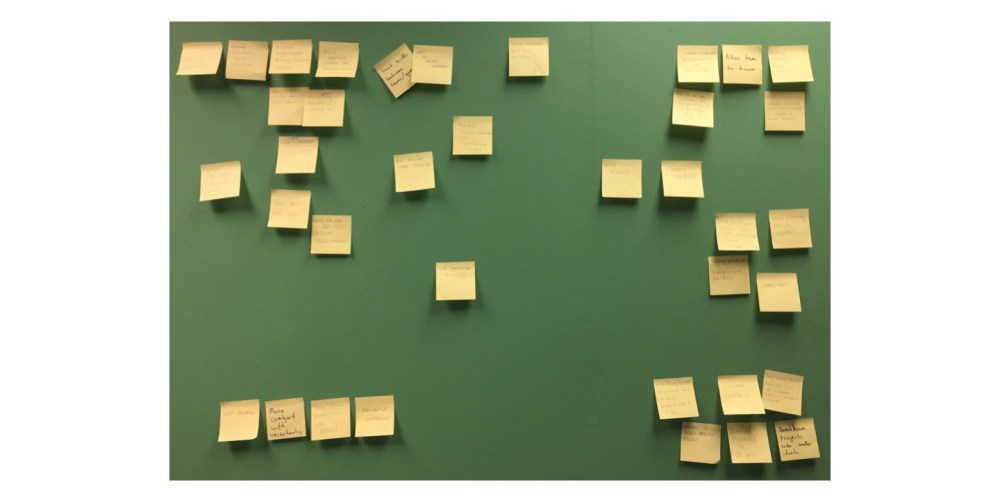
One of the notable highlights of an Agendashift workshop comes when we take the list of outcomes generated by the 15-minute FOTO game [1], transcribe them onto stickies, and organise them 4-points style [2]:
Through the experience of the ‘4 points contextualisation exercise’ (to give it almost its full name), participants are slowly introduced to the Cynefin framework [3], the facilitator trying all the while to avoid naming the model or using Cynefin terminology such as ‘obvious’, ‘complicated’, ‘complex’, or ‘chaos’ (trust me, it’s hard!). For participants familiar with the model, it’s always a funny moment when the penny finally drops and the realisation dawns that Cynefin can be so much more than just a conceptual model, especially when there’s a good supply of ‘narrative fragments’ – outcomes, in our case – to play with. For those that haven’t come across it before, it’s a great opportunity to explore why different kinds of outcomes need different kinds of approaches, a lesson that’s much more meaningful when it’s learned through interacting with your own data (‘sensemaking’) than it would be as a lecture.
Up to now – and as described in the book [4] – the translation from the Cynefin representation to one based on a story map has been a 2-stage process. First, a few minutes of organised chaos as stickies are moved to under their respective headings:
Second, as much time as we want to spend – anything from a few moments to an hour or more – prioritising stickies within columns, and through that process making sure that there is a shared understanding of what each of them means and their possible dependencies on other stickies. Anyone who has done story mapping before will recognise that this can provide an important opportunity for some valuable conversations; we’ve found this to be the case even in public workshops, with ‘teachable moments’ aplenty.
A refinement
Instead of the ‘organised chaos’ followed by prioritisation, work clockwise from bottom right, prioritising as we go:
Starting with the ‘obviously obvious’: Sticky by sticky, check that they really are obvious (ie we can all quickly agree what needs to be done and can be pretty sure of the likely outcome), put them in their correct columns, and prioritise. Prioritisation will be easy, as there’ll be at most a few per column, a mixture of quick wins and less important items.
The ‘borderline complicated’: For the items on the border between obvious and complicated, explore why they were placed there, and discuss what should be done about their non-obvious aspects (perhaps there’s some important detail that someone will need to get to grips with). Prioritise them relative to the already-prioritised ‘obviously obvious’ items in their respective columns (again, this should be easy)
The complicated, one sticky at a time: who might be delegated to run with this item? Should we get some external help? In its appropriate column, how does it prioritise relative to the items already there?
I could at this point say “and so on through the complex and chaos” but the facilitator will flag up here that anything in or bordering on complex is likely to be a good candidate for hypothesis-based change (a session later in the day, see also [5]), and so it’s a good idea to mark each item in some way so that they can be identified easily later. And for the borderline cases:
‘Borderline complex’: Are the complicated and complex parts easily separable? How will we organise this, mainly linear with some room for refinement along the way, or mainly through iteration with some expert input or planned work at the appropriate time?
‘Borderline chaos’: Is it urgent to address symptoms or or attempt some diagnosis now, or can we afford to wait until we see what’s thrown up in the course of other work?
I’ll be honest: it’s still early days for this change and there’s no slideware [6] for it yet – if any is needed we’ll learn that through practice and by partner demand. That’s usually the best way!
We are champions and enablers of outcome-oriented change and continuous transformation. Building from agreement on outcomes, Agendashift facilitates rapid, experiment-based emergence of process, practice, and organisation. Instead of Lean and Agile by imposition – contradictory and ultimately self-defeating – we help you keep your business vision and transformation strategy aligned with and energised by a culture of meaningful participation. More…
In this edition: Another podcast interview; The Agile travesty; Right to Left; Translations; Public workshops (UK*2, IT, DE*2); Speaking (UK*2, IT); Top posts
Another podcast interview
Last month I was interviewed by Vasco Duarte for the Scrum Master Toolbox Podcast. For reasons that now escape me this missed the July roundup, so I lead with it this time:
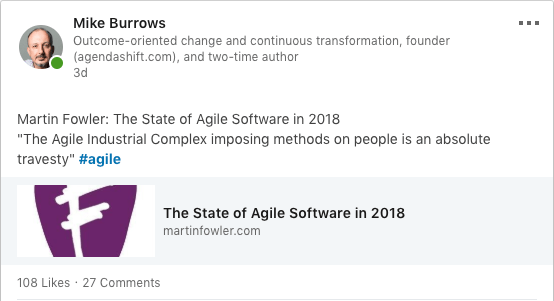
This quote from Martin Fowler’s The State of Agile Software in 2018 keynote has drawn quite a bit of attention over the past few days:
Of course the Agendashift community not only stands against imposition, we offer positive alternatives (or in other words, we’re neither grandstanding nor whining). Authentic engagement on outcomes isn’t that hard, certainly not beyond the capability of anyone who can reasonably claim to be an effective change agent or sponsor. If you’re not sure how, let us show you!
Right to Left
Monthly status check: 17,014 words, three chapters (of six) completed.
I’ve updated the landing page to list the chapters:
The eagle-eyed may spot a subtle title change: there’s no “Lean-Agile” in the book’s title now – given its intended audience it seemed just that bit too jargony.
As promised, two of last months book-related tweets…
The next chapter to be written, 4. Viable scaling, is one I really must get right. Scaling is a controversial topic, but hardly one I can ignore while covering the Lean-Agile landscape. Via Agendashift and a new mystery ingredient I believe I can address the controversy constructively while still remaining fair to all sides. Of course I might just end up offending everyone – we’ll see!
For questions or the latest updates, go to Slack channel #right-to-left. See also some research-related conversations in channel #systhink-complexity.
Meanwhile, Agendashift surveys are now multilingual. Short version: survey participants can now switch languages from the default specified by the survey’s administrator.
Slack channel #agendashift-studio if interested in attending another cozy and low-cost workshop for 3-4 participants in my studio office in Chesterfield (close to the Peak District National Park; lunch is at a local farm shop). Delighted to report that two of September’s participants are attendees of past workshops, returning for more!
The Brescia workshop now has a booking page (it wasn’t ready for last month’s roundup)
The Berlin workshop doesn’t yet have a booking page; watch the LinkedIn group or #events in Slack for updates, or drop me a line
We are champions and enablers of outcome-oriented change and continuous transformation. Building from agreement on outcomes, Agendashift facilitates rapid, experiment-based emergence of process, practice, and organisation. Instead of Lean and Agile by imposition – contradictory and ultimately self-defeating – we help you keep your business vision and transformation strategy aligned with and energised by a culture of meaningful participation. More…
The cue card for 15-minute FOTO, our Clean Language-inspired coaching game is now available in Swedish, thanks to Agendashift partner Johan Nordin. Tack så mycket!
A place has just become available for the September 14th Agendashift Studio – first come first served! By definition, it’s a cozy and informal Agendashift workshop for up to 4 participants held in my detached studio office in Chesterfield, convenient for the Peak District National Park; lunch at a local farm shop. £195 + VAT. £25 discount to past attendees &/or Agendashift partners; 40% off for public sector, educational & non-profit employees. Make yourself known the #agendashift-studio channel in Slack if interested in attending at another time.
We are champions and enablers of outcome-oriented change and continuous transformation. Building from agreement on outcomes, Agendashift facilitates rapid, experiment-based emergence of process, practice, and organisation. Instead of Lean and Agile by imposition – contradictory and ultimately self-defeating – we help you keep your business vision and transformation strategy aligned with and energised by a culture of meaningful participation. More…
Later still, we get good at deployment, so good in fact that we can do it at will
As work starts to flow, deficiencies in development and testing become more apparent, and they get dealt with
All of a sudden, the real bottleneck turns out to be outside of development – a lack of high quality ideas in the pipeline and/or frustrating delays in getting decisions made
Now what???
There is something almost inevitable in this sequence – in fact anyone familiar with the Theory of Constraints (TOC) will expect it! If you’re unfamiliar with TOC, it’s the model behind Eli Goldratt’s classic business novel The Goal, and much more recently the DevOps novel The Phoenix Project; TOC teaches that once you’ve addressed enough of your internal constraints, your key constraint will be found outside.
Although there’s a lot to be celebrated in that progression, no team wants to get to the “Now what???” stage. Your choices:
Hope that it never happens (or not care, because teams are there to be disbanded)
Plan to deal with it when it does happen
Make Discovery (or “upstream” or whatever else you call it) a first class activity in your process
Option 3 implies some proactivity, but that doesn’t mean that it has to be difficult. Instead of dismantling that capability as your latest initiative gets off the ground, keep it going, even if at a reduced level. Instead of accepting requirements at face value, make sure that someone is taking the time to understand their authentic situations of need. Instead of fire-and-forget delivery, validate that needs are being met, expecting to feed some new learning back into the process. Simple changes, but as documented in my first book, the effect can be profound, even humbling!
You can of course go further. One of the most important moves made by the UK Government Digital Service (GDS) was to insist that every new service had a credible plan to sustain user research and ongoing service evolution – not just at the beginning but indefinitely into the future. “Start with needs” wasn’t just a slogan, it was a strategy, and a successful one! If government could do this in times of austerity, what excuse does your organisation have?
Make yourself known the #agendashift-studio channel in Slack if interested in attending another cozy 1-day or 2-day workshop for 3-4 participants in my studio office in Chesterfield, Derbyshire (minutes away from the Peak District National Park).
We are champions and enablers of outcome-oriented change and continuous transformation. Building from agreement on outcomes, Agendashift facilitates rapid, experiment-based emergence of process, practice, and organisation. Instead of Lean and Agile by imposition – contradictory and ultimately self-defeating – we help you keep your business vision and transformation strategy aligned with and energised by a culture of meaningful participation. More…
A number of Agendashift surveys have been multinational, but not multilingual. Or at least, not easily: for the Agendashift global survey for example, I set up separate surveys for each supported language, and then linked to them individually from the landing page. Clunky to put it mildly, and not something I would want to do again.
The default language for this survey is English (EN). After signing in to your assessment, you can switch to French (FR), German (DE), Italian (IT), Dutch (NL), Russian (RU), Spanish (ES), Swedish (SV), or Hebrew (HE) if you prefer.
This new feature applies to all surveys. Not sure whether to distribute a survey in German or Russian (to take an actual example from a multinational team)? Just choose a default, and let the user switch as needed.
We are champions and enablers of outcome-oriented change and continuous transformation. Building from agreement on outcomes, Agendashift facilitates rapid, experiment-based emergence of process, practice, and organisation. Instead of Lean and Agile by imposition – contradictory and ultimately self-defeating – we help you keep your business vision and transformation strategy aligned with and energised by a culture of meaningful participation. More…
Quick one: Massimo Sarti has kindly translated the 15-minute FOTO cue card into Italian. Thanks to Alex Pukinskis, we have it in German also. If you’d like either one of these, just go to the 15-minute FOTO page, request the materials as usual, and mention which one you’d like.
Massimo’s translation is particularly timely: since July’s roundup we now have a booking page up for the Core Agendashift workshop Facilitating Outcome-Oriented Change in Brescia, Italy on November 9th, ahead of Italian Agile Day 2018on the 10th. We both hope to see you there!
15-minute FOTO is our Clean Language-inspired coaching game, an essential and memorable component of every Agendashift workshop. We have released it under a Creative Commons with-attribution licence to enable its wider use and to encourage adaptations.
FOTO stands for “From Obstacles to Outcomes”, and you have 15 minutes to generate as many as you can, using only the questions on the cue card. An example of “generative over prescriptive” if you like.
We are champions and enablers of outcome-oriented change and continuous transformation. Building from agreement on outcomes, Agendashift facilitates rapid, experiment-based emergence of process, practice, and organisation. Instead of Lean and Agile by imposition – contradictory and ultimately self-defeating – we help you keep your business vision and transformation strategy aligned with and energised by a culture of meaningful participation. More…
Years ago, in my past life as a manager (which I still re-enter from time to time as an interim), I learned that there was little value in me tracking tasks. What mattered to me was the deliverable. Interestingly, I noticed that when I visibly stopped taking an interest in tasks, most of my team members followed suit. I said “It’s completely fine by me to tasks on the board if that’s what works for you, but I’m not going to ask about them”, and soon the task stickies disappeared.
As a team, we made rare exceptions for features that failed our “2 day rule”, which is to say features that at a very rough guess would require more than a couple of days worth of development. Experience taught us that these were disproportionately risky, so it seemed justified to insist on some kind of plan. Of course what actually happened was that most of these big features got sliced into smaller features, and then everyone’s happy to go back to feature-level tracking.
Stop tracking tasks, and no longer does the tracking system drive the developer to work in a way that doesn’t seem natural. A bit over here, a bit over there, then back to the first bit… if the tests say it’s fine, it’s fine! Two people with different skills working together on the same feature? Go for it! And at a stroke it eliminates the anti-pattern of “tasks for quality” – ie separate tasks for unit tests, refactoring, and the like (in the global department I ran more than a decade ago, these tasks disappeared when I asked why these things weren’t happening as the code was being written; I guess my predecessor didn’t see things in quite the same way).
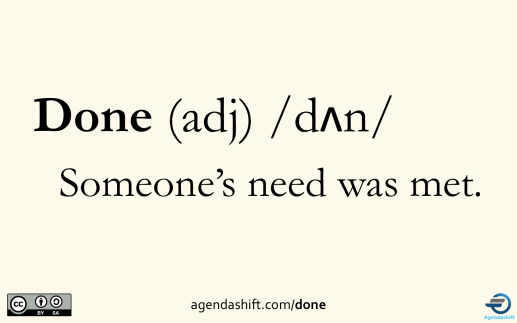
And then there’s the whole question of when a task can be said to be “done”. How do you that some low-level piece of work is really done if the feature as a whole isn’t yet working? Somehow I think that this may have come up before….
In this edition: Strategy workshop and Agendashift Studio; Right to Left; Public workshops (US, UK, IT, DE); Top posts
Strategy workshop and Agendashift Studio
On consecutive days early this month (before things began to slow down for the summer) I led a private strategy workshop done Agendashift-style and then a small “Agendashift Studio” workshop held in my studio office in Chesterfield, Derbyshire, just outside the Peak District National Park.
For obvious reasons I can’t go into a lot of detail about the private workshop but it did result in a blog post:
There’ll be at least a chapter’s worth of this in the new book (more on that in a moment), covering the use of this kind of outside-in structure for strategy and operations reviews in the kind of depth that wasn’t possible in the Agendashift book.
The Agendashift Studio workshop was a lot of fun. Here’s some great feedback:
Use of Clean Language to generate fragments for 4-corners contextualization is just magic. @snowded – I think you'd like it. Thanks @asplake for superb @agendashift training. Highly recommended! 😀
We’ve started a new #agendashift-studio channel in the Agendashift Slack for coordinating future Studio workshops. It’s an exercise in self-organisation – if 3 or 4 participants can agree a date that also works for me, then we have a workshop; likely we’ll have another one in the coming weeks, perhaps as soon as August. They’re very affordable, there are generous discounts for government/education/nonprofit etc, and we generally hold them on a Friday or Saturday so that participants can spend some weekend time in the Peak District if they wish.
Right to Left
Monthly status check: 11,258 words, and well into chapter 3. Also, a new landing page:
The first of those is already a top 3 post for the year, which is very encouraging! I happen to know that at least one forthcoming article from a member of the SAFe community has been inspired by it, and I’m hopeful of some constructive engagement with other scaling communities too. If you’re part of one, please get in touch!
Some tweetable thoughts that might become future blog posts:
Don’t settle for a static system. If long periods go by with no apparent challenge to management and no change to system designs, policies, feedback loops, or external interfaces, then there’s a problem. Don’t let that problem be you!#lean#agile#leadership#RightToLeft
Right to Left will be my least technical book (it’s aimed at managers first, practitioners second), but still I maintain my usual respect for my sources. I’ve been exploring the Viable System Model as “deep background”, and several of us have been discussing this and other things from the world of Systems Thinking, Complexity, and the Learning Organisation, which you may recognise as a chapter title from my first book Kanban from the Inside. To join us in that particular conversation, find the #systhink-complexity channel in the Agendashift Slack.
We are champions and enablers of outcome-oriented change and continuous transformation. Building from agreement on outcomes, Agendashift facilitates rapid, experiment-based emergence of process, practice, and organisation. Instead of Lean and Agile by imposition – contradictory and ultimately self-defeating – we help you keep your business vision and transformation strategy aligned with and energised by a culture of meaningful participation. More…

 Blog: Monthly roundups | Classic posts



 Agendashift