Monticello House
45 Russell Square
London
WC1B 4JP
That’s fairly central, a 20ish-minute walk from St Pancras International, and close to Russell Square (Piccadilly Line), Goodge Street (Northern Line), and Holborn (Central Line and Piccadilly Line) tube stations.
TLDR:Agendashift wouldn’t have happened without Kanban from the Inside. It is however very much its own book. I think you will enjoy it 🙂
Not only is Agendashiftnot a book about Kanban – in fact it is very consciously method-neutral – it makes few assumptions about the reader’s knowledge of Kanban either. In terms of detailed content then, the overlap is minimal and both books stand alone. The resonances between the two are however very strong:
The titles of the first six chapters of KFTI make an appearance in Agendashift chapter 2 (Exploration) as the headings of the Agendashift values-based delivery assessment. These are the values of Transparency, Balance, Collaboration, Customer focus, Flow, and Leadership. If you’re wondering what happened to Understanding, Agreement, and Respect (KFTI chapters 7, 8, and 9), they belong with Leadership (which shouldn’t be a big surprise).
Reverse STATIK (which was developed while KFTI was nearing completion) reappears in chapter 3 (Mapping), not as an improvement process, but to provide a sense of narrative flow to the transformation map, something the values can’t easily provide.
The same sense of respect for a broad range of models described in KFTI part II, in particular Agile, Lean, Lean-Agile, Lean Startup, Cynefin, Systems Thinking, and Scrum. If anything, the appreciation is deepened thanks to experience and integration.
Moreover, you can see the final chapter of KFTI (chapter 23, Rollout) as the springboard for Agendashift, a more thoroughly exercised how-to – not for Kanban, but for continuous transformation, a term not found in the older book. Expect these themes from chapter 23 to be developed more fully:
Making the agenda for change visible
Pulling change through the system
Making a connection between purpose and transformation
Identifying increments of change
Managing change visually
Recognising different kinds of change (and choosing appropriate tools)
The section Identifying increments of change contained the seeds for the Agendashift values-based delivery assessment, which in turn gave rise to the transformation mapping workshop and our now well-rehearsed routines for identifying priorities, obstacles, outcomes, options, actions, and so on. These are covered in chapters 2-4 of the new book.
In short, Agendashift wouldn’t have happened without Kanban from the Inside. It is however very much its own book. I think you will enjoy it 🙂
Part I of Agendashift: clean conversations, coherent collaboration, continuous transformation is available now on Leanpub in MOBI (Kindle), EPUB (iBooks, Google Books, and other e-readers), and PDF formats, also via Leanpub’s online reader. Buy it today and you’ll still have time to recommend it to your colleagues for the weekend 🙂
If you plan to read it on your iPad or iPhone, note that we have encountered a couple of formatting bugs specific to Kindle on the iOS platform and I’d recommend downloading the EPUB format and reading it in iBooks.
In celebration, we’re offering a discount on Lean-Agile Strategy Days, London (June 7th & 8th). For the next week, you can use the code BOOKLAUNCH for a discount of 10%. It just goes to show that launch codes can sometimes be used for good…
What next?
In the next week or two I’ll be sharing plans for Part II and some thoughts about next steps for Agendashift more broadly. To stay tuned, join our LinkedIn group and/or Slack community. Meanwhile, enjoy part 1!
June 8th is a special day: not just because the UK general election is (somewhat inconsiderately) being held on that day, but because I’m pairing up with Karl Scotland for a 2-day public workshop in London, Lean-Agile Strategy Days.
I like to think of it as “pure & applied” strategy deployment. On day 1, we’ll be experimenting with Lean approaches for engaging people in the development and implementation of strategy. On day 2, we’ll use Agendashift as a model for continuous Lean-Agile transformation, a serious question of organisational strategy if ever there was one.
This workshop is a first, and I’m proud to be doing it with Karl. We describe the workshop as an opportunity for collaboration, and this isn’t just hype. As a key collaborator in the development of Agendashift, Karl did much to push Agendashift upstream, suggesting (and bravely testing) ways to develop the Discovery tools, also to better integrate the Cynefin-related material. He has a gift for nudging me in productive directions, and I would be surprised if something new and exciting didn’t come out of this event.
When I say “press”, I mean that it will be available for purchase and download in multiple formats from leanpub.com/agendashift.
The teaser:
How do you bring about continuous transformation, and how do you do it without resorting to the questionable top-down and bottom-up approaches of the 20th century? Agendashift describes an inclusive, values-based, and methodology-neutral approach fit for the 21st century, based on genuine participation and integrating the best of modern techniques.
And the main blurb:
Imagine… everyone able to work consistently at their best:
Individuals, teams, between teams, across the organisation
Right conversations, right people, best possible moment
Needs anticipated and met at just the right time
Fun to imagine, but how do you begin to bring that kind of Lean-Agile vision to life?
This book has some answers, exploring new ways to scope, launch, or re-energise your Lean-Agile transformation, integrating some powerful techniques from Clean Language, Cynefin, Agile, Lean Startup, A3, and Kanban.
Modelled on the Agendashift transformation mapping workshop, this book covers:
Discovery – identifying strategic goals, obstacles, and outcomes
Exploration – prioritising areas for attention, generating outcomes, agreeing scope and approach
Mapping – building your transformation plan
Elaboration – generating options; framing and developing actions
Operation – organising for continuous transformation
Read this book if any of the following apply:
You’ve an interest – whether as a practitioner or potential sponsor – in Lean-Agile change (perhaps under a banner of “Agile transformation” or similar)
You’d like to see what a 21st century change management approach can look like, and how that might inform your work as coach, consultant, or some other kind of change agent
You’d love to see a model for Lean-Agile change that properly reflects Lean-Agile values and demonstrates Lean-Agile process and thinking in operation
In this edition: Limited free trial; Featureban 2.2; Cue cards; Book update; Lean-Agile Strategy Days, London (a joint 2-day workshop in June with Karl Scotland); Top posts
Limited free trial
Hiding in plain sight for a while but unannounced: agendashift.com now offers a free trial, allowing you to create your own Agendashift surveys for use with individuals or small groups. You’ll have access to the 18-prompt “mini edition” assessment template, which is available in English, French, German, Italian, Russian, Dutch, and Spanish.
Neither will you have access to the offline assets (workshop materials, source files for things otherwise available only as PDFs, etc)
Your surveys will be limited to a maximum of 10 participants each
Your surveys will be filed under a single ‘Free trial’ context that you won’t be able to rename
Still, a good way to get a taste of what we’re about!
Featureban 2.2
I was over in Oslo last weekend for a private 1-day practitioner’s workshop (Friday) followed by a Featureban session at our host’s weekend offsite. It was an opportunity to test some changes and the updated deck is now available.
Talking of resources, and as mentioned in the March roundup, I’ve also updated the Clean Language cue cards for our game 15-minute FOTO. The blog post describing that change came too late but you can read it now:
Part 1 of the new Agendashift book is very close to completion, and it’s conceivable that it will be out on Leanpub before next month’s roundup. You can read a preview of the intro and chapter 1 meanwhile: request yours here. Feel free to re-request your preview if you received yours earlier than April 22nd.
Lean-Agile Strategy Days, London (a joint 2-day workshop in June with Karl Scotland)
My next public workshop will be Lean-Agile Strategy Days, London, a 2-day event held jointly with Agendashift partner Karl Scotland. Karl has been one of my closest collaborators, and to say that I’m looking forward to this would be a massive understatement!
For the uninitiated, Featureban is our simple, fun, and highly customisable kanban simulation game, licensed under the Creative Commons Attribution-ShareAlike 4.0 International License.
There were already some minor updates pending, but the biggest change was inspired by an exercise described in the first chapter of the new book Practical Kanban by my friend Klaus Leopold. With the board full of work-in-progress (WIP), how long will it take to clear it? Or in other words, roughly how long will the next piece of work take, assuming it’s of normal priority and doesn’t get to jump over everything else?
The price of Klaus’s book goes up with each completed chapter, but he has kindly given us a coupon that fixes the price at just $4 until the end of May. Grab yours here:
Hidden slides for the reference of the facilitator are now clearly marked as such
Clarified the wording of the pairing rule
New ‘Take Stock’ slides at the end of iterations 1 & 2, the review of WIP described above
‘Cleaned up’ the debrief slides
What was that like?
Then what happens?
What just happened?
The ‘By the same author’ slide now includes the Agendashift book
Added a final slide with a link to Okaloa Flowlab, a fully productionised simulation game and workshop initially inspired by Featureban, by my friends Patrick Steyaert and Arlette Vercammen
From DfDM, the Department for Dodgy Mnemonics, two for the same day, April 18th, 2017.
Mnemonic 1: DUL
Don’t blame Schein for the awful nmemonic, but do thank him for the process:
Discomfirmation: when we come to the (perhaps difficult) realisation that past assumptions, values, or solutions either don’t hold, cause as many problems as they solve, or must make way for something else
Unlearning (or unfreezing): when we work through the implications of that realisation, and become open to alternatives
Learning: when we begin to work with a new set of assumptions, values, and solutions
Or if you prefer, POOO, or GOOO. It’s a pattern we use repeatedly:
Prompts (or prioritised goals): We prioritise assessment prompts (or similar descriptions of how we would like things to be) because we realise that they represent – in a positive way – something that isn’t working as it should. See also DUL.
Obstacles: We identify things that stop those prioritised prompts or goals from being realised as we would like. See also DUL.
What would you like to have happen?: We identify outcomes hiding behind those obstacles.
Then what happens?: More outcomes – the outcomes behind the outcomes.
Worst case, we get to discover what’s beyond our most immediate outcomes. Better (and quite likely) case: we agree on outcomes more interesting and achievable than the ones we started with.
I don’t mind admitting it: I was struggling a bit with chapter 5 (the last chapter of Part I and the main obstacle to initial publication). Then came London Lean Kanban Days 2017 and corridor conversations with Karl Scotland, Greg Brougham, Patrick Steyaert, and Ray Edgar that continued on Slack afterwards.
I was only too happy to scrap my first attempt and start again. What got the juices flowing again was this simple picture:
It occurs to me that there’s a trap that Lean, Agile, and Lean-Agile folks fall into more often than they realise: believing that responsiveness (of delivery) implies adaptability, the ability to develop new capabilities and new levels of capability in the organisation. There’s a correlation certainly, but the trap is another way of describing the issues I raised a few weeks ago in Why Agile needs some 21st century Lean thinking. To what extent is responsiveness just a local optimisation, doing what we do increasingly quickly, but never breaking out of our comfort zone?
The rewritten chapter 5 takes the Agendashift Values-based delivery assessment and refocuses it on adaptability. The original version doesn’t completely ignore capability and adaptability but as its name implies, it is mostly about delivery. It turns out however that necessary modifications are very modest, an almost mechanical translation: yes there definitely is a relationship between responsiveness and adaptability, a kind of duality even.
These dualities aren’t new. Lean Startup demonstrates that tools for process improvement can be applied to product development, and vice versa. If your organisation can get to understand that change is work and value them both the same, much of the rest follows.
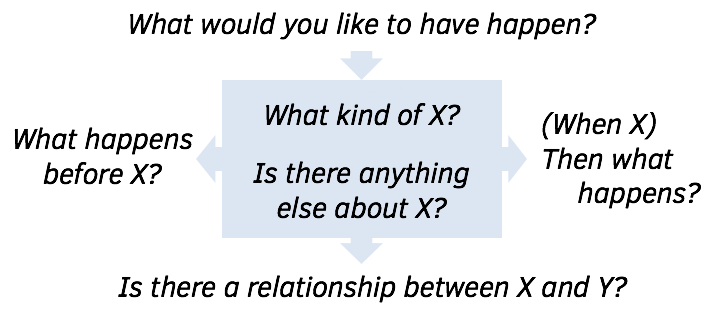
Registered users of our cue cards received an update a few days ago – we’ve added a sixth Clean Language question.
The six clean questions of the v2 card
The new question is the one at the bottom of the card: Is there a relationship between X and Y?
As with all the Clean questions, the coach (or the player in the coaching role in our game 15-minute FOTO) replaces any placeholders (the X and Y here) with words or phrases previously spoken by the client (or player in that role). Both in the game and in Clean Language generally, the coach’s job isn’t to offer/impose advice, but to help the client explore some landscape and build up some kind of model of it.
In 15-minute FOTO (the FOTO standing for “From Obstacles To Outcomes”), that landscape consists initially of goals and obstacles to those goals. Then comes the chance to discover outcomes hiding behind those obstacles, more outcomes behind those outcomes, outcomes that are more abstract or more specific, intermediate outcomes (stepping stones), and so on.
Technically, these outcomes are the raw material from which maps (plans), options, and then actions are generated. In this regard they’re a great unit of currency, as they don’t force us to choose (or prescribe) solutions too early. It’s worth spelling out also that they describe things that we want; instead of worrying about buy-in for change, we start with it!
If you’ve read the preview chapter you’ll remember a description of the game but not this new question. This isn’t an oversight. It is saved for chapter 2, Exploration, where it provides the opportunity for connections to be explored between the outcomes generated after debriefing the Agendashift survey and the goals and other high level outcomes captured during Discovery (chapter 1, the preview chapter).
Health warning
Is there a relationship between X and Y?
One reason for delaying this question’s introduction is that it might be asked judgmentally, breaking the flow of the game (or worse). It is better introduced second time around, when players already have a good feel for how the questions work.
A PDF of the cue cards (I get mine printed on satin card, A5 size)
The preview chapter of the book (PDF also); this includes a description of the 15-minute FOTO game
Questions? Comments? Discuss this post right here, in our LinkedIngroup, or in the #cleanlanguage channel in our Slack community. Or just drop me a line.


 Agendashift