The Deliberately Adaptive Organisation Assessment was tested in a beta programme with multiple organisations a few months ago and will feature in the forthcoming Leading with Outcomes module Adaptive Organisation: Business agility at every scale. Recording begins next week!
18-26 April, Live online, 12pm-4pm EST Tuesdays and Wednesdays, April 18, 19, 25, 26 2023: Creating Generative Conversations by Leading with Outcomes – Part of the Cape Cod Institute’s BMI Series in dialogic organisation development
[Updated 2023-04-23: Improved the image (borrowed from the latest iteration of Leading with Outcomes: Foundation; minor changes to the text]
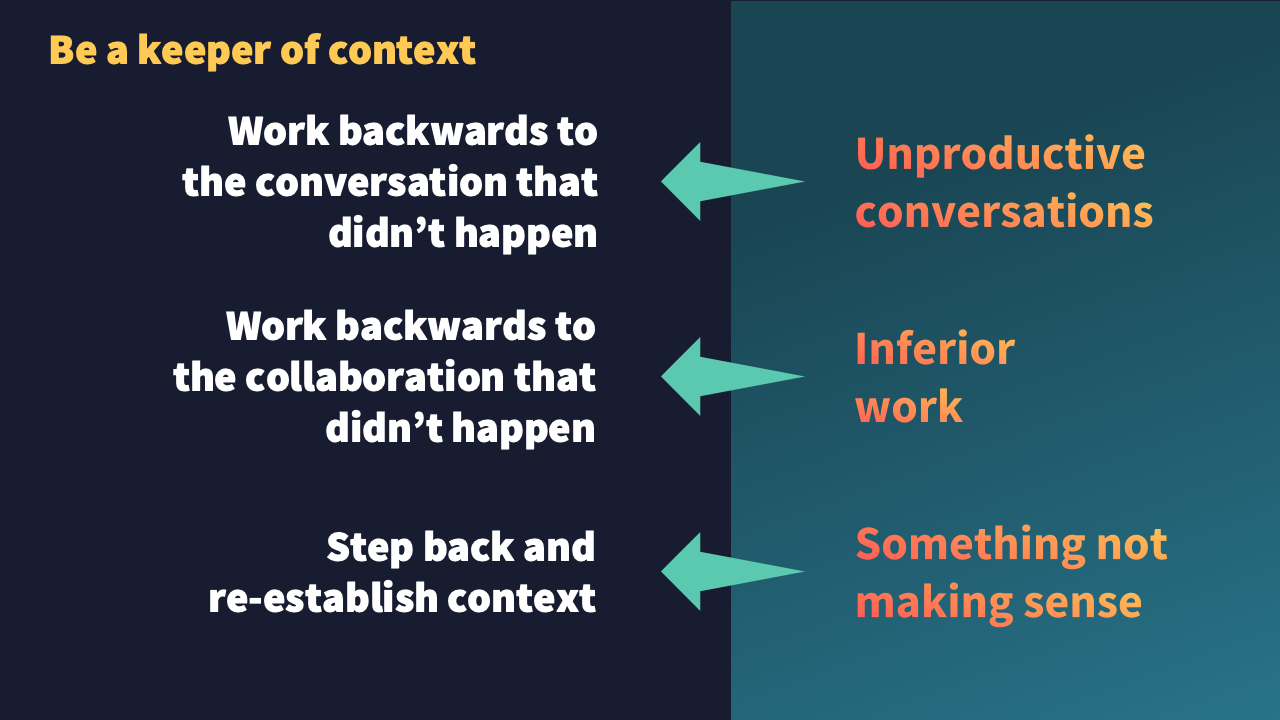
What if all failures were failures of context? OK, that’s an exaggeration, but as a working default assumption, it sure beats assuming failures of competence or character. Moreover, it can be the beginning of a generative line of thinking, one that puts you in the role of keeper of context.
Suppose that you’re a leader in a transforming organisation [1] and you witness an unproductive conversation. What is the shared context that this conversation is missing? You might intervene and provide some, but that’s not the point here. Work backwards. What was the conversation that didn’t take place, the one in which that context would have been established? Look not only at formal meetings but at how activities are sequenced, how their respective conversations happen, and their quality. What opportunities for context-creating conversations are we missing?
Looking at your organisation’s processes, it’s easy to focus on just the formal sequence of activities and overlook the interactions that happen (or need to happen) between them, and in particular, their conversations. When each activity involves different people and the chain of activities is long, it’s not hard to see how context gets lost.
Going deeper into organisation design and questions of meaningfulness, suppose now that you come across some work that failed to delight the customer. What went wrong? Lack of skill? Lack of commitment? These are easy conclusions to reach, but let’s try a different kind of assumption. Could this again be a failure of context? Was that work done with a deep enough appreciation of the context into which that work would be delivered? Where was the opportunity to appreciate the customer’s struggles? Where was the opportunity to explore their needs, to identify measures of customer progress, and so on? And suppose that the work had instead been successful, what kind of feedback would those involved have received? Could it be that our role definitions and process designs keep the people closest to the work insulated from the context they need?
Finally, suppose now that you suspect you’re seeing people lose their sense of what’s important, who they are, and what their team is about. Not so surprising in a transforming organisation! When you see confusion, it doesn’t usually help to ask what people are doing or what they are thinking. Instead, go back to the beginning and let them tell the story. If it turns out that the one who was confused was you, don’t be surprised. Context really is everything.
My perspective on these issues of context has evolved. In my first book, I suggested that you might begin with the assumption that any failures of process you encountered were rooted in failures of collaboration. If you’re looking for systemic causes – making it easier to adopt this perspective non-judgementally – I’ve found that this perspective can be highly productive.
Going back a few more years to when I was a global manager of managers, I would see failures of leadership. Confrontational perhaps, but again productive when the failing collaboration involved an imbalance of power or experience, and the more senior party involved needed to understand their additional responsibility in the relationship.
Failures of context, collaboration, or leadership: three closely related perspectives yet quite different in tone. When you’re a manager dealing with these issues daily or an external practitioner sensing one for the first time, which perspective do you choose? I remain comfortable with all three; the right one on the day is the one that leads to the insights needed via a safe and productive conversation. And if you’re not sure, you can always ask!
Leading with Outcomes from the Agendashift Academy “Leadership and strategy in the transforming organisation”
Leading with Outcomes is our modular curriculum in leadership and organisation development. Each module is available as self-paced online training or as private, instructor-led training (online or in-person). Certificates of completion or participation according to format. Its modules in the recommended order:
Individual subscriptions from £24.50 £18.40 per month after a 7-day free trial, with discounts available for employees and employers in the government, healthcare, education, and non-profit sectors. For bulk subscriptions, ask for our Agendashift for Business brochure.
To deliver Leading with Outcomes training or workshops yourself, see our Authorised Trainer and Authorised Facilitator programmes. See our events calendar for Train-the-Trainer / Facilitator (TTT/F) and Leading in a Transforming Organisation trainings.
At every scope and scale, developing strategy together, pursuing strategy together, outcomes before solutions, working backwards (“right to left”) from key moments of impact and learning.
In this edition: Patterns of generative conversations; December TTT/F; (The Deliberately) Adaptive Organisation; Upcoming; Top posts
Patterns of generative conversations
Something to celebrate: This morning I delivered the manuscript for my fourth book, working title Patterns of Generative Conversations, a shortish (100-page) commission for Gervase Bushe and Bob Marshak’s BMI series in dialogic organisation development. If you’ve read the Agendashift 2nd edition, it expands on the “one model to the tune of another” reconciliation I did between Agendashift and Gervase’s Generative Change Model. If you haven’t, it will be an accessible and (I’m told) energetic introduction to both. As soon as I have a publication schedule I will of course announce it here.
December TTT/F
We have a quorum for September’s Leading with Outcomes Train-the-Trainer / Facilitator, so December’s is now open. It will take place over Zoom in the evenings UK time, beginning 17:30 GMT, 12:30 ET, 09:30 PT. If that’s too late for you, the September one begins 13:00 BST (places still available), and the February one (to be opened in due course) will take place in the morning, UK time.
And don’t forget to use your discount code! 30% off for partners, 25-40% off for most Academy subscribers (according to your subscription plan), 40% off for government, non-profit, education, etc also. If you don’t have your code already, ping me.
(The Deliberately) Adaptive Organisation
August has been a strangely productive month – that’s what a diary mostly empty of meetings does for you! Over September I’ll start recording the fourth module of Leading with Outcomes, Adaptive Organisation: Business agility at every scale, and as part of my preparations, some blog posts:
18-26 April, Live online, 12pm-4pm EST Tuesdays and Wednesdays, April 18, 19, 25, 26 2023: Creating Generative Conversations by Leading with Outcomes – Part of the Cape Cod Institute’s BMI Series in dialogic organisation development
We have a quorum for September’s Leading with Outcomes TTT/F so December’s is now open. It will take place over Zoom in the evenings UK time, beginning 17:30 GMT, 12:30 ET, 09:30 PT. If that’s too late for you, the September one begins 13:00 BST (places still available), and the February one (to be opened in due course) will take place in the morning, UK time.
And don’t forget to use your discount code! 30% off for partners, 25-40% off for most Academy subscribers (according to your subscription plan), 40% off for government, non-profit, education, etc also. If you don’t have your code already, ping me.
18-26 April, Live online, 12pm-4pm EST Tuesdays and Wednesdays, April 18, 19, 25, 26 2023: Creating Generative Conversations by Leading with Outcomes – Part of the Cape Cod Institute’s BMI Series in dialogic organisation development
Just for the months of August and September I’m opening up the Academy’s AMA sessions to all. If you have any questions at all about Leading with Outcomes, the new Trainer & Facilitator programmes (see Upcoming events below for the first TTT/F training), or anything else for that matter, join us!
If you knew about these already, please note that this week’s is pushed back to next week due to an ongoing medical thing family-wise which means that I can’t be sure to be able to make it. I am however contactable and would be glad of a catch-up if you don’t mind the possibility of life intruding a bit!
Open AMA sessions
For the Zoom link, check the email version of this post if you’re on the mailing list, the #community channel on Slack, or Public events in Circle, or ping me.
Wednesday, August 17th, 10:00 BST, 11:00 CEST (not the 10th as previously advertised)
18-26 April, Live online, 12pm-4pm EST Tuesdays and Wednesdays, April 18, 19, 25, 26 2023: Creating Generative Conversations by Leading with Outcomes – Part of the Cape Cod Institute’s BMI Series in dialogic organisation development
In this edition: Outside-in Strategy: Positioned for success; Train-the-Trainer / Facilitator (TTT/F); Two new interviews; Cape Cod Institute’s BMI Series; Upcoming events; Top posts
Outside-in Strategy: Positioned for success
The fifth and final chapter of Outside-in Strategy: Positioned for success went live today. If you need a customer-first strategy or you have something to contribute to one, check out this unique self-paced training. With plenty of leadership-focussed content, it’s based on the outside-in strategy review found in my books Right to Left (where most of a chapter is devoted to it) and the Agendashift 2nd edition (where we ask the question “Who’s invited?“).
This is the third of four planned Leading with Outcomes modules, and like everything we do it’s applicable at every scale – team, team-of-teams, something bigger, something different even – and every level of experience. Come join us! Have your colleagues join us!
We have subscription plans for individuals and businesses, and do reach out if you’re in the government, non-profit, or educational spaces – we’d be glad to work something out for you.
Next April I’m doing a workshop for the Cape Cod Institute’s BMI Series in dialogic organisation development – organised with the people responsible for some of Agendashift’s key references: Dialogic Organisation Development (Bushe & Marshak), The Dynamics of Generative Change (Bushe), and a curated series of books, including (fingers crossed) one of mine in the not-too-distant future. Needless to say, it is quite something to be invited, and more on that new book soon.
Another milestone for Agendashift and the Agendashift Academy: the partner programme goes into sunset mode (no new signups accepted from today) and is replaced by two new programmes:
Authorised Leading with Outcomes Facilitator – everything you need to bring the tools of Leading with Outcomes into your workplace or practice
Authorised Leading with Outcomes Trainer – on top of the above, the ability to deliver certified public or private training in the Leading with Outcomes curriculum
Of the two, Facilitator corresponds most closely with the old partner programme: it provides access to the Agendashift assessment tools and to integrated workshop materials.
The Trainer programme goes significantly further in allowing something that previously was excluded, namely for Agendashift-related services to be offered explicitly as training. Moreover, it is designed to be open to innovation: trainers will be able to use Academy-provided materials as-is, customised to local needs, used with or without the Academy’s video material, packaged for cohort-based training, and so on.
You’ll find detailed information on both programmes at the link below, including dates for forthcoming Train-the-Trainer / Facilitator (TTT/F) events.
Let me finish by thanking the existing partners and early Academy students for their support, patience, encouragement, and enthusiasm as they watch this come together. It means a lot! Thank you!
Where we got to last time (and from there to what a healthy relationship with the process frameworks looks like):
A structure that makes sense – not just tidy on paper, but purposeful at every scale – allowing each unit at every scale to self-manage effectively (structuring itself to minimise dependencies, for example)
Each unit at every scale able to express its own strategy in its own words, in terms appropriate to its domain and its customers, aligning it with other units and other scales according to both structure and opportunity
Each unit at every scale able to identify what it must manage at that scale – no more and no less – with protocols to deal with what should be managed elsewhere
We reached those conclusions via a route that made it very obvious that each of them apply at every scale, and that the consequences can be serious if there’s a problem with any of them. But it doesn’t stop there. Whilst it’s possible for a scale to be badly designed in its own right – awkward structure, missing capabilities, or poor coordination to name but a few – it’s not hard to see that the relationships between scales are no less important. If anything, they’re more troubling.
Consider these:
One unit doing the coordination work of another – micromanaging, or interfering in other ways
One unit doing the strategy work of another – imposing it downwards (directly, via an overly-top-down or centralised plan), second-guessing upwards, etc
Units taking on responsibility for outcomes over which they have insufficient control
Units providing insufficient transparency about strategy, progress, or risks for related others to make good decisions
Units failing to share useful intelligence
Or conversely, units not listening (or worse, punishing unwelcome news)
These describe dysfunctional relationships even when they’re between peers, but when there’s any kind of power imbalance involved, those at the receiving end may feel powerless to fix them.
The Deliberately Adaptive Organisation
Let’s recast those challenging but still fixable problems more positively, as principles. These are table stakes I believe for any serious approach to scaling. With minor caveats they apply to every identifiable scope or scale:
Each responsible for its own strategy and accountable for its own performance
Respectful of the autonomy of others, each responsible for its next level of internal structure and its self-management across it
Each committed to building mutual trust in every direction
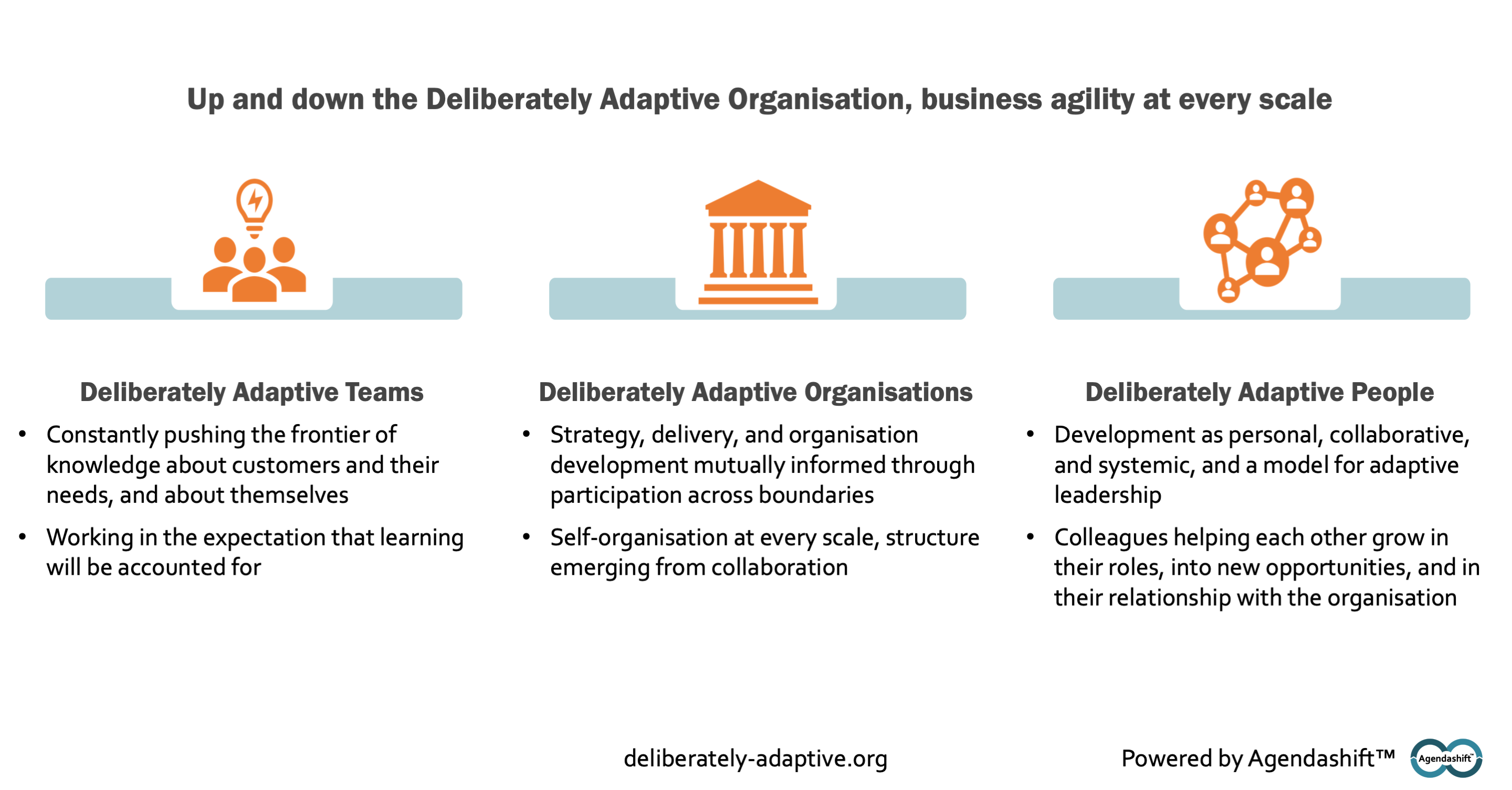
Choosing its models carefully to maintain that “at every scope or scale” vibe, the Deliberately Adaptive Organisation (deliberately-adaptive.org) integrates the following:
From Agendashift: rapid strategy development and alignment between scopes and scales through generative conversations, multi-level participation, and outcome-orientation
From Lean and Agile, patterns for collaboration and coordination, and the deep integration of delivery and learning
From Sociocracy (known to some as dynamic governance and to Akoff fans as circular hierarchy), consent and purpose as the basis for effective self-organisation and governance
From the Deliberately Developmental Organisation (as described in An Everyone Culture by developmental psychologists Robert Kegan and Lisa Laskow-Lahey), attention to the human side of development
What holds it all together is one of the crowning achievements of Systems Thinking, Stafford Beer’s Viable System Model (VSM), perhaps the most powerfully “at every scale” organisational model in existence. We take the management consultant’s Swiss Army knife and give it some 21st-century attitude in an innovative and accessible presentation.
Given that most of the popular approaches to scaling focus mainly on process, it is important for me to stress that the Deliberately Adaptive Organisation is not a process framework. Neither is it prescriptive. Instead, it is two kinds of model in one:
Diagnostic, but only in the everyday sense that it helps with the identification of dysfunctions and opportunities (building on strengths as well as mitigating weaknesses), not in the sense that those dysfunctions become the excuse for heavy-handed prescription
Generative in the sense that it helps organisations engage constructively with themselves, generate a wealth of ideas, and find their own way forward
If you know Agendashift (mostly generative, with the diagnostic part done generatively), you will recognise that winning combination. In fact, the Deliberately Adaptive Organisation is introduced in the closing chapters of the Agendashift 2nd edition (2021), my previous book Right to Left (2020) doing some of the setup.
As that roadmap indicates, the earliest access to the next iteration of the Deliberately Adaptive Organisation will be via the Academy, and you can be part of it. Join one of our regular Ask Me Anything sessions and even before the content is released I’ll be only too happy to explore it with you. Subscribe now:
Let’s begin with teams, or more specifically with its members, people. Even allowing for diversity, there are a number of near-universal things you can say about the members of any well-established team:
They each know who they are; many will also have a sense of who they’d like to be
They each know what they want to contribute; many will also have identified capabilities they’d like to develop
They each have a sense of what they can manage on their own and what should be managed more collectively
There are some boundaries there. They may be fuzzy and there may be room for negotiation in the short term and for development in the longer term, but cross them – insist that people do things that “aren’t them”, aren’t what they signed up for, or take away their ability to self-manage to the level they expect – and you have unhappy people in an unhappy team. For example, most people don’t like to be micro-managed; neither do they want to see important things left unattended.
Now to the team itself. You’d be hard-pressed to find a high-performing team for which these aren’t true:
There are collective senses of identity, purpose, and of what it aspires to
It knows what it’s there to do, what it is capable of, and ways in which those capabilities might be developed
It knows what it can manage for itself as a team, and (conversely) what needs to be managed more collectively, ie with (and perhaps by) other teams – potentially even with others outside the organisation
Again, there are some boundaries there. Fuzzy and negotiable no doubt, but only a fool would think they could cross them without negative consequences.
Jump now to the organisation as a whole. I almost don’t need to write these points down, but I will:
It has a sense of identity, a sense of purpose, and a sense of what it aspires to
It knows what it’s there to do, what it is capable of, and ways in which those capabilities might be developed
It knows what it can manage for itself as an organisation, and (conversely) what needs to be managed with others – suppliers, customers, industry groups, and so on
You can be pretty sure that if there are significant issues with any of those points, you’re looking at an organisation that has problems – big problems. At the extreme: identity crises, or working catastrophically beyond its capabilities or its remit.
Starting again at the level of the individual, on the topic of what makes the work meaningful, the answers may vary hugely. Moreover, you never know until you ask, and perhaps not even then until you get to know them well enough. At higher levels, diversity of purpose and capability is essential to meeting the complexities of the business environment. The successful organisation has them distributed effectively whilst maintaining some coherence of its own, not an easy balance to maintain when the environment is changing.
What does all that mean for teams-of-teams? Does this repeating pattern – a pattern that already works at three levels – the levels of individuals, teams, and the whole organisation – apply at other scales? Pretty much!
If your team-of-teams doesn’t have its own sense of identity and purpose – meaningful to the people in it, not just its designers – it is unlikely to amount to anything more than an aggregation of its parts. What is it for? What is it capable of? What does it add, other than overhead? If this problem is widespread, you have a structure that is hard to navigate, a direct cost to the organisation and potentially a problem for customers too.
What if it has those senses of identity and purpose but not a sense of where it would like to get to, what it would like to become, and so on? In that case, what holds it all together as its component parts continue to develop?
And what does it manage? If it’s trying to manage what its constituent parts are capable of managing on their own – interfering, in other words – it does both them and itself a serious disservice.
All that said, what does good look like?
A structure that makes sense – not just tidy on paper, but purposeful at every scale – allowing each unit at every scale to self-manage effectively (structuring itself to minimise dependencies, for example)
Each unit at every scale able to express its own strategy in its own words, in terms appropriate to its domain and its customers, aligning it with other units and other scales according to both structure and opportunity
Each unit at every scale able to identify what it must manage at that scale – no more and no less – with protocols to deal with what should be managed elsewhere
Any problems here I would characterise as organisational problems first (the organisation getting in the way of doing the right thing), problems of the strategy process second, and problems of the delivery process third – a distant third if the first two are in any way significant. And as leadership problems? It is hard work for leaders when these problems aren’t dealt with, so let’s be careful not to personalise problems that may not be of their own making. Neither should we underestimate the power of participation, self-management, and self-organisation. But if as a leader you’re getting in the way of the organisation fixing its problems or are complacent about them, well that’s on you.
Neither should you expect your problems of organisation, strategy, and leadership to go away by rolling out a process framework. Why would they? I don’t know if we have got to “peak process framework” yet – I don’t suppose we can know until some time afterwards and I’m not ready to call it – but in the meantime let’s be realistic about what they can and can’t do. And while we’re at it, let’s not pretend that a framework rollout is an easy and risk-free thing.
Much as I detest the rollout, this is not an anti-framework rant. If you find the opportunity to borrow from a framework as you address those more fundamental problems, that’s totally sensible – there’s no point in reinventing the wheel. You are still are in control of your own destiny, free to pursue what really matters.
Before part 2, more on the topic of maintaining healthy relationships with frameworks in these two articles:
Watch those last two come together in the coming months. At the Agendashift Academy, the final Leading with Outcomes module, Adaptive Organisation: Business agility at every scale is due in the autumn. You can get ready meanwhile with the first three modules:
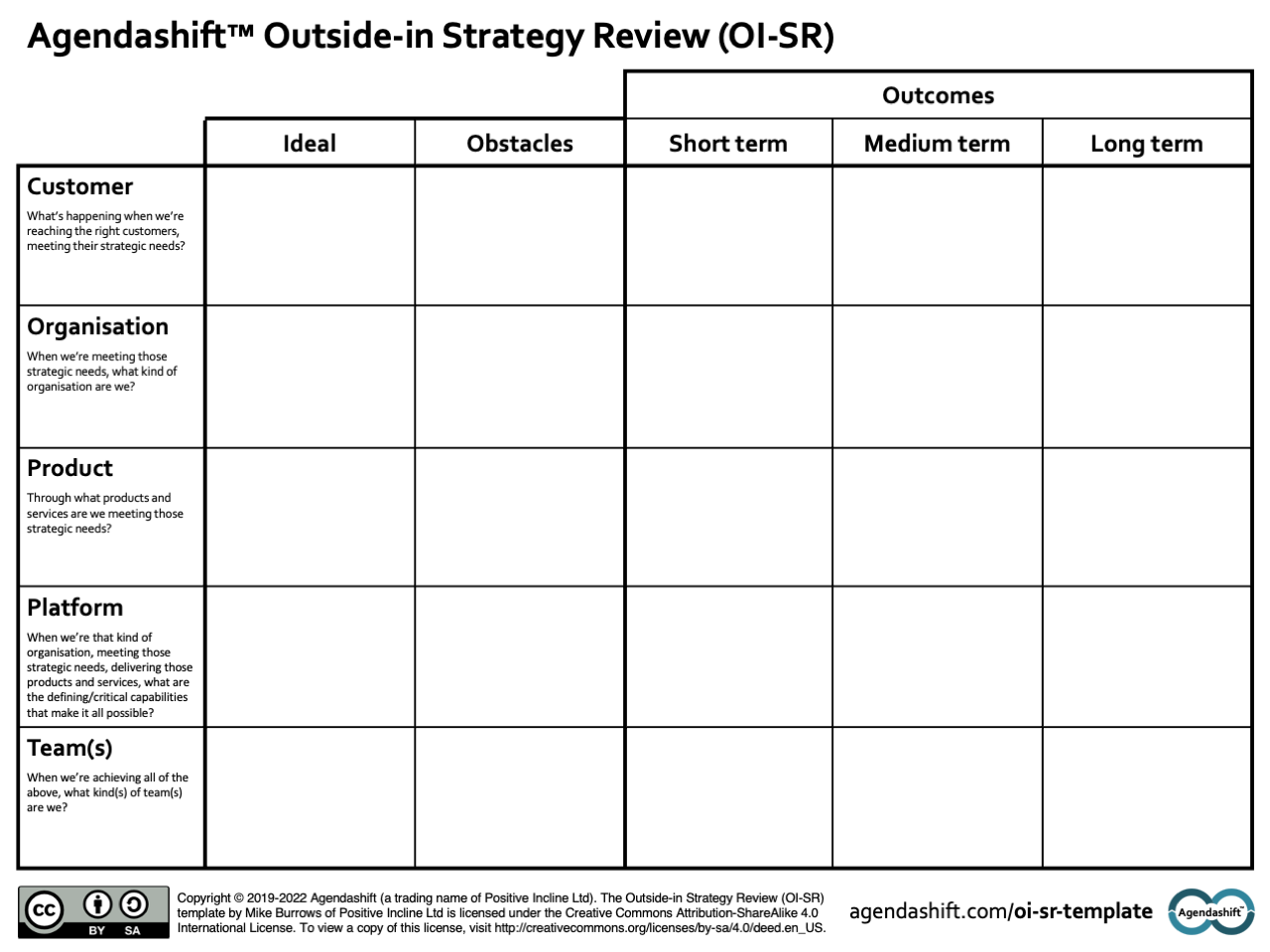
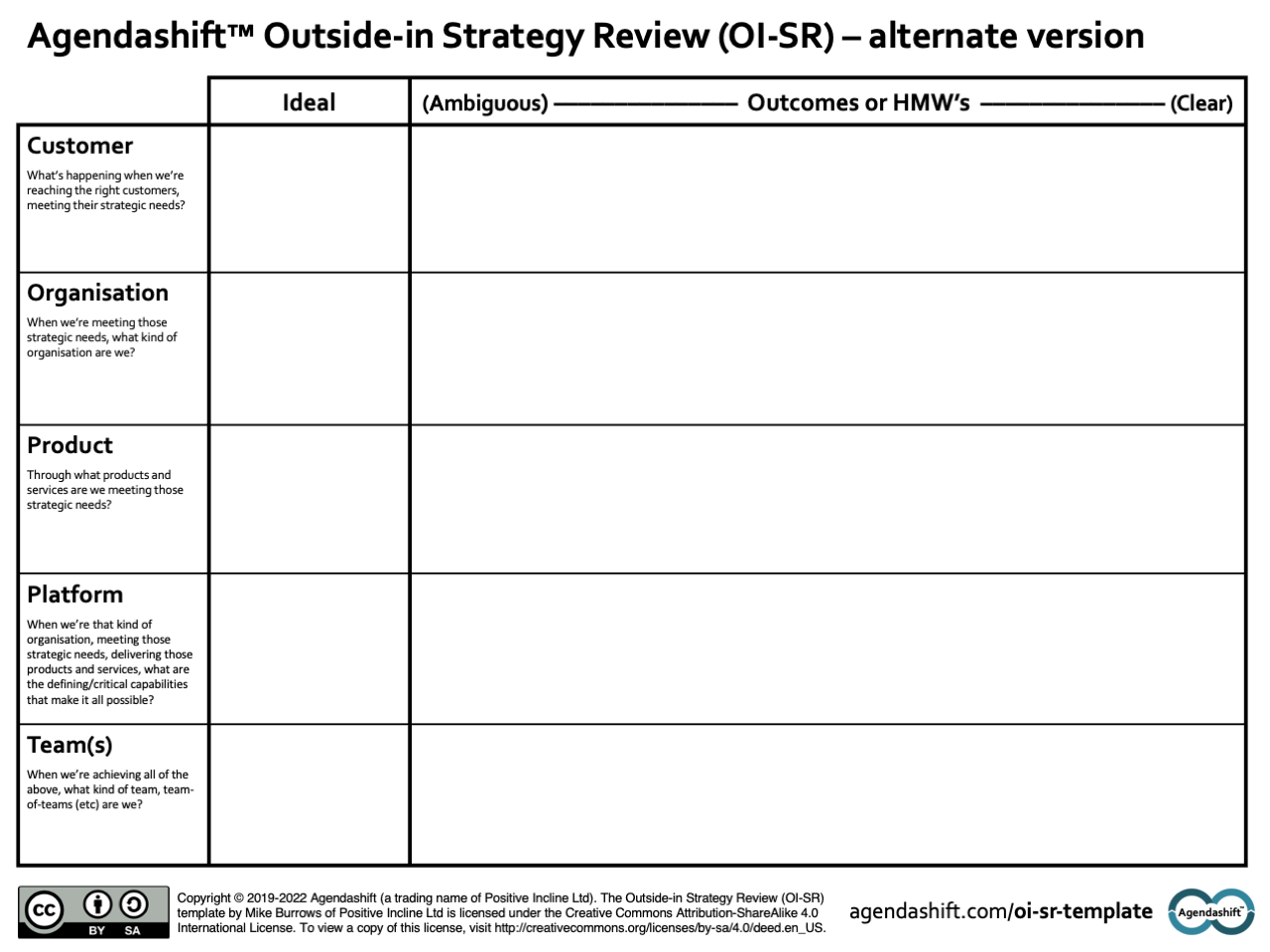
The Outside-in Strategy Review (OI-SR) template as described in my books Right to Left: The digital leader’s guide to Lean and Agile and Agendashift: Outcome-oriented change and continuous transformation (the 2nd edition especially). For a given scope – team, team-of-teams, something bigger (up to whole organisation) – it poses an interesting sequence of questions that launch generative conversations of the form Ideal, Obstacles, Outcomes, in other words the IdOO (“I do”) pattern.
I have added an alternate version:
This new version is especially for fans of tools such as Option Relationship Mapping, Wardley Mapping, and Challenge Mapping. The idea is to keep outcomes (or alternatively “How might we?”s) nicely spread out so that the relationships between them can be identified and drawn. Then choose an objective and work backwards to find suitable starting points. If you’re a fan of OKR, work forwards again and you have your key results in a sensible sequence.
It is of course no coincidence that over at the Agendashift Academy, the latest self-paced training module in the Leading with Outcomes series is Outside-in Strategy: Positioned for success. The first two chapters/episodes of five have already been released, the next is due on Friday, and it will be available in its entirety by the end of the month. It takes you through the layers, unpacking their respective questions, and walks you through the Ideal, Obstacles, Outcomes process too.
Watch the introductory video (05:33):
As I mentioned in the June roundup, the Leading with Outcomes curriculum is nicely on track to complete its rollout this year:
All four self-paced modules are included in your Agendashift Academy subscription. Beginning from as little as €29 per month, there are affordable plans for both businesses and individuals, yearly and monthly options in both cases, and a 7-day risk-free trial period for all card-based plans. If you’re a leader in a transforming organisation, you aspire to that role, or you support others in that journey, you’ll find plenty there for you and your colleagues.
Watch this space for a Zoom-based Train-the-Trainer (and Facilitator) event, and of course give me a shout if you need a strategy review facilitated for you.
What if we put agreement on outcomes ahead of solutions?


 Agendashift