Engage, Invite, Celebrate: Leading “wholeheartedly” for innovation

[respond to this post to LinkedIn]

You may remember that a little over six years ago I published Towards the wholehearted organisation, outside in, a blog post inspired by this quote:

"A thing is whole according to how free it is of inner contradictions. When it is at war with itself, and gives rise to forces which act to tear it down, it is unwhole. The more free it is of its own inner contradictions, the more whole and healthy and wholehearted it becomes"

Christopher Alexander, The Timeless Way of Building (1979)

I won’t retell all of the history of what followed, but wholehearted went on to become a key piece in both Agendashift and Leading with Outcomes. It lent its name to Agendashift’s mission statement, and in Leading with Outcomes it features in both the Foundation and Adaptive Organisation training modules. In short, it has legs! However, the way we introduce wholehearted as a model for leadership has evolved over the years, and it’s about time I shared a little of where we have got to with it.

From the Alexander quote, we picked out three words: unwhole, whole, and wholehearted. Then we asked a question: In relation to those, what expectations or responsibilities might a wholehearted organisation place on its leaders? Alternatively: By what behaviours do we recognise the leaders among us? We need leaders to be:

  1. Engaging on the right challenges – attending to all that makes the organisation unwhole, i.e. to what makes it in any way disconnected, incomplete, unbalanced, incoherent, or otherwise dysfunctional; attending also to what might lead to a sense of unwholeness in the future – opportunities missed, for example
  2. Inviting people to participate – not only for their perspectives and ideas but for the integration (i.e. making whole) that happens when you bring people together 
  3. Celebrating their initiative – amplifying the organisation’s capacity to innovate, not only in terms of enhanced products and services but in terms of the organisation’s own development also

Taking those first at face value, what word is better than ‘leader’ to describe people who demonstrate a commitment to engage, invite, and celebrate? Conversely, what would we think of a leader who isn’t engaging on the right issues? What would we think of a leader who is slow to invite people into the process? And what would we say of an organisation that has little progress to celebrate, or of a leader who keeps missing the opportunity?

We must recognise that leaders are human, and the organisations they work within aren’t perfect, so what stops leaders from leading more wholeheartedly, i.e. in the ways suggested? Moreover, what stops you (or leaders around you) from leading like that? Could it be that the conversation your organisation needs is the one that 1) identifies those obstacles and 2) explores what might be made possible if ways can be found around or through them?

The Foundation module of Leading with Outcomes starts with just such a conversation. Now, under the headings of Engage, Invite, and Celebrate, let’s explore how those ideas have developed.

Engage

What are the right challenges that leaders should be engaging on? Going back to the idea of unwholeness, there’s what is making the organisation unwhole now, and there’s what the organisation may come to regret if the opportunity isn’t grasped now. Bringing those together as “areas of opportunity” (actually the name of one of our exercises), Leading with Outcomes offers three main perspectives from which they can be identified:

  1. Inside-out Strategy – an approach to strategy that begins with the internal experience of the organisation or some smaller scope thereof and its delivery capabilities, moving on to the possible consequences internal and external of developing them
  2. Outside-in Strategy – complementary to the first perspective, this begins with customers, users, and other actors in the outside environment, considering those relationships, and works inwards to the implications for the organisation, its product, its underlying platform of technology, know-how, and so on, and its teams
  3. Adaptive Organisation – deeply integrating the preceding into the life of an organisation in a fundamentally relational, generative, and fundamentally complexity-aware way

As my friend and collaborator Philippe Guenet observed at the London training a couple of weeks ago, Leading with Outcomes is unusual in how “three dimensional” it is, and he meant that not only about the three perspectives above. He appreciates the way we avoid letting the flow metaphor dominate to the exclusion of strategy and structure. Along with leadership, we see those not as things to roll out or to accept meekly as givens, but as aspects of organisation that interact in dynamic and complex ways with each other and the delivery flow, such that each can be seen as both products of and constraints on the others.

Accordingly, a three-dimensional set of “right challenges” to engage on might look something like the following:

  1. Impediments to flow (it should not be taken from the preceding paragraphs that I believe flow and its impediments to be unimportant, only that other perspectives are vital too)
  2. Obstacles that lie in the way of the organisation being where it wants to be and who it wants to be – in healthy and productive relationships with its customers, users, suppliers, and so on, and well positioned with respect to its competitors
  3. Constraints of structure, policy, and habit that impact negatively on the organisation’s ability to deploy its decision-making, communication, and innovation capacities where they are most needed, and for those to self-organise as needed

If you were ever at a loss to know what it means for leaders to be “creating the conditions” for an adaptive, innovative, and resilient organisation, we have here the basis of a leadership agenda. By keeping focus on these things (the process never stops), more of the “right challenges” will be engaged with at every level of organisation, for as long or short a time as might be needed. 

Each type of challenge applies at every level of organisation, and at each level, no leader can hope to adequately address all of those by themselves. Even the task of framing the key challenges may best be done with other people, so let’s move on to the invitation to participate.

Invite

The idea that you can expect to succeed in a complex challenge with a rollout-based approach belongs in the 1990’s. If by the time you’re inviting people into the process you’re already talking about predetermined solutions, you’ve left it far too late. Even to be inviting solution ideas is too late if you’ve missed the opportunity to explore the “challenge space” together.

Important aspects of the challenge space include 1) the obstacles that people bump up against every day, and 2) the possibilities they can envisage if only those obstacles could be dealt with in some way. If they are given the opportunity to identify and articulate those in their own words, you (together) not only obtain the raw material for a coherent strategy that is grounded in reality and contains its own measures of success, you greatly increase the strategy’s “surface area”. In it, more people at more levels of organisation will find more that they can engage with and contribute to.

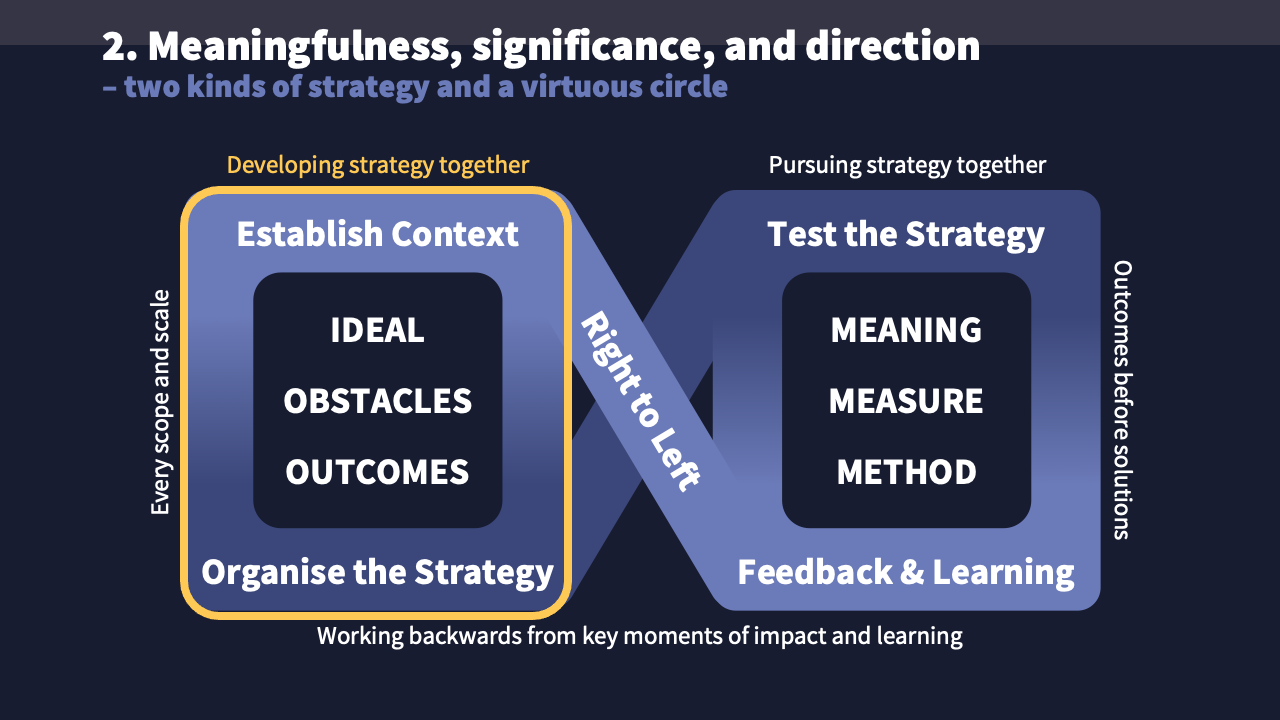
To be clear, and recalling that to integrate is to make whole, what I am describing is the integration through participation of the development and pursuit of strategy. Two of Leading with Outcomes’ three main patterns fit here:

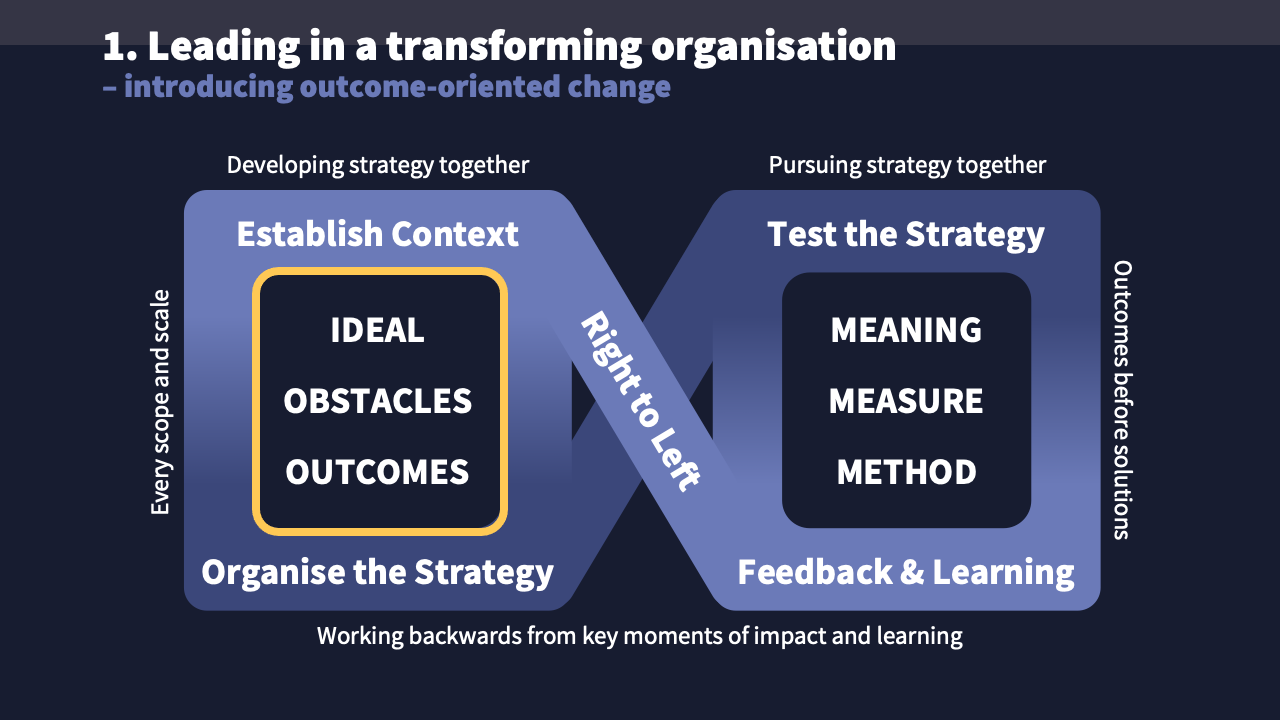
  1. The IdOO (“I do”) pattern – Ideal, Obstacles, Outcomes
  2. The 3M pattern – Meaning, Measure, Method
Developing & pursuing strategy in the language of outcomes


These patterns are the main focus of the Foundation module of Leading with Outcomes and much of the Agendashift1 and Organizing Conversations2 books. They translate coaching conversations to two different scales: everyday leadership routines and the structures of set-piece strategy events – workshops, training, and the like. In the latter, participants practice the former so that the experience “rubs off” to benefit of the everyday working experience.

In its typical usage, the 3M pattern incorporates the IdOO pattern (I’ve highlighted the words “ideal”, “obstacles”, and outcomes” below), so I’ll expand here just on 3M:

  1. Meaning: for some focal challenge or outcome, what does this look like in the ideal and for whom (broadening and energising a conversation beyond the obvious), and what is the significance of the obstacles that impede the pursuit of that ideal?
  2. Measure: not only in terms of metrics, by what observable outcomes will we know that we are being successful – behaviours and other indications that obstacles have been overcome and that people are making meaningful progress, the contexts within which they operate changed in some beneficial way
  3. Method: generating multiple and diverse solution ideas, and for the most interesting of those, framing them as hypotheses

These generative conversations need not take long – from moments to at most minutes. Why organisations instead commit so quickly to singular, monolithic, and oversized solutions seems a mystery! Perhaps it is partly human nature (a general overconfidence in planning) and partly a vestige of the 1990s change management and project management models that business schools and senior leaders have done far too little to challenge.

Likewise, and stepping back to deeper conversations on strategy, it would seem highly sensible to invest just a few minutes or hours to avoid overcommitting to what might turn out to be many months of execution, but again, old habits die hard. There is cause for hope in modern notions of complexity and emergence, but if we are leaving leaders to interpret these rather abstract concepts in their organisational contexts and to join the dots themselves, this seems a very big ask.

Let us move on then to celebration, which hides a serious message about learning. Without the means to support it – indeed for the organisation to expect it – an innovation process is very hard to sustain.

Celebrate

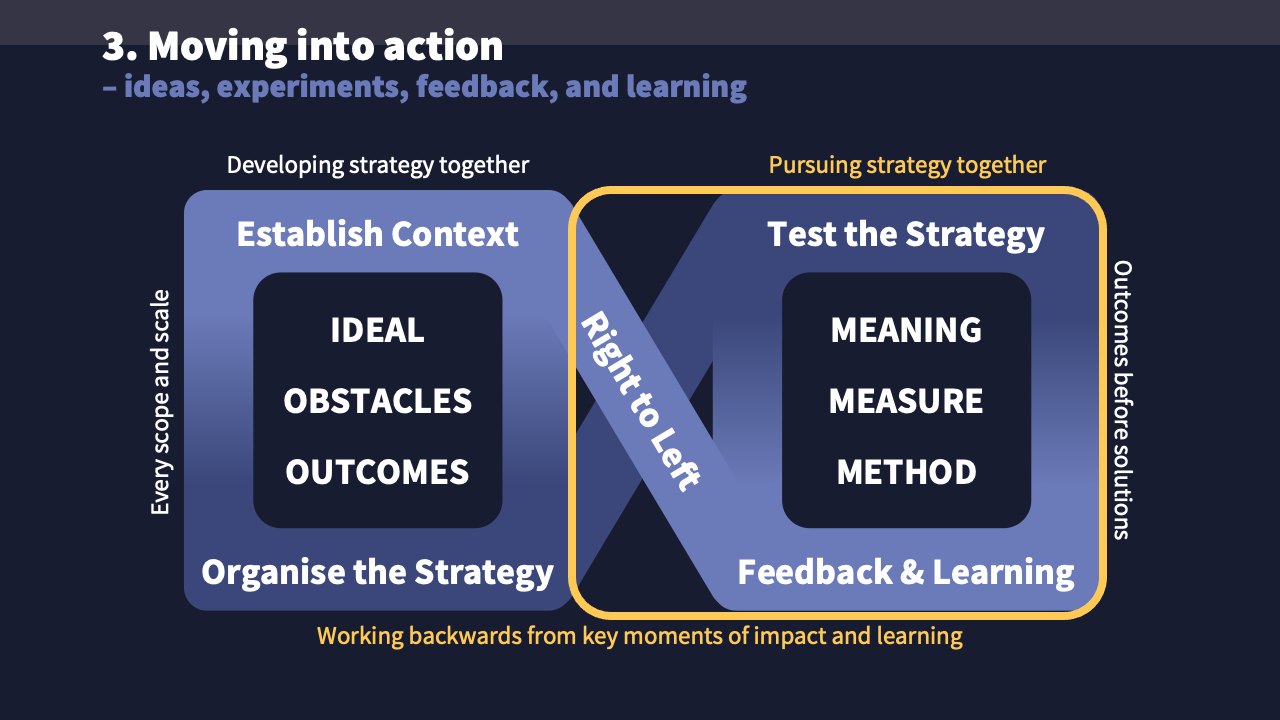
The third of Leading with Outcomes’ three main patterns is Right to Left (not uncoincidentally the title of another of my books3). It refers to working backwards from two key moments, moments of impact and learning otherwise known as done and really done:

  • done: someone’s need was met
  • really done: we’ve accounted for the learning

As a coordination mechanism, the practice of reviewing work closest to completion first creates the foundations for flow. If work items are sufficiently granular, opportunities to celebrate getting them to meaningful states of done and really done should be frequent. Meaningfulness and alignment to purpose are enhanced greatly if “closest to completion” refers (as it should) to the work that is closest to making a customer impact. Add a delivery process that asks the right questions at the right time and in which everyone knows the boundaries of time and organisational scope within which the accounting will be done, a container for learning is formed.

To maximise the conditions for learning, leaders make multiple contributions. They represent and thereby reinforce those boundaries; some of them span boundaries helpfully also. They care that the right questions are asked at the right time, and not only when they themselves are the ones doing the asking. They care that at every stage of the delivery process, people have the customer and organisational context they need to make good decisions and deliver great work.

I could have added to that list, but that last responsibility says a lot about the distribution of decision-making capacity in the organisation. The need to make decisions and to find and create effective solutions does not fall only on leaders. It is characteristic of knowledge work that this is happening everywhere; the challenge for leaders is to help the combined effort keep its coherence and its senses of direction and purpose. Fortunately, they need not – and indeed cannot – do this on their own. Yes, they need to engage on the right challenges, but also they should be confident (or else working to build the confidence) that others around them are doing the same. Inviting more people into the process should be an early second step if it is not already part of the first. And let the celebrations begin! The sooner and more frequently those come, the faster the organisation delivers, learns, and adapts.

Engage, Invite, Celebrate: The call to action

Where will you start? Where is your greatest opportunity? Is it to engage on the right issues, to invite people into an integrated strategy process, or is it to celebrate their initiative, their successes, and their (everyone’s) learning? Or is it to help others around you to do the same? The choice really is yours, but you may find it helpful to work backwards – Right to Left if you like. Nothing builds trust like celebrating success. As you get better at it and learn to share the load, you create capacity. That capacity can be directed at identifying, framing, and prioritising your challenges. By the time you can anticipate celebrating your successes you will be well on your way.

Coming soonish: Wholehearted, the book

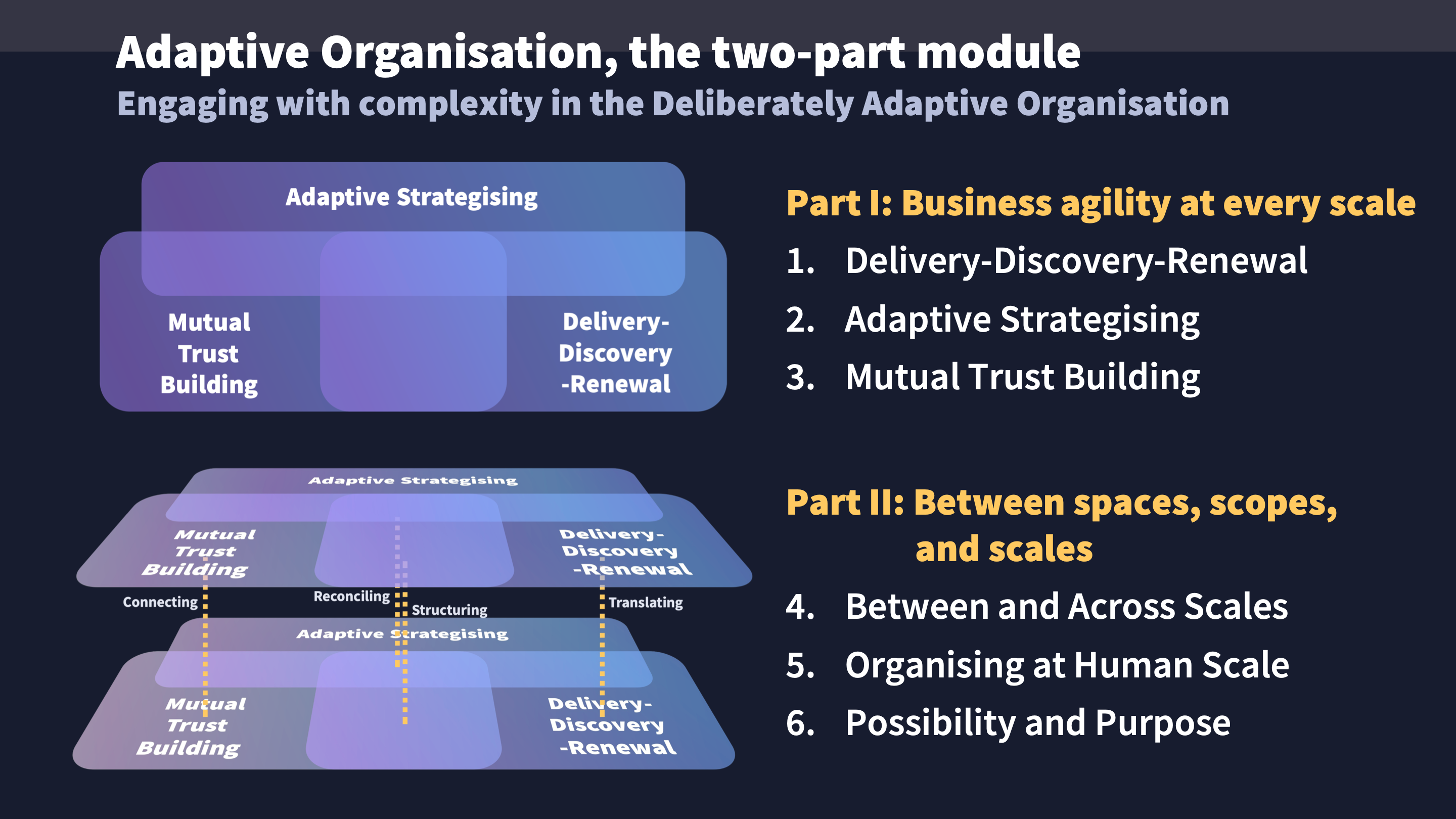
My fifth book, Wholehearted: Engaging with complexity in the Deliberately Adaptive Organisation will expand on many of the themes of this post. The Wholehearted of the title is of course a reference to the Engage, Invite, Celebrate model and the Christopher Alexander quote that inspired it. Its main focus is a deep dive into the kinds of challenges that leaders need to be engaged on, in particular to the dysfunctions that arise out of imbalances in the relationships between different aspects of the organisation. Healthy and productive relationships – for example between the work and how it is coordinated, or between delivery work and developmental work – are absolutely crucial to the effective deployment of the organisation’s decision-making capacity (and vice versa).

The book’s central model is the Deliberately Adaptive Organisation, a complexity-friendly retelling of the Viable System Model, faithful to the structure of Stafford Beer’s classic model but taking a very different approach to its application. Gone is the top-down analysis; in its place is a participatory, “everywhere all at once” approach. Going out of its way to avoid privileging any singular perspective, the goal is not to document an agreed view of the current or future state of the organisation but to identify through dialogue its challenges, underlying constraints, and possible interventions. By continuing to intervene on those constraints, the organisation works on becoming a better version of itself with a healthier and more productive relationship with its environment.

I use “constraints” here very much in the way understood in complexity science. Not just people and teams but other identifiable aspects of organisation affect each other’s behaviour not only by design but by their mere proximity. Too many and too interconnected for anyone to fully understand, let alone manage, these myriad relationships give rise to complexity, and do much to explain the poor track record of traditional approaches to organisational change. The approach here is to go with the grain of natural social processes, making it easier for desirable and ultimately rewarding interactions first to happen, and then to be repeated until they are normalised.

Yes (I’ve been told this more than once), to attempt to bring the systems and complexity worlds together like this is ambitious. It works though! The key I think is not to approach it as a problem of modelling or execution but as the kind of strategy challenge in which its development and pursuit must proceed hand-in-hand through dialogue. Organisations don’t just do stuff, they are experienced, and every experience is different. Through dialogue, and with effective frameworks for making sense of those diverse experiences, common themes emerge, and new stories are told. And so a process of generative change begins, one in which solutions emerge where they are needed.

I am not yet giving a timeframe for publication. Part I, Business Agility at Every Scale, is reviewing well, but work on Part II, Between Spaces, Scopes, and Scales, has only just begun. And majoring on the dialogic (i.e. dialogue-based) and generative aspects of organisation development (OD) I have alluded to, Organizing Conversations has only been out for a few weeks!

1 Agendashift: Outcome-oriented change and continuous transformation (2nd edition 2021)
2 Organizing Conversations: Preparing Groups to Take on Adaptive Challenges (May 2024)
3 Right to Left: The digital leader’s guide to Lean and Agile (2019, audiobook 2020)

[respond to this post to LinkedIn]

Related posts

And in relation to the recently-published Organizing Conversations:

Learn more

The abovementioned patterns – IdOO, 3M, and Right to Left – are introduced in the online self-paced training module Leading with Outcomes: Foundation, available on a subscription basis or delivered privately by an authorised trainer as a 1-day in-person or online class.

After Foundation come the Leading with Outcomes modules listed below. Although may you prefer to bring Adaptive Organisation forward or even to begin with Outside-in Strategy, the default sequence is as follows:

  1. Inside-out Strategy:
  1. Adaptive Organisation:
  1. Outside-in Strategy: Positioned for success (soon to split into two parts also)

As with the Foundation module, all are available privately in both classroom training and online forms, also as shorter facilitated workshops. Publicly as well as privately, Leading for Innovation in the Knowledge Economy (formerly Leading in a Transforming Organisation) combines Foundation and Adaptive Organisation into a 3-day class, the next of which takes place in October. That and both online and in-person versions of Train-the-Trainer/Facilitator (TTT/F) are included in our calendar below:


Agendashift™: Serving the transforming organisation
Links: Home | Subscribe | Events | Media | Contact | Mike

Agendashift  Academy: Leading with Outcomes | Trainer and Facilitator Programmes | Store

At every scope and scale, developing strategy together, pursuing strategy together, outcomes before solutions, working backwards (“right to left”) from key moments of impact and learning.

[respond to this post to LinkedIn]

Agile’s Great Rebalancing: My next book’s take on the Agile manifesto

Some context: Measured in chapters (not time, alas) I’ve reached the halfway mark in the writing of my fifth book, Wholehearted: Engaging with Complexity in the Deliberately Adaptive Organisation, completing the first three of six chapters and with those, part I (Business agility at every scale) of two parts. I’ve adapted the article below from a passage in Chapter 1 in which we’re exploring a space I call Delivery-Discovery-Renewal (Figure 1). That space encompasses the productive activity of a team or other organisational scope at any scale of organisation – everything that’s done in the “here and now”, as opposed to, say, planning or retrospecting.

Figure 1. The Delivery-Discovery-Renewal Space

The Delivery-Discovery-Renewal Space comprises the following:

  1. The value-creating work – delivery-related work (obviously), discovery-related work (making sure that we will be delivering the right things, scouting for new opportunities), and renewal-related work (working on the organisation itself, building and improving the capabilities needed)
  2. How that work is coordinated – understood very broadly as all the constraints on that work that have any kind of coordinating effect
  3. How that work is organised – organising around commitments and managing towards goals, another set of constraints on the work

…and their relationships:

  1. Mutual relationships between systems 1, 2, and 3 above, i.e. between the value-creating work, how its is coordinated, and how it is organised – how they constrain each other, how they inform each other, the effects they have on each other, and so on
  2. The relationship with the external environment – for the purposes of this article, relationships with customers and users most especially
  3. Relationships inside system 1 above (the value-creating work) – collaborations, process-defined interactions, structures, and so on

You may recognise there a good chunk of Stafford Beer’s Viable System Model (VSM), and with the mention of constraints, hints of something complexity-related also. The Deliberately Adaptive Organisation model and the forthcoming book cover three such spaces (Delivery-Discovery-Renewal, Adaptive Strategising, and Mutual Trust Building), the relationships between them, relationships internal to them, and the much-neglected relationships between different scales of organisation.

It is very much a relational model, i.e. not a process model but complementary to those, providing them with some sorely-needed theory, particularly on matters of scale. It is easy to engage with, it provides a fresh perspective on familiar things, it translates straightforwardly to a complexity-based perspective, and it can be the basis of a participatory strategy process – all very different from the more analytical ways in which such models are typically used.

In the lightly-adapted excerpt below, we are mid-chapter. You might find it worth giving the above introduction a second read therefore (I’ll refer to Figure 1 more than once). Somewhat in the vein of my January post From Flow to Business Agility (by a huge margin my most-read post of the year so far), we are exploring a key question for the Delivery-Discovery-Renewal space and for the other two spaces:

How might we increase our decision-making capacity?

The Great Rebalancing

One important way to increase decision-making capacity in this Delivery-Discovery-Renewal space is to move away from people serving the process and toward the process serving those who do the work. Some clear signs of success:

  • Routine work can be done with negligible overhead
  • Coordination problems – contention, overburdening, starvation, and the rest – are seen not as facts of life that people must simply endure, but as symptoms of something systemic that can and should be addressed
  • In non-routine situations, appropriate courses of action are made no harder than necessary by, for example, bureaucracy or overly restrictive policies
  • Those doing the work have appropriate control over their working environments, and that agency is seen as a potential source of innovation

Each of those reflects some change in the balance between the elements I identified in the introduction to this article, most especially between the value-creating work and how it is coordinated (systems 1 and 2 respectively in Figure 1 above). Taken together, they remind me of the Agile manifesto [1] and, in particular, the first and most famous of its four “this over that” declarations: “Individuals and interactions over processes and tools”. The remaining three declarations can be understood in a similar way, i.e. as representing a sometimes radical rebalancing of relationships inside the Delivery-Discovery-Renewal space.

“Working software over comprehensive documentation”: If we’re staying strictly within the Delivery-Discovery-Renewal space and focusing on the work rather than the thinking behind it, this declaration impacts mostly the balance between upstream and downstream activities. This idea has consequences in many spheres outside of technology development and the book will develop it further. Here though, let’s understand it in manifesto terms.

The 1990s, the context in which Agile arose, saw the peak of the linear project model. Technology projects proceeded in a sequence of phases (see Figure 2 below for an example), and because activities were separated in time, those upstream-downstream relationships barely existed. And at such a cost! As projects moved from one documentation-heavy phase to the next, the emphasis was on demonstrating that the latest work conformed to expectations set in preceding stages, not on establishing whether those expectations were based on accurate assumptions. When those assumptions were about the behaviours of users and people-based systems, they would often prove unsafe, but by the time they were invalidated it was already too late.

Figure 2. A linear project model

The remedy: upstream and downstream activities no longer in separate phases but tightly integrated in an iterative or continuous process. With people from different disciplines working closely together, feedback could come in days or less, not the weeks, months, or longer that it took previously. In support of those collaborations, documentation would become much more granular, produced no earlier or later than needed (i.e. just in time), taking perhaps the minimalistic form of user stories [2] or job stories [3], describing not whole projects but very thin slices of functionality – specific usages of individual features. Given an appropriate sequencing of these small but still individually useful deliverables, an incomplete but still meaningfully useful product could emerge quickly. With more time, and perhaps over an indefinite period (funded not as a project but as a product line), it could evolve into something fitting.

The genuine documentation needs of developers, customers, and end-users never completely went away, and there remains the responsibility of the Delivery-Discovery-Renewal space towards its future self. Pity the poor person who, a year from now, has to understand the design decision you made today or debug the code that you’re writing. Perhaps you owe it to them to leave at least some clues, not to mention that this poor person might turn out to be you! Working in the here and now, when the creation of those usually very small pieces of documentation is an integral part of the development process, a more maintainable system results. There remains a need, however, to keep that effort proportionate to its value, an issue outside the “here and now” and the province of the Adaptive Strategising space.

“Customer collaboration over contract negotiation”: The obvious rebalancing here is away from an adversarial relationship that makes change difficult and increasingly costly as it is delayed, and towards a partnership relationship in which risks and benefits are shared equitably and managed cooperatively. The benefits in terms of decision-making capacity alone are enormous, and I have first-hand experience of it working wonderfully in surprising settings.

Before the launch of the UK’s Government Digital Service in 2011, who would have thought that working on a government project as part of a mixed team of staff and consultants could be a truly special experience? As the interim delivery manager on two of GDS’s ‘exemplar’ projects, I experienced exactly that. There were two customer relationships there: the supplier/government relationship and the government/citizen relationship. By far the more important relationship there was the second, and the abiding principle was “Start with needs: user needs not government needs”. That was more than a slogan. We lived by it, and projects that couldn’t demonstrate it would find themselves in trouble.

Of course, beyond the neglect of user needs there are other ways in which the customer relationship can become dysfunctional. The rapid growth of the attention economy, the asymmetries involved in the handling of personal data, and the rise of AI have combined to create a new issue: the technology/user relationship becoming exploitative to the extent of causing real harm. Unlike the Agile revolution, I don’t see the technology industry solving this issue itself; it has become a matter for governments.

One cause of these problems is that the customer and the user are often not the same person. A sponsor paying for a system they will never use isn’t as troubling as an advertiser paying for access to data the user regards as private, but their product teams ignore the user at their peril. Users have untapped expertise, and how they interact with the product has a lot to teach the product team. Even the bad guys know that they need to make their products usable! Again: software cannot be said to be “working” if it fails to meet user needs, and if that needs to be expressed contractually, so be it. Better still, get users as close to the team as you can manage, even part of the team where that’s possible.

“Responding to change over following a plan”: This is the last of the Agile manifesto’s four “this over that” declarations. For the most part this one belongs with the Adaptive Strategising space, but – spoiler alert – the relationship between that space and Delivery-Discovery-Renewal works through what the two spaces share, the scope’s ability to organise (labelled 3 in Figure 1 above). In the “here and now” of this chapter, the relevant capacity-sapping dysfunction is over-commitment.

Overcommitment is closely related to overburdening and one may contribute to the other, but they should not be confused. Overburdening, a coordination dysfunction (system 2 in Figure 1), leaves a team, activity, process, or other organisational scope in an unhealthy and poorly performing condition because it is trying to work on too many things at once. This multi-tasking incurs costs in context switching, quality issues, delays, and frustration. Compounding all of that, additional work in the form of rework. Overcommitment, a dysfunction in organising (system 3 in Figure 1), means that new commitments can’t be made without breaking commitments previously made. Whether that’s the result of taking on too much work, working to a planning horizon that’s too long, working in chunks too large, or working to plans that leave insufficient room for manoeuvre, that’s a different but similarly serious problem. The scope’s capacity for independent action – John Boyd’s definition of viability – is compromised.

Taking those last three “this over that” declarations together, an Agile process matches its commitments to the short length of time it takes to generate useful information. Progress is made hypothesis by hypothesis, goal by goal. Out of an Agile process, products aren’t built fully formed to a design fixed in advance; they emerge.

When I use ‘Agile’ capitalised like that, I’m describing things that can be traced back to the Agile manifesto. In that sense, the forthcoming book is an Agile book per se; its roots are elsewhere. You can see in the above discussion, however, both what’s at stake and what’s possible. This is not to say that all is rosy in the Agile world: my previous books all address the issue of the Agile industry imposing process and practice on people, to the extent that “Individuals and interactions over processes and tools” can seem cruelly ironic at times. Nevertheless, I make the bold suggestion that Agile has been more successful – unreasonably successful – than perhaps its own community realises.

Consider the effect of this Great Rebalancing (or if you prefer, a great shift in organisational constraints) not only on the decision-making and communication capacities of the teams involved but also on those around it. Capacity that previously was consumed by the need to manage teams from the outside has been relieved of much of that burden. Capacity thus freed can be applied to more interesting things. That improves the experience of leadership, increases the quality of leadership, and greatly increases the chances that self-organised innovation will occur not only within teams but at larger scales too. That is what the book will be about: identifying and dealing with dysfunctions at every scale, enabling other great rebalancings, and unleashing thereby other kinds of “unreasonable effectiveness”.


Ping me if interested in tracking progress on the book; some have early access to the manuscript already, and with a view to getting multiple perspectives on it I will be setting up multiple review circles in the coming weeks covering tech, healthcare, education (i.e. universities), faith communities and other voluntary or not-for-profit organisations, and the systems and complexity communities.

See also Leading in a Transforming Organisation in Berlin, London, and Southampton in the list below of upcoming events. Highly relevant! Days 2 and 3 have much the same structure as the book. Likewise, under the heading of Leading with Outcomes, the self-paced Adaptive Organisation parts I & II further down the page below.

[1] More properly the Manifesto for Agile Software Development (2001), agilemanifesto.org

[2] See my favourite Agile book: Jeff Patton and Peter Economy, User Story Mapping: Discover the Whole Story, Build the Right Product (2014, O’Reilly Media)

[3] Another book that I recommend frequently: If interested in job stories and the jobs-to-be-done (JTBD) framework, start here: Bob Moesta & Greg Engle, Demand-Side Sales 101: Stop Selling and Help Your Customers Make Progress (2020, Lioncrest Publishing)

Upcoming events

February

March

*TTT/F and (where shown) LIKE events include free one-year membership of the Leading with Outcomes Authorised Facilitator programme, upgradeable to Authorised Trainer at any time. Both of those include access to the video-based Leading with Outcomes training and the full range of Agendashift assessment tools.


Leading with Outcomes from the Agendashift Academy
“Leadership and strategy in the transforming organisation”

Leading with Outcomes is our modular curriculum in leadership and organisation development. Each module is available as self-paced online training or as private, instructor-led training (online or in-person). Certificates of completion or participation according to format. Its modules in the recommended order:

  1. Foundation module:
  2. Inside-out Strategy:
  3. Adaptive Organisation:
  4. Outside-in Strategy:

Individual subscriptions from £24.50 £18.40 per month after a 7-day free trial, with discounts available for employees and employers in the government, healthcare, education, and non-profit sectors. For bulk subscriptions, ask for our Agendashift for Business brochure.

To deliver Leading with Outcomes training or workshops yourself, see our Authorised Trainer and Authorised Facilitator programmes. See our events calendar for Train-the-Trainer / Facilitator (TTT/F) and Leading in a Transforming Organisation trainings.


Agendashift™: Serving the transforming organisation
Links: Home | Subscribe | Events | Media | Contact | Mike

Agendashift  Academy: Leading with Outcomes | Trainer and Facilitator Programmes | Store

At every scope and scale, developing strategy together, pursuing strategy together, outcomes before solutions, working backwards (“right to left”) from key moments of impact and learning.
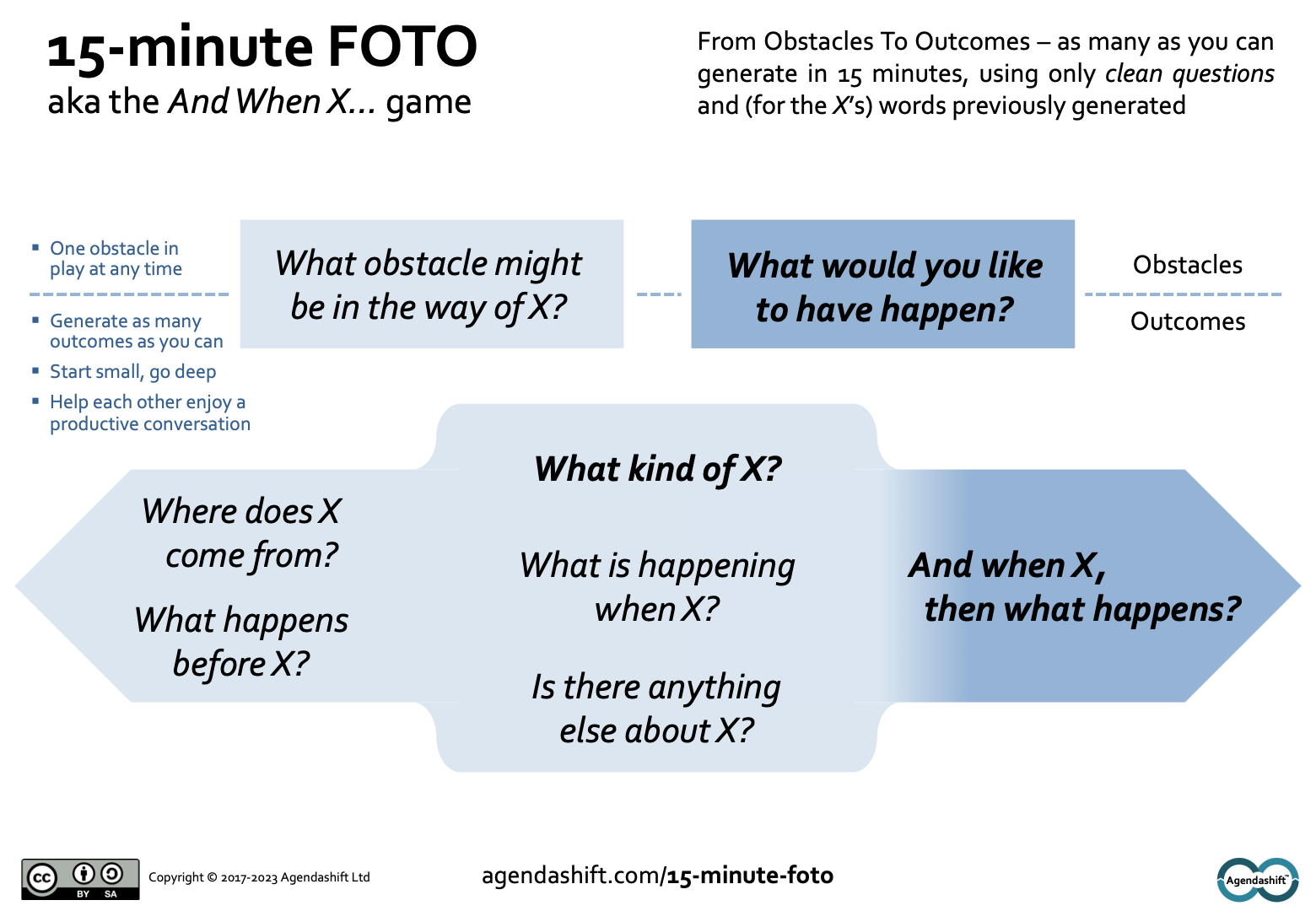
A big update to 15-minute FOTO

In this new version of our Clean Language-inspired coaching game:

  1. Integrating the Classic and Lite editions formats
  2. Cheat mode
  3. General tidyup
  4. Standard and premium versions

1. Integrating the Classic and Lite formats

The Lite format (or ‘edition’, as it has been called up to now) was introduced in 2019 in version 7 thus:

To understand why we’ve wanted to make changes, consider what each participant is doing when they play the game for the first time:

  • Familiarising themselves with the Clean Language questions (from the cue card if it’s an in-room workshop, from the screen if it’s online)
  • Taking turns in the role of client, coach, scribe, or observer, participating in or supporting what can be an intense 1-on-1 coaching conversation
  • Worrying about the game’s objective, which to generate and capture outcomes

That’s a lot! Instead of doing this all at once, the Lite edition starts with a familiarisation exercise, turns the conversation into one for the table group as a whole, and the objective matters only after everyone has had a chance to get comfortable with it all.

If, as happens in many of our workshops, you plan to do 15-minute FOTO twice, you can start with the Lite edition and do the classic edition the second time round.

Since 2021 and version 11, the Scribe and Observer roles have been combined into a Host role. With the latest wording for the Lite format, the formats and roles are now described as follows:

  • Classic format – rotating every few minutes through the roles of Client, Coach, and Host so that everyone gets a turn in every role
  • Lite format – anyone can ask, anyone can answer – but don’t get stuck too long in one role or on one obstacle

Role responsibilities:

  • Client: Chooses obstacles, responds to the coach’s questions with short, bullet point answers
  • Coach: Guides the conversation using only the clean questions from the card and the client’s own words
  • Host: Helps others enjoy a productive conversation, ensuring that “anything that sounds like an outcome” gets captured

Previously, the slides for the Lite format didn’t mention roles until the debrief. We have found however that participants find them helpful, to the extent that some facilitators choose to skip the introductory Lite format and go straight to the altogether more intense Classic format. They are now integrated such that with just one Classic slide, Lite participants gain a clearer picture of how the game can proceed, and are free to play the game anywhere on a wide spectrum between only loosely coordinated and the highly structured Classic format itself.

Facilitators may skip/hide slides or explain both formats as they prefer, perhaps leaving decisions on that until the last moment. Training and workshop decks need only one set of 15-minute FOTO slides, not two. These benefits are substantial – not least to me, who maintains it all!

2. Cheat mode

Introduced recently in the blog post 15-minute FOTO’s cheat mode, the game now allows an additional question (or variants thereof):

  • Why is that important?

For reasons explained in that article, this question is not included on the cue card.

3. General tidyup

I won’t describe them all in detail, but there has been a raft of minor-to-moderate changes, including:

  • The sequencing of slides in the facilitation deck
  • A thorough overhaul of the 15-minute FOTO page on agendashift.com – well worth a read
  • Wording aligned with Leading with Outcomes

An example of that last one is this tip:

  • Treat What would you like to have happen? as inviting a small outcome – a first, tiniest sign that something interesting might be beginning to emerge

That wording comes from the commentary I use behind a progression familiar to Adademy students. Long before we introduce 15-minute FOTO in a later module, we see this from Foundation onwards:

  • Signs of emergence
  • Indicators of progress
  • Measures of success
  • Goals and aspirations

It’s outcomes all the way down!

4. Standard and premium versions

As ever, the standard Creative Commons (CC-BY-SA) version of the materials that has the same look and feel as other open source resources is available via the 15-minute FOTO page on agendashift.com. This format also includes translations in to French, German, Swedish, Danish, and Italian, some of these more up to date than others. If you’ve accessed it via Dropbox previously, you’ll find the latest materials – deck, cue card, etc – already there for you.

The premium version of 15-minute FOTO has the Agendashift Academy look and feel, some bonus slides, and a short video. Together with other premium resources, it is available to Academy subscribers and supporters here. For access to that and much more, visit the store. The bonus slides:

  • A nice introductory slide that facilitators can practice speaking over as it builds up
  • An extra slide in the debrief exploring the relationship between coaching conversations and strategy conversations
  • A parting shot: Client, Coach, Host: Who’s the leader here?

All of that is explained in the Leading with Outcomes module Inside-out Strategy (I): On the same page, with purpose. We will take a second look in Inside-out Strategy (II): Fit for maximum impact (recording beginning shortly), and it is used in the Adaptive Organisation and Outside-in Strategy modules also. 15-minute FOTO features also in nearly all of our workshops – often the highlight!

While we’re here, Obstacles Fast and Slow

One prerequisite for 15-minute FOTO is a list of obstacles, suitably framed. To that end, don’t miss our upcoming webinar:

Obstacles Fast and Slow is an update to the exercise formerly known as Good Obstacle, Bad Obstacle, and the webinar recording will go on the revised page.

Related


Upcoming events

February

March

*TTT/F and (where shown) LIKE events include free one-year membership of the Leading with Outcomes Authorised Facilitator programme, upgradeable to Authorised Trainer at any time. Both of those include access to the video-based Leading with Outcomes training and the full range of Agendashift assessment tools.


Leading with Outcomes from the Agendashift Academy
“Leadership and strategy in the transforming organisation”

Leading with Outcomes is our modular curriculum in leadership and organisation development. Each module is available as self-paced online training or as private, instructor-led training (online or in-person). Certificates of completion or participation according to format. Its modules in the recommended order:

  1. Foundation module:
  2. Inside-out Strategy:
  3. Adaptive Organisation:
  4. Outside-in Strategy:

Individual subscriptions from £24.50 £18.40 per month after a 7-day free trial, with discounts available for employees and employers in the government, healthcare, education, and non-profit sectors. For bulk subscriptions, ask for our Agendashift for Business brochure.

To deliver Leading with Outcomes training or workshops yourself, see our Authorised Trainer and Authorised Facilitator programmes. See our events calendar for Train-the-Trainer / Facilitator (TTT/F) and Leading in a Transforming Organisation trainings.


Agendashift™: Serving the transforming organisation
Links: Home | Subscribe | Events | Media | Contact | Mike

Agendashift  Academy: Leading with Outcomes | Trainer and Facilitator Programmes | Store

At every scope and scale, developing strategy together, pursuing strategy together, outcomes before solutions, working backwards (“right to left”) from key moments of impact and learning.

From Flow to Business Agility

Preamble: You may have noticed that I don’t use words like ‘waste’, ‘improvement’, or ‘flow’ nearly as much as my history in Lean-Agile [1, 2] might suggest. Recently [3] I expressed what could be interpreted as a lack of enthusiasm for a more recent term, ‘cognitive load’. Not to put fuel on the fire but to put those and similar terms into what I think is their proper context, here’s where I’m coming from.


Pick a scope, any scope. Bigger is better perhaps – your whole organisation even – but what I’m about to share works for small scopes too, your team, say.

Now picture its sweet spot, a metaphor for the set of its most desirable states or configurations: the right people working on the right things, the right conversations happening at the best possible moment, needs anticipated, met at just the right time [4].

Enjoy that for a moment.

What stops that? What gets in the way? Well, here’s how it often plays out.

Decisions on what work to start aren’t always optimal, and to correct past decisions, new work may need to be started. Already, and despite good intentions, we’re out of that sweet spot.

As a consequence perhaps of those earlier decisions, some of what is in progress can’t be finished, so yet more things get started. Inevitably, before this increasing pile of work finishes, new work arrives, and some of that gets started too.

Those “right conversations”? Can’t you see that we’re busy? Now there’s work being done by people who don’t have all the customer or business context they need. This results in yet more work – rework. With all of that going on, little thought can be spared for the question of how the organisation itself impedes those conversations. 

“Needs anticipated, met at just the right time?” You’re kidding me! People overburdened, work lying around not getting finished, staff and customers alike frustrated by delays, the business having to finance not only the productive, value-adding work, but the delays and the rework too. That sweet spot turned out to be a tiny island in an ocean of other, far less desirable states.

The improvement story runs in the opposite direction. Focusing on finishing. Learning to be more careful about what gets started when. Reducing overburden. Testing assumptions sooner [5]. Improving quality. Reducing rework. These are measures that promote flow – better for the people doing the work, better for the customer, better for the business – a triple win!

So far, so conventional. Is that all there is to it? Of course not. If it were enough simply to manage the process more efficiently, why not just outsource it or sell off the offending product line? Let others find the efficiencies! That can’t be the right answer for most teams, most product lines, or most organisations – those with any kind of future ahead of them at least – but if the logical conclusion of that kind of thinking is a race to the bottom, there must be something that we are missing. Clearly, there’s a trap here.

With some justification, the missing piece is often assumed to be purpose. But the issue is even more basic than that. It is viability. Excluding perhaps project organisations whose mission and timescale are bounded, most organisations would not wish to pursue purpose in ways incompatible with survival, and efficiency is only part of that challenge.

John Boyd (of OODA loop fame) [6], described the challenge as one of “developing our capacity for independent action in a changing environment”. If there is a better definition of the pursuit of viability than that, I haven’t found it. Understand (as Boyd did) the competitive nature of that challenge, and it describes business agility very well too. Without going too deeply here into the study of viable systems [7] (fascinating, but outside the scope of this article), let’s try to make that actionable.

First of all, let’s see all that waste (including other forms of waste not identified above) not only as impediments to flow (as measured by things like lead time, flow efficiency, etc), but as drains on the organisation’s decision-making capacity. All that extra workload, the constant context switching, the quality issues, the dependencies, the frustration, the untested assumptions, the rework, and so on and so on – all of that needs to be dealt with, consuming the decision-making capacity of every participant in the system.

Conversely, improving the system releases decision-making capacity. A good thing no doubt, but improve the system enough it might seem to someone obsessed with efficiency that we now have excess capacity. That’s people we no longer need, right? It’s that trap again!

To understand why that decision-making capacity is so vital, we must understand that sweet spot not as the ultimate goal, but as a local optimum. Adjacent to it are other possibilities – possibilities that people now have the capacity to explore. And what lies beyond those? Not just optimisations to the end-to-end process, but new communication channels that might one day lead to new organisational structures. Not just changes in practice, but innovations and understandings that might lead to radically new solution ideas. Not just improved performance, but the organisation reaching a different understanding of itself and its position in the world.

That is what “developing our capacity for independent action in a changing environment” looks like. Turning that around, if you’re not developing your capacity for independent action, sooner or later you run out of options, and it’s game over. That applies at every level: to the organisation, to its larger structures (teams-of-teams, value streams, cross-cutting structures, and so on) down even to its teams and their team members. It applies to you. At none of these levels do you want your capacity for independent action to be so constrained that effectively you’re out of options. You don’t want to be out of options, and you don’t want that happening around you either.

You thought business agility was only about speed? Think again. Business agility comes from the capacity to keep creating options (ie to strategise), to select and test the best of them at the right time and with sufficient pace (I hesitate to call that execution), and to keep learning from the experience. To sustain it, the organisation must keep striking the right balances between delivering to existing commitments, discovering new opportunities, and developing the capacities they will need. At any level of organisation, some of those activities may (rightly) bring into challenge its structure, its purpose, even its identity. All of that demands decision-making capacity at every level [7, 8].

Decision-making capacity is a fundamental constraint on organisations. Without it, needs and challenges go unrecognised. Opportunities go unexplored. Options don’t get generated. Good options don’t get exercised at the right time or with the right priority. It is provisioned not only by reducing wasteful drains on it (reducing what is popularly known as cognitive load), but by enabling it to be exercised effectively. Therein lies the organisational challenge, because it depends on the availability of opportunities to participate and on situational awareness, both of which are constrained by far more than workload [9].

Ask yourself this: what is stopping people from deciding for themselves to do the right thing, to deviate where necessary from accepted practice, to seek to understand their work more contextually, to empathise more deeply with the customer, to interact with different people, to enter into new collaborations, to self-organise around new challenges – ie to innovate process-wise, product-wise, or organisationally? This is the organisation exercising and developing its capacity for independent action, but if the cost is too high or the capacity simply isn’t there, it won’t happen. Or perhaps at some level it is happening, but the surrounding organisation is too focused on other things for it to make a difference.

The truth is that no formal process or organisational structure can guarantee you the decision-making capacity to deal with every situation that your organisation will face. In a changing environment, they may hinder as much as they help. Whether for reasons material or psychological, the people closest to the challenge may feel constrained from acting. Lacking context, others around them may fail to lend their support. The wider organisation may be impeded structurally from recognising that the problem or opportunity even exists.

Yes, it’s important to seek efficiencies, to reduce waste, to pursue flow, to iterate and learn faster. But don’t see it only as a productivity play. If you aren’t quickly seeing the improvements spill over into a more profound kind of capacity [10], it could be that you aren’t helping your organisation half as much as you think. Your organisation’s reserves are enormous. Is it time you released them?

(Comment on LinkedIn | Hacker News)

References

[1] Kanban from the Inside (2014)

[2] Right to Left: The digital leader’s guide to Lean and Agile (2019, audiobook 2020)

[3] I may be on my own here but… (linkedin.com)

[4] Borrowing from Agendashift True North (agendashift.com/resources/true-north)

[5] Cockburn, Alistair, Elements to a Theory of Software Development (HaT Technical Report, 2016)

[6] Boyd, John R., Destruction and Creation (U.S. Army Comand and General Staff College, 1976)

[7] Everywhere all at once: Introducing the Deliberately Adaptive Organisation (agendashift.com/resources/everywhere-all-at-once)

[8] Adaptive Organisation (I): Business agility at every scale (academy.agendashift.com/c/adaptive-organisation-i)

[9] Between spaces, scopes, and scales: What the scaling frameworks don’t tell you (agendashift.com/keynotes#between)

[10] Explaining the “unreasonable effectiveness” of Agile (blog.agendashift.com)

Acknowledgements

For their encouragement, feedback, and comments as this post developed over the holiday period I am grateful to the following: Andrea Place, Badre Srinivasan, Cat Hicks, Craig Lucia, Daniel Walters, David Michel, Dickson Alves de Souza, Dustin Parham, Elizabeth Jones, John Obelenus, Karl Scotland, Kyle Byrd, Leif Hanack, Matt Mitchell, Matthew White, Michael Cicotti, Nader Talai, Nariman Dorafshan, Ricardo Alvarez, Robert Howes, Sarah Whitely, and Shern Tee. Thank you all.

What Lies Beneath (Spoiler: Constraints)

Updates

  • 2024-05-10: Minor edits for consistency, in the summary most especially
  • 2023-11-18: Improvements to the Constraints Club wording; Removed a pre-visualisation step of sorting by difficulty before sorting by energy
  • 2023-11-07: Added the question “Out of what does that emerge?” to the Constraints Club exercise

This is a writeup of What Lies Beneath, a new string of exercises that now forms the final session of the Leading with Outcomes module Adaptive Organisation (II): Between spaces, scopes, and scales, and by extension, the 3-day in-person training Leading in a Transforming Organisation. I tested it in that latter form in Melbourne, Australia last week and will be bringing it back to the UK soon (Manchester, November 14-16).

In right to left style, I will describe it backwards:

  • Premise, goals, next steps
  • Visualisation: Estuarine Framework
  • Inquiry: Constraints Club
  • Establishing context: Assessment

I will summarise the process from start to finish at the end of this post.

Premise, goals, next steps

In a complex adaptive system (CAS), lasting change is achieved in two ways:

  1. By shocking the system into finding a new configuration from which regression is unlikely
  2. By changing the constraints under which the system operates

The first has some obvious drawbacks. How can you be sure how the system will respond? Not to rule out that option entirely but coherently with goals of adaptability (more on that later), we’ll be taking the second route. Broadly, we identify constraints that are open to change and prioritise some of those for further work, doing that in such a way that participants are well motivated to find and then act on potential solutions. That “moving into action” aspect – ideation, hypotheses, experiments, and feedback – is a mature part of Agendashift / Leading with Outcomes, and it won’t be developed further here.

Visualisation: Estuarine Framework

Feeding that “moving into action” aspect is this visual organisation of constraints – constraints having been identified in a generative process to be described shortly:

This is Dave Snowden’s Estuarine Framework, which comprises an Energy/Time “affordance grid” overlaid with boundaries between four groups of constraints:

  1. Those we accept as given
  2. Those we can’t manage on our own but might engage on with others
  3. Those we can manage
  4. Those volatile or flimsy enough that we need do little more than monitor them

The significance of the colours will be explained later, in the Inquiry section.

The Estuarine Framework is the visualisation part of Dave Snowden’s Estuarine Mapping [1]. I have been guilty of confusing the two names, but to disambiguate them: Mapping here is the overall process, and Dave uses Framework consistently with something familiar to most readers of this blog, his Cynefin Framework.

Energy here refers to the amount of energy (or quantities convertible to energy) required to make a constraint no longer applicable; Time similarly. Our inquiry process (which differs from Dave’s) captures them in the form of “true and fair statements”; here we are organising them according to the energy and time required to make those statements no longer true.

Consistent with other mapping techniques in the Agendashift / Leading with Outcome repertoire we build the visualisation in stages. This is not necessarily how Dave does it, but it will feel familiar to many:

  1. Beginning with extreme examples – most and least energy requirement – arrange vertically by energy requirement, using all the available space
  2. Decide where the 0 of the energy axis sits (some constraints may have enough pent-up energy that their net energy requirement is negative)
  3. Keeping vertical positions fixed, organise horizontally by time requirement, again beginning with extreme examples so as to use all the available space
  4. Make adjustments where an energy/time tradeoff may exist
  5. Regarding constraints as affordances (ie things we can interact with in order to effect change), prioritise some for action, marking them visually in some way

In Melbourne, we built our visualisation horizontally on a tabletop, convenient in some ways but not at all conducive to photography. A photo of our work in Melbourne is available on request but it is so awful I do not include it here! That niggle aside, the feedback (linkedin.com) was enthusiastic, most notably:

“Energised by the E/T mapping exercise”

Inquiry: Constraints Club

The first rule of Constraints Club is not to mention constraints

Constraint can be a difficult word, often interpreted as something negative. But without the tendency of constraints to contain or connect, complex systems would not cohere. Although the preceding training / workshop material does deal explicitly with constraints, with that difficulty in mind we are experimenting here with identifying constraints without mentioning the term – a successful experiment, as it turns out.

In place of Estuarine Mapping’s constraint typology, a generative process:

  1. Why is that important?of a prompt, story, obstacle or outcome we have prioritised or captured
  2. How do we experience that today? What stories can we tell?
    • Short sentences, true and fair observations
    • No blaming, theorising, or selling (solutions or theories)
    • If you struggle to write something that most people would easily agree with, scope it down – independent sentences, as few as needed
  3. What makes it that way? What keeps it that way? Out of what does that emerge?
    • More true and fair observations, kept separately (or different colour)
  4. Drilling down or expanding, rinse & repeat from 3, 2, or 1

For two aspects of that process, I’m grateful to Mushon Zer-Aviv, who is also doing some Estuarine-adjacent experimentation. The first is the idea of answering with short sentences that are (in my words) “true and fair observations”. The second is the drilling down aspect, which Mushon does with multiple mapping exercises. “No blaming, theorising, or selling a solution” references the Agendashift / Leading with Outcomes exercise Good Obstacle, Bad Obstacle [2] that participants will by this time be familiar with; Mushon deals with those issues in his own way.

The idea (if not the wording) behind “scope it down” in cases of disagreement is Dave’s.

Mainly with visualisation in mind, answers to questions 2 and 3 are kept separate – in separate lists on paper or by using differently coloured stickies. This explains the two-tone colouring in the visualisation slide in the preceding section.

Establishing context: Assessment

The string of exercises we call What Lies Beneath begins with a twist or two on the long-established Agendashift Assessment Debrief. The first twist is that we’re debriefing the assessment as a whole not at the beginning of the event, but towards its end. We have however been interacting with it section by section for some time, developing all the while a model of organisation that is both relational and constraint-based, the Deliberately Adaptive Organisation [3]. This is an innovative “re-presentation” of Stafford Beer’s Viable System Model (VSM), making it more accessible and (in the modern sense) complexity-friendly.

In contrast with typical systems practice, at no point do we seek to establish system boundaries. Instead, we take a “start where you are, everywhere all at once” approach, and this is reflected in the invitation to the assessment [4]. Participants each bring their perspectives on all the organisational scopes with which they individually identify, likely at multiple scales of organisation, ranging from sub-team to whole organisation and sometimes (as was the case last week) beyond.

The full Deliberately Adaptive Organisation assessment template has 35 prompts in the following 5 sections:

  1. Delivery, Discovery, Renewal
  2. Adaptive Strategising
  3. Mutual Trust Building
  4. Between Spaces, Scopes, and Scales
  5. Organising at Human Scale

A free, 12-prompt mini template is available at [5].

Each participant scores each prompt on a four-point scale, then “stars” (ie multi-votes) prompts they would prioritise for further development. Participants may also compose their own prompts, for which purpose a style guide is provided.

The typical survey debrief proceeds as follows:

  1. Score distributions overall
  2. Areas of closest agreement
  3. Strongest
  4. Weakest
  5. Most starred (ie most votes)

The second twist is to return at the end of the debrief to step 2, Areas of closest agreement, reviewing prompts that have the strongest consensus on scores. In the first pass, we have used this page of the debrief report to build confidence in the results, spending little time on what seems uncontroversial. Second time through though, we are wondering whether something interesting might be going on. Given the range of scopes and scales considered, might this level of consensus be seen as remarkable? What might explain that? The Constraints Club exercise isn’t limited to areas of high consensus on scores (rather on the strength of desire for change), but the thought certainly carries across.

Summary: What Lies Beneath

To finish, a summary of the process, this time forwards:

  1. Assessment Debrief
    • Unconventionally, this finishes with revisiting areas of closest agreement, ie strongest consensus on scores
    • After the debrief, prioritise prompts that identify areas in which there is the strongest desire for change
  2. Constraints Club
    • Initially to those prioritised prompts, in answer to the questions How do we experience that today? What stories can we tell? and What makes it that way? What keeps it that way? Out of what does that emerge?, generate constraints in two lists (or colours)
    • Drill down and/or expand until a suitable number have been generated
  3. Estuarine Framework
    • Arrange by energy and time
    • Draw boundaries
  4. Moving Into Action
    • Prioritise constraints
    • Ideation, experimentation, feedback, etc

Acknowledgements

I wish to express my thanks to the following:

  • Dave Snowden, for the Estuarine Framework
  • Mushon Zer-Aviv, as mentioned in the Constraints Club section
  • Participants at the Melbourne Leading in a Transforming Organisation, October 2023, where the What Lies Beneath string was first tested

References

[1] Dave Snowden, Estuarine Framework (cynefin.io)
[2] Mike Burrows Good Obstacle, Bad Obstacle (agendashift.com)
[3] Mike Burrows, Everywhere all at once: Introducing the Deliberately Adaptive Organisation (docs.gogle.com)
[4] Mike Burrows, An invitation to a more thoughtful assessment, September 2023, (blog.agendashift.com)
[5] Global survey: Deliberately Adaptive Organisation, mini edition (agendashift.com)


Upcoming events

February

March

*TTT/F and (where shown) LIKE events include free one-year membership of the Leading with Outcomes Authorised Facilitator programme, upgradeable to Authorised Trainer at any time. Both of those include access to the video-based Leading with Outcomes training and the full range of Agendashift assessment tools.


Leading with Outcomes from the Agendashift Academy
“Leadership and strategy in the transforming organisation”

Leading with Outcomes is our modular curriculum in leadership and organisation development. Each module is available as self-paced online training or as private, instructor-led training (online or in-person). Certificates of completion or participation according to format. Its modules in the recommended order:

  1. Foundation module:
  2. Inside-out Strategy:
  3. Adaptive Organisation:
  4. Outside-in Strategy:

Individual subscriptions from £24.50 £18.40 per month after a 7-day free trial, with discounts available for employees and employers in the government, healthcare, education, and non-profit sectors. For bulk subscriptions, ask for our Agendashift for Business brochure.

To deliver Leading with Outcomes training or workshops yourself, see our Authorised Trainer and Authorised Facilitator programmes. See our events calendar for Train-the-Trainer / Facilitator (TTT/F) and Leading in a Transforming Organisation trainings.


Agendashift™: Serving the transforming organisation
Links: Home | Subscribe | Events | Media | Contact | Mike

Agendashift  Academy: Leading with Outcomes | Trainer and Facilitator Programmes | Store

At every scope and scale, developing strategy together, pursuing strategy together, outcomes before solutions, working backwards (“right to left”) from key moments of impact and learning.

15-minute FOTO’s cheat mode

15-minute FOTO, Agendashift’s Clean Language-inspired coaching game, has a cheat mode! It’s a question that’s not on the card*:

The secret question:

Why is that important?

If you’re starting with an obstacle that seems to beg the answer to “What would you like to have happen?”, try “Why is that important?” instead. Much more interesting! Yesterday in Melbourne, it worked so well that nearly every conversation in the game began that way. You can’t be sure that what gets generated will be an obstacle or an outcome – if the answer is long, probably some of both – so listen carefully and choose your next question accordingly.

That’s not its only use. If you feel that you’ve exhausted “Then what happens?”, try “Why is that important?”. Want to go back to something mentioned earlier in the conversation? Same question, prefixing it with “And when…” to reference the thing of interest.

If “Why is that important?” works so well, why is it not on the card? Well, it’s not a canonical Clean question; it’s only “cleanish”. In the wrong context, that question can be loaded with assumption. If I ask it of (say) an obstacle that someone has taken the trouble to prioritise, refine, and so on, it’s important, no problem. But if I ask it of something whose importance isn’t established, I’m making an assumption. If our goal is to explore the model existing or being built in someone else’s mind, let’s treat it (and by implication, that other person, the client) with due respect. To bring our own assumptions into the conversation would risk tainting that model, perhaps irrecoverably. So use with care!

I have no plans to add that question (or any other – Clean or cleanish) to the cue card. I’m in no hurry to add it to the facilitation deck either. It can be our little secret 😉

While we’re here, a couple of special offers:

Both of those links have the discounts already applied for you. For the first one, larger discounts are available for for public sector, non-profits, etc; ping me if they apply.

*Note that the card has received some minor updates recently, most notably the four bullets upper left, straddling the Obstacles/Outcomes boundary – not a replacement for the facilitation deck but a useful reminder. Grab the latest from here if you’re an Academy subscriber, from the 15-minute FOTO dropbox if you have access to that, or request access here.

Related


Upcoming events

February

March

*TTT/F and (where shown) LIKE events include free one-year membership of the Leading with Outcomes Authorised Facilitator programme, upgradeable to Authorised Trainer at any time. Both of those include access to the video-based Leading with Outcomes training and the full range of Agendashift assessment tools.


Leading with Outcomes from the Agendashift Academy
“Leadership and strategy in the transforming organisation”

Leading with Outcomes is our modular curriculum in leadership and organisation development. Each module is available as self-paced online training or as private, instructor-led training (online or in-person). Certificates of completion or participation according to format. Its modules in the recommended order:

  1. Foundation module:
  2. Inside-out Strategy:
  3. Adaptive Organisation:
  4. Outside-in Strategy:

Individual subscriptions from £24.50 £18.40 per month after a 7-day free trial, with discounts available for employees and employers in the government, healthcare, education, and non-profit sectors. For bulk subscriptions, ask for our Agendashift for Business brochure.

To deliver Leading with Outcomes training or workshops yourself, see our Authorised Trainer and Authorised Facilitator programmes. See our events calendar for Train-the-Trainer / Facilitator (TTT/F) and Leading in a Transforming Organisation trainings.


Agendashift™: Serving the transforming organisation
Links: Home | Subscribe | Events | Media | Contact | Mike

Agendashift  Academy: Leading with Outcomes | Trainer and Facilitator Programmes | Store

At every scope and scale, developing strategy together, pursuing strategy together, outcomes before solutions, working backwards (“right to left”) from key moments of impact and learning.

Explaining the “unreasonable effectiveness” of Agile

Anyone who has worked in an environment where Agile is working well will agree: when it’s great, it’s really great. However, this post is not about what separates the great from the mediocre or worse (for that I would recommend my 2019 book Right to Left), but about Agile’s impact on the organisation more broadly.

Agile’s benefits are usually touted in terms of things like these:

  • Delivery speed (“twice the work in half the time”)
  • Rate of learning, enabled by incremental and iterative delivery coupled with regular reflection
  • Ability to adapt (“responding to change over following a plan”)
  • Customer satisfaction, enabled by the above

Don’t worry, I’m not about to say that there’s anything wrong with any of these. Notice however how all but the last one are about what’s happening in the team or value stream, and as is so often the case with things Agile-related, none of them have anything at all to say about the wider organisation.

This has long bothered me, but for once I am going to be positive about that poorly understood relationship. What if Agile’s “unreasonable success” (when it happens) could be traced to organisational effects attributable to the Agile manifesto’s emphasis on “individuals and interactions”?

Starting with the team:

  • Improvements to communication and decision-making capacity at team level encourage self-organisation and other emergent behaviours (this relationship has been observed for decades)

Then the overlooked but very significant second-order benefit:

  • The decision-making burden on the surrounding organisation is thereby reduced, increasing both its available decision-making capacity and the possibility of emergent outcomes at larger scales

More succinctly: Agile increases its surrounding organisation’s decision-making capacity. What it does with that is of course down to the organisation itself, but it’s interesting that if its communication capacity is correspondingly good (or correspondingly improved), emergent outcomes are made very much more likely. Nice, and without any mention of process, not the easiest of things to scale!

A couple of parallels:

  • Channeling Modig & Åhlström’s This is Lean, we might describe Agile as “a strategy for improving an organisation’s decision-making capacity”
  • Skelton & Pais’s Team Topologies talks of “reducing cognitive load”. It’s written more with team-level benefits in mind I think, but it’s an excellent starting point

To the first of those (and perhaps the second), it wouldn’t be completely wrong to describe Lean or Lean-Agile in those terms either. But that ship has sailed, and flow remains an important concept even if waste and its elimination lack something in attractiveness if not generativity.

Happily for me, I am free (within reason) to describe the Deliberately Adaptive Organisation in whatever way I like. Already, this idea of “improving an organisation’s decision-making capacity” is one of its key concerns.

Learn more:


Upcoming events

February

March

*TTT/F and (where shown) LIKE events include free one-year membership of the Leading with Outcomes Authorised Facilitator programme, upgradeable to Authorised Trainer at any time. Both of those include access to the video-based Leading with Outcomes training and the full range of Agendashift assessment tools.


Leading with Outcomes from the Agendashift Academy
“Leadership and strategy in the transforming organisation”

Leading with Outcomes is our modular curriculum in leadership and organisation development. Each module is available as self-paced online training or as private, instructor-led training (online or in-person). Certificates of completion or participation according to format. Its modules in the recommended order:

  1. Foundation module:
  2. Inside-out Strategy:
  3. Adaptive Organisation:
  4. Outside-in Strategy:

Individual subscriptions from £24.50 £18.40 per month after a 7-day free trial, with discounts available for employees and employers in the government, healthcare, education, and non-profit sectors. For bulk subscriptions, ask for our Agendashift for Business brochure.

To deliver Leading with Outcomes training or workshops yourself, see our Authorised Trainer and Authorised Facilitator programmes. See our events calendar for Train-the-Trainer / Facilitator (TTT/F) and Leading in a Transforming Organisation trainings.


Agendashift™: Serving the transforming organisation
Links: Home | Subscribe | Events | Media | Contact | Mike

Agendashift  Academy: Leading with Outcomes | Trainer and Facilitator Programmes | Store

At every scope and scale, developing strategy together, pursuing strategy together, outcomes before solutions, working backwards (“right to left”) from key moments of impact and learning.
Developing & pursuing strategy in the language of outcomes

Avoiding the disaster that is ‘solution-driven’

Organisations live with the status quo (old or new) or with failing or disappointing solutions because they let solutions replace strategy. Whatever goals they might have had, implementing the solution became the thing. Solution-driven, change-managed – call it what you like, it’s a disaster. And because a generation of leaders has been taught that this is “doing it properly”, they can’t see it!

In the following, solution refers to anything we’d like to implement (or at least try to implement) in pursuit of our goals. Products, tools, technologies, practices, frameworks – they all apply. With that broad definition in mind, what does progress look like? Framed as a series of questions, it looks something like this:

  1. Are there solutions that might work for us here?
  2. Is that solution feasible here?
  3. Now that we’re implementing that solution, does it seem to work, at least on its own terms?
  4. Does that solution deliver the outcomes we expected?
  5. Are we making the progress we expected on our wider goals?

There are hazards at every step:

  1. Moving on from a “solved problem” (solved only in your head, that is)
  2. Abandoning the strategy, because the one solution you thought of (or were sold) isn’t feasible
  3. Abandoning the strategy, living with a failing solution
  4. Abandoning the strategy, living with a disappointing solution
  5. Abandoning the strategy, when it seemed to be going so well

Organisations live with the status quo (old or new) or with failing or disappointing solutions because they let solutions replace strategy. Whatever goals they might have had, implementing the solution became the thing. Solution-driven, change-managed – call it what you like, it’s a disaster. And because a generation of leaders has been taught that this is “doing it properly”, they can’t see it!

To be fair to them, taught to think one way, most people won’t immediately see that the answer is to flip things around, to turn them on their head. Paradigm shifts are hard! But let’s try. Working backwards, or right to left, as we call it:

  1. What are our goals and measures of success (outcomes both)?
  2. What are our progress indicators (more outcomes) telling us?
  3. On what particular areas of opportunity (outcomes again) are we currently focussing, and where do we think they will lead?
  4. What have we learned from recent experiments (prototype solutions or smaller probes)?
  5. What are we learning from current experiments?
  6. What do we hope to learn (and to gain – outcomes again) from our next experiments?

Not solution-driven, strategic thinking quickly abandoned in the implementation of monolithic, ill-fitting solutions, but (quite literally) outcome-oriented, our direction given by the outcomes we have chosen to pursue. Outcomes before solutions, strategy both developed and pursued in the language of meaningful outcomes. No solution too big to fail, solutions of appropriate granularity emerging at the right time from the people closest to the problem, engaged people finding solutions they are motivated to implement. The strategy process and the innovation process properly wired up, working backwards from impact and learning.

There is some skill to be learned in the practice of outcome-orientation. Mostly though it’s a language that leaders at every level of experience and responsibility can easily learn. Acquire that language (it’s not hard) and practice it a bit (it’s an everyday thing, not only for set piece events) and the thinking quickly follows.

Related:

Breaking:

For a more organisational perspective, optional pre-reading for the upcoming Leading in a Transforming Organisation is a draft white paper with the long but quite descriptive title Everywhere all at once: Introducing the Deliberately Adaptive Organisation, an accessible, situational, and complexity-aware presentation of the Viable System Model. Mailing list subscribers will be offered the PDF to download today; alternatively you can request your copy here. Agendashift Academy subscribers have access to the source Google Doc for comment (see the Adaptive Organisation space); your access can be arranged if you have constructive comments to make. Or just send them to me!

And added to the calendar today:

Discuss this post on LinkedIn


Upcoming events

February

March

*TTT/F and (where shown) LIKE events include free one-year membership of the Leading with Outcomes Authorised Facilitator programme, upgradeable to Authorised Trainer at any time. Both of those include access to the video-based Leading with Outcomes training and the full range of Agendashift assessment tools.


Leading with Outcomes from the Agendashift Academy
“Leadership and strategy in the transforming organisation”

Leading with Outcomes is our modular curriculum in leadership and organisation development. Each module is available as self-paced online training or as private, instructor-led training (online or in-person). Certificates of completion or participation according to format. Its modules in the recommended order:

  1. Foundation module:
  2. Inside-out Strategy:
  3. Adaptive Organisation:
  4. Outside-in Strategy:

Individual subscriptions from £24.50 £18.40 per month after a 7-day free trial, with discounts available for employees and employers in the government, healthcare, education, and non-profit sectors. For bulk subscriptions, ask for our Agendashift for Business brochure.

To deliver Leading with Outcomes training or workshops yourself, see our Authorised Trainer and Authorised Facilitator programmes. See our events calendar for Train-the-Trainer / Facilitator (TTT/F) and Leading in a Transforming Organisation trainings.


Agendashift™: Serving the transforming organisation
Links: Home | Subscribe | Events | Media | Contact | Mike

Agendashift  Academy: Leading with Outcomes | Trainer and Facilitator Programmes | Store

At every scope and scale, developing strategy together, pursuing strategy together, outcomes before solutions, working backwards (“right to left”) from key moments of impact and learning.

Developing & pursuing strategy in the language of outcomes

Picturing Foundation

“At every scope and scale, developing strategy together, pursuing strategy together, (agreement on) outcomes before solutions”

Last week I shared a picture (above), around which I built a new talk on Right to Left (the title of my 2019 book and 2020 audiobook). Not only did I enjoy bringing Right to Left up to date, I have now incorporated the picture into the deck for Leading with Outcomes: Foundation. I had the chance to test it today in session 1 of Train-the-Trainer / Facilitator (TTT/F).

[Update: A recording of that talk is available on the keynotes page]

Beginning with those words again, expanded slightly for emphasis, here is Foundation in overview:

At every scope and scale, developing strategy together, pursuing strategy together, outcomes before solutions – agreement on outcomes before solutions” – all of which we’ll be practising today.

In Chapter 1, we’ll be getting familiar with the conversational pattern central to Leading with Outcomes, namely the IdOO (“I do”) pattern. We’ll be using it to begin our exploration of leadership and strategy, and afterwards we’ll take the pattern apart and put it back together again. What does each part do? What if we skipped them? What if we overdid them?

Don’t take Chapter 2’s rather cryptic title too seriously (Update: it is now “Conversations in strategy”); what we’ll be doing here is to develop some strategy. Using that IdOO pattern again of course, but this time establishing context beforehand (establishing some common ground for our conversation) and organising the results of our conversations afterwards (it would be a shame to let it all go to waste).

In Chapter 3 we’ll move into pursuing strategy. We’ll learn another pattern – Meaning, Measure, Method, a great way to generate the solution ideas our strategy needs – and we’ll look at how we sustain the process. Often that is the hardest part, and we’ll begin with that. Lack of confidence in the process can be a bit of a self-fulfilling prophecy, so we’ll be nipping that one in the bud right away.

So that’s Foundation, and it’s aptly named. You’ll see those patterns in every module and every workshop we do. The principles of outcome-orientation that we make explicit all the way through Foundation underpin all our other work. And they’re highly effective! Whatever their level of experience or scope, any leader can learn to lead with outcomes. You can learn to lead with outcomes!

Once again now: “At every scope and scale, developing strategy together, pursuing strategy together, (agreement on) outcomes before solutions

While we’re here, some quick updates:

In chronological order:

  • Although the recording of last week’s Right to Left session isn’t yet available, the one for my webinar session yesterday with special guest Klaus Leopold already is. Together with references, slides (unused, but hey, why waste them), and other goodies, find it here. The next webinar/AMA in the series will be on June 6th.
  • It’s not in the calendar yet, but late afternoon (UK time) on June 8th I’ll be giving the next iteration of the rapidly-evolving talk Between spaces, scopes, and scales: What the scaling frameworks don’t tell you. Also not yet in the calendar, the same talk on July 6th, this time in person in Nottingham, UK.
  • Too often known as “The June event”, the thing happening June 20th-22nd and also in Melbourne in October badly needs a snappier name! Answers on a postcard please (actually LinkedIn), discount coupons for all contributors

Upcoming events

February

March

*TTT/F and (where shown) LIKE events include free one-year membership of the Leading with Outcomes Authorised Facilitator programme, upgradeable to Authorised Trainer at any time. Both of those include access to the video-based Leading with Outcomes training and the full range of Agendashift assessment tools.


Leading with Outcomes from the Agendashift Academy
“Leadership and strategy in the transforming organisation”

Leading with Outcomes is our modular curriculum in leadership and organisation development. Each module is available as self-paced online training or as private, instructor-led training (online or in-person). Certificates of completion or participation according to format. Its modules in the recommended order:

  1. Foundation module:
  2. Inside-out Strategy:
  3. Adaptive Organisation:
  4. Outside-in Strategy:

Individual subscriptions from £24.50 £18.40 per month after a 7-day free trial, with discounts available for employees and employers in the government, healthcare, education, and non-profit sectors. For bulk subscriptions, ask for our Agendashift for Business brochure.

To deliver Leading with Outcomes training or workshops yourself, see our Authorised Trainer and Authorised Facilitator programmes. See our events calendar for Train-the-Trainer / Facilitator (TTT/F) and Leading in a Transforming Organisation trainings.


Agendashift™: Serving the transforming organisation
Links: Home | Subscribe | Events | Media | Contact | Mike

Agendashift  Academy: Leading with Outcomes | Trainer and Facilitator Programmes | Store

At every scope and scale, developing strategy together, pursuing strategy together, outcomes before solutions, working backwards (“right to left”) from key moments of impact and learning.
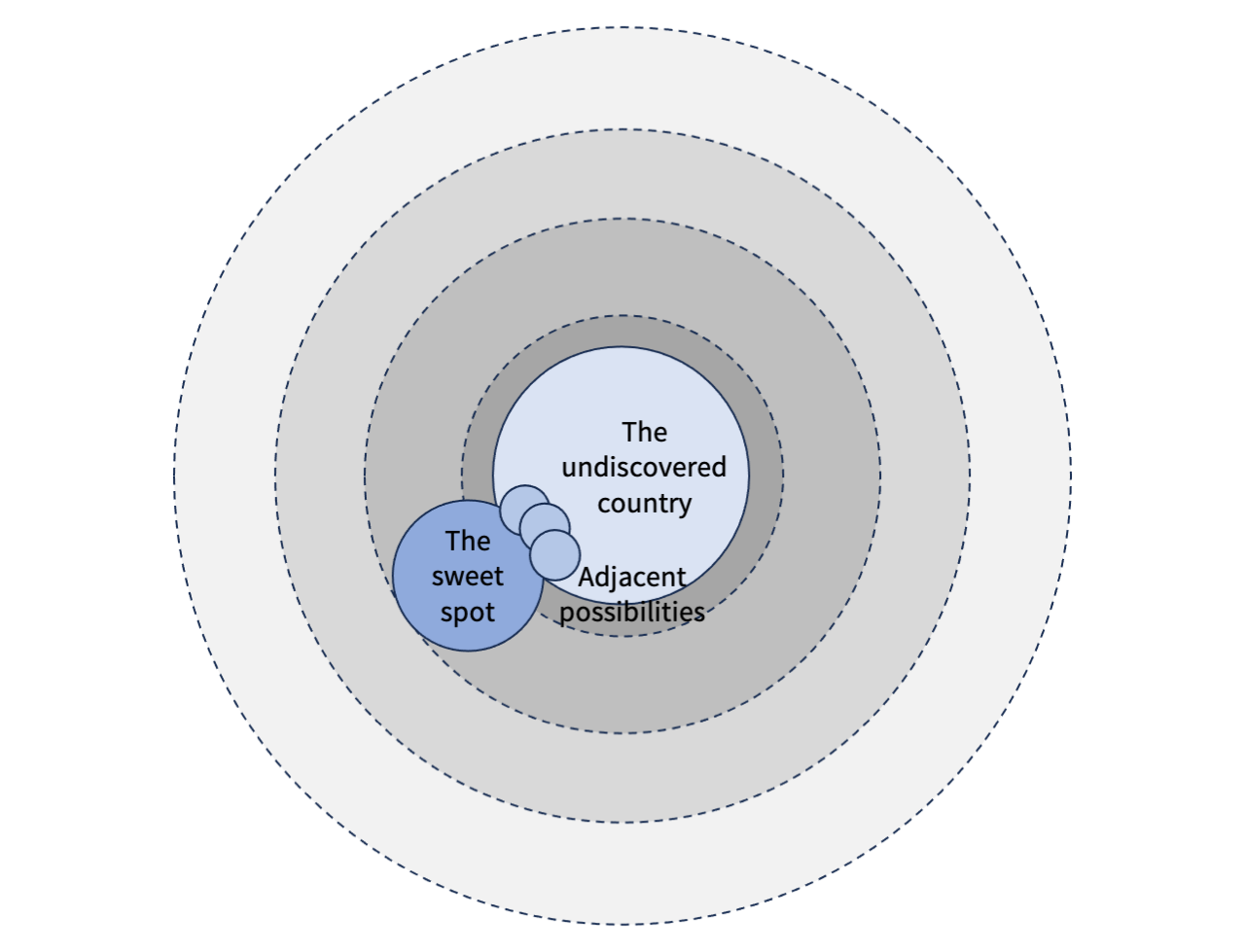
Start where you are

Start where you are. Use what you have. Do what you can.

Arthur Ashe

“Start where you are” doesn’t have to be about process! Try this exercise:

  1. Disregarding organisational boundaries, and in relation to the work you are already committed to (your “organising commitments”), who do you interact with? Then reflexively: who interacts with you regarding their organising commitments? And transitively: who do they interact with, who interacts with them, and so on outwards?
  2. Again disregarding organisational boundaries, and whether as an act of planning or of response to something unexpected, who do you consult with when your organising commitments need to change? And again reflexively and transitively: Who consults with you, who do they consult with, and so on outwards?
  3. Now reflect on the relationships you have identified in those two networks. Whose relationships don’t you understand as well as you might? To the extent that it affects your own work, what context do you lack that others might be able to provide? Who else might be struggling for lack of context that you or someone closer to you might be able to provide? Is it time then for some trust-building conversations?

Now you know where you are, start!

Related posts:

While we’re here, a couple of updates to upcoming events:

  • The next TTT/F begins in just over a week on Wednesday 15th – ping me for a coupon code if you need one
  • I’ve added the April edition of our monthly free webinar/AMA series

Upcoming events

February

March

*TTT/F and (where shown) LIKE events include free one-year membership of the Leading with Outcomes Authorised Facilitator programme, upgradeable to Authorised Trainer at any time. Both of those include access to the video-based Leading with Outcomes training and the full range of Agendashift assessment tools.


Leading with Outcomes from the Agendashift Academy
“Leadership and strategy in the transforming organisation”

Leading with Outcomes is our modular curriculum in leadership and organisation development. Each module is available as self-paced online training or as private, instructor-led training (online or in-person). Certificates of completion or participation according to format. Its modules in the recommended order:

  1. Foundation module:
  2. Inside-out Strategy:
  3. Adaptive Organisation:
  4. Outside-in Strategy:

Individual subscriptions from £24.50 £18.40 per month after a 7-day free trial, with discounts available for employees and employers in the government, healthcare, education, and non-profit sectors. For bulk subscriptions, ask for our Agendashift for Business brochure.

To deliver Leading with Outcomes training or workshops yourself, see our Authorised Trainer and Authorised Facilitator programmes. See our events calendar for Train-the-Trainer / Facilitator (TTT/F) and Leading in a Transforming Organisation trainings.


Agendashift™: Serving the transforming organisation
Links: Home | Subscribe | Events | Media | Contact | Mike

Agendashift  Academy: Leading with Outcomes | Trainer and Facilitator Programmes | Store

At every scope and scale, developing strategy together, pursuing strategy together, outcomes before solutions, working backwards (“right to left”) from key moments of impact and learning.

Start where you are. Use what you have. Do what you can. ~Arthur Ashe