You may remember that a a couple of years ago (give or take), our Clean-language inspired coaching game – a fixture of nearly all of Agendashift Academy’s training and workshop products – gained a hidden “cheat mode”. Now, and thanks to input from Judy Rees, to whom I am very grateful, we have made it official, kinda.
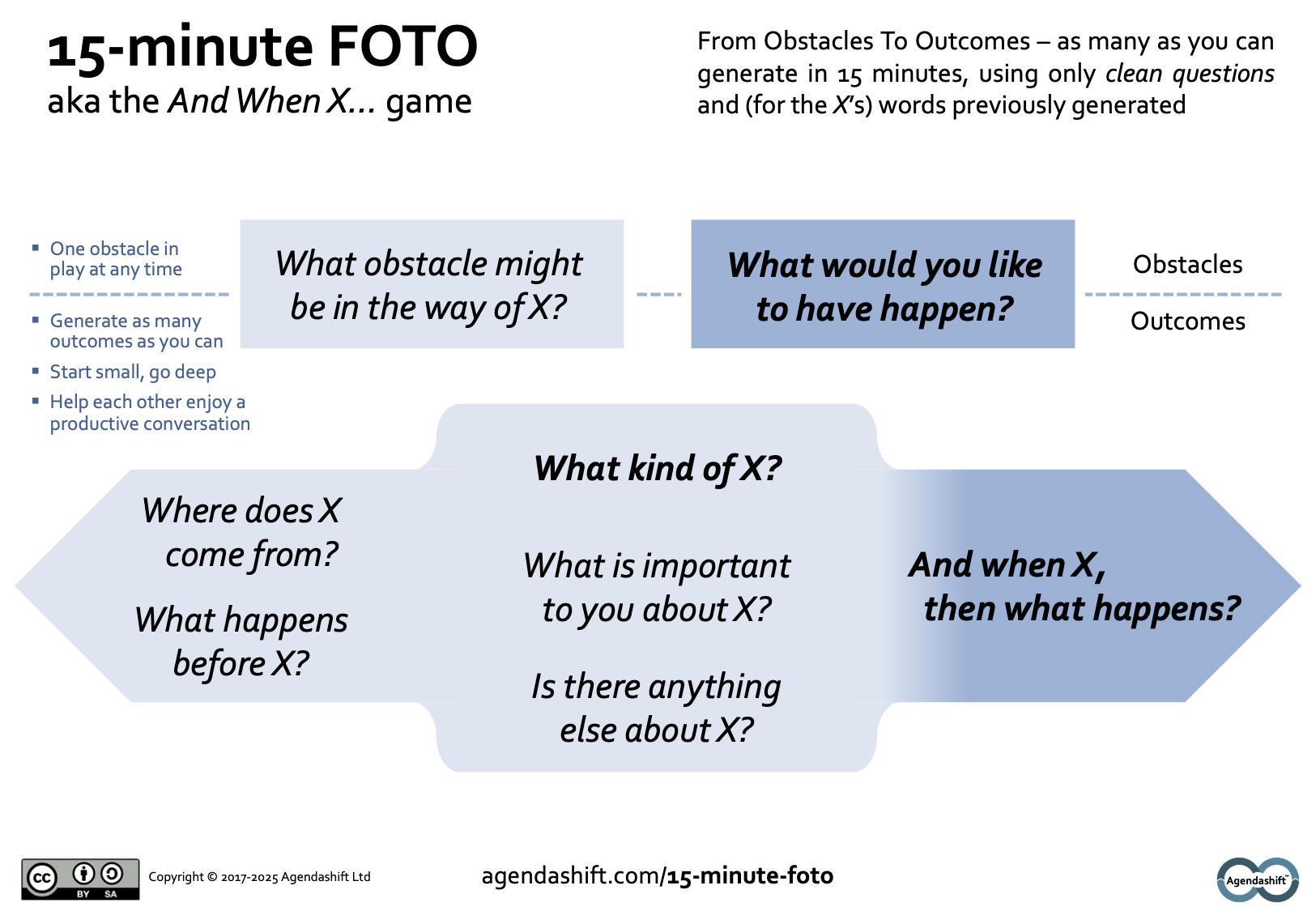
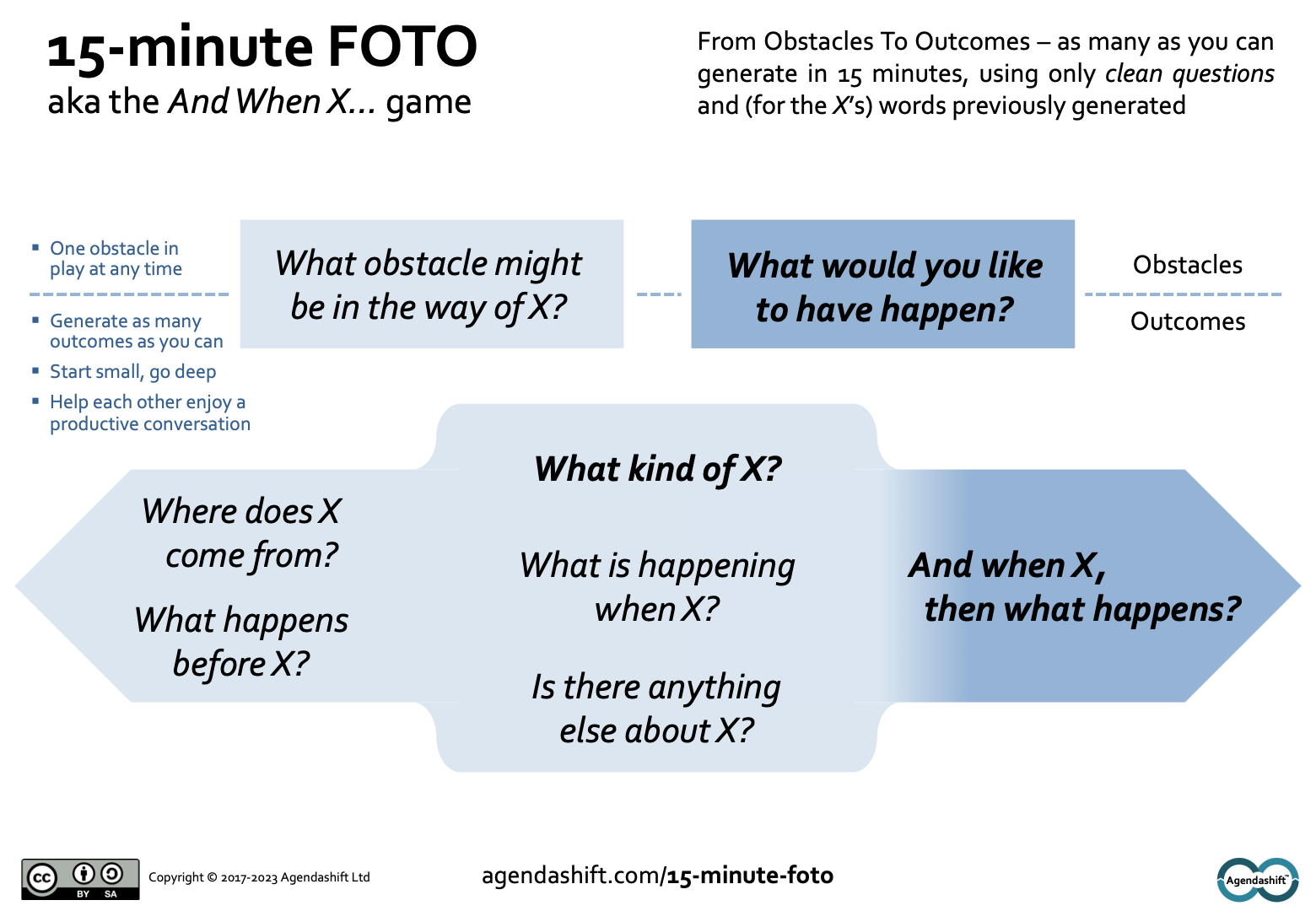
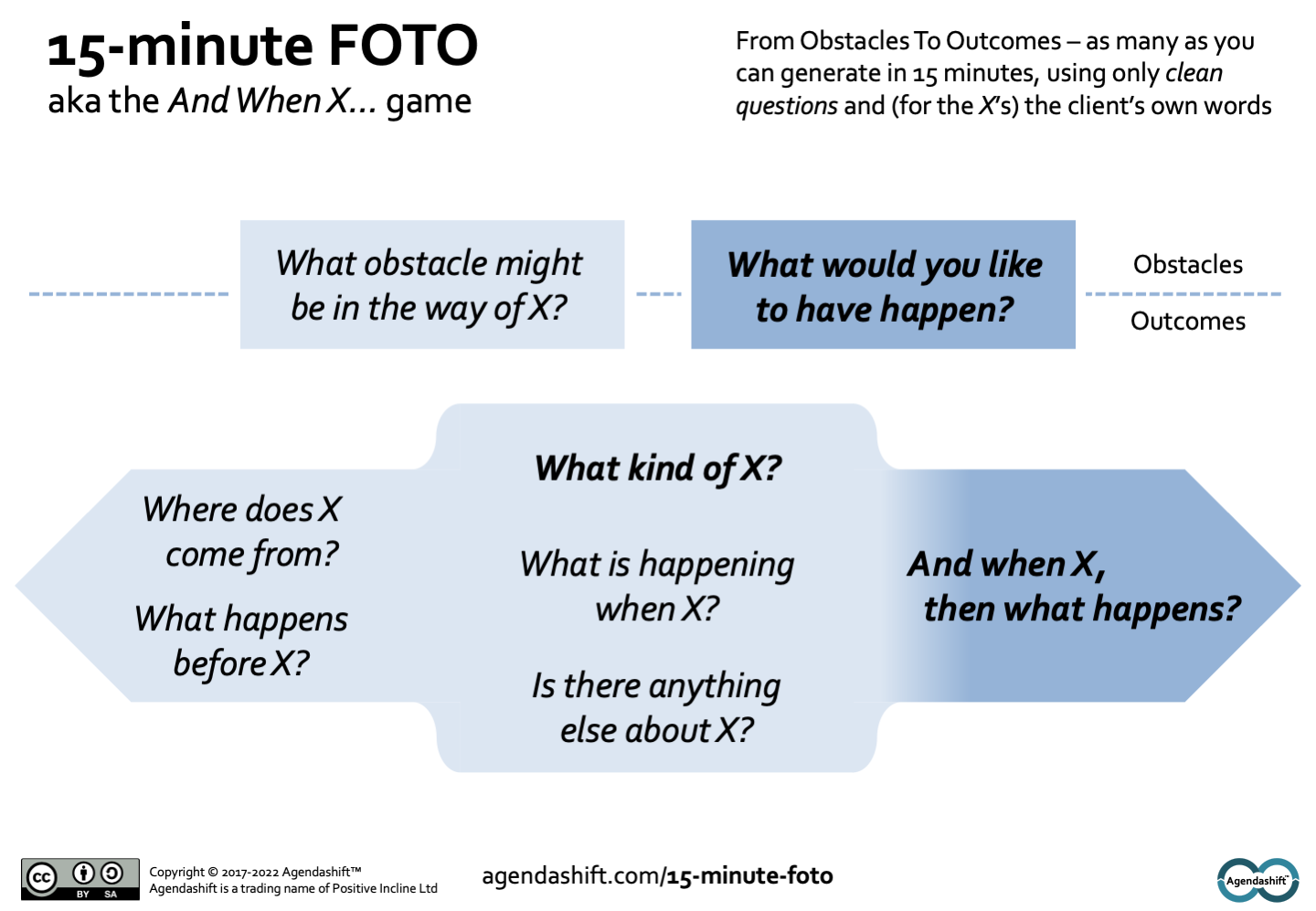
Here’s the updated cue card, not exactly adding the cheat question “Why is that important?”, but sacrificing a lesser-used question, “What is happening when X”, in favour of “What is important to you about X?”. Instead of a Why question, which would have stood out like a sore thumb, a What question. Remember, we’re aiming for curious, not inquisitorial!
Still, even this new question is not so much Clean – i.e. cleaned of any tendency to introduce unwarranted assumptions – but Cleanish. With this one in particular, it would be careless to use it when nothing is of any special importance, so make sure that the context justifies it. With something that has just been prioritised (an input to the game, for example), it’s fair game; thereafter, use with care.
A fork in the road
For reasons of practical necessity, there are now two versions of the game. First, there’s the standard, open source version. Second, and for a while now, there has also been a premium, Academy version. Until now, the latter’s only real difference has been that its facilitation deck is formatted with a proprietary template. This looks great (no regrets there), but I must be careful about how I share it, hence its restriction to Academy subscribers. What’s new is that the Academy version has also been redesigned to better integrate with other Academy resources content-wise. Able to introduce or assume things that the public version really shouldn’t, it benefits from a shorter/slicker introduction.
Anyway, I remain happy to maintain the two versions in parallel. You can grab the latest here:
15-minute FOTO (academy.agendashift.com, Academy subscribers only)
Other news
While we’re here, if you’re based in or near the East Midlands, I’m one of several speakers at a special 11th birthday event for Agile Nottingham on February 12th:
In this new version of our Clean Language-inspired coaching game:
Integrating the Classic and Lite editions formats
Cheat mode
General tidyup
Standard and premium versions
1. Integrating the Classic and Lite formats
The Lite format (or ‘edition’, as it has been called up to now) was introduced in 2019 in version 7 thus:
To understand why we’ve wanted to make changes, consider what each participant is doing when they play the game for the first time:
Familiarising themselves with the Clean Language questions (from the cue card if it’s an in-room workshop, from the screen if it’s online)
Taking turns in the role of client, coach, scribe, or observer, participating in or supporting what can be an intense 1-on-1 coaching conversation
Worrying about the game’s objective, which to generate and capture outcomes
That’s a lot! Instead of doing this all at once, the Lite edition starts with a familiarisation exercise, turns the conversation into one for the table group as a whole, and the objective matters only after everyone has had a chance to get comfortable with it all.
If, as happens in many of our workshops, you plan to do 15-minute FOTO twice, you can start with the Lite edition and do the classic edition the second time round.
Since 2021 and version 11, the Scribe and Observer roles have been combined into a Host role. With the latest wording for the Lite format, the formats and roles are now described as follows:
Classic format – rotating every few minutes through the roles of Client, Coach, and Host so that everyone gets a turn in every role
Lite format – anyone can ask, anyone can answer – but don’t get stuck too long in one role or on one obstacle
Role responsibilities:
Client: Chooses obstacles, responds to the coach’s questions with short, bullet point answers
Coach: Guides the conversation using only the clean questions from the card and the client’s own words
Host: Helps others enjoy a productive conversation, ensuring that “anything that sounds like an outcome” gets captured
Previously, the slides for the Lite format didn’t mention roles until the debrief. We have found however that participants find them helpful, to the extent that some facilitators choose to skip the introductory Lite format and go straight to the altogether more intense Classic format. They are now integrated such that with just one Classic slide, Lite participants gain a clearer picture of how the game can proceed, and are free to play the game anywhere on a wide spectrum between only loosely coordinated and the highly structured Classic format itself.
Facilitators may skip/hide slides or explain both formats as they prefer, perhaps leaving decisions on that until the last moment. Training and workshop decks need only one set of 15-minute FOTO slides, not two. These benefits are substantial – not least to me, who maintains it all!
2. Cheat mode
Introduced recently in the blog post 15-minute FOTO’s cheat mode, the game now allows an additional question (or variants thereof):
Why is that important?
For reasons explained in that article, this question is not included on the cue card.
3. General tidyup
I won’t describe them all in detail, but there has been a raft of minor-to-moderate changes, including:
The sequencing of slides in the facilitation deck
A thorough overhaul of the 15-minute FOTO page on agendashift.com – well worth a read
Treat What would you like to have happen? as inviting a small outcome – a first, tiniest sign that something interesting might be beginning to emerge
That wording comes from the commentary I use behind a progression familiar to Adademy students. Long before we introduce 15-minute FOTO in a later module, we see this from Foundation onwards:
Signs of emergence
Indicators of progress
Measures of success
Goals and aspirations
It’s outcomes all the way down!
4. Standard and premium versions
As ever, the standard Creative Commons (CC-BY-SA) version of the materials that has the same look and feel as other open source resources is available via the 15-minute FOTO page on agendashift.com. This format also includes translations in to French, German, Swedish, Danish, and Italian, some of these more up to date than others. If you’ve accessed it via Dropbox previously, you’ll find the latest materials – deck, cue card, etc – already there for you.
The premium version of 15-minute FOTO has the Agendashift Academy look and feel, some bonus slides, and a short video. Together with other premium resources, it is available to Academy subscribers and supporters here. For access to that and much more, visit the store. The bonus slides:
A nice introductory slide that facilitators can practice speaking over as it builds up
An extra slide in the debrief exploring the relationship between coaching conversations and strategy conversations
A parting shot: Client, Coach, Host: Who’s the leader here?
Obstacles Fast and Slow is an update to the exercise formerly known as Good Obstacle, Bad Obstacle, and the webinar recording will go on the revised page.
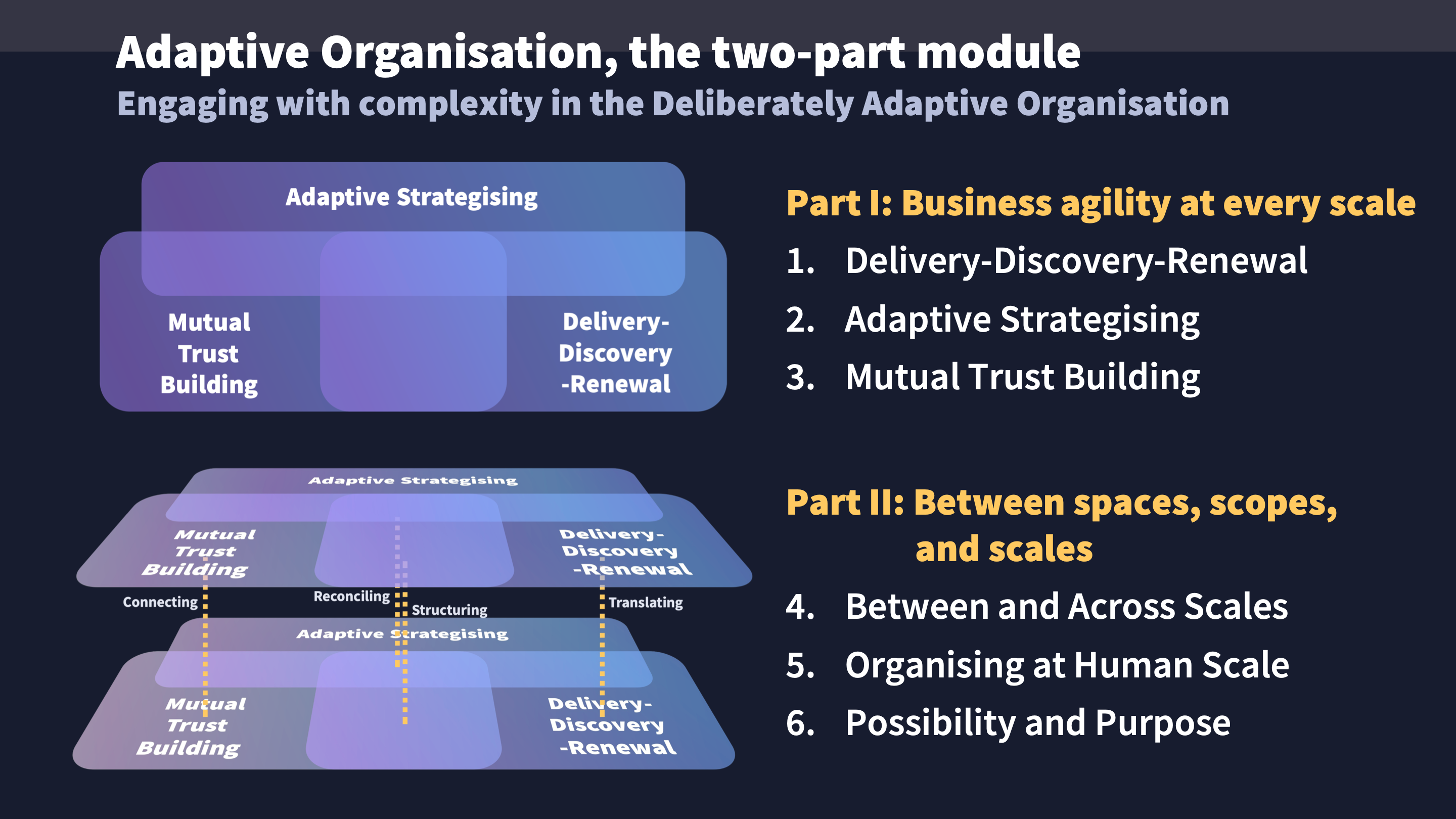
Leading with Outcomes from the Agendashift Academy “Leadership and strategy in the transforming organisation”
Leading with Outcomes is our modular curriculum in leadership and organisation development. Each module is available as self-paced online training or as private, instructor-led training (online or in-person). Certificates of completion or participation according to format. Its modules in the recommended order:
Individual subscriptions from £24.50 £18.40 per month after a 7-day free trial, with discounts available for employees and employers in the government, healthcare, education, and non-profit sectors. For bulk subscriptions, ask for our Agendashift for Business brochure.
To deliver Leading with Outcomes training or workshops yourself, see our Authorised Trainer and Authorised Facilitator programmes. See our events calendar for Train-the-Trainer / Facilitator (TTT/F) and Leading in a Transforming Organisation trainings.
At every scope and scale, developing strategy together, pursuing strategy together, outcomes before solutions, working backwards (“right to left”) from key moments of impact and learning.
15-minute FOTO, Agendashift’s Clean Language-inspired coaching game, has a cheat mode! It’s a question that’s not on the card*:
The secret question:
Why is that important?
If you’re starting with an obstacle that seems to beg the answer to “What would you like to have happen?”, try “Why is that important?” instead. Much more interesting! Yesterday in Melbourne, it worked so well that nearly every conversation in the game began that way. You can’t be sure that what gets generated will be an obstacle or an outcome – if the answer is long, probably some of both – so listen carefully and choose your next question accordingly.
That’s not its only use. If you feel that you’ve exhausted “Then what happens?”, try “Why is that important?”. Want to go back to something mentioned earlier in the conversation? Same question, prefixing it with “And when…” to reference the thing of interest.
If “Why is that important?” works so well, why is it not on the card? Well, it’s not a canonical Clean question; it’s only “cleanish”. In the wrong context, that question can be loaded with assumption. If I ask it of (say) an obstacle that someone has taken the trouble to prioritise, refine, and so on, it’s important, no problem. But if I ask it of something whose importance isn’t established, I’m making an assumption. If our goal is to explore the model existing or being built in someone else’s mind, let’s treat it (and by implication, that other person, the client) with due respect. To bring our own assumptions into the conversation would risk tainting that model, perhaps irrecoverably. So use with care!
I have no plans to add that question (or any other – Clean or cleanish) to the cue card. I’m in no hurry to add it to the facilitation deck either. It can be our little secret 😉
You may remember that I contributed the foreword to Allan Kelly’s Succeeding with OKRs in Agile; he’s offering 20% off his Writing OKRs masterclass, also next month
Both of those links have the discounts already applied for you. For the first one, larger discounts are available for for public sector, non-profits, etc; ping me if they apply.
*Note that the card has received some minor updates recently, most notably the four bullets upper left, straddling the Obstacles/Outcomes boundary – not a replacement for the facilitation deck but a useful reminder. Grab the latest from here if you’re an Academy subscriber, from the 15-minute FOTO dropbox if you have access to that, or request access here.
Leading with Outcomes from the Agendashift Academy “Leadership and strategy in the transforming organisation”
Leading with Outcomes is our modular curriculum in leadership and organisation development. Each module is available as self-paced online training or as private, instructor-led training (online or in-person). Certificates of completion or participation according to format. Its modules in the recommended order:
Individual subscriptions from £24.50 £18.40 per month after a 7-day free trial, with discounts available for employees and employers in the government, healthcare, education, and non-profit sectors. For bulk subscriptions, ask for our Agendashift for Business brochure.
To deliver Leading with Outcomes training or workshops yourself, see our Authorised Trainer and Authorised Facilitator programmes. See our events calendar for Train-the-Trainer / Facilitator (TTT/F) and Leading in a Transforming Organisation trainings.
At every scope and scale, developing strategy together, pursuing strategy together, outcomes before solutions, working backwards (“right to left”) from key moments of impact and learning.
The facilitation deck for our Clean Language-inspired coaching game 15-minute FOTO is now at version 12. Just one change: for the Lite format of the game, what previously were announced under a heading of “Tips:” are now announced as follows:
Help your colleagues enjoy a productive time:
Start small: 5% and 15% outcomes, bullet point answers
Be generous in the outcomes you accept (and write down)
If a minute passes without an outcome being captured, something is wrong
A renamed heading might seem a trivial change, but in the debrief after the game we will introduce (retrospectively) the three roles of Client, Coach, and Host, which in the Lite format any player can adopt at any time. Client and Coach correspond very obviously to the tasks of answering and asking the questions from the cue card, but until this version, it didn’t seem that we had done enough to set up the Host role.
Bonus
Emphasising the “leading” in Leading with Outcomes (the Agendashift Academy’s core curriculum), this discussion question comes from the Academy version of the 15-minute FOTO debrief:
Reflecting some more on the Client, Coach, and Host roles, which one is the leader?
There it’s pre-recorded; I have tested it “live” also.
For some background on prior changes that led up to this one:
The facilitation deck for our Clean Language-inspired coaching game 15-minute FOTO is now at version 11. Minor tweaks aside, the two main changes:
The tip to “start small” with 5% and 15% outcomes
The four roles of the Classic edition of the game have been reduced to three (the Lite edition doesn’t mention roles until the debrief)
You can read some background to the “start small” advice in the recent post Get unstuck and get going: Starting small with 5% and 15% outcomes. Thinking about it more tactically, if the objective of the game is to produce a quantity of outcomes, jumping straight to “world peace” leaves a lot of space unexplored! So start small, see where “Then what happens?” takes you, and in the process uncover not just meaningful objectives to pursue, but places to start, outcomes to organise around, outcomes that tell us when we’re winning, outcomes that (at the right time) will lead to solutions, and so on.
The change to the roles in the Classic edition takes us from the four of Client, Coach, Scribe, and Observer to the three of Client, Coach, and Host. The host’s job subsumes scribe and observer but goes further: it is to ensure that within the deliberate constraints of the game, everyone has an enjoyable and productive time. It covers things like:
Making sure the client and coach who they are and what they are meant to be doing
Making sure the client has chosen the obstacle that will be the focus of the next conversation
Making sure that outcomes get captured – whether or not that means performing the scribing task themselves
Safety officer (noting that whatever the coach might think, “I can’t answer that” is a valid answer)
Referee – keeping the conversation to the rules (it is a game after all)
Time-keeper – it takes some time discipline to ensure that everyone gets to play every role within the game’s 15 minutes
Intervening when a conversation hasn’t got started (distracted by meta conversations perhaps) or is running out of steam (perhaps it’s time to choose another obstacle)
Observer – from a perspective outside the conversation, noticing things that might be useful to recall later in the debrief
As per the 2014 book Host by Mark McKergow and Helen Bailey, hosting is a powerful metaphor for leadership. If ever you’ve struggled with the notion of servant leadership or feel that the leader’s responsibility to “create the environment” is never properly explained, then host leadership is for you. It’s worth noting also that Mark McKergow is also a co-author of one of the references / inspirations for 5% outcomes – see the abovementioned post for details.
In chapter 1 of Agendashift (2nd edition 2021) you’ll find a crucial but awkwardly-named exercise, Practice Outcomes. It’s there because the main event, the Clean Language-inspired coaching game 15-minute FOTO, goes so much better if players have been primed to start small. If your first outcome is a small one, the chain of consequences that follows – “Then what happens? Then what happens?” – is so much more productive.
5% outcomes, getting unstuck
I’ve been working on making not just the exercise of Practice Outcomes but its outputs and its rationale easier to reference. Hence “5% outcomes”, the kind of teeny-tiny outcomes you get from the miracle question (source: Solutions-focused brief therapy, via the 2006 Jackson and McKergow book The Solutions Focus). The version of the miracle question we use in Practice Outcomes isn’t exactly canonical but it’s close enough:
If that obstacle disappeared overnight (it doesn’t matter how), what would be the first thing you would notice? (something positive)
The rationale? Make your outcomes small enough, and perhaps they’re there already if only you knew where to look. And if they’re there, so are what causes them – solutions! A great way to get unstuck.
If you find yourself not wanting to explain the miracle question, something simpler:
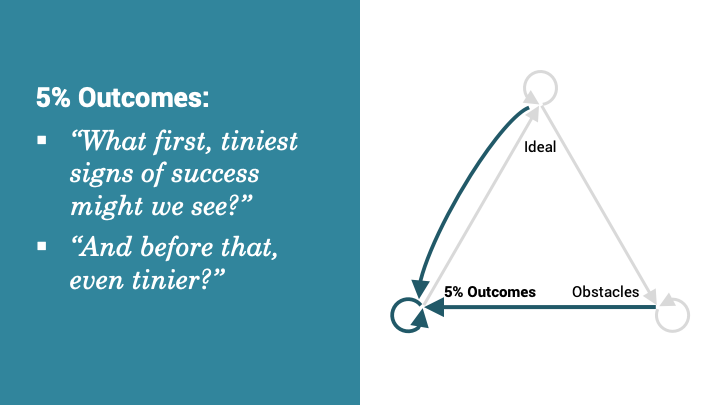
What first, tiniest signs of success might we see?
And before that, even tinier?
Context for those questions might be a some kind of obstacle, an outcome (a larger one, obviously), or even our overall objective. Here I’ve visualised it in terms of the IdOO (“I do”) pattern:
15% outcomes, getting going
If we get unstuck with 5% outcomes and their corresponding 5% solutions, then 15% outcomes and their corresponding 15% solutions are how we make faster progress. I’m riffing on the Liberating Structures pattern 15% Solutions, whose rationale speaks to the stuckness issue but invites us to think a little bigger. If our attitude is that “15% is always there for the taking”, then we’re primed to iterate towards our goals. Faced with an adaptive challenge, the sooner we embrace that kind of approach, the better. Here, 100% solution are worse than unlikely, they’re a route to failure.
“How will we know that we’ve made a small but significant step in the right direction?”
“And then what happens?”
Anticipating one of the three most important questions in 15-minute FOTO, the “And then what happens?” is already getting us to think more iteratively. Visualised:
5% and 15% outcomes, yes outcomes
You might be wondering why I start with Solutions Focus and 15% Solutions and invite participants to capture not solutions but outcomes. Is this some strange insult to my sources? Not a bit of it!
Think of Agendashift as a two-pronged approach to adaptive strategy:
its formation through an ongoing process of meaningful participation
integrated with innovation and learning processes
In the context of an adaptive challenge in a changing environment (one we’re actively changing, no less), if we take the attitude that solutions are always there for the taking – a core premise of both our sources – the right time for solutions is just in time. To solutionise sooner is to invite solutions that may be beyond their shelf life by the time they’re really needed. Worse, having them designed only by the people who happen to be in the room at the time is another recipe for failure.
We are not merely counting on but institutionalising the emergence of solutions “from the people closest to the problem”, to quote my friend Karl Scotland. Keeping that innovation process well fed, appropriately oriented, and with room to breathe, strategy is developed in the language of outcomes.
Going as far as mostly as avoiding the term change management for fear of being associated with it, this is the very antithesis of 1990’s-style managed change. Great for upgrading your email server, but completely the wrong paradigm for anything transformational. Catch yourself thinking that a preconceived solution – worse, a borrowed one – should be your main response to your adaptive challenge? Tempting, but think again. You’d be making a category error, already a terrible place to start. Rolling it out, overcoming resistance to change and all that? Well that would be doubling down, compounding the mistake, and the consequences will be yours to own.
So solutions come well after outcomes, not before. But if you hear a solution prematurely – even a 5% or 15% solution – don’t worry. They’re easy to deal with:
Then what happens?
Get unstuck and get going with 5% and 15% outcomes. Small – tiny even – but powerful!
What if we put agreement on outcomes ahead of solutions?
On Daniel Hulter’s recommendation I grabbed the audiobook edition of Adam Grant’s Think Again: The Power of Knowing What You Don’t Know (Penguin Audio, 2021). Loved it, highly recommended!
Let me share a couple particularly relevant quotes. The first one sits very well with Agendashift’s opening two chapters, the second with the closing two and a bit:
Listening well is more than a matter of talking less. It’s a set of skills in asking and responding. It starts with showing more interest in other people’s interests rather than trying to judge their status or prove our own. As journalist Kate Murphy writes, we can all get better at asking truly curious questions that don’t have the hidden agenda of fixing, saving, advising, convincing, or correcting.
Rethinking is more likely to happen in a learning culture, where growth is the core value and rethinking cycles are routine. In learning cultures, the norm is for people to know what they don’t know, doubt their existing practices, and stay curious about new routines to try out. Evans shows that in learning cultures, organisations innovate more and make fewer mistakes. After studying and advising change initiatives at NASA and the Gates Foundation I’ve learned that learning cultures thrive under a particular combination of psychological safety and accountability.
The Leading with Outcomes workshop – there are two interactive workshops upcoming (see below) and watch this space for news of new online self-paced training
The first half of the Core, Deep Dive, and Outside-in strategy workshops; we’ll shortly be adding a Deep Dive at an Americas-friendly time
Yes, you read that right: March 2021. Publication imminent!
Go to agendashift.com/leading-with-outcomes-cheat-sheet or click on the image below for download information, references, etc. It’s Creative Commons (CC-BY-SA); by subscribing you’ll get not just the PDF but the original .pptx file too – translations and other adaptations welcome. Enjoy!
What if we put agreement on outcomes ahead of solutions?
Quick one: the facilitation deck for our Clean Language-inspired coaching game 15-minute FOTO is now at version 10. Changes:
Added a slide for a quick practice: the two and three most important questions (the questions in bold on the card, the ones that do most of the work in the game) on your most concrete and most abstract obstacles, respectively without and with the What kind of… question (my favourite). You can do it as a facilitator-led demonstration and/or a short breakout (doing both isn’t overkill in my experience).
Removed a slide titled Essential: Launch from a clear challenge, go deep. Essential it might be, but it’s smoother to cover the point while on the preceding slide.
Moved the And when X... slide to improve the flow.
Updated the reference material at the back to mention the now-imminent 2nd edition of the book.
In the past couple of weeks I’ve recorded myself using this version and am much happier with the flow now.
As demonstrated by the models-sources-inspirations picture below, I like my models. If you’ve read my third book Right to Left, you’ll know also that I have little time for the idea that there is one best model – one best Agile framework, for example. And the fun isn’t in choosing between them, not even in recognising what each of them can bring, but in integrating them. And it doesn’t stop there: this is not a one-shot process design exercise, but a process of continuous transformation. In short, I’m a pluralist, and I love to see what happens when models and their underlying patterns are allowed to combine.
Believe it or not, I am a picky though. In one of our weekly community Zoom sessions (see #community in Slack), that pickiness resulted in a conversation that was outside our usual norms (if the truth be told I was abrupt to the point of rudeness) and I reflected afterwards on what happened. Happily, we cleared things up quickly and had a much healthier conversation the following week after I had the chance to turn something heartfelt into something more articulate. What follows is a summary.
If Agendashift has taught me anything, it is to be very careful with assumptions. Credit for this goes to Clean Language, which turns the dial up to 11 on the discipline of its practitioners to minimise the influence of their private assumptions (which are SO not the point) on their conversations. This discipline applies most to their explicitly Clean conversations but it rubs off elsewhere in ways that need not mean “coachiness” when that is not called for. Practicing it subtly trains your brain to recognise when you are imposing yourself in ways that aren’t helpful.
You see that attention to assumptions in Agendashift’s outside-in strategy review. The way we make explicit its carefully minimal assumptions is of great help to the facilitator. See my recent Cutter paper for details (announcement included in my post last week); they’re also in Right to Left (chapter 5) and there will be brief coverage in the forthcoming 2nd edition of Agendashift also.
I tend to avoid models that encourage me to make assumptions about what is going in someone’s mind, how they will behave, how they will develop, and so on. The same at team level and organisation level, and I have come to be particularly sceptical of extrapolations from one of those levels to another. The replication crisis (en.wikipedia.org) gives me pause also. For better or for worse therefore, you won’t see Agendashift depending on many “popular” models of psychology, development, or maturity. This is not to say that they are valueless, rather that they make potentially unreliable foundations.
What I do appreciate:
Challenges to my own assumptions
Ways to moderate the impact of unsafe assumptions
Ways to bring assumptions and misalignments to the surface at the right time
Ways to encourage people to find their own solutions in the pursuit of outcomes (authentically shared outcomes most especially)
Ways to sustain all of the above – engines of transformation
And supporting those:
Models that have withstood scrutiny over a length of time
Models that treat the individual’s agency, creativity, and problem-solving ability with the utmost respect (you’ll permit me some personal values and base assumptions there I trust)
Models that help to scale up the preceding
Thankfully, the list of helpful and reliable models compatible with my outlook of optimistic pluralism outlook is long, a fact to which my Models, Source, and Inspirations picture attests. And please do not take the omission of a favourite model of yours as a snub; if I don’t have time to throw yours into the Great Model Collider™ in the hope that something interesting will fly out, perhaps you (or someone else) will.
Opinions mine, strongly held it would seem. Thank you Andrea Chiou and Tom Ayerst for putting up with me – we got there in the end 🙂
What if we put agreement on outcomes ahead of solutions?



 Agendashift