When to use which Leading with Outcomes workshop

The facilitated workshops page lists five workshop designs, the first four (those shown on the image above) deliverable by authorised facilitators and trainers alike, the fifth only by trainers:

Plenty of choice there, so which should be used when?

The first two of those work both standalone and together (in either order), and the last two should be regarded as alternatives to each other, so let’s divide them into three groups: Inside-out, Outside-in (that middle workshop in a category of its own), and Adaptive Organisation. No surprise there: the Leading with Outcomes training curriculum is organised in much the same way.

Inside-out

Inside-out covers the first two workshops, Discovery and Assessment Debrief, both of these being up-to-date versions of the workshop designs covered in the first two chapters of my book Agendashift: Outcome-oriented change and continuous transformation (2nd edition 2021).

We use the Discovery Workshop in two ways:

  1. To kick off internal change
  2. To give fresh perspective to a change initiative that is already underway

That second point includes stepping back from the detail uncovered by an Assessment Debrief workshop, perhaps some weeks later as part of a coaching or consulting engagement. Alternatively, a Discovery workshop leads quickly (perhaps directly) into an Assessment Debrief workshop, the former giving context to the latter. Either way, the Discovery workshop produces a high level strategy developed in the language of outcomes – meaningful goals, more immediately actionable outcomes (places to start), and outcomes of intermediate scale (meaningful indicators of success) – all organised coherently.

The Assessment Debrief Workshop can be used with any of our assessment templates (our monthly experience/practice sessions cycle through three of the shorter ones), but most often it is used with the Agendashift Delivery Assessment, aka the Values-Based Assessment, after its six headings of Transparency, Balance, Collaboration, Customer Focus, Flow, and Leadership. Refined repeatedly over a span of nearly a decade for maximum applicability to the widest range of delivery organisations (techology-related or otherwise), this template started life as a framework-agnostic adaptation of the bullets at the end of my first book, Kanban from the Inside, whose 10th anniversary comes in September.

Each assessment template is designed such that participants can be expected to respond positively to at least some of its prompts. Prompts are prioritised, “enjoyed” for what it would be like when (in context) they’re working at their ideal best. Then come obstacles – things that stand in the way of those ideals. They are identified, refined [1], and used as the springboard for the generation of outcomes. As with the Discovery workshop, outcomes are then organised, perhaps more visually this time. Going further into the process than the Discovery workshop does, solution ideas are generated for the most interesting outcomes and experiments designed for the best of those, deliberately biasing that generative process to the outcomes and solutions most likely to generate valuable learning for the organisation.

So… high level first and perhaps drill down, or engage at a more detailed level first and perhaps step back, the choice is yours. Online or in person, each is doable in half a day; a day is sufficient for both.

Outside-in

The two Inside-out workshops are both open to significant customisation, but for initiatives that begin with the customer or other external relationships (with competitors, suppliers, etc), the Outside-in Strategy Review Workshop may be more appropriate. We don’t use this one so often, but when the time is right, it’s powerful.

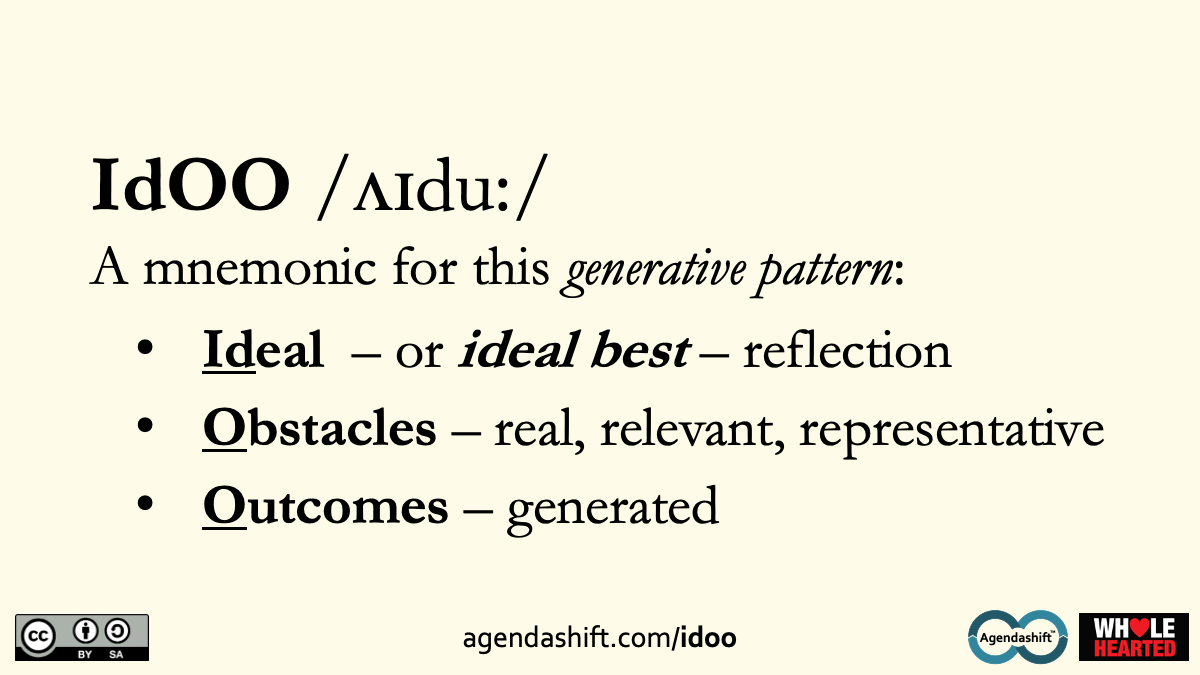
There are echoes of the previous two workshops in its Ideal, Obstacles, Outcomes progression, but here that IdOO (“I do”) pattern (as we call it) happens within a higher-level agenda:

  1. Customer
  2. Organisation
  3. Product
  4. Platform
  5. Team(s)

We work our way inwards, each subsequent layer given proper context by those that precede it. If you’re looking for customer alignment and/or internal alignment to an organisation that knows the position in the competitive landscape it aims to occupy, this is a great place to start.

Adaptive Organisation

Explaining many organisational dysfunctions and missed opportunities in terms of imbalances, in the Adaptive Organisation workshops we are exploring what it means for different kinds of relationships to be healthy and productive. Given the number and range of these relationships and the agency of many of their participants, we are in the realms of the complex adaptive system (CAS). Accordingly, we pay much attention to the constraints that govern system behaviour.

You will get from that description that the Adaptive Organisation workshops are a little more technical than the others. If there is a workshop/training spectrum, we moving in the direction of training, but still the focus is on the host organisation and it’s very much a participatory experience.

The 1-day Adaptive Organisation Workshop can be thought of as an Assessment Debrief workshop with some supporting material. Underlying both its assessment template and that additional material is a very interesting model, the Deliberately Adaptive Organisation, a radical, engaging, and complexity-friendly take on an absolute classic, Stafford Beer’s Viable System Model.

The 3-day Leading in a Transforming Organisation begins with a day of Leading with Outcomes: Foundation (this introduces the IdOO pattern and others) and expands Adaptive Organisation to two days, allowing a much deeper exploration of the model and the organisational issues it helps uncover. That adds up to 3 days of training presented in workshop form, suitable for both public and private settings.

As well as being interesting for its own sake, Leading in a Transforming Organisation can also be used as a near-alternative to Leading with Outcomes: Train-the-Trainer / Facilitator (TTT/F). See the store page for details.

[1] See Obstacles Fast and Slow – the March 7th event, the video it will produce, and some updated resources


Upcoming events

February

March

*TTT/F and (where shown) LIKE events include free one-year membership of the Leading with Outcomes Authorised Facilitator programme, upgradeable to Authorised Trainer at any time. Both of those include access to the video-based Leading with Outcomes training and the full range of Agendashift assessment tools.


Leading with Outcomes from the Agendashift Academy
“Leadership and strategy in the transforming organisation”

Leading with Outcomes is our modular curriculum in leadership and organisation development. Each module is available as self-paced online training or as private, instructor-led training (online or in-person). Certificates of completion or participation according to format. Its modules in the recommended order:

  1. Foundation module:
  2. Inside-out Strategy:
  3. Adaptive Organisation:
  4. Outside-in Strategy:

Individual subscriptions from £24.50 £18.40 per month after a 7-day free trial, with discounts available for employees and employers in the government, healthcare, education, and non-profit sectors. For bulk subscriptions, ask for our Agendashift for Business brochure.

To deliver Leading with Outcomes training or workshops yourself, see our Authorised Trainer and Authorised Facilitator programmes. See our events calendar for Train-the-Trainer / Facilitator (TTT/F) and Leading in a Transforming Organisation trainings.


Agendashift™: Serving the transforming organisation
Links: Home | Subscribe | Events | Media | Contact | Mike

Agendashift  Academy: Leading with Outcomes | Trainer and Facilitator Programmes | Store

At every scope and scale, developing strategy together, pursuing strategy together, outcomes before solutions, working backwards (“right to left”) from key moments of impact and learning.
Meaningfulness, significance, and direction

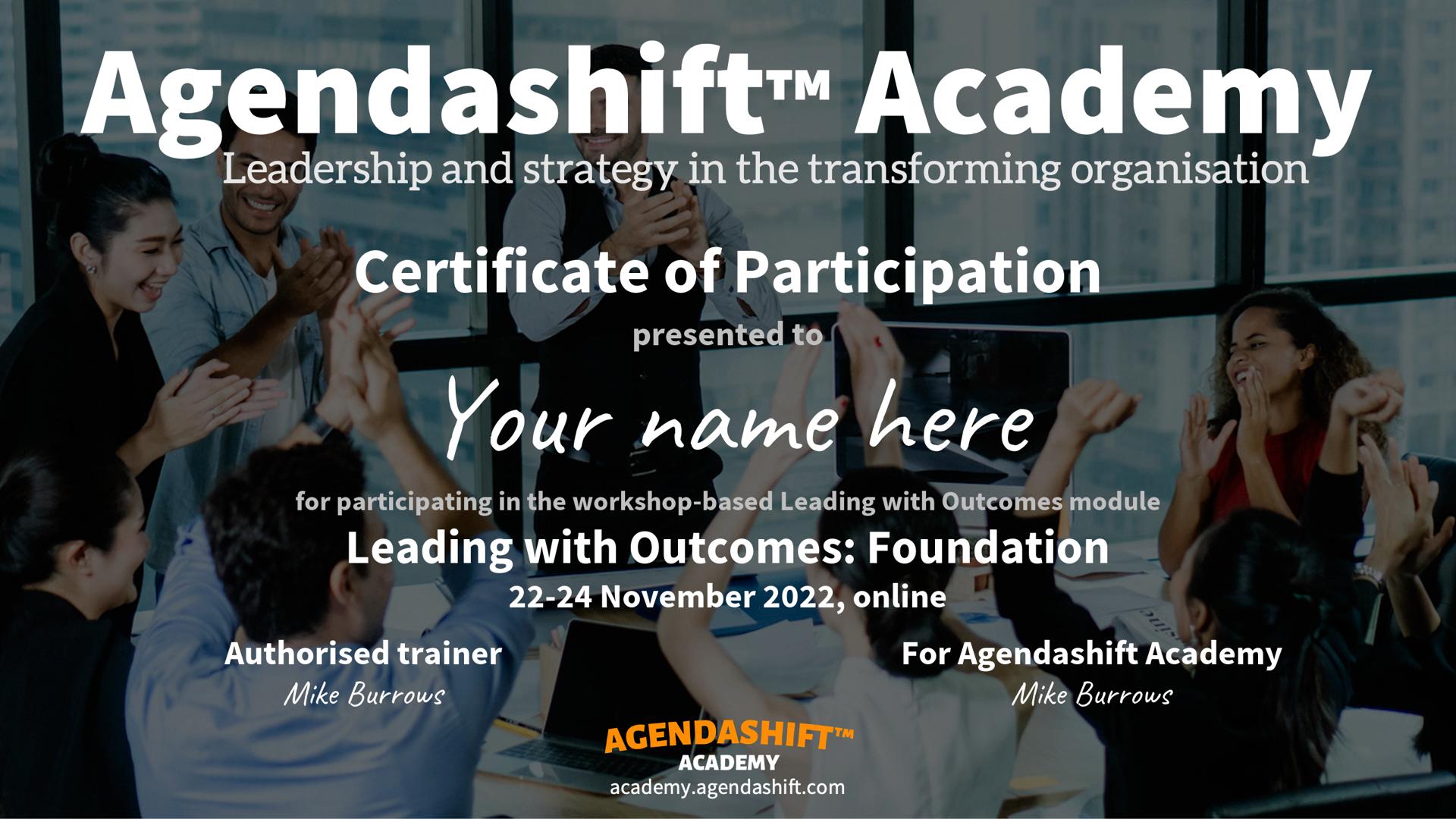
As I mentioned last week, I’m busy working on a leaner, fitter version of Leading with Outcomes: Foundation. This updates the first self-paced study module at the Agendashift Academy and also makes it available in the form of interactive training, productised for use by other trainers.

Since last week’s announcement, I have renamed the middle session (of three). On reflection, “Aspiring to performance” seemed a bit generic – clichéd even. Its replacement, “Meaningfulness, significance, and direction” emerges quite naturally from the content – not summarising it exactly, but those three qualities do correspond nicely to the Ideal, Obstacles, Outcomes model – the IdOO (“I do”) pattern that is introduced (through hands-on practice) in session 1 and further developed in chapter 2 (again through practice).

The core of the model goes like this:

  • Ideal – envision a compelling future
  • Obstacles – identify what’s in the way of what we want
  • Outcomes – look beyond those obstacles to something better

As you learn to move easily between those elements, properly contextualise those conversations, and organise what they produce into something coherent, you’re getting better at strategy. This can be “everyday” strategy – quick conversations to clarify the thinking around everyday bits of work – or as the overall arc of the “set piece” strategy occasion – participatory strategy reviews and the like. It’s even a model for leadership!

And so to meaningfulness, significance, and direction. Not a new model, but capturing some of the intent behind the IdOO pattern and Agendashift more broadly:

  • Meaningfulness – outcomes not as metrics or targets, but things meaningful to us, identified and articulated through authentic dialogue. Often, we set this up in the Ideal part with stories of people making meaningful progress.
  • Significance – instead of falling into the trap of solving problems just because they are there, choosing our obstacles for what they represent and taking the trouble to frame them carefully
  • Direction – our direction is set by the outcomes we’re choosing to pursue, not by monolithic solutions (perhaps sold to us with outcomes), or by plans whose all-consuming execution comes at the expense of what’s meaningful and significant. Outcome-orientation, in other words.

As well as re-recording the self-paced study version of Foundation, I’m also hosting it in the form of participatory online training over the 23rd, 24th, and 25th of November. All sessions 14:00-16:00GMT, over Zoom, and highly hands-on. Price: just £195 + VAT. Ping us for a discount code if:

  • You have an Academy subscription
  • You’re an Agendashift partner
  • You’re an employee of a government, educational, or non-profit organisation, or are currently unemployed – we’re glad to offer significant discounts here
  • You completed September’s TTT/F or are booked on December’s – for you it’s free

Book here:

And if interested in teaching it yourself or in facilitating the related workshops:


Upcoming

Anytime:


Agendashift™: Serving the transforming organisation
Agendashift  Academy: Leading with Outcomes | Facilitator and Trainer Programmes

Links: HomeSubscribe | Events | Contact | Mike
Resources: Tools & Materials | Media | BooksAssessments 
Blog: Monthly roundups | Classic posts
Community: Slack | LinkedIn group | Twitter

Announcing 15-minute FOTO version 11

The facilitation deck for our Clean Language-inspired coaching game 15-minute FOTO is now at version 11. Minor tweaks aside, the two main changes:

  1. The tip to “start small” with 5% and 15% outcomes
  2. The four roles of the Classic edition of the game have been reduced to three (the Lite edition doesn’t mention roles until the debrief)

You can read some background to the “start small” advice in the recent post Get unstuck and get going: Starting small with 5% and 15% outcomes. Thinking about it more tactically, if the objective of the game is to produce a quantity of outcomes, jumping straight to “world peace” leaves a lot of space unexplored! So start small, see where “Then what happens?” takes you, and in the process uncover not just meaningful objectives to pursue, but places to start, outcomes to organise around, outcomes that tell us when we’re winning, outcomes that (at the right time) will lead to solutions, and so on.

The change to the roles in the Classic edition takes us from the four of Client, Coach, Scribe, and Observer to the three of Client, Coach, and Host. The host’s job subsumes scribe and observer but goes further: it is to ensure that within the deliberate constraints of the game, everyone has an enjoyable and productive time. It covers things like:

  • Making sure the client and coach who they are and what they are meant to be doing
  • Making sure the client has chosen the obstacle that will be the focus of the next conversation
  • Making sure that outcomes get captured – whether or not that means performing the scribing task themselves
  • Safety officer (noting that whatever the coach might think, “I can’t answer that” is a valid answer)
  • Referee – keeping the conversation to the rules (it is a game after all)
  • Time-keeper – it takes some time discipline to ensure that everyone gets to play every role within the game’s 15 minutes
  • Intervening when a conversation hasn’t got started (distracted by meta conversations perhaps) or is running out of steam (perhaps it’s time to choose another obstacle)
  • Observer – from a perspective outside the conversation, noticing things that might be useful to recall later in the debrief

As per the 2014 book Host by Mark McKergow and Helen Bailey, hosting is a powerful metaphor for leadership. If ever you’ve struggled with the notion of servant leadership or feel that the leader’s responsibility to “create the environment” is never properly explained, then host leadership is for you. It’s worth noting also that Mark McKergow is also a co-author of one of the references / inspirations for 5% outcomes – see the abovementioned post for details.

As ever go to agendashift.com/15-minute-foto for tips, download instruction, and an ancient but still fun video.

15-Minute-FOTO-cue-card-2020-09-v16


What if we put agreement on outcomes ahead of solutions?

Agendashift™: Serving the transforming organisation
Agendashift  Academy: Leading with OutcomesHome | Store

Links: Home | Subscribe | Become an Agendashift partner Events | Contact | Mike
Resources: Tools & Materials | Media | Books | Assessments 
Blog: Monthly roundups | Classic posts
Community: Slack | LinkedIn group | Twitter

The 1967 Manifesto for The Deliberately Adaptive Organisation

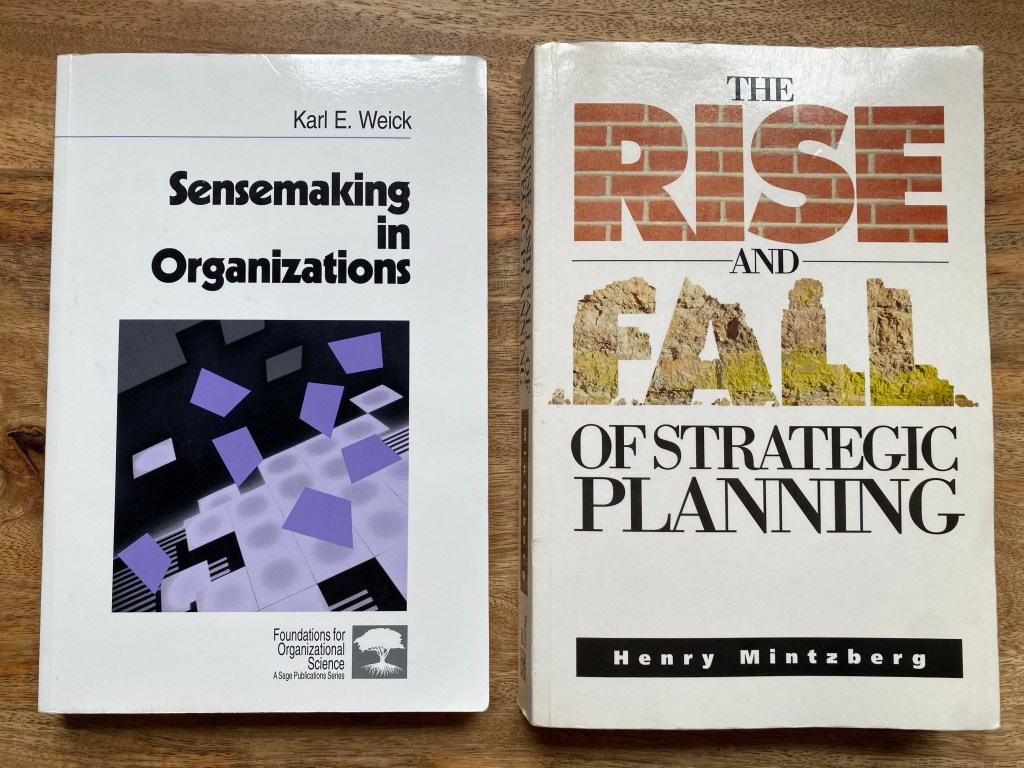
It may still too early to judge the 1990’s for its net contribution to organisational understanding. If much of what was published on the specific topic of change management had never been written, it might have been for the better! It’s not all bad though: I have recently enjoyed two books from that period, Karl Weick’s Sensemaking in Organizations (1995) and the 1994 first edition of Henry Mintzberg’s Rise and Fall of Strategic Planning. (Regarding the latter one, if you can tell me whether I should also read the 2000 second edition, do let me know.)

Reading Mintzberg, what stood out for me wasn’t so much his concept of emergent strategy (arguably not much more than a fancy name for what really happens to our best-laid plans) but these five things:

  1. The limits of rationalism and control, and the apparent disregard shown for them not just by the mid 20th-century strategic planners but by their champions in academia
  2. The idea, attributed to Edelman, of experts being those who avoid (or merely bemoan) the pitfalls but fail to notice the grand fallacy (see point 1 above, and I suspect I may never hear the words ‘expert’ and ‘pitfall’ in quite the same way again!)
  3. Primed by my prior reading of that Weick book on sensemaking, the idea of strategy as the means by which we make sense and meaning of our decisions; strategies don’t just help us to act in the present and project ourselves into the future, their role in helping us reinterpret how we got here is important too
  4. And before we get too comfortable with strategy as story, strategy as theory – something to be tested, lightly held
  5. Brian Loasby’s 1967 Manifesto for the Deliberately Adaptive Organisation

I’m having a bit of fun with that last one of course. I’ve no reason to think that Loasby (now Emeritus Professor in Economics at Stirling University) had anything manifesto-like in mind, and the Deliberately Adaptive Organisation didn’t exist back then. Not even its sources: the Viable System Model (Beer) was not yet fully formed; the Deliberately Developmental Organisation (Kegan & Lahey) was decades off; Agendashift’s main architect (yours truly) was just two years old.

But check this out:

if, instead of asking how they can more accurately foresee future events and thus make better decisions further ahead, firms were to ask first what they can do to avoid the need to decide so far ahead, they might be led to discover important ways of improving their performance.

Brian Loasby, 1967, via Mintzberg

Let me recast that in the “this over that” style of a notable document familiar to many readers, the Agile Manifesto. Adding some flourishes of my own:

In the pursuit of business performance, we are finding it useful to see plans and strategies more as theories to be tested quickly than as predictions and commitments for the longer term. Through this change of perspective, we are learning to value anticipating and meeting needs over setting and meeting deadlines, open options over past decisions, and rate of learning over closeness of control. Not that deadlines, decisions, and control have no value, rather that when valued against needs, flexibility, and adaptability, it is the latter group that drives our development forward.

I am not seriously advocating a new manifesto – for me, that ship sailed long ago – but Loasby was definitely onto something all those years ago. Rewriting history, there is already something Lean-like about his heuristic, and for anyone trying it, I’ve little doubt that Lean’s explicit attention to people and to flow would soon be required in any determined application of it. Invite the customer inside that way of thinking and you get something quite Agile-like. And compared to Agile as first framed, much more obviously relatable to business agility too. Interesting!


What if we put agreement on outcomes ahead of solutions?

Agendashift™: Serving the transforming organisation
Agendashift  Academy: Leading with OutcomesHome | Store

Links: Home | Subscribe | Become an Agendashift partner Events | Contact | Mike
Resources: Tools & Materials | Media | Books | Assessments 
Blog: Monthly roundups | Classic posts
Community: Slack | LinkedIn group | Twitter

Get unstuck and get going: Starting small with 5% and 15% outcomes

In chapter 1 of Agendashift (2nd edition 2021) you’ll find a crucial but awkwardly-named exercise, Practice Outcomes. It’s there because the main event, the Clean Language-inspired coaching game 15-minute FOTO, goes so much better if players have been primed to start small. If your first outcome is a small one, the chain of consequences that follows – “Then what happens? Then what happens?” – is so much more productive.

5% outcomes, getting unstuck

I’ve been working on making not just the exercise of Practice Outcomes but its outputs and its rationale easier to reference. Hence “5% outcomes”, the kind of teeny-tiny outcomes you get from the miracle question (source: Solutions-focused brief therapy, via the 2006 Jackson and McKergow book The Solutions Focus). The version of the miracle question we use in Practice Outcomes isn’t exactly canonical but it’s close enough:

  • If that obstacle disappeared overnight (it doesn’t matter how), what would be the first thing you would notice? (something positive)

The rationale? Make your outcomes small enough, and perhaps they’re there already if only you knew where to look. And if they’re there, so are what causes them – solutions! A great way to get unstuck.

If you find yourself not wanting to explain the miracle question, something simpler:

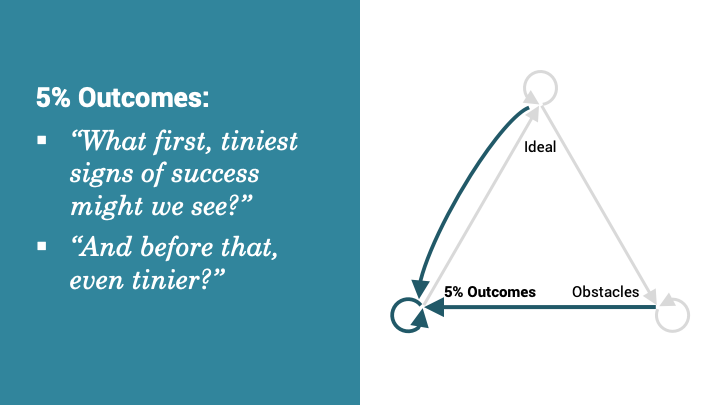
  • What first, tiniest signs of success might we see?
  • And before that, even tinier?

Context for those questions might be a some kind of obstacle, an outcome (a larger one, obviously), or even our overall objective. Here I’ve visualised it in terms of the IdOO (“I do”) pattern:

5-percent-outcomes

15% outcomes, getting going

If we get unstuck with 5% outcomes and their corresponding 5% solutions, then 15% outcomes and their corresponding 15% solutions are how we make faster progress. I’m riffing on the Liberating Structures pattern 15% Solutions, whose rationale speaks to the stuckness issue but invites us to think a little bigger. If our attitude is that “15% is always there for the taking”, then we’re primed to iterate towards our goals. Faced with an adaptive challenge, the sooner we embrace that kind of approach, the better. Here, 100% solution are worse than unlikely, they’re a route to failure.

15% is always there for the taking

15% Solutions: Discover and Focus on What Each Person Has the Freedom and Resources to Do Now (liberatingstructures.com)

The questions here:

  • “How will we know that we’ve made a small but significant step in the right direction?”
  • “And then what happens?”

Anticipating one of the three most important questions in 15-minute FOTO, the “And then what happens?” is already getting us to think more iteratively. Visualised:

15-percent-outcomes

5% and 15% outcomes, yes outcomes

You might be wondering why I start with Solutions Focus and 15% Solutions and invite participants to capture not solutions but outcomes. Is this some strange insult to my sources? Not a bit of it!

Think of Agendashift as a two-pronged approach to adaptive strategy:

  1. its formation through an ongoing process of meaningful participation
  2. integrated with innovation and learning processes

In the context of an adaptive challenge in a changing environment (one we’re actively changing, no less), if we take the attitude that solutions are always there for the taking – a core premise of both our sources –  the right time for solutions is just in time. To solutionise sooner is to invite solutions that may be beyond their shelf life by the time they’re really needed. Worse, having them designed only by the people who happen to be in the room at the time is another recipe for failure.

We are not merely counting on but institutionalising the emergence of solutions “from the people closest to the problem”, to quote my friend Karl Scotland. Keeping that innovation process well fed, appropriately oriented, and with room to breathe, strategy is developed in the language of outcomes.

Going as far as mostly as avoiding the term change management for fear of being associated with it, this is the very antithesis of 1990’s-style managed change. Great for upgrading your email server, but completely the wrong paradigm for anything transformational. Catch yourself thinking that a preconceived solution – worse, a borrowed one – should be your main response to your adaptive challenge? Tempting, but think again. You’d be making a category error, already a terrible place to start. Rolling it out, overcoming resistance to change and all that? Well that would be doubling down, compounding the mistake, and the consequences will be yours to own.

So solutions come well after outcomes, not before. But if you hear a solution prematurely – even a 5% or 15% solution – don’t worry. They’re easy to deal with:

  • Then what happens?

Get unstuck and get going with 5% and 15% outcomes. Small – tiny even – but powerful!


What if we put agreement on outcomes ahead of solutions?

Agendashift™: Serving the transforming organisation
Agendashift  Academy: Leading with OutcomesHome | Store

Links: Home | Subscribe | Become an Agendashift partner Events | Contact | Mike
Resources: Tools & Materials | Media | Books | Assessments 
Blog: Monthly roundups | Classic posts
Community: Slack | LinkedIn group | Twitter

Pilots wanted

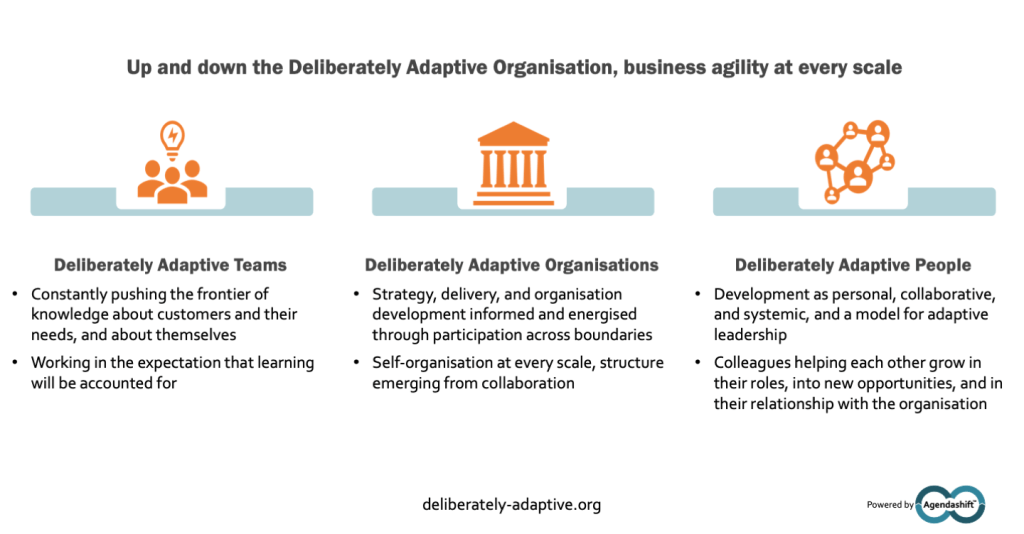
As of the past week or so, Agendashift partners now have access to a new assessment template, a spin-off from the 2nd edition of the Agendashift book. It’s an Agendashift-style (non-prescriptive, non-judgemental, outcome-oriented, trust-building, etc) assessment tool for the Deliberately Adaptive Organisation (deliberately-adaptive.org) and a significant development.

It’s a key part of the roadmap for 2021, both in its own right and as a stepping stone to Transforming with Outcomes, the third of three self-paced training modules (the first, Leading with Outcomes, is already up and running and the second, Outside-in Strategy with Outcomes, launches soon). The assessment is highly accessible and requires no special knowledge on the part of participants; nevertheless, the underlying model is super interesting.

The Deliberately Adaptive Organisation integrates Agendashift and the Deliberately Developmental Organisation (see Bob Kegan and Lisa Laskow Lahey’s 2016 book An Everyone Culture) into the Viable System Model. VSM is Stafford Beer’s classic at-every-scale (fractal) model of systems that “have the desire to meet the demands of a changing environment”, and it’s a model of extraordinary diagnostic power. Combining it with Agendashift creates the opportunity to use it in a dialogic way – not diagnosing and prescribing, but helping the organisation have the conversations it needs to have with itself.

The assessment comprises 35 prompts across 5 categories:

  1. Intentful Knowledge Discovery
  2. Mutual Trust Building
  3. Adaptive Strategy
  4. Between and Across Levels
  5. Self-governance, Self-development, and Self-organisation

I’m looking for potential pilots to test the assessment, complete with its accompanying Agendashift-style debrief and followup exercises.

Further to the fourth of the above categories, Between and Across Levels, I’m particularly interested in contexts where there’s the potential for strategy to develop at and across multiple levels of organisation – in teams of teams for example.

To set some expectations:

  • There are no set limits to the number of survey respondents – typically most will respond online in their own time but scheduled one-to-ones for a selected few can work well too
  • The debrief workshop requires 6-25 participants, ideally representing at least 3 levels of seniority

The debrief workshop identifies the raw materials for an Agenda for Change, a shared organisational strategy:

  • Survey results sliced & diced in various ways
  • Survey prompts prioritised in breakout groups of 3-5 people
  • In those groups, consideration of what those most important prompts could mean for you in context, when they’re working at their “ideal best” for you
  • Obstacles and outcomes, in each breakout group’s own words

The IdOO (“I do”) pattern and very much as recommended in the book (the Exploration chapter specifically), with room also to explore the models behind the new tool. The process for moving forward from there is well practiced; I can get you started in a few hours if you’d appreciate help with organising outcomes strategically, designing some initial experiments etc.

All in all, it comes to a few hours to at most a few days work at heavily discounted rates – I am not in the market for longer engagements. Think of this as sponsored research for mutual benefit. I’m looking to do a few of these between now and late autumn – mainly to test the assessment, to compare results within and across diverse organisations (so there’s no right kind of organisation if you were wondering about that), and later in the year perhaps to pilot the training (interactive &/or self-paced).

Interested? Contact me here!


What if we put agreement on outcomes ahead of solutions?

Agendashift™: Serving the transforming organisation
Agendashift  Academy: Leading with OutcomesHome | Store

Links: Home | Subscribe | Become an Agendashift partner Events | Contact | Mike
Resources: Tools & Materials | Media | Books | Assessments 
Blog: Monthly roundups | Classic posts
Community: Slack | LinkedIn group | Twitter

Inside-out or outside-in? A strategy warmup

In case you have been wondering why it has been quieter than usual here, we had four night’s worth of respite break last week (long story but it was great, the longest break we’ve had since the pandemic started). Refreshed and energised, by the power of Zoom I was in New Zealand early in the morning of my first day back for a Limited WIP Society meetup and I thought it would be fun to try an experiment.

As per most of my meetup appearances we did a IdOO (“I do”) pattern exercise, three breakouts discussing the Ideal, Obstacles, and Outcomes for a given challenge. Composed for the event, here’s the challenge we used:

Imagine…

…reaching the right customers, meeting their strategic needs*, achieving results in the way to which we aspire

*strategic needs: their needs, our strategy

(And here is that challenge plugged into the IdOO Breakout Generator announced last month)

There are several things going on that challenge, and I was careful not to steer people towards any particular element. In the debrief afterwards:

To which part did you most respond? Right customers and their strategic needs, or how we achieve them? If right customers and their strategic needs, chat “outside-in”. If you responded mainly to the how part, “inside-out.

Interestingly, the split was roughly 50:50.

Inside-out and outside-in describe two important and complementary approaches to strategy. If you start with developing capability, performance, or culture, it’s inside-out. Whether or not it qualifies as effective strategy depends on a few things: if you identify one or more meaningful objectives (not too many of those – you need focus), some measures of success (how to know that you’re winning), the most important obstacles you’ll likely need to overcome (no point focussing on the wrong obstacles or obstacles that don’t really exist), and other sources of uncertainty (be honest now), you’ve made a good start, but still you’re set up for failure if you can’t back that up with the necessary commitments.

You can get all of that right and still waste a lot of time finding out that it’s all completely irrelevant from the customer’s perspective – a potentially catastrophic problem if left unaddressed. The alternative? Outside-in means starting from the customer and other actors in the changing business environment, and working inwards. In the process, it creates meaning and context for what happens inside, a powerful exercise in alignment when done right.

Don’t get me wrong, organisations absolutely need to balance both perspectives, and it’s good to be skilled in facilitating both approaches. It’s good also to know which one you’re doing, and to recognise when the other is what’s needed or is happening anyway (trust me, it happens, and it can be a good thing).

If you know you have an urgent need to look at things from both ends, my firm advice is to start outside-in. With the right kind of structure you’ll get quickly to a point where you can bounce back out again, and the whole exercise will make so much more sense. Agreeing instead on a load of improvement work that later turns out to be irrelevant is at best wasteful, and at worst, demoralising.

Back from my break I have started recording Outside-in Strategy with Outcomes, the outside-in complement to the self-paced training Leading with Outcomes with which we launched the Agendashift Academy last month. Together with our signature interactive workshops – see Upcoming below for dates – we’re building a comprehensive training programme, all designed to help organisations, their leaders, and their expert practitioners thrive together in a changing environment. For us that means some motivating objectives for the year consistent with our mission, and some new capabilities to develop. And don’t worry, no shortage of commitment!

Related posts:

Resources (agendashift.com/resources)


What if we put agreement on outcomes ahead of solutions?

Agendashift™: Serving the transforming organisation
Agendashift  Academy: Leading with OutcomesHome | Store

Links: Home | Subscribe | Become an Agendashift partner Events | Contact | Mike
Resources: Tools & Materials | Media | Books | Assessments
Blog: Monthly roundups | Classic posts
Community: Slack | LinkedIn group | Twitter

The IdOO pattern as leadership model

The IdOO pattern (below) is integral to the first two chapters of the Agendashift 2nd edition (March 2021) and also to our Leading with Outcomes and Coaching with Outcomes training (self-paced and interactive workshop respectively). It hardly seems possible that the pattern is only a year old, but this post from April last year really does seem to be my first mention of it.

agendashift-framework-overview-16x10-2020-12-07-idoo

So what is it? Well, it’s at least four things in one, demonstrating its considerable “stretchiness” in terms of the timescales involved:

  • It’s a leadership routine – three or four quick questions, some quick answers, taking just moments
  • It’s a coaching pattern – a higher-level structure to wrap around your favourite coaching tools to bring some strategic perspective – less emphasis on getting to the next commitment, more on the strategic landscape in which options will be developed
  • For facilitators, it’s the overall arc for a string of workshop exercises, whether that’s an hour’s worth or a day’s
  • For consultants, it’s a way to frame a client engagement – as helping them understand where they’d like to get to, what’s in the way of that, and what they might achieve along the way

When taken slowly enough it’s fractal: there may be obstacles in the way of any outcome, and there is always the opportunity to bootstrap the process and identify new ideals at different levels of detail.

This post relates most closely to the first of those uses, IdOO as leadership routine. Here is the IdOO mnemonic not as the structure of a conversation but as an easily-remembered leadership model:

  • Ideal – sustaining a sense of overall direction, connecting people to purpose, helping people find meaning in their work
  • Obstacles – building trust and empathy by recognising the obstacles that people face – their everyday frustrations, the “struggling moments” of actual and potential customers – everything that stands in the way of performance and success; real, relevant, and representative problems that better-designed organisations or products would alleviate
  • Outcomes – keeping at the forefront the goals around which work is organised and to which streams of work are aligned; remembering to celebrate their achievement and to focus the associated learning (both organisational and individual) to the maximum

It’s not a million miles away from my 3-point summary of Servant Leadership. Here in the last chapter of Right to Left I’m channeling Greenleaf, noting what I describe as his “masterful systems thinking”:

  1. The first responsibility of the Servant Leader is to help others to be successful – removing impediments, ensuring that basic needs are met
  2. For people to remain engaged, the Servant Leader must help others find autonomy and meaning in their work, together discovering, developing, and pursuing the organisation’s values, mission, and purpose in society
  3. For this process of transformation to be sustained indefinitely, Servant Leaders must help develop Servant Leadership in others

Right to Left: The digital leader’s guide to Lean and Agile, Mike Burrows (2019, audiobook 2020)

I wouldn’t for a moment suggest that IdOO supersedes any of that (IdOO only scratches the surface of point 3, for example), but it could be a good starting point if you find Servant Leadership hard to grapple with.

Sources

I’ve mentioned my Agendashift (2021) and Right to Left (2019) already; let me mention some other books I’ve referenced in one or both of those:

  • Servant Leadership: A Journey into the Nature of Legitimate Power and Greatness, Robert K. Greenleaf (Paulist Press, 25th Anniversary edition, 2002) – decades ahead of its time and still an inspiration; I re-read it every few years
  • The Serving Leader: Five powerful actions to transform your team, business, and community, Kenneth R. Jennings & John Stahl-Wert (Berrett-Koehler Publishers, 2nd edition, 2016) – a recent take on servant leadership and a tweak on the language that some will welcome; I’m grateful to Agendashift partner and Servant Leadership champion Angie Main for finding that one
  • Host: Six new roles of engagement, Mark McKergow & Helen Bailey (Solutions Books, 2014) – a change of metaphor and one that brings new insights
  • Turn the Ship Around! A True Story of Turning Followers into Leaders, L. David Marquet (Portfolio, 2013) – another great book all round; helpful advice here with regard both to obstacles (when and when not to take them away, for example) and to the learning and development aspects of the model

Not referenced but worthy additions to that list:

  • Speed of Trust: The One Thing that Changes Everything, Stephen M.R. Covey (Free Press, 2006)
  • Demand-side Sales 101: Stop Selling and Help Your Customers Make Progress, Bob Moesta (Lioncrest Publishing, 2020)

I’m currently listening to the audiobook of Covey’s Speed of Trust, good stuff so far. Bob Moesta’s book fits here better than you might guess from the title; it’s a great book on Jobs to be Done, and it’s my source for the the phrase “struggling moments”.

IdOO at the the conferences

Don’t forget the Agendashift 2021 conference on May 18th – not long now! The IdOO pattern will certainly get a mention in my opening introduction (not keynote – that honour goes to Pia-Mia Thorén). And I’m thrilled that Gervase Bushe will be speaking on leadership in the closing keynote. He is the author or co-author of two of the 2nd edition’s key references, The Dynamics of Generative Change and Dialogic Organisation Development.  

Possibly a mention of IdOO in one form or another in my LAG21 talk on the 25th, trust-building being a key element of the Deliberately Adaptive Organisation (see the last couple of chapters of the Agendashift 2nd edition). Agendashift Academy is proud to sponsor that conference too.


Upcoming

Listed now on the Agendashift Academy’s Store page are our scheduled workshops:

And always now the self-paced option:

Selected appearances by Agendashift partners, me where unspecified:


Agendashift™, the wholehearted engagement model
Links: Home |
About | Our mission: Wholehearted | Become an Agendashift partner | Assessments | Books | Resources | Media | Events | Contact | MikeSubscribe
Workshops: Transformation strategy | Outside-in strategy | Short training
Blog: Monthly roundups | Classic posts
Community: Slack | LinkedIn group | Twitter

Leading with Outcomes: a cheat sheet

To whet the appetite, a cheat sheet for:

Yes, you read that right: March 2021. Publication imminent!

Go to agendashift.com/leading-with-outcomes-cheat-sheet or click on the image below for download information, references, etc. It’s Creative Commons (CC-BY-SA); by subscribing you’ll get not just the PDF but the original .pptx file too – translations and other adaptations welcome. Enjoy!

leading-with-outcomes-cheat-sheet-2021-03-14-v1


What if we put agreement on outcomes ahead of solutions?

Agendashift™: Serving the transforming organisation
Agendashift  Academy: Leading with OutcomesHome | Store

Links: Home | Subscribe | Become an Agendashift partner Events | Contact | Mike
Resources: Tools & Materials | Media | Books | Assessments 
Blog: Monthly roundups | Classic posts
Community: Slack | LinkedIn group | Twitter

The IdOO pattern meets ‘Good Obstacle, Bad Obstacle’

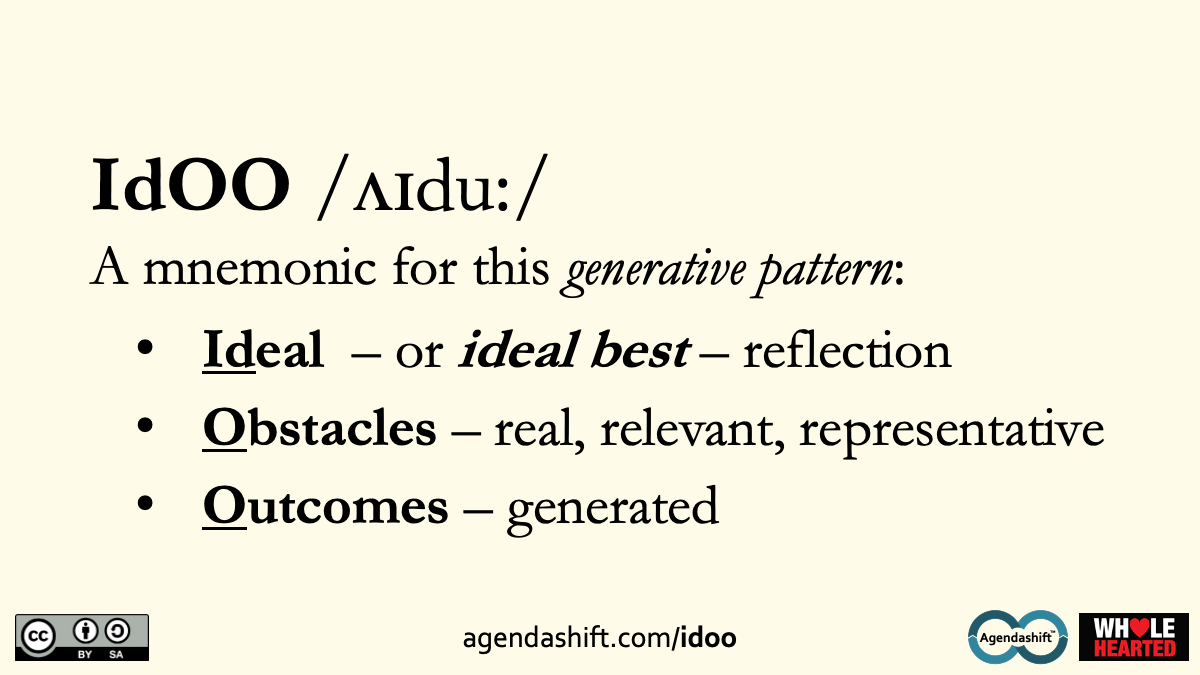
Finishing up the writing of the Agendashift 2nd edition (linkedin.com) I’ve made two updates to the IdOO pattern resource. The first is in the wording of this “definition”:

IdOO image

What’s different:

  1. “real, relevant, representative” – this is quoting Good Obstacle, Bad Obstacle [1], the name of a workshop exercise that like the IdOO pattern itself is new to the 2nd edition, also of a webinar recording and some associated resources
  2. “generated” – in case it needs to be said

Further to that second point, the IdOO deck (obtainable via the IdOO page) includes this version of the slide:

IdOO 2020 12

This is to emphasise that the generative process represented by the IdOO pattern needn’t be linear. If you’re at Outcomes, for example, “What stops that?” or “What obstacle might be in the way of that?” [2] takes you back to obstacles. From either Obstacles or Outcomes, the Challenge Mapping [3] question “Why is that important?” may take the conversation in the direction of the Ideal.

What the IdOO pattern gives you is a simple structure into which your favourite generative questions (and frameworks thereof) can be used, resulting in conversations that can be more strategic in nature than those coaching conversations whose main goal is to get to the next commitment. In the 2nd edition’s first two chapters you’ll see the Discovery and Exploration activities explained in those terms. But that’s not IdOO’s only use: it reappears as an ideation pattern too.

I can’t yet give a publication date, sorry! If you want to stay posted you can subscribe to the mailing list.

[1] Good Obstacle, Bad Obstacle (agendashift.com, video and associated resources)
[2] For a discussion on those two question forms, see The language of outcomes: 2. Framing obstacles (January 2020)
[3] See I’m really enjoying Challenge Mapping (June 2020), also some related links on the IdOO pattern page


Upcoming workshops

All the usual discounts apply: repeat visits (not uncommon), partners, gov, edu, non-profit, country, un- or under-employment, bulk orders. If you think that one might apply to you, do please ask.

And if you think that you might become an Agendashift partner, join before the Deep Dive and the partner discount on the workshop covers your membership!


Agendashift™, the wholehearted engagement model
Links: Home |
About | Our mission: Wholehearted | Become an Agendashift partner | Assessments | Books | Resources | Media | Events | Contact | MikeSubscribe
Workshops: Transformation strategy | Outside-in strategy | Short training
Blog: Monthly roundups | Classic posts
Community: Slack | LinkedIn group | Twitter