Updates: Renamed network #2, minor edits elsewhere. This model is now included in the Agendashift Academy module Adaptive Organisation (II): Between spaces, scopes, and scales and the in-person training Leading in a Transforming Organisation. Video of my SEACON keynote here.
Expanding slightly on yesterday’s LinkedIn post (linkedin.com), your organisation in 5 networks:
Network #1: Your reporting network. This is just your formal structure – typically a hierarchy, perhaps with the occasional bit of dual reporting thrown in – seen here as lines of communication. Because sideways communication has to be implemented indirectly via upward and downward communication, it can be highly inefficient.
Network #2: Your delivery operations network. I am referring not to material flows or to the knowledge work equivalent, but to the interactions between people that make those flows what they are, performing as they do. In siloed organisations, the delivery operations network cuts across the reporting network, sometimes uncomfortably.
Network #3: Your strategy network. Typically richer than the reporting network, this connects everyone involved in anybody else’s strategic decision-making – any decision-making at any level of organisation that impacts on things like identity, purpose, objectives, learning, and adaptation. A more abstract and less messy version of this network connects not people but domains of responsibility at varying levels of granularity (see circular organisation).
Network #4: Your trust-building network. This is the network of all connections that are enhanced by meaningful efforts to build or maintain mutual trust. In a high-trust organisation, this can be expected to overlap significantly with the preceding three networks.
Network #5: Your social network: All the above and more – the totality of your organisation’s network of interaction and influence, covering all the conversations that contribute to making your organisation what it is and what it is becoming.
And two hypotheses (with caveats):
Hypothesis 1. The more that networks 2, 3, and 4 are healthy, the more that networks 1 and 5 look after themselves.
Hypothesis 2. The richer you can make them, the more likely is the serendipitous conversation, increasing the rate of innovation.
As rightly observed in some of the questions and comments on the first version of this post, these hypotheses are slightly in tension. Rich is good, richer would be better for many if not most organisations, and leaders within them would do well to pay attention to those networks. You can however have too much of a good thing, not to mention that some innovation happens in the darker corners, so to speak. In my use of the word “healthy” in hypothesis 1 I did intend a sense of balance, and I should have worked that sense into hypothesis 2 also. Instead though, this paragraph’s caveats 🙂
Some questions for you:
- In your organisation, which network or networks dominate?
- At what cost?
- Given where you sit in each of these networks and the reach that they afford you, what might you do?
Your answers, questions, or feedback can go on the original post (linkedin.com).
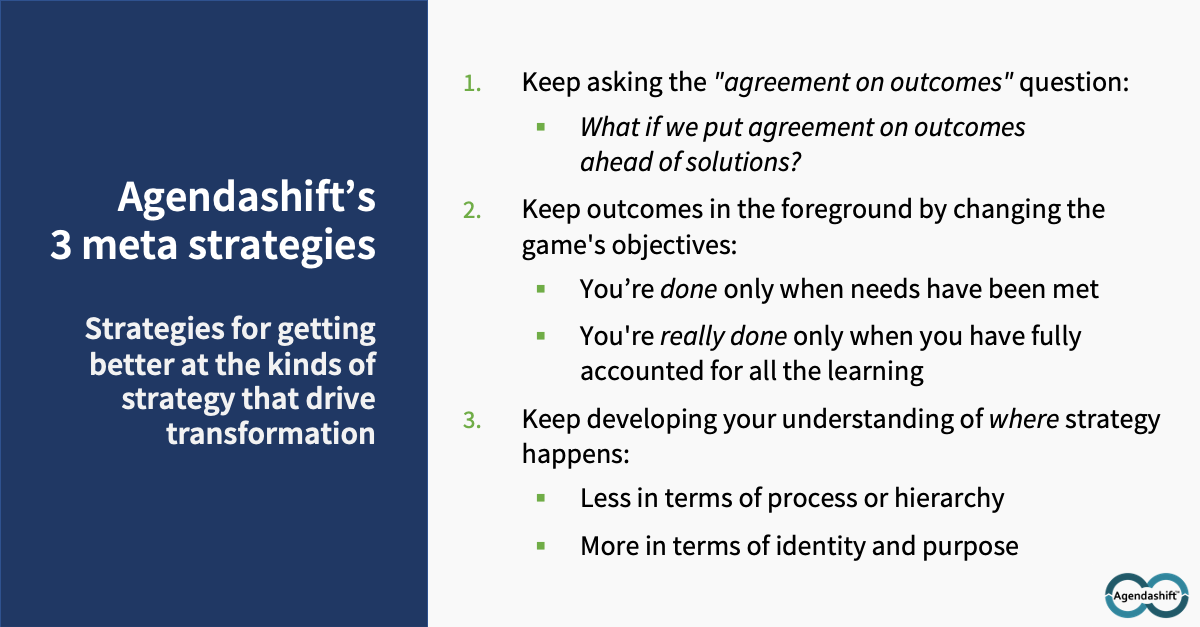
PS The slide below is adapted from the talk I gave last week at SEACON (the Studies in Enterprise Agility Conference).

Upcoming events
February
- 18 February, Online, 16:00 GMT, 17:00 CET, 11am ET, Agile Strategy Meetup Group:
Meet Mike Burrows on strategy - 24-27 February, four 4-hour sessions online, afternoons UK time:
Leading with Outcomes: Train-the-Trainer / Facilitator (TTT/F)*
March
- 06 March, London, UK:
Kanban Edge 2025
*TTT/F and (where shown) LIKE events include free one-year membership of the Leading with Outcomes Authorised Facilitator programme, upgradeable to Authorised Trainer at any time. Both of those include access to the video-based Leading with Outcomes training and the full range of Agendashift assessment tools.
Leading with Outcomes from the Agendashift Academy
“Leadership and strategy in the transforming organisation”
Leading with Outcomes is our modular curriculum in leadership and organisation development. Each module is available as self-paced online training or as private, instructor-led training (online or in-person). Certificates of completion or participation according to format. Its modules in the recommended order:
- Foundation module:
- Inside-out Strategy:
- Adaptive Organisation:
- Outside-in Strategy:
Individual subscriptions from £24.50 £18.40 per month after a 7-day free trial, with discounts available for employees and employers in the government, healthcare, education, and non-profit sectors. For bulk subscriptions, ask for our Agendashift for Business brochure.
To deliver Leading with Outcomes training or workshops yourself, see our Authorised Trainer and Authorised Facilitator programmes. See our events calendar for Train-the-Trainer / Facilitator (TTT/F) and Leading in a Transforming Organisation trainings.
Agendashift™: Serving the transforming organisation
Links: Home | Subscribe | Events | Media | Contact | Mike
Agendashift Academy: Leading with Outcomes | Trainer and Facilitator Programmes | Store
At every scope and scale, developing strategy together, pursuing strategy together, outcomes before solutions, working backwards (“right to left”) from key moments of impact and learning.
 Agendashift