Online and offline, the Agendashift unbenchmarking report

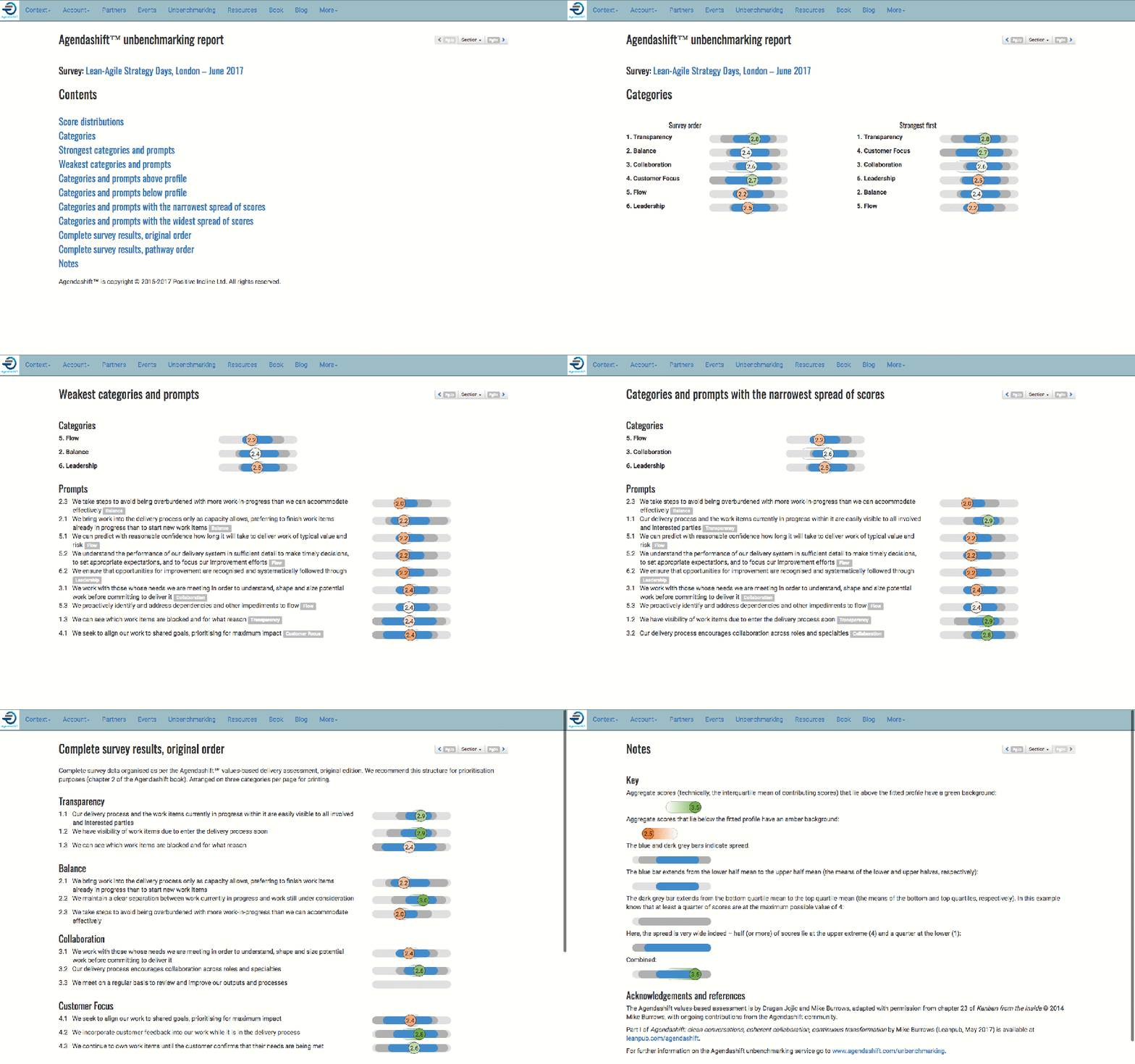
Online first. Here’s the unbenchmarking report as a simple single page app (SPA). Instead of fiddling about with sort orders in the old ‘charts’ view, this is facilitator-friendly, taking you through survey results in the same tried-and-documented sequence that we use in our workshops. You can even page through it with your clicker!

unbenchmarking animated

For offline purposes, it prints nicely to A4 and (as of our next deployment) US Letter. Here’s a sample as a 14-page PDF download:

Note: This isn’t quite the full report. I’ve taken the full-sized 43-prompt original edition survey taken as prework for the recent Lean-Agile Strategy Days workshop and applied the 18-prompt mini edition template to it. The latter has one prompt (3.3) not included in the original survey, which is why it shows no scores.

The sections titled Complete survey results, original order and Complete survey results, pathway order are specifically designed for printing, optimised for the 43-prompt template (explaining the large amounts of white space in the sample). We find that paper copies of these two sections are invaluable when prioritising prompts and producing transformation maps (respectively).

Related

Please note that the unbenchmarking report is currently available only in English. If you’d like to receive or facilitate one in another language, please let us know.


Agendashift-cover-thumb
Blog: Monthly roundups | Classic posts

Links: 
Home | Partner programme | Resources | ContactMike
Community: Slack | LinkedIn group | Twitter

Agendashift roundup, June 2017

In this edition: Unbenchmarking; Three meetups in three weeks (with one on video); Public workshops recent and future; The book – don’t forget the book!; Upcoming events; Top posts

New: Unbenchmarking

A week ago we announced the Agendashift unbenchmarking service, in which we run your survey results against our dataset and identify areas of opportunity for you automatically. It’s our unique values-based assessment combined with machine learning.

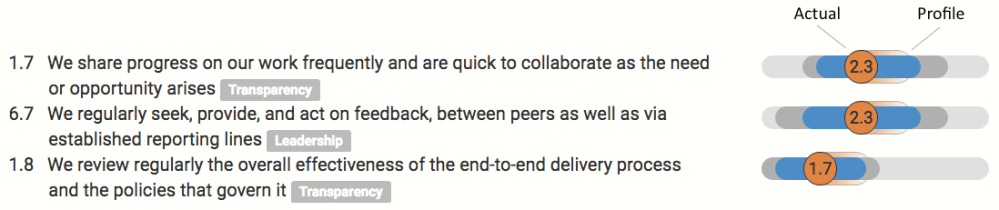
For example, these three prompts clearly share some underlying issues, falling as they do some distance below the scores that our machine model would predict given the shape of this survey’s results overall and the correlations we have seen elsewhere:

unbenchmarking 2017-06-29 11.37.24 annotated

You can access unbenchmarking in a number of ways:

Three meetups in three weeks (with one on video)

This month I did three UK-based meetups in three weeks – Adventures with Agile (London), Agile Yorkshire (Leeds), and Agile Peterborough.

At Leeds and Peterborough I did my interactive keynote Managing change in the 21st century: what we know & where we must do better. In London I facilitated a Discovery session, normally the first of five sessions in an Agendashift workshop. You can watch the video here.

Public workshops recent and future

My most recent public workshop was Lean-Agile Strategy Days, London, a collaboration with Karl Scotland. We’ll definitely be doing this again!

My next two are also collaborations:

Both workshops incorporate an Agendashift practitioner’s workshop. Super-early bird for the London workshop ends on July 26th – don’t miss out!

The book – don’t forget the book!

As described in What next after part I?, the recent work on machine learning is part of a bigger plan, some of which feeds into part II of the book. Part I meanwhile is of course available on Leanpub.

Upcoming events

Top posts

Recent:

Older:


Agendashift-cover-thumb
Blog: Monthly roundups | Classic posts

Links: 
Home | Partner programme | Resources | ContactMike
Community: Slack | LinkedIn group | Twitter

Announcing the Agendashift Unbenchmarking Service

First the hint (in What next after part I?):

I am already able to demonstrate the automatic identification of survey scores that don’t fit the model – areas in which the organisation in question has unusually strong areas to celebrate or weak areas for further investigation – all driven by the data, not the biases of the person facilitating the debrief

Now the announcement: the Agendashift unbenchmarking service is now available.

In a nutshell: we run your survey results against our dataset and identify areas of opportunity for you automatically.

When and why to unbenchmark

  • You’re embarking on a journey of Lean-Agile transformation and you want a better understanding of the landscape you’ll be navigating
  • Your improvement efforts are stalling and it’s time to agree priorities afresh
  • As input to your corporate culture exercise, team retrospective, departmental meeting, or offsite
  • Anytime you need to reorient, re-baseline, take stock, and re-energise
  • When it’s time to take a regular checkpoint
  • As a low-commitment step before taking an Agendashift workshop or engaging an Agendashift partner

How it works

  • We set up for you an online survey with the full 43-prompt Agendashift values-based delivery assessment
  • You distribute it internally for your staff to complete by the agreed deadline
  • We report back to you:
    • The overall distribution of your scores
    • Stronger and weaker categories and prompts, as measured in absolute terms (without reference to other data)
    • Categories and prompts whose aggregate scores are above or below the expected profile given the correlations we have observed
    • Areas of agreement and disagreement, reinforcing the more obvious findings and creating opportunities for story-gathering where the picture is more mixed
    • The complete set of aggregate results for all categories and prompts (twice over in fact – one set for prioritisation purposes, another for planning)

If you’re a veteran of one of our workshops or you have read the Agendashift book (chapters 2 and 3 in particular), you’ll recognise this reporting structure. It reflects how we typically organise a survey debrief and the mapping exercises that follow.

Unbenchmarking

The new and exciting bit is the identification of data points above or below the expected profile, ie scores that differ from what might be expected given your survey’s overall shape and the correlations we observe elsewhere. We’ve used machine learning techniques on our growing dataset to create a model of survey results to which yours can be fitted; the deviations above and below the best-fit model identify what’s particular to you. Instead of a crude index or vanity metric that’s meaningless in the context of an open-ended journey of transformation, we give you detailed insights you can actually work with.

Additionally, we can control the granularity of the model so that you see deviations not just from the total population but from organisations that show traits similar to yours. This helps you put your findings into proper context, and makes the insights even more actionable.

Should you decide to repeat the exercise at some later date, any significant changes to your profile will cause new areas of interest to be highlighted. Just as you’d expect!

In this real example, the three prompts whose scores lie furthest below the expected profile clearly have something in common:
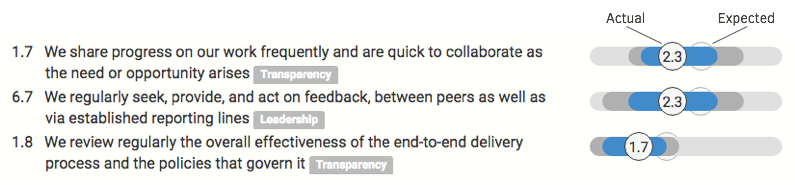
As illustrated here, the biggest opportunities can hide in unexpected places, away from where absolute scores are obviously weak. Unbenchmarking highlights these potential action items for you automatically.

What happens next is of course up to you. However, the process of turning prioritised prompts into an agreed plan of actionable outcomes appropriate to your unique context is something we are well practised at facilitating; no matter wherever you are located, we should be able to find you some valuable support.

Pricing

The Agendashift unbenchmarking service is priced at £125 (about €145 or $160) per survey plus £1 per person over 10 people surveyed, with survey sizes specified in advance.

Several discounts are available:

  • We make generous allowances for charitable, non-profit, educational, and government organisations
  • If you’re based outside the major economies we can make PPP adjustments
  • For large exercises involving multiple teams or departments, you may find it helpful to receive both separate and combined results; pricing will depend on complexity but multiple surveys will in general attract discounts.
  • Similarly, repeat exercises (eg quarterly) will be discounted

The Agendashift values-based delivery assessment is already included as prework for our transformation mapping and practitioner’s workshops. Where workshops follow unbenchmarking we’ll adjust workshop pricing appropriately. You won’t pay twice!

Finally, you should consider engaging one of our partners, professionals well qualified to support you in your journey of transformation.

Get in touch now to arrange your unbenchmarking exercise:

Arrange an unbenchmarking exercise

Related


Agendashift-cover-thumb
Blog: Monthly roundups | Classic posts

Links: 
Home | Partner programme | Resources | ContactMike
Community: Slack | LinkedIn group | Twitter
Video: Exercises in Lean-Agile transformation

Two weeks ago I led a big Agendashift-style Discovery session (chapter 1 of the book) for 80+ people as guest of Adventures With Agile’s London meetup. Here’s the video:

Last week I was at Agile Yorkshire. Tomorrow (Wednesday June 20th) I’ll be doing my third meetup in three weeks, when I’m at Agile Peterborough. 75 people signed up so far!


Agendashift-cover-thumb
Blog: Monthly roundups | Classic posts

Links: 
Home | Partner programme | Resources | ContactMike
Community: Slack | LinkedIn group | Twitter
What next after part I?

What’s next after part I of the new Agendashift book (published last month), that is.

The obvious answer would be part II, which I intend to consist mainly of case studies and smaller real-world examples of Lean-Agile change in action. Before that though, I’ve been experimenting with some machine learning tools, in particular in the area of dimension reduction. Broadly, this allows the 43-dimensional data of the Agendashift survey results to be boiled down to just a few key features (factors, traits, tendencies, etc).

This has considerable potential:

  1. I am already able to demonstrate the automatic identification of survey scores that don’t fit the model – areas in which the organisation in question has unusually strong areas to celebrate or weak areas for further investigation – all driven by the data, not the biases of the person facilitating the debrief
  2. Cluster analysis could allow representatives of organisations exhibiting similar traits to be introduced and their experiences compared
  3. A combination of 1 & 2 could lead to some kind of recommendation system – machine-assistance for the coach, perhaps

Expect an announcement very soon on point 1, a new commercial offering and new functionality available soon to paid users (ie Agendashift partners).

Point 2 is in fact my plan for part II. Technicalities aside: bring people together, get them talking, write it up 🙂

Point 3 is for the longer term. A “living” version of the book, if you like.

Technical footnote: The machine learning (ML) tools available in Python are truly awesome. Book recommendation: Python Machine Learning by Sebastian RaschkaI’ve made good use of his online tutorials too.

Questions? Go to #next-steps in our Slack.


Agendashift-cover-thumb
Blog: Monthly roundups | Classic posts

Links: 
Home | Partner programme | Resources | ContactMike
Community: Slack | LinkedIn group | Twitter
Which workshop?

Check out these two workshop descriptions and you’ll see the same structure:

Not just the same structure, but the same materials too. What’s the difference?

The difference is context and objectives:

  • In the transformation mapping workshop, the participants share a context – their organisation – and the workshop’s objective is to formulate a response to that organisation’s needs
  • In the practitioner workshop there may be little or no shared context; participants are there to experience and practice, often building on what they may have already read (not that reading is a prerequisite)

They aren’t mutually exclusive:

  • A recent private workshop made significant progress on organisational issues in the workshop and in the period following, but many of the attendees could be described as practitioners (subsequently, one participant become an Agendashift partner and has now at his disposal all the tools and materials needed to run workshops himself)
  • A participant at a recent public practitioner workshop later invited me back to his company, shifting the focus from practice back to context

Why make the distinction? A discussion about objectives beforehand is always valuable. Expectations should clear on both sides, it’s important to get the right set of people in the room, and if it’s left to the day of the workshop to think about what happens afterwards, it may be too late.


Agendashift-cover-thumb
Blog: Monthly roundups | Classic posts

Links: 
Home | Partner programme | Resources | ContactMike
Community: Slack | LinkedIn group | Twitter

Which assessment template?

[Update: I’ve summarised the options in a table near the bottom of this post]

A small enhancement got released today, causing assessment templates to be listed in a sensible order when you’re creating or editing a survey:

Screenshot 2017-06-01 14.51.31

They’re organised by family, edition, and language.

Family

Currently, there are two families:

  1. Agendashift values-based delivery assessment – this is the main one, the template we’ve been iterating on since 2014
  2. Agendashift values-based adaptability assessment – this is new, developed in parallel with chapter 5 of the new book

Unless you specifically want to assess your organisation’s ability to make change happen, you almost certainly want the first one.

Edition

This specifies both the structure and the size of the assessment:

  1. Original edition – the full-sized template (43 prompts at the latest count), structured by value (transparency, balance, collaboration, etc)
  2. Mini edition – like the original edition, but only 18 prompts (3 per value)
  3. Pathway edition – with minor variations the same prompts of the original edition, structured not by value but by the steps of Reverse STATIK
  4. Mini pathway edition – an 18-prompt version of the above
  5. Featureban edition – the mini edition, re-purposed (see the Featureban home page)

Partners (and their clients) have the full range of templates available to them. The free trial gives access to the mini and mini pathway editions only.

Surveys are generally conducted using the original or mini editions. The pathway or mini pathway editions come into play later when creating a transformation map (chapter 3).

Language

As shown in the screenshot, all of these combinations are available in English (EN), and most of them in French (FR) and German (DE) also. The original and mini editions are also available in Spanish (ES), Hebrew (HE), Italian (IT), Dutch (NL), and Russian (RU).

Summary

Here are all the options summarised in a table:


Family  
Edition Agendashift
values-based delivery assessment
Agendashift
values-based change assessment

Languages

Original

Partners

n/a

EN, DE, ES, FR, HE, IT, NL, RU

Pathway

Partners

n/a

EN, DE, FR

Mini

Trial, Partners

Trial, Partners

EN, DE, ES, FR, HE, IT, NL, RU

Mini pathway

TrialPartners

Trial, Partners

EN, DE, FR

Featureban

Trial, Partners

n/a

EN

Agendashift-cover-thumb
Blog: Monthly roundups | Classic posts

Links: 
Home | Partner programme | Resources | ContactMike
Community: Slack | LinkedIn group | Twitter

Agendashift roundup, May 2017

In this edition: The book is out; Lean-Agile Strategy Days, London; A True North for Lean-Agile; Looking ahead; Top posts; Upcoming events

The book is out!

Part I at least – thoughts on part II later. You won’t blame me for blogging about it more than once:

Get your copy here: Agendashift: clean conversations, coherent collaboration, continuous transformation [leanpub.com].

Lean-Agile Strategy Days, London (June 7th & 8th)

I mentioned this exciting event in last month’s roundup and it is fast approaching. Karl Scotland (my co-facilitator) wrote about it here, and I gave my take here. Tickets here [eventbrite.com].

A True North for Lean-Agile?

Imagine… everyone able to work consistently at their best:
 • Individuals, teams, between teams, across the organisation
 • Right conversations, right people, best possible moment
 • Needs anticipated, met at just the right time

If you’ve read the book or seen the blurb for our workshops, those words will seem familiar. As described here, I’d love to seem them used more widely. What do you think?

Looking ahead

In preparation for part II of the book I’ve been performing a new analysis on Agendashift survey data, using Principal Component Analysis (PCA) – a technique popular in machine learning circles – to identify traits common to different sub-populations. I’ll release some early findings soon. There’s some great potential here:

  • Identifying potential case studies for the book
  • Automatically highlighting prompts that have unexpected values
  • Connecting people/organisations based on similarity or complementarity

To keep tabs on this work, on new enhancements to the online tools, and on anything else part II-related, join us in #next-steps on Slack.

Top posts

Upcoming events
07 June, London, UK:
Adventures with Agile meetup: Exercises in Lean-Agile transformation


7-8 June, London, UK:
Lean-Agile Strategy Days, London (2-day workshop incorporating an Agendashift practitioner’s workshop)


21 June, Peterborough, UK:
Agile Peterborough meetup: Managing change in the 21st century: what we know & where we must do better


Agendashift-cover-thumb
Blog: Monthly roundups | Classic posts

Links: 
Home | Partner programme | Resources | ContactMike
Community: Slack | LinkedIn group | Twitter

New feature: tagging assessments

Now that part I of the book is out, I’ve been using the #next-steps channel in the Agendashift Slack both to share plans for part II and to discuss enhancements to the online tools. I’ll blog about part II soon; this post is about a new feature that addresses a quite frequently-expressed need.

The basic need is the ability to analyse survey results in finer detail, reporting on different sub-populations – managers and staff, different teams, different roles, different projects, and so on.

There is already a crude way to achieve this, conducte multiple surveys and aggregate the results afterwards. It has two drawbacks however:

  1. The UI is very crude (it involves URL hacking)
  2. It works only if the populations are surveyed separately. That’s not always possible, it requires forethought, and it adds significant administrative overhead

Point 1 is of course fixable, but point 2 may not be. A different kind of solution is required.

Now, survey administrators and participants may ‘tag’ their assessments, as many tags as they like:

Screenshot 2017-05-25 06.18.18

And in the charts view, assessments may be included or excluded by tag:

Screenshot 2017-05-25 06.21.10

You could, for example, include all assessments tagged for a given department, but exclude assessments tagged for certain roles.

Finally, if you’re curious about the context name ‘Free trial’, it’s one way to experiment with the mini version of the Agendashift values-based delivery assessment for free. You can sign up here.


Agendashift-cover-thumb
Blog: Monthly roundups | Classic posts

Links: 
Home | Partner programme | Resources | ContactMike
Community: Slack | LinkedIn group | Twitter
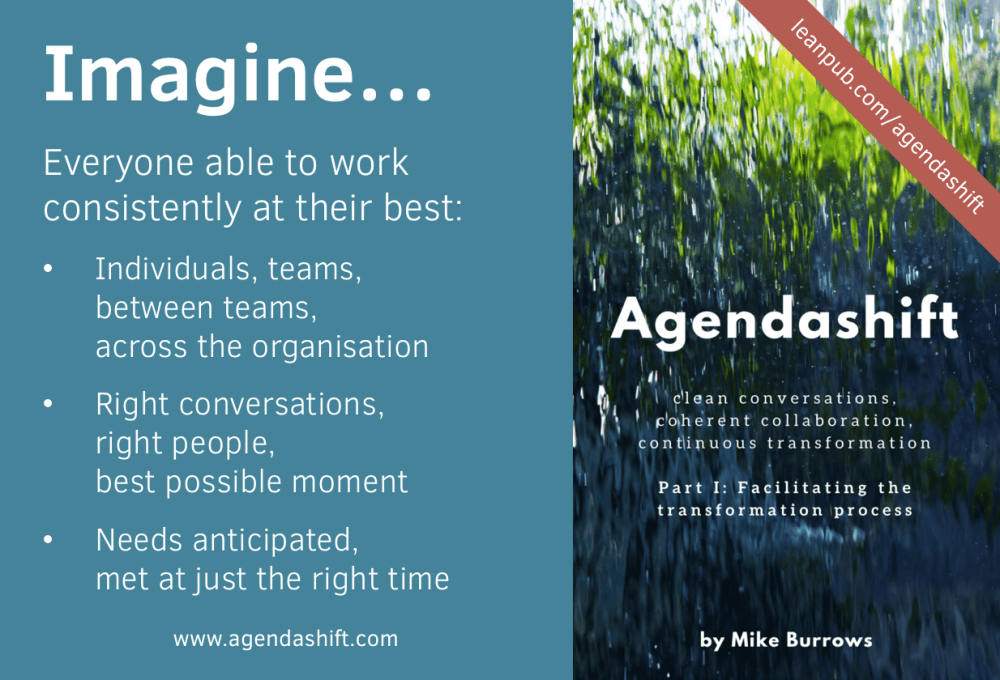
A True North for Lean-Agile?

You may have noticed that the blurb for our workshops and for the new book always starts with this:

Imagine… everyone able to work consistently at their best:
 • Individuals, teams, between teams, across the organisation
 • Right conversations, right people, best possible moment
 • Needs anticipated, met at just the right time

It’s taken from one of our Discovery exercises (chapter 1), an early opportunity for participants to explore different ways of working not from the perspective of prescribed practices, but in terms of what it is like – how it feels, what’s different, and so on.

Some of the groups I’ve facilitated have found the exercise so cathartic that they ask repeatedly for more time. It’s not hard to see why:

  • If you feel that you’re rarely given the opportunity to work at your best, your team doesn’t work well, or you’re painfully aware that teams aren’t working work well together, it can come as a relief to be given the chance to imagine a different reality
  • Whether you’re a front line worker or a manager, conversations happening at the wrong time (or not at all) can be very frustrating
  • For most of us, knowing that we’re meeting needs is crucial to finding meaning in our work

The current text of the book doesn’t identify these words as a True North statement (a compass direction rather than a destination), but it probably should. A True North for Agendashift certainly, and I’d like to put it forward as a True North for Lean-Agile also. It’s consistent with the Lean pillars of respect for people and just in time. Consistent with the Agile manifesto, it elevates individuals and interactions, combining those with a sense of timeliness (I joke that Agile seems to imply lots of meetings, the beginning – one hopes– of true collaboration).

In its favour as a worthy True North:

  • It is easy to understand, worth striving for, and will remain always just out of reach. Transformation must be continuous, not a one-off project
  • It works at every scale – from individual to organisation, and at scales in between
  • In its last bullet, it conveys much-needed senses of proactive discovery (needs don’t get consistently anticipated by accident) and purpose (needs being met)

Also, it’s not specifically about software, or even about product development. That’s a departure from the Agile manifesto, but I have no doubt that this is in its favour too.

So… Does it work for you?

Related:

Screenshot 2017-05-22 13.42.56


What if we put agreement on outcomes ahead of solutions?

Agendashift™: Serving the transforming organisation
Agendashift  Academy: Leading with OutcomesHome | Store

Links: Home | Subscribe | Become an Agendashift partner Events | Contact | Mike
Resources: Tools & Materials | Media | Books | Assessments
Blog: Monthly roundups | Classic posts
Community: Slack | LinkedIn group | Twitter