Alignment on outcomes

[First, previous, next in series]

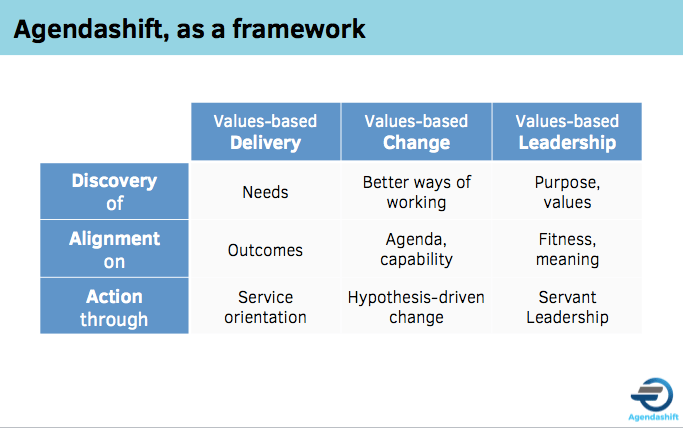
This is the second of nine articles in a series exploring the matrix below (introduced here):
Screen Shot 2016-01-05 at 19.16.55

Previously we looked at Needs; today we’re moving down one cell to Outcomes.

Alignment on outcomes – aligning the outcomes of the delivery process with those of experienced by the user and customer – has several things in common with Discovery of needs:

  1. It seems obvious – “yes of course we should make a deliberate effort to understand rather than assume needs, and of course their success is our success!”
  2. It is rarely practised well, and often practiced not at all, seen as “too hard”
  3. It is genuinely hard if certain things aren’t in place, but is easy and natural when they are

The closest many organisations get to aligning the outcomes of the delivery process with those of the customer is when they use a business case to justify each piece of work. Consider that carefully: their “best practice” is to ask via a business case (sic) whether the project in question will deliver good outcomes to their customers, some months down the line. A conversation removed from the customer in perspective, in space, and in time. Oops.

What’s needed are conversations with real customers that happen close in time to the realisation of their outcomes. Two prerequisites then: some kind of collaboration with the customer, and the opportunity to realign before, during, and – crucially –  after the work is done. Closing a feedback loop.

This is easy and natural when work is delivered incrementally (as opposed to in huge batches) and there is opportunity for customer engagement during the delivery process. This is easier and more natural still when there is an expectation from the customer side that it will happen. Cultivate that if you can!

To finish I will illustrate with a story, an excerpt from my book, Kanban from the Inside. It’s from Chapter 4, which explores customer focus, one of the nine values of the Kanban Method and the fourth category in the Agendashift values-based delivery assessment.

Satisfaction Assured

Recall this policy from the scenario that opened Chapter 1 [Transparency]:

  • Developers retain responsibility for work items until they have obtained customer confirmation that the item is proving its worth

This policy was a relatively late addition. We had evolved a development process that seemed effective enough. We’d gather requirements, build new features, test them, and release them. After a while, we got a little more sophisticated: We added a column on our board that let us track features that were released but still required further implementation steps before they could be considered complete.

Too often, though, when we checked, we found that we’d delivered features that would never be used. Features that had been asked for! How does that happen?

Our new policy was added to address what we assumed at the time to be bad customer behavior. Why ask for stuff you don’t need? How about letting us know when you change your mind? However, it soon became apparent that this new policy was changing behavior on both sides. Closing a feedback loop was the catalyst for a level of customer collaboration (a value straight out of the Agile Manifesto) not previously seen.

Knowing that the process was going to end in what could turn out to be a difficult conversation, developers and our internal customers alike made sure to nail those final implementation steps (clarifying timetables, keeping people suitably informed and trained, getting static data cleaned up, and so on). When necessary, these steps would be tested beforehand, often collaboratively. That, in turn, influenced the way development and specification was done. All the way back at the start of the process, it changed even the way work got prioritized, now that it was apparent that success depended on shared commitment.

I’m not exaggerating when I say that the impact of this policy change went way beyond my expectations. Some humility is in order too: We didn’t have bad customers, just relationships that weren’t effective enough.


Agendashift-cover-thumb
Blog: Monthly roundups | Classic posts

Links: 
Home | Partner programme | Resources | ContactMike
Community: Slack | LinkedIn group | Twitter
Discovering user needs should be a first class activity

[Next in series]

This is the first of nine articles in a series investigating this matrix (first introduced here):

Screen Shot 2016-01-05 at 19.16.55

This post takes on delivery and discovery  At their intersection, Agendashift places the single word “needs”. This can refer to team needs and organisation needs, but these are well represented elsewhere in our framework, so this should be taken to refer mainly to customer needs and user needs.

Customer needs and user needs can (and should) overlap significantly, but they are two distinct concepts, because customers and users aren’t always the same people! Customers pay for (or otherwise sponsor) stuff; users are the people that interact day-to-day with the results.

Agendashift is an “opinionated framework”. As such, we make a stand on behalf of the oft-neglected user here and state that discovering user needs should be a first class activity of the delivery process.

This is a more radical departure from the norm than it might sound. Do not confuse user needs with requirements, or discovery with analysis. The focus of user needs discovery is different (on the user, and further removed from solution design) and may require some new skills (user research, user experience, etc).

Promoted to “first class status”, the discovery of user needs even has the power to transform a problem of bounded scope (the product backlog or a project) into an ongoing process. We’re recognising that user needs do not stand still, and (excitingly) that by engaging with them we may help them and our relationship with them evolve in ways we can’t always predict.

Of course the deepest of user needs are relatively stable over time – good news if we’re seeking lasting engagement. Some writers refer to these as customer values. These aren’t the values that first spring to my mind when I think of “values-based delivery” but nevertheless it is important that there is some alignment. We’ll look at that next.


Agendashift-cover-thumb
Blog: Monthly roundups | Classic posts

Links: 
Home | Partner programme | Resources | ContactMike
Community: Slack | LinkedIn group | Twitter
Agendashift roundup, November 2015

Agendashift on the web:

Out and about:

  • I had a great time at the Dublin Lean Coffee (with wine!) in Dublin last week. I’ll be making visits to Northern Ireland next month and January, working again with my friends at InvestNI
  • Also next month I’ll be a keynote speaker at Lean Kanban India

Progress on the platform:

  • The values-based delivery template has now been translated into French, German, Italian, and Dutch, with a Russian translation out soon. Go to the Depth of Kanbanland 2015 survey page to try them out. Thank you Christophe Keromen, Markus Hippeli, Marco Bresciani, Martien van Steenbergen, and Nikita Vishnevskiy.
  • Development of the new hypothesis-based change functionality is progressing well, though no launch date just yet!

Transforming Lean/Agile transformation

To reflect more accurately the interests of our user base of beta testers and survey respondents and the clients of our training and consulting services, we’ve updated our strapline to “Transforming Lean/Agile transformation”. If you’re contemplating, starting, or in any way struggling with Lean/Agile transformation in your organisation, one of our unique workshops may help you get unstuck:

Alternatively, let us facilitate an Agendashift assessment exercise for you. If you’re a coach or trainer yourself, talk to us about beta testing and co-training.


Agendashift-cover-thumb
Blog: Monthly roundups | Classic posts

Links: 
Home | Partner programme | Resources | ContactMike
Community: Slack | LinkedIn group | Twitter
Agendashift in a nutshell

[Update, February 2020: We’ve come a long way since this was first published back in 2015 and you’ll find a more up-to-date overview here. We now understand Agendashift as The wholehearted engagement model, and rather than “value-based” (as used here), outcome-oriented much better describes Agendashift’s stance. And there have been two books: Agendashift: Outcome-oriented change and continuous transformation (2018) and Right to Left: The digital leader’s guide to lean and Agile (2019).]

[Slideshare below added 2015-11-16; I’d treat this as more definitive than the blog post]

[Lightly edited 2015-11-07 based on feedback]

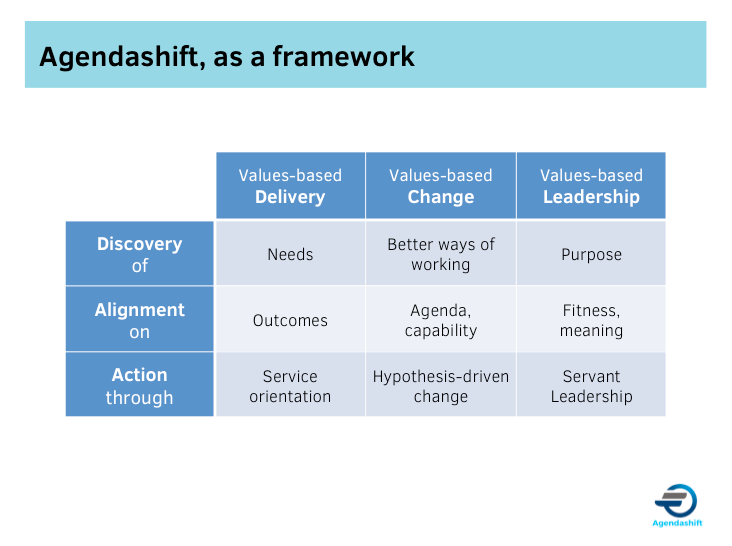
Question: What do you get when you cross feedback loops with Agendashift’s core themes, namely values-based delivery, values-based change, and values-based leadership? Answer: Something that looks eerily like a framework!

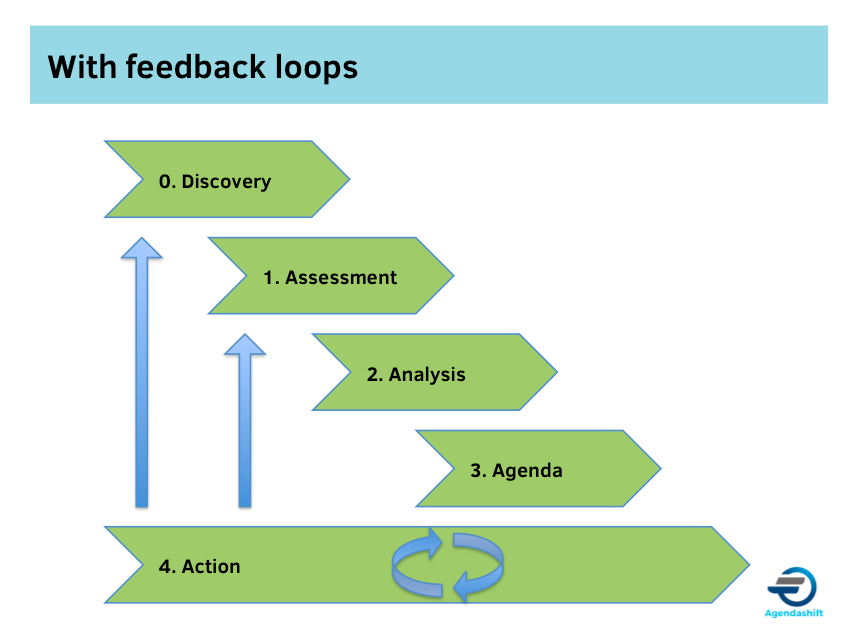
Let’s start with those feedback loops. For some months I’ve been using this picture to describe the process I first outlined in my book:

With feedback loops

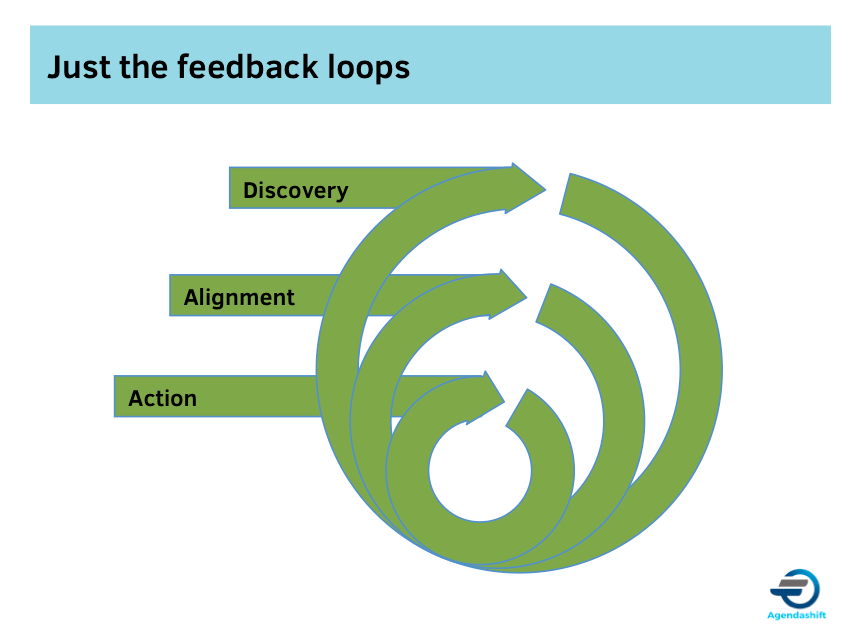
What starts at step 1 as a linear process becomes over time a system of nested feedback loops. The initial pass leaves us with actions to track; when those are exhausted or become uninteresting, we revisit the assessment and agree a new agenda for change. When we’re getting diminishing returns there, it’s time to revisit our initial “givens” – the values and behaviours of the assessment template – and work to make them truly our own.

In this next picture I’ve given those loops names – “Action”, “Alignment”, and “Discovery” – and removed all extraneous detail:

Screen Shot 2015-11-05 at 10.44.25

That picture seemed to me quite reusable, very adequately describing not only a process of change (hypothesis-driven or otherwise), but of delivery too (ditto). Could it be applied to leadership also? It was time for me to draw up a 3×3 matrix and to try to fill the blanks. Here’s how it came out:

Screen Shot 2015-11-05 at 15.51.34

I don’t know how accessible this matrix is to the casual reader, but to me it does a good job of summarising what I’m trying to achieve. Additionally, it has helped me to identify those areas where I (and Agendashift) could be said to be particularly “opinionated”. In a few bullet points:

  • Discovering user needs should be a first class activity; delivery success should somehow align to customer outcomes; service orientation (Kanban-style) is a powerful way to think about how to organise and improve delivery
  • In parallel with delivery, discovering better ways of doing things needs also to be recognised as a first class activity; alignment here is to a values-based agenda and towards the kinds and levels of capability needed; hypothesis-driven change coupled with a pull-based process captures much of what we know and teach about framing and managing change
  • Servant Leadership (in its fullest sense – see my recent post Servant Leadership un-neutered) helps us separate the enduring and aspirational aspects of our organisation (purpose, values, etc) from those that need to evolve; alignment on purpose helps to enhance the meaning we derive from work

To make my sources of inspiration explicit, Agendashift can be described as a values-based integration of the following:

  • Agile: collaborative, sustainable delivery; fast feedback
  • Kanban: service orientation and fitness for purpose
  • Lean: validated, hypothesis-driven change; the pursuit of flow
  • Systems thinking, complexity, Cynefin: longevity (of the organisation), safety (of people), leverage; narrative, the importance of context
  • Servant Leadership: meeting needs, aligning to purpose, finding meaning in work

That list rather understates Kanban’s enormous contribution – you could say that Agendashift is Kanban with attitude! All the Kanban principles, practices and values should be taken as read, in particular the first foundational principle: Start with what you do now. Start with what you do now, learn to use the Kanban Lens and to see services; scale out service by service. Alongside existing Kanban tools (eg STATIK), use Agendashift to frame, prioritise, and manage changes. Take leadership seriously and endeavour to build something that will outlast everything you’re currently doing and bring real benefit along the way.

That, in a nutshell, is Agendashift-the-framework. Agendashift-the-tools are coming along nicely (try the assessment part here), as are Agendashift-the-services (here and here, for example). There don’t seem to be quite enough hours in the day but I didn’t ask for a life free of challenge, so that’s ok!


Agendashift-cover-thumb
Blog: Monthly roundups | Classic posts

Links: 
Home | Partner programme | Resources | ContactMike
Community: Slack | LinkedIn group | Twitter
Agendashift, meet Reverse STATIK

Like this example from few weeks ago, I often find it useful to reconcile one model against another. What are the correspondences? Can I explain one in terms of the other? At the very least it’s a completeness check, but often it’s a great opportunity to give one or both models a thorough going-over.

In this instance, the two models are the Agendashift values-based delivery assessment template (the one behind our 2015 survey) and Reverse STATIK, another key component of our 1-day Agendashift workshop in values-based, hypothesis-driven change.

For the uninitiated, Reverse STATIK takes STATIK, the long-taught recipe for implementing Kanban (it’s the second day of your typical 2-day Kanban workshop), and backtracks through it, looking for improvement ideas as we go. Serendipitously, it has a nice presentational structure: it starts with the mechanics of kanban systems (the process assumes you have one to improve), layers on some new concepts, and finishes with a flourish on purpose and fitness.

So how do they reconcile? Pretty well:

  1. Kanban systems: This gets 5 of the 8 transparency prompts, plus one from balance (“Our system has a clear commitment point that separates potential work from work in progress”).
  2. Classes of service: the “urgency” part of the transparency prompt We distinguish different work items according to how they’re processed, their source, and their urgency” belongs here. Others have already noted that this prompt could benefit from a little rework! Four flow prompts and one more from balance complete the set.
  3. The knowledge discovery process: this takes 5 prompts from customer focus, 2 from collaboration, and 1 from flow.
  4. Demand and capability: 5 prompts from balance (no surprise there) and 1 from customer focus.
  5. Sources of dissatisfaction: all the prompts that relate to dependencies, other impediments, and organisational structure belong here. 2 from transparency, 1 from balance, 3 from collaboration, and 2 from flow.
  6. Purpose and fitness: this takes the whole of the leadership category, plus prompts relating to validation, measurement and safety (2 from flow and 1 each from transparency and customer focus.

No prompts go wasted, but bringing them together from different value categories does reveal some redundancy. I don’t feel too bad about that however – so what if the assessment template for Reverse STATIK will be a little shorter than the original! That said, I’ve no doubt that the completion of this exercise will result in some improvements being fed back.

So watch this space for announcements. I and our beta testers will likely test this privately with clients in workshop and coaching settings before publicising it more widely. I don’t know if it will hit Agendashift’s front page in a “featured” survey but you can be sure that it will in due course be made available to those that can make good use of it.


What if we put agreement on outcomes ahead of solutions?

Agendashift™: Serving the transforming organisation
Agendashift  Academy: Leading with OutcomesHome | Store

Links: Home | Subscribe | Become an Agendashift partner Events | Contact | Mike
Resources: Tools & Materials | Media | Books | Assessments
Blog: Monthly roundups | Classic posts
Community: Slack | LinkedIn group | Twitter

Featureban’s new home

The Featureban game – a simple, fun, and highly customisable kanban simulation game – now has its very own page on agendashift.com. Any significant updates will be posted here on the Agendashift blog; join the Agendashift LinkedIn group to be sure of not missing anything.

Last week in Moscow I facilitated six concurrent games at Lean Kanban Russia 2015. We then used the game as our base scenario for a series of exercises on hypothesis-driven change, connected by an Agendashift assessment online. The two sessions together make up the morning half of our 1-day introductory workshop in Values-based change with Agendashift and the Kanban Method. You want a quick workshop? We can do it!

Visit now: Featureban facilitation information and downloads. Not only is Featureban free, it is published under a Creative Commons license and is easily adaptable to your needs. Enjoy!


Agendashift-cover-thumb
Blog: Monthly roundups | Classic posts

Links: 
Home | Partner programme | Resources | ContactMike
Community: Slack | LinkedIn group | Twitter

The “agreement” part of values-based change and values-based leadership

I’m in Moscow for Lean Kanban Russsia 2015. On Saturday morning I’m giving a half day workshop there that is essentially a half-day taster for the two Agendashift training classes, the 1-day class on values-based change and the 2-day class on values-based leadership (aka “Applied Servant Leadership”, as discussed in my previous post, Servant leadership un-neutered).

As a rule I don’t like wordy slides, but I have made an exception for this annotated excerpt from the Agreement chapter of Kanban from the Inside (my book):

Change agents often position themselves at the nexus of four sets of stakeholders:

  1. The people whose work patterns will be most directly impacted by the change, often the change agent’s primary focus [those Impacted]

  2. Those on the margins whose cooperation is likely to make the implementation of change easier [Influencers]

  3. The customers who stand to benefit directly or indirectly from the change – [Customers and other beneficiaries]

  4. Those to whom the change agent is personally accountable—line managers, a project board, perhaps shareholders [management and governance]

Some useful prompts (ie usefully awkward questions) follow, which you can use as a coach or on yourself:

  1. What solutions to the problem has the team considered?
  2. What, specifically, have your peers (and others impacted) agreed to do?
  3. In what ways does the customer benefit?
  4. How does this look from the organization’s perspective?

Expect to see support for these “people” aspects in Agendashift’s change management tooling also. Coming soon!


Agendashift-cover-thumb
Blog: Monthly roundups | Classic posts

Links: 
Home | Partner programme | Resources | ContactMike
Community: Slack | LinkedIn group | Twitter

Servant Leadership un-neutered

In recent weeks I have had the very good fortune of working with my good friends at Code Genesys LLC who have supported me in the development of a new 2-day class in values-based leadership. Our client (already committed into a values-based approach) refers to it as “Applied Servant Leadership”, and that choice of words is quite telling.

It’s not hard to see why such a class is needed. I might characterise much of the Agile community’s understanding of Servant Leadership as little more than “unblock all the things and get out of the way”. I don’t think I’m being too unfair, and it’s woefully inadequate!

With Greenleaf as our highly-recommended (and still inspirational) reference, here’s how we might summarise it:

  1. Yes, removing impediments so that others can be successful
  2. Enabling autonomy and meaning in others as together we meet external needs in the pursuit of the organisation’s mission and purpose
  3. Developing servant leadership and servant leaders for the long term

See how recursive this is? The systems thinker will recognise that there are reinforcing loops at play here. It’s the kind of thinking that long-lived organisations have already applied – they understand that without it, their culture is unlikely to be sustained across generations. Greenleaf goes on to describe this process at the level of the individual (“The servant as leader”), the organisation and its service to society (“The institution as servant”), and the governance and stewardship that keeps it true (“Trustees as servants”). It’s stretching stuff, but still reachable.

Don’t get me wrong – there can be plenty of meaning to be found in “unblocking all the things”. But please don’t call it Servant Leadership if it stops there. Ask yourself: are you enabling others to find meaning in the mission and purposes of your organisation, and do you feel part of a system that will sustain this into the future? If not, what do you do about it?


Agendashift-cover-thumb
Blog: Monthly roundups | Classic posts

Links: 
Home | Partner programme | Resources | ContactMike
Community: Slack | LinkedIn group | Twitter

Latest progress on Agendashift (September 2015)

First off, the Agendashift home page has been completely overhauled. It now calls out three core themes:

  1. Values-based delivery – using Agendashift’s assessment tools to gain a deeper understanding of your organisation and its delivery processes. In case you didn’t get the memo, you can get a taste of this now by participating in our Depth of Kanbanland 2015 survey (and don’t worry, you are very welcome to take part even even if you’re not a card-carrying member of the Kanban community).
  2. Values-based change – using your shared understanding as a springboard for re-alignment and change. Development of this key change management functionality is just getting underway; there’ll be a paper-based version to try at my half-day workshop in Moscow next month.
  3. Values-based leadership – creating conditions that enable excellence in delivery and change to go hand-in-hand. There’s no app for that – together with consulting and coaching we offer 1-day and 2-day classes and a half-day taster workshop. I’ll blog separately on these soon.

The new home page also invites you to meet us online:

Our beta testers meanwhile are actively using Agendashift to support their coaching and training activities. For myself, I’m particularly pleased with the new survey-level reporting functionality (sneak peaks here and here); this will become more visible as I present survey findings in the coming weeks.

Several of our early users are not native English speakers. Accordingly, translations of the assessment template into French, German, Norwegian and Dutch are in progress. We’ll make further announcements on these as they become available online.

Smaller changes are happening all the time. Notable among recent changes are an overhauled navigation menu and a “remember me” option on login. For clarity, the next deployment will ensure that our ‘house’ assessment template (the one used by the public survey) has the “Agendashift values-based delivery” branding. This will make references to our template unambiguous as other templates (public or private) get added.


Agendashift-cover-thumb
Blog: Monthly roundups | Classic posts

Links: 
Home | Partner programme | Resources | ContactMike
Community: Slack | LinkedIn group | Twitter

Another teaser: category summary chart (with a tiny bit of statistics)

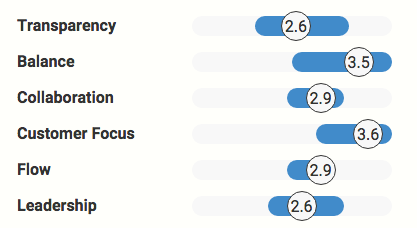
Unlike yesterday’s chart which showed real data from the Depth of Kanbanland 2015 survey (which is still open if you want to try the Values-based delivery assessment), this one shows dummy data. I have seen the real thing, but I don’t want to give too much away before I start presenting results at October’s Moscow and Stockholm conferences.

Screen Shot 2015-08-27 at 11.48.11

Had this been a survey of our team or organisation, we might infer that:

  • There is room for optimism on Transparency — we might not be there yet but there are some good things happening
  • We’re strongest on Customer focus – yay!
  • Balance has the potential to catch up with Customer focus but it looks vulnerable on the downside too. A good place to focus our attention?
  • Flow is nothing if not consistent! Even before we look at the prompt-level data we know we must have some consensus in this category. That in itself might be something to build on.

Just for the record (it’s not vital that you know this): Each score is an interquartile mean, the average value of the middle two quartiles (ie the middle half) of that category’s data. To indicate spread, the blue bars cover the range between the means of the lower two and upper two quartiles (the lower half mean and upper half mean, if you wish). I chose these truncated mean statistics for their ability to incorporate plenty of data without being unduly influenced by any one data point.


Agendashift-cover-thumb
Blog: Monthly roundups | Classic posts

Links: 
Home | Partner programme | Resources | ContactMike
Community: Slack | LinkedIn group | Twitter