Neat hierarchies vs self-expressed strategy

Oh dear, a “vs” in the title on a subject where perhaps some nuance is called for. My apologies – naming is hard – but then again, on this topic I do take a strong and (I suspect) non-mainstream position.

Last week I put this question to LinkedIn:

At scale [across multiple organisational units], do you:
1) maintain neat hierarchical work breakdown structures (saga, epic, feature, story, task, perhaps)
Or 2) allow each level and each unit within – down to team if not individual level – to express their respective strategies in their own language as they are fit?

To be clear, the intention behind this question is not about terminology (not method-level terminology at least)

Quite a range of answers, many of them describing organisations that were much closer to one extreme than the other, with aspirations to reverse the situation. The really funny thing: this went in both directions. People working with neat hierarchies aspiring to greater self-organisation, and people at that end aspiring to consistency and to what they saw as a source of alignment.

So where am I on this? Pieter Mulder’s comment represents my thoughts pretty well:

My opinion is very much that point 1 will only let you scale so far and it must take a heck of a lot of effort to maintain that as you continue to scale and it comes with risk when teams or individuals don’t conform and the whole system breaks down – also, who decides the structures and how do you change them when they don’t work? Point 2 can scale infinitely as the decision-making and accountability sits much lower down so it is much easier to optimise the system (smaller experiments, smaller tweaks, smaller risk to the whole).

Teams are living organisms which are never the same. What works for one team doesn’t always work for another (even if they are seemingly identical).

I am completely biased as I have never seen 1 work well (and have seen it fail or frustrate too many times) and I have seen 2 work really well.

Late 90’s, before Agile was even a thing, two investment bank projects sealed it for me.

The first of these projects impacted borrowers and lenders of fixed income securities in the UK (Gilts most especially) and was sponsored by the Bank of England. I was hired as a contract developer into the relevant front office team and was surprised (in a very good way) about how things were organised. Quickly I found myself taking the lead in agreeing interchange protocols with middle and back office systems and we all got on with our work. For the purpose of this project, each system had its champions in various parts of the business, and between us all we worked out how testing would be conducted, both separately and integrated. Project managers meanwhile stayed mainly out of our way, looking after the BoE relationship. On launch night we converted literally billions of pounds worth of stock between old and new trade models, and one minor hiccup aside (fixed in minutes), we were live. My first experience of a “front-to-back” project was a very positive one.

Since many of my front office colleagues preferred more trading-focussed projects it wasn’t surprising that I found myself as the front office tech lead for another front-to-back project, completely rewriting a mission critical system in the year leading up to the launch of the Euro. What would have been a high profile project at any time became a truly high stakes project. And the really great thing: we followed much the same model but with two enhancements:

  1. Even greater business involvement, to the extent that across all impacted systems (of which there were several), people co-opted from “line” jobs to work as subject matter experts and testers easily outnumbered the developers
  2. An early focus on testing (one of my first bits of development helped to make testing a largely self-service activity, a few hours coding that paid for itself countless times over), supporting a highly engaged and iterative process

In early autumn we went into parallel running, started migrating trading books a few at a time and then in larger numbers until we were fully live. Not only were we ready in good time for the Euro conversion, we were earlier than anyone’s best predictions!

20-25 years have passed since those projects and despite all I’ve experienced since, there’s very little that I would change about them. And if self-organisation can work on projects of such scale and significance, why is it not more the norm? Or perhaps it is, but we don’t like to own up to something that looks messy, and surely those nice, neat hierarchies are what counts for “doing it properly” these days?

In more recent years my opinions have only hardened. I know that context is everything, but show me a beautifully-groomed backlog and two worries spring immediately to my mind:

  • When the work gets to the front of the queue, will it still be relevant?
  • How much does it cost to incorporate everything that’s been learned meanwhile?

To make that learning process work at scale and speed, you’ve got to be truly exceptional. For the unexceptional – and I’m referencing Right to Left here – the big risk is that you end up ploughing through backlogs of requirements, a mediocre experience leading to mediocre results, hardly Agile at all (if that’s a goal).

More recently still, and in the process of appreciating and integrating models as diverse as OKR, Viable System Model, Sociocracy, and Leader-Leader, I keep landing on a common theme: autonomous teams (and other organisational units) each expressing strategy in their own words, strategies negotiated, developed, and aligned through collaboration and participation.

To the top-down extreme, in the Agendashift 2nd edition (due later this month) I express my feelings thus:

It’s a funny kind of autonomy when strategy is something that happens to you. [And] it’s a funny kind of adaptive strategy if it doesn’t know how to listen.

Again, to make a hierarchical approach work effectively at scale and speed, you’ve got to be truly exceptional. Maybe you are; more likely you are not. Whether or not you are, please let’s agree not to describe it as the default “doing it properly” approach to which all Agile organisations should aspire.

While we wait for the 2nd edition (subscribe here for news), let me recommend Allan Kelly’s Succeeding with OKRs in Agile: How to create & deliver objectives & key results for teams, foreword by yours truly. Highly relevant to this topic!

Related:


Agendashift™, the wholehearted engagement model
Links: Home |
About | Our mission: Wholehearted | Become an Agendashift partner | Assessments | Books | Resources | Media | Events | Contact | MikeSubscribe
Workshops: Transformation strategy | Outside-in strategy | Short training
Blog: Monthly roundups | Classic posts
Community: Slack | LinkedIn group | Twitter
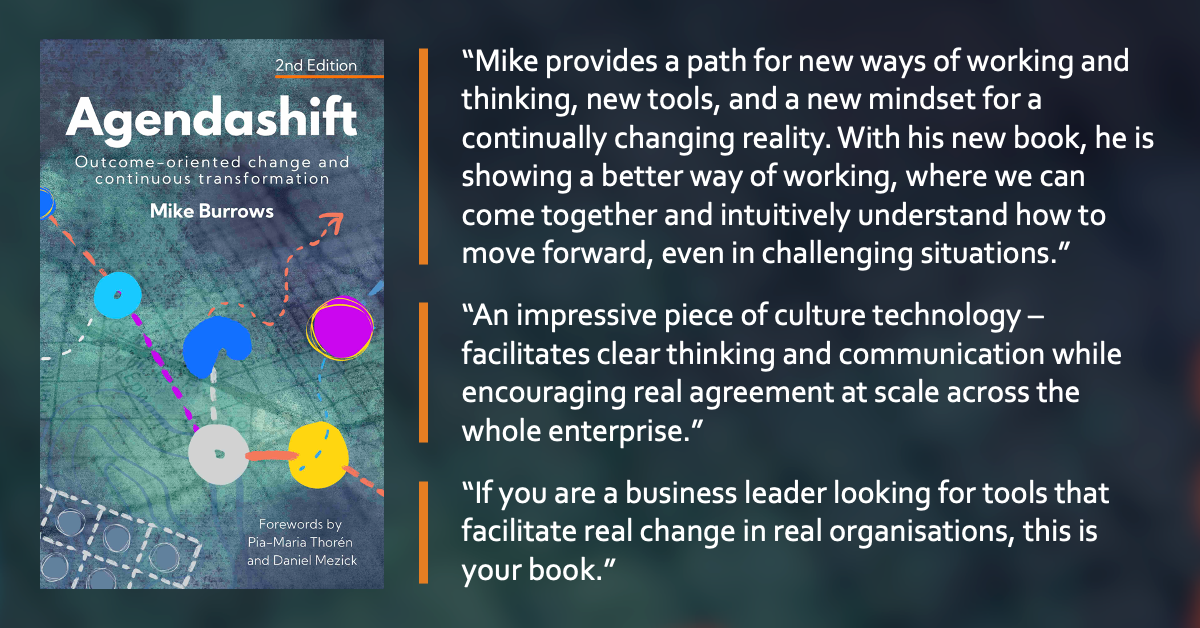
Coming soon, the 2nd edition!https://www.agendashift.com/books/agendashift-2nd-edition

What’s new in the February Deep Dive workshop

February’s Agendashift Deep Dive isn’t just the first of the year, it’s the first since I delivered the manuscript for the 2nd edition (publication is due in March). The revision process has helped me identify a number of improvements to the workshop materials. More significantly – and as I mentioned in my previous post on strategy [1] – we have been digging some deep foundations in systems, organisation, and personal development over the past 18 months or so, work of a kind that takes its time to feed through.

There are two main elements coming now to the foreground. One is pre-existing, familiar to followers of this blog, and receiving an upgrade; the other is new. But before I introduce them, a reminder of what Agendashift is: it’s an engagement model. And what does an engagement model do? My definition [2] states that they have three jobs to do:

  1. To structure and support the work of those that would encourage innovation, change, and transformation
  2. To help the organisation engage its staff meaningfully in change-related work
  3. To keep the the organisation’s parts engaged with each other as they change

Visualised:

2021-01-18-engagment-model

The upgraded and new elements in Agendashift speak to the Organisation box in that picture:

  1. Wholehearted, our mission [3]
  2. The Deliberately Adaptive Organisation, a non-prescriptive but still powerfully diagnostic model of business agility

In the 2nd edition you will see Wholehearted reconciled to two foundational models, Bushe & Marshak’s Generative Change Model [4] and Stafford Beer’s classic Viable System Model (VSM) [5]. Out of that reconciliation come a number of base assumptions [6] that Deep Dive participants will have the opportunity to validate, reject, or reflect on. (I’ll share them here once the book’s out.)

Book-wise I nearly left it there, but after sketching out an appendix with more detail on how that reconciliation worked, I felt compelled to add a whole new final chapter, Up and down the Deliberately Adaptive Organisation, a title inspired by Robert Kegan & Lisa Laskow Lahey’s Deliberately Developmental Organisation [6]. My model plugs theirs, Agendashift, Sociocracy [7], and OKR [8] into VSM. Thanks to the way that VSM scales – fractally – the combination is able not only to describe team-level, organisational-level, and people-level agility in one self-similar model, it reveals some of the organisational issues that Agile delivery frameworks either ignore or exacerbate [9].

For the Deep Dive, the Deliberately Adaptive Organisation helps to put several of our tools into better perspective, including:

I may also add an exercise on those scaling issues.

Details of that February Deep Dive:

And before that:

For all three workshops, all the usual discounts apply: repeat visits (not uncommon), partners, gov, edu, non-profit, country, un- or under-employment, bulk orders. If you think that one might apply to you, do please ask. Many of those considerations apply to private workshops also.

For the Deep Dive especially, if you think that you might become an Agendashift partner, partner discounts make it well worthwhile to get on board before you sign up to the workshop.

References

[1] If you are not already engaging on strategy, the time to get serious is now (January)
[2] agendashift.com/about
[3] agendashift.com/wholehearted
[4] The Dynamics of Generative Change, Gervase Bushe, Gervase R. Bushe, (BMI Publishing, 2020)
[5] The Fractal Organization: Creating Sustainable Organizations with the Viable System Model, Patrick Hoverstadt, (John Wiley & Sons, 2008)
[6] Organizational Culture and Leadership, Edgar H. Schein, (Jossey Bass, 5th edition, 2016)
[7] An Everyone Culture: Becoming a Deliberately Developmental Organization, Robert Kegan & Lisa Laskow Lahey, (Harvard Business Review, 2016)
[8] We the people: Consenting to a Deeper Democracy, John Jr. Buck & Sharon Villenes, (Sociocracy.info Press, second edition, 2019)
[9] What the (Lean-)Agile scaling frameworks don’t give you (December)


Agendashift™, the wholehearted engagement model
Links: Home |
About | Our mission: Wholehearted | Become an Agendashift partner | Assessments | Books | Resources | Media | Events | Contact | MikeSubscribe
Workshops: Transformation strategy | Outside-in strategy | Short training
Blog: Monthly roundups | Classic posts
Community: Slack | LinkedIn group | Twitter

The IdOO pattern meets ‘Good Obstacle, Bad Obstacle’

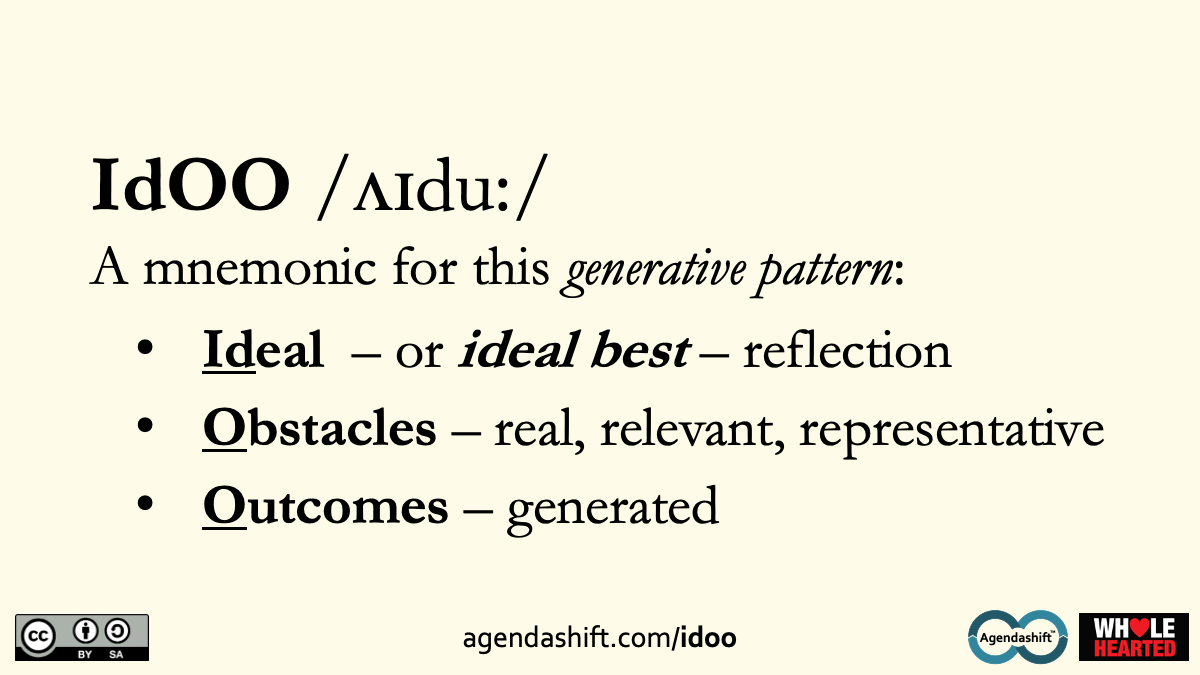
Finishing up the writing of the Agendashift 2nd edition (linkedin.com) I’ve made two updates to the IdOO pattern resource. The first is in the wording of this “definition”:

IdOO image

What’s different:

  1. “real, relevant, representative” – this is quoting Good Obstacle, Bad Obstacle [1], the name of a workshop exercise that like the IdOO pattern itself is new to the 2nd edition, also of a webinar recording and some associated resources
  2. “generated” – in case it needs to be said

Further to that second point, the IdOO deck (obtainable via the IdOO page) includes this version of the slide:

IdOO 2020 12

This is to emphasise that the generative process represented by the IdOO pattern needn’t be linear. If you’re at Outcomes, for example, “What stops that?” or “What obstacle might be in the way of that?” [2] takes you back to obstacles. From either Obstacles or Outcomes, the Challenge Mapping [3] question “Why is that important?” may take the conversation in the direction of the Ideal.

What the IdOO pattern gives you is a simple structure into which your favourite generative questions (and frameworks thereof) can be used, resulting in conversations that can be more strategic in nature than those coaching conversations whose main goal is to get to the next commitment. In the 2nd edition’s first two chapters you’ll see the Discovery and Exploration activities explained in those terms. But that’s not IdOO’s only use: it reappears as an ideation pattern too.

I can’t yet give a publication date, sorry! If you want to stay posted you can subscribe to the mailing list.

[1] Good Obstacle, Bad Obstacle (agendashift.com, video and associated resources)
[2] For a discussion on those two question forms, see The language of outcomes: 2. Framing obstacles (January 2020)
[3] See I’m really enjoying Challenge Mapping (June 2020), also some related links on the IdOO pattern page


Upcoming workshops

All the usual discounts apply: repeat visits (not uncommon), partners, gov, edu, non-profit, country, un- or under-employment, bulk orders. If you think that one might apply to you, do please ask.

And if you think that you might become an Agendashift partner, join before the Deep Dive and the partner discount on the workshop covers your membership!


Agendashift™, the wholehearted engagement model
Links: Home |
About | Our mission: Wholehearted | Become an Agendashift partner | Assessments | Books | Resources | Media | Events | Contact | MikeSubscribe
Workshops: Transformation strategy | Outside-in strategy | Short training
Blog: Monthly roundups | Classic posts
Community: Slack | LinkedIn group | Twitter
What the (Lean-)Agile scaling frameworks don’t give you

[Minor edits 2020-12-11 and again 2021-01-08 with an updated title. It is now aligned to the final version of the manuscript that went to the publisher this week] 

Not a gratuitous provocation but putting it out there for review. The text below comes from the final chapter of the forthcoming 2nd edition of Agendashift; it’s a quick first draft (written today) and I want feedback! The chapter is new to the 2nd edition; it is titled Up and down the Deliberately Adaptive Organisation and the excerpt below comes at the end of a section called Scaling up.

For context, we have by this point reconciled Agendashift with a powerful diagnostic tool, the Viable System Model (VSM). Stafford Beer’s classic model has lessons for all organisations that have the desire to “meet the demands of surviving in the changing environment”.

What the (Lean-)Agile scaling frameworks don’t give you

I can’t help noting that not everything identified in this reconciliation exercise is addressed well by the scaling frameworks. If you’re looking to one of those as the basis of your Deliberately Adaptive Organisation or (somewhat equivalently) as a model of business agility, here are five things that you may need to attend to yourself:

1. Meaningful experimentation

A worthwhile proportion – perhaps even the majority – of your delivery capacity will need to be devoted to objective-aligned insight generation. There is nothing adaptive about ploughing through backlogs of requirements and hoping for a good outcome. Random experimentation isn’t adaptive either; whilst it flexes some important muscles and can be a useful source of innovation, unless the bulk of it is meaningfully aligned to shared objectives (and driven from them in a way that creates meaning for the people doing the work), it’s unlikely to take you very far.

2. Meaningful negotiation between levels based on trust and transparency

If you’re not careful, cascading hierarchies of objectives end up as backlogs of requirements to be ploughed through, and we know where that leads. Dressing up that hierarchy in Agile terms – saga, epic, feature, story, etc – doesn’t change that.

Remember that what’s asked for, what’s needed, what’s possible, and what’s sensible are four different things. Moreover, each level will have its own language, its own way of looking at things, and its own measures of success, and it’s not helpful when one level projects (or worse, imposes) theirs onto another. Instead: trust-building transparency, then mutual understanding, then alignment.

3. Containers for multi-level, multi-loop organisational learning

I’m referring of course to your framework’s equivalent of the Outside-in Service Delivery Review (OI-SDR) and VSM system 4 more generally. How does your framework help you build and evolve shared models of the system and the world outside? How strong are the expectations of learning that it creates? How does it challenge? How does it help you monitor progress towards objectives? How does it challenge? How does it ensure that intelligence and insights are shared quickly across the organisation?

4. Meaningful participation in strategy

Let me say it again: It’s a funny kind of autonomy when strategy is something that happens to you. Now let me add that it’s a funny kind of adaptive strategy if it doesn’t know how to listen. What we have here are two organisational antipatterns that Agile frameworks – scaled or otherwise – has done little to address. Perhaps it’s unreasonable to expect that they would, but when they’re sold as transformative models of organisation I believe that some scepticism is entirely appropriate.

5. Meaningful self-organisation at every scale

Not just who does what (better described as self-management), but self-organisation as the interplay between structure and spontaneity – who collaborates with whom, at whatever scale, and with what potential. How does your framework both encourage that to happen and ensure that when it happens it is done well?

How well does your scaled (Lean-)Agile implementation demonstrate those five things? The most likely answers are “not very” or “not at all”. If you’re thinking of embarking on a framework-based scaling initiative, I would suggest that it may pay to attend to these issues first. You’ll then be in a much better position both to understand what the frameworks still have to offer and to make whatever further changes now seem necessary.

To be clear, I’m not anti-framework. To understand how a scaling framework really works is to appreciate how its patterns have been integrated, and there’s definitely value in that. But anyone thinking that it’s cool to roll out a large framework waterfall-style is living in the 1990s! Expert-driven ‘tailoring’ doesn’t fundamentally change that. Much better to use your expertise to help people experiment with combining patterns from the full range of sources at their disposal.

Related:


Upcoming workshops

All the usual discounts apply: repeat visits (not uncommon), partners, gov, edu, non-profit, country, un- or under-employment, bulk orders. If you think that one might apply to you, do please ask.

And if you’re thinking of becoming an Agendashift partner, it pays to sign up to that first (in fact it might even pay for itself).


Agendashift™, the wholehearted engagement model
Links: Home |
About | Our mission: Wholehearted | Become an Agendashift partner | Assessments | Books | Resources | Media | Events | Contact | MikeSubscribe
Workshops: Transformation strategy | Outside-in strategy | Short training
Blog: Monthly roundups | Classic posts
Community: Slack | LinkedIn group | Twitter

A postscript to ‘How I Choose my Models’

With a view to referencing it in the Agendashift 2nd edition I’ve been checking out the new Cynefin book Cynefin – Weaving Sense-Making into the Fabric of Our World (Dave Snowden & friends). It’s a book with many contributors and I wasn’t 100% sure what to expect but I’m enjoying it! If you have any interest in Cynefin I would definitely recommend it.

Despite appearances, this post isn’t about Cynefin. One contribution by Anne Caspari and Johann Entz von Zerssen really resonated with me, especially these two paragraphs from Anne (quoted with her permission):

I (Anne) come from 15 years of critical engagement with integral theory, adult development, and all kinds of change theories. When I started working with these theories and frameworks, they helped me immensely. They opened up my thinking and gave me a means to counteract both gross and subtle reductionism in practical work. This was especially helpful to me in my project management work in environmental planning and sustainability contexts. Adult development theory also helped me understand some of the phenomena I encountered in coaching and leadership work.

Over time, however, I experienced a growing scepticism around a new kind of reductionism that crept into most applications of these theories that often went unobserved by the respective communities. Examples include developmental bias (“we need to develop people”) in large parts of the integral theory scene and some very formulaic and linear applications of change theories (“step 5: find deeper meaning and purpose”).  Since this kind of uneasiness is hard to pinpoint and address, I just noticed that I kept away. I settled at the fringes of these communities and did my own thing. 

Yes! This! Exactly!

Anne’s struggle is the same as the one that triggered (via an outburst over Zoom of which I am not proud) the How I choose my models post. And the really funny thing: Andrea Chiou, the target of my outburst agrees with me. Violent agreement is a strange beast! From our Slack channel #what-i-am-reading (I pasted the above quote there as soon as I read it):

It is the ‘we need to’ of the ‘we need to develop people’ that annoys me. It separates ‘us’ from them -> increasing the gap between the ‘experts’ and the underdeveloped others.

And yes, you are doing your own thing.

It has been in fact a very interesting few weeks, one of those times when you’re really glad to be part of a diverse and supportive community with knowledge in areas I’ll never be expert in. My gut instinct hasn’t changed, I stand by every every word I wrote in How I choose my models, and yet I’ll be referencing some of that developmental stuff (caveated of course) in the 2nd edition.

The title of a new 6th and final chapter, Up and down the Deliberately Adaptive Organisation, is inspired by Robert Kegan & Lisa Lahey Laskow’s Deliberately Developmental Organisation (DDO), a model described in their interesting but slightly scary book An Everyone Culture. The surprise (not least to me) is that the DDO model comes from the same stable as Adult Development Theory, my “trigger”! I’m grateful to Jonathan Sibley for pointing me in that interesting direction, also to Teddy Zetterlund for some earlier seed-sowing.

I’ve learned that living by these three bullets of mine is harder than I thought:

  • Models that have withstood scrutiny over a length of time
  • Models that treat the individual’s agency, creativity, and problem-solving ability with the utmost respect
  • Models that help to scale up the preceding

If I’m not going to ignore a ton of potentially valuable and relevant work, there’ll be times when I will need to remind myself that the model, my reaction to it, and the reactions I observe in others or fear from them, are different things. What helps to win me – albeit cautiously – over to DDO is that this is part of the model itself. Not in an especially self-aware way methinks, but it’s a start.

A last word to Jonathan, which I apply first to myself:

A great challenge is to build a model and then hold it lightly. And sometimes, followers hold the model more tightly than the founder does!


Upcoming workshops

All the usual discounts apply: repeat visits (not uncommon), partners, gov, edu, non-profit, country, un- or under-employment, bulk orders. If you think that one might apply to you, do please ask.


Agendashift™, the wholehearted engagement model
Links: Home |
About | Our mission: Wholehearted | Become an Agendashift partner | Assessments | Books | Resources | Media | Events | Contact | MikeSubscribe
Workshops: Transformation strategy | Outside-in strategy | Short training
Blog: Monthly roundups | Classic posts
Community: Slack | LinkedIn group | Twitter
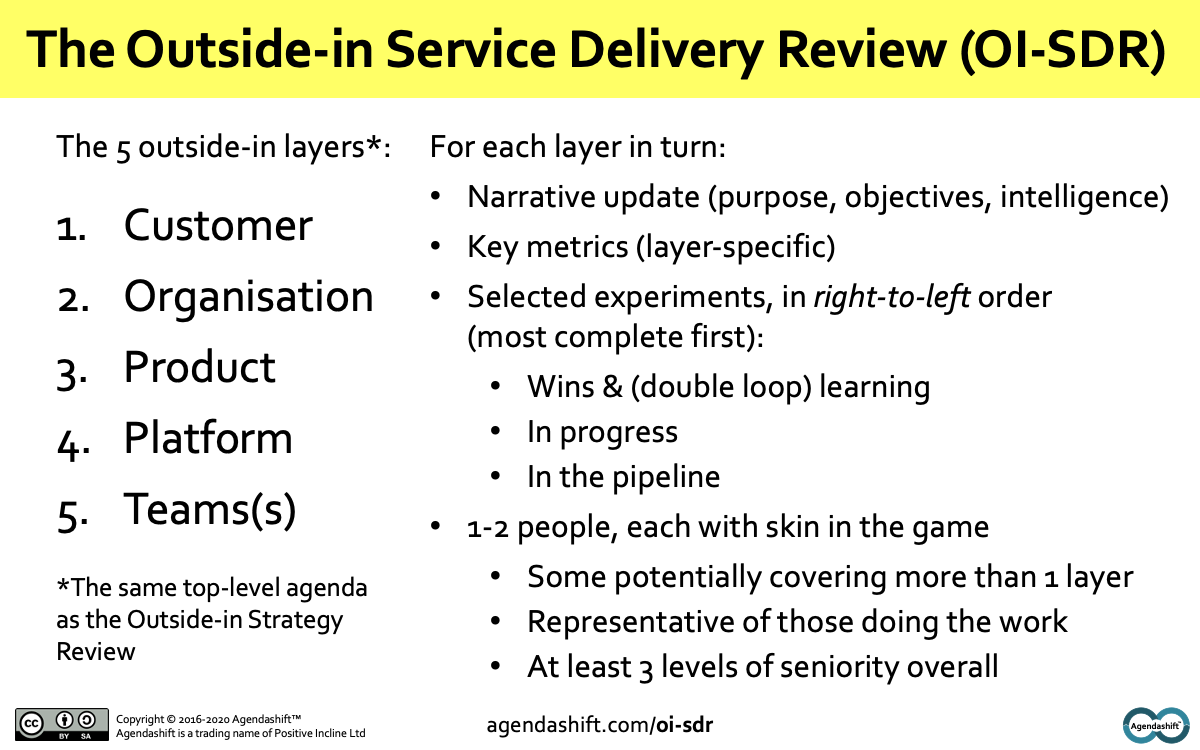
The Outside-in Service Delivery Review (OI-SDR)

oi-sdr-slide-2020-11-07

It’s something of a work in progress but I have given the Outside-in Service Delivery Review (OI-SDR) its own page now, agendashift.com/oi-sdr, its content Creative Commons (CC-BY-SA). It’s long overdue – the OI-SDR was introduced in the 1st edition of Agendashift (2018), described more fully (with a case study) in chapter 5 of the  Right to Left: The digital leader’s guide to Lean and Agile (2019, audiobook 2020) and it will be revisited big time in the Agendashift 2nd edition due early 2021.

I don’t want to give too much away just yet but you can expect the second edition to be a lot stronger on questions of organisation, leadership, and (self-)governance than the first, and the OI-SDR is a key part of that (moreso than might be obvious at first glance). Meanwhile, there’s plenty in Right to Left if you haven’t already read that or listened to it, and the Deep Dive workshop – see Upcoming workshops below.

Related

Upcoming workshops

All the usual discounts apply: repeat visits (not uncommon), partners, gov, edu, non-profit, country, un- or under-employment, bulk orders. If you think that one might apply to you, do please ask. We have a quorum already but the more the merrier.


Agendashift™, the wholehearted engagement model
Links: Home |
About | Our mission: Wholehearted | Become an Agendashift partner | Assessments | Books | Resources | Media | Events | Contact | MikeSubscribe
Workshops: Transformation strategy | Outside-in strategy | Short training
Blog: Monthly roundups | Classic posts
Community: Slack | LinkedIn group | Twitter
Agendashift roundup, October 2020

In this edition: Media – recordings, articles, etc; November Deep Dive; Updates to Celebration-5W; Progress on the 2nd edition; Top posts

Media – recordings, articles, etc

Released this month:

I’ve taken the opportunity to gather these and similar resources from the past year or more on a new media page, agendashift.com/media. Over time I’ll add dig out some Agendashift-era conference recordings etc also. If you have any favourites you think I should add, let me know!

Thanks for those I’ve added so far go to the Cutter Consortium, Jay Hrcsko (Agile Uprising podcast), Martin Aziz & team (SquirrelNorth), Joe Auslander & Jakub Jurkiewicz (Joekub podcast), Ben Linders (InfoQ), Rahul Bhattacharya (Agile Atelier podcast), Mo Hagar (Agile on the Edge podcast), John Rouda (A Geek Leader podcast), Paul Klipp & Justyna Pindel (Agile Book Club podcast).

November Deep Dive

17th-20th November: Agendashift Deep Dive: Coaching and leading continuous transformation – eight 2-hour sessions over four days, EMEA-friendly timing. A practical, hands-on experience of Agendashift, the wholehearted outcome-oriented, engagement model.

All the usual discounts apply: repeat visits (not uncommon), partners, gov, edu, non-profit, country, un- or under-employment, bulk orders. If you think that one might apply to you, do please ask. We have a quorum already but the more the merrier.

Updates to Celebration-5W

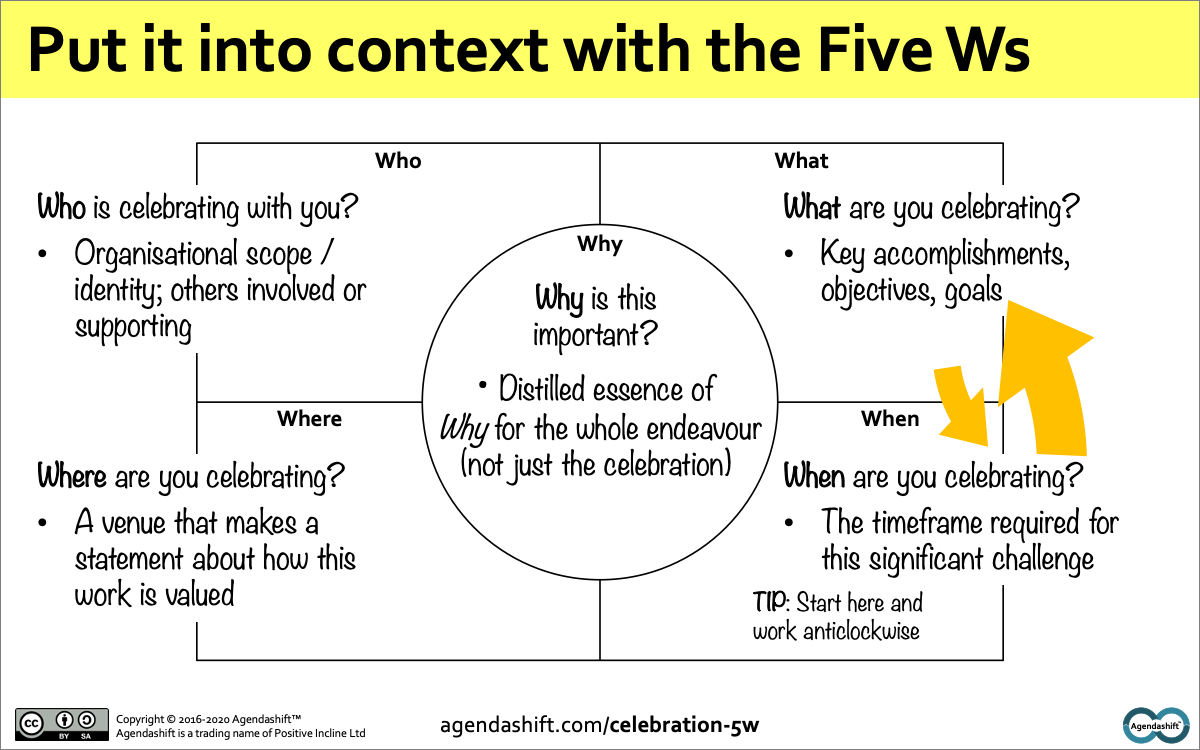
There is a new version 4 deck for our workshop kickoff exercise, Celebration-5W. Like most of our exercises, games, templates etc it is Creative Commons (CC-BY-SA) and you can obtain it via its resource page agendashift.com/celebration-5w.

The main changes:

  • I’ve tweaked a key slide – see the image below – to suggest some initial iteration between When and What; the discussion (if not its later presentation) begins here
  • Unhiding the initial slides for facilitators – they weren’t showing up in Dropbox
  • In those initial slides for facilitators, the quote from Agendashift is now from the pending 2nd edition (more on that in a moment)

celebration-5w-2020-10-30

Progress on the 2nd edition

A couple of blog posts this month flow from (among other things) work on the 2nd edition of Agendashift:

From the second of those, nearly 3 weeks old now:

I’ll be pulling out all the stops, integrating (as Agendashift has done consistently for a long time) ideas and experience from Lean-Agile, organisation development, and strategy

Glad to report that this work on the 5th and final chapter is not only well underway, I can see the light at the end of the tunnel now! Just a few more sections and I’ll have a first complete draft and I’ll be at the “90% done and still half the work to do” stage. I’m not quoting dates yet but quarter 1 of 2021 seems very doable.

Top posts

Recent:

Classic:


Agendashift™, the wholehearted engagement model
Links: Home |
About | Our mission: Wholehearted | Become an Agendashift partner | Assessments | Books | Resources | Media | Events | Contact | MikeSubscribe
Workshops: Transformation strategy | Transformation strategy | Short training
Blog: Monthly roundups | Classic posts
Community: Slack | LinkedIn group | Twitter
How I choose my models

As demonstrated by the models-sources-inspirations picture below, I like my models. If you’ve read my third book Right to Left, you’ll know also that I have little time for the idea that there is one best model – one best Agile framework, for example. And the fun isn’t in choosing between them, not even in recognising what each of them can bring, but in integrating them. And it doesn’t stop there: this is not a one-shot process design exercise, but a process of continuous transformation. In short, I’m a pluralist, and I love to see what happens when models and their underlying patterns are allowed to combine.

agendashift-inspiration-map-2020-06-29

Believe it or not, I am a picky though. In one of our weekly community Zoom sessions (see #community in Slack), that pickiness resulted in a conversation that was outside our usual norms (if the truth be told I was abrupt to the point of rudeness) and I reflected afterwards on what happened. Happily, we cleared things up quickly and had a much healthier conversation the following week after I had the chance to turn something heartfelt into something more articulate. What follows is a summary.

If Agendashift has taught me anything, it is to be very careful with assumptions. Credit for this goes to Clean Language, which turns the dial up to 11 on the discipline of its practitioners to minimise the influence of their private assumptions (which are SO not the point) on their conversations. This discipline applies most to their explicitly Clean conversations but it rubs off elsewhere in ways that need not mean “coachiness” when that is not called for. Practicing it subtly trains your brain to recognise when you are imposing yourself in ways that aren’t helpful.

You see that attention to assumptions in Agendashift’s outside-in strategy review. The way we make explicit its carefully minimal assumptions is of great help to the facilitator. See my recent Cutter paper for details (announcement included in my post last week); they’re also in Right to Left (chapter 5) and there will be brief coverage in the forthcoming 2nd edition of Agendashift also.

I tend to avoid models that encourage me to make assumptions about what is going in someone’s mind, how they will behave, how they will develop, and so on. The same at team level and organisation level, and I have come to be particularly sceptical of extrapolations from one of those levels to another. The replication crisis (en.wikipedia.org) gives me pause also.  For better or for worse therefore, you won’t see Agendashift depending on many “popular” models of psychology, development, or maturity. This is not to say that they are valueless, rather that they make potentially unreliable foundations.

What I do appreciate:

  • Challenges to my own assumptions
  • Ways to moderate the impact of unsafe assumptions
  • Ways to bring assumptions and misalignments to the surface at the right time
  • Ways to encourage people to find their own solutions in the pursuit of outcomes (authentically shared outcomes most especially)
  • Ways to sustain all of the above – engines of transformation

And supporting those:

  • Models that have withstood scrutiny over a length of time
  • Models that treat the individual’s agency, creativity, and problem-solving ability with the utmost respect (you’ll permit me some personal values and base assumptions there I trust)
  • Models that help to scale up the preceding

Thankfully, the list of helpful and reliable models compatible with my outlook of optimistic pluralism outlook is long, a fact to which my Models, Source, and Inspirations picture attests. And please do not take the omission of a favourite model of yours as a snub; if I don’t have time to throw yours into the Great Model Collider™ in the hope that something interesting will fly out, perhaps you (or someone else) will.

Opinions mine, strongly held it would seem. Thank you Andrea Chiou and Tom Ayerst for putting up with me – we got there in the end 🙂


What if we put agreement on outcomes ahead of solutions?

Agendashift™: Serving the transforming organisation
Agendashift  Academy: Leading with OutcomesHome | Store

Links: Home | Subscribe | Become an Agendashift partner Events | Contact | Mike
Resources: Tools & Materials | Media | Books | Assessments
Blog: Monthly roundups | Classic posts
Community: Slack | LinkedIn group | Twitter

Still not a fan of the PDCA cycle or the continuous improvement initiative

I’ve just finished the first decent draft of chapter 3 of the Agendashift 2nd edition and its segue into the more operational part of the book. Choosing my words here quite carefully: you can take this post as warning that I won’t be praising the PDCA cycle or the continuous improvement initiative. There, I said it. Heresy?

Last week I posted this question on LinkedIn:

Ask LinkedIn: Why does Lean Startup’s build-measure-learn loop seem often to sustain itself but the continuous improvement loop (PDCA) that inspired it typically run out of steam quickly? I’ve written on the PDCA problem more than once before and I have plans to do so again but I’m curious to know what people think [source]

36 comments and several good answers later, the one that best gets to the issue is this from my friend Patrick Hoverstadt:

My suspicion Mike is that this is structural – PDCA works ON the process, whereas build-measure-learn IS the process. If you stop doing PDCA, the work still goes on, product still gets produced and shipped and paid for, but it just stops improving. If you stop doing build-measure-learn, then the build part stops, so no product, and the business stops. PDCA shouldn’t be, but often is seen as an extra. [source]

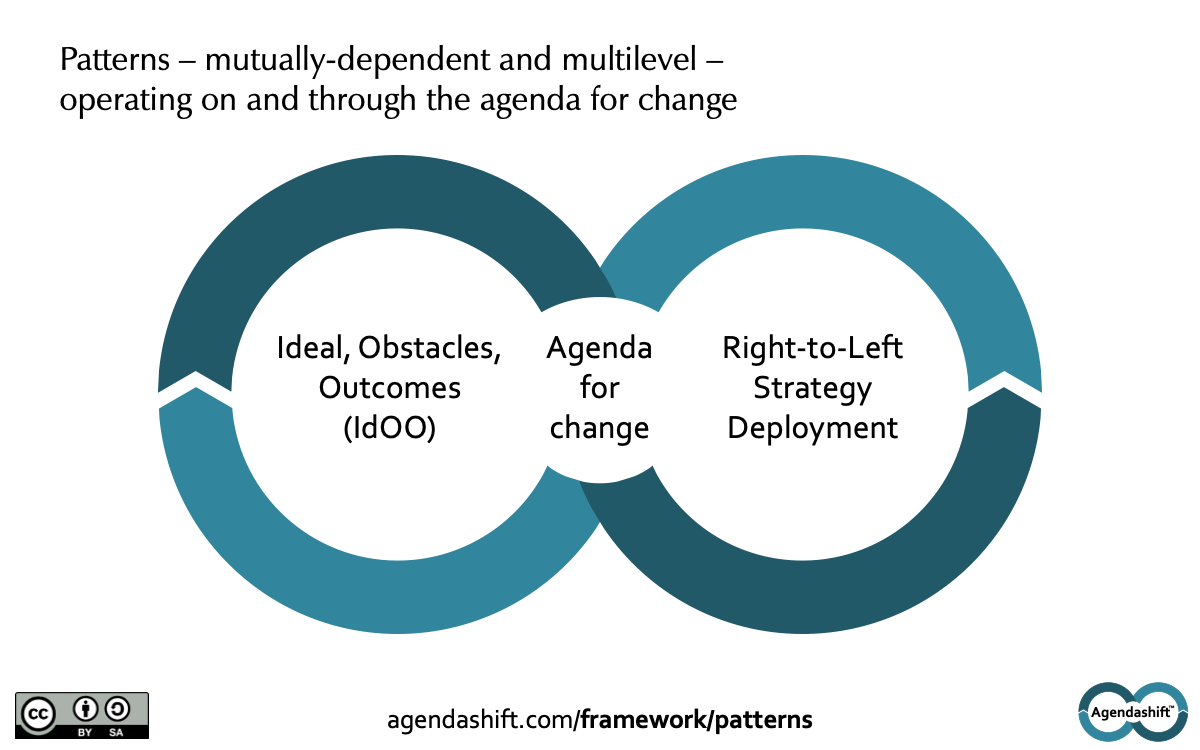
The Agendashift book’s strapline is Outcome oriented change and continuous transformation, so I do need to get beyond just identifying the issue. Here’s how the new chapter 3 begins to tackle it (and for context, here first is the patterns picture):

patterns

The […] myth is that change happens naturally in cycles. You plan an experiment. You do the work of the experiment. You check the results of the experiment. You act on those results. Rinse and repeat, one experiment leading to the next. The PDCA cycle (<figure>) in other words.

Replace PDCA with another improvement cycle and the brutal fact remains: one experiment does not inevitably launch another. Improvement cycles are not perpetual motion machines; they do not sustain themselves. If ever you have wondered why continuous improvement initiatives seem to run out of steam so quickly, perhaps instead you should be wondering how they last any time at all.

Let’s look at two places where experimentation does seem widespread:

  • At the high tech startup
  • At Toyota, the inspiration for Lean

Size-wise, they’re at opposite ends of the scale. So what do they have in common? It can’t be the technology – many of Toyota’s experiments are remarkably low-tech. Common (and I would say glib) answers such as “leadership”, “sponsorship”, or “culture” don’t help much because their respective cultures are so different. There is a grain of truth to them though, and I believe the lesson is this:

Experimentation is sustained where these two things are true:

  1. The learning that it generates matters to people
  2. When that learning isn’t happening, it gets noticed

If you’re not a startup it would be inauthentic to pretend that your situations are equivalent. Even if genuinely you’re in a fight for survival, your organisation most likely has (or at least had) some viable business at its core; the startup lacks even that anchor. And don’t expect to magic up Toyota’s kaizen culture overnight – it took them generations after all.

Agendashift’s answer:

  1. Experiments flow from meaningful outcomes and their measures of success (not rationalised the other way round), each experiment framed to ensure that learning will happen regardless of how it turns out
  2. Experimentation is conducted in the full knowledge that multiple levels of learning will be accounted for in forums that matter

My advice is to abandon the notion of the cycle and to keep separate the framing of individual experiments, the day-to-day management of your active experiments, and the harvesting of learning. Of the three, the last is by far the most important; with the right focus on it, the other two fall into line behind it.

Hence the pattern Right to left strategy deployment, the right to left part signifying the working backwards from meaningful outcomes, the strategy deployment part a reminder (among other things) of ­the importance and relevance of the work. Solving problems just because they are there will no longer do.

A reminder of those three aspects to keep separate:

  1. Framing experiments
  2. Managing your portfolio of active experiments
  3. Harvesting the learning

They’re covered across the final two chapters. The first two of those are well understood and the 1st edition covers them well. For the last one, which really means building a learning organisation, I’ll be pulling out all the stops, integrating (as Agendashift has done consistently for a long time) ideas and experience from Lean-Agile, organisation development, and strategy. Chapter 5 won’t be just the wrap-up chapter, it will be the climax, and I’m really excited about it. Happy to report that doing a 2nd edition is no drag 🙂

Before you go, a couple of dates for your diary:

Only a few places left for that first one. For the second, don’t hesitate to ask for a discount if you think you might qualify on grounds of country, non-profit, government, educational, etc. Also if you’d be a repeat participant, of which there have been a good number!

Related articles


What if we put agreement on outcomes ahead of solutions?

Agendashift™: Serving the transforming organisation
Agendashift  Academy: Leading with OutcomesHome | Store

Links: Home | Subscribe | Become an Agendashift partner Events | Contact | Mike
Resources: Tools & Materials | Media | Books | Assessments
Blog: Monthly roundups | Classic posts
Community: Slack | LinkedIn group | Twitter

The quality that now has a name

The term quality without a name comes from a favourite book of mine, Christopher Alexander’s The Timeless Way of Building [1]. I discovered only today in my research for this article that 20 years after writing that wonderful book he did in fact give this intriguing thing a name: wholeness [2].

My ignorance aside, that’s almost spooky! Wholehearted is the concept in my book Right to Left [3] that was directly inspired by Alexander. It was quickly embraced by the Agendashift community, and later it gave its name to our mission statement [4].

What prompted today’s post was the realisation that repeatedly, people have cited wholehearted as the thing that attracted them to Agendashift. Fascinatingly, many of them were members of the community even before wholehearted was a thing! In other words, it seems to give a name to something that people somehow perceived already.

I’m working now on the 2nd edition of the Agendashift book [5] and it affords me a valuable opportunity say more about wholehearted than I could at the time of Right to Left. I am determined however not to over-specify it. Much of its power comes from the way that it resonates with different people in different ways, and while that’s happening, it’s a source of both creativity and energy. I make a point therefore of starting not with a definition, but with the word itself and what it tends to evoke.

As written here previously [6], it evokes two clusters of qualities:

  1. Engagement, commitment, and purposefulness
  2. Alignment, integration, integrity, and wholeness

(And yes, that’s Alexander’s wholeness again.)

Beyond that almost gut reaction, it’s fair to ask what it means to me personally, and in more concrete and perhaps practical terms. Inevitably, I relate it to things that interest, influence, and motivate me:

  1. Generativity – generative conversations [7], generative patterns [8] and so on, energisers of emergent and adaptive thinking and the focus of much that is exciting in modern organisation development
  2. Viability – the science of how organisations (at every level) maintain their independence and integrity, explaining much about their vulnerabilities and dysfunctions also
  3. Outcome-orientation ­– ends before means, outcomes before solutions – both as a deliberate stance, and as demonstrated in Right to Left, a way to understand and integrate – a way to approach Lean, Agile, and Lean-Agile for example

Across all three of those: purpose, participation, and pluralism, making it all very human when done well.

The later chapters of the significantly updated Agendashift will put a little flesh on those bones, enough to make it practical in a non-prescriptive way, prescription bringing only contradiction in a book that describes an engagement model [9]. Wholehearted meanwhile is not a process or a framework. It’s barely even a model, and I’m happy to keep it that way!

References

[1] The Timeless Way of Building, Christopher Alexander, (OUP USA, 1980)
[2] Quality Without a Name (wiki.c2.com)
[3] Right to Left: The digital leader’s guide to Lean and Agile, Mike Burrows  (New Generation Publishing, 2019; audiobook 2020)
[4] Our mission: Wholehearted (agendashift.com)
[5] Agendashift: Outcome-oriented change and continuous transformation, Mike Burrows  (New Generation Publishing, 2018)
[6] Revisiting ‘wholehearted’ (blog.agendashift.com)
[7] See for example our Clean Language-inspired coaching game, 15-minute FOTO (agendashift.com)
[8] Agendashift’s Generative Patterns (agendashift.com)
[9] Engagement model (agendashift.com)

Upcoming events


Agendashift™, the wholehearted engagement model
Links: Home |
About | Our mission: Wholehearted | Become an Agendashift partner | Assessments | Books | Resources | Events | Contact | MikeSubscribe
Workshops: Transformation strategy | Transformation strategy | Short training
Blog: Monthly roundups | Classic posts
Community: Slack | LinkedIn group | Twitter

Wholehearted