The agenda and the shift: what Agendashift makes explicit

“Make your agenda for change explicit”. Well what does that mean?

Were we or one of our soon-to-be-revealed partners to take you through the process, here are the key things we will help you make explicit. Which of these are “agenda” and which are “shift” I’ll leave to your imagination – perhaps it depends on where you are now…

Context

  • Problems, challenges, and objectives
  • Individual, team, and organisation
  • Outcomes #cleanlanguage
  • Change strategies #cynefin
  • Where we are now – the Agendashift values-based delivery assessment #lean-agile #kanban #values

Agreement on action areas

  • Their respective outcomes and change strategies #cleanlanguage #cynefin

Actions

  • Hypothesis #leanstartup #a3 #lean
  • Assumptions, dependencies, pilot experiments
  • Risks – upside as well as downside – and safety #cynefin
  • People

Organisation and follow-through

  • Visibility
  • Feedback loops
  • Accountabilities

Take out the Agendashift values-based delivery assessment and you still have a non-judgemental, agreement-driven, outcome-focussed, complexity-aware change management framework. With it, you have a uniquely values-based way to give focus and energy to your Lean-Agile transformation.

Think you could facilitate this yourself? Then get in touch – we’re launching next month and are accepting pre-launch partners now!


Agendashift-cover-thumb
Blog: Monthly roundups | Classic posts

Links: 
Home | Partner programme | Resources | ContactMike
Community: Slack | LinkedIn group | Twitter

Two new tools and how I’m finding them useful

I have been incorporating two new tools in my workshops: Clean Language (which could be described as a coaching tool) and the Cynefin Four Points Contextualisation exercise. Here’s how we put them to use.

Clean Language

You’re probably familiar with the idea of coaching often taking the form of identifying a goal, then helping the client focus on the process of getting there. The GROW model [1] is probably the canonical example, a conversation structured – explicitly, or implicity in the mind of one or both participants – along these easily-remembered lines:

  1. Goal
  2. Current Reality
  3. Options
  4. Way forward (or Will)

Clean Language [2, 3] covers some of the same ground, using language particularly good at (among other things) getting to outcomes (the Goal in GROW model), and doing so in a noticeably judgement-free manner.

There is some discipline involved:

  • Sticking to the the preferred prompts
  • Incorporating the client’s language
  • Note-taking

I’m not yet skilled enough myself to do all of those simultaneously and I certainly don’t expect others to do so without practice! It is however a fun and useful exercise for workshop participants to take the roles of the client (with real or imagined problems, challenges, or potential solutions to explore), coach (whose job it is to guide the exploration), and scribe (who writes down anything that sounds like an outcome).

In our exercise, the coach is allowed only these prompts (a small but important subset of the whole):

  • “What would you/X like to have happen?”
  • “(And) then what happens?”
  • ”(And) what happens before X”?
  • “What kind of X?”
  • “Is there anything else about X?”

In the context of the exercise, first two of those are the most important, taking the conversation away from problems and solutions and towards desired outcomes. The middle one has multiple applications; here it could be used when the coach does not grasp the mental leap the client has made. The last two are more exploratory, likely taking the conversation into areas more metaphorical, descriptive, or detail oriented (perhaps too much so, but that’s the choice of the coach).

No big explanation needed – we try it, and it works! We’re just dipping our toes in the water, but there’s the opportunity afterwards to explain that we have here a set of tools that could be of great value to anyone interested in further developing their coaching skills.

Four Points Contextualisation

The nuts and bolts of the Cynefin Four Points Contextualisation exercise are well described in the first part of this article from the Adventures with Agile blog: Cynefin Review Part 7 – Finding Your Place on the Framework.

More interesting to me than the mechanics have been some of the implications. This exercise powerfully illustrates some important things:

  • The importance of choosing an implementation approach that is appropriate in context, whether that’s one based on careful analysis and planning, on experimentation, or on direct action
  • The range of opinion on what’s appropriate, given any particular outcome or solution
  • The strength of our personal biases in favour of some approaches over others, making us  – myself very much included – vulnerable to blind spots and at risk of judging others quite unfairly

Interesting stuff! Here’s the output from one such exercise (on the Featureban scenario, not anything sensitive):

IMG_1523.jpg

Opportunities for you to give them a try

Both tools are now standard elements of the Agendashift debrief/action workshop, with the option to remove or gloss over them if a shorter workshop is called for. For the 1-day training workshop, they’re both optional extras – choosing them will be at the expense of other material. [Note: with some big site changes pending they’re not in the blurb yet]

There’ll be opportunity to see one or both of them in action at these upcoming events:

I’ll look into whether we can something at Lean Kanban India 2016 (9th-10th September) also.

Want to facilitate one a session yourself? Watch this space – we’ll soon be making this possible. Drop me a line your need is urgent!

References

[1] Sir John Whitmore, Coaching for Performance
[2] Lynne Cooper and Marriette Castellino, The Five Minute Coach: Improve performance – rapidly
[
3] Wendy Sullivan and Judy Rees, Clean Language: Revealing metaphors and opening minds


What if we put agreement on outcomes ahead of solutions?

Agendashift™: Serving the transforming organisation
Agendashift  Academy: Leading with OutcomesHome | Store

Links: Home | Subscribe | Become an Agendashift partner Events | Contact | Mike
Resources: Tools & Materials | Media | Books | Assessments
Blog: Monthly roundups | Classic posts
Community: Slack | LinkedIn group | Twitter
It’s time to reclaim Servant Leadership

This has been a hard post to write – several attempts, most of them ranty. The provocation? A survey of the internet for “Agile Servant Leadership”. Try it yourself and quickly be disheartened.

Then again, you might see nothing amiss if you’ve been taught that Servant Leadership is just about serving the team,removing impediments, being a facilitator. The Scrum Master as servant-leader seems a good fit (and in many ways it is). Nothing to see here, move along.

But serving the team is only the beginning. Servant Leadership is also about purpose: discovering it, remaining true to it. It’s outward as well as inward, seeking purpose in the people the team serves, ultimately to society. And it’s transformational, guiding and equipping the organisation so that it is capable of serving its purpose tomorrow as well as today. These aims are not well supported by a narrow understanding of Scrum Mastery, one in which the goal is simply to do better Scrum.

We can do better. Watch out for a series of posts on Servant Leadership through a lens of Lean-Agile transformation, one post for each of the strategies in the Agendashift white paper 6+1 Essential strategies for successful Lean-Agile transformation. Each post will describe ways in which you can exercise Servant Leadership consistently with both Agile values and Lean principles. Put them all together, and you have a model for leadership that is much stronger than the prevailing one, truer also to Greenleaf’s inspirational vision. Let’s reclaim Servant Leadership!

The series


Agendashift-cover-thumb
Blog: Monthly roundups | Classic posts

Links: 
Home | Partner programme | Resources | ContactMike
Community: Slack | LinkedIn group | Twitter

A good working definition of “Done”

Ever got into one of those discussions about what constitutes “done”, “done done”, or even “done DONE done done”? It’s done when it’s code complete? Tested? Deployed?

What you’re really discussing there is not the actual work, but the process and its policies. That’s not a bad thing to discuss (quite the contrary), but still it risks missing the point.

How about a definition of done that’s not about roles or activities (“code complete”, “tested”, etc)? Try this one for size:

How (if at all) does your process confirm to you that someone’s need was indeed met?

Update: How do you identify the need in the first place?


What if we put agreement on outcomes ahead of solutions?

Agendashift™: Serving the transforming organisation
Agendashift  Academy: Leading with OutcomesHome | Store

Links: Home | Subscribe | Become an Agendashift partner Events | Contact | Mike
Resources: Tools & Materials | Media | Books | Assessments
Blog: Monthly roundups | Classic posts
Community: Slack | LinkedIn group | Twitter

The Agile process paradox (OR: Right conversations, right time)

Here’s the paradox: How do you reconcile “Individuals and interactions over processes and tools” with the ceremony and seeming process-heaviness of Agile frameworks?

I think you can resolve this constructively by digging beneath the values, bringing  an assumption or two to the surface. In my ‘6+1 strategies’ paper (more on this at the end) I make this statement:

Agile assumes that software development is best … delivered through … processes that respect, support, and amplify the effective, deliberate, and timely interactions of skilled people

Even after editing some out, there are multiple assumptions at work here (“skilled”, for example), but it will serve our current purpose. It’s a statement that supports much (if not all) the Agile Process Heaviness Spectrum™, from the big frameworks near one end and most of the way towards “get a bunch of smart people together in one room” at the other.

Success is heavily dependent on the right conversations happening at the right time. If they’re not happening, some more process might help. More process might not generate exactly the right conversations, but there will at least be some more regular ones!

So the thinking goes anyway, but there’s a balance to be struck. Here are five ways you can try to improve that balance:

  1. Do you have a recurring frustration that might be addressed through the implementation of some extra ceremony? Find one that fits, and introduce it as an experiment.
  2. Before experimenting with any new ceremony, make sure you understand the assumptions beneath it. Does it address a problem that you actually experience? Will the benefits outweigh the cost?
  3. Do each of your existing ceremonies “respect, support, and amplify the effective, deliberate, and timely interactions of skilled people”? If not, more experimentation needed!
  4. Do you have an existing ceremony that seems particularly painful, either a poor use of people’s time or revealing problems only late in the day? As the XP folks might advise, experiment with doing it sooner and more often. Examples: Plan a non-painful planning meeting with frequent “pre-planning”. Head off painful code reviews with regular design conversations. At the extreme: planning on demand and pair programming, hardly ceremonial at all, and more achievable than you might think!
  5. Can you see when conversations are overdue? For example, if it’s not obvious when there is “unready” or “unreviewed” work for example, then make those states more visible, eg with columns on your board.

6+1 Effective strategies for successful Lean-Agile transformation

The second draft of this paper is now out for review. All being well, the final version should be out next week. Register here for your copy.


Agendashift-cover-thumb
Blog: Monthly roundups | Classic posts

Links: 
Home | Partner programme | Resources | ContactMike
Community: Slack | LinkedIn group | Twitter

Who sets the agenda?

Who or what drives your agenda for change? From which direction? Two common and clear-cut answers to these questions are these:

  • Bottom up – continuous improvement (coaching or otherwise enabling the ‘doers’ to find better ways of working), the sideways and upwards sharing of learning, and so on
  • Top down – strategic direction, strategic initiatives, etc, including also some unattractive versions such as management by objectives

Top down and bottom up describe extremes that are often a poor fit for a reality that seems much messier. How about middle out? This is can refer to either or a combination of these:

  • Change led by people who have (i) a foot in both the operational and strategic camps and (ii) networks that reach out across the organisation
  • Change stimulated stimulated by ‘mid level’ feedback loops such as service delivery reviews that sit above the more operational feedback loops of replenishment meetings, delivery planning meetings, and daily standups

In larger organisations, these ‘foot in both camps’ people are middle managers. The service delivery review is a key tool of Enterprise Services Planning. As someone who remembers what it was like to be a middle manager and an enthusiastic support and implementer of feedback loops, I have sympathy with both definitions!

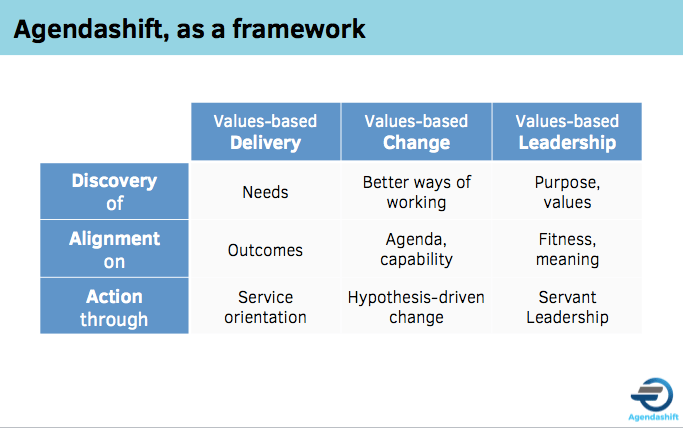
With the agenda [for change] sitting right at the centre of the Agendashift model (below), I could describe Agenadashift as incorporating elements of bottom up, top down, and middle out change. Would that be helpful? Not really. I could stick with middle out and use it to mean “neither entirely top down or bottom up” but that would be a cop-out. Let’s not use the term so carelessly!

Screen Shot 2016-05-07 at 16.26.08

Happily, my thinking around how to describe what sets the agenda for change has further crystalised recently, thanks in part to the happy coincidence of reading Schein [aside: this works surprisingly well as an audiobook] and a scheduled chat with Karl Scotland on the topic of strategy deployment.

I have concluded that the agenda for change is best described not in terms of source or direction, but more simply as ‘the result of a process’. It might be a deliberate process (perhaps including some those approaches already described), supported by tools (such as the strategy deployment tools Karl and I discussed), or something rather more implicit, perhaps neglected. The process and therefore the agenda can be fed through continuous improvement. They can be informed by purpose and strategy. They can be aligned to values. They can be kept on the straight and narrow by feedback loops. Their outward impact is in multiple directions too – changed performance, changed outcomes, changed ways of working, changed attitudes.

I have long been wary of throwing the culture word around too casually but I’m very encouraged to find parallels with the ‘agenda-setting as a process’ that lies at the heart of Agendashift and Schein’s very helpful description of culture as the result of a process of social learning, again a process that may or may not be deliberate. The model is holding up well 🙂


Agendashift-cover-thumb
Blog: Monthly roundups | Classic posts

Links: 
Home | Partner programme | Resources | ContactMike
Community: Slack | LinkedIn group | Twitter

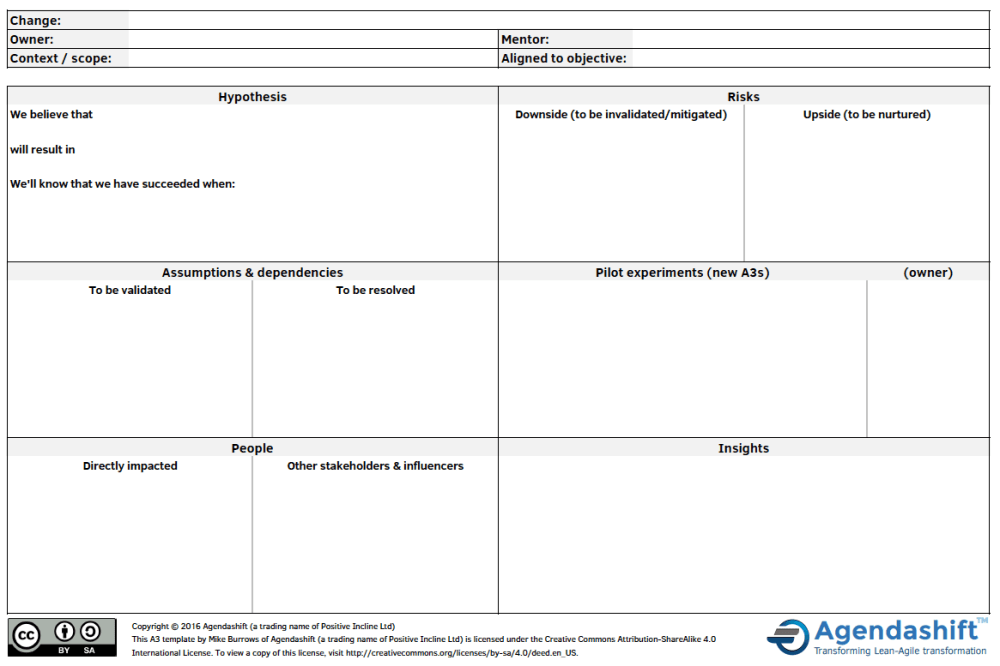
A3 template for hypothesis-driven change

[Update 23-Sep-2019: The version shown here has been updated a few times since publication. The latest version of this and several other Creative Commons resources may now be found at agendashift.com/resources; clicking on the image below now takes you to the relevant resource page]

[Update 10-Aug-2016: The latest version is still downloadable here; see Outcomes, alignment, and changes to our A3 template for a description of recent changes]

As mentioned in On not teaching PDCA, I’ve been using an A3 template in my training classes and debrief/action workshops. I’m now releasing under the same model as Featureban – I’ve given it a Creative Commons Attribution-ShareAlike license, you can download the PDF here, and drop me a line for the original .xlsx file if you want to translate it or adapt it in some other way.

I typically cover it in this order:

  1. Hypothesis
  2. Assumptions & Dependencies
  3. Pilot Experiments (potentially spawning new A3’s)
  4. Risks
  5. Pilot Experiments (again, if prompted by the risks)
  6. People
  7. Insights.

Enjoy!

Screenshot 2016-08-10 10.46.46.png


What if we put agreement on outcomes ahead of solutions?

Agendashift™: Serving the transforming organisation
Agendashift  Academy: Leading with OutcomesHome | Store

Links: Home | Subscribe | Become an Agendashift partner Events | Contact | Mike
Resources: Tools & Materials | Media | Books | Assessments
Blog: Monthly roundups | Classic posts
Community: Slack | LinkedIn group | Twitter
What does the coin represent?

We’re about to play Featureban and we’ve reached the coin slide.

coin-toss
Redwood Photography, via Flickr CC BY-ND 2.0

“Everybody needs a coin – have you got one (or access to one)?”

Inevitably, some borrowing and lending ensues. “An exercise in trust, this bit!”

“Can you think what the what your coins might represent?”

Chance, you say? Decisions?

Those are both good answers, but not precisely the one I was looking for. Apologies for using a piece of jargon (we really do try to keep that to an absolute minimum), but the coin is a source of what we call ‘variation’.

I’m sure that nothing like this never happens in your company, but let me tell you about an effect I’ve noticed elsewhere. Sometimes, a 1-day piece of work becomes a 2-day, 3-day, even 8-day piece of work. Something we thought would take a day, takes eight! Shocking, isn’t it! But you never see it here, right?

Joking aside, it should not be surprising that in our line of work we see plenty of variation. How often do we start a piece of work with just a sticky note or email’s worth of information? Does anyone really know at this stage what’s involved? Of course not. And even after we dig into it, there are always new things to discover (it’s not called ‘knowledge work’ for nothing), dependencies to manage, people changing their minds (for good reasons as well as bad), bugs, absences (planned and unplanned), and so on.

Would it not make sense then to manage our work using systems that comfortably deal with variation – embrace it even – as opposed to pretending that it doesn’t exist or unfairly blaming people when it manifests itself? That’s what we’re going to experience in our game.

Some of you will get frustrated by this variation. Use that feeling! We’ll learn how to go about doing something about it too.

Footnote

In all fairness to Mr Deming (see On not teaching PDCA for why I have some making up to do), variation is a word forever associated with the great man. “Understanding variation” is part 2 of his 4-part System of Profound Knowledge.


What if we put agreement on outcomes ahead of solutions?

Agendashift™: Serving the transforming organisation
Agendashift  Academy: Leading with OutcomesHome | Store

Links: Home | Subscribe | Become an Agendashift partner Events | Contact | Mike
Resources: Tools & Materials | Media | Books | Assessments
Blog: Monthly roundups | Classic posts
Community: Slack | LinkedIn group | Twitter
On not teaching PDCA

[Update: the A3 I refer to here is now available via our Resources page]

[Update: see also the Changeban game which can be used to introduce many of the concepts explored in this post]

I’ve had the pleasure of running my classes and workshops in the company of experienced Lean practitioners, and I’m always amused when I see that lightbulb moment. “I see what you’re doing – it’s PDCA!”. We exchange knowing smiles and carry on.

At risk of being burned at the stake for heresy, I will admit however that I no longer teach the canonical improvement cycle PDCA by name or in its original form.

Otherwise known as the Deming Cycle, PDCA (Plan-Do-Check-Act) and its close cousin PDSA (Plan-Do-Study-Act) describe an experimental approach to improvement.

Here’s part of the problem (and I’m quoting verbatim from my book): The words Plan, Do, Check, and Act don’t mean what you think they mean – they’re even a little misleading – until you use them with the word “experiment”:

  • Plan an experiment (based on a hypothesis)
  • Do (conduct) the experiment
  • Check (or Study) the results (or outcome) of the experiment
  • Act on the results, changing either the hypothesis or the system accordingly, sharing appropriately

Instead talking abstractly about experiments (with or without the health warning), I now dive straight into reframing our action ideas Lean Startup style (early 2010’s instead of early 1950’s):

We believe that <actionable change>
will result in <meaningful impact>.
We’ll know that we have succeeded when <measureable signals>.

We complete Plan in the form of an A3 (named after the paper size, and the vehicle for a coaching conversation). This includes various kinds of risk and stakeholder analysis and a list of pilot experiments that will (we hope) take us closer to our goal and tell whether our change is likely to fly (and we aim for it to fly high).

Another problem is that there’s nothing at all inevitable about the “cycle” part. So, having shown how to frame and develop an experiment, it’s important address how a portfolio of experiments (plural) will be managed.

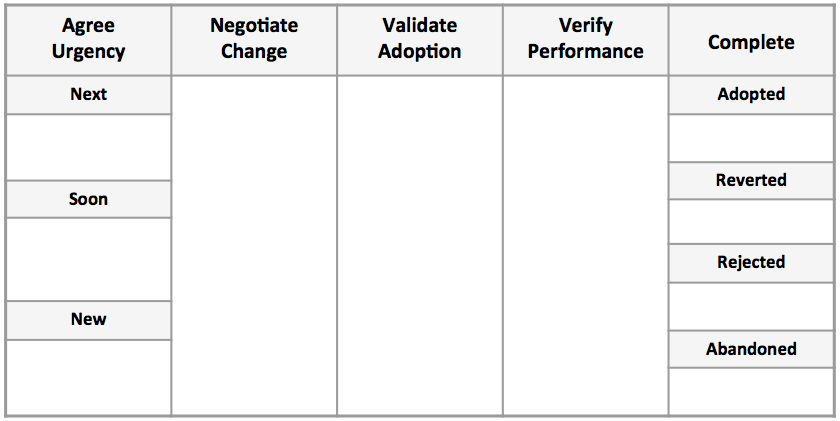
Check, Do and Act can be addressed visually by a kanban board. This too is inspired by Lean Startup, adapted to change management purposes by Jeff Anderson (with a couple of David Anderson-inspired tweaks for the right-hand column):

Screen Shot 2016-03-01 at 21.09.12

There’s plenty to talk about here:

  • How to encourage ideas to join the board (under New) and what happens next
  • The various ways in which they can finish
  • The key questions of the middle three columns – What are we agreeing and with whom? Can we do it?  Does it help?
  • Feedback loops – the opportunities afforded by the organisation to review progress and thereby sustain the change process

In summary, we split PDCA into two:

  1. a framing part, learned by doing, represented (if you wish) by an A3
  2. a follow-through part, highlighting a common organisational weakness, represented by the kanban board and accompanying feedback loops (which I stress)

As a bonus, we observe in passing the applicability in a development context of what workshop attendees have just practised in a change context. Meanwhile, our debt to PDCA is acknowledged in our books (mine, Eric Ries’s, and many others). And here too of course 🙂


Agendashift-cover-thumb
Blog: Monthly roundups | Classic posts

Links: 
Home | Partner programme | Resources | ContactMike
Community: Slack | LinkedIn group | Twitter

Action through values-based Servant Leadership

[First, previous in series]

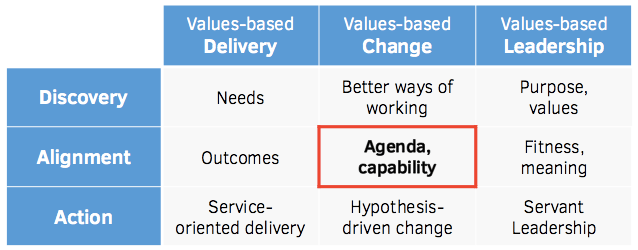
This is last in a series of nine articles exploring the matrix below (introduced here), and we’ve reached the bottom right hand corner.

Agendashift puts Servant Leadership at the intersection of “Values-based leadership” and “Action”. This is not to keep Servant Leadership in its box somehow (we’ll see that it has application right across the framework); rather it is to emphasise that it is an active thing, not just a question of style. Moreover, after reading this post you’d be forgiven for thinking that Agendashift is mostly about Servant Leadership!

Screen Shot 2016-01-05 at 19.16.55

I am on record as taking issue with the simplistic characterisation of Servant Leadership as “unblock all the things and get out of the way”. It’s not hard to guess why this gets taught, but this kind of facilitation is only the beginning of process that requires anticipation, proactivity, presence, and patience. As I wrote previously, Greanleaf’s inspiring vision of Servant Leadership is a long game:

  1. Removing impediments so that others can be successful
  2. Enabling autonomy and meaning in others as together we meet external needs in the pursuit of the organisation’s mission and purpose
  3. Developing servant leadership and servant leaders for the long term

The systems thinker will recognise that there are reinforcing loops at play here. It’s the kind of thinking that long-lived organisations have already applied – they understand that without it, their culture is unlikely to be sustained across generations. Greenleaf goes on to describe this process at the level of the individual (“The servant as leader”), the organisation and its service to society (“The institution as servant”), and the governance and stewardship that keeps it true (“Trustees as servants”). It’s stretching stuff, but still reachable.

Too hard? Too big? If you aspire to leadership, try using the Agendashift framework to give some structure to this challenge. Column-wise from the right, look for opportunities in the following:

1. Values-based leadership:

  • Facilitating exploration and agreement on the purpose and values of  your organisation (or your part thereof). Consider its service to its customers, its position in its immediate ecosystem, and its broader contribution to employees, customers and other stakeholders, even its role in society. Be ready to give due recognition to behaviours that exemplify the organisation’s shared values, and to provide appropriate challenge when gaps emerge between purpose, values, and behaviour (more on this below under Values-based delivery).
  • Pursuing fitness for purpose for the organisation and meaning for its staff. Reah a shared understanding what fitness looks like, tracking progress towards it. Recognise that competition can make this a moving target, so allow your thinking to be challenged from time to time. Encourage alignment between purpose and meaning, but have the openness to accept that people can find meaning in their work in a wide variety of ways.

2.Values-based change

3) Values-based delivery

  • Making needs a primary concern of your delivery process – a more fundamental and powerful shift than many realise
  • Aligning outcomes, not being satisfied with measuring success only in your own narrow terms
  • Organising for service, such that everyone knows what they’re delivering (not just what they do), to whom (whether internal or external), and why it matters (to the end customer most especially). But don’t rush to the big reorg! Start by organising the work and let the rest follow.

Still too big? I have three suggestions. The first could be called “Small acts of values-based leadership”. Here, each bite-sized leadership opportunity relates to one of Kanban’s values (six of the nine are represented here explicitly), and I’m quoting from my book Kanban from the Inside:

  • Transparency: In knowledge work, things don’t make themselves visible or explicit by themselves; leaders choose to make them so. This is as true in the small details—the wording of a policy, for example—as it is in the bigger things, such as institutional feedback loops.
  • Balance: Where are we overloaded, and why? Are our pain points obvious, or does the volume of work hide them? Is the mix of work right? There is leadership opportunity in asking these questions as well as in the decisions that may follow.
  • Collaboration: Making an introduction, reaching out, sharing a problem, noticing how people interact—all of these can be acts of leadership.
  • Customer focus: It takes leadership to acknowledge that the process may be ineffective at discovering and meeting real customer needs.
  • Flow: Are you seeing it? What is stuck today? Where do blockages repeatedly occur? Why is that? These are everyday questions of leadership.
  • Leadership: Encouraging leadership in others can demand real leadership on the part of the encourager. Kanban’s kind of leadership not only spreads, it reinforces itself.

My second suggestion is the Agendashift values-based delivery assessment. This has the same six categories as “Small acts of values-based leadership” above, but offers a number of specific prompts that point in the direction of mature organisational behaviour. There’s a mini 18-prompt version available to all; get in touch if you’d like access to the full 44-prompt version, perhaps for a consolidated group exercise. After taking the assessment, which prompts would you prioritise? What action would you take? What impact do you think it would have? How would you know?

My third suggestion is to get help, whether that’s from me (helping leaders engaged in Lean-Agile transformation is a large part of what I do), from someone you source locally, or from someone you already trust. When you’re playing a long game like this, it really helps have someone close by who will help you put things into words and put your challenges and frustrations into proper perspective. Input in the form of training, coaching, or consultancy can be invaluable too. You don’t need to do it on your own!

Agendashift resources

References


Agendashift-cover-thumb
Blog: Monthly roundups | Classic posts

Links: 
Home | Partner programme | Resources | ContactMike
Community: Slack | LinkedIn group | Twitter