How Agendashift scales

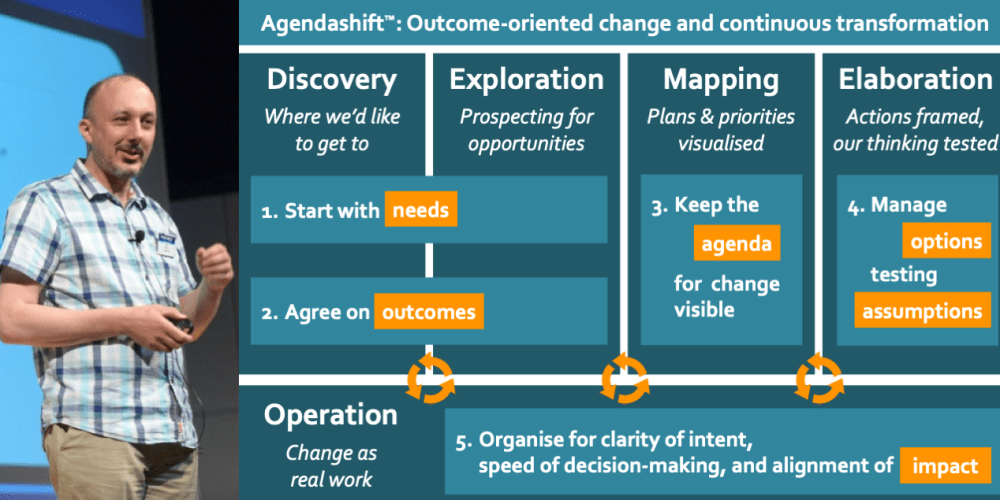
Last week’s post Visualising Agendashift: The why and how of outcome-oriented change and continuous transformation is already in the top 3 for 2019. Clearly it resonates! I will build on that post now by enumerating some the ways in which Agendashift scales – not by becoming bigger, heavier, more layered, or more bureaucratic, but by fitting its context.

The bottom line: Agendashift scales because it is scale-free (not an oxymoron, but using the technical term), evidenced by a fractal quality inside it, similar patterns occurring naturally at different scales.

First, there are some initial high level decisions to be made about scale:

  • The initial organisational scope of the exercise (we find that it is well worth making this explicit)
  • Who is invited to participate in workshops (and how that invitation should be given)
  • Who is invited to participate in the pre-workshop assessment (at a minimum, this is the workshop participants for whom it is set as prework, but it is often widened)
  • Any specific organisational themes that should mentioned in either invitation

Often, the exercise is centred on a leadership team of some kind, making the above decisions quite easy to make. However, I do make two recommendations:

  • At least three levels of seniority should participate – not to make a virtue of hierarchy but allowing it to be bypassed for the sake of interesting and authentic conversations
  • It’s good to get wide coverage in the assessment; potentially the whole business function and beyond, or some representative sample thereof

There are more choices about workshop design that we could make here, but usually they’re better left until later exercises and we’ll put them to one side for a moment.

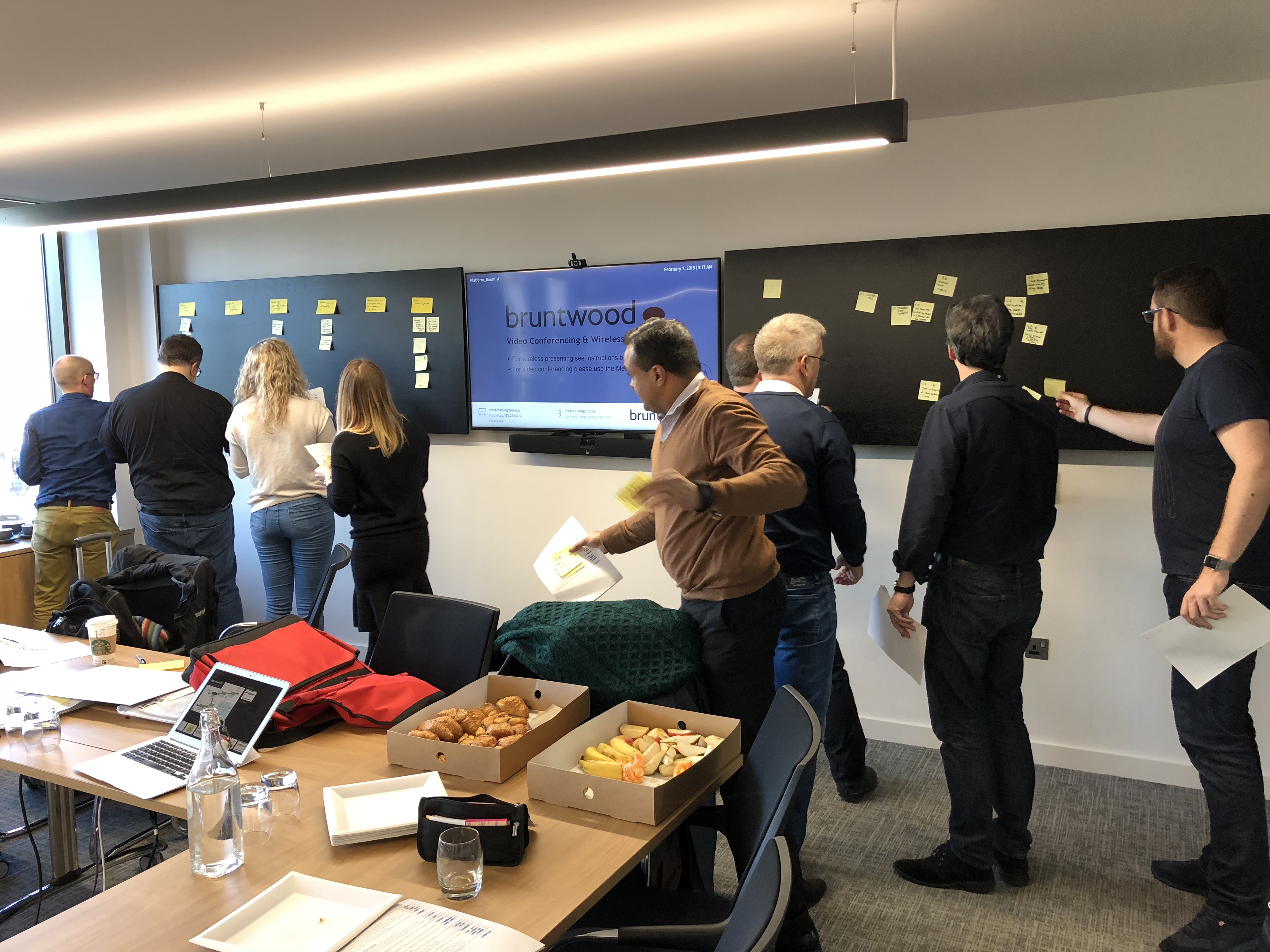
In the workshop itself, scale is everywhere:

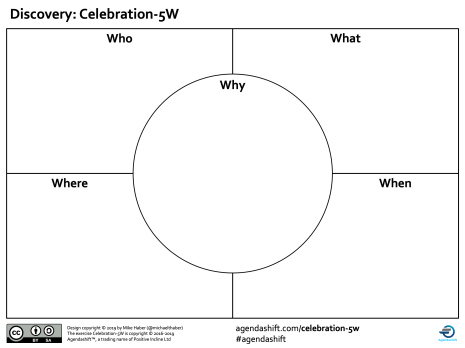
  • In the warm-up exercise Celebration-5W, different table groups might generate anything from an internal technical achievement for a small team to things like “One billion pounds in turnover” or “Our millionth registration” (both of these are actual examples). I recall one team coming up with a new product idea!
  • After True North (in Discovery) and the assessment debrief (in Exploration), obstacles can range from everyday niggles to fundamental misalignments and dysfunctions.
  • For any given obstacle, the outcomes generated in 15-minute FOTO can range from short-term quick wins beyond even long-term goals through to enduring values. Surprisingly often, the entire range is covered in the course of a conversation that lasts only a few minutes.
  • The Mapping exercises expose different kinds of structure in the naturally coherent (by construction) but still fragmentary output of the preceding exercises.
  • In Elaboration, we bring focus where the range of options is high, looking up for the big payoff and down for opportunities for rapid learning and early value.
  • In Operation, we raise awareness of the connection between everyday choices and bigger-picture organisation design

Discovery and Exploration both feature our Clean Language-inspired coaching game 15-minute FOTO. At first glance it might seem redundant but the repetition of the same tool in different settings demonstrates the utility, repeatability, and scale-independence and of the pattern (for that is what it is). Regardless of scale, you can:

  • Reflect on the promise of the challenge in question
  • Identify and (briefly) clarify the obstacles currently in the way of a successful conclusion to that challenge
  • Rapidly explore the landscape of outcomes to be found when those obstacles are overcome, bypassed, or ignored
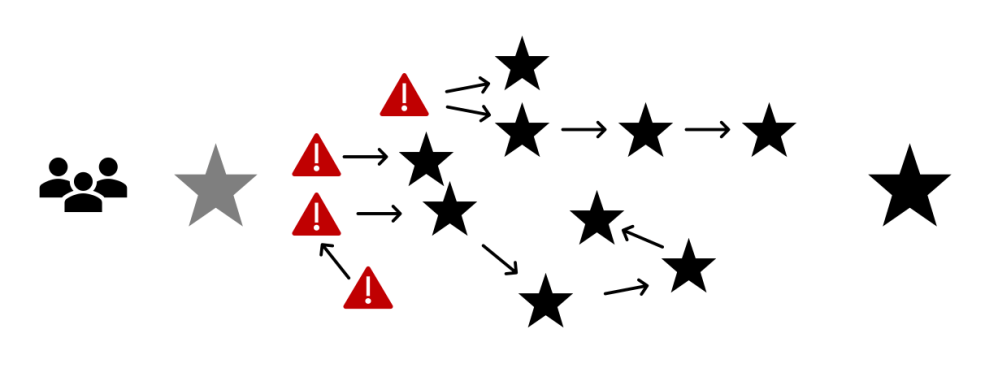
Screenshot 2019-06-24 14.29.37That might sound obvious, but for people used to the experience of conversations that start with solutions already decided, it’s both liberating and highly illuminating.

The workshop designer seeds this process with challenges that have some compelling promise, made all the more compelling by their avoidance of prescription. The off-the-shelf workshop design provides these in the form of the True North and the assessment prompts. These have been tested and refined through repeated use and I would recommend sticking to them initially (advice that may evolve as we gain more customisation experience). However, subsequent events may make use of harvested content, with the potential to make any broader ‘scale out’ excitingly fractal.

There’s a balance to be struck between focussing on new kinds of conversation (clean, outcome-oriented), and on new conversations (the follow-through on specific, newly-articulated outcomes). There’s win on both sides so perhaps I worry too much about whether I get the balance right, but why not have it both ways? Those new kinds of conversations re-seeded by those harvested outcomes. Now we’re talking!

___________

While we’re here, check out these opportunities to experience this for yourself in a public setting (for private settings reach out to me or your friendly neighbourhood partner). One of them is less than two weeks away:


Leading change in the 21st century? You need a 21st century engagement model:
Blog: Monthly roundups | Classic posts
Links: Home | Partners | Books |Resources | Events | Contact | Mike
Community: Slack | LinkedIn group | Twitter
More ‘Open’, and my first online workshops

I’m getting ready for a busy couple of weeks mid May:

Partly in preparation and partly as housekeeping, I’ve updated the generic workshop description page Advanced Agendashift: Coaching and Leading Continuous Transformation as follows:

  1. Very much in the Open spirit of the Boston symposium, it now has a Creative Commons 4.0 CC-BY-SA license. That’s not quite the big deal that it might sound since the Overview pages that describe all Agendashift-based workshops have long had one, but it’s good to get that sorted.
  2. Its structure now tallies with recent improvements. Day 1 is Learning the language of outcomes. Day 2 is Organising for impact, and it reflects the “rejigging” described in last week’s Notes from the April 2019 Advanced Agendashift workshop, London. I’ve updated the abovementioned Overview pages also.

As a spinoff from Boston (there’ll be discounts for attendees), from June I’ll be offering an online workshop, also titled Learning the language of outcomes. Presented as two 2-hour sessions on consecutive days it will be a great way to get up to speed quickly with outcome-orientation and Clean Language, getting some real practice in applying the latter to the former. At a minimum we’ll cover:

Officially, we launch these at the Symposium, but for a sneak preview (and early bird prices):

In person or online, I hope to see you soon!


Upcoming workshops – Boston, Berlin, Oslo, and Stockholm

Watch this space for Greece, Turkey, London, and the Benelux region in the autumn.

workshop-2x1


Blog: Monthly roundups | Classic posts
Links: Home | About | Partners | Resources | Contact | Mike
Community: Slack | LinkedIn group | Twitter
We are champions and enablers of outcome-oriented change and continuous transformation. Building from agreement on outcomes, Agendashift facilitates rapid, experiment-based emergence of process, practice, and organisation. Instead of Lean and Agile by imposition – contradictory and ultimately self-defeating – we help you keep your business vision and transformation strategy aligned with and energised by a culture of meaningful participation. More…


Notes from the April 2019 Advanced Agendashift workshop, London

Update (June 28th 2019): Over the months, the exercise referred to here by my working title Reverse Wardley has served us incredibly well. With full credit to Liz and Karl, it’s a great addition to our workshops and I love it! My name for it has proved way too nerdy for some tastes though, and after several iterations in the Agendashift Slack we may be settling on Option Visibility Mapping. If that changes, I’ll update this update! I’ve also added a new tag ‘mapping‘ to this and related posts.

Thursday and Friday last week was the 2-day Advanced Agendashift workshop in London. The quick version of my takeaways (all confirmed by the retro stickies):

  1. Mike Haber’s Celebration-5W template is a keeper
  2. The beta version of the 15-minute FOTO cue card passes muster
  3. My “Rule of Three” seems to resonate
  4. Some rejigging
  5. Excitement around “wholehearted

Also, details of the next four of these workshops – Boston, Berlin, Oslo, and Stockholm.

Mike Haber’s Celebration-5W template is a keeper

Announced only a couple of weeks ago, I would definitely recommend using Mike Haber’s template – it makes the exercise easier for everyone involved, and the output vastly more presentable. I’ve updated the Celebration-5W page to make it more prominent.

Celebration-5W-template-2019-03-v1

The beta version of the 15-minute FOTO cue card passes muster

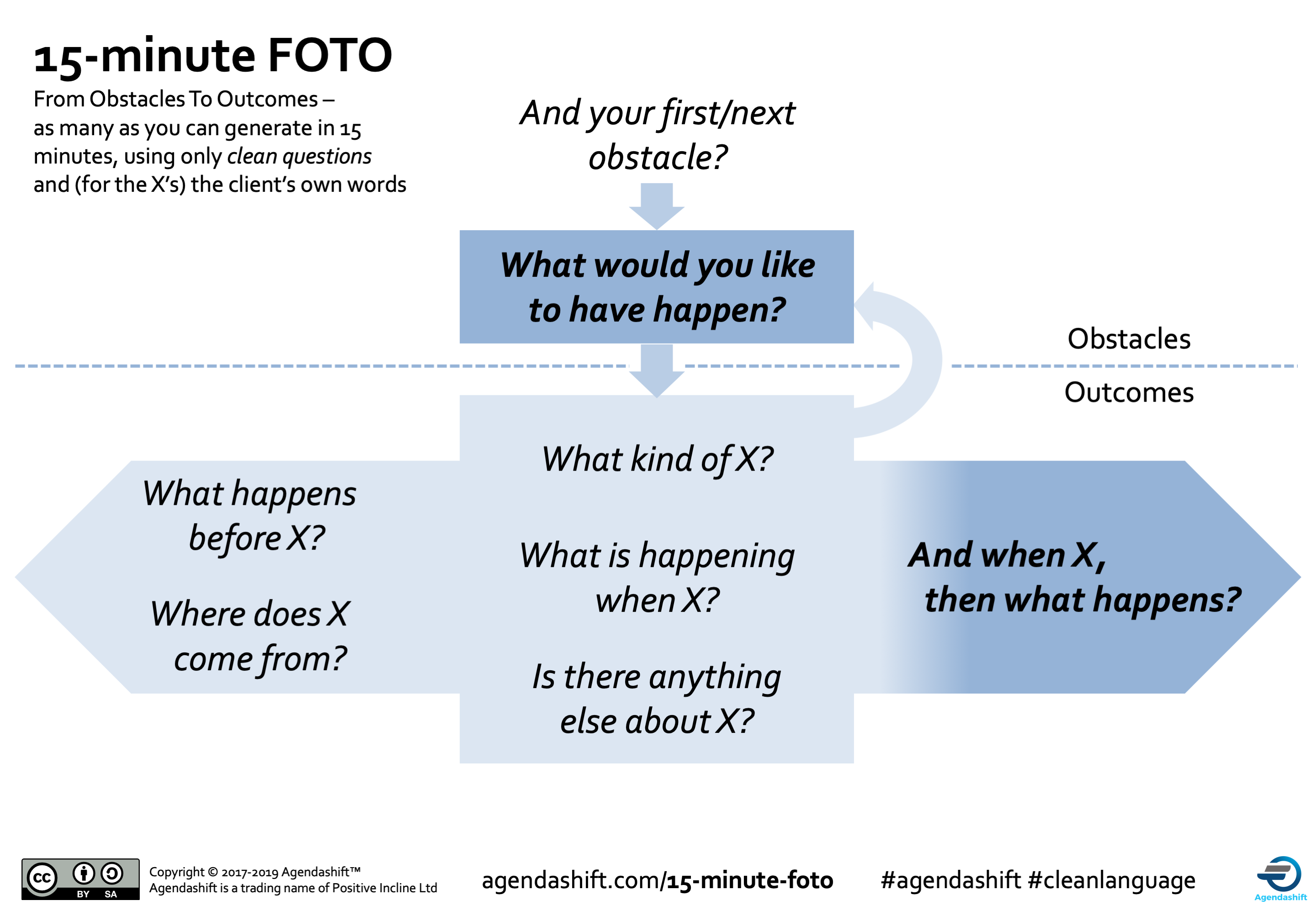
Also announced recently but previously untested, a beta version of the 15-minute FOTO cue card is now made official:

No-one missed the old “Is there a relationship between X and Y?” question (a question that comes with health warnings) and according to the retro sticky, the new question “Where does X come from?” rocks!

My “Rule of Three” seems to resonate

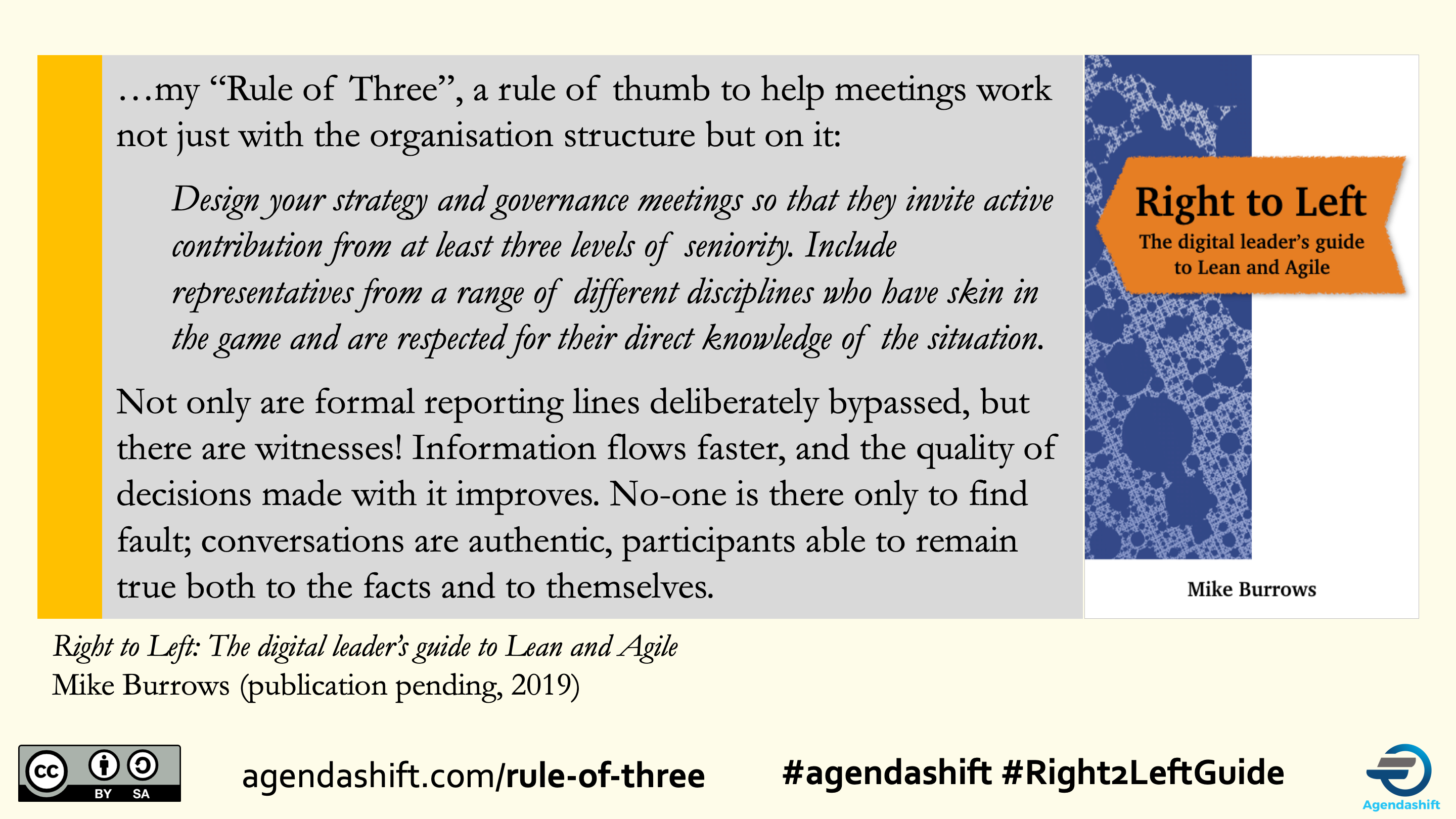
I mentioned my “Rule of Three” in answer to an important question about who should be invited to internal workshops. I had already written it up for my forthcoming book Right to Left but I was encouraged to put together a page for it with an easy-to-remember url, agendashift.com/rule-of-three.

After a few iterations on the text (helped by feedback in the #right-to-left channel in Slack), here’s the key quote:

Clicking on the image or the link above you’ll find a condensed, bullet point version, and some notes that hint at what’s to come in the book.

Some rejigging

Consolidating experiments described in Stringing it together with Reverse Wardley, The Cynefin Four Points exercise moves from day 1 to day 2, the launchpad for Mapping rather than the conclusion to Exploration. It allowed me to run “my slowest ever Discovery” on day 1, and nobody minded one bit.

Update: The name “Reverse Wardley” is (as we say in the UK) “a bit Marmite”, meaning that some loved it and others hated it. Is it “way too geeky”? This was already suspected, but I still don’t have a better alternative.

Excitement around “wholehearted

Remember Towards the wholehearted organisation, outside in (May 2018)? For the evening of day 1, Steven Mackenzie (one of Right to Left‘s reviewers) suggested we held a “Lean Curry” around the topic. Here he is with his heart-shaped picture:

Before Right to Left is even published, perhaps a spinoff! Definitely one to watch.

Upcoming workshops – Boston, Berlin, Oslo, and Stockholm


Blog: Monthly roundups | Classic posts
Links: Home | About | Partners | Resources | Contact | Mike
Community: Slack | LinkedIn group | Twitter
We are champions and enablers of outcome-oriented change and continuous transformation. Building from agreement on outcomes, Agendashift facilitates rapid, experiment-based emergence of process, practice, and organisation. Instead of Lean and Agile by imposition – contradictory and ultimately self-defeating – we help you keep your business vision and transformation strategy aligned with and energised by a culture of meaningful participation. More…


Testing some changes to the 15-minute FOTO cue card

Subscribers to the 15-minute FOTO Dropbox may have noticed a new ‘ v12 BETA’ version of the cue card. 15-minute FOTO is our Clean Language-inspired coaching game, the name being short for “From Obstacles to Outcomes in just 15 minutes”. We’ll be testing this updated version – twice! – at the London workshop early next month (and while we’re here, note that early bird pricing expires tomorrow).

15-minute FOTO 2019 03 v12 BETA

Changes:

  1. Dropped the question “Is there a relationship between X and Y”. Quite simply, this question was more trouble than it was worth. That it needed health warnings was already a strong indication that it should go, and learning that this question seems to have few defenders among expert Clean Language users clinched it for me.
  2. Added “Where does X come from?” as an alternative to “What happens before X?”. I’m taking advantage of the space relinquished by the first change to add a question that I find useful. You can use it to follow system flows upstream (from Right to Left, so to speak), and also to explore abstract outcomes – “Where does that collaboration come from?”, for example (see also My favourite Clean Language question).
  3. The two questions “What would you like to have happen?” and “And when X, then what happens” are highlighted more clearly than before. In the game, when presented with (respectively) an obstacle or an outcome, these are the default questions to use, the former to ‘flip’ obstacles to outcomes and the latter to generate more outcomes, going deeper into outcome space.
  4. Additional visual cues: a boundary between the obstacle and outcome ‘spaces’, along with a reminder (the curved arrow) to use the WWYLTHH question in the event that the conversations lingers unproductively inside obstacle space.

For the time being, you can download a PDF here. For the source pptx file, the facilitator’s deck, and for continued updates, subscribe here. You’ll find a video there too.

Questions or ideas for improvements? #cleanlanguage in the Agendashift Slack. And see chapters 1 and 2 of the Agendashift book, where the exercise is described in depth and in context (twice).


Upcoming Agendashift workshops

See also the recent blog post: Agendashift workshops in Seattle, London, Boston, and Berlin, which includes a detailed description of the 2-day workshop. Workshops facilitated by Mike Burrows (yours truly) unless otherwise indicated:


Agendashift-cover-thumbBlog: Monthly roundups | Classic posts
Links: Home | About | Partners | Resources | Contact | Mike
Community: Slack | LinkedIn group | Twitter
We are champions and enablers of outcome-oriented change and continuous transformation. Building from agreement on outcomes, Agendashift facilitates rapid, experiment-based emergence of process, practice, and organisation. Instead of Lean and Agile by imposition – contradictory and ultimately self-defeating – we help you keep your business vision and transformation strategy aligned with and energised by a culture of meaningful participation. More…

My favourite Clean Language question

We describe our coaching game 15-minute FOTO [1] as “Clean Language-inspired”, and as shown on the cue card (below) it makes use of a small subset of the Clean Language questions, a subset particularly suited to exploring or modelling (ie building a model of) a landscape of obstacles and (especially) outcomes.

The objective of the game and its function in Agendashift is to generate a good number of outcomes that can then be organised in various interesting ways. Through subsequent exercises we facilitate agreement on outcomes, thereby helping to co-create the basis for organisational change. Those goals aren’t quite the same as those of Clean Language, and through my favourite Clean Language question I hope to say a bit about the latter.

Here’s the 15-minute FOTO cue card, an essential piece of equipment for the game. Notice that the X‘s (and in one question a Y), placeholders which the coach replaces with the client’s own words (coach and client are roles in the game; participants take turns in different roles):

15-minute-foto-cue-card-2018-01-29

Given the game’s objectives, the two most important questions on the card are these:

  1. “What would you like to have happen?”, which tends to “flip” obstacles into outcomes, moving from the negative to the positive, quickly identifying the outcome that might be found hiding behind the obstacle (figuratively speaking).
  2. “And when X, then what happens?”, which when the X is an outcome, generates another, and sometimes several. Asked a few times, a surprisingly long chain of outcomes can be generated with the minimum of prompting from the coach.

However, my favourite question on the card is a different one, namely “What kind of X?”. Functionally, it’s a clarifying question, one we use in preference to questions such as “What do you mean by X?”, and “Can you be more specific?”. In the aspiring Lean-Agile context typical of an Agendashift workshop, examples might include:

  • “What kind of Agile?” (instead of “What do you mean by Agile?”)
  • “What kind of collaboration?” (instead of “Can you be more specific about the kind of collaboration you’re talking about?”)

(Aside: see [2] for my answer to the first of those)

Let me further illustrate the “What kind of X?” (WKO) question with an everyday scenario that I frequently find helpful as an example. You have just told me that you’ll be on holiday next week. How do I respond?

Some possible responses politely close the conversation before it gets started: “That’s nice!”, “I hope you have a lovely time!”, and so on.

I might show some interest with a question: “Where are you going?”. Unfortunately, this well-intentioned question is not entirely without risk. Suppose your answer is “I’m not going anywhere, I’m staying at home”.  Awkward! Have I embarrassed you?

To be clear, “Where are you going?” isn’t a terrible question. It is at least an open question, a question to which might be given a wide range of possible answers. This is in contrast with binary questions that expect mainly yes/no answers or leading questions which are mostly about the questioner’s own agenda (in the Agendashift book [3] I describe the latter as not genuine).

The possible flaw in the question “Where are you going?” is that it makes an assumption that might not be valid in this context, the assumption that you’re going somewhere. “What kind of holiday?” removes that assumption – in fact it is about as stripped of assumption as a question can get. As a result, it is much more likely to lead to an interesting answer, one that I can’t easily predict.

This is what Clean Language is all about. It’s not about the killer question, a trick that like the world’s funniest joke soon gets old. It’s about putting the coach’s assumptions to one side, because what’s in the mind of the client is far more valuable. As well as heightening curiosity it improves listening, because we can’t fill in those X‘s if we’re not paying attention. And although there is some skill in choosing the question (a skill that we begin to develop by playing the game), it’s not about leading the client on the strength of the coach’s domain knowledge – there’s a time and place for that, but not yet. Instead, it’s about facilitating a process, one that helps navigate what may be complex issues, often helping the client arrive at some real insights.

15-minute FOTO is carefully framed as a game: it works within clear constraints and with clear goals. It’s not therapy, and never pretends to be. But for some it has been the gateway to the Clean Language body of knowledge with its generous community and has kindled interest in a deeper kind of coaching. And that’s wonderful!

References

[1] 15-minute FOTO
[2] My kind of Agile
[3] Agendashift: Outcome-oriented change and continuous transformation; Clean Language is introduced with 15-minute FOTO in chapters 1 and 2. See also its recommended reading page, in particular (these Clean Language-related books):

  • The Five Minute Coach: Improve Performance Rapidly
    Lynne Cooper & Mariette Castellino (2012, Crown House Publishing)
  • Clean Language: Revealing Metaphors and Opening Minds
    Wendy Sullivan & Judy Rees (2008, Crown House Publishing)
  • From Contempt to Curiosity: Creating the Conditions for Groups to Collaborate Using Clean Language and Systemic Modelling
    Caitlin Walker (2014, Clean Publishing)

Acknowledgements: I’m grateful to Johan Nordin, Steve Williams, and Mike Haber for feedback on earlier drafts of this post.


Upcoming events

February

March

*TTT/F and (where shown) LIKE events include free one-year membership of the Leading with Outcomes Authorised Facilitator programme, upgradeable to Authorised Trainer at any time. Both of those include access to the video-based Leading with Outcomes training and the full range of Agendashift assessment tools.


Leading with Outcomes from the Agendashift Academy
“Leadership and strategy in the transforming organisation”

Leading with Outcomes is our modular curriculum in leadership and organisation development. Each module is available as self-paced online training or as private, instructor-led training (online or in-person). Certificates of completion or participation according to format. Its modules in the recommended order:

  1. Foundation module:
  2. Inside-out Strategy:
  3. Adaptive Organisation:
  4. Outside-in Strategy:

Individual subscriptions from £24.50 £18.40 per month after a 7-day free trial, with discounts available for employees and employers in the government, healthcare, education, and non-profit sectors. For bulk subscriptions, ask for our Agendashift for Business brochure.

To deliver Leading with Outcomes training or workshops yourself, see our Authorised Trainer and Authorised Facilitator programmes. See our events calendar for Train-the-Trainer / Facilitator (TTT/F) and Leading in a Transforming Organisation trainings.


Agendashift™: Serving the transforming organisation
Links: Home | Subscribe | Events | Media | Contact | Mike

Agendashift  Academy: Leading with Outcomes | Trainer and Facilitator Programmes | Store

At every scope and scale, developing strategy together, pursuing strategy together, outcomes before solutions, working backwards (“right to left”) from key moments of impact and learning.

A small departure from the book

Slightly technical, but if you’re interested in what we know to be a remarkably effective combination of Clean Language, Cynefin, and Story Mapping as practiced in most Agendashift workshops, read on…

One of the notable highlights of an Agendashift workshop comes when we take the list of outcomes generated by the 15-minute FOTO game [1], transcribe them onto stickies, and organise them 4-points style [2]:

cynefin-finished-2017-12-16

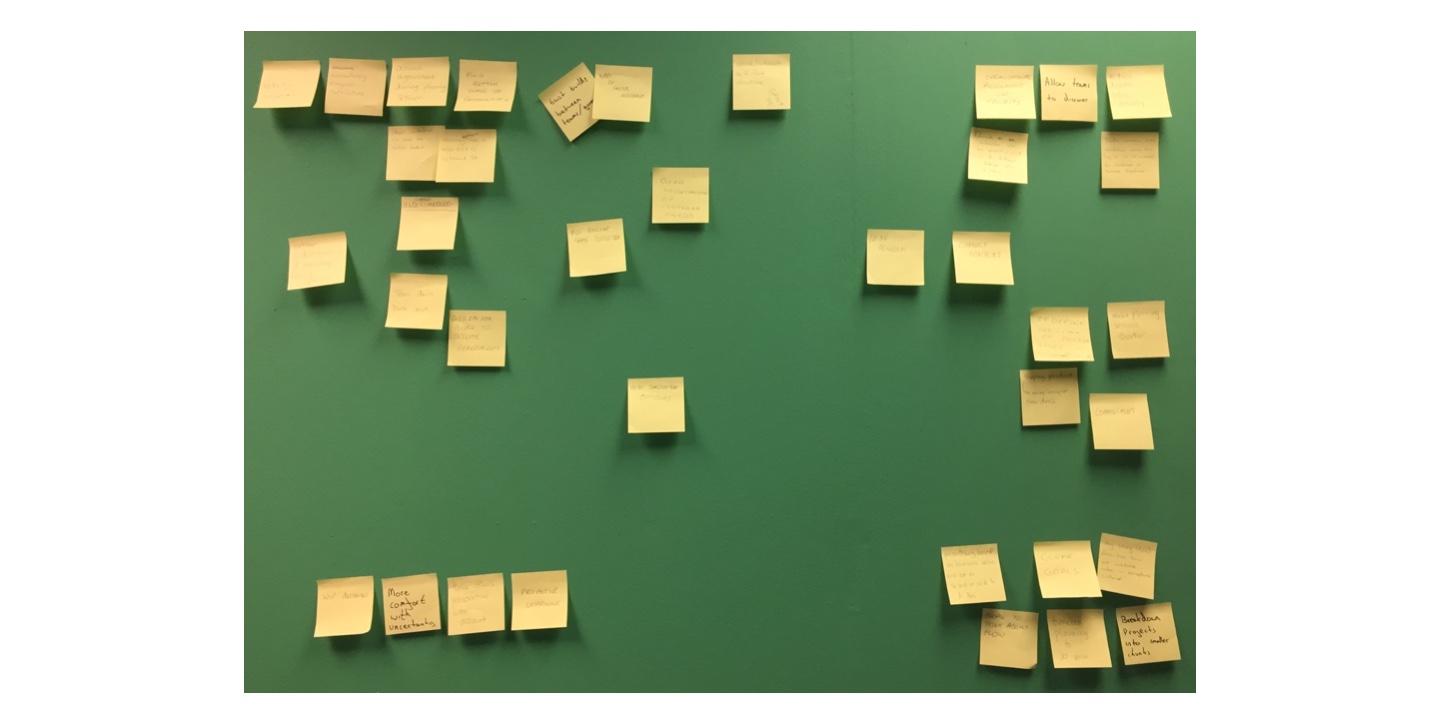
Through the experience of the ‘4 points contextualisation exercise’ (to give it almost its full name), participants are slowly introduced to the Cynefin framework [3], the facilitator trying all the while to avoid naming the model or using Cynefin terminology such as ‘obvious’, ‘complicated’, ‘complex’, or ‘chaos’ (trust me, it’s hard!). For participants familiar with the model, it’s always a funny moment when the penny finally drops and the realisation dawns that Cynefin can be so much more than just a conceptual model, especially when there’s a good supply of ‘narrative fragments’ – outcomes, in our case – to play with. For those that haven’t come across it before, it’s a great opportunity to explore why different kinds of outcomes need different kinds of approaches, a lesson that’s much more meaningful when it’s learned through interacting with your own data (‘sensemaking’) than it would be as a lecture.

Up to now – and as described in the book [4] – the translation from the Cynefin representation to one based on a story map has been a 2-stage process. First, a few minutes of organised chaos as stickies are moved to under their respective headings:

Second, as much time as we want to spend – anything from a few moments to an hour or more – prioritising stickies within columns, and through that process making sure that there is a shared understanding of what each of them means and their possible dependencies on other stickies. Anyone who has done story mapping before will recognise that this can provide an important opportunity for some valuable conversations; we’ve found this to be the case even in public workshops, with ‘teachable moments’ aplenty.

A refinement

Instead of the ‘organised chaos’ followed by prioritisation, work clockwise from bottom right, prioritising as we go:

  • Starting with the ‘obviously obvious’: Sticky by sticky, check that they really are obvious (ie we can all quickly agree what needs to be done and can be pretty sure of the likely outcome), put them in their correct columns, and prioritise. Prioritisation will be easy, as there’ll be at most a few per column, a mixture of quick wins and less important items.
  • The ‘borderline complicated’: For the items on the border between obvious and complicated, explore why they were placed there, and discuss what should be done about their non-obvious aspects (perhaps there’s some important detail that someone will need to get to grips with). Prioritise them relative to the already-prioritised ‘obviously obvious’ items in their respective columns (again, this should be easy)
  • The complicated, one sticky at a time: who might be delegated to run with this item? Should we get some external help? In its appropriate column, how does it prioritise relative to the items already there?

I could at this point say “and so on through the complex and chaos” but the facilitator will flag up here that anything in or bordering on complex is likely to be a good candidate for hypothesis-based change (a session later in the day, see also [5]), and so it’s a good idea to mark each item in some way so that they can be identified easily later. And for the borderline cases:

  • ‘Borderline complex’: Are the complicated and complex parts easily separable? How will we organise this, mainly linear with some room for refinement along the way, or mainly through iteration with some expert input or planned work at the appropriate time?
  • ‘Borderline chaos’: Is it urgent to address symptoms or or attempt some diagnosis now, or can we afford to wait until we see what’s thrown up in the course of other work?

I’ll be honest: it’s still early days for this change and there’s no slideware [6] for it yet – if any is needed we’ll learn that through practice and by partner demand. That’s usually the best way!

[1] 15-minute FOTO, our Clean Language-inspired coaching game
[2] Cynefin Review Part 7 – Finding Your Place on the Framework (adventureswithagile.com)
[3] The Cynefin framework (wikipedia.org)
[4] Agendashift: Outcome-oriented change and continuous transformation, Mike Burrows (New Generation Press, 2018), chapters 2 and 3 in particular
[5] The Agendashift A3 template (and chapter 4)
[6] The Agendashift partner programme

Finally, some opportunities to experience it for yourself:


Agendashift-cover-thumbBlog: Monthly roundups | Classic posts
Links: Home | About | Partners | Resources | Contact | Mike
Community: Slack | LinkedIn group | Twitter

We are champions and enablers of outcome-oriented change and continuous transformation. Building from agreement on outcomes, Agendashift facilitates rapid, experiment-based emergence of process, practice, and organisation. Instead of Lean and Agile by imposition – contradictory and ultimately self-defeating – we help you keep your business vision and transformation strategy aligned with and energised by a culture of meaningful participation. More…

And in Swedish…

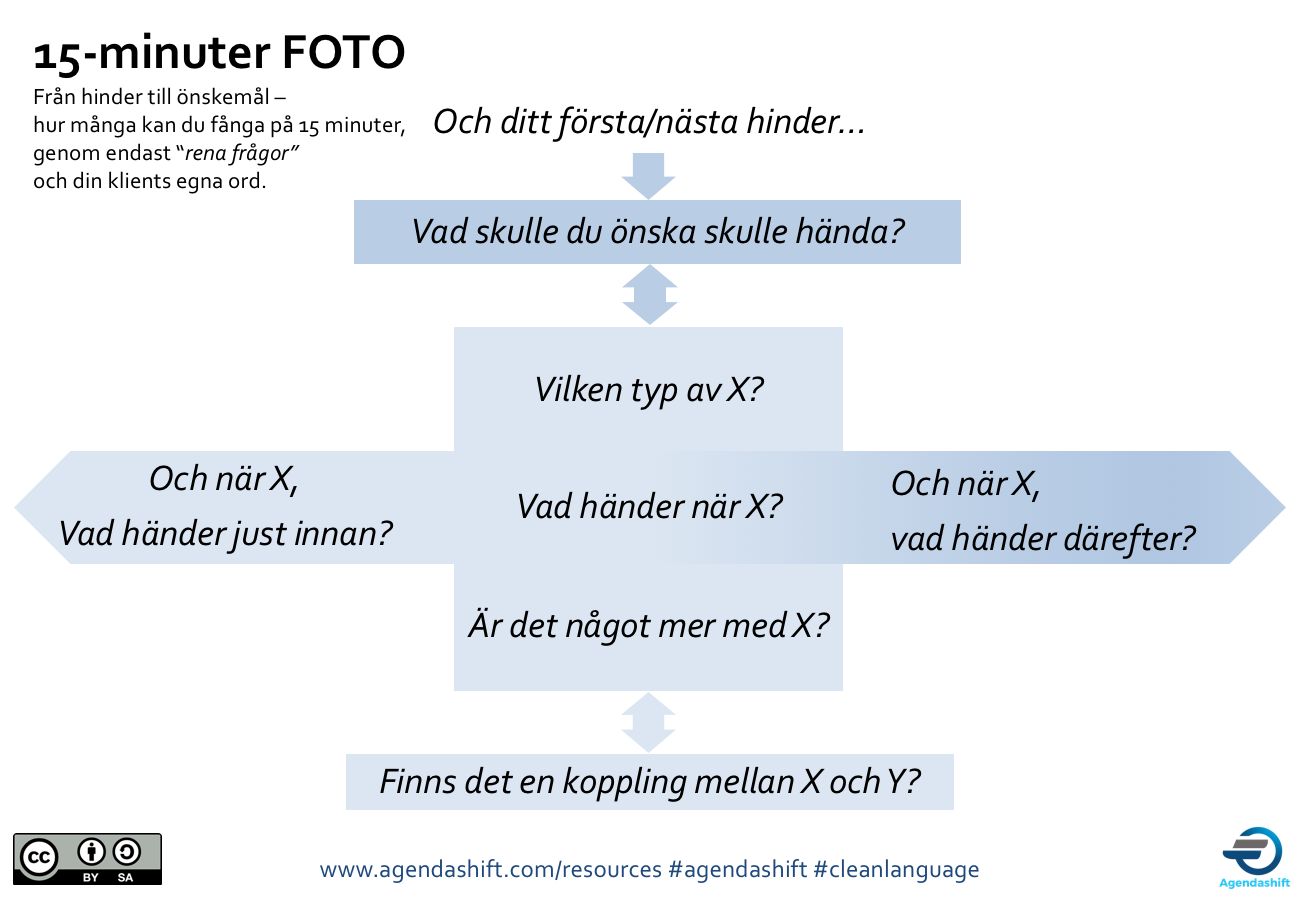
The cue card for 15-minute FOTO, our Clean Language-inspired coaching game is now available in Swedish, thanks to Agendashift partner Johan Nordin. Tack så mycket!

Screenshot 2018-08-21 09.11.26

Downloads, a video, and other information about the game may be found at www.agendashift.com/15-minute-foto.

See also FOTO in 15-minuti, announcing Italian and German translations.


Public workshops (US, UK, IT, DE)

A place has just become available for the September 14th Agendashift Studio – first come first served! By definition, it’s a cozy and informal Agendashift workshop for up to 4 participants held in my detached studio office in Chesterfield, convenient for the Peak District National Park; lunch at a local farm shop. £195 + VAT. £25 discount to past attendees &/or Agendashift partners; 40% off for public sector, educational & non-profit employees. Make yourself known the #agendashift-studio channel in Slack if interested in attending at another time.


Agendashift-cover-thumbBlog: Monthly roundups | Classic posts
Links: Home | About | Partners | Resources | Contact | Mike
Community: Slack | LinkedIn group | Twitter
We are champions and enablers of outcome-oriented change and continuous transformation. Building from agreement on outcomes, Agendashift facilitates rapid, experiment-based emergence of process, practice, and organisation. Instead of Lean and Agile by imposition – contradictory and ultimately self-defeating – we help you keep your business vision and transformation strategy aligned with and energised by a culture of meaningful participation. More…

FOTO in 15-minuti

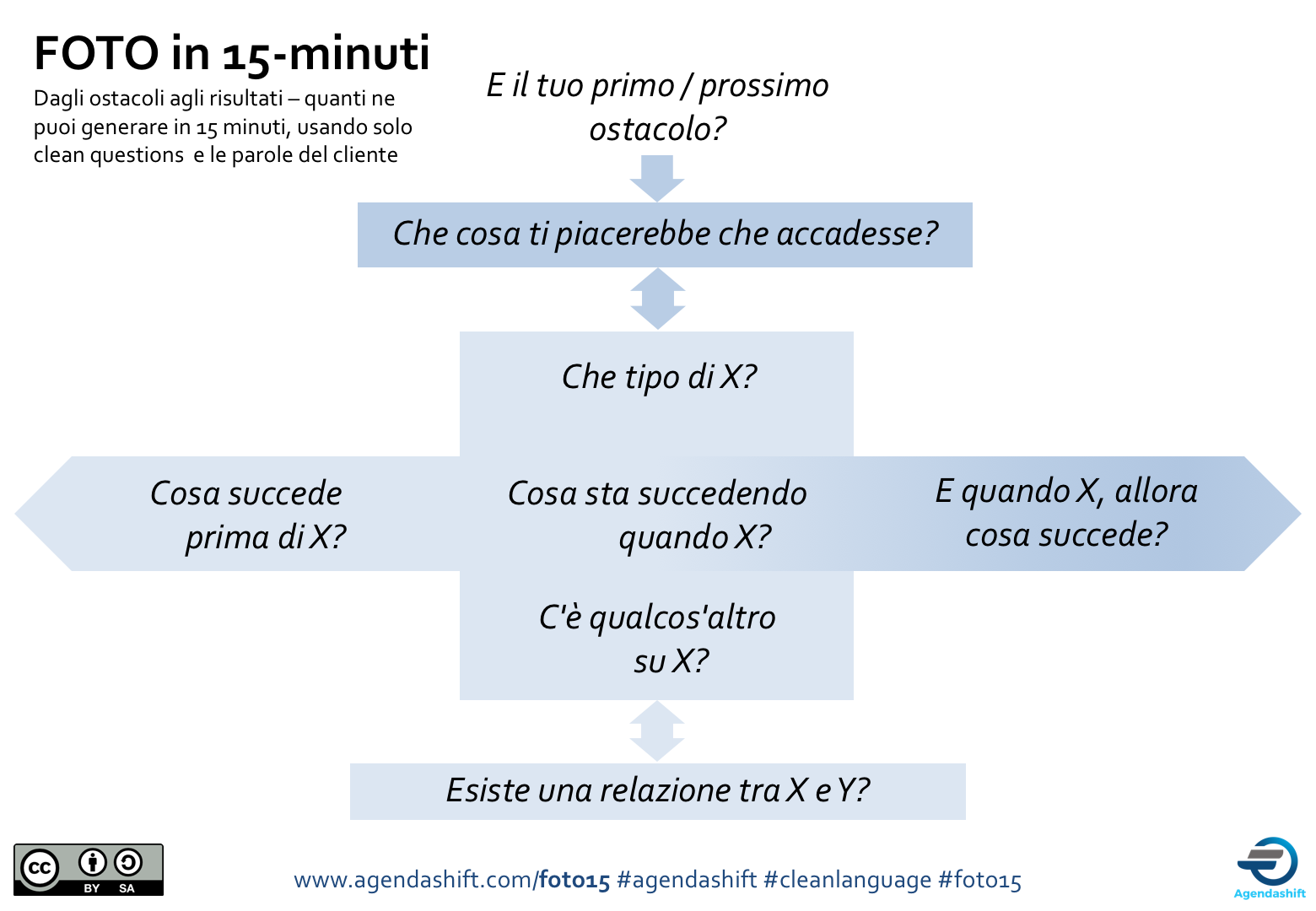
Quick one: Massimo Sarti has kindly translated the 15-minute FOTO cue card into Italian. Thanks to Alex Pukinskis, we have it in German also. If you’d like either one of these, just go to the 15-minute FOTO page, request the materials as usual, and mention which one you’d like.

Massimo’s translation is particularly timely: since July’s roundup we now have a booking page up for the Core Agendashift workshop Facilitating Outcome-Oriented Change in Brescia, Italy on November 9th, ahead of Italian Agile Day 2018 on the 10th. We both hope to see you there!

Screenshot 2018-08-06 12.41.25

15-minute FOTO is our Clean Language-inspired coaching game, an essential and memorable component of every Agendashift workshop. We have released it under a Creative Commons with-attribution licence to enable its wider use and to encourage adaptations.

FOTO stands for “From Obstacles to Outcomes”, and you have 15 minutes to generate as many as you can, using only the questions on the cue card. An example of “generative over prescriptive” if you like.


Public workshops (US, UK, IT, DE)


Agendashift-cover-thumbBlog: Monthly roundups | Classic posts
Links: Home | About | Partners | Resources | Contact | Mike
Community: Slack | LinkedIn group | Twitter

We are champions and enablers of outcome-oriented change and continuous transformation. Building from agreement on outcomes, Agendashift facilitates rapid, experiment-based emergence of process, practice, and organisation. Instead of Lean and Agile by imposition – contradictory and ultimately self-defeating – we help you keep your business vision and transformation strategy aligned with and energised by a culture of meaningful participation. More…

An outside-in strategy review, Agendashift style

I’ve just about finished an initial draft of the second chapter of Right to Left: The digital leader’s guide to Lean-Agile (which now has a landing page). Its three-part structure is firming up nicely as follows:

  1. Right to left (four chapters): Lean; Agile; Fundamental Lean-Agile patterns and how they combine; Scaling frameworks
  2. Outside in (one to three chapters): Strategy reviews (and related tools); Capability reviews; Feedback loops and other organisational patterns
  3. Upside down (one  to two chapters): Designing for leadership and change: Servant leadership, Leader-Leader, the inverted pyramid, engagement models (of which Agendashift is an example) and so on

The shape works, and I’m thrilled with how the well the right-to-left thing is working out – see for example last week’s post #RightToLeft works for Scrum too which is already a top 5 post for the year and is helping me find collaborators interested in giving the scaling frameworks a similar treatment.

I’ve not just been writing. Let me share four questions I posed (one at a time) at a outside-in strategy review (a private workshop):

  1. Customer: What’s happening when we’re reaching the right customers, meeting their strategic needs? (‘Strategic needs’ being the customer needs that best define our mission)
  2. Organisation: When we’re meeting those strategic needs, what kind of organisation are we?
  3. Product: Through what products and services are we meeting those strategic needs?
  4. Platform: When we’re that kind of organisation, meeting those strategic needs, delivering those products and services, what are the defining/critical capabilities that make it all possible?

(Admission: I got two of these the wrong way round in my prep last week, which changes the wording slightly. This exercise still worked great though!)

If you’re familiar with the model, you may be wondering what happened to the fifth and innermost layer, Team. This we covered not by a question, but via the Agendashift True North, focussing not on the work that teams are doing but on ways of working.

As we considered each layer, we captured some vision, then obstacles. After exploring the five layers individually, 15-minute FOTO to turn obstacles into outcomes.

15-minute-foto-cue-card-2018-01-29 The 15-minute FOTO cue card

Precede all of that with some forward-looking context-setting and segue into hypothesis driven change and A3 (all of which are standard features of our transformation strategy workshops) and you have an outcome-oriented strategy review, done Agendashift style.

Want to explore these and other complementary strategy-related tools with us? Join myself and Karl Scotland at our Agendashift + X-Matrix Masterclass9th-11th October, Brighton, UK. Or drop us a line about private workshops. You might even facilitate one yourself – the tools and materials aren’t expensive!


What if we put agreement on outcomes ahead of solutions?

Agendashift™: Serving the transforming organisation
Agendashift  Academy: Leading with OutcomesHome | Store

Links: Home | Subscribe | Become an Agendashift partner Events | Contact | Mike
Resources: Tools & Materials | Media | Books | Assessments
Blog: Monthly roundups | Classic posts
Community: Slack | LinkedIn group | Twitter
Agendashift roundup, May 2018

In this edition:  ‘Done’ goes viral; Right to left; Reviews for Agendashift; Munich and South Wales; Tools and translations; Upcoming; Top posts

‘Done’ goes viral

I don’t usually start with the blog, but within days of posting, My handy, referenceable Definition of Done jumped to the top of the leader board for 2018, bringing with it a linked post from 2016, Better user stories start with authentic situations of need.

Screenshot 2018-05-05 06.23.15

The reaction to this post was striking. Clearly, most people got what I was doing right away, but a few (5% maybe) seemed offended that I had dared to subvert a cherished Agile concept, the definition of done. I have absolutely no regrets on that score, and not just because it provoked a response: it’s a legitimate target that I’d be only too happy taken down and replaced with better things – definitions of ready (the obvious technical alternative), needs, outcomes, goals, validation, and so on.

Right to left

It seems slightly crazy that I’ve started work on a new book (my third) so soon after Agendashift, but I just can’t help myself!

Are you tired of introductions to Agile (and actual implementations, for that matter) that start “on the left” with projects and backlogs and work their way slowly rightwards to where the long-suffering customer patiently waits for something of value actually to happen? Well so am I, and I’m doing something about it.

My best guess is that Right to left will be available sometime in 2019, and hopefully no more than 12 months from now – let’s call it early summer ’19. There’s no landing page for it yet but there is a #right-to-left channel in the Agendashift Slack and some blog posts:

For completeness, theme 3 of 3, “upside down”, the supportive organisation, will get its own post in the next few days.

In terms of tone, I’m aiming for “a book you’ll happily give your manager and hope they’ll want to pass on to theirs” – less practitioner-focussed than KFTI and Agendashift then, but plenty for the expert to enjoy too I’m sure.

Word count so far: 2,910 (May 31st, 2018).

Reviews for Agendashift

Fewer than I’d like (to be honest I’m a little frustrated), but the reviews we do have are great, all 5-star so far. See for yourself:

Many thanks to those that have taken the trouble so far, and keep them coming!

Munich, and South Wales

For reasons we don’t fully understand, the Munich workshop didn’t quite get off the ground. There were sales, but not quite enough of them came soon enough for us to be confident of being able to give a good experience. Postponed rather than cancelled, and we may find a client organisation both to host it and to ensure numbers. That’s a model that could work in your city too; do get in touch if you have even just a small core of people interested.

Cardiff though – with DevOpsGuys as both excellent hosts and active participants – was great. Again some fantastic feedback for the 2-day Advanced workshop, and I spoke afterwards at the South Wales Agile Group.

I’ll be in South Wales again in July for Agile Cymru, where no fewer than five Agendashift partners will be speaking:  Cat SwetelJose CasalKarl ScotlandMatt Turner, and yours truly. That’s amazing! Clearly, if you want to find good people, you should check out the partner directory, and perhaps decide to join that list yourself 😉

Tools and translations

  • The 15-minute FOTO cue card is now available in German – thank you Agendashift partner Alex Pukinskis
  • Featureban is now available in Spanish – thank you Youssef Oufaska and Daniel Carroza

After a long wait, we finally got to play Changeban during the Cardiff workshop and it worked great! A new version of the deck is now available, a couple of bugs fixed (just with the deck, the game itself worked as planned). More here:

Upcoming

Speaking:

Over the summer period, the only workshops I’ll be doing will either be private or the Agendashift Studio event on July 7th (in my home studio office in Chesterfield, UK, and it’s sold out). Watch this space for an exciting autumn/winter programme.

Top posts

Recent:

From the archives:


Agendashift-cover-thumbBlog: Monthly roundups | Classic posts
Links: 
Home | About | Partners | Resources | Contact | Mike
Community: Slack | LinkedIn group | Twitter
We are champions and enablers of outcome-oriented change and continuous transformation. Building from agreement on outcomes, Agendashift facilitates rapid, experiment-based evolution of process, practice, and organisation. Instead of Lean and Agile by imposition – contradictory and ultimately self-defeating – we help you keep your business vision and transformation strategy aligned with and energised by a culture of meaningful participation. More…