Agendashift roundup, May 2021

In this edition: Conferences (I): Agendashift comes of age; Conferences (II): Lean Agile Global and the Deliberately Adaptive Organisation; Xagility podcast interview; Upcoming; Top posts

Conferences (I): Agendashift comes of age

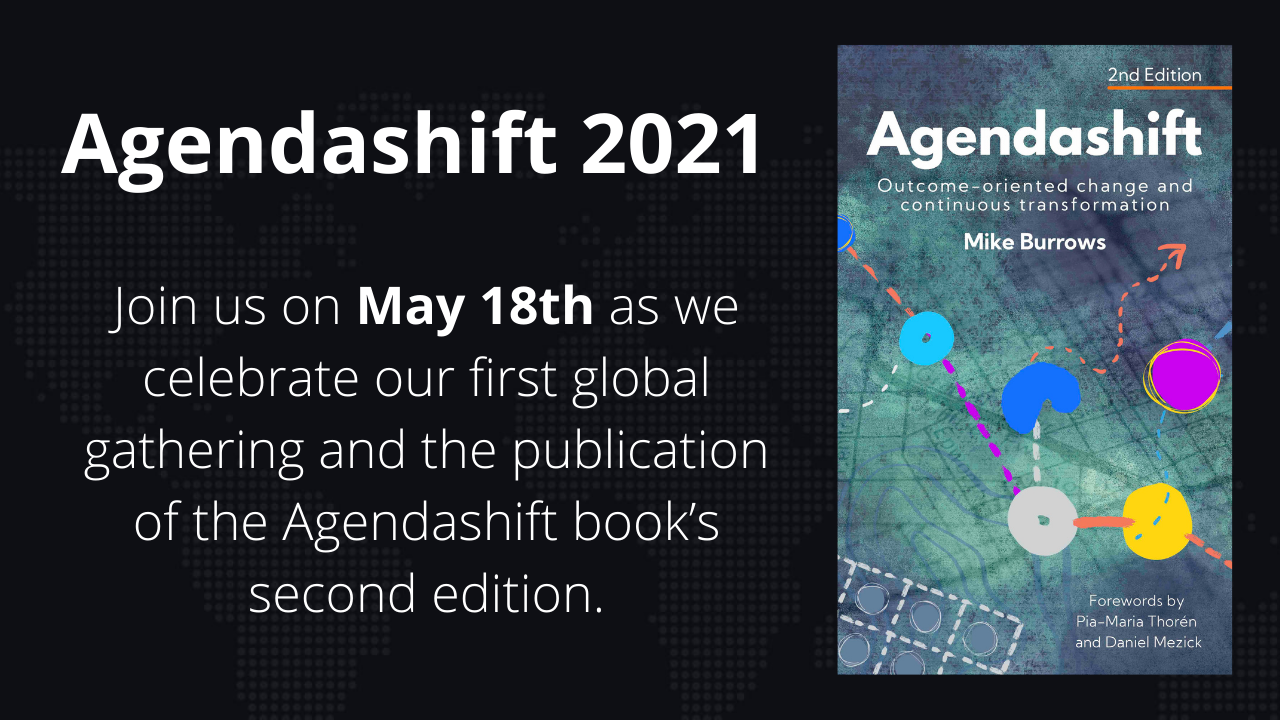
2021 will go down as an epic year for Agendashift – the 2nd edition, the Agendashift Academy, and now (last week) our first conference. More than 400 registrations taken over a highly compressed launch period (500, if you count those who asked to register after the event), great feedback, and given that it was neither instigated nor organised by me, proof that Agendashift has a life of its own! Expanding on that thought, I blogged about it the following day:

If you have a paid ticket, you have access to the recordings already. Log back into the conference site, visit the auditorium, and find the plenary sessions (my introduction and opening and closing keynotes), the two main tracks, and a bonus session. If you don’t have access, watch this space – we’ll make an announcement on that soon.

Conferences (II): Lean Agile Global 2021

This week I spoke at Lean Agile Global 2021 (which we sponsored) with a brand new talk titled ‘Up and Down the Deliberately Adaptive Organisation – business agility at every scale‘. As per the last couple of chapters of the Agendashift 2nd edition, it’s Agendashift plugged into the classic Viable System Model, a model that scales like no other. Check out deliberately-adaptive.org both for a flavour and for some clues of future developments.

deliberately-adaptive-image

Xagility podcast

I had the pleasure of doing a podcast interview this month with John Coleman for the Xagility podcast. Listen to it on your favourite podcast platform (where you can leave a rating/review) or here:

This and past recordings both audio and video are available listed on our media page.

Upcoming

My apologies for the postponement for family reasons of the June Deep Dive. That leaves no interactive public workshops in next month but don’t forget the self-paced option! It’s a great place to start and there’s plenty of time to complete it before Coaching with Outcomes in July.

Not that it’s compulsory but there’s easily time to complete this before the next of our scheduled interactive workshops:

*Expanded from 2 hours

Top posts

  1. What do I mean by ‘generative pattern’;?
  2. Agendashift came of age yesterday
  3. The IdOO pattern as leadership model
  4. From Reverse STATIK to a ‘Pathway’ for continuous transformation (October 2019)
  5. Announcing 1) our first self-paced training Leading with Outcomes (LwO) and 2) the Agendashift Academy (April)

What if we put authentic agreement on meaningful outcomes ahead of solutions?

Welcome to Agendashift™, the wholehearted engagement model

Agendashift™, the wholehearted engagement model
Links: Home |
About | Our mission: Wholehearted | Become an Agendashift partner | Assessments | Books | Resources | Media | Events | Contact | MikeSubscribe
Workshops: Transformation strategy | Outside-in strategy | Short training
Blog: Monthly roundups | Classic posts
Community: Slack | LinkedIn group | Twitter

What do I mean by ‘generative pattern’?

That question came up recently in our weekly #community Zoom and again afterwards so I thought it would make sense to write it up here. I have two possible definitions, but before I get to those, some lower-level building blocks:

  • Generative and generative process: Generative has two meanings, (i) capable of creating something, or (ii) something with finite rules that when applied repeatedly can produce things of arbitrary complexity (for example the production of language from the rules of grammar; computer-generated art or music). Both of these meanings have some relevance here; I use generative process when referring specifically to the second of those meanings.
  • Generative image: words or images designed both to challenge and to inspire a wide range of possible responses, usually achieved by taking care not to prescribe or otherwise over-specify, perhaps to the extent of deliberately introducing ambiguity or paradox. Two notable examples, beginning with the most famous of them all: “sustainable development” and “Agile Software Development”. Examples from Agendashift include our True North statement, “wholehearted organisations” (best left under-specified), and the assessment prompts (inspired by practice but carefully non-prescriptive); we have others. These examples are all carefully crafted well in advance but they might instead be harvested from the organisation or created through (say) a workshop exercise; one of the earliest exercises in  Gervase Bushe’s The Dynamics of Generative Change (2020) has the objective of crafting a generative purpose statement for the change initiative in question.
  • Generative question: open-ended questions that can be used in a wide range of contexts and generate a wide range of valuable but unpredictable answers, perhaps provoking some insight in the process. Examples: setup questions such as “For this ___ to be really useful for you, it will be like what?” (from Clean Setup) and menus of questions that can be used repeatedly within a generative process, for example “Why is that important?” and “What stops that?” (from Challenge Mapping), and the Clean Language questions (our Clean Language-inspired coaching game 15-minute FOTO includes 8 of the 40+ canonical questions)

Rather like the word generative, the term generative pattern could have several meanings. Literally “things that as patterns recur in different contexts and that are generative”, would do. Then there’s the more specialised, “patterns that combine in a pattern language” – think for example Christopher Alexander’s pattern language for architecture and the facilitation patterns of Liberating Structures.

Agendashift’s usage is tends to be more specific but still compatible with both of those meanings. Usually I’m referring to higher level structures into which which all of the lower-level generative elements mentioned so far can be plugged in. The design community’s double diamond would be an example of that, a recognisable pattern with applicability in a wide range of innovation contexts, within whose overarching structure a wide of generative tools can be used.

The most memorable generative pattern in Agendashift is the IdOO pattern (“I do”, for Ideal, Obstacles, Outcomes) and it meets all of these definitions. It’s clearly a pattern (it’s recognisable in different contexts), it combines with other patterns (even with itself – the landscape of obstacles and outcomes is fractal), and it’s a structure into which other generative elements can be inserted:

  • Ideal: typically a reflection on a generative image and often with the aid of a setup question; sometimes it’s just a question, perhaps with the hint of a generative image embedded in it (see the Outside-in Strategy Review template for at least one example of that)
  • Obstacles: “What stops that?” as a generative question or something more elaborate, the TRIZ exercise from Liberating Structures for example
  • Outcomes: SFBT’s miracle question on its own or as a precursor to 15-minute FOTO, generative question and generative process respectively

What it does of course is keep that generative conversation moving forward in a productive direction. Unconstrained, the random walk might be enjoyable for a while but trust in the process would diminish rather quickly.

Postscript 1

It’s about time I announced the IdOO breakout generator tool. I’ve been using it in meetups for a few weeks now. It’s simple online tool to help you facilitate breakout discussions or personal reflections with the Ideal, Obstacles, Outcomes (IdOO) pattern. These convenience links will take you to first user-facing page with an Agendashift-related challenge already configured for you:

You can also configure it to use a challenge of your own. Read the tips and gave a play!

Postscript 2

Talking of structure, while this post was already under construction I saw in a community forum this from Ian Phillips . With his permission:

…so I know a few people on here attended the MindShift Conference on ING’s. Am reflecting a bit on Jesko von den Steinen and:
  • “There is intuition in your structure.”
  • “Structure your intuition.”

Love that! It took a while for Agendashift’s patterns to crystallise out but it was well worth encouraging that process. After doing it once with the IdOO pattern (and it took much of the time between the 1st and 2nd editions of the book), it got easier. 2MBM took only hours 🙂

Related

agendashift-2nd-ed-sharing-1200x628-2021-02-10

agendashift.com/book (March 2021)


What if we put agreement on outcomes ahead of solutions?

Agendashift™: Serving the transforming organisation
Agendashift  Academy: Leading with OutcomesHome | Store

Links: Home | Subscribe | Become an Agendashift partner Events | Contact | Mike
Resources: Tools & Materials | Media | Books | Assessments 
Blog: Monthly roundups | Classic posts
Community: Slack | LinkedIn group | Twitter

Agendashift came of age yesterday

Yesterday was Agendashift 2021, our inaugural conference, and by all accounts it was a big success. I’m hearing words like “inspiring”, “wonderful”, and (importantly) “valuable”, and we got past 400 registrations in the limited number of weeks available for marketing it.

We can truly say now that Agendashift has a life of its own. The conference wasn’t my idea (I always saw it as something that would happen one day, not something I felt ready to instigate), and of the committee members, I was actually the least involved! A heartfelt thank you therefore to Kjell Tore Guttormsen, Andrew Jones, Karl Scotland, and Russ Lewis – outstanding work! My most sincere thanks also to our two keynote speakers Pia Maria Thorén and Gervase Bushe, all our other speakers, and our generous sponsors. So much there, so well presented, and so aligned.

Given that there were two tracks, I haven’t been able to watch every presentation yet. Two quotes of the day stood out for me though. They’re from the Agendashift and Transformation tracks respectively, the first from Dragan Jojic:

Invite people, or invite resistance

The second is from Daniel Mezick:

Agile transformations around the world are epic train wrecks

What ties the two quotes together isn’t just the idea of invitation to participation – Daniel literally (co)-wrote the book on that – but the sad fact that too much of the change industry still sees resistance as something to overcome, not the massive clue that they’re approaching transformative change completely backwards. This is of course Agendashift’s starting point, its big “what if” question and the opening of my introductory talk: What if we put agreement on outcomes ahead of solutions?

2021 is a year not to squander and we won’t be resting on our laurels. The 2nd edition is out, the Agendashift Academy is launched, and the first few participant are approaching the end of Leading with Outcomes, our first self-paced training. Beyond LwO we have a training roadmap not quite ready for publication but it’s already the focus of partner discussions and I’m ready at short notice to do a quick Zoom on it with any prospective partner or corporate client. There’s opportunity too for the partner programme to evolve, allowing partners to deliver a wider range of hybrid solutions with different combinations of self-paced and in-person training, integrated with hands-on client work such that it can be recognised for its developmental value. I’ve no doubt that we’ll see some some real innovation there.

If I may, let me briefly mention another conference, next week’s Lean Agile Global 2021. Not just because we’re sponsors, but because my brand new talk Up and Down the Deliberately Adaptive Organisation will reveal more of where we’re headed content-wise. For some hints of what’s in store, visit deliberately-adaptive.org.

So, once again, thank you everyone who participated yesterday. A milestone moment, the day Agendashift came of age, definitely well worth being there 🙂

Agendashift 2021 May 18th Page Image

One last thank you to our sponsors:

Gold

Silver:

Bronze:


Upcoming

Listed now on the Agendashift Academy’s Store page are our scheduled workshops:

And my apologies: June’s Deep Dive workshop (Americas) must be rescheduled for family reasons.

Always now the self-paced option (and it’s a great option):

Selected appearances by Agendashift partners, me where unspecified:


What if we put authentic agreement on meaningful outcomes ahead of solutions?

Welcome to Agendashift™, the wholehearted engagement model

Links: Home | About | Our mission: Wholehearted | Become an Agendashift partner | Assessments | Books | Resources | Media | Events | Contact | MikeSubscribe
Workshops: Transformation strategy | Outside-in strategy | Short training
Blog: Monthly roundups | Classic posts
Community: Slack | LinkedIn group | Twitter

Why the Agendashift 2nd edition? What happened?

In case you missed it:

What happened since 2018 and the 1st edition? Quite a lot actually!

Engagement models happened

It may seem a bit daft to say that one of the things that happened was the foreword to the 1st edition, but it’s true! Daniel Mezick’s use of the term engagement model (a term I hadn’t used) was a gift. It gives us a constructive and generative name for “change through means other than imposition”, it creates an identity for a category distinct from those linear models of change management, and I’ve come to appreciate the distance and differentiation that this affords. To quote from the book:

You can’t upgrade your organisation like you’re upgrading your email server!

The 2nd edition gains a foreword from Pia-Maria Thorén. So glad to make that connection with HR community! Time will tell where that will lead, somewhere good I’m sure.

Lots of small and not-so-small improvements happened

To name just a few:

Patterns happened

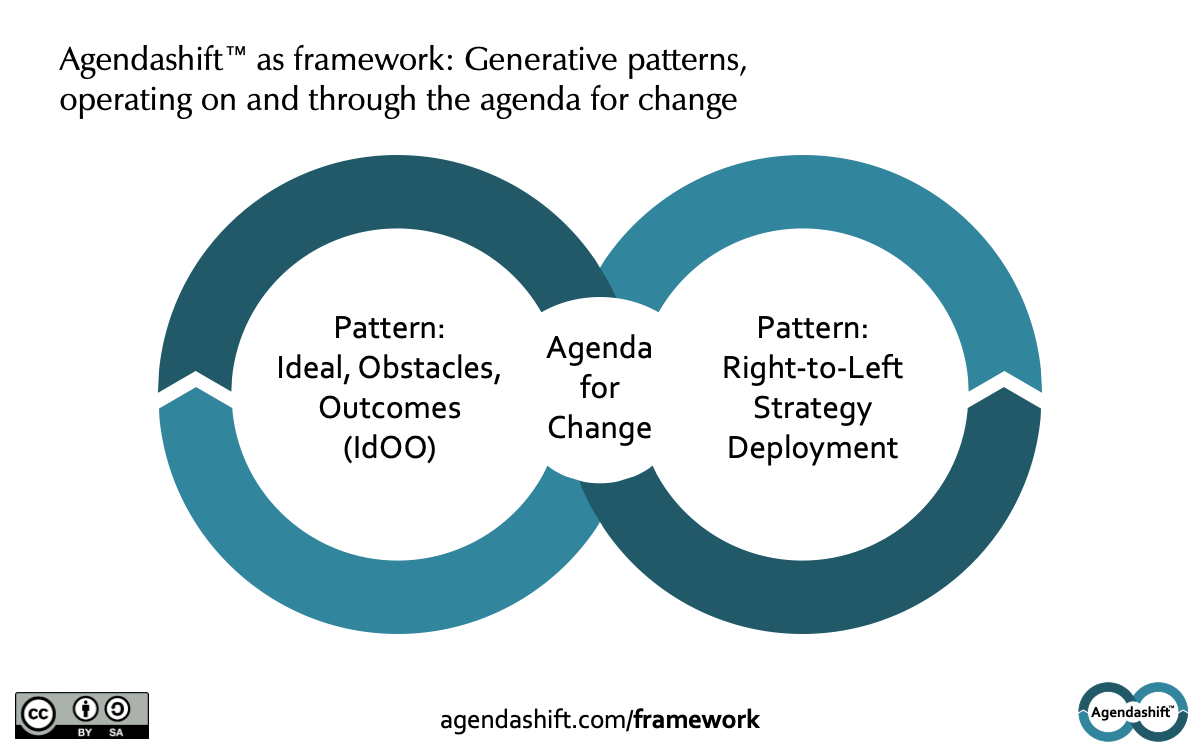
The “Agendashift as a river” poster is gone (hands up on that one, it was a mistake). In its place, the figure-of-8 framework picture, with Agendashift’s two main patterns for each loop and the Agenda for Change at their intersection:
Framework image

Chapters 1 & 2 each provide a demonstration of the Ideal, Obstacles, Outcomes (IdOO) pattern. The pattern is discussed in relation to other coaching models and leadership routines – GROW, Toyota Kata etc, and it creates the opportunity for the now much more developed Outside-in Strategy Review (OI-SR) to be introduced much earlier in the book.

By chapter 3 (the Mapping chapter), the Agenda for Change is already well established and much better defined than it was in the 1st edition. It is one of the most-changed chapters, now describing the well-tested string of three mapping exercises practiced since early 2019:

  1. Option Approach Mapping – Cynefin Four Points with outcomes and under a pseudonym (it’s better that way)
  2. Option Relationship Mapping – Karl Scotland and Liz Keogh’s Cynefin-inspired brilliant reworking of Wardley Mapping designed to work with outcomes
  3. Pathway Mapping – ‘Transformation Mapping’ in the 1st edition, Story Mapping with outcomes

I wouldn’t describe either Mapping or the Agenda for Change as patterns but certainly there are patterns in that chapter – describing the three exercises together really helped me see those and I think they will be helpful to facilitators of these and similar exercises.

Chapter 3 is also the launchpad for the Right to Left Strategy Deployment pattern, making it the pivotal chapter. It changes the perspective of chapter 4 (Elaboration) quite noticeably, and chapter 5 (Operation) is completely rewritten. Before that, a smaller pattern, Meaning before Metric, Measure before Method (2MBM), which goes with improvements to the ideation part of chapter 4 (Elaboration).

Covid-19 happened

Let me just quote the Introduction (like chapter 5 this was rewritten from scratch):

Finally, Covid-19 happened. I have a vulnerable family member, and by the time lockdown was formalised in the UK I was already in self-imposed quarantine after a trip abroad. I realised very quickly that my globetrotting days were done and that I had to make a strategic shift online. I found that the change of platform helped me see the material through fresh eyes, and I have been glad of the opportunity to collaborate and experiment rapidly with others. We’re determined to deliver the best possible online experience and this new 2nd edition benefits significantly from what we’ve learned through this extraordinary time.

Stepping back from those technical improvements and personal challenges, it has never been clearer that strategy and ways of working are matters of urgency, and that they need to be tackled in an integrated and, dare I say, wholehearted, way. As the world shifts online, so customer relationships change (and as I observed in Right to Left, so increases the opportunity to learn from them). Meanwhile, the need for individuals and teams to connect both to purpose and to each other becomes critical. The alternative – irrelevance, fragmentation, and alienation – hardly bears thinking about. If instead I could bottle some of the best experiences in our progress since the 1st edition – special moments in workshops, client engagements, community and cross-community events, and smaller, purposeful collaborations – well I’d be a happy man indeed.

Right to Left happened, and Dialogic/Generative OD happened

Right to Left: The digital leader’s guide to Lean and Agile, my 2019 book and 2020 audiobook gave rise to the 1-liner for our mission, “We’re in the business of building wholehearted organisations”.

Right from the earliest days of wholehearted I’ve taken great care not to spoil the generative quality of the word by over-defining it. Nevertheless, chapter 5 does give some shape to the wholehearted organisation via Bushe & Marshak’s Dialogic Organisation Development (2015) (see this 2019 post on my initial encounter with it), the Generative Change Model as described in Bushe’s The Dynamics of Generative Change (2019), and – continuing a journey started in Right to Left –  Stafford Beer’s classic Viable System Model (VSM). Two strikingly different bodies of knowledge there but they work wonderfully well together in a vision of the organisation in which strategy, organisation development, and delivery are integrated through participation. Key quote:

It’s a funny kind of autonomy when strategy is something that happens to you

Right to Left is the also the source of two key elements of chapter 5, the Outside-in Service Delivery Review (OI-SDR) and the Outside-in Strategy Review (OI-SR), the latter introduced in chapter 2 as previously mentioned. In the 1st edition they were only hinted at; I developed them properly in Right to Left. For the 2nd edition I didn’t want to just rehash that material though and so it extracts from them a number of lessons of organisation design and leadership. Clue: the Who’s invited? question is asked three times in chapter 5 alone.

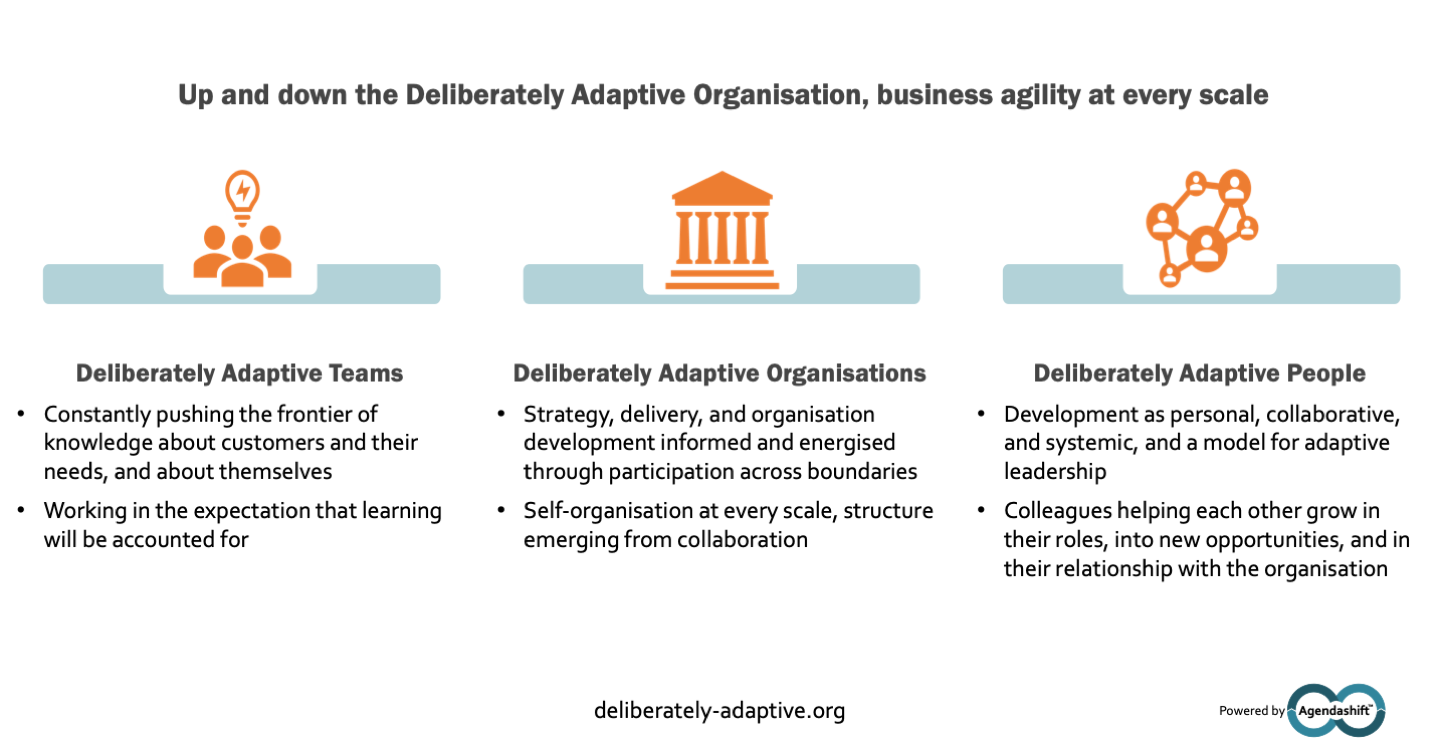
And so to the new chapter 6, Up and down the Deliberately Adaptive Organisation. This was very nearly just an appendix – a reconciliation between Agendashift and VSM – but it grew! Its name is inspired by Kegan & Lahey’s Deliberately Developmental Organisation (see An Everyone Culture: Becoming a Deliberately Developmental Organization, 2016), which despite my sometimes outspoken aversion to staged development models, maturity models, etc integrates really nicely.

This has been a very rewarding process. We’ve established some deep foundations, learned a lot, tweaked the language a bit, and found that we could say something both challenging and constructive about scale. And nothing broke!

And out of it, something new that might be substantial enough to enjoy a life of its own:
deliberately-adaptive-image

The lines between Agendashift and the Deliberately Adaptive Organisation are perhaps a little blurry but I don’t mind that. If now we’re in the business of building wholehearted and deliberately adaptive organisations, Agendashift is how that happens, ‘wholehearted and deliberately adaptive’ describes what we’re aiming for, and any blurriness is a function of that mission’s internal consistency. I find that rather satisfying.

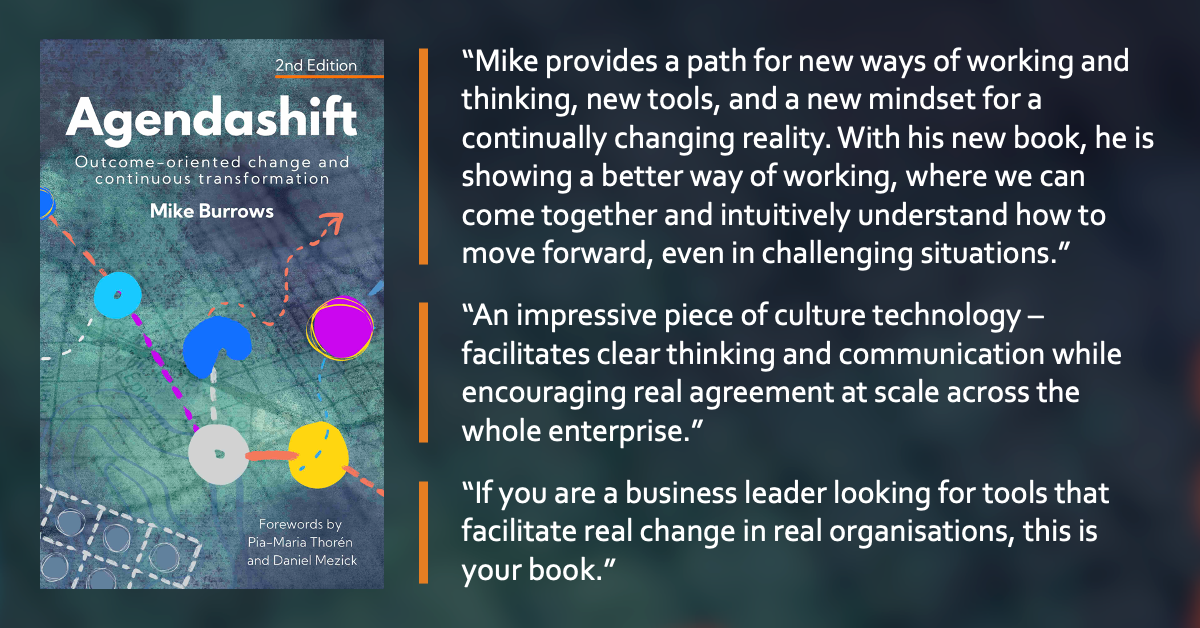
So yes, quite a lot happened since 2018. Be in no doubt, the 2nd edition of Agendashift: outcome-oriented change and continuous transformation is a big update. It’s available here:

An ePub edition is imminent also – expect to find it very soon on Apple Books, Google Play, Kobo, and elsewhere.
agendashift-2nd-ed-sharing-1200x628-2021-02-10


Upcoming workshops

The long-promised Deep Dive for the Americas is in the calendar at last and we’ve added a shorter Leading with Outcomes for APAC also:


Agendashift™, the wholehearted engagement model
Links: Home |
About | Our mission: Wholehearted | Become an Agendashift partner | Assessments | Books | Resources | Media | Events | Contact | MikeSubscribe
Workshops: Transformation strategy | Outside-in strategy | Short training
Blog: Monthly roundups | Classic posts
Community: Slack | LinkedIn group | Twitter
Eating our own dog food (3/n): Harvesting

This is the third post in what has become a series:

  1. Eating our own dog food (1/n): Our outside-in strategy review (OI-SR):
  2. Eating our own dog food (2/n): The strategy review’s assumptions
  3. Eating our own dog food (3/n): Harvesting (this post)

From the first of those posts:

What it would be like if the Agendashift partner network was making a point of eating its own dog food (so to speak), in the powerful sense that it models a lot of what it’s like to be a wholehearteddeliberately adaptive organisation, its work happening in self-organising, self-governing circles, reviewing its strategy outside in, conducting outside-in service delivery reviews, and so on.

Yesterday we started an outside-in strategy review (OI-SR). As suspected, we didn’t get through all five questions in the limited time available, just one hour. And in my haste to get started we glossed over something important: In the question (below) for layer 1. Customer, who is there “we” here?

1. Customer: What’s happening when we’re reaching the right customers, meeting their strategic needs?

If from the preceding posts you’ve seen me explore some of the assumptions behind that question, you’ll have an idea of why I’m kicking myself! The one time I didn’t kick off with the Celebration-5W exercise was the time I most needed it…

Despite that little hiccup, some great stuff was captured for the first two layers, customer and organisation. That work was done in breakout groups (5 of them); we then had a brief whole-room discussion for Product and Platform before we ran out of time.

1. Customer

Who are those “right customers”?

  • Organisations that have the need and desire for change but not the know-how
  • Organisations that are stuck, needing clarity about their situation (framing their obstacles in ways that will help them get past them), wider perspectives, more options
  • Organisations that want to create shared awareness and from that define a way forward
  • Organisations that have suffered a bad experience of change and are looking for a better way
  • Organisations that want to adapt and innovate faster
  • Pioneers or those who have gone full circle – ready to get past the the “doing Agile” vs “being Agile” thing
  • Leaders willing to engage, organisations committed to supporting that
  • Leaders with skin in the game, taking responsibility

Their struggles:

  • Repeated attempts at change that don’t stick
  • The feeling that they have plateaued
  • Feelings of overwhelm and helplessness, no longer owners of their own destiny

Wrong customers:

  • Those unable to think beyond the linear project (not meant judgmentally – paradigm shifts are hard) 
  • Those unwilling to experiment (ditto – risk appetites differ, sometimes with good reason)
  • Those who want it all done for them (and again – old habits die hard)

Over-investing in these “wrong customers” in the short term would  waste of not just our time but theirs. However, we’re not writing them off. Their struggles are real enough, and the long game here is to inform the passive and (later) active seekers of help.

2. Organisation

When that customer part is working at its ideal best, what must be happening on our side? Answers below organised by circle (this was a two-part exercise):

  • Learning & other self-help:
    • Helping each other by sharing experiences of what did and didn’t work
    • Case studies (valuable also for marketing), “Agendashift from the Trenches” (see footnote later under Product)
    • Building the confidence of partners with less experience
    • How-to’s for engagement proposals and other commercial aspects
  • Content development & curation
    • Tools, exercises, models, etc
  • Marketing
    • Events
    • Other launches
    • Promotion generally
  • Domain-specific, for example:
    • SMEs
    • DevOps
    • Role-specific, eg senior leadership

3. Product

We really only had the time to discuss stuff that’s already in the pipeline or beyond:

  • The 2nd edition of Agendashift – very close to being able to announce a publication date
  • A conference (our first) to celebrate that
  • Self-paced learning options
  • The assessment tools:
    • Continuing some great work done on the language of the mini assessment and extending it to the full version
    • Two new assessment tools for the 1) wholehearted and 2) deliberately adaptive organisation
    • Doing a better job of promoting something we’re rightly proud of!

And a footnote on “Agendashift from the Trenches” (see 2. Organisation above): I wasn’t part of this breakout conversation but I have shared with the 2nd edition’s review team an idea for a collaborative book project. I’m thinking Wholehearted: Up and down the deliberately adaptive organisation, two key models from the 2nd edition brought to life through experience reports.

4. Platform

Some discussion (not completely conclusive) on technologies to support the work of those circles.

Despite my initial oversight, that’s a good haul for just one hour’s discussion – the outside-in structure delivers again! And let me repeat: If this kind of strategy review could work for you, do get in touch.


Upcoming

Tomorrow’s workshop below is nearly sold out but I’ve added another for early May. Keeping April free for book-related stuff!

All the usual discounts apply: repeat visits (not uncommon), partners, gov, edu, non-profit, country, un- or under-employment, bulk orders. If you think that one might apply to you, do please ask. Many of those considerations apply to private workshops also.

For the Deep Dive especially, if you think that you might become an Agendashift partner, partner discounts make it well worthwhile to get on board before you sign up to the workshop.


Agendashift™, the wholehearted engagement model
Links: Home |
About | Our mission: Wholehearted | Become an Agendashift partner | Assessments | Books | Resources | Media | Events | Contact | MikeSubscribe
Workshops: Transformation strategy | Outside-in strategy | Short training
Blog: Monthly roundups | Classic posts
Community: Slack | LinkedIn group | Twitter
Eating our own dog food (2/n): The strategy review’s assumptions

Update: This has become a series:

  1. Eating our own dog food (1/n) Our outside-in strategy review
  2. Eating our own dog food (2/n): The strategy review’s assumptions (this post)
  3. Eating our own dog food (3/n): Harvesting

Graham Hill asks in response to Monday’s Eating our own dog food (1/n): Our outside-in strategy review (OI-SR):

Competitors? (source – linkedin.com)

Great question! 

The five main questions of our outside-in strategy review (OI-SR) are worded to be non-prescriptive – to the point of generative – but that doesn’t mean they don’t hide some assumptions. Some were called out in that initial post but there are others. Moreover, identifying assumptions like this is a really helpful facilitation technique; through them the question can be unpacked and the conversation encouraged to unfold productively.

Here in full is the relevant passage from the forthcoming 2nd edition:

Assumption 1 (the first of three) is that “reaching the right customers, meeting their strategic needs” is actually worth talking about. It usually is, but it doesn’t hurt to check! And this key phrase begs three further questions:

  1. Who are those “right customers” ?
  2. What does “reaching” mean for us here?
  3. And to those “strategic needs”(their needs, our strategy – the needs that help define our mission): What are they, and how will we know that we’re meeting them?

Assumption 2 is that there is a meaningful “when”. Is there a timeframe in which those customers and their strategic needs will coincide with our ability to reach and meet them?

Assumption 3 lies in the “we” of that sentence. Why us? Why not a competitor? And for an internal strategy review, why not another organisational unit, outsource even?

Bringing those back together, it should be clear that this single question combines a stimulating and potentially provocative generative image with concepts of positioning, timing, and competition. Not the last word on mission-oriented and multi-agent competitive strategy[i], but a start!

[i] Or in other words, manoeuvre strategy, although that term is a little militaristic for some tastes. An excellent book on the corporate form is written by friends of mine: Patterns of Strategy, Patrick Hoverstadt & Lucy Loh, (Routledge, 2017)

To Graham’s question, let me address assumption 3 in the context of tomorrow’s review. Why us? Why not a competitor?

I see two main competitors to Agendashift:

  1. Other engagement models
  2. Old-school change management

Two quite distinct categories, the former representing a paradigm shift with respect to the latter. OpenSpace Agility is our most notable competition in the engagement model space, and we complement each other far more than we compete. Our respective communities overlap significantly, and there is real innovation happening right now in that intersection.

Our challenge with old-school change management is helping people understand its limitations. It is so entrenched that people still regard as “doing it properly” a model that fails repeatedly when applied to adaptive rather than technical challenges – change that’s about culture, leadership, innovation, and yes, engagement. You don’t upgrade your organisation like your upgrading your email server!

This is well understood by the workshop’s participants – Agendashift partners – for whom an important motivation for joining is the contrast between the two paradigms. Much of the challenge for the rest of tomorrow’s review lies in making sure that not just our products and services but also how we organise ourselves best amplifies that message.

Next: Eating our own dog food (3/n): Harvesting


Upcoming

Tomorrow’s workshop below is nearly sold out but I’ve added another for early May. Keeping April free for book-related stuff!

All the usual discounts apply: repeat visits (not uncommon), partners, gov, edu, non-profit, country, un- or under-employment, bulk orders. If you think that one might apply to you, do please ask. Many of those considerations apply to private workshops also.

For the Deep Dive especially, if you think that you might become an Agendashift partner, partner discounts make it well worthwhile to get on board before you sign up to the workshop.


Agendashift™, the wholehearted engagement model
Links: Home |
About | Our mission: Wholehearted | Become an Agendashift partner | Assessments | Books | Resources | Media | Events | Contact | MikeSubscribe
Workshops: Transformation strategy | Outside-in strategy | Short training
Blog: Monthly roundups | Classic posts
Community: Slack | LinkedIn group | Twitter
Eating our own dog food (1/n): Our outside-in strategy review (OI-SR)

Update: This has become a series:

  1. Eating our own dog food (1/n) Our outside-in strategy review (this post)
  2. Eating our own dog food (2/n): The strategy review’s assumptions 
  3. Eating our own dog food (3/n): Harvesting

Last Thursday we held the first of two partner meetings over Zoom, the second happening this coming Thursday. The overall plan: a discovery session (facilitated last week by Kert Peterson) and a second session that’s more about ideas for the coming months.

At last week’s session I wondered out loud what it would be like if the Agendashift partner network was making a point of eating its own dog food (so to speak), in the powerful sense that it models a lot of what it’s like to be a wholehearted and deliberately adaptive organisation, its work happening in self-organising, self-governing circles, reviewing its strategy outside in, conducting outside-in service delivery reviews, and so on.

I suggested that we were months away, but why wait? Why not make this coming session an outside-in strategy review? Why not indeed!

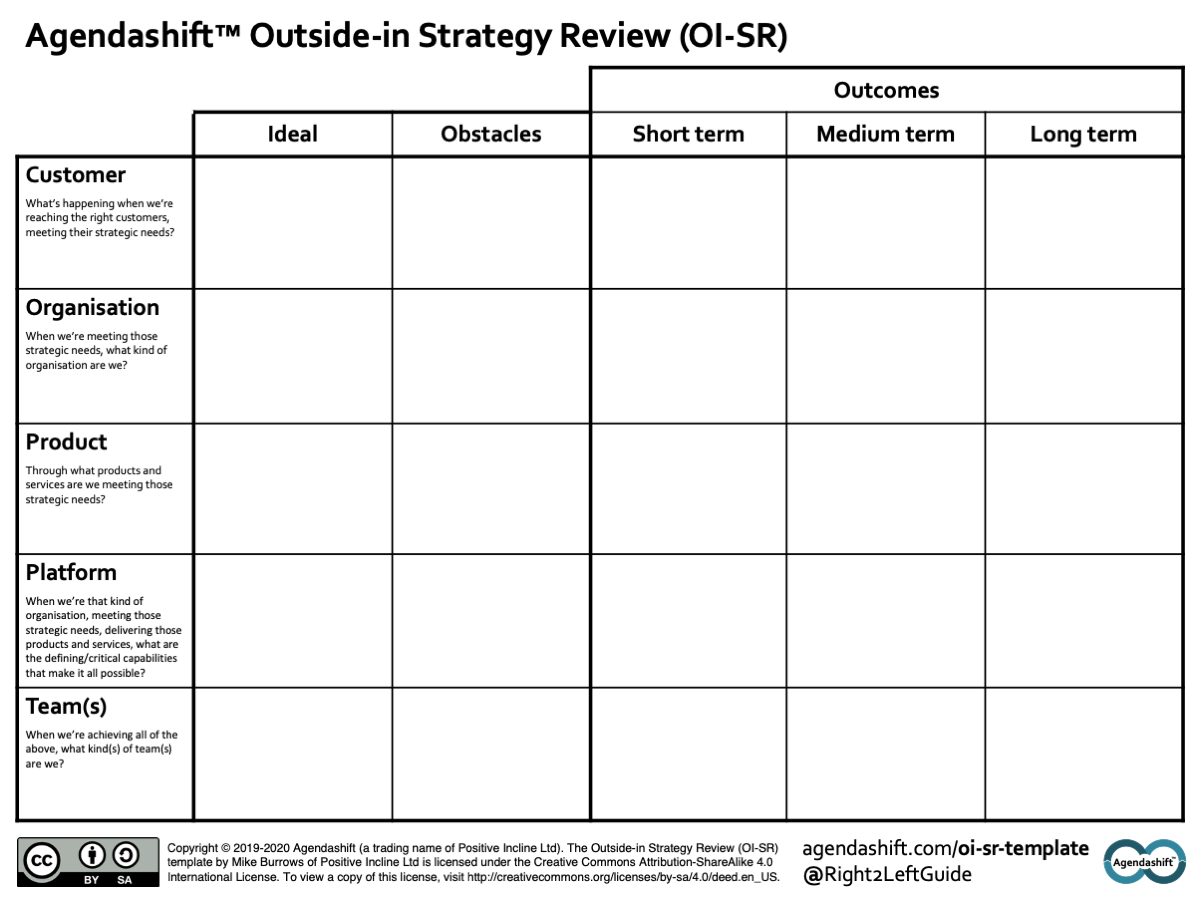
So… with more here than probably we’ll have time for, an outline. It’s pretty much the standard questions as per the template and our workshop materials, contextualised just a bit. Not shown here, by Thursday I will line up some breakout exercises to support each of the 5 layers and their corresponding questions.

1. Customer: What’s happening when we’re reaching2 the right customers1, meeting their strategic needs3?

1Who are those “right customers”?

2What does “reaching” mean for us here?

3To those “strategic needs” (their needs, our strategy – the needs that help define our mission): What are they, and how will we know that we’re meeting them? When we’re meeting them, what new stories could they tell? What is their struggle? How do we help them make progress? [1] 

A bit of a steer: The “right customers” question can be surprisingly tricky sometimes, and it certainly is for us here. Who are they? Client organisations? Their staff? Members of the partner network? Current? Prospective? Yes, all of those and perhaps more!

2. Organisation: When we’re meeting those strategic needs, what kind of organisation are we?

This one is effectively answered by this review’s context (see my preamble above), so we’ll dig down a bit. Let’s turn that “What kind of…?” question into something that’s more like a “What’s happening…?” question:

  • With that customer part happening as we’d wish, identify what activities must be happening on our side

And then:

  • What set of circles would best be responsible for those activities? (Give names to them)

For the purposes of this exercise, a circle is defined only loosely, as a self-governing group of people responsible for a domain, business, technical, functional, geographical, or whatever. For stronger definitions, see Right to Left [2], We the People [3], and the Wikipedia page for Sociocracy [4]. Right to Left remains by the way the best source for our outside-in strategy review (OR-SR); the forthcoming Agendashift 2nd edition [5] covers it too but not in the same depth.

3. Product: Through what product and services are we meeting those strategic needs?

An opportunity both to mention some things that are in the pipeline (to be announced here at the appropriate time) and to ask if we’re missing anything important.

4. Platform: When we’re that kind of organisation, meeting those strategic needs, delivering those products and services, what are the defining/critical capabilities that make it all possible?

In support of all we have discussed so far, what are we currently lacking in terms of infrastructure (technical or otherwise), intellectual property, and so on?

5. Team(s): When we’re achieving all of the above, what kind(s) of team(s) are we?

Time for another strong steer. What if part of being a wholehearted and (especially) deliberately adaptive organisation was developmental [6] at the level of individual partners and prospective partners? More widely? How do we:

  1. Help each other grow where each of us currently is?
  2. Help each other identify and grow into new opportunities?
  3. Help each other step far enough back to look with some objectivity at our relationship with the system as it is and could be?

In other words, development that’s simultaneously personal, collaborative, and systemic. Can we organise ourselves to encourage this? I think we can.

I don’t know that we’ll get through all of that – certainly not the Ideal, Obstacles, Outcomes (IdOO) bit – but it will be fun to try! And if this kind of strategy review could work for you, do get in touch.

[1] “What is their struggle? How do we help them make progress?”: This new wording is inspired by connections I’m seeing connections between our outside-in strategy review (OI-SR) and Jobs to Be Done (JTBD). See Demand-side Sales 101: Stop selling and help your customers make progress, Bob Moesta (2020, Lioncrest Publishing)
[2] Right to Left: The digital leader’s guide to Lean and Agile by yours truly (2019, audiobook 2020)
[3] We the people: Consenting to a Deeper Democracy, John Jr. Buck & Sharon Villenes (Sociocracy.info Press, second edition, 2019)
[4] en.wikipedia.org/wiki/Sociocracy
[5] Agendashift: Outcome-oriented change and continuous transformation (2nd edition due March 2021)
[6] An Everyone Culture: Becoming a Deliberately Developmental Organization, Robert Kegan & Lisa Laskow Lahey (Harvard Business Review, 2016)

Next: Eating our own dog food (2/n): The strategy review’s assumptions


Upcoming

Tomorrow’s workshop below is nearly sold out but I’ve added another for early May. Keeping April free for book-related stuff!

All the usual discounts apply: repeat visits (not uncommon), partners, gov, edu, non-profit, country, un- or under-employment, bulk orders. If you think that one might apply to you, do please ask. Many of those considerations apply to private workshops also.

For the Deep Dive especially, if you think that you might become an Agendashift partner, partner discounts make it well worthwhile to get on board before you sign up to the workshop.


Agendashift™, the wholehearted engagement model
Links: Home |
About | Our mission: Wholehearted | Become an Agendashift partner | Assessments | Books | Resources | Media | Events | Contact | MikeSubscribe
Workshops: Transformation strategy | Outside-in strategy | Short training
Blog: Monthly roundups | Classic posts
Community: Slack | LinkedIn group | Twitter

What’s new in the February Deep Dive workshop

February’s Agendashift Deep Dive isn’t just the first of the year, it’s the first since I delivered the manuscript for the 2nd edition (publication is due in March). The revision process has helped me identify a number of improvements to the workshop materials. More significantly – and as I mentioned in my previous post on strategy [1] – we have been digging some deep foundations in systems, organisation, and personal development over the past 18 months or so, work of a kind that takes its time to feed through.

There are two main elements coming now to the foreground. One is pre-existing, familiar to followers of this blog, and receiving an upgrade; the other is new. But before I introduce them, a reminder of what Agendashift is: it’s an engagement model. And what does an engagement model do? My definition [2] states that they have three jobs to do:

  1. To structure and support the work of those that would encourage innovation, change, and transformation
  2. To help the organisation engage its staff meaningfully in change-related work
  3. To keep the the organisation’s parts engaged with each other as they change

Visualised:

2021-01-18-engagment-model

The upgraded and new elements in Agendashift speak to the Organisation box in that picture:

  1. Wholehearted, our mission [3]
  2. The Deliberately Adaptive Organisation, a non-prescriptive but still powerfully diagnostic model of business agility

In the 2nd edition you will see Wholehearted reconciled to two foundational models, Bushe & Marshak’s Generative Change Model [4] and Stafford Beer’s classic Viable System Model (VSM) [5]. Out of that reconciliation come a number of base assumptions [6] that Deep Dive participants will have the opportunity to validate, reject, or reflect on. (I’ll share them here once the book’s out.)

Book-wise I nearly left it there, but after sketching out an appendix with more detail on how that reconciliation worked, I felt compelled to add a whole new final chapter, Up and down the Deliberately Adaptive Organisation, a title inspired by Robert Kegan & Lisa Laskow Lahey’s Deliberately Developmental Organisation [6]. My model plugs theirs, Agendashift, Sociocracy [7], and OKR [8] into VSM. Thanks to the way that VSM scales – fractally – the combination is able not only to describe team-level, organisational-level, and people-level agility in one self-similar model, it reveals some of the organisational issues that Agile delivery frameworks either ignore or exacerbate [9].

For the Deep Dive, the Deliberately Adaptive Organisation helps to put several of our tools into better perspective, including:

I may also add an exercise on those scaling issues.

Details of that February Deep Dive:

And before that:

For all three workshops, all the usual discounts apply: repeat visits (not uncommon), partners, gov, edu, non-profit, country, un- or under-employment, bulk orders. If you think that one might apply to you, do please ask. Many of those considerations apply to private workshops also.

For the Deep Dive especially, if you think that you might become an Agendashift partner, partner discounts make it well worthwhile to get on board before you sign up to the workshop.

References

[1] If you are not already engaging on strategy, the time to get serious is now (January)
[2] agendashift.com/about
[3] agendashift.com/wholehearted
[4] The Dynamics of Generative Change, Gervase Bushe, Gervase R. Bushe, (BMI Publishing, 2020)
[5] The Fractal Organization: Creating Sustainable Organizations with the Viable System Model, Patrick Hoverstadt, (John Wiley & Sons, 2008)
[6] Organizational Culture and Leadership, Edgar H. Schein, (Jossey Bass, 5th edition, 2016)
[7] An Everyone Culture: Becoming a Deliberately Developmental Organization, Robert Kegan & Lisa Laskow Lahey, (Harvard Business Review, 2016)
[8] We the people: Consenting to a Deeper Democracy, John Jr. Buck & Sharon Villenes, (Sociocracy.info Press, second edition, 2019)
[9] What the (Lean-)Agile scaling frameworks don’t give you (December)


Agendashift™, the wholehearted engagement model
Links: Home |
About | Our mission: Wholehearted | Become an Agendashift partner | Assessments | Books | Resources | Media | Events | Contact | MikeSubscribe
Workshops: Transformation strategy | Outside-in strategy | Short training
Blog: Monthly roundups | Classic posts
Community: Slack | LinkedIn group | Twitter