Neat hierarchies vs self-expressed strategy

Oh dear, a “vs” in the title on a subject where perhaps some nuance is called for. My apologies – naming is hard – but then again, on this topic I do take a strong and (I suspect) non-mainstream position.

Last week I put this question to LinkedIn:

At scale [across multiple organisational units], do you:
1) maintain neat hierarchical work breakdown structures (saga, epic, feature, story, task, perhaps)
Or 2) allow each level and each unit within – down to team if not individual level – to express their respective strategies in their own language as they are fit?

To be clear, the intention behind this question is not about terminology (not method-level terminology at least)

Quite a range of answers, many of them describing organisations that were much closer to one extreme than the other, with aspirations to reverse the situation. The really funny thing: this went in both directions. People working with neat hierarchies aspiring to greater self-organisation, and people at that end aspiring to consistency and to what they saw as a source of alignment.

So where am I on this? Pieter Mulder’s comment represents my thoughts pretty well:

My opinion is very much that point 1 will only let you scale so far and it must take a heck of a lot of effort to maintain that as you continue to scale and it comes with risk when teams or individuals don’t conform and the whole system breaks down – also, who decides the structures and how do you change them when they don’t work? Point 2 can scale infinitely as the decision-making and accountability sits much lower down so it is much easier to optimise the system (smaller experiments, smaller tweaks, smaller risk to the whole).

Teams are living organisms which are never the same. What works for one team doesn’t always work for another (even if they are seemingly identical).

I am completely biased as I have never seen 1 work well (and have seen it fail or frustrate too many times) and I have seen 2 work really well.

Late 90’s, before Agile was even a thing, two investment bank projects sealed it for me.

The first of these projects impacted borrowers and lenders of fixed income securities in the UK (Gilts most especially) and was sponsored by the Bank of England. I was hired as a contract developer into the relevant front office team and was surprised (in a very good way) about how things were organised. Quickly I found myself taking the lead in agreeing interchange protocols with middle and back office systems and we all got on with our work. For the purpose of this project, each system had its champions in various parts of the business, and between us all we worked out how testing would be conducted, both separately and integrated. Project managers meanwhile stayed mainly out of our way, looking after the BoE relationship. On launch night we converted literally billions of pounds worth of stock between old and new trade models, and one minor hiccup aside (fixed in minutes), we were live. My first experience of a “front-to-back” project was a very positive one.

Since many of my front office colleagues preferred more trading-focussed projects it wasn’t surprising that I found myself as the front office tech lead for another front-to-back project, completely rewriting a mission critical system in the year leading up to the launch of the Euro. What would have been a high profile project at any time became a truly high stakes project. And the really great thing: we followed much the same model but with two enhancements:

  1. Even greater business involvement, to the extent that across all impacted systems (of which there were several), people co-opted from “line” jobs to work as subject matter experts and testers easily outnumbered the developers
  2. An early focus on testing (one of my first bits of development helped to make testing a largely self-service activity, a few hours coding that paid for itself countless times over), supporting a highly engaged and iterative process

In early autumn we went into parallel running, started migrating trading books a few at a time and then in larger numbers until we were fully live. Not only were we ready in good time for the Euro conversion, we were earlier than anyone’s best predictions!

20-25 years have passed since those projects and despite all I’ve experienced since, there’s very little that I would change about them. And if self-organisation can work on projects of such scale and significance, why is it not more the norm? Or perhaps it is, but we don’t like to own up to something that looks messy, and surely those nice, neat hierarchies are what counts for “doing it properly” these days?

In more recent years my opinions have only hardened. I know that context is everything, but show me a beautifully-groomed backlog and two worries spring immediately to my mind:

  • When the work gets to the front of the queue, will it still be relevant?
  • How much does it cost to incorporate everything that’s been learned meanwhile?

To make that learning process work at scale and speed, you’ve got to be truly exceptional. For the unexceptional – and I’m referencing Right to Left here – the big risk is that you end up ploughing through backlogs of requirements, a mediocre experience leading to mediocre results, hardly Agile at all (if that’s a goal).

More recently still, and in the process of appreciating and integrating models as diverse as OKR, Viable System Model, Sociocracy, and Leader-Leader, I keep landing on a common theme: autonomous teams (and other organisational units) each expressing strategy in their own words, strategies negotiated, developed, and aligned through collaboration and participation.

To the top-down extreme, in the Agendashift 2nd edition (due later this month) I express my feelings thus:

It’s a funny kind of autonomy when strategy is something that happens to you. [And] it’s a funny kind of adaptive strategy if it doesn’t know how to listen.

Again, to make a hierarchical approach work effectively at scale and speed, you’ve got to be truly exceptional. Maybe you are; more likely you are not. Whether or not you are, please let’s agree not to describe it as the default “doing it properly” approach to which all Agile organisations should aspire.

While we wait for the 2nd edition (subscribe here for news), let me recommend Allan Kelly’s Succeeding with OKRs in Agile: How to create & deliver objectives & key results for teams, foreword by yours truly. Highly relevant to this topic!

Related:


Agendashift™, the wholehearted engagement model
Links: Home |
About | Our mission: Wholehearted | Become an Agendashift partner | Assessments | Books | Resources | Media | Events | Contact | MikeSubscribe
Workshops: Transformation strategy | Outside-in strategy | Short training
Blog: Monthly roundups | Classic posts
Community: Slack | LinkedIn group | Twitter
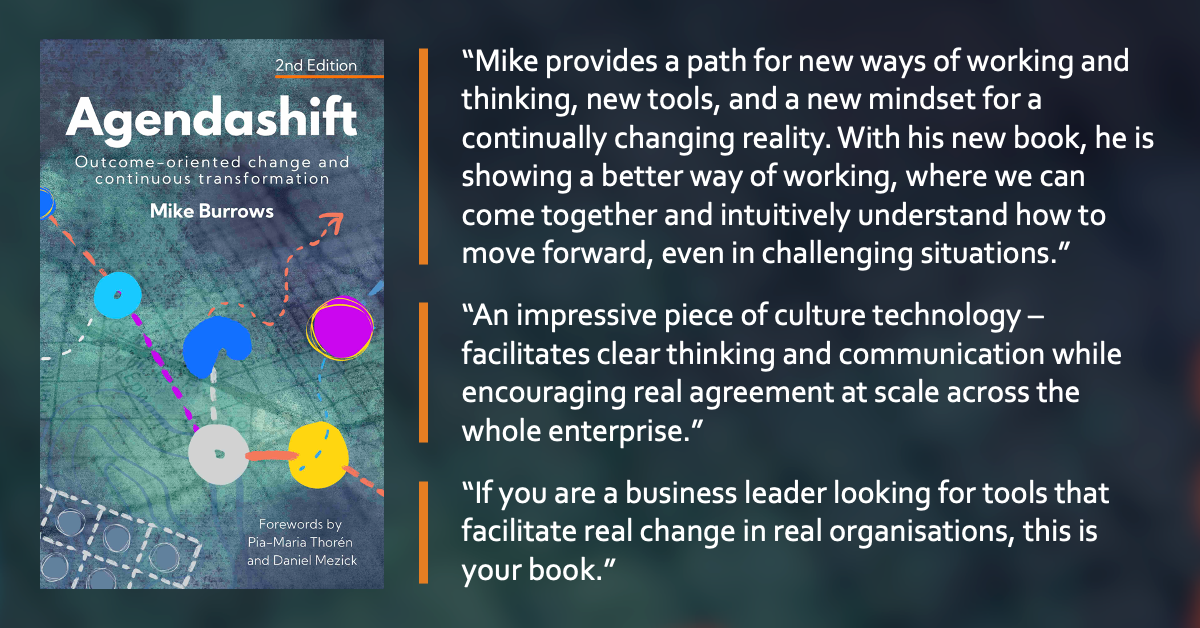
Coming soon, the 2nd edition!https://www.agendashift.com/books/agendashift-2nd-edition

Updates to the Agendashift True North exercise

An update to material that has served us very well for a long time! A True North for Lean-Agile? was posted in 2017, and my last update to the material is nearly a year old although not announced until last August with True North, tweaked.

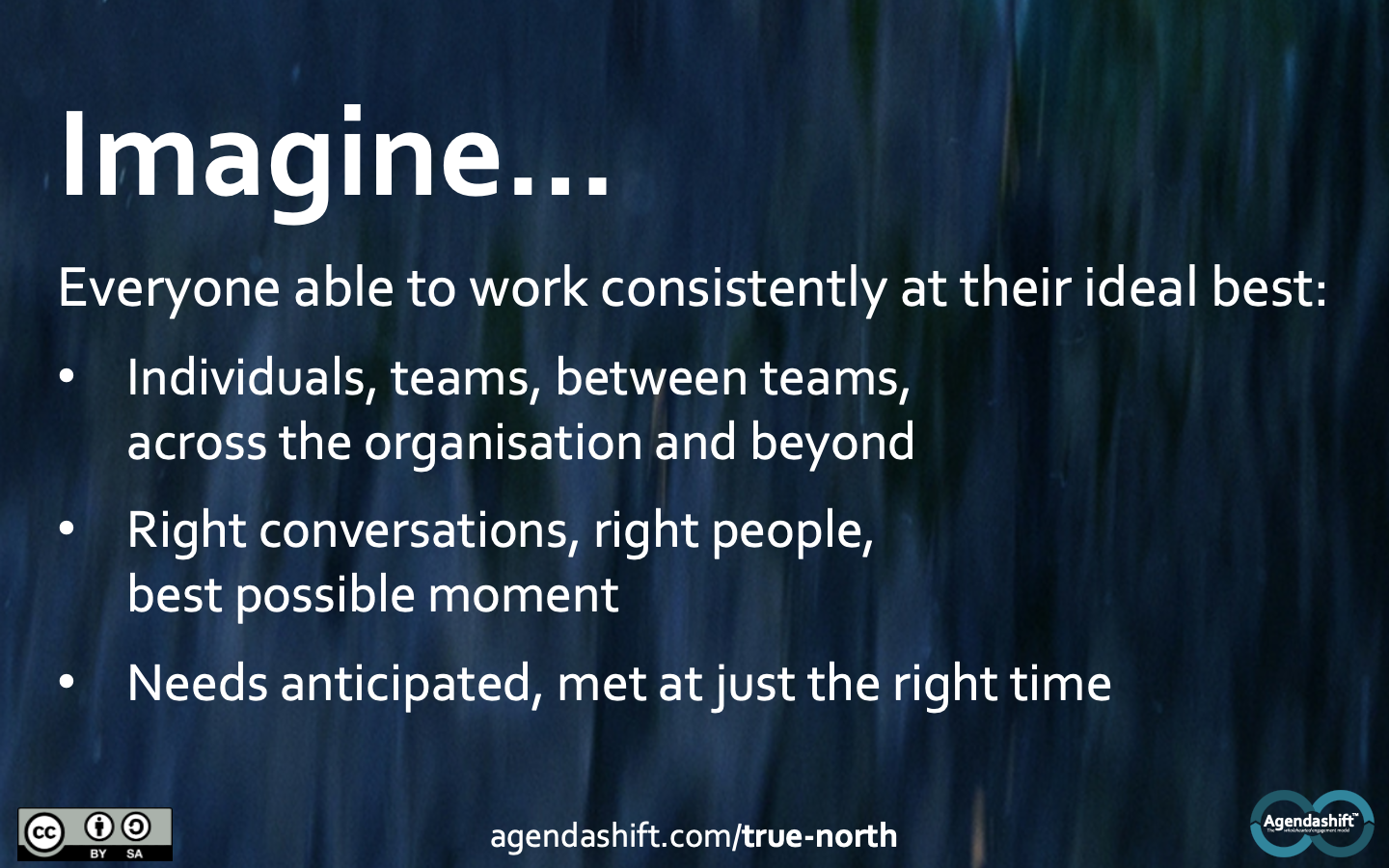
The Agendashift True North statement remains unchanged this time:

true-north-2020-08-12

What have changed are two of the setup questions, questions that gently lead participants through a Discovery discussion (usually in breakout groups, perhaps 1-2-4-All style). Previously:

  • (When that’s happening) What new stories could we tell?
  • In those those stories, whose needs are we meeting?

Now:

  • (When that’s happening) Whose needs would we be meeting?
  • What new stories could they tell?

I’ve done more than just swap those bullets around. Notice that the storytellers have changed: what was “we”, is now “they”. The change is subtle, but it does a better job of directing attention to what’s happening when needs are being met, when (to use JTBD language) we’re helping people make progress in what today are their moments of struggle.

I’ve put the complete set of setup questions in the facilitation deck – two versions of them in fact, one intended for workshop settings and one more suited to less formal occasions, meetups and the like. The deck is published under Creative Commons (CC-BY-SA) license and you can obtain it via the True North page. Be my guest!


What if we put agreement on outcomes ahead of solutions?

Agendashift™: Serving the transforming organisation
Agendashift  Academy: Leading with OutcomesHome | Store

Links: Home | Subscribe | Become an Agendashift partner Events | Contact | Mike
Resources: Tools & Materials | Media | Books | Assessments
Blog: Monthly roundups | Classic posts
Community: Slack | LinkedIn group | Twitter

Eating our own dog food (3/n): Harvesting

This is the third post in what has become a series:

  1. Eating our own dog food (1/n): Our outside-in strategy review (OI-SR):
  2. Eating our own dog food (2/n): The strategy review’s assumptions
  3. Eating our own dog food (3/n): Harvesting (this post)

From the first of those posts:

What it would be like if the Agendashift partner network was making a point of eating its own dog food (so to speak), in the powerful sense that it models a lot of what it’s like to be a wholehearteddeliberately adaptive organisation, its work happening in self-organising, self-governing circles, reviewing its strategy outside in, conducting outside-in service delivery reviews, and so on.

Yesterday we started an outside-in strategy review (OI-SR). As suspected, we didn’t get through all five questions in the limited time available, just one hour. And in my haste to get started we glossed over something important: In the question (below) for layer 1. Customer, who is there “we” here?

1. Customer: What’s happening when we’re reaching the right customers, meeting their strategic needs?

If from the preceding posts you’ve seen me explore some of the assumptions behind that question, you’ll have an idea of why I’m kicking myself! The one time I didn’t kick off with the Celebration-5W exercise was the time I most needed it…

Despite that little hiccup, some great stuff was captured for the first two layers, customer and organisation. That work was done in breakout groups (5 of them); we then had a brief whole-room discussion for Product and Platform before we ran out of time.

1. Customer

Who are those “right customers”?

  • Organisations that have the need and desire for change but not the know-how
  • Organisations that are stuck, needing clarity about their situation (framing their obstacles in ways that will help them get past them), wider perspectives, more options
  • Organisations that want to create shared awareness and from that define a way forward
  • Organisations that have suffered a bad experience of change and are looking for a better way
  • Organisations that want to adapt and innovate faster
  • Pioneers or those who have gone full circle – ready to get past the the “doing Agile” vs “being Agile” thing
  • Leaders willing to engage, organisations committed to supporting that
  • Leaders with skin in the game, taking responsibility

Their struggles:

  • Repeated attempts at change that don’t stick
  • The feeling that they have plateaued
  • Feelings of overwhelm and helplessness, no longer owners of their own destiny

Wrong customers:

  • Those unable to think beyond the linear project (not meant judgmentally – paradigm shifts are hard) 
  • Those unwilling to experiment (ditto – risk appetites differ, sometimes with good reason)
  • Those who want it all done for them (and again – old habits die hard)

Over-investing in these “wrong customers” in the short term would  waste of not just our time but theirs. However, we’re not writing them off. Their struggles are real enough, and the long game here is to inform the passive and (later) active seekers of help.

2. Organisation

When that customer part is working at its ideal best, what must be happening on our side? Answers below organised by circle (this was a two-part exercise):

  • Learning & other self-help:
    • Helping each other by sharing experiences of what did and didn’t work
    • Case studies (valuable also for marketing), “Agendashift from the Trenches” (see footnote later under Product)
    • Building the confidence of partners with less experience
    • How-to’s for engagement proposals and other commercial aspects
  • Content development & curation
    • Tools, exercises, models, etc
  • Marketing
    • Events
    • Other launches
    • Promotion generally
  • Domain-specific, for example:
    • SMEs
    • DevOps
    • Role-specific, eg senior leadership

3. Product

We really only had the time to discuss stuff that’s already in the pipeline or beyond:

  • The 2nd edition of Agendashift – very close to being able to announce a publication date
  • A conference (our first) to celebrate that
  • Self-paced learning options
  • The assessment tools:
    • Continuing some great work done on the language of the mini assessment and extending it to the full version
    • Two new assessment tools for the 1) wholehearted and 2) deliberately adaptive organisation
    • Doing a better job of promoting something we’re rightly proud of!

And a footnote on “Agendashift from the Trenches” (see 2. Organisation above): I wasn’t part of this breakout conversation but I have shared with the 2nd edition’s review team an idea for a collaborative book project. I’m thinking Wholehearted: Up and down the deliberately adaptive organisation, two key models from the 2nd edition brought to life through experience reports.

4. Platform

Some discussion (not completely conclusive) on technologies to support the work of those circles.

Despite my initial oversight, that’s a good haul for just one hour’s discussion – the outside-in structure delivers again! And let me repeat: If this kind of strategy review could work for you, do get in touch.


Upcoming

Tomorrow’s workshop below is nearly sold out but I’ve added another for early May. Keeping April free for book-related stuff!

All the usual discounts apply: repeat visits (not uncommon), partners, gov, edu, non-profit, country, un- or under-employment, bulk orders. If you think that one might apply to you, do please ask. Many of those considerations apply to private workshops also.

For the Deep Dive especially, if you think that you might become an Agendashift partner, partner discounts make it well worthwhile to get on board before you sign up to the workshop.


Agendashift™, the wholehearted engagement model
Links: Home |
About | Our mission: Wholehearted | Become an Agendashift partner | Assessments | Books | Resources | Media | Events | Contact | MikeSubscribe
Workshops: Transformation strategy | Outside-in strategy | Short training
Blog: Monthly roundups | Classic posts
Community: Slack | LinkedIn group | Twitter
Eating our own dog food (2/n): The strategy review’s assumptions

Update: This has become a series:

  1. Eating our own dog food (1/n) Our outside-in strategy review
  2. Eating our own dog food (2/n): The strategy review’s assumptions (this post)
  3. Eating our own dog food (3/n): Harvesting

Graham Hill asks in response to Monday’s Eating our own dog food (1/n): Our outside-in strategy review (OI-SR):

Competitors? (source – linkedin.com)

Great question! 

The five main questions of our outside-in strategy review (OI-SR) are worded to be non-prescriptive – to the point of generative – but that doesn’t mean they don’t hide some assumptions. Some were called out in that initial post but there are others. Moreover, identifying assumptions like this is a really helpful facilitation technique; through them the question can be unpacked and the conversation encouraged to unfold productively.

Here in full is the relevant passage from the forthcoming 2nd edition:

Assumption 1 (the first of three) is that “reaching the right customers, meeting their strategic needs” is actually worth talking about. It usually is, but it doesn’t hurt to check! And this key phrase begs three further questions:

  1. Who are those “right customers” ?
  2. What does “reaching” mean for us here?
  3. And to those “strategic needs”(their needs, our strategy – the needs that help define our mission): What are they, and how will we know that we’re meeting them?

Assumption 2 is that there is a meaningful “when”. Is there a timeframe in which those customers and their strategic needs will coincide with our ability to reach and meet them?

Assumption 3 lies in the “we” of that sentence. Why us? Why not a competitor? And for an internal strategy review, why not another organisational unit, outsource even?

Bringing those back together, it should be clear that this single question combines a stimulating and potentially provocative generative image with concepts of positioning, timing, and competition. Not the last word on mission-oriented and multi-agent competitive strategy[i], but a start!

[i] Or in other words, manoeuvre strategy, although that term is a little militaristic for some tastes. An excellent book on the corporate form is written by friends of mine: Patterns of Strategy, Patrick Hoverstadt & Lucy Loh, (Routledge, 2017)

To Graham’s question, let me address assumption 3 in the context of tomorrow’s review. Why us? Why not a competitor?

I see two main competitors to Agendashift:

  1. Other engagement models
  2. Old-school change management

Two quite distinct categories, the former representing a paradigm shift with respect to the latter. OpenSpace Agility is our most notable competition in the engagement model space, and we complement each other far more than we compete. Our respective communities overlap significantly, and there is real innovation happening right now in that intersection.

Our challenge with old-school change management is helping people understand its limitations. It is so entrenched that people still regard as “doing it properly” a model that fails repeatedly when applied to adaptive rather than technical challenges – change that’s about culture, leadership, innovation, and yes, engagement. You don’t upgrade your organisation like your upgrading your email server!

This is well understood by the workshop’s participants – Agendashift partners – for whom an important motivation for joining is the contrast between the two paradigms. Much of the challenge for the rest of tomorrow’s review lies in making sure that not just our products and services but also how we organise ourselves best amplifies that message.

Next: Eating our own dog food (3/n): Harvesting


Upcoming

Tomorrow’s workshop below is nearly sold out but I’ve added another for early May. Keeping April free for book-related stuff!

All the usual discounts apply: repeat visits (not uncommon), partners, gov, edu, non-profit, country, un- or under-employment, bulk orders. If you think that one might apply to you, do please ask. Many of those considerations apply to private workshops also.

For the Deep Dive especially, if you think that you might become an Agendashift partner, partner discounts make it well worthwhile to get on board before you sign up to the workshop.


Agendashift™, the wholehearted engagement model
Links: Home |
About | Our mission: Wholehearted | Become an Agendashift partner | Assessments | Books | Resources | Media | Events | Contact | MikeSubscribe
Workshops: Transformation strategy | Outside-in strategy | Short training
Blog: Monthly roundups | Classic posts
Community: Slack | LinkedIn group | Twitter
Eating our own dog food (1/n): Our outside-in strategy review (OI-SR)

Update: This has become a series:

  1. Eating our own dog food (1/n) Our outside-in strategy review (this post)
  2. Eating our own dog food (2/n): The strategy review’s assumptions 
  3. Eating our own dog food (3/n): Harvesting

Last Thursday we held the first of two partner meetings over Zoom, the second happening this coming Thursday. The overall plan: a discovery session (facilitated last week by Kert Peterson) and a second session that’s more about ideas for the coming months.

At last week’s session I wondered out loud what it would be like if the Agendashift partner network was making a point of eating its own dog food (so to speak), in the powerful sense that it models a lot of what it’s like to be a wholehearted and deliberately adaptive organisation, its work happening in self-organising, self-governing circles, reviewing its strategy outside in, conducting outside-in service delivery reviews, and so on.

I suggested that we were months away, but why wait? Why not make this coming session an outside-in strategy review? Why not indeed!

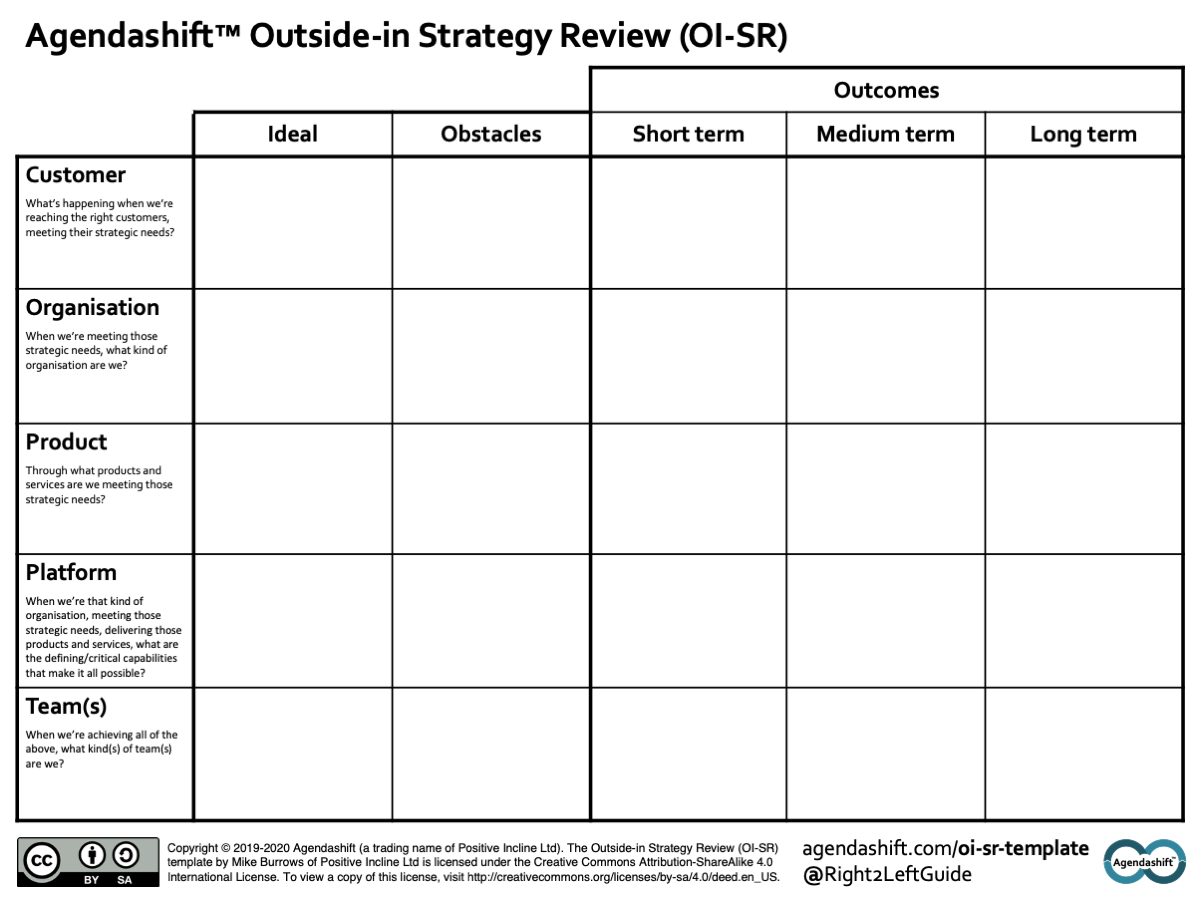
So… with more here than probably we’ll have time for, an outline. It’s pretty much the standard questions as per the template and our workshop materials, contextualised just a bit. Not shown here, by Thursday I will line up some breakout exercises to support each of the 5 layers and their corresponding questions.

1. Customer: What’s happening when we’re reaching2 the right customers1, meeting their strategic needs3?

1Who are those “right customers”?

2What does “reaching” mean for us here?

3To those “strategic needs” (their needs, our strategy – the needs that help define our mission): What are they, and how will we know that we’re meeting them? When we’re meeting them, what new stories could they tell? What is their struggle? How do we help them make progress? [1] 

A bit of a steer: The “right customers” question can be surprisingly tricky sometimes, and it certainly is for us here. Who are they? Client organisations? Their staff? Members of the partner network? Current? Prospective? Yes, all of those and perhaps more!

2. Organisation: When we’re meeting those strategic needs, what kind of organisation are we?

This one is effectively answered by this review’s context (see my preamble above), so we’ll dig down a bit. Let’s turn that “What kind of…?” question into something that’s more like a “What’s happening…?” question:

  • With that customer part happening as we’d wish, identify what activities must be happening on our side

And then:

  • What set of circles would best be responsible for those activities? (Give names to them)

For the purposes of this exercise, a circle is defined only loosely, as a self-governing group of people responsible for a domain, business, technical, functional, geographical, or whatever. For stronger definitions, see Right to Left [2], We the People [3], and the Wikipedia page for Sociocracy [4]. Right to Left remains by the way the best source for our outside-in strategy review (OR-SR); the forthcoming Agendashift 2nd edition [5] covers it too but not in the same depth.

3. Product: Through what product and services are we meeting those strategic needs?

An opportunity both to mention some things that are in the pipeline (to be announced here at the appropriate time) and to ask if we’re missing anything important.

4. Platform: When we’re that kind of organisation, meeting those strategic needs, delivering those products and services, what are the defining/critical capabilities that make it all possible?

In support of all we have discussed so far, what are we currently lacking in terms of infrastructure (technical or otherwise), intellectual property, and so on?

5. Team(s): When we’re achieving all of the above, what kind(s) of team(s) are we?

Time for another strong steer. What if part of being a wholehearted and (especially) deliberately adaptive organisation was developmental [6] at the level of individual partners and prospective partners? More widely? How do we:

  1. Help each other grow where each of us currently is?
  2. Help each other identify and grow into new opportunities?
  3. Help each other step far enough back to look with some objectivity at our relationship with the system as it is and could be?

In other words, development that’s simultaneously personal, collaborative, and systemic. Can we organise ourselves to encourage this? I think we can.

I don’t know that we’ll get through all of that – certainly not the Ideal, Obstacles, Outcomes (IdOO) bit – but it will be fun to try! And if this kind of strategy review could work for you, do get in touch.

[1] “What is their struggle? How do we help them make progress?”: This new wording is inspired by connections I’m seeing connections between our outside-in strategy review (OI-SR) and Jobs to Be Done (JTBD). See Demand-side Sales 101: Stop selling and help your customers make progress, Bob Moesta (2020, Lioncrest Publishing)
[2] Right to Left: The digital leader’s guide to Lean and Agile by yours truly (2019, audiobook 2020)
[3] We the people: Consenting to a Deeper Democracy, John Jr. Buck & Sharon Villenes (Sociocracy.info Press, second edition, 2019)
[4] en.wikipedia.org/wiki/Sociocracy
[5] Agendashift: Outcome-oriented change and continuous transformation (2nd edition due March 2021)
[6] An Everyone Culture: Becoming a Deliberately Developmental Organization, Robert Kegan & Lisa Laskow Lahey (Harvard Business Review, 2016)

Next: Eating our own dog food (2/n): The strategy review’s assumptions


Upcoming

Tomorrow’s workshop below is nearly sold out but I’ve added another for early May. Keeping April free for book-related stuff!

All the usual discounts apply: repeat visits (not uncommon), partners, gov, edu, non-profit, country, un- or under-employment, bulk orders. If you think that one might apply to you, do please ask. Many of those considerations apply to private workshops also.

For the Deep Dive especially, if you think that you might become an Agendashift partner, partner discounts make it well worthwhile to get on board before you sign up to the workshop.


Agendashift™, the wholehearted engagement model
Links: Home |
About | Our mission: Wholehearted | Become an Agendashift partner | Assessments | Books | Resources | Media | Events | Contact | MikeSubscribe
Workshops: Transformation strategy | Outside-in strategy | Short training
Blog: Monthly roundups | Classic posts
Community: Slack | LinkedIn group | Twitter
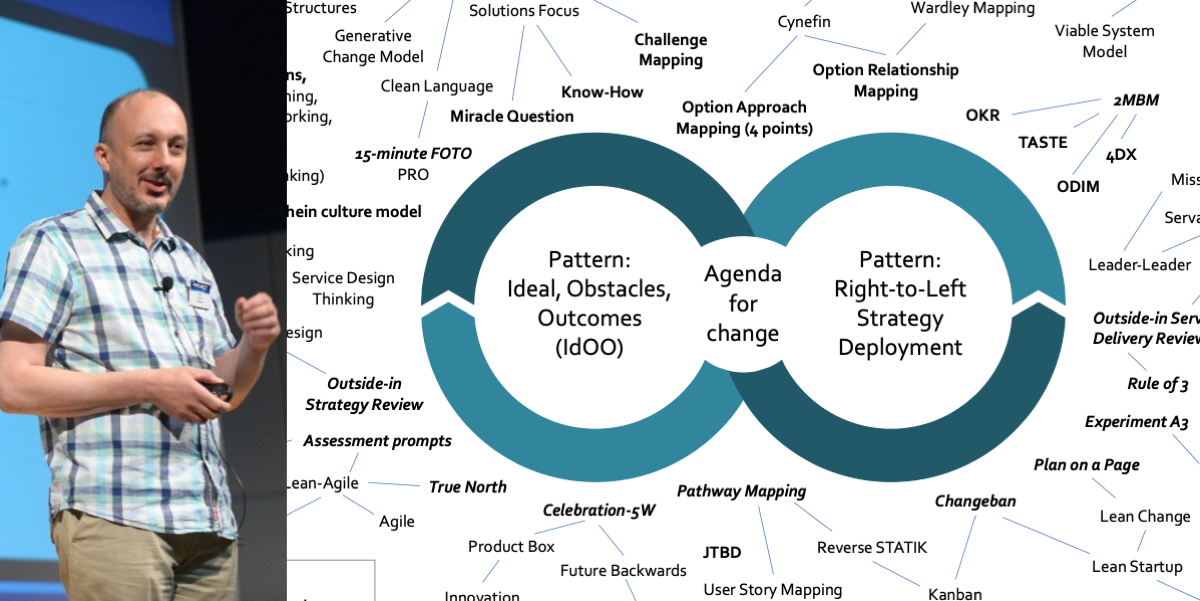
Agendashift 2020 roundup

I don’t wish to dwell for long on the pandemic but what a year! We’re still staying safe (we have a vulnerable family member so we’re ultra careful), made the clear decision to move Agendashift online very early on (pre lockdown, and not just temporarily), and in a weird way it has been highly productive. With all of that in mind, let me take this opportunity to express my sincere gratitude to everyone the Agendashift community around the world for your encouragement and inspiration through this extraordinary period. Thank you.

In this edition: A quick December roundup; Upcoming; Top posts of the year, recent and classic

A quick December roundup

Out just this week:

  1. Right to Left (2019, audiobook 2020) has been published in German. A big thank you to Chris Steindel for her translation, to the team at dpunkt.verlag for making it all happen, and to Markus Hippeli for championing the project
  2. The latest addition to the media page, I was interviewed by Ian Gill for the Agility by Nature podcast

I have meanwhile a complete draft of the Agendashift 2nd edition that I’m happy with. Very happy in fact – for me it’s now the best of my three books but we’ll see next year what the world makes of it! While we wait, reading (or listening to) Right to Left would be excellent preparation if you’ve haven’t done so already.

Work on the 2nd edition is context to my more recent blog posts. Most-read so far this month:

  1. A postscript to ‘How I Choose my Models’
  2. What the (Lean-)Agile scaling frameworks don’t always give you
  3. How I choose my models (October)
  4. What I really think about Scrum (August)
  5. The IdOO pattern meets ‘Good Obstacle, Bad Obstacle’

Finally, today’s #community Zoom is the last until January 14th. Details on Slack.

Upcoming

The workshops continue to evolve at quite a pace and watch out for some new developments next year. In the calendar for early 2021:

All the usual discounts apply: repeat visits (not uncommon), partners, gov, edu, non-profit, country, un- or under-employment, bulk orders. If you think that one might apply to you, do please ask. Most of those considerations apply to private workshops also.

For the Deep Dive especially, if you think that you might become an Agendashift partner, partner discounts make it well worthwhile to get on board before you sign up to the workshop.

Top posts for the year

Recent:

  1. What I really think about Scrum (August)
  2. #2MBM: Meaning before Metric, Measure before Method (July)
  3. I’m really enjoying Challenge Mapping (June)
  4. The language of outcomes: 1. Identifying the adaptive challenge (January) – and the rest in the series, some of which would make this list in their own right
  5. The audiobook is out! Right to Left: The digital leader’s guide to Lean and Agile (May)
  6. How I choose my models (October)
  7. Agendashift as framework (April)
  8. Still not a fan of the PDCA cycle or the continuous improvement initiative (October)
  9. Making it official: Agendashift, the wholehearted engagement model (January)
  10. Aka the ‘And when X…’ game (February)

Classic:

  1. My favourite Clean Language question (January 2019)
  2. There will be caveats: Warming cautiously to OKR (September 2019)
  3. From Reverse STATIK to a ‘Pathway’ for continuous transformation (October 2019)
  4. Stringing it together with Reverse Wardley (February 2019)
  5. How the Leader-Leader model turns Commander’s Intent upside down (June 2018)

And yes, carried over from the positiveincline blog, Introducing Kanban through its values (2013) is still going strong.


Agendashift™, the wholehearted engagement model
Links: Home |
About | Our mission: Wholehearted | Become an Agendashift partner | Assessments | Books | Resources | Media | Events | Contact | MikeSubscribe
Workshops: Transformation strategy | Outside-in strategy | Short training
Blog: Monthly roundups | Classic posts
Community: Slack | LinkedIn group | Twitter
workshop 2x1

The IdOO pattern meets ‘Good Obstacle, Bad Obstacle’

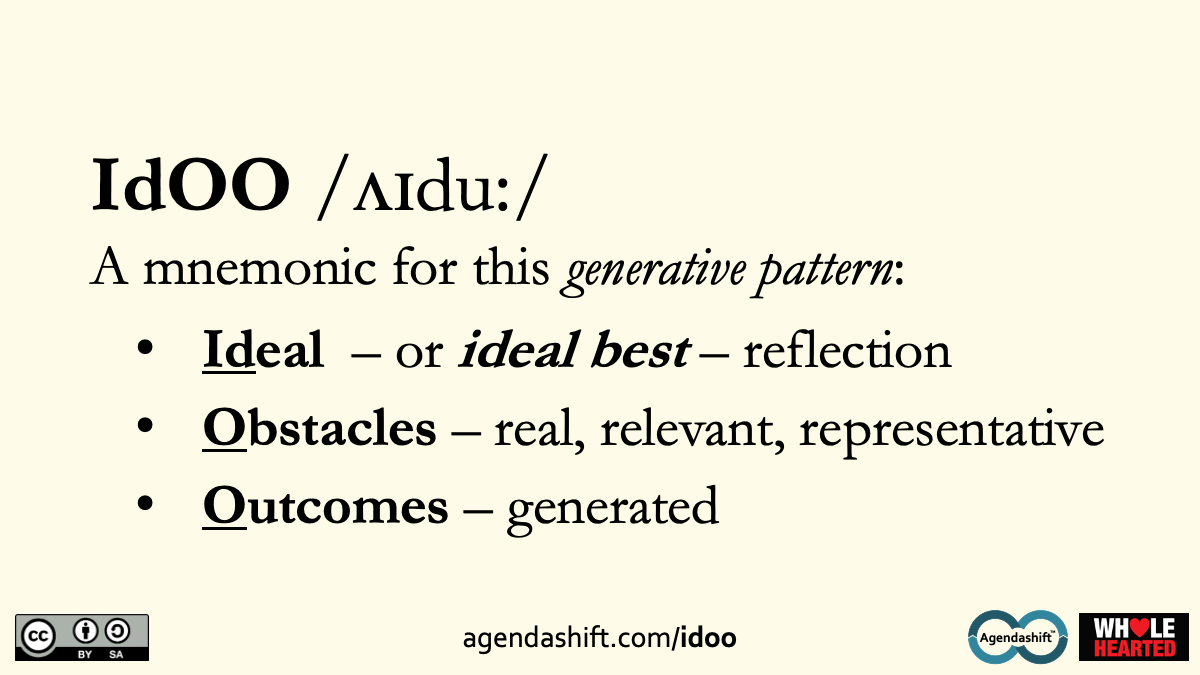
Finishing up the writing of the Agendashift 2nd edition (linkedin.com) I’ve made two updates to the IdOO pattern resource. The first is in the wording of this “definition”:

IdOO image

What’s different:

  1. “real, relevant, representative” – this is quoting Good Obstacle, Bad Obstacle [1], the name of a workshop exercise that like the IdOO pattern itself is new to the 2nd edition, also of a webinar recording and some associated resources
  2. “generated” – in case it needs to be said

Further to that second point, the IdOO deck (obtainable via the IdOO page) includes this version of the slide:

IdOO 2020 12

This is to emphasise that the generative process represented by the IdOO pattern needn’t be linear. If you’re at Outcomes, for example, “What stops that?” or “What obstacle might be in the way of that?” [2] takes you back to obstacles. From either Obstacles or Outcomes, the Challenge Mapping [3] question “Why is that important?” may take the conversation in the direction of the Ideal.

What the IdOO pattern gives you is a simple structure into which your favourite generative questions (and frameworks thereof) can be used, resulting in conversations that can be more strategic in nature than those coaching conversations whose main goal is to get to the next commitment. In the 2nd edition’s first two chapters you’ll see the Discovery and Exploration activities explained in those terms. But that’s not IdOO’s only use: it reappears as an ideation pattern too.

I can’t yet give a publication date, sorry! If you want to stay posted you can subscribe to the mailing list.

[1] Good Obstacle, Bad Obstacle (agendashift.com, video and associated resources)
[2] For a discussion on those two question forms, see The language of outcomes: 2. Framing obstacles (January 2020)
[3] See I’m really enjoying Challenge Mapping (June 2020), also some related links on the IdOO pattern page


Upcoming workshops

All the usual discounts apply: repeat visits (not uncommon), partners, gov, edu, non-profit, country, un- or under-employment, bulk orders. If you think that one might apply to you, do please ask.

And if you think that you might become an Agendashift partner, join before the Deep Dive and the partner discount on the workshop covers your membership!


Agendashift™, the wholehearted engagement model
Links: Home |
About | Our mission: Wholehearted | Become an Agendashift partner | Assessments | Books | Resources | Media | Events | Contact | MikeSubscribe
Workshops: Transformation strategy | Outside-in strategy | Short training
Blog: Monthly roundups | Classic posts
Community: Slack | LinkedIn group | Twitter

What the (Lean-)Agile scaling frameworks don’t give you

[Minor edits 2020-12-11 and again 2021-01-08 with an updated title. It is now aligned to the final version of the manuscript that went to the publisher this week] 

Not a gratuitous provocation but putting it out there for review. The text below comes from the final chapter of the forthcoming 2nd edition of Agendashift; it’s a quick first draft (written today) and I want feedback! The chapter is new to the 2nd edition; it is titled Up and down the Deliberately Adaptive Organisation and the excerpt below comes at the end of a section called Scaling up.

For context, we have by this point reconciled Agendashift with a powerful diagnostic tool, the Viable System Model (VSM). Stafford Beer’s classic model has lessons for all organisations that have the desire to “meet the demands of surviving in the changing environment”.

What the (Lean-)Agile scaling frameworks don’t give you

I can’t help noting that not everything identified in this reconciliation exercise is addressed well by the scaling frameworks. If you’re looking to one of those as the basis of your Deliberately Adaptive Organisation or (somewhat equivalently) as a model of business agility, here are five things that you may need to attend to yourself:

1. Meaningful experimentation

A worthwhile proportion – perhaps even the majority – of your delivery capacity will need to be devoted to objective-aligned insight generation. There is nothing adaptive about ploughing through backlogs of requirements and hoping for a good outcome. Random experimentation isn’t adaptive either; whilst it flexes some important muscles and can be a useful source of innovation, unless the bulk of it is meaningfully aligned to shared objectives (and driven from them in a way that creates meaning for the people doing the work), it’s unlikely to take you very far.

2. Meaningful negotiation between levels based on trust and transparency

If you’re not careful, cascading hierarchies of objectives end up as backlogs of requirements to be ploughed through, and we know where that leads. Dressing up that hierarchy in Agile terms – saga, epic, feature, story, etc – doesn’t change that.

Remember that what’s asked for, what’s needed, what’s possible, and what’s sensible are four different things. Moreover, each level will have its own language, its own way of looking at things, and its own measures of success, and it’s not helpful when one level projects (or worse, imposes) theirs onto another. Instead: trust-building transparency, then mutual understanding, then alignment.

3. Containers for multi-level, multi-loop organisational learning

I’m referring of course to your framework’s equivalent of the Outside-in Service Delivery Review (OI-SDR) and VSM system 4 more generally. How does your framework help you build and evolve shared models of the system and the world outside? How strong are the expectations of learning that it creates? How does it challenge? How does it help you monitor progress towards objectives? How does it challenge? How does it ensure that intelligence and insights are shared quickly across the organisation?

4. Meaningful participation in strategy

Let me say it again: It’s a funny kind of autonomy when strategy is something that happens to you. Now let me add that it’s a funny kind of adaptive strategy if it doesn’t know how to listen. What we have here are two organisational antipatterns that Agile frameworks – scaled or otherwise – has done little to address. Perhaps it’s unreasonable to expect that they would, but when they’re sold as transformative models of organisation I believe that some scepticism is entirely appropriate.

5. Meaningful self-organisation at every scale

Not just who does what (better described as self-management), but self-organisation as the interplay between structure and spontaneity – who collaborates with whom, at whatever scale, and with what potential. How does your framework both encourage that to happen and ensure that when it happens it is done well?

How well does your scaled (Lean-)Agile implementation demonstrate those five things? The most likely answers are “not very” or “not at all”. If you’re thinking of embarking on a framework-based scaling initiative, I would suggest that it may pay to attend to these issues first. You’ll then be in a much better position both to understand what the frameworks still have to offer and to make whatever further changes now seem necessary.

To be clear, I’m not anti-framework. To understand how a scaling framework really works is to appreciate how its patterns have been integrated, and there’s definitely value in that. But anyone thinking that it’s cool to roll out a large framework waterfall-style is living in the 1990s! Expert-driven ‘tailoring’ doesn’t fundamentally change that. Much better to use your expertise to help people experiment with combining patterns from the full range of sources at their disposal.

Related:


Upcoming workshops

All the usual discounts apply: repeat visits (not uncommon), partners, gov, edu, non-profit, country, un- or under-employment, bulk orders. If you think that one might apply to you, do please ask.

And if you’re thinking of becoming an Agendashift partner, it pays to sign up to that first (in fact it might even pay for itself).


Agendashift™, the wholehearted engagement model
Links: Home |
About | Our mission: Wholehearted | Become an Agendashift partner | Assessments | Books | Resources | Media | Events | Contact | MikeSubscribe
Workshops: Transformation strategy | Outside-in strategy | Short training
Blog: Monthly roundups | Classic posts
Community: Slack | LinkedIn group | Twitter
A postscript to ‘How I Choose my Models’

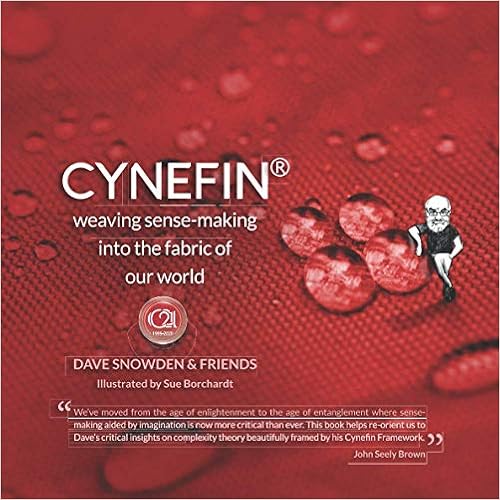
With a view to referencing it in the Agendashift 2nd edition I’ve been checking out the new Cynefin book Cynefin – Weaving Sense-Making into the Fabric of Our World (Dave Snowden & friends). It’s a book with many contributors and I wasn’t 100% sure what to expect but I’m enjoying it! If you have any interest in Cynefin I would definitely recommend it.

Despite appearances, this post isn’t about Cynefin. One contribution by Anne Caspari and Johann Entz von Zerssen really resonated with me, especially these two paragraphs from Anne (quoted with her permission):

I (Anne) come from 15 years of critical engagement with integral theory, adult development, and all kinds of change theories. When I started working with these theories and frameworks, they helped me immensely. They opened up my thinking and gave me a means to counteract both gross and subtle reductionism in practical work. This was especially helpful to me in my project management work in environmental planning and sustainability contexts. Adult development theory also helped me understand some of the phenomena I encountered in coaching and leadership work.

Over time, however, I experienced a growing scepticism around a new kind of reductionism that crept into most applications of these theories that often went unobserved by the respective communities. Examples include developmental bias (“we need to develop people”) in large parts of the integral theory scene and some very formulaic and linear applications of change theories (“step 5: find deeper meaning and purpose”).  Since this kind of uneasiness is hard to pinpoint and address, I just noticed that I kept away. I settled at the fringes of these communities and did my own thing. 

Yes! This! Exactly!

Anne’s struggle is the same as the one that triggered (via an outburst over Zoom of which I am not proud) the How I choose my models post. And the really funny thing: Andrea Chiou, the target of my outburst agrees with me. Violent agreement is a strange beast! From our Slack channel #what-i-am-reading (I pasted the above quote there as soon as I read it):

It is the ‘we need to’ of the ‘we need to develop people’ that annoys me. It separates ‘us’ from them -> increasing the gap between the ‘experts’ and the underdeveloped others.

And yes, you are doing your own thing.

It has been in fact a very interesting few weeks, one of those times when you’re really glad to be part of a diverse and supportive community with knowledge in areas I’ll never be expert in. My gut instinct hasn’t changed, I stand by every every word I wrote in How I choose my models, and yet I’ll be referencing some of that developmental stuff (caveated of course) in the 2nd edition.

The title of a new 6th and final chapter, Up and down the Deliberately Adaptive Organisation, is inspired by Robert Kegan & Lisa Lahey Laskow’s Deliberately Developmental Organisation (DDO), a model described in their interesting but slightly scary book An Everyone Culture. The surprise (not least to me) is that the DDO model comes from the same stable as Adult Development Theory, my “trigger”! I’m grateful to Jonathan Sibley for pointing me in that interesting direction, also to Teddy Zetterlund for some earlier seed-sowing.

I’ve learned that living by these three bullets of mine is harder than I thought:

  • Models that have withstood scrutiny over a length of time
  • Models that treat the individual’s agency, creativity, and problem-solving ability with the utmost respect
  • Models that help to scale up the preceding

If I’m not going to ignore a ton of potentially valuable and relevant work, there’ll be times when I will need to remind myself that the model, my reaction to it, and the reactions I observe in others or fear from them, are different things. What helps to win me – albeit cautiously – over to DDO is that this is part of the model itself. Not in an especially self-aware way methinks, but it’s a start.

A last word to Jonathan, which I apply first to myself:

A great challenge is to build a model and then hold it lightly. And sometimes, followers hold the model more tightly than the founder does!


Upcoming workshops

All the usual discounts apply: repeat visits (not uncommon), partners, gov, edu, non-profit, country, un- or under-employment, bulk orders. If you think that one might apply to you, do please ask.


Agendashift™, the wholehearted engagement model
Links: Home |
About | Our mission: Wholehearted | Become an Agendashift partner | Assessments | Books | Resources | Media | Events | Contact | MikeSubscribe
Workshops: Transformation strategy | Outside-in strategy | Short training
Blog: Monthly roundups | Classic posts
Community: Slack | LinkedIn group | Twitter
The Outside-in Service Delivery Review (OI-SDR)

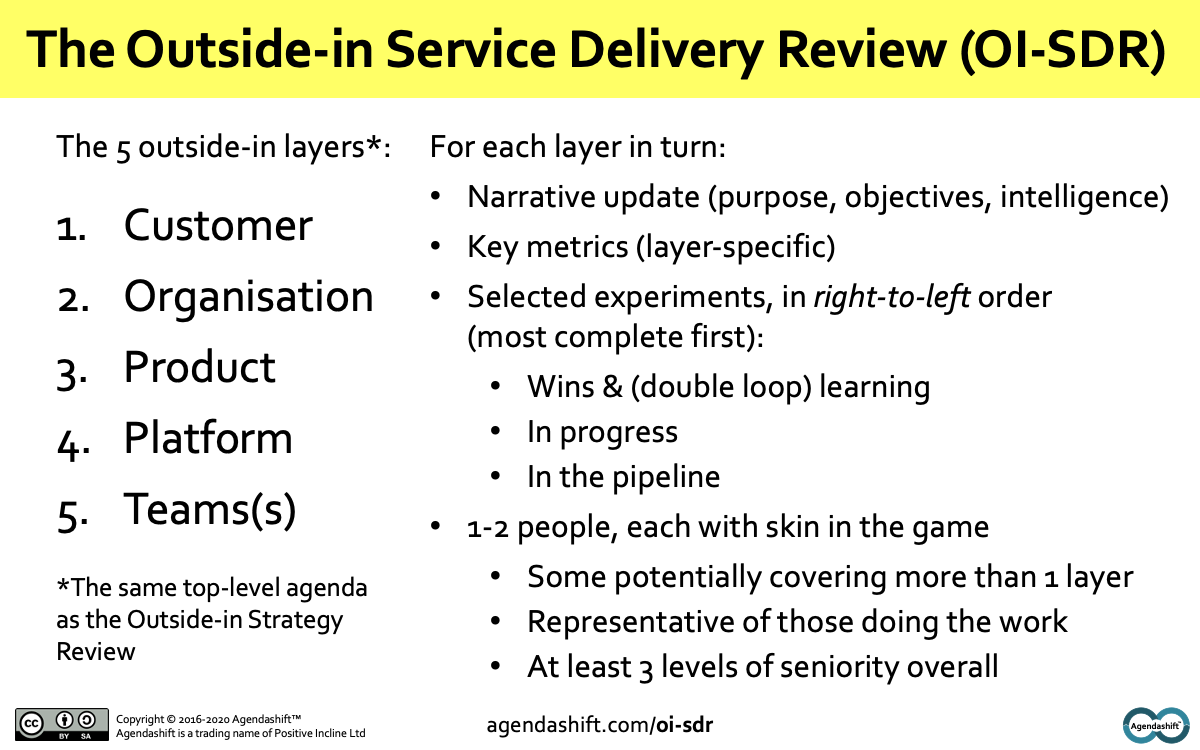
oi-sdr-slide-2020-11-07

It’s something of a work in progress but I have given the Outside-in Service Delivery Review (OI-SDR) its own page now, agendashift.com/oi-sdr, its content Creative Commons (CC-BY-SA). It’s long overdue – the OI-SDR was introduced in the 1st edition of Agendashift (2018), described more fully (with a case study) in chapter 5 of the  Right to Left: The digital leader’s guide to Lean and Agile (2019, audiobook 2020) and it will be revisited big time in the Agendashift 2nd edition due early 2021.

I don’t want to give too much away just yet but you can expect the second edition to be a lot stronger on questions of organisation, leadership, and (self-)governance than the first, and the OI-SDR is a key part of that (moreso than might be obvious at first glance). Meanwhile, there’s plenty in Right to Left if you haven’t already read that or listened to it, and the Deep Dive workshop – see Upcoming workshops below.

Related

Upcoming workshops

All the usual discounts apply: repeat visits (not uncommon), partners, gov, edu, non-profit, country, un- or under-employment, bulk orders. If you think that one might apply to you, do please ask. We have a quorum already but the more the merrier.


Agendashift™, the wholehearted engagement model
Links: Home |
About | Our mission: Wholehearted | Become an Agendashift partner | Assessments | Books | Resources | Media | Events | Contact | MikeSubscribe
Workshops: Transformation strategy | Outside-in strategy | Short training
Blog: Monthly roundups | Classic posts
Community: Slack | LinkedIn group | Twitter