Agendashift roundup, February 2022

In this edition: Leading with Outcomes: Foundation is live!; Agendashift’s three meta strategies; Upcoming events; Top posts

Leading with Outcomes: Foundation is live!

As announced earlier this month:

The short version: The “old” Leading with Outcomes (online self-paced training from the Agendashift Academy) is replaced with a foundation module, the beginnings of a new three-track curriculum. We’re very excited about it! Two and a half hours of video in tasty bitesized chunks taking you through 18 practical exercises. If by any definition you could describe yourself as being (or aspiring to being) a leader in a transforming organisation, then it’s for you – and for many of your colleagues also.

Sign up here:

Very happy with feedback so far. Happy also to report meanwhile that recording of Inside-out Strategy: Fit for maximum impact is going well. And to complement it in the Inside-out Strategy track we’ll be announcing an interactive workshop soon.

certificate-079mZeQ-07RXRNG-1920-1080

Agendashift’s three meta strategies

Or less grandly, three things to keep doing if you’re doing anything strategy-related.

It’s early days, but it seems likely to me that these will supersede the principles that in the Agendashift 2nd edition were already de-emphasised:

Upcoming events

As mentioned, we’ll start scheduling workshops again as the new Leading with Outcomes curriculum gets up and running.

Several private speaking engagements happening – can’t talk about those of course but one public one is imminent:

Top posts

This month’s top five most-read posts are the three already mentioned plus a couple of old favourites:

  1. Out of beta, Leading with Outcomes: Foundation goes fully live today
  2. Agendashift’s three meta strategies
  3. Agendashift Academy has a community on Circle
  4. The 1967 Manifesto for The Deliberately Adaptive Organisation (October 2021)
  5. My favourite Clean Language question (January 2019)

What if we put authentic agreement on meaningful outcomes ahead of solutions?

Welcome to Agendashift™, the wholehearted engagement model

Agendashift™, the wholehearted engagement model
Links: Home |
About | Our mission: Wholehearted | Become an Agendashift partner | Assessments | Books | Resources | Media | Events | Contact | MikeSubscribe
Academy: Home | Store
Blog: Monthly roundups | Classic posts
Community: Slack | LinkedIn group | Twitter

Agendashift’s three meta strategies

Or less grandly, three things to keep doing if you’re doing anything strategy-related (which, if you think about it, should be a lot of the time).

Meta strategy 1. Keep asking this question: “What if we put agreement on outcomes ahead of solutions?”

Authentic agreement on meaningful outcomes. “Authentic agreement” meaning the right people in the room, agreeing on things that matter, expressed in their own words. “Meaningful outcomes” meaning not just numbers, not just targets, but needs met, happy endings to stories, the world changed for people in meaningful ways.

Solutions second, outcomes leading the way – literally “leading with outcomes” [1] – solutions emerging from the people closest to the problem [2], people already motivated to find them.

All of that is a 180 degree turnaround from those 1990’s models of managed change, a different paradigm entirely. Instead of using outcomes to sell solutions (and very often solutions of the wrong kid of scale), we use outcomes to find solutions. Not just game-changing for engagement, a completely different game.

Meta strategy 2. Keep outcomes in the foreground; you’re ‘done’ when needs have been met, ‘really done’ when you have fully accounted for all the learning

Outcomes don’t go away once we start thinking about solutions – quite the opposite. Outcomes change what ‘done’ and ‘really done’ mean. When we account properly for learning, it creates certain expections, helping to keep ‘done’, ‘really done’, and all the outcomes they represent in the foreground. Solutions are kept in their proper place, just a means to an end, held much more lightly.

We’re done when “someone’s need was met” [3], the outcome demonstrably achieved. This implies that we know whose need we’re trying to meet, what need, and how we’d know that we have indeed met it.

We’re really done when we’ve fully accounted for all the learning that goes with achieving the outcome. To be sure of not missing any, work is framed in the right way (as hypotheses and experiments, whenever that’s appropriate), the right things are monitored, and regular reviews are in place. The regular rhythm of review and the shared understanding of what each review entails creates containers for learning. If you know that the learning will need to be accounted for, it really changes how you work.

Meta strategy 3. Keep developing your understanding of where all this happens

Where rather than how, because the third meta strategy of the three is not about practice or process, but organisation [4]. It’s about working to eliminate a common organisational dysfunction, also working to develop a kind of organsational agility that’s about so much more than mere speed.

If instead of keeping outcomes in the foreground you allow yourself to be distracted by solutions and how you’re rolling them out, you manage for progress, not impact. Compounding the error, one group manages things that people closer to the work could easily be managing for themselves. And it works in the opposite direction too: one group second-guessing the needs, priorities, and strategies of another. In short: the wrong people managing for the wrong things. Totally dysfunctional, so common, and don’t be so sure that your branded process framework or your PMO will fix it for you either!

Often this dysfunction happens between levels of organisation (up and/or down), but the trick is to think less in terms of levels or hierarchy and more in terms of identity. For an outcome, what’s the group of people most closely identified with it or that you would want to see organising around it? Conversely (and more powerfully), for any group of people with an identity of its own and the apparent will to develop itself – team, team of teams, something bigger, something cross-cutting, whatever – what are the outcomes that it is pursuing? What, in other words, is its strategy, and has it been afforded the opportunity to develop it for itself and in its own words?

That way of looking at organisation has a dynamism that’s simply not there in the org chart or the process diagram. People participating in multiple circles, circles that overlap and rapidly share learning, insights, and intelligence because they also share people. For as long as they’re needed, circles that have lives of their own. Structures that support both the development of people and the development of the organisation. Structures rich and dynamic enough to meet the ever-changing complexities of the business environment.

With this third meta strategy, the preceding two don’t just have a home, they have many homes. Strategy becomes something fractal and emergent, living in the conversations not just within circles, but between them.
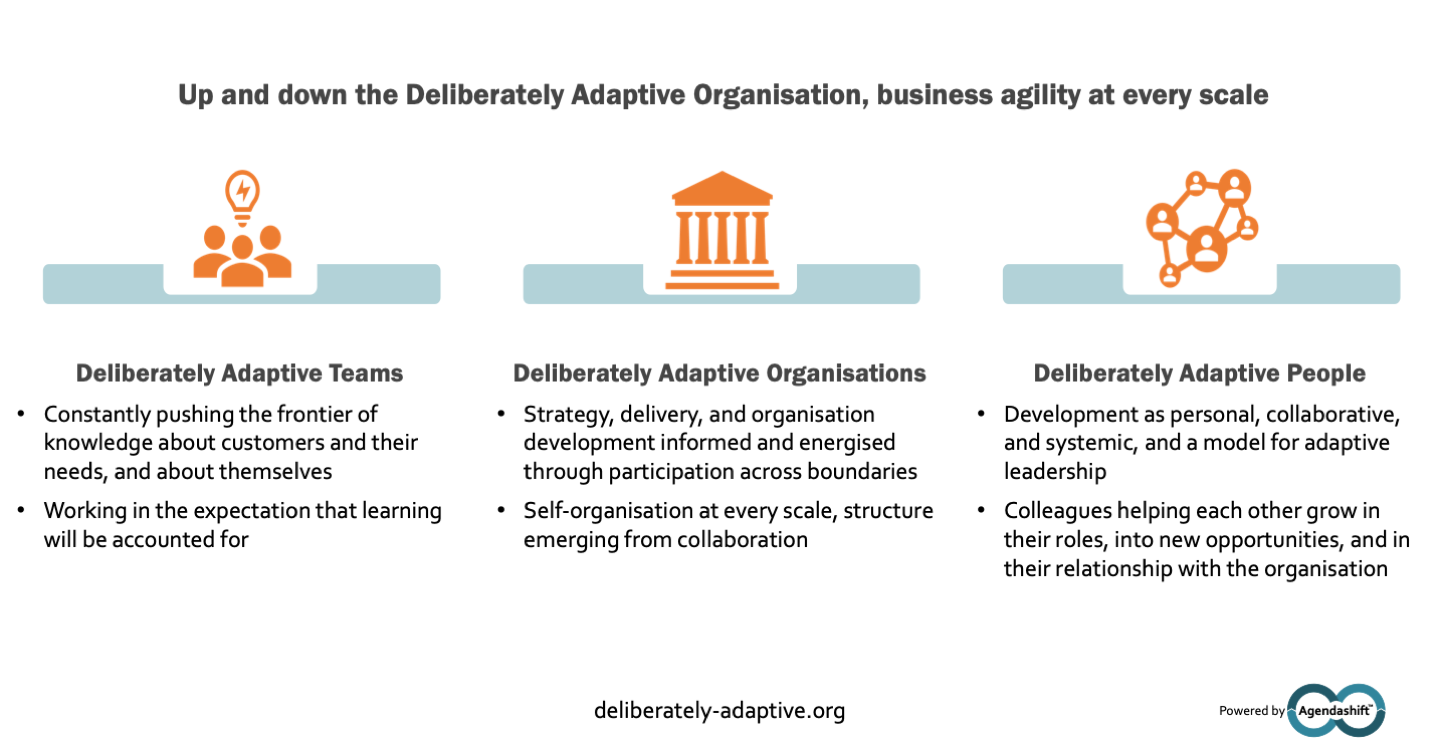
deliberately-adaptive-image

Summary

Agendashift’s three meta strategies, things to keep doing if you’re doing anything strategy-related:

  1. Keep asking this question:
    • What if we put agreement on outcomes ahead of solutions?
  2. Keep outcomes in the foreground:
    • You’re ‘done’ only when needs have been met
    • You’re ‘really done’ only when you have fully accounted for all the learning
  3. Keep developing your understanding of where all this happens:
    • Less in terms of hierarchy
    • More in terms of identity

[1] This section drawn from the first video in Leading with Outcomes: Foundation (academy.agendashift.com)
[2] Thank you Karl Scotland for that wording
[3] See Done (agendashift.com/done)
[4] See the Deliberately Adaptive Organisation (deliberately-adaptive.org)

For further reading, my two most recent books:

  1. Agendashift: Outcome-oriented change and continuous transformation (2nd ed 2021)
  2. Right to Left: The digital leader’s guide to Lean and Agile (2019, audibook 2020)

What if we put authentic agreement on meaningful outcomes ahead of solutions?

Welcome to Agendashift™, the wholehearted engagement model

Agendashift™, the wholehearted engagement model
Links: Home |
About | Our mission: Wholehearted | Become an Agendashift partner | Assessments | Books | Resources | Media | Events | Contact | MikeSubscribe
Academy: Home | Store
Blog: Monthly roundups | Classic posts
Community: Slack | LinkedIn group | Twitter

What if we put agreement on outcomes ahead of solutions?

Agendashift™: Serving the transforming organisation
Agendashift  Academy: Leading with OutcomesHome | Store

Links: Home | Subscribe | Become an Agendashift partner Events | Contact | Mike
Resources: Tools & Materials | Media | Books | Assessments 
Blog: Monthly roundups | Classic posts
Community: Slack | LinkedIn group | Twitter
Agendashift Academy has a community on Circle

For students and supporters of the Agendashift Academy (“Leadership and strategy in the transforming organisation”) there is now a community on Circle. Regardless of your role or level of seniority, if by any definition you’re a leader in a transforming organisation, you aspire to be one, or you support others in that, then you are most welcome.

Currently, it has two main areas (we’re calling them ‘circles’, each with their own more topic-specific  spaces within them):

  1. The Welcome circle is open to all logged-in users, a shared space for public Announcements and Public Events, also Member guidelines (please read) and the latest progress on Curriculum development. If you’d like to invite interested colleagues to this shared space you are welcome to use this link.
  2. The Foundation circle is a private, invitation-only space for students of Leading with Outcomes: Foundation. Invitation is automatic on signing up to the course, and every post in the course invites community commenting – you can do it without leaving the course but naturally you’ll want to join the conversation afterwards 🙂

Over the course of 2022, the three tracks of the Leading with Outcomes curriculum will get their own circles, as will members of the Academy’s affiliate programme and training community.

For mobile users on iOS there’s an app for Circle, this community’s host platform. Highly recommended! We’re told that an Android app is in the pipeline.

Should I join?

The new Circle-based community doesn’t replace the LinkedIn group or our Slack community – audiences overlap but they’re not the same. It is primarily for Agendashift Academy students and (soon) for other kinds of participants, but if for whatever reason, you’re interested in seeing how the Academy develops content-wise or ecosystem-wise, you’d be most welcome. Join here.

If you sign up for any Agendashift Academy training you’ll be invited automatically and added to the relevant private space. Currently that means the Foundation space for students of Leading with Outcomes: Foundation. If by any definition you could describe as a leader in a transforming organisation, you aspire to that, or you support others in that unique challenge, then it’s for you! Two and a half hours of bite-sized video content and 18 short exercises – great value at €99.

The next two Leading with Outcomes modules – one self-paced, one workshop – will be announced soon. They’re from the same track and you’ll be able to take them separately or together. The Foundation module will be a prerequisite for both.


What if we put agreement on outcomes ahead of solutions?

Agendashift™: Serving the transforming organisation
Agendashift  Academy: Leading with OutcomesHome | Store

Links: Home | Subscribe | Become an Agendashift partner Events | Contact | Mike
Resources: Tools & Materials | Media | Books | Assessments 
Blog: Monthly roundups | Classic posts
Community: Slack | LinkedIn group | Twitter

Out of beta, Leading with Outcomes: Foundation goes fully live today

Too many organisations are habitually and perpetually distracted by solutions – often clumsy and inadequate solutions, solutions aimed at problems of little relevance to the business’s real challenges. Those solutions rarely live up to expectations, but still the organisation keeps paying the price – the pain of implementation and the business cost of all that distraction. What an expensive habit!

Up and down successfully transforming organisations, leaders in all kinds of roles have broken that habit. They know to lead not with solutions but with outcomes, inviting and sustaining engagement on what the organisation needs to achieve and on what it needs to become. And they have learned to keep those objectives integrated and relevant as things change and understanding evolves, a process that’s happening continuously at every level of organisation.

So if you’re a leader in a transforming organisation, whatever your level of experience, whatever your role, whatever your scope – team, team-of-teams, or something much bigger – Leading with Outcomes: Foundation is for you.

Yes, it’s here at last! It took a little longer than expected, but we leave beta proud of what we have created. If you participated in that beta, thank you!

certificate-079mZeQ-07RXRNG-1920-1080

What to expect

  • In bite-sized chunks – we take “self-paced” seriously – nearly two and a half hours of video instruction, no video more than a few minutes long
  • Four “chapters”:
    1. Inside-out strategy: Fit for maximum impact – the biggest chapter, as it introduces the Ideal, Obstacles, Outcomes structure, Agendashift’s IdOO (“I do”) pattern
    2. Outside-in strategy: Positioned for success
    3. Adaptive Organisation: Business agility at every scale
    4. Innovating for performance: Ideation, experimentation, and feedback
  • Over the course of those four chapters, 18 exercises taking you through that process
  • A student workbook in a choice of convenient formats
  • A student community where you can ask questions, share insights, and meet other leaders

All of it is designed for leaders at every level of organisation. Whatever your level of experience or authority, whether you’re a leader in a team, a team-of-teams, or the whole enterprise, you’ll find it relatable, fresh, and with just the right level of challenge. All for €99!

What’s new

What makes Leading with Outcomes: Foundation different to anything we’ve done before:

  • Our audience, “leaders in transforming organisations”, a description we hope many will be able to relate to, likewise the Agendashift Academy’s new strapline, “Leadership and strategy in the transforming organisation”
  • Compared to our workshops, it is unequivocally a training product, designed and delivered as such

To that first point, my empathy towards leaders in transforming organisations is very real, because I’ve been there myself. During the banking crisis I led a global department that found itself uncomfortably close to the centre of the storm. I’ve been a CTO in a startup, looking for its exit, needing to transform itself in the process. I’ve had hands-on leadership roles in two government digital transformations and advised others, much of that at the kind of scale that kept me in mind of what it was like to lead teams or to manage managers for the first time. More recently, it seems that Agendashift, its community, and its ecosystem are constantly evolving – something I’m glad about and a different kind of leadership responsibility perhaps, but still I feel it.

That second, training-related point is important too. Up to now, Agendashift has been largely a workshop-based product. But many workshops – including some very enjoyable and productive ones – should not be understood as training. The Leading with Outcomes curriculum will of course include the workshops for which we are best known, but LwO:Foundation is designed from the ground up as training. Its primary goal is clear: it is to greatly increase the number of leaders at all levels of experience and authority who are equipped to participate thoughtfully and effectively in the processes of strategy and transformation. Helping leaders increase their impact is how we increase ours.

What stays the same

What stays the same is the question:

What if we put agreement on outcomes ahead of solutions?

At a minimum, Leading with Outcomes: Foundation demonstrates the practicality of an outcome-oriented approach, all students having the opportunity to practice some basic strategy development themselves (and no, that is not above anyone’s pay grade, nor a job only for specialists). We hope that this will whet the appetite to develop fluency in the language of outcomes, whether that’s to enhance their leadership skills at their place of work or to support others.

What’s in store

After the LwO:Foundation prerequisite, Leading with Outcomes branches out into three tracks:

  1. Inside-out strategy – working on the experience and capability of the organisation (or your unit thereof), creating new possibilities, gaining fluency in the language of outcomes
  2. Outside-in strategy – keeping your organisation/unit well positioned in its business environment, meeting strategic needs, creating the right perceptions, developing product offerings, building a platform, creating advantage
  3. Adaptive organisation – helping the organisation become the organisation it needs to become, addressing its imbalances, disconnects, and other structural issues within and between levels, developing its people, and accelerating its learning

Each has modules in two formats, study (self-paced or classroom-based) and experiential (the workshops, in other words). As with Foundation, nothing is only for specialists; nothing is above (or below) anyone’s pay grade. Always, we start with the context that matters, yours.

The tracks will roll out in the above sequence over the course of 2022. Once they’re all in place, you’ll be able to take modules in whichever order suits you best. They will feature some of our best-known tools: Celebration-5W, 15-minute FOTO, the Agendashift Delivery Assessment, the Deliberately Adaptive Organisation Assessment, multiple mapping tools, Changeban, and more. The dual-format approach of each track means that you’ll have the opportunity both to experience these tools as a participant and to understand them from a more expert perspective.

What does it mean for Agendashift’s practitioner community?

Many in the Agendashift community are practitioners – consultants, coaches, facilitators, trainers, and so on. What does Leading with Outcomes mean for them?

Honestly, it is early days, and for me, 2022 will be dominated by the development of the three tracks. We don’t have all the details defined yet but we are making it possible to participate in more ways:

  1. Participating in the same training that your clients will take
  2. Participating economically as an affiliate
  3. Participating as a connector of communities
  4. Delivering certifiable training and/or workshops yourself

The first two of those options exist from day 1, with generous discounts/commissions for affiliates. The third option however isn’t yet well defined at all, and developing the pathway to the last one is a significant piece of work in its own right. We do know though that there is significant appetite already, and we are very open to working with others. With the right participation, perhaps it will come together sooner rather than later.

Let’s do this

Sign up today to Leading with Outcomes: Foundation. And bring your colleagues!

If you need to explore with us what it might mean to bring Foundation, the Leading with Outcomes curriculum or parts thereof into your organisation – perhaps as part of your leadership development or organisation development programme – don’t hesitate to get in touch. You can reach us via support@agendashift.academy, the Agendashift contact page,  or you can contact me directly at mike@agendashift.com. Likewise if you see yourself participating in some of the other ways I have described – there is plenty of opportunity there!


What if we put agreement on outcomes ahead of solutions?

Agendashift™: Serving the transforming organisation
Agendashift  Academy: Leading with OutcomesHome | Store

Links: Home | Subscribe | Become an Agendashift partner Events | Contact | Mike
Resources: Tools & Materials | Media | Books | Assessments 
Blog: Monthly roundups | Classic posts
Community: Slack | LinkedIn group | Twitter

Agendashift roundup, November 2021

In this edition: Leading with Outcomes: Foundation; 15-minute FOTO, version 11; New video on Agendashift assessments; Top posts

Leading with Outcomes: Foundation

As announced this morning to current and existing students, the “old” Leading with Outcomes will be retired soon, and its replacement will look and feel strikingly different.

Leading with Outcomes: Foundation goes into limited private beta this week, to be launched in full around the end of the year. We’re aiming for a much broader audience – all “leaders in transforming organisations” – and as the name suggests, it’s also the starting point for more. Henceforth, the name “Leading with Outcomes” covers a whole curriculum that reorganises the Agendashift Academy’s existing offerings (both self-paced and interactive) into three parallel tracks, for which the highly accessible Foundation module will be a prerequisite.

For more detail than that, you’ll have to wait for the announcements. Remember meanwhile our guiding principle: Agreement on outcomes before solutions – literally, leading with outcomes! If you share our desire to see more of that, up and down transforming organisations everywhere, then you understand the level of our ambition. We’re going to make it easier for more people to participate in the realisation of that vision, so if you’re with us, get ready.

15-minute FOTO, version 11

The latest version of our Clean Language-inspired coaching game 15-minute FOTO was announced this week, and the announcement drew a lot of interest. Read it here:

15-Minute-FOTO-cue-card-2020-09-v16

New video on Agendashift assessments

Added this month to our media page:

Top posts

  1. Announcing 15-minute FOTO version 11
  2. Get unstuck and get going: Starting small with 5% and 15% outcomes (August)
  3. The 1967 Manifesto for The Deliberately Adaptive Organisation (October)
  4. My favourite Clean Language question (January 2019)
  5. Up and Down the Deliberately Adaptive Organisation (September)

What if we put authentic agreement on meaningful outcomes ahead of solutions?

Welcome to Agendashift™, the wholehearted engagement model

Agendashift™, the wholehearted engagement model
Links: Home |
About | Our mission: Wholehearted | Become an Agendashift partner | Assessments | Books | Resources | Media | Events | Contact | MikeSubscribe
Academy: Home | Store
Blog: Monthly roundups | Classic posts
Community: Slack | LinkedIn group | Twitter

Announcing 15-minute FOTO version 11

The facilitation deck for our Clean Language-inspired coaching game 15-minute FOTO is now at version 11. Minor tweaks aside, the two main changes:

  1. The tip to “start small” with 5% and 15% outcomes
  2. The four roles of the Classic edition of the game have been reduced to three (the Lite edition doesn’t mention roles until the debrief)

You can read some background to the “start small” advice in the recent post Get unstuck and get going: Starting small with 5% and 15% outcomes. Thinking about it more tactically, if the objective of the game is to produce a quantity of outcomes, jumping straight to “world peace” leaves a lot of space unexplored! So start small, see where “Then what happens?” takes you, and in the process uncover not just meaningful objectives to pursue, but places to start, outcomes to organise around, outcomes that tell us when we’re winning, outcomes that (at the right time) will lead to solutions, and so on.

The change to the roles in the Classic edition takes us from the four of Client, Coach, Scribe, and Observer to the three of Client, Coach, and Host. The host’s job subsumes scribe and observer but goes further: it is to ensure that within the deliberate constraints of the game, everyone has an enjoyable and productive time. It covers things like:

  • Making sure the client and coach who they are and what they are meant to be doing
  • Making sure the client has chosen the obstacle that will be the focus of the next conversation
  • Making sure that outcomes get captured – whether or not that means performing the scribing task themselves
  • Safety officer (noting that whatever the coach might think, “I can’t answer that” is a valid answer)
  • Referee – keeping the conversation to the rules (it is a game after all)
  • Time-keeper – it takes some time discipline to ensure that everyone gets to play every role within the game’s 15 minutes
  • Intervening when a conversation hasn’t got started (distracted by meta conversations perhaps) or is running out of steam (perhaps it’s time to choose another obstacle)
  • Observer – from a perspective outside the conversation, noticing things that might be useful to recall later in the debrief

As per the 2014 book Host by Mark McKergow and Helen Bailey, hosting is a powerful metaphor for leadership. If ever you’ve struggled with the notion of servant leadership or feel that the leader’s responsibility to “create the environment” is never properly explained, then host leadership is for you. It’s worth noting also that Mark McKergow is also a co-author of one of the references / inspirations for 5% outcomes – see the abovementioned post for details.

As ever go to agendashift.com/15-minute-foto for tips, download instruction, and an ancient but still fun video.

15-Minute-FOTO-cue-card-2020-09-v16


What if we put agreement on outcomes ahead of solutions?

Agendashift™: Serving the transforming organisation
Agendashift  Academy: Leading with OutcomesHome | Store

Links: Home | Subscribe | Become an Agendashift partner Events | Contact | Mike
Resources: Tools & Materials | Media | Books | Assessments 
Blog: Monthly roundups | Classic posts
Community: Slack | LinkedIn group | Twitter

Up and Down the Deliberately Adaptive Organisation

As mentioned in last week’s roundup, I was the guest speaker last night at a #bacommunity webinar hosted by Adrian Reed of Blackmetric Business Solutions. I am blown away by the response (still ongoing), and Adrian has kindly made the recording available already. You can watch it here (below, ad free), on YouTube, or on Adrian’s webinar page (blackmetric.com).

A modern take on a 70’s classic, we take some of the tools of modern product and organisation development and plug them into Stafford Beer’s Viable System Model, a model that (still) describes organisations of all sizes that have the drive to survive in a changing environment. The result of this exercise will feel remarkably familiar to Lean-Agile eyes, and yet it helps to reveal some of the serious dysfunctions too often experienced with current frameworks, both team-level and larger.

Mike Burrows

About the Speaker
Agendashift founder Mike Burrows is the author of Agendashift: Outcome-oriented change and continuous transformation (2nd edition March 2021), Right to Left: The digital leader’s guide to Lean and Agile (2019, audiobook 2020), and the Lean-Agile classic Kanban from the Inside (2104). Mike is recognised for his pioneering work in Lean, Agile, and Kanban and for his advocacy for participatory and outcome-oriented approaches to change, transformation, and strategy. Prior to his consulting career, he was global development manager and Executive Director at a top tier investment bank, CTO for an energy risk management startup, and interim delivery manager for two of the UK government’s digital ‘exemplar’ projects.

Links shared in the talk:

  • deliberately-adaptive.org
  • agendashift.com/changeban
  • agendashift.com/assessments
  • agendashift.com/a3-template
  • agendashift.com/book (the 2021 2nd edition of Agendashift) and its recommended reading page, looking out in particular for these authors:
    • Stafford Beer (VSM originator)
    • my friend Patrick Hoverstadt – for The Fractal Organisation, the second of two of his books I reference
    • Robert Kegan & Lisa Laskow Lahey – here for An Everyone Culture.  Despite my oft-expressed aversion – alluded to in my talk – to staged development models, maturity models and the like, they impress hugely. The name ‘Deliberately Adaptive Organisation’ is totally inspired by their ‘Deliberately Developmental Organisation’, referenced towards the end of my talk. To integrate strategy, delivery, and development to the depth envisioned in Agendashift’s wholehearted mission, you need this stuff. Their Immunity to Change resonates too.
  • agendashift.com/subscribe – per the last slide, a ton of stuff still brewing and you don’t want to miss out 🙂

Enjoy!


What if we put authentic agreement on meaningful outcomes ahead of solutions?

Welcome to Agendashift™, the wholehearted engagement model

Agendashift™, the wholehearted engagement model
Links: Home |
About | Our mission: Wholehearted | Become an Agendashift partner | Assessments | Books | Resources | Media | Events | Contact | MikeSubscribe
Academy: Home | Store
Blog: Monthly roundups | Classic posts
Community: Slack | LinkedIn group | Twitter

Celebration-5W version 6, “your next big breakthrough”

Agendashift is founded on one simple but radical idea: authentic agreement on meaningful outcomes as the basis for change. If there’s a stronger foundation for the kind of change where engagement, collaboration, and innovation are key – any interesting kind of change, in other words – I have yet to find it.

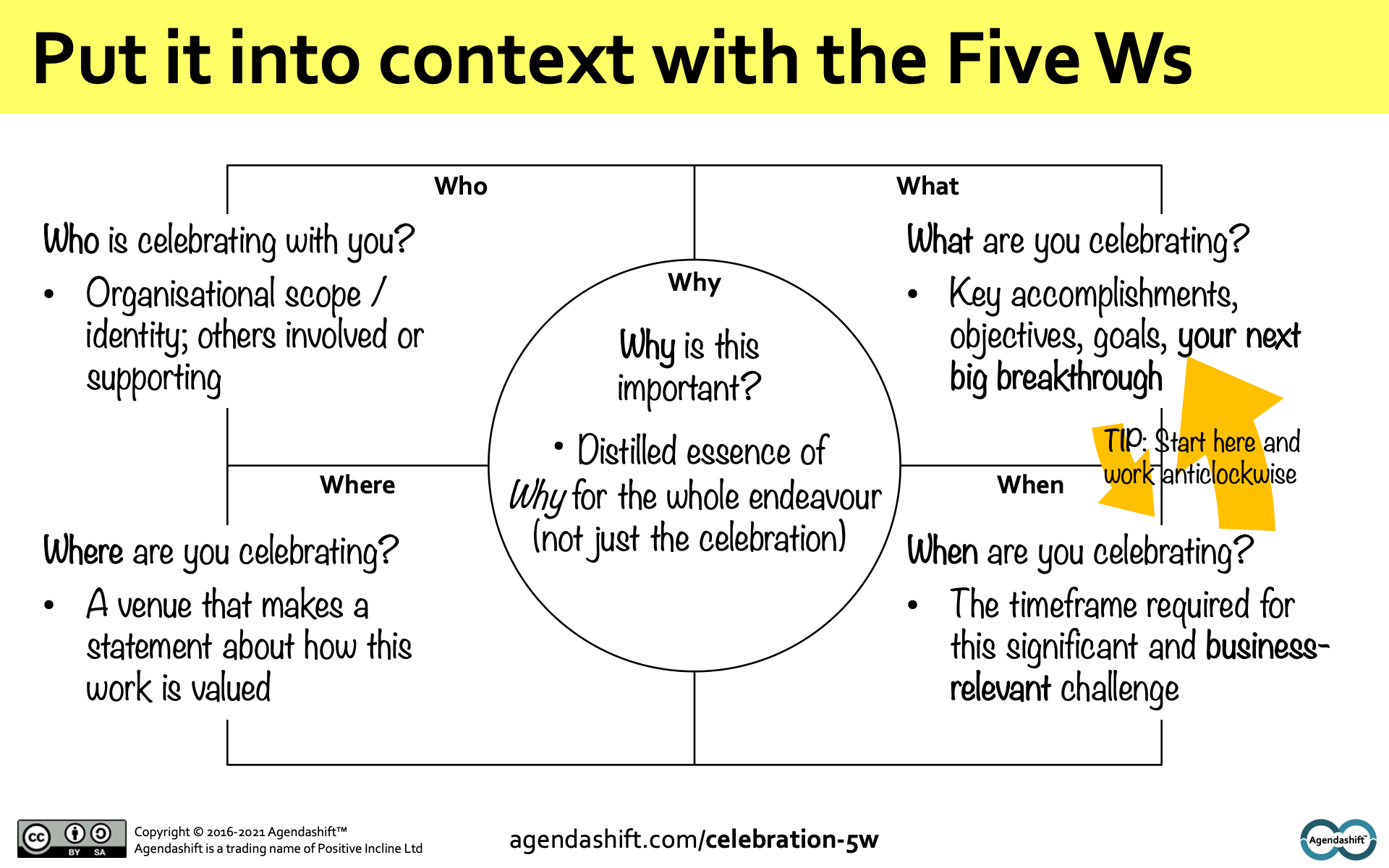
Accepting that authentic agreement is unlikely without some kind of conversation, where do those conversations start? One tried-and-tested place is Celebration-5W, our context-capturing workshop kickoff exercise. It’s not the only available starting point, but it is certainly a reliable one. It’s a time travel exercise with a simple premise: we use the journalistic Five Ws – Who, What, Where, When, and Why – to report on a celebration that will take place some time from now. The exercise is usually done in small groups, with outputs compared in a debrief afterwards.

In version 6 I’ve made a couple of small changes to align the materials with how I already introduce and facilitate it:

  1. Under What, “your next big breakthrough”. This is a deliberate nudge away from the thinking that we must wait for the end of a project. For a while in my patter I would say things like “your next big piece of learning” but that’s too abstract for this early stage in proceedings and not nearly as engaging.
  2. Under When, I inserted “business-relevant” to make a “significant and business-relevant challenge”.  An obvious enough tweak, but I have always stressed that it’s not good enough to celebrate something specific to (say) Agile practitioners without making its business relevance very clear. Better indeed to start with something recognisably business-related and work backwards from there. In fact, it’s perfectly possible to do an Agendashift workshop without mentioning the A word at all and I make no apologies for that.

Celebration-5W-slide-2021-08-v6

As per the tip highlighted middle right on the above slide, the two affected W’s together represent a good place to start the exercise. The trick is to iterate between the What (top right in Mike Haber’s nice template) and the When (bottom right) until you have a scope that seems to work. We recommend a timeframe measured in months, long enough for there to be some real challenge remaining but not so long that it risks becoming just an aspiration or someone else’s problem.

Your next big breakthrough

What if workshop exercises aren’t your thing or if now’s not the time? Fair enough! A little mental/paper exercise for you:

  • What is the next big (multi-month, significant, and business-relevant) breakthrough that you would like to be celebrating?
  • Where do you think that breakthrough will come from?
  • Were you to ask those questions of your colleagues, how do you think they would answer?
  • How would their Five Ws compare to each other’s and to yours?

Be honest now! Answers aren’t going to be identical, but you do want them to be coherent. If they are not, you have a problem, perhaps even the seeds of real crisis (I do not exaggerate – we’ve seen it firsthand). Of course it’s not normally as bad as that, but incoherence, misalignment, or complacency are hardly trivial issues either. One way or another, it’s time to get together and start creating some shared context.

Celebration-5W is one of the first exercises in our self-paced online training Leading with Outcomes. It represents just one of multiple opportunities for you to engage with questions of transformational leadership and with a range of tools specifically designed for productive conversations in the language of outcomes. Whether you’re a manager or a practitioner, we’re confident that it will help you be a better leader. Could it be where your next personal breakthrough comes from?

Related resources


What if we put agreement on outcomes ahead of solutions?

Agendashift™: Serving the transforming organisation
Agendashift  Academy: Leading with OutcomesHome | Store

Links: Home | Subscribe | Become an Agendashift partner Events | Contact | Mike
Resources: Tools & Materials | Media | Books | Assessments 
Blog: Monthly roundups | Classic posts
Community: Slack | LinkedIn group | Twitter
The IdOO pattern as leadership model

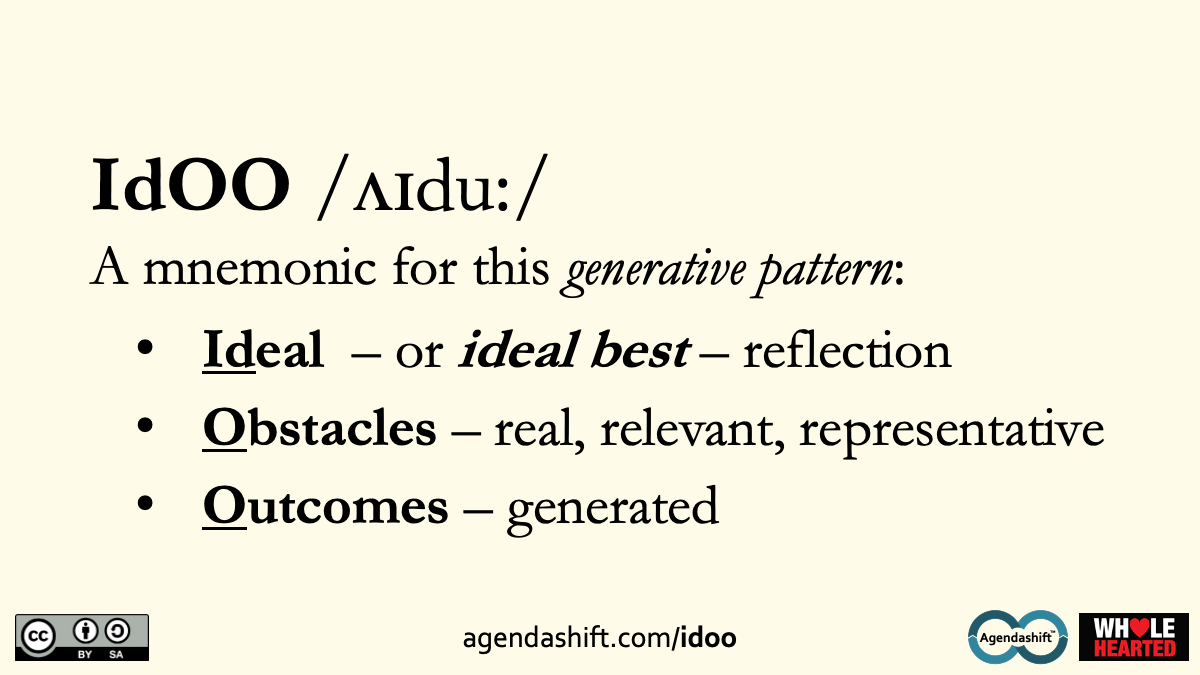
The IdOO pattern (below) is integral to the first two chapters of the Agendashift 2nd edition (March 2021) and also to our Leading with Outcomes and Coaching with Outcomes training (self-paced and interactive workshop respectively). It hardly seems possible that the pattern is only a year old, but this post from April last year really does seem to be my first mention of it.

agendashift-framework-overview-16x10-2020-12-07-idoo

So what is it? Well, it’s at least four things in one, demonstrating its considerable “stretchiness” in terms of the timescales involved:

  • It’s a leadership routine – three or four quick questions, some quick answers, taking just moments
  • It’s a coaching pattern – a higher-level structure to wrap around your favourite coaching tools to bring some strategic perspective – less emphasis on getting to the next commitment, more on the strategic landscape in which options will be developed
  • For facilitators, it’s the overall arc for a string of workshop exercises, whether that’s an hour’s worth or a day’s
  • For consultants, it’s a way to frame a client engagement – as helping them understand where they’d like to get to, what’s in the way of that, and what they might achieve along the way

When taken slowly enough it’s fractal: there may be obstacles in the way of any outcome, and there is always the opportunity to bootstrap the process and identify new ideals at different levels of detail.

This post relates most closely to the first of those uses, IdOO as leadership routine. Here is the IdOO mnemonic not as the structure of a conversation but as an easily-remembered leadership model:

  • Ideal – sustaining a sense of overall direction, connecting people to purpose, helping people find meaning in their work
  • Obstacles – building trust and empathy by recognising the obstacles that people face – their everyday frustrations, the “struggling moments” of actual and potential customers – everything that stands in the way of performance and success; real, relevant, and representative problems that better-designed organisations or products would alleviate
  • Outcomes – keeping at the forefront the goals around which work is organised and to which streams of work are aligned; remembering to celebrate their achievement and to focus the associated learning (both organisational and individual) to the maximum

It’s not a million miles away from my 3-point summary of Servant Leadership. Here in the last chapter of Right to Left I’m channeling Greenleaf, noting what I describe as his “masterful systems thinking”:

  1. The first responsibility of the Servant Leader is to help others to be successful – removing impediments, ensuring that basic needs are met
  2. For people to remain engaged, the Servant Leader must help others find autonomy and meaning in their work, together discovering, developing, and pursuing the organisation’s values, mission, and purpose in society
  3. For this process of transformation to be sustained indefinitely, Servant Leaders must help develop Servant Leadership in others

Right to Left: The digital leader’s guide to Lean and Agile, Mike Burrows (2019, audiobook 2020)

I wouldn’t for a moment suggest that IdOO supersedes any of that (IdOO only scratches the surface of point 3, for example), but it could be a good starting point if you find Servant Leadership hard to grapple with.

Sources

I’ve mentioned my Agendashift (2021) and Right to Left (2019) already; let me mention some other books I’ve referenced in one or both of those:

  • Servant Leadership: A Journey into the Nature of Legitimate Power and Greatness, Robert K. Greenleaf (Paulist Press, 25th Anniversary edition, 2002) – decades ahead of its time and still an inspiration; I re-read it every few years
  • The Serving Leader: Five powerful actions to transform your team, business, and community, Kenneth R. Jennings & John Stahl-Wert (Berrett-Koehler Publishers, 2nd edition, 2016) – a recent take on servant leadership and a tweak on the language that some will welcome; I’m grateful to Agendashift partner and Servant Leadership champion Angie Main for finding that one
  • Host: Six new roles of engagement, Mark McKergow & Helen Bailey (Solutions Books, 2014) – a change of metaphor and one that brings new insights
  • Turn the Ship Around! A True Story of Turning Followers into Leaders, L. David Marquet (Portfolio, 2013) – another great book all round; helpful advice here with regard both to obstacles (when and when not to take them away, for example) and to the learning and development aspects of the model

Not referenced but worthy additions to that list:

  • Speed of Trust: The One Thing that Changes Everything, Stephen M.R. Covey (Free Press, 2006)
  • Demand-side Sales 101: Stop Selling and Help Your Customers Make Progress, Bob Moesta (Lioncrest Publishing, 2020)

I’m currently listening to the audiobook of Covey’s Speed of Trust, good stuff so far. Bob Moesta’s book fits here better than you might guess from the title; it’s a great book on Jobs to be Done, and it’s my source for the the phrase “struggling moments”.

IdOO at the the conferences

Don’t forget the Agendashift 2021 conference on May 18th – not long now! The IdOO pattern will certainly get a mention in my opening introduction (not keynote – that honour goes to Pia-Mia Thorén). And I’m thrilled that Gervase Bushe will be speaking on leadership in the closing keynote. He is the author or co-author of two of the 2nd edition’s key references, The Dynamics of Generative Change and Dialogic Organisation Development.  

Possibly a mention of IdOO in one form or another in my LAG21 talk on the 25th, trust-building being a key element of the Deliberately Adaptive Organisation (see the last couple of chapters of the Agendashift 2nd edition). Agendashift Academy is proud to sponsor that conference too.


Upcoming

Listed now on the Agendashift Academy’s Store page are our scheduled workshops:

And always now the self-paced option:

Selected appearances by Agendashift partners, me where unspecified:


Agendashift™, the wholehearted engagement model
Links: Home |
About | Our mission: Wholehearted | Become an Agendashift partner | Assessments | Books | Resources | Media | Events | Contact | MikeSubscribe
Workshops: Transformation strategy | Outside-in strategy | Short training
Blog: Monthly roundups | Classic posts
Community: Slack | LinkedIn group | Twitter
Leading with Outcomes: a cheat sheet

To whet the appetite, a cheat sheet for:

Yes, you read that right: March 2021. Publication imminent!

Go to agendashift.com/leading-with-outcomes-cheat-sheet or click on the image below for download information, references, etc. It’s Creative Commons (CC-BY-SA); by subscribing you’ll get not just the PDF but the original .pptx file too – translations and other adaptations welcome. Enjoy!

leading-with-outcomes-cheat-sheet-2021-03-14-v1


What if we put agreement on outcomes ahead of solutions?

Agendashift™: Serving the transforming organisation
Agendashift  Academy: Leading with OutcomesHome | Store

Links: Home | Subscribe | Become an Agendashift partner Events | Contact | Mike
Resources: Tools & Materials | Media | Books | Assessments 
Blog: Monthly roundups | Classic posts
Community: Slack | LinkedIn group | Twitter