Changeban has reached version 1.0

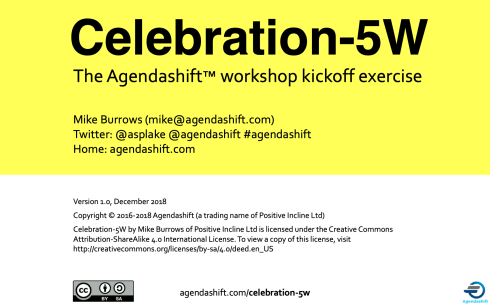
After several iterations (including runs at multiple workshops just this month) I’m delighted to announce that our Lean Startup-flavoured Kanban simulation game Changeban has reached version 1.0. As with its older sibling Featureban, it is released under the Creative Commons Attribution-ShareAlike 4.0 International License.

changeban-crazy-wip-2018-11-26
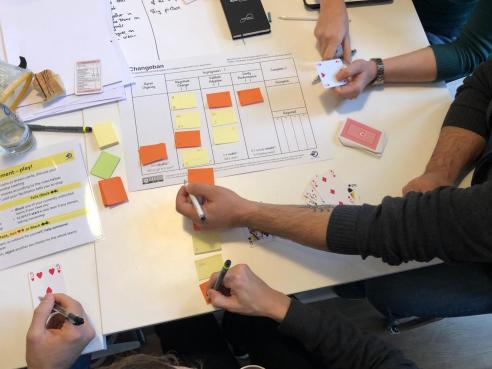
Some crazy, off-the-board WIP happening there…

In recent weeks we have:

  • Removed all mention of coins (the source of variation in Changeban’s older sibling, Featureban), coming down firmly on the side of using playing cards.
  • Clarified instructions, with fewer slides and fewer words
  • Amplified certain concepts, most notably rejection (the positive, celebration-worthy decision to deem an experiment as failed), pull, and double-loop learning

I created Featureban in 2014 and it has been very good to me. In that time it has seen multiple adaptations and translations (thank you!) and has been used the world over. This year, I’ve played Changeban enough times to know that it’s a worthy successor, and it’s my preferred choice unless I have a particular need for Featureban’s metrics coverage (enough justification to use both with some clients, on separate visits). Changeban doesn’t just teach mechanics, it teaches a learning process, and because it feels less tied to a development process it removes a potential obstacle for some non-techies. In short: if you like Featureban, I think you’ll love Changeban.

Attendees of my 2-day Advanced Agendashift workshop in Gurugram (below) will definitely get to play it, and attendees of 1-day Core workshops (Julia’s in Munich or mine in Mumbai) might also. In Core workshops it would be at the expense of other things, but that’s a trade that participants are often happy to make.

Want to know more? Head over to the Changeban page – it’s all there!

Registered users will be emailed download instructions in the next few hours. Agendashift partners will find it under the Commons folder in the partner Dropbox.


Upcoming public Agendashift workshops (Germany, India * 2):


Agendashift-cover-thumbBlog: Monthly roundups | Classic posts
Links: Home | About | Partners | Resources | Contact | Mike
Community: Slack | LinkedIn group | Twitter
We are champions and enablers of outcome-oriented change and continuous transformation. Building from agreement on outcomes, Agendashift facilitates rapid, experiment-based emergence of process, practice, and organisation. Instead of Lean and Agile by imposition – contradictory and ultimately self-defeating – we help you keep your business vision and transformation strategy aligned with and energised by a culture of meaningful participation. More…


A small revision to Changeban

Friday was quite a big day! Agendashift’s second birthday, plenty of attention for the article Engagement: more than a two-way street, and an Agendashift Studio*, a small-scale workshop held in my studio office.

After lunch at our local farm shop we played Changeban. Changeban is based on our popular Featureban game, with slightly different mechanics, a Lean Startup-inspired board design (below), and an introduction to hypothesis-based techniques.

Screenshot 2018-09-18 11.42.20

It went down a treat, generating these interesting comments:

Featureban’s great but I think I will start using Changeban with my clients instead. By not simulating a software development process, people who work outside of technology will relate to it much more easily.
– Steve

Absolutely agree. Not once during playing the game did we reference or talk about anything tech-related.
– Karen

Always keen to make language as accessible as possible (something the Agendashift delivery assessment is appreciated for), I’ve done another pass on the Changeban deck and removed all references to “features”. Instead of “feature ideas”, we have “product ideas”; “feature experiments” becomes “product experiments”, and so on. Small changes, but every little helps!

These new references to “product” also help to reinforce an observation made in the Agendashift book: tools designed for the product development space often have applicability in the organisational/process improvement space, and vice versa. Lean Startup is the perfect example of that!

If you’re a registered Changeban user, you’ll receive an update by email from me sometime in the next few hours. If you aren’t registered and would like to be, sign up here. We’re now up to revision 0.4; it seems stable enough to go to 1.0 once I get round to preparing a page of facilitation instructions (there’s a #changeban channel in the Agendashift Slack meanwhile).

*There is no calendar for these Agendashift Studio events – they’re self-organised via the #agendashift‑studio channel in Slack. If 3‑4 participants can agree on a date that works for me too, then we’re on! We’re based in Chesterfield, UK, close to the Peak District National Park.


Upcoming Agendashift workshops (UK, IT, DE)


Agendashift-cover-thumbBlog: Monthly roundups | Classic posts
Links: Home | About | Partners | Resources | Contact | Mike
Community: Slack | LinkedIn group | Twitter

We are champions and enablers of outcome-oriented change and continuous transformation. Building from agreement on outcomes, Agendashift facilitates rapid, experiment-based emergence of process, practice, and organisation. Instead of Lean and Agile by imposition – contradictory and ultimately self-defeating – we help you keep your business vision and transformation strategy aligned with and energised by a culture of meaningful participation. More…

True North, tweaked – and a couple more classic posts restored

At last week’s workshop there was a brief discussion on whether the last line of the Agendashift True North – the focus of one of my favourite workshop exercises – should make explicit reference not just to needs, but to “individual needs, corporate needs, societal needs” (or something similar). These have long been in my mind as a result of my several explorations into Servant Leadership – clearly I did not stop at the neutered, team-centric version typically taught in Agile circles.

Through our discussions in Slack and LinkedIn, the more it become clear that change was justified, but not the one I proposed. Here’s that line:

Needs anticipated, met at just at the right time

A conversation with Damian Crawford quickly convinced me to leave this line alone. As currently written, this line includes a range of needs that that hadn’t necessarily occurred to me, and we concluded that it would be unfortunate to exclude them. All it takes to dig deeper here is a simple question (thanks again Damian for asking this Clean-style):

What kind of needs anticipated?

A comment from Vincent van der Lubbe meanwhile reminded me that even whole organisations don’t live in a vacuum, and we turned to this line:

Individuals, teams, between teams, across the organisation

Very easily fixed:

Individuals, teams, between teams, across the organisation, and beyond

Scaling, anyone?

In full, from agendashift.com/true-north, where I’ve updated both the image and the text:

true-north-2018-02-13

Needs anticipated

That last line also attracted comment in relation to the phrase “Needs anticipated”. I dug out a relevant quote from Kanban from the Inside (published 2014) and it was nice to remind myself to find that I’ve been been banging the drum for needs and anticipation since 2013 if not earlier. Today I restored these two classic posts from positiveincline.com (explaining the sudden flurry if you’re an email subscriber!):

Enjoy those blasts from the past!


Upcoming Agendashift workshops (see Events):


Agendashift-cover-thumbBlog: Monthly roundups | Classic posts
Links: 
Home | About | Partners | Resources | Contact | Mike
Community: Slack | LinkedIn group | Twitter

We are champions and enablers of outcome-oriented change and continuous transformation. Building from agreement on outcomes, Agendashift facilitates rapid, experiment-based evolution of process, practice, and organisation. Instead of Lean and Agile by imposition – contradictory and ultimately self-defeating – we help you keep your business vision and transformation strategy aligned with and energised by a culture of meaningful participation. More…

Featureban 2.2 (and a special offer)

For the uninitiated, Featureban is our simple, fun, and highly customisable kanban simulation game, licensed under the Creative Commons Attribution-ShareAlike 4.0 International License.

There were already some minor updates pending, but the biggest change was inspired by an exercise described in the first chapter of the new book Practical Kanban by my friend Klaus Leopold. With the board full of work-in-progress (WIP), how long will it take to clear it? Or in other words, roughly how long will the next piece of work take, assuming it’s of normal priority and doesn’t get to jump over everything else?

The price of Klaus’s book goes up with each completed chapter, but he has kindly given us a coupon that fixes the price at just $4 until the end of May. Grab yours here:

Changes

  • Hidden slides for the reference of the facilitator are now clearly marked as such
  • Clarified the wording of the pairing rule
  • New ‘Take Stock’ slides at the end of iterations 1 & 2, the review of WIP described above
  • ‘Cleaned up’ the debrief slides
    • What was that like?
    • Then what happens?
    • What just happened?
  • The ‘By the same author’ slide now includes the Agendashift book
  • Added a final slide with a link to Okaloa Flowlab, a fully productionised simulation game and workshop initially inspired by Featureban, by my friends Patrick Steyaert and Arlette Vercammen

See also


Agendashift-cover-thumb
Blog: Monthly roundups | Classic posts

Links: 
Home | Partner programme | Resources | ContactMike
Community: Slack | LinkedIn group | Twitter

A sixth question for our cue cards

Registered users of our cue cards received an update a few days ago – we’ve added a sixth Clean Language question.

Screenshot 2017-04-03 18.09.15
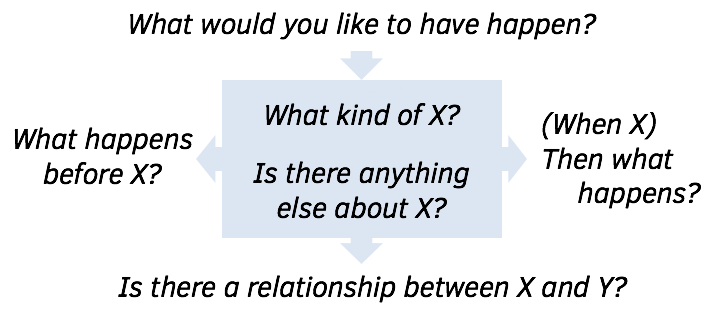
The six clean questions of the v2 card

The new question is the one at the bottom of the card: Is there a relationship between X and Y?

As with all the Clean questions, the coach (or the player in the coaching role in our game 15-minute FOTO) replaces any placeholders (the X and Y here) with words or phrases previously spoken by the client (or player in that role). Both in the game and in Clean Language generally, the coach’s job isn’t to offer/impose advice, but to help the client explore some landscape and build up some kind of model of it.

In 15-minute FOTO (the FOTO standing for “From Obstacles To Outcomes”), that landscape consists initially of goals and obstacles to those goals. Then comes the chance to discover outcomes hiding behind those obstacles, more outcomes behind those outcomes, outcomes that are more abstract or more specific, intermediate outcomes (stepping stones), and so on.

Technically, these outcomes are the raw material from which maps (plans), options, and then actions are generated. In this regard they’re a great unit of currency, as they don’t force us to choose (or prescribe) solutions too early. It’s worth spelling out also that they describe things that we want; instead of worrying about buy-in for change, we start with it!

If you’ve read the preview chapter you’ll remember a description of the game but not this new question. This isn’t an oversight. It is saved for chapter 2, Exploration, where it provides the opportunity for connections to be explored between the outcomes generated after debriefing the Agendashift survey and the goals and other high level outcomes captured during Discovery (chapter 1, the preview chapter).

Health warning

  • Is there a relationship between X and Y?

One reason for delaying this question’s introduction is that it might be asked judgmentally, breaking the flow of the game (or worse). It is better introduced second time around, when players already have a good feel for how the questions work.

Get yours

Both of these free resources (and more) are available via  www.agendshift.com/resources:

  • A PDF of the cue cards (I get mine printed on satin card, A5 size)
  • The preview chapter of the book (PDF also); this includes a description of the 15-minute FOTO game

Questions? Comments? Discuss this post right here, in our LinkedIn group, or in the #cleanlanguage channel in our Slack community. Or just drop me a line.


Agendashift-cover-thumb
Blog: Monthly roundups | Classic posts

Links: 
Home | Partner programme | Resources | ContactMike
Community: Slack | LinkedIn group | Twitter

Free preview: Read the introduction and first chapter of the forthcoming Agendashift book

[Update: The completed book is of course now available here]

It’s taking shape – Agendashift: clean conversations, coherent collaboration, continuous transformation.  Part 1 – “Facilitating the transformation process” – is due out by the summer [Update: it’s out now, at the above link]. Meanwhile, you can request a free PDF containing the introduction and first chapter, Discovery.

agendashift-cover-mid

You’ll definitely want to read this book if any of these apply to you:

  • You’re dissatisfied (if that’s a strong enough word) with transformation approaches that seem either disrespectful or feeble
  • You’d like to see what a 21st century change management approach can look like, and how that might inform your work as coach, consultant, or some other kind of change agent
  • You’ve an interest – whether as a practitioner or potential sponsor – in Lean-Agile change (perhaps under the banner of “Agile transformation” or similar)
  • You’d love to see a model for Lean-Agile change that reflects Lean-Agile values and demonstrates Lean-Agile process and thinking in operation

Also, check out the related Resources page. Find out how to obtain:

  • Cue cards for our Clean Language game 15-Minute FOTO, a description of which is included in chapter 1 (the preview chapter)
  • The Agendashift values-based delivery assessment, described in chapter 2
  • Our white paper 6+1 Essential strategies for successful Lean-Agile transformation (referred to in chapter 3) and the related video Servant Leadership un-neutered
  • The Agendashift A3 template, referred to in chapter 4
  • Featureban, our Creative Commons-licensed simulation game (not referred to in the book, but it’s still great!)

Agendashift-cover-thumb
Blog: Monthly roundups | Classic posts

Links: 
Home | Partner programme | Resources | ContactMike
Community: Slack | LinkedIn group | Twitter
 

Featureban 2.1 (unplugged)

Last night I ran a small Featureban session (7 people across 2 games) at our local meetup (Spire Digital meetup in Chesterfield, Derbyshire) and I thought it would be fun to do it “unplugged”, without the deck. I decided to capture my preparation in the deck itself so that others could use it; this in turn created an opportunity to make two unrelated changes I had pending (both optional). Let’s start with those.

New: “What would you change”

For this optional addition I’m indebted to Patrick Steyaert and Andy Carmichael.

Featureban already makes the connection between the rules of the game and the “policies” of the Kanban Method practice “Make policies explicit”. Patrick and Andy’s idea was to encourage experimentation with the rules, just as we would encourage real-world policies to evolve in the pursuit of improvement.

Some facilitators have sought to distinguish between policies that are fixed and those that the players are free to experiment with. I have left it more open:

screen-shot-2016-10-12-at-09-43-59If you’re going to do this, I would recommend introducing it in the middle of Iteration 3 (Metrics).

New: Start tracking in Iteration 2

In the new hidden facilitator’s overview slide for iteration 2 you will find this addition:

  • Optionally:
    • Keep track of “day number”; write the day number on stickies when you start them (leaving existing in-progress stickies as they are)
    • Stop this iteration when when all your in-progress stickies have a day number on them and you’ve completed all the stickies that were still in progress at the end of iteration 1

We did this last night, and I consider it a success. It adds a small overhead to iteration 2 but it is outweighed by the extra sense of objective given to that iteration (flushing out all the old stickies) and its immediate impact to iteration 3. No longer do we need to wait for several rounds in iteration 3 before we start to see items completed with known lead times.

Unplugged

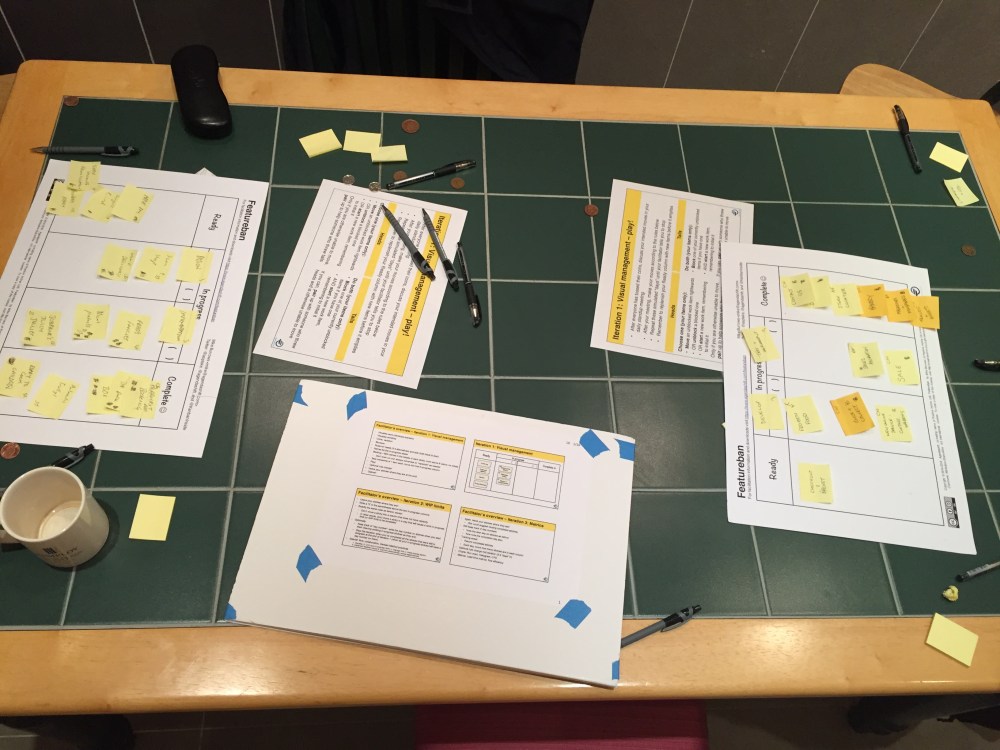
In the deck, each iteration is now preceded by a hidden slide with a facilitator’s overview. I printed these four-to-a-page, the fourth page being a picture of the board (slide 3). You can see them here taped to the back of my board, stiffened with a rigid A3 foam tile I bought from Staples (they’re quite handy – I keep a few of these in my bag to protect my materials). I referred to mine only once but it was good to know that they were there!

2016-10-11-20-11-16

As you can see, I also printed the rules page for iteration 1, one copy per team. There is no need to print the rules for later iterations.

It turns out that the picture slide I printed (upper right of the four) doesn’t demonstrate the ideal setup for explaining the rules unplugged. You may have noticed in that the setups used in the deck to explain the rules for heads, tails, and blockers differ slightly. I used this setup instead, which has two stickies owned by me (MB), one of them blocked:

2016-10-12-10-33-04

I have now added an updated hidden slide for reference. While I explained the rules, I moved stickies and pretended to write on them (without actually marking them).

A final picture: here’s the histogram we made from the stickies completed in iteration 3:

2016-10-11-21-19-44

We sketched a run chart and a CFD also (no pictures, alas), and discussed Little’s Law also.

Further information

Interested in facilitating Featureban yourself? These are the main places to visit:


What if we put agreement on outcomes ahead of solutions?

Agendashift™: Serving the transforming organisation
Agendashift  Academy: Leading with OutcomesHome | Store

Links: Home | Subscribe | Become an Agendashift partner Events | Contact | Mike
Resources: Tools & Materials | Media | Books | Assessments
Blog: Monthly roundups | Classic posts
Community: Slack | LinkedIn group | Twitter
Outcomes, alignment, and changes to our A3 template

Last week’s post Two new tools* and how I’m finding them useful has generated a lot of interest – after just six days it is already the 3rd most popular post of the year!

*Spoiler: Clean Language and the Cynefin Four Points Contextualisation exercise

One piece of detail I neglected to mention is a tweak I have made to the A3 template we use to guide people through the process of framing and developing their actions as hypothesis-driven changes. The header area at the top of the page has gained a new field: “Aligned to objective”.

It’s a chance to identify:

  1. a pre-existing high level objective to which this action aligns, or
  2. a summary outcome shared by this and other actions (a theme, if you like).

Better still, both at the same time – this is after all what alignment and strategy deployment [availagility.co.uk] are all about. Without alignment, so-called improvement can easily descend into just fixing stuff – interesting locally perhaps but unlikely to be important in the grand scheme of things.

Resources


Agendashift-cover-thumb
Blog: Monthly roundups | Classic posts

Links: 
Home | Partner programme | Resources | ContactMike
Community: Slack | LinkedIn group | Twitter

Featureban 2.0

If you’re reading about Featureban for the first time, be aware that there have been updates since this page was first published in 2016. For all Featureban-related posts, click here, and for the Featureban landing page, here. See also Changeban, a new Lean-Startup flavoured variant, with posts here, and landing page here. Enjoy!

As mentioned in the May roundup, I’ve released a new 2.0 version of the Featureban simulation game, the simple, fun, and highly customisable kanban simulation game. We use Featureban in our own training workshops, and it has been used by trainers and coaches in Lean, Agile, and Kanban-related events the world over.

This version consolidates a number of incremental improvements I’ve made and tested in training over the months, plus a complete change to the game scenario.  The rules are basically unchanged, though there’s an optional rule change slide to be introduced at the facilitator’s discretion.

The PDF of the slide deck is freely downloadable and I’m happy to give out the source files on request.  Featureban is licensed under a Creative Commons Attribution-ShareAlike 4.0 International License and customisation is encouraged!

Do read Featureban facilitation information and downloads if you are planning to try it.

Changes:

  • New scenario – No longer car-related (too reminiscent of manufacturing), it’s now based on a supermarket website, still with a few quirky feature ideas thrown in. Some of the example features are just product lines, so it should still be very easy for people to come up with feature ideas.
  • Nicer visuals, much easier to edit in Powerpoint
  • Two coin-related slides:
    1. What does the coin represent? (See blog post)
    2. No coin? justflipacoin.com (Welcome to our cashless society!)
  • The slide on blocked work items now follows the coin slide
  • Two “Setup” slides
  • Clearer rules slides
  • An optional intervention with a  rule change – stop play and introduce during iteration 1 if you wish. See Frustrated with throwing too many tails in Featureban?
  • Easier, more subjective debriefs
  • Consolidated the Kanban Method slides after the iteration 2 debrief. Previously, the transparency-related practices were described after iteration 1; now it should be apparent to participants that visual management is not enough on its own.
  • Incorporated some improvements to the metrics slides from Vicy Wenzelmann at Leanovate
  • Reference to Kanban from the Inside under my CFD (taken from my case study)
  • A slide encouraging participants to do an Agendashift values-based delivery assessment on the game scenario (and for themselves if they so wish)
  • A minor layout change to the board, grouping the two in-progress columns together (credit to Susanne and Andreas Bartel for that I think)

Enjoy!


What if we put agreement on outcomes ahead of solutions?

Agendashift™: Serving the transforming organisation
Agendashift  Academy: Leading with OutcomesHome | Store

Links: Home | Subscribe | Become an Agendashift partner Events | Contact | Mike
Resources: Tools & Materials | Media | Books | Assessments
Blog: Monthly roundups | Classic posts
Community: Slack | LinkedIn group | Twitter

A3 template for hypothesis-driven change

[Update 23-Sep-2019: The version shown here has been updated a few times since publication. The latest version of this and several other Creative Commons resources may now be found at agendashift.com/resources; clicking on the image below now takes you to the relevant resource page]

[Update 10-Aug-2016: The latest version is still downloadable here; see Outcomes, alignment, and changes to our A3 template for a description of recent changes]

As mentioned in On not teaching PDCA, I’ve been using an A3 template in my training classes and debrief/action workshops. I’m now releasing under the same model as Featureban – I’ve given it a Creative Commons Attribution-ShareAlike license, you can download the PDF here, and drop me a line for the original .xlsx file if you want to translate it or adapt it in some other way.

I typically cover it in this order:

  1. Hypothesis
  2. Assumptions & Dependencies
  3. Pilot Experiments (potentially spawning new A3’s)
  4. Risks
  5. Pilot Experiments (again, if prompted by the risks)
  6. People
  7. Insights.

Enjoy!

Screenshot 2016-08-10 10.46.46.png


What if we put agreement on outcomes ahead of solutions?

Agendashift™: Serving the transforming organisation
Agendashift  Academy: Leading with OutcomesHome | Store

Links: Home | Subscribe | Become an Agendashift partner Events | Contact | Mike
Resources: Tools & Materials | Media | Books | Assessments
Blog: Monthly roundups | Classic posts
Community: Slack | LinkedIn group | Twitter