Join us on May 18th for Agendashift 2021, our inaugural conference

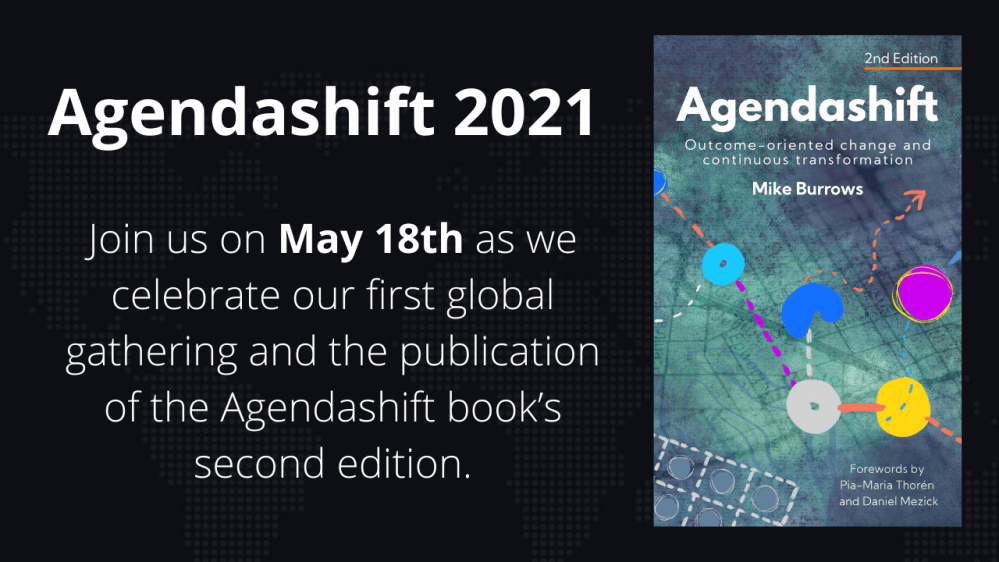
Join us on May 18th for Agendashift 2021 as we celebrate our first global gathering and the publication of the Agendashift book’s second edition.

Do check out my 2-minute welcome video  – under than 2 minutes long and still plenty of time for Agendashift’s new elevator pitch!

Our speakers, a truly impressive lineup (names to be announced over the coming weeks) will be highly reflective of our community, sharing our values of participation and outcome-orientation. We’re in the business of building wholehearted and deliberately adaptive organisations, and we work towards a world in which everyone is invited to engage meaningfully in every decision that affects their work. Expect therefore not a narrowly framework-centric event but something pluralistic, challenging, and of course engaging.

The conference will be held on Tuesday May 18th, a half day event timed for maximum reach. If you’re based in Europe, the Middle East, or Africa, it takes place in your afternoon and evening. If you’re in the Americas, it begins in your morning. You can attend for free, or pay just €10 for access to video recordings of every session. And starting at just €99, there are some fantastic sponsorship packages too.

10% of all revenue goes to global Covid relief – an issue that affects us all – and thanks to the extraordinary commitment of the organising team who I just can’t thank enough, every last penny of the remainder will be reinvested into community development, education, and future events.

Register now!

Agendashift 2021 May 18th Page Image


Upcoming workshops


Agendashift™, the wholehearted engagement model
Links: Home |
About | Our mission: Wholehearted | Become an Agendashift partner | Assessments | Books | Resources | Media | Events | Contact | MikeSubscribe
Workshops: Transformation strategy | Outside-in strategy | Short training
Blog: Monthly roundups | Classic posts
Community: Slack | LinkedIn group | Twitter

Why the Agendashift 2nd edition? What happened?

In case you missed it:

What happened since 2018 and the 1st edition? Quite a lot actually!

Engagement models happened

It may seem a bit daft to say that one of the things that happened was the foreword to the 1st edition, but it’s true! Daniel Mezick’s use of the term engagement model (a term I hadn’t used) was a gift. It gives us a constructive and generative name for “change through means other than imposition”, it creates an identity for a category distinct from those linear models of change management, and I’ve come to appreciate the distance and differentiation that this affords. To quote from the book:

You can’t upgrade your organisation like you’re upgrading your email server!

The 2nd edition gains a foreword from Pia-Maria Thorén. So glad to make that connection with HR community! Time will tell where that will lead, somewhere good I’m sure.

Lots of small and not-so-small improvements happened

To name just a few:

Patterns happened

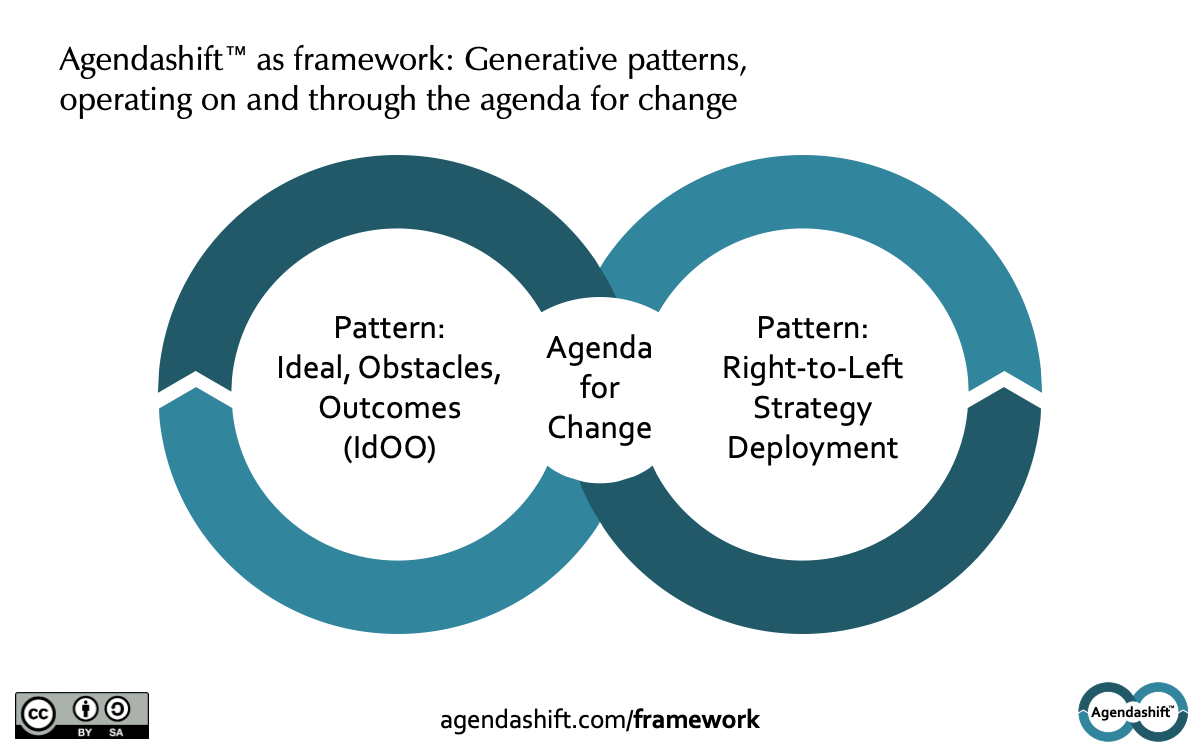
The “Agendashift as a river” poster is gone (hands up on that one, it was a mistake). In its place, the figure-of-8 framework picture, with Agendashift’s two main patterns for each loop and the Agenda for Change at their intersection:
Framework image

Chapters 1 & 2 each provide a demonstration of the Ideal, Obstacles, Outcomes (IdOO) pattern. The pattern is discussed in relation to other coaching models and leadership routines – GROW, Toyota Kata etc, and it creates the opportunity for the now much more developed Outside-in Strategy Review (OI-SR) to be introduced much earlier in the book.

By chapter 3 (the Mapping chapter), the Agenda for Change is already well established and much better defined than it was in the 1st edition. It is one of the most-changed chapters, now describing the well-tested string of three mapping exercises practiced since early 2019:

  1. Option Approach Mapping – Cynefin Four Points with outcomes and under a pseudonym (it’s better that way)
  2. Option Relationship Mapping – Karl Scotland and Liz Keogh’s Cynefin-inspired brilliant reworking of Wardley Mapping designed to work with outcomes
  3. Pathway Mapping – ‘Transformation Mapping’ in the 1st edition, Story Mapping with outcomes

I wouldn’t describe either Mapping or the Agenda for Change as patterns but certainly there are patterns in that chapter – describing the three exercises together really helped me see those and I think they will be helpful to facilitators of these and similar exercises.

Chapter 3 is also the launchpad for the Right to Left Strategy Deployment pattern, making it the pivotal chapter. It changes the perspective of chapter 4 (Elaboration) quite noticeably, and chapter 5 (Operation) is completely rewritten. Before that, a smaller pattern, Meaning before Metric, Measure before Method (2MBM), which goes with improvements to the ideation part of chapter 4 (Elaboration).

Covid-19 happened

Let me just quote the Introduction (like chapter 5 this was rewritten from scratch):

Finally, Covid-19 happened. I have a vulnerable family member, and by the time lockdown was formalised in the UK I was already in self-imposed quarantine after a trip abroad. I realised very quickly that my globetrotting days were done and that I had to make a strategic shift online. I found that the change of platform helped me see the material through fresh eyes, and I have been glad of the opportunity to collaborate and experiment rapidly with others. We’re determined to deliver the best possible online experience and this new 2nd edition benefits significantly from what we’ve learned through this extraordinary time.

Stepping back from those technical improvements and personal challenges, it has never been clearer that strategy and ways of working are matters of urgency, and that they need to be tackled in an integrated and, dare I say, wholehearted, way. As the world shifts online, so customer relationships change (and as I observed in Right to Left, so increases the opportunity to learn from them). Meanwhile, the need for individuals and teams to connect both to purpose and to each other becomes critical. The alternative – irrelevance, fragmentation, and alienation – hardly bears thinking about. If instead I could bottle some of the best experiences in our progress since the 1st edition – special moments in workshops, client engagements, community and cross-community events, and smaller, purposeful collaborations – well I’d be a happy man indeed.

Right to Left happened, and Dialogic/Generative OD happened

Right to Left: The digital leader’s guide to Lean and Agile, my 2019 book and 2020 audiobook gave rise to the 1-liner for our mission, “We’re in the business of building wholehearted organisations”.

Right from the earliest days of wholehearted I’ve taken great care not to spoil the generative quality of the word by over-defining it. Nevertheless, chapter 5 does give some shape to the wholehearted organisation via Bushe & Marshak’s Dialogic Organisation Development (2015) (see this 2019 post on my initial encounter with it), the Generative Change Model as described in Bushe’s The Dynamics of Generative Change (2019), and – continuing a journey started in Right to Left –  Stafford Beer’s classic Viable System Model (VSM). Two strikingly different bodies of knowledge there but they work wonderfully well together in a vision of the organisation in which strategy, organisation development, and delivery are integrated through participation. Key quote:

It’s a funny kind of autonomy when strategy is something that happens to you

Right to Left is the also the source of two key elements of chapter 5, the Outside-in Service Delivery Review (OI-SDR) and the Outside-in Strategy Review (OI-SR), the latter introduced in chapter 2 as previously mentioned. In the 1st edition they were only hinted at; I developed them properly in Right to Left. For the 2nd edition I didn’t want to just rehash that material though and so it extracts from them a number of lessons of organisation design and leadership. Clue: the Who’s invited? question is asked three times in chapter 5 alone.

And so to the new chapter 6, Up and down the Deliberately Adaptive Organisation. This was very nearly just an appendix – a reconciliation between Agendashift and VSM – but it grew! Its name is inspired by Kegan & Lahey’s Deliberately Developmental Organisation (see An Everyone Culture: Becoming a Deliberately Developmental Organization, 2016), which despite my sometimes outspoken aversion to staged development models, maturity models, etc integrates really nicely.

This has been a very rewarding process. We’ve established some deep foundations, learned a lot, tweaked the language a bit, and found that we could say something both challenging and constructive about scale. And nothing broke!

And out of it, something new that might be substantial enough to enjoy a life of its own:

deliberately-adaptive-image

The lines between Agendashift and the Deliberately Adaptive Organisation are perhaps a little blurry but I don’t mind that. If now we’re in the business of building wholehearted and deliberately adaptive organisations, Agendashift is how that happens, ‘wholehearted and deliberately adaptive’ describes what we’re aiming for, and any blurriness is a function of that mission’s internal consistency. I find that rather satisfying.

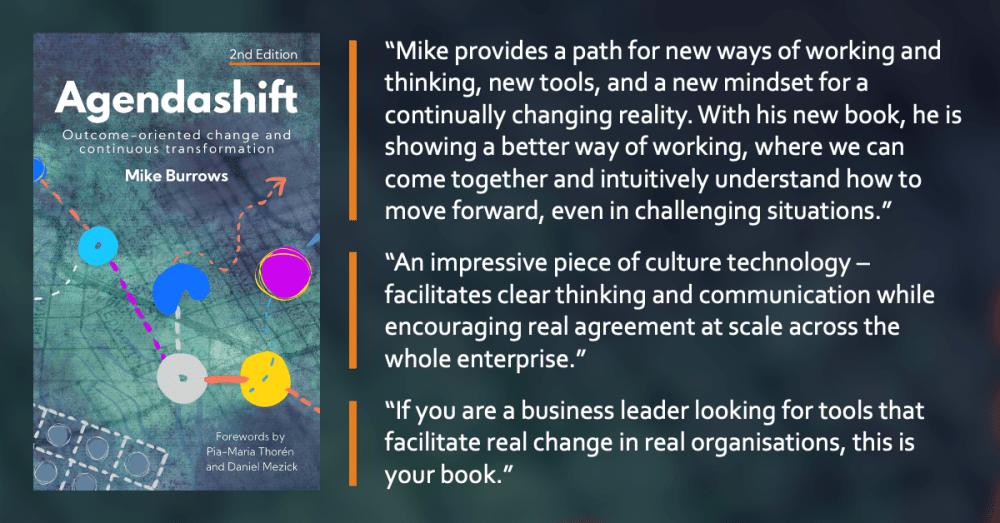
So yes, quite a lot happened since 2018. Be in no doubt, the 2nd edition of Agendashift: outcome-oriented change and continuous transformation is a big update. It’s available here:

An ePub edition is imminent also – expect to find it very soon on Apple Books, Google Play, Kobo, and elsewhere.
agendashift-2nd-ed-sharing-1200x628-2021-02-10


Upcoming workshops

The long-promised Deep Dive for the Americas is in the calendar at last and we’ve added a shorter Leading with Outcomes for APAC also:


Agendashift™, the wholehearted engagement model
Links: Home |
About | Our mission: Wholehearted | Become an Agendashift partner | Assessments | Books | Resources | Media | Events | Contact | MikeSubscribe
Workshops: Transformation strategy | Outside-in strategy | Short training
Blog: Monthly roundups | Classic posts
Community: Slack | LinkedIn group | Twitter
Agendashift roundup, March 2021

In this edition: The 2nd edition is out; Upcoming workshops; Top posts

The 2nd edition is out!

As announced last Friday, the 2nd edition of Agendashift: outcome-oriented change and continuous transformation was released on Monday. It is available here:

An ePub edition is imminent also – expect to find it very soon on Apple Books, Google Play, Kobo, and elsewhere.

You heard it here first: Spring 2021 is going to awesome. A number of exciting things have been waiting on this critical dependency, publication is only the start, and there’ll be further announcements over the next few weeks. Until after the Easter weekend though, I’m happy just to enjoy that we got there, thankful for all the input and support that made it possible.

It’s a big update on the 1st edition so do read this one, and I would be enormously grateful if you would leave a review – these days and on Amazon especially they’re crucial. The first one in gives it five stars, describing the book as a Must read for those leading and coaching change.

agendashift-2nd-ed-sharing-1200x628-2021-02-10

agendashift.com/books/agendashift-2nd-edition

Upcoming workshops

The long-promised Deep Dive for the Americas is in the calendar at last and we’ve added a shorter Leading with Outcomes for APAC also:

Top posts

A massive response to the new cheat sheet, surpassing even the ever-popular 15-minute FOTO, which got an update this month:

  1. Leading with Outcomes: a cheat sheet
  2. 15-minute FOTO version 10
  3. Out on Monday, the Agendashift 2nd edition
  4. Neat hierarchies vs self-expressed strategy
  5. My favourite Clean Language question (January 2019)

Agendashift™, the wholehearted engagement model
Links: Home |
About | Our mission: Wholehearted | Become an Agendashift partner | Assessments | Books | Resources | Media | Events | Contact | MikeSubscribe
Workshops: Transformation strategy | Outside-in strategy | Short training
Blog: Monthly roundups | Classic posts
Community: Slack | LinkedIn group | Twitter
Out on Monday, the Agendashift 2nd edition

agendashift-2nd-ed-sharing-1200x628-2021-02-10Thrilled and relieved in almost equal measure, I have the great pleasure of announcing that the 2nd edition of Agendashift: outcome-oriented change and continuous transformation is released on Monday. It is available meanwhile for preorder here:

An ePub edition is imminent also – expect to find it very soon on Apple Books, Google Play, Kobo, and elsewhere.

Make no mistake, this is a big update. Not just three years of refinement and stress testing in the field, we’ve dug deep, established solid foundations, and from there grown in scope, substance, and confidence. Some chapters have been entirely rewritten, a new chapter 6 added. But don’t worry, it’s still Agendashift, just older and wiser 🙂

The list of people to whom I am indebted is long. To mention just a few of those most directly in Agendashift’s development: Dragan Jojic, Karl Scotland, Andrea Chiou, and Steven Mackenzie – there from the beginning, and Patrick Hoverstadt, Jonathan Sibley, Andreas Wittler, Tom Ayerst, Matthew Dodwell, Kjell Tore Guttormsen, and Teddy Zetterlund in relation to the 2nd edition specifically.

Less directly involved but influential, helpful, and supportive (and in parentheses the communities they represent, all of them intersecting significantly with Agendashift’s): Gervase Bushe (Dialogic and Generative Organisation Development), Dave Snowden (Cynefin), Simon Wardley (Mapping), Pia-Maria Thorén (Agile People), Judy Rees & Caitlin Walker (Clean Language both), Daniel Mezick (OpenSpace Agility).

The foreword to the 2nd edition is by Pia-Maria. Daniel’s 1st edition foreword remains; as will be explained in this edition’s completely rewritten introduction, his contains a hidden gift. Sincerely, thank you both.

We’re in business of building wholehearted and deliberately adaptive organisations. If that sentence could one day describe you too, read the book!

PS. While you wait for your copy to arrive, let me recommend the new cheat sheet agendashift.com/leading-with-outcomes-cheat-sheet. Consider it a taste of the first two chapters.

PPS. Likes & comments on this post on LinkedIn would be hugely appreciated. And when the time comes, reviews!

Upcoming


Agendashift™, the wholehearted engagement model
Links: Home |
About | Our mission: Wholehearted | Become an Agendashift partner | Assessments | Books | Resources | Media | Events | Contact | MikeSubscribe
Workshops: Transformation strategy | Outside-in strategy | Short training
Blog: Monthly roundups | Classic posts
Community: Slack | LinkedIn group | Twitter
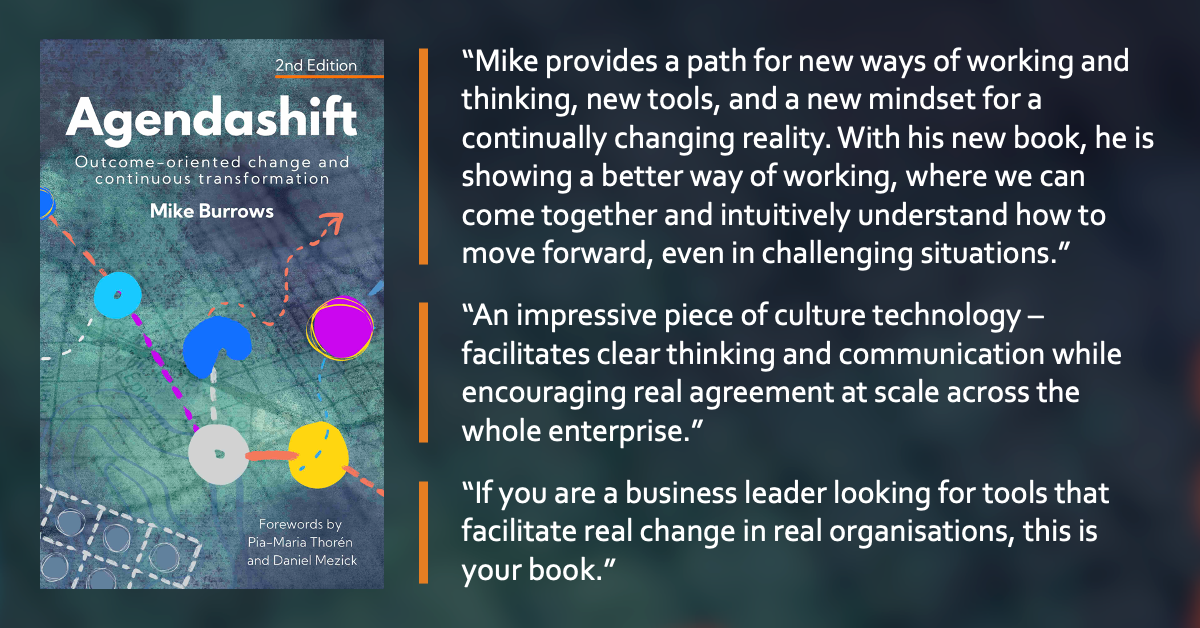
Leading with Outcomes: a cheat sheet

To whet the appetite, a cheat sheet for:

Yes, you read that right: March 2021. Publication imminent!

Go to agendashift.com/leading-with-outcomes-cheat-sheet or click on the image below for download information, references, etc. It’s Creative Commons (CC-BY-SA); by subscribing you’ll get not just the PDF but the original .pptx file too – translations and other adaptations welcome. Enjoy!

leading-with-outcomes-cheat-sheet-2021-03-14-v1


What if we put agreement on outcomes ahead of solutions?

Agendashift™: Serving the transforming organisation
Agendashift  Academy: Leading with OutcomesHome | Store

Links: Home | Subscribe | Become an Agendashift partner Events | Contact | Mike
Resources: Tools & Materials | Media | Books | Assessments 
Blog: Monthly roundups | Classic posts
Community: Slack | LinkedIn group | Twitter

15-minute FOTO version 10

Quick one: the facilitation deck for our Clean Language-inspired coaching game 15-minute FOTO is now at version 10. Changes:

  1. Added a slide for a quick practice: the two and three most important questions (the questions in bold on the card, the ones that do most of the work in the game) on your most concrete and most abstract obstacles, respectively without and with the What kind of… question (my favourite). You can do it as a facilitator-led demonstration and/or a short breakout (doing both isn’t overkill in my experience).
  2. Removed a slide titled Essential: Launch from a clear challenge, go deep. Essential it might be, but it’s smoother to cover the point while on the preceding slide.
  3. Moved the And when X... slide to improve the flow.
  4. Updated the reference material at the back to mention the now-imminent 2nd edition of the book.

In the past couple of weeks I’ve recorded myself using this version and am much happier with the flow now.

More: Go to agendashift.com/15-minute-foto for tips, download instruction, and an ancient but still fun video.

15-Minute-FOTO-cue-card-2020-09-v16


Agendashift™, the wholehearted engagement model
Links: Home |
About | Our mission: Wholehearted | Become an Agendashift partner | Assessments | Books | Resources | Media | Events | Contact | MikeSubscribe
Workshops: Transformation strategy | Outside-in strategy | Short training
Blog: Monthly roundups | Classic posts
Community: Slack | LinkedIn group | Twitter

Neat hierarchies vs self-expressed strategy

Oh dear, a “vs” in the title on a subject where perhaps some nuance is called for. My apologies – naming is hard – but then again, on this topic I do take a strong and (I suspect) non-mainstream position.

Last week I put this question to LinkedIn:

At scale [across multiple organisational units], do you:
1) maintain neat hierarchical work breakdown structures (saga, epic, feature, story, task, perhaps)
Or 2) allow each level and each unit within – down to team if not individual level – to express their respective strategies in their own language as they are fit?

To be clear, the intention behind this question is not about terminology (not method-level terminology at least)

Quite a range of answers, many of them describing organisations that were much closer to one extreme than the other, with aspirations to reverse the situation. The really funny thing: this went in both directions. People working with neat hierarchies aspiring to greater self-organisation, and people at that end aspiring to consistency and to what they saw as a source of alignment.

So where am I on this? Pieter Mulder’s comment represents my thoughts pretty well:

My opinion is very much that point 1 will only let you scale so far and it must take a heck of a lot of effort to maintain that as you continue to scale and it comes with risk when teams or individuals don’t conform and the whole system breaks down – also, who decides the structures and how do you change them when they don’t work? Point 2 can scale infinitely as the decision-making and accountability sits much lower down so it is much easier to optimise the system (smaller experiments, smaller tweaks, smaller risk to the whole).

Teams are living organisms which are never the same. What works for one team doesn’t always work for another (even if they are seemingly identical).

I am completely biased as I have never seen 1 work well (and have seen it fail or frustrate too many times) and I have seen 2 work really well.

Late 90’s, before Agile was even a thing, two investment bank projects sealed it for me.

The first of these projects impacted borrowers and lenders of fixed income securities in the UK (Gilts most especially) and was sponsored by the Bank of England. I was hired as a contract developer into the relevant front office team and was surprised (in a very good way) about how things were organised. Quickly I found myself taking the lead in agreeing interchange protocols with middle and back office systems and we all got on with our work. For the purpose of this project, each system had its champions in various parts of the business, and between us all we worked out how testing would be conducted, both separately and integrated. Project managers meanwhile stayed mainly out of our way, looking after the BoE relationship. On launch night we converted literally billions of pounds worth of stock between old and new trade models, and one minor hiccup aside (fixed in minutes), we were live. My first experience of a “front-to-back” project was a very positive one.

Since many of my front office colleagues preferred more trading-focussed projects it wasn’t surprising that I found myself as the front office tech lead for another front-to-back project, completely rewriting a mission critical system in the year leading up to the launch of the Euro. What would have been a high profile project at any time became a truly high stakes project. And the really great thing: we followed much the same model but with two enhancements:

  1. Even greater business involvement, to the extent that across all impacted systems (of which there were several), people co-opted from “line” jobs to work as subject matter experts and testers easily outnumbered the developers
  2. An early focus on testing (one of my first bits of development helped to make testing a largely self-service activity, a few hours coding that paid for itself countless times over), supporting a highly engaged and iterative process

In early autumn we went into parallel running, started migrating trading books a few at a time and then in larger numbers until we were fully live. Not only were we ready in good time for the Euro conversion, we were earlier than anyone’s best predictions!

20-25 years have passed since those projects and despite all I’ve experienced since, there’s very little that I would change about them. And if self-organisation can work on projects of such scale and significance, why is it not more the norm? Or perhaps it is, but we don’t like to own up to something that looks messy, and surely those nice, neat hierarchies are what counts for “doing it properly” these days?

In more recent years my opinions have only hardened. I know that context is everything, but show me a beautifully-groomed backlog and two worries spring immediately to my mind:

  • When the work gets to the front of the queue, will it still be relevant?
  • How much does it cost to incorporate everything that’s been learned meanwhile?

To make that learning process work at scale and speed, you’ve got to be truly exceptional. For the unexceptional – and I’m referencing Right to Left here – the big risk is that you end up ploughing through backlogs of requirements, a mediocre experience leading to mediocre results, hardly Agile at all (if that’s a goal).

More recently still, and in the process of appreciating and integrating models as diverse as OKR, Viable System Model, Sociocracy, and Leader-Leader, I keep landing on a common theme: autonomous teams (and other organisational units) each expressing strategy in their own words, strategies negotiated, developed, and aligned through collaboration and participation.

To the top-down extreme, in the Agendashift 2nd edition (due later this month) I express my feelings thus:

It’s a funny kind of autonomy when strategy is something that happens to you. [And] it’s a funny kind of adaptive strategy if it doesn’t know how to listen.

Again, to make a hierarchical approach work effectively at scale and speed, you’ve got to be truly exceptional. Maybe you are; more likely you are not. Whether or not you are, please let’s agree not to describe it as the default “doing it properly” approach to which all Agile organisations should aspire.

While we wait for the 2nd edition (subscribe here for news), let me recommend Allan Kelly’s Succeeding with OKRs in Agile: How to create & deliver objectives & key results for teams, foreword by yours truly. Highly relevant to this topic!

Related:


Agendashift™, the wholehearted engagement model
Links: Home |
About | Our mission: Wholehearted | Become an Agendashift partner | Assessments | Books | Resources | Media | Events | Contact | MikeSubscribe
Workshops: Transformation strategy | Outside-in strategy | Short training
Blog: Monthly roundups | Classic posts
Community: Slack | LinkedIn group | Twitter

Coming soon, the 2nd edition!https://www.agendashift.com/books/agendashift-2nd-edition

Agendashift roundup, February 2021

At the end of an unpredictably busy week, this month’s roundup is another quick one. Watch out over the course of the next month for the 2nd edition of the Agendashift book (very excited about that) and more. If you haven’t already, now’s a good time to subscribe!

Upcoming workshops

The list below looks shorter than usual but expect a flurry of activity after the book launch!

All the usual discounts apply: repeat visits (not uncommon), partners, gov, edu, non-profit, country, un- or under-employment, bulk orders. If you think that one might apply to you, do please ask. Many of those considerations apply to private workshops also.

Top posts

With the top 3 constituting a series, 7 this time:

  1. Eating our own dog food (1/n): Our outside-in strategy review (OI-SR)
  2. Eating our own dog food (2/n): The strategy review’s assumptions
  3. Eating our own dog food (3/n): Harvesting
  4. Updates to the Agendashift True North exercise
  5. From Reverse STATIK to a ‘Pathway’ for continuous transformation (October 2019)
  6. What kind of Organisational Development (OD)? (And a book recommendation) (May 2019)
  7. What the (Lean-)Agile scaling frameworks don’t give you (December 2020)

Next week, expect something based on this LinkedIn post (and comments thereon – yours would be most welcome):


Agendashift™, the wholehearted engagement model
Links: Home |
About | Our mission: Wholehearted | Become an Agendashift partner | Assessments | Books | Resources | Media | Events | Contact | MikeSubscribe
Workshops: Transformation strategy | Outside-in strategy | Short training
Blog: Monthly roundups | Classic posts
Community: Slack | LinkedIn group | Twitter
Coming soon, the 2nd edition!https://www.agendashift.com/books/agendashift-2nd-edition

Updates to the Agendashift True North exercise

An update to material that has served us very well for a long time! A True North for Lean-Agile? was posted in 2017, and my last update to the material is nearly a year old although not announced until last August with True North, tweaked.

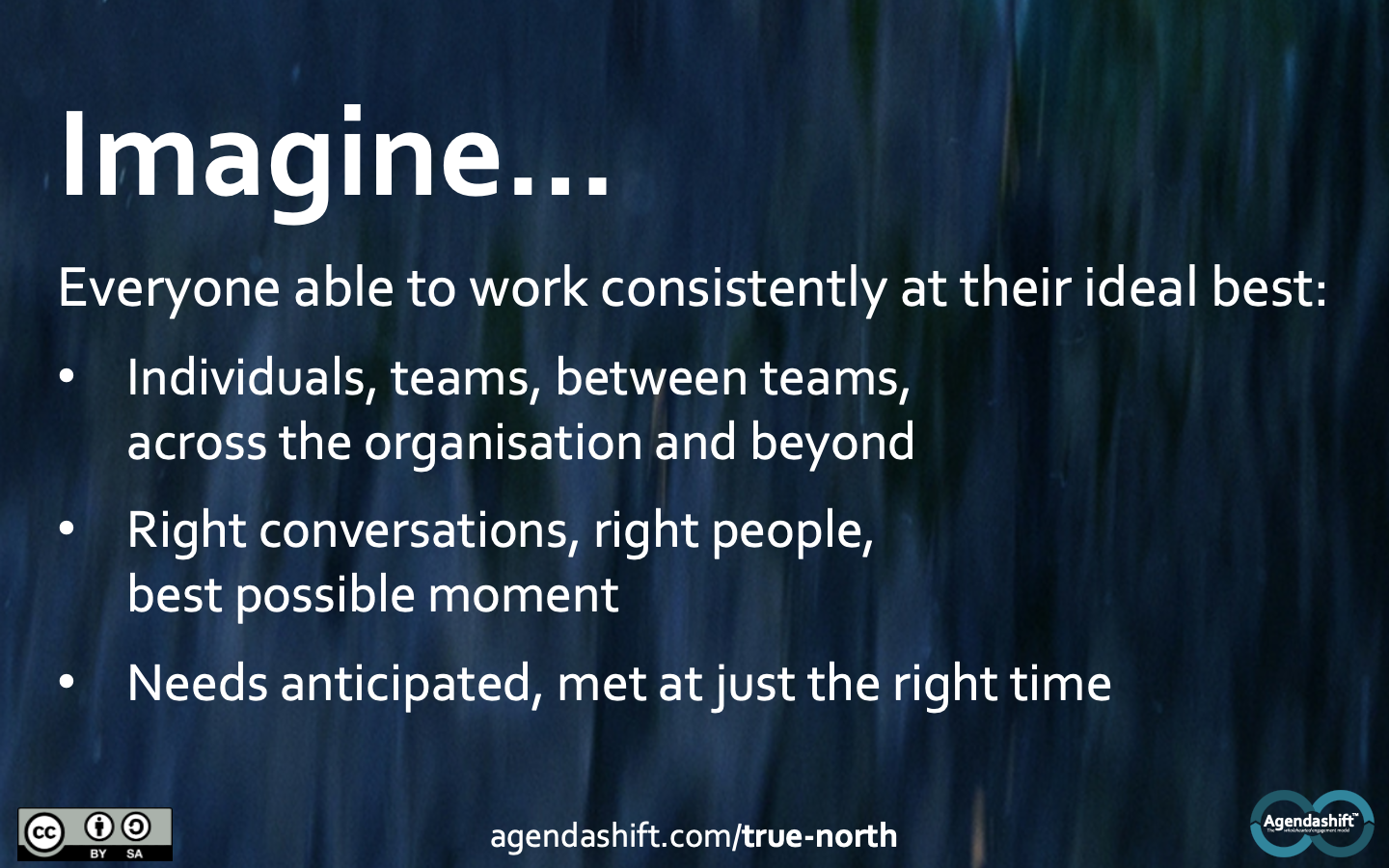
The Agendashift True North statement remains unchanged this time:

true-north-2020-08-12

What have changed are two of the setup questions, questions that gently lead participants through a Discovery discussion (usually in breakout groups, perhaps 1-2-4-All style). Previously:

  • (When that’s happening) What new stories could we tell?
  • In those those stories, whose needs are we meeting?

Now:

  • (When that’s happening) Whose needs would we be meeting?
  • What new stories could they tell?

I’ve done more than just swap those bullets around. Notice that the storytellers have changed: what was “we”, is now “they”. The change is subtle, but it does a better job of directing attention to what’s happening when needs are being met, when (to use JTBD language) we’re helping people make progress in what today are their moments of struggle.

I’ve put the complete set of setup questions in the facilitation deck – two versions of them in fact, one intended for workshop settings and one more suited to less formal occasions, meetups and the like. The deck is published under Creative Commons (CC-BY-SA) license and you can obtain it via the True North page. Be my guest!


What if we put agreement on outcomes ahead of solutions?

Agendashift™: Serving the transforming organisation
Agendashift  Academy: Leading with OutcomesHome | Store

Links: Home | Subscribe | Become an Agendashift partner Events | Contact | Mike
Resources: Tools & Materials | Media | Books | Assessments
Blog: Monthly roundups | Classic posts
Community: Slack | LinkedIn group | Twitter
Eating our own dog food (3/n): Harvesting

This is the third post in what has become a series:

  1. Eating our own dog food (1/n): Our outside-in strategy review (OI-SR):
  2. Eating our own dog food (2/n): The strategy review’s assumptions
  3. Eating our own dog food (3/n): Harvesting (this post)

From the first of those posts:

What it would be like if the Agendashift partner network was making a point of eating its own dog food (so to speak), in the powerful sense that it models a lot of what it’s like to be a wholehearteddeliberately adaptive organisation, its work happening in self-organising, self-governing circles, reviewing its strategy outside in, conducting outside-in service delivery reviews, and so on.

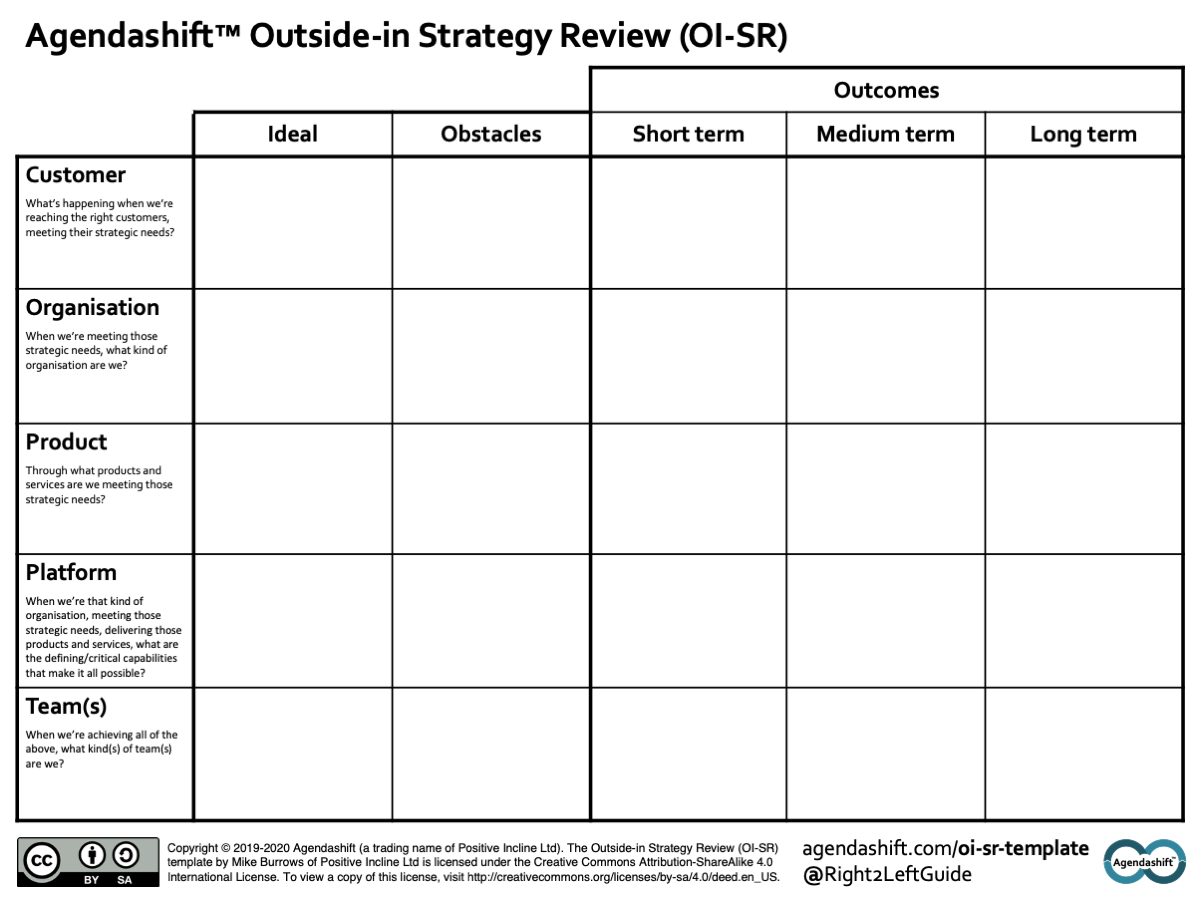
Yesterday we started an outside-in strategy review (OI-SR). As suspected, we didn’t get through all five questions in the limited time available, just one hour. And in my haste to get started we glossed over something important: In the question (below) for layer 1. Customer, who is there “we” here?

1. Customer: What’s happening when we’re reaching the right customers, meeting their strategic needs?

If from the preceding posts you’ve seen me explore some of the assumptions behind that question, you’ll have an idea of why I’m kicking myself! The one time I didn’t kick off with the Celebration-5W exercise was the time I most needed it…

Despite that little hiccup, some great stuff was captured for the first two layers, customer and organisation. That work was done in breakout groups (5 of them); we then had a brief whole-room discussion for Product and Platform before we ran out of time.

1. Customer

Who are those “right customers”?

  • Organisations that have the need and desire for change but not the know-how
  • Organisations that are stuck, needing clarity about their situation (framing their obstacles in ways that will help them get past them), wider perspectives, more options
  • Organisations that want to create shared awareness and from that define a way forward
  • Organisations that have suffered a bad experience of change and are looking for a better way
  • Organisations that want to adapt and innovate faster
  • Pioneers or those who have gone full circle – ready to get past the the “doing Agile” vs “being Agile” thing
  • Leaders willing to engage, organisations committed to supporting that
  • Leaders with skin in the game, taking responsibility

Their struggles:

  • Repeated attempts at change that don’t stick
  • The feeling that they have plateaued
  • Feelings of overwhelm and helplessness, no longer owners of their own destiny

Wrong customers:

  • Those unable to think beyond the linear project (not meant judgmentally – paradigm shifts are hard) 
  • Those unwilling to experiment (ditto – risk appetites differ, sometimes with good reason)
  • Those who want it all done for them (and again – old habits die hard)

Over-investing in these “wrong customers” in the short term would  waste of not just our time but theirs. However, we’re not writing them off. Their struggles are real enough, and the long game here is to inform the passive and (later) active seekers of help.

2. Organisation

When that customer part is working at its ideal best, what must be happening on our side? Answers below organised by circle (this was a two-part exercise):

  • Learning & other self-help:
    • Helping each other by sharing experiences of what did and didn’t work
    • Case studies (valuable also for marketing), “Agendashift from the Trenches” (see footnote later under Product)
    • Building the confidence of partners with less experience
    • How-to’s for engagement proposals and other commercial aspects
  • Content development & curation
    • Tools, exercises, models, etc
  • Marketing
    • Events
    • Other launches
    • Promotion generally
  • Domain-specific, for example:
    • SMEs
    • DevOps
    • Role-specific, eg senior leadership

3. Product

We really only had the time to discuss stuff that’s already in the pipeline or beyond:

  • The 2nd edition of Agendashift – very close to being able to announce a publication date
  • A conference (our first) to celebrate that
  • Self-paced learning options
  • The assessment tools:
    • Continuing some great work done on the language of the mini assessment and extending it to the full version
    • Two new assessment tools for the 1) wholehearted and 2) deliberately adaptive organisation
    • Doing a better job of promoting something we’re rightly proud of!

And a footnote on “Agendashift from the Trenches” (see 2. Organisation above): I wasn’t part of this breakout conversation but I have shared with the 2nd edition’s review team an idea for a collaborative book project. I’m thinking Wholehearted: Up and down the deliberately adaptive organisation, two key models from the 2nd edition brought to life through experience reports.

4. Platform

Some discussion (not completely conclusive) on technologies to support the work of those circles.

Despite my initial oversight, that’s a good haul for just one hour’s discussion – the outside-in structure delivers again! And let me repeat: If this kind of strategy review could work for you, do get in touch.


Upcoming

Tomorrow’s workshop below is nearly sold out but I’ve added another for early May. Keeping April free for book-related stuff!

All the usual discounts apply: repeat visits (not uncommon), partners, gov, edu, non-profit, country, un- or under-employment, bulk orders. If you think that one might apply to you, do please ask. Many of those considerations apply to private workshops also.

For the Deep Dive especially, if you think that you might become an Agendashift partner, partner discounts make it well worthwhile to get on board before you sign up to the workshop.


Agendashift™, the wholehearted engagement model
Links: Home |
About | Our mission: Wholehearted | Become an Agendashift partner | Assessments | Books | Resources | Media | Events | Contact | MikeSubscribe
Workshops: Transformation strategy | Outside-in strategy | Short training
Blog: Monthly roundups | Classic posts
Community: Slack | LinkedIn group | Twitter