Agendashift roundup, March 2017

In this edition: A little spring cleaning; Continuous transformation and 21st century thinking; An update to our Clean Language cue cards; Returning to India! ; Upcoming events; Top posts

A little spring cleaning

Spring is in the air here in beautiful Derbyshire! It’s also six months since launch, and it seems a good time for some spring cleaning. First order of the day: renaming the Agendashift facilitator day to the Agendashift practitioner’s workshop. Not a dramatic change, but it does more clearly reflect 1) the typical audience, and 2) the fact that it’s a hands-on workshop and not some other kind of event. We have two public workshops coming up in late April – Oslo (24th) and Bristol (27th)  – and we’ve updated both their titles and their descriptions. Check them out!

I’m also leading some private workshops in the next few weeks, two of them abroad. These come in two flavours: the practitioner’s workshop (essentially the same as the public workshop but with the advantage of some shared context), and the Agendashift transformation mapping workshop, aimed at client organisations. The former is mainly for coaches, consultants, and managers; at the latter we’ve had everyone from C-suite execs down to new joiners (diverse is good, by the way).

We may in due course rename the partner programme also. I’ve been soliciting the input of existing partners; overall we think the name describes the relationship well but there is the nagging concern that it may suggest a level of difficulty or cost that may cause some to be deterred quite unnecessarily.

Continuous transformation and 21st century thinking

The blog and by extension the LinkedIn group have been particularly active in recent weeks – helping ideas to crystallise before they find their way into the book – so do please make a point of reviewing this month’s highlights towards the end of this roundup. I’m very encouraged by the response so far. Long story short: 20th century prescriptions have had their day, and even the Lean and Agile communities need to take notice.

An update to our Clean Language cue cards

I’ve reached out to everyone who has requested the PDF for the Clean Language cue cards we use in our 15-minute FOTO game (FOTO standing for From Obstacles to Outcomes) and as described in my new book’s preview chapter. Soon there’ll be a blog post describing both the recent update and the role Clean Language fulfills in Agendashift; meanwhile to obtain either or both of these free resources just drop me a line.

Returning to India!

I’m thrilled to be invited back to India this autumn. If you’d be interested in attending an Agendashift practitioner’s workshop in Bangalore in September (immediately before or after Lean Kanban India), do please let me know. Let’s make this happen!

Upcoming events featuring Agendashift partners

Top posts


Agendashift-cover-thumb
Blog: Monthly roundups | Classic posts

Links: 
Home | Partner programme | Resources | ContactMike
Community: Slack | LinkedIn group | Twitter

Reflections on the Manchester facilitator day

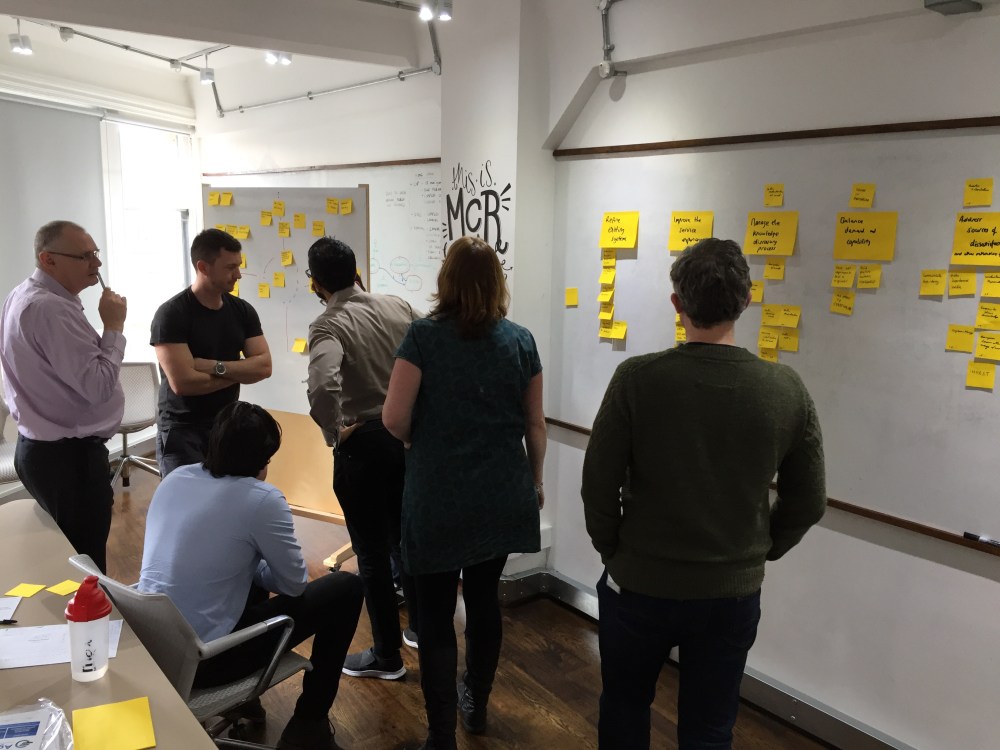
March 23rd saw another public Agendashift facilitator day, the practitioner-focused version of the Transformation mapping workshop. Each time we knock off a rough corner or two, remove some unnecessary words, and make the overall process clearer. Observations in session order:

0. Intro

1. Discovery

  • Participant and former colleague Imran Younis noticed an interesting parallel with this session – focused on strategic goals, obstacles and outcomes – and the game Hero’s Journey [www.funretrospectives.com]. This game is new to me; Imran has used it to good effect in product discovery workshops.

2. Exploration

  • I mentioned a planned update to the 15-minute FOTO cue cards (pictured below). We’ll be adding add a sixth question “Is there a relationship between X and Y?”, encouraging exploration of the relationships between the outcomes of Exploration and the goals of Discovery. Is the one a milestone to the other, just a distraction, or is the relationships not yet understood? Watch this space for an announcement about the new cards.

img_1789

3. Mapping

  • Faster mapping, thanks in part to the recent New feature: cross-referencing prompts across templates, also to the advice to prioritise “ruthlessly”
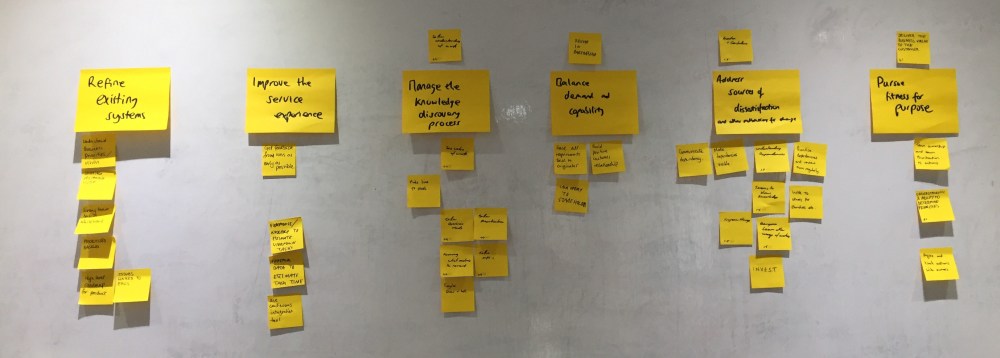
  • A very nice transformation map produced (below). Notice the generated “thematic outcomes” above the original, predefined headings. If preferred, the former could replace the latter.

Transformation map

Elaboration

  • Notice the group making reference not just to the transformation map but also the output from the Cynefin Four Points exercise (from Exploration). We’ve made the step of generating options much more explicit, thank you Karl Scotland. Trying that for the first time it makes sense to choose outcomes most amenable to exploratory approaches. “The right tool for the job” and all that…

img_1928

5. Operation

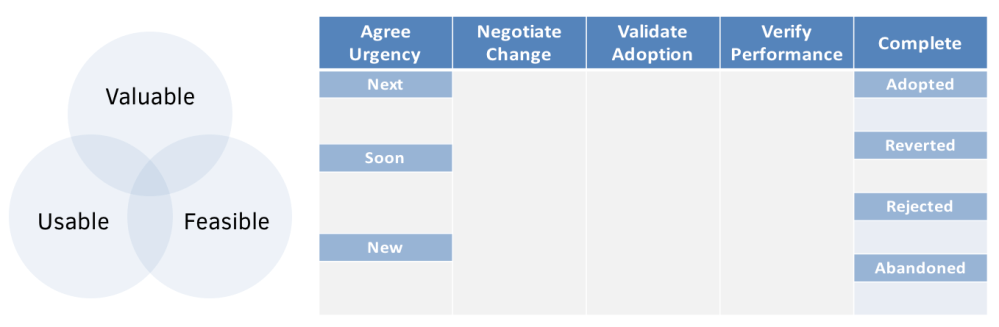
  • Visual management with Kanban – Lean Startup style. See how the Venn diagram on the left explains the board design on the right? Almost certainly not an original thought (in fact I’m pretty sure it’s by design), but it’s nice when you spot a connection like that.

Screenshot 2017-03-24 19.00.06


Agendashift-cover-thumb
Blog: Monthly roundups | Classic posts

Links: 
Home | Partner programme | Resources | ContactMike
Community: Slack | LinkedIn group | Twitter

Why Agile needs some 21st century Lean thinking

At least as far as the textbooks go, 21st century Lean is quite a different beast to its 20th century forebear. The best of the more modern Lean literature is now explicit in its recognition that you can’t just take the Lean tools out of one context, drop them into another, and expect the same results. Just because it works for Toyota, doesn’t mean it will work for you. Just because it works in a car factory… I hardly need to complete that sentence!

Not unmodified, that’s for sure. The kind of Kanban I described in Kanban from the Inside that works so well for people engaged in creative knowledge work is almost unrecognisable from the canonical kanban systems of the automotive factory. Many of the underlying principles are the same – for example visual management, controls on work-in-progress, the quest for flow – but their physical or electronic realisations are very different. In one, cards move left to right (downstream) on a kanban board to reflect the progress of work; in the other, cards are sent upstream when some downstream activity wishes to signal a need for some just-in-time replenishment.

But that’s just technical detail. The best of the 21st century Lean authors have been humble enough to make an even more important admission: even within the manufacturing domain you can’t (as the 20th century writers tried to suggest) transplant the tools whilst ignoring the management systems that guide, support, and sustain them, and still expect good results. An important case in point is continuous improvement (or kaizen, if you prefer). Don’t get me wrong: continuous improvement will always be a good idea. Unfortunately though, it is rarely sustained for long through goodwill alone. Asking your workforce for continuous improvement as a low-commitment way to achieve real transformation will almost certainly result in disappointment, even harm.

We in the Agile community know all this of course – how often do we see retrospectives fall into a state of neglect once the easy changes have been made? Unfortunately, we make it harder for ourselves, and by design! As an end-of-century reaction to 20th century top-down and plan-driven management styles wholly unsuited to the challenges of rapid product development in uncertain environments, Agile rightly sought to wrest control back to the teams doing the work. The unfortunate side-effect: blindness to the power of the kind of internal structures that create regular opportunities for mutual reflection, support, and accountability well beyond the team. How is the Agile team supposed to help the organisation become more Agile when it is determined to live inside its own protected bubble? This is how inspect-and-adapt (Agile’s continuous improvement) runs out of steam. Even at team level it’s hard enough to sustain; expecting it to drive broader change without support is, well, optimistic.

I’m not looking to throw the baby out with the bathwater. I’m not suggesting any backsliding on Agile values. I’m not making the case for 20th century top-down management (in fact quite the opposite). I’m asking that we look beyond the delivery-centric processes and tool (most especially beyond the determinedly team-centric ones) and start to think about what that cross-boundary support and accountability could look like.

In particular:

  • What will drive Agile teams and their host organisations to help each other to serve their customers’ and each other’s needs more effectively?
  • Where are the joint forums for reflection?
  • What mechanisms will provide support and ensure follow-through, even when the necessary changes become more challenging on both sides?
  • Where are the opportunities for people to engage seriously in the development and pursuit of organisational goals?
  • What skills will be  needed to make these things happen?

Outside the Agile mainstream, Kanban and Lean Startup have opinions (if not explicit guidance) on many of these questions. Helping people pay attention to concerns such as these is one Agendashift’s main motivations. Much of Agile however still seems to ignore them, sometimes recognising the need for end-to-end thinking but still wary of “at every level” thinking.

The good news is that these concerns are largely orthogonal to delivery. Agile delivery frameworks probably don’t need to be any bigger than they are today (let’s hope so). Some awareness of organisational context and its journey will be necessary though, and it may mean leaving aside the rhetoric of past battles. Welcome to the 21st century!


Agendashift-cover-thumb
Blog: Monthly roundups | Classic posts

Links: 
Home | Partner programme | Resources | ContactMike
Community: Slack | LinkedIn group | Twitter


New feature: cross-referencing prompts across templates

Disturbed night, so a quick new feature coded before breakfast:

Screenshot 2017-03-08 13.25.43

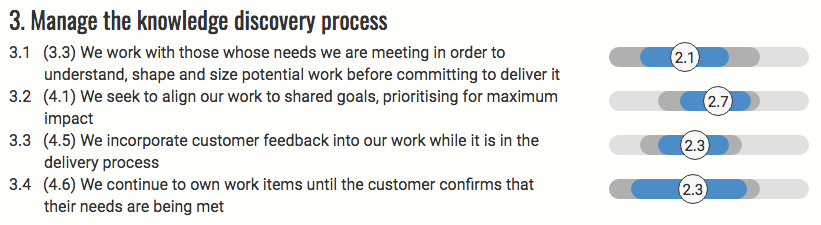
This excerpt shows some of the results from the collaboration and customer focus categories of a survey based on the Agendashift Values-based delivery assessment, but displayed using a so-called ‘pathway’ template.

We have long found that people respond very well to the values-based organisation of the assessment, with category headings of Transparency, Balance, Collaboration, Customer focusFlow, Leadership. Experience forces us to admit however that a plan based on these values isn’t very compelling. Where do you start? Conversely, whilst a narrative arc makes for a much more compelling plan, it would feel strange for an assessment. Hence the very useful trick (a few months old now) of being able switch templates when the time comes to work with the results.

This week’s little enhancement is to display the original index numbers of the prompts – the 3.3, 4.1, and so on in the example  – in the reorganised results. This means that in workshops, we can generate outputs against either (or both) sets of results and still maintain traceability. This in turn makes it easier to reuse the products of the Exploration session (which includes the survey debrief) in the Mapping session. Slick!

Want to try this for yourself? Some options:


Agendashift-cover-thumb
Blog: Monthly roundups | Classic posts

Links: 
Home | Partner programme | Resources | ContactMike
Community: Slack | LinkedIn group | Twitter

Why “continuous transformation”?

If you were wondering about the last couple of words of the new book’s title Agendashift: clean conversations, coherent collaboration, continuous transformation, here’s your explanation.

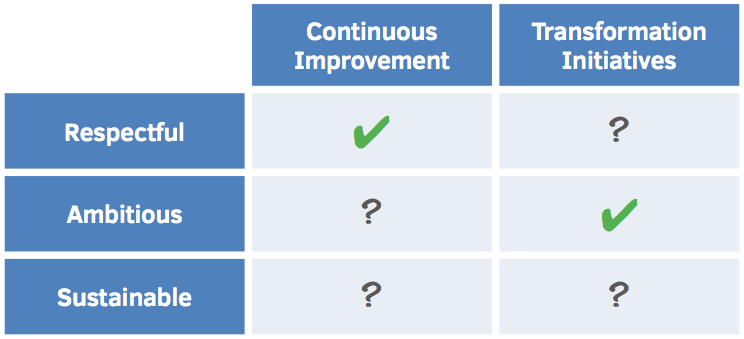
This picture sums up the challenge:

screenshot-2017-03-03-11-05-53

The good:

  • Yes, continuous improvement (in its many forms) is respectful – respectful (generally speaking) of people, respectful of current state, respectful of how you got there.
  • Yes, transformation initiatives do generally have a sense of ambition. Goals, rationale, sponsorship, and so on.

And the questionable:

  • Continuous improvement may be guided by some sense of direction, but often that’s more about the comfort of those inside the system than it is about purpose. The lack of meaningful goals means that few are motivated to overcome serious organisational challenges.
  • Too often, transformation initiatives are about imposing someone else’s vision on the people who know how things actually work. Too much is invested in overcoming resistance to change, not enough in engaging people in an open process.
  • If the organisational design doesn’t support it, continuous improvement quickly runs out of steam. Almost by definition – and certainly by the textbook definition of project –  most initiatives are set up to exist for only a limited time. Either way, sustainability is an ever-present challenge.

What if we could combine the best of both – respect and appropriate ambition – and at the same time confront the sustainability problem? This is what I am looking for in continuous transformation. I would define this as transformation that is:

  1. Respectful of present and past, the current context and the open-ended journey
  2. Appropriately ambitious for the future – – not grandiose, but with goals more ambitious than typically implied by continuous improvement, inspect and adapt, and the like
  3. Not just reactive, but proactive and anticipatory
  4. Happening all the time because – by design and by habit – the organisation’s core systems now demand and sustain it

If that sounds attractive, you’ve come to the right place. Grab your preview chapter. Join our Slack community and LinkedIn group. Check out our partner programme. And come to the next Agendashift facilitator day, in Manchester on March 23rd.


Agendashift-cover-thumb
Blog: Monthly roundups | Classic posts

Links: 
Home | Partner programme | Resources | ContactMike
Community: Slack | LinkedIn group | Twitter
Agendashift roundup, February 2017

In this edition: Agendashift facilitator days; Preview chapter; Resources page; London Lean Kanban Days 2017; Upcoming events; Top posts

Agendashift facilitator days

For the second month in a row I’m kicking off with the Agendashift facilitator day, the practitioner-focussed incarnation of the Agendashift transformation mapping workshop. The next one is on March 23rd in Manchester, and already the material incorporates the latest learning from this month’s workshop in Hamburg (see Reflections on another Agendashift Facilitator Day). The last two workshops both sold out, so book soon!

Watch out for a date change: we’re putting on an additional public event in Oslo on April 24th after the semi-public event currently advertised for the 21st sold out to internal takers. Watch out also for more 2-day events, where I partner with Martin Burns (Edinburgh), Karl Scotland (London), and others to be announced.

Preview chapter

It was good to find more opportunities to streamline the workshop material but it had a knock-on effect on the book. Chapter 1 (Discovery) is now shorter, chapter 2 (Exploration) correspondingly longer. Chapter 3 needed only minor change and is just about ready for my review team. Overall this added some delay but it was well worth the effort and and it’s moving forward at a good pace again now. Only two more chapters (Elaboration and Operation) before part I is complete!

agendashift-cover-mid


The introduction and first chapter (Discovery) are available as a PDF preview now. Read the announcement here or just ping me for your copy.

Resources page

Writing the book has prompted me to do something I should have done much sooner, and that is to gather into one resources page the following:

  • Cue cards for our Clean Language game 15-Minute FOTO, a description of which is included in chapter 1 (the preview chapter)
  • The Agendashift values-based delivery assessment, described in chapter 2
  • Our white paper 6+1 Essential strategies for successful Lean-Agile transformation (referred to in chapter 3) and the related video Servant Leadership un-neutered
  • The Agendashift A3 template, referred to in chapter 4
  • Featureban, our Creative Commons-licensed simulation game (not referred to in the book, but it’s still great!)

London Lean Kanban Days 2017

Agendashift is proud to sponsor London Lean Kanban Days (April 3rd and 4th) once again, and as now seems traditional for one of my favourite events of the year I’ll be presenting a new talk, 21st century change management: what we know and where we must do better.  Expect some blog posts soon as I knuckle down and write the talk. There’s still something to enjoy meanwhile, a 10% discount code for the conference. Get in touch if you’d like one.

Upcoming events


24 April, Oslo, Norway (note the change to the advertised date):
Agendashift facilitator day, Oslo
 Mike Burrows,  Thorbjørn Sigberg


Top posts


Agendashift-cover-thumb
Blog: Monthly roundups | Classic posts

Links: 
Home | Partner programme | Resources | ContactMike
Community: Slack | LinkedIn group | Twitter
Free preview: Read the introduction and first chapter of the forthcoming Agendashift book

[Update: The completed book is of course now available here]

It’s taking shape – Agendashift: clean conversations, coherent collaboration, continuous transformation.  Part 1 – “Facilitating the transformation process” – is due out by the summer [Update: it’s out now, at the above link]. Meanwhile, you can request a free PDF containing the introduction and first chapter, Discovery.

agendashift-cover-mid

You’ll definitely want to read this book if any of these apply to you:

  • You’re dissatisfied (if that’s a strong enough word) with transformation approaches that seem either disrespectful or feeble
  • You’d like to see what a 21st century change management approach can look like, and how that might inform your work as coach, consultant, or some other kind of change agent
  • You’ve an interest – whether as a practitioner or potential sponsor – in Lean-Agile change (perhaps under the banner of “Agile transformation” or similar)
  • You’d love to see a model for Lean-Agile change that reflects Lean-Agile values and demonstrates Lean-Agile process and thinking in operation

Also, check out the related Resources page. Find out how to obtain:

  • Cue cards for our Clean Language game 15-Minute FOTO, a description of which is included in chapter 1 (the preview chapter)
  • The Agendashift values-based delivery assessment, described in chapter 2
  • Our white paper 6+1 Essential strategies for successful Lean-Agile transformation (referred to in chapter 3) and the related video Servant Leadership un-neutered
  • The Agendashift A3 template, referred to in chapter 4
  • Featureban, our Creative Commons-licensed simulation game (not referred to in the book, but it’s still great!)

Agendashift-cover-thumb
Blog: Monthly roundups | Classic posts

Links: 
Home | Partner programme | Resources | ContactMike
Community: Slack | LinkedIn group | Twitter
 

Reflections on another Agendashift Facilitator Day

Day 2 of Hamburg Flow Days was the opportunity to run another Agendashift Facilitator Day, my third. As now seems traditional,  some thoughts on updates to the material prompted by the experience.

Before that, some thanks are in in order: Susanne and Andreas for being such excellent hosts, and Patrick for day 1, centered around his Flowlab, a very flexible Kanban simulation tool. On the morning of day 1 we spent the morning having fun with scenarios not much more complicated than is typical with my own Featureban. In the afternoon we experienced the delights of Customer Kanban, CONWIP systems, and the like. Awesome, both in its own right and for setting the scene!

Day 2 takeaways and updates (already made)

  • The overall shape is solid. I don’t see the 5 main sections (Discovery, Exploration, Mapping, Elaboration, and Operation) changing anytime soon.
  • Clean Language got a lot of love in the post-event retrospective. We know how to facilitate the several exercises that use it now, a whole lot easier since creating the Clean Language cards (pic below; PDF on request).
  • Based on feedback, the deck now has much clearer signposting – no-one should ever again feel at all disoriented. If that was your experience, sorry!
  • The idea of experimentation should seem less technical and more valuable if there is a tough choice to be made between alternative ideas. Should make for a more interesting transition from Mapping to Elaboration (I’ve been guilty of rushing this).

img_1789

Interestingly, people are still taking the trouble to give feedback on the December workshop. That material seems a little ancient already, but nevertheless it’s gratifying that participants are still finding that it is speaking to them. Why the delay? There is definitely something radical about it (particularly its commitment to conversations and outcomes before solutions), and perhaps it needs time to sink in. Let’s make sure that its radical edge isn’t lost as it becomes more polished in delivery.

Here’s a comment received less than a week ago, two months after the Leeds workshop:

When I originally signed up for the Agendashift workshop I was drawn in by the promise of blending techniques like Clean Language, Cynefin and A3 thinking in an applied sense.  After the workshop what stood out for me most was how the participants started to develop a shared ownership of organisational change through shared outcomes and values.  Ramble over – what I’m trying to say is it even managed to align a bunch of completely random strangers on the day.

Thank you Tony!

Interested? Upcoming Agendashift facilitator days:

Three recent events have sold out and some of the upcoming events have early bird pricing available, so hurry, book your place now!


Agendashift-cover-thumb
Blog: Monthly roundups | Classic posts

Links: 
Home | Partner programme | Resources | ContactMike
Community: Slack | LinkedIn group | Twitter
Agendashift as Good Strategy

[This is the third and last of a three-part series. Start from the beginning: Lean-Agile transformation as Lean-Agile process]

This post has been a while in coming. If you’ve been waiting, apologies! I’m going to cheat a little: what follows is lifted directly from the end of the just-written third chapter (Mapping) of the forthcoming book [Update – it’s now out: Agendashift, clean conversations, coherent collaboration, continuous transformation].


Is it Good Strategy?

To finish this chapter, the promised third reconciliation. This time a very quick reconciliation of your transformation map with Rumelt’s strategy kernel. This model comes from another brilliant book:

Three questions (Rumelt’s model, my words):

  1. Diagnosis: Is your strategy rooted in an understanding of the challenges you face and the opportunities available?
  2. Guiding policy: What gives shape to your strategy?
  3. Coherent actions: Are your planned actions coherent with each other, your guiding policy, and your diagnosis?

By virtue of your transformation map’s construction you should be able to give positive answers to questions 1 and 2, and a partial answer to question 3:

  1. Diagnosis? Witness the obstacles and their respective outcomes from Discovery, Exploration, and Mapping (chapters 1-3) together with the survey analysis that informed Exploration (chapter 2).
  2. Guiding policy? Your strategy was given shape first by the values and prompts of the assessment (chapter 2), and then by the transformation journey steps of this chapter.
  3. Coherent actions? You have identified detailed outcomes that you have reconciled with your broader goals. Moreover, most (if not all) those outcomes align with one or more of the values of the survey, and those values are themselves coherent.

We could add to point 3 that our overall approach to the transformation process is highly coherent with our Lean-Agile sensibilities. Hardly a minor point!

So we’re good then? Not so fast. A solid basis for a good strategy certainly, but a further level of detail is still required. We’ve said what we want to have happen, not the concrete steps we will take and what impact we think they will make. Cue chapter 4, Elaboration.


This was the third of three related posts:

  1. Lean-Agile transformation as Lean-Agile process
  2. Agendashift as coaching framework
  3. Agendashift as good strategy

See also Karl Scotland’s post Good Agile/Bad Agile: The difference and why it matters.


Agendashift-cover-thumb
Blog: Monthly roundups | Classic posts

Links: 
Home | Partner programme | Resources | ContactMike
Community: Slack | LinkedIn group | Twitter
Agendashift roundup, January 2017

In this edition: Agendashift facilitator days; Clean Language cue cards; Progress on the new book; Upcoming events; Top posts

Agendashift facilitator days

We held the second of these practitioner workshops this month, it was sold out well in advance, and I’m very happy with the new structure (described here: Lean-Agile transformation as Lean-Agile process). Some great feedback too! This one – about the very first of these workshops – made my day:

Looking back to the Agendashift day in Leeds a few weeks ago, it has been incredibly helpful to me in my professional development
– EB, Scrum Master & coach

See the upcoming events section below for dates of workshops in HamburgManchester, Edinburgh, Oslo, and Bristol. Don’t see one near you ? Want one in-house? Get in touch.

The Hamburg event (next week) is a 2-day combined Flowlab & Agendashift workshop. There is only one ticket left, so grab your place while you still can! Most of the later workshops have early bird pricing available too so there’s every reason to book early.

Clean Language cue cards

Clean Language has been a huge influence on Agendashift, helping us deliver on our promise of transformation based not on the imposition of practices but on the genuine search for agreement on goals, opportunities, and outcomes.

Here’s a group (one of several) at the Agile Derby meetup this month using our Clean Language cue cards:

image

These cards have proved themselves very helpful to everyone playing the ‘coach’ role in our outcomes game. I had a hundred of these printed on A5 card just a couple of weeks ago and I’m nearly out already! You can print your own – just drop me a line and I will gladly send you the PDF.

These cards show only a small subset of what Clean Language has to offer. In the hope that that they pique your interest, let me recommend these books (in the order I read them):

  • The Five Minute Coach: Improve Performance Rapidly
    Lynne Cooper & Mariette Castellino (2012)
  • Clean Language: Revealing Metaphors and Opening Minds
    Wendy Sullivan & Judy Rees (2008)
  • From Contempt to Curiosity: Creating the Conditions for Groups to Collaborate Using Clean Language and Systemic Modelling
    Caitlin Walker (2014)

Progress on the new book

I’m currently working on chapter 3 (Mapping) of a 5-chapter Part 1. I’m hopeful that Chapter 1 (Discovery) can be released as a free preview in the next few weeks. All being well, I’ll be able to release part 1 electronically by the summer before full publication with a 6-chapter part 2 later in the year.

If you’re not already on the Agendashift mailing list and would like to receive updates, let me know.

Upcoming events featuring Agendashift partners

Top posts


Agendashift-cover-thumb
Blog: Monthly roundups | Classic posts

Links: 
Home | Partner programme | Resources | ContactMike
Community: Slack | LinkedIn group | Twitter