What we hope to learn from the 2016 Agendashift global survey

It has been running quietly all year, but I’d like to draw your attention to the 2016 Agendashift global survey.

Last year’s was our first, and we published the results in this InfoQ article: Q&A on Agendashift with Mike Burrows. Quite a bit has changed since then:

  • The prompts have been refined through collaboration (a process that continues), making them easier to understand and score
  • We now have a “mini” assessment (thank you Patrick for the idea) that doesn’t take long to complete
  • We’ve reduced friction by not requiring names and email addresses from participants (we still ask you, but you can leave them blank)

To that last point, let me describe what we hope to do with the data and why it might be valuable to make yourself known to us.

Our plan is to examine the correlations between scores at prompt and category level. For example, is the prompt “We can see which work items are blocked and for what reason” a strong predictor of combined scores in the most obvious categories (Transparency and Flow) and in other places (Customer focus perhaps)?

There’s some basic analysis to be done – ie calculating the correlations – then there’s what we can learn from followups with participants. Without followup, we’ll never know if the correlation signifies a causal relationship. Which interventions tend to drive progress overall? Which were just the result of playing catch up?

We might get enough data to do some cluster analysis too. Are there different patterns in the data, each representing different kinds of organisation or different transformation strategies? I’ve no doubt that we could find such clusters, but will they be meaningful? We can theorise as much as we like, but without followup we won’t know.

So… do please take part, and share widely. By all means participate anonymously if you prefer, but understand also the potential value of engaging with us fully in this project. It could be awesome!

The link again: agendashift.com/2016. It will run until the end of this year, results and analysis to be published early next.

Thank you,
Mike


Agendashift-cover-thumb
Blog: Monthly roundups | Classic posts

Links: 
Home | Partner programme | Resources | ContactMike
Community: Slack | LinkedIn group | Twitter

Agendashift roundup, October 2016

This month: Agendashift facilitator days; Private classes and workshops; inclusive • contextual • fulfilling • open; Upcoming events; Top posts

Agendashift facilitator days

We’re excited to announce the first two of what I hope will be many Agendashift facilitator days, to be held in Leeds and London on December 5th and January 19th respectively. They’re a chance to experience, practice, and explore the main elements of the Agendashift debrief/action workshop from the perspective of both participant and facilitator.

Book a place at the Leeds workshop [eventbrite] for just £265 (plus VAT where applicable) or register interest for the London workshop. Existing Agendashift partners get a £50 discount, and any attendees who subsequently join the partner programme will then receive the equivalent benefit.

If neither of these dates or locations work for you, get in touch anyway. I’m particularly keen to hear from anyone who’d like the opportunity to host such an event, whether in other parts of the UK or abroad.

Private classes and workshops

It has been a while since I have mentioned private training and workshops. After a summer spent launching Agendashift it will be good to get back in the saddle! My 1-day training Kanban and Lean-Agile essentials with Agendashift and the aforementioned Agendashift debrief/action workshop complement each other well; so well in fact that I offer the two together as a package.

There is leadership training on offer as well. Be aware that I plan to rework this around the “6+1 strategies” of our white paper, combining Servant Leadership with Lean-Agile transformation even more explicitly than is apparent from the current class description.

inclusive • contextual • fulfilling • open

One thing I never fail to celebrate is our Slack community! One particularly intense conversation last week really helped to crystallise things for us. Read the blog post that summarises what we believe brings us together:  inclusive • contextual • fulfilling • open.

Upcoming events

See also our new online events calendar, where we also feature events supported our partners.

Top posts


Agendashift-cover-thumb
Blog: Monthly roundups | Classic posts

Links: 
Home | Partner programme | Resources | ContactMike
Community: Slack | LinkedIn group | Twitter

inclusive • contextual • fulfilling • open

It started quite innocently yesterday on #random:

screen-shot-2016-10-27-at-09-14-26

Martien wanted to know whether this was addressing Agendashift’s How, What or Why. Excellent question! Settling quickly on the Why and after multiple iterations over several frantic pages of chat with Martien,  Andrea, and Jussi we got to this:

  • Inclusive – because we’re more interested in what we can accomplish with others than in what we can achieve alone
  • Contextual – because every situation is unique, to be explored and developed in ways both tried-and-tested and novel
  • Fulfilling – because meeting people’s needs, goals, and wishes brings meaning, direction, and pleasure
  • Open – because we’re still uncovering better ways of working and new ways in which to combine them

We share this now as an invitation. If in any capacity you’re in the business of Lean-Agile transformation and these words resonate with you, read on.

Inclusive

Why inclusive? Because we’re more interested in what we can accomplish with others than in what we can achieve alone.

The Agendashift community embraces practitioners of a range of methods including Scrum, Kanban, SAFe, and ESP. And we get along just fine! What we have in common is a commitment to the crafts of coaching, facilitating, and leading. We also share a strong interest in developing contemporary approaches to transforming organisations so that they work radically better for those inside and outside of them. The tools we use are broadly neutral on the choice of delivery method (including the choice of no single one).

This deliberate inclusivity encourages diversity. The way Agendashift integrates ideas from bodies of knowledge as varied as Clean Language, Cynefin, Lean Startup, and Servant Leadership owes much to the range of specialisms and passions of the growing number of people I’m proud to identify as collaborators. To mention just a few, people like AndreaDraganJussiKarlMartienPatrick, Susanne, and Thorbjørn make Agendashift what it is today.

It is absolutely NOT our goal to define some kind of overarching method, the next SAFe, say. We love to see people take the likes of Scrum and Kanban in their purest forms and see just how far they can take them. Likewise, practitioners of LeSS, SAFe, and ESP can test larger scale patterns in the field, and there’s much we can learn from their experience, especially in terms of how to support this level of change. Inclusive is not “embrace and extend” – often a sign of a shallow understanding of what went before – but “celebrate diversity”.

Contextual

Why contextual? Because every situation is unique, to be explored and developed in ways both tried-and-tested and novel

How are your standup meetings conducted? Physically or figuratively speaking, are they round the room with the three questions, or right-to-left, closest-to-completion first?

OK, bad question. Let’s approach it in a different way. Instead of binary, checkbox questions, consider this prompt – one of several from the Agendashift values-based delivery assessment that touch on how we organise and discuss our day-to-day work:

We share progress on our work frequently and are quick to collaborate as the need or opportunity arises

This isn’t just more inclusive. Yes, we allow ourselves a range of solutions drawn from multiple sources, inside or outside the mainstream. Also, we’re choosing not lead with a preferred practice to which there may be perfectly valid objections. We’re starting instead with outcomes, and if there’s agreement that those outcomes are desirable, we’re already halfway there.

But even that’s not the full story. Who gets to say that standup meetings should be the next item on the change agenda? Contextual isn’t just about choosing best-fit practices and bypassing resistance to change. It’s about discovering where the organisation is most amenable to the kind and degree of change that it needs. Contextual isn’t just problem-solving, it is strategic, ambitious, and purposeful. The alternative is irrelevance.

Fulfilling

Why fulfilling? Because meeting people’s needs, goals, and wishes brings meaning, direction, and pleasure

This works at so many levels! It applies to us as agents of change: for all its frustrations, there’s joy in our work! It applies to all who bring an attitude of service to their customers and colleagues. It applies to every leader of companies, teams, or communities who recognises with respect and humility the degree of choice available to every employee, member, or participant.

There are technical, strategic, and even political issues here too. A striking example is the “Start with needs” strategy implemented by the UK government for its digital services, a model that is now being replicated in other countries. Out of that strategy followed new user-centric specialisms (new at least in the government context), concrete evidence that the days of sponsor-driven or supplier-driven design were coming to an end.

Our sincere wish is that for every piece of work we consider starting, we pause to identify the authentic situation of need that is waiting to be addressed by it. If we can find one, our work has purpose. If we can’t, it’s likely that we’re building mediocre solutions to the wrong problems. Nobody needs that.

Open

Why Open? Because we’re still uncovering better ways of working and new ways in which to combine them

The Agile manifesto didn’t draw a line and say “job done” in 2001. We’ve seen an explosion since, and still the job isn’t done. Nor should we expect it to be.

However, 15 years is long enough for a new status quo to be established. In many organisations and communities, “that’s how we’ve always done it” can be said about Agile practices just as naturally as it can about the kind of practices that Agile sought to replace. And having established a new status quo it’s tempting to defend it.

That would be a mistake, however. In our business (in any business?), there are few “solved problems”, problems that will stay forever and optimally solved. If we’re complacent enough to let our competitors explore beyond boundaries we’ve set for ourselves, we get what we deserve. Unfortunately, that kind of complacency can incur severe collateral damage and it’s no wonder that these “sins of omission” have been described as being among the most serious that leaders can commit [1].

Open sits very well with inclusive, but we’re not going not pretend that between us we have all the answers. Open by design means that we’re encouraging innovation, we’re ready to borrow from surprising places, and we’re prepared to let go. Open is also vulnerable, and vulnerability is difficult. Fortunately, we do it in very good company.

Join us!

If this makes any kind of sense to you, hang out with us. Join our Slack community or LinkedIn group – you would be very welcome in either or both places. You can help by sharing knowledge, trying new things and sharing your experience, refining our message, getting it out there. Or just spend some time with us and discover what it’s all about.

For the most part, the tools live on agendashift.com, with a deck for workshop facilitators (partners), and an A3 template that like our Featureban game has been released under a Creative Commons license. There’s also a white paper that was last updated in July – feels like an age ago!

Consider participating in one of our Agendashift facilitator days – Leeds, UK on December 5th [eventbrite.co.uk] or London, UK on January 19th (details to be published by the end of next week; register interest here).

And beyond your individual participation, think about what Agendashift’s inclusive • contextual • fulfilling • open might mean for your community or organisation. What can we learn from each other? How can we support each other?

[1] Ackoff, Russell L. 1991. Ackoff’s Fables: Irreverent Reflections on Business and Bureaucracy. Hoboken, NJ: John Wiley & Sons.

My thanks to Martien and Jussi for their invaluable feedback on earlier drafts.


Agendashift-cover-thumb
Blog: Monthly roundups | Classic posts

Links: 
Home | Partner programme | Resources | ContactMike
Community: Slack | LinkedIn group | Twitter
Agendashift facilitator days in Leeds and London

Updates:

Quick one…

In response to demand, we’re looking into running Agendashift facilitator days in Leeds and London, early-mid December and mid January respectively.

You should consider attending if:

  • You’re already an Agendashift partner and you’d like to see and practice the running of an Agendashift debrief/action workshop
  • You’re considering becoming a partner and you’d like to get up to speed quickly
  • You’ve a general interest in Lean-Agile transformation as coach, consultant or sponsor and would like to see what our inclusive, non-prescriptive, method-neutral and values-based approach is all about

Pricing isn’t set yet but we plan to keep this affordable. Locations will be accessible by train. We have some interest from Europe for the London event and we’re likely to choose a location near St Pancras.

If interested, contact me (Mike Burrows) directly or via these links:

Neither of these work for you? We’d love to hear your thoughts on where and when these events could be successful:

Have a great weekend!


Agendashift-cover-thumb
Blog: Monthly roundups | Classic posts

Links: 
Home | Partner programme | Resources | ContactMike
Community: Slack | LinkedIn group | Twitter

Featureban 2.1 (unplugged)

Last night I ran a small Featureban session (7 people across 2 games) at our local meetup (Spire Digital meetup in Chesterfield, Derbyshire) and I thought it would be fun to do it “unplugged”, without the deck. I decided to capture my preparation in the deck itself so that others could use it; this in turn created an opportunity to make two unrelated changes I had pending (both optional). Let’s start with those.

New: “What would you change”

For this optional addition I’m indebted to Patrick Steyaert and Andy Carmichael.

Featureban already makes the connection between the rules of the game and the “policies” of the Kanban Method practice “Make policies explicit”. Patrick and Andy’s idea was to encourage experimentation with the rules, just as we would encourage real-world policies to evolve in the pursuit of improvement.

Some facilitators have sought to distinguish between policies that are fixed and those that the players are free to experiment with. I have left it more open:

screen-shot-2016-10-12-at-09-43-59If you’re going to do this, I would recommend introducing it in the middle of Iteration 3 (Metrics).
New: Start tracking in Iteration 2

In the new hidden facilitator’s overview slide for iteration 2 you will find this addition:

  • Optionally:
    • Keep track of “day number”; write the day number on stickies when you start them (leaving existing in-progress stickies as they are)
    • Stop this iteration when when all your in-progress stickies have a day number on them and you’ve completed all the stickies that were still in progress at the end of iteration 1

We did this last night, and I consider it a success. It adds a small overhead to iteration 2 but it is outweighed by the extra sense of objective given to that iteration (flushing out all the old stickies) and its immediate impact to iteration 3. No longer do we need to wait for several rounds in iteration 3 before we start to see items completed with known lead times.

Unplugged

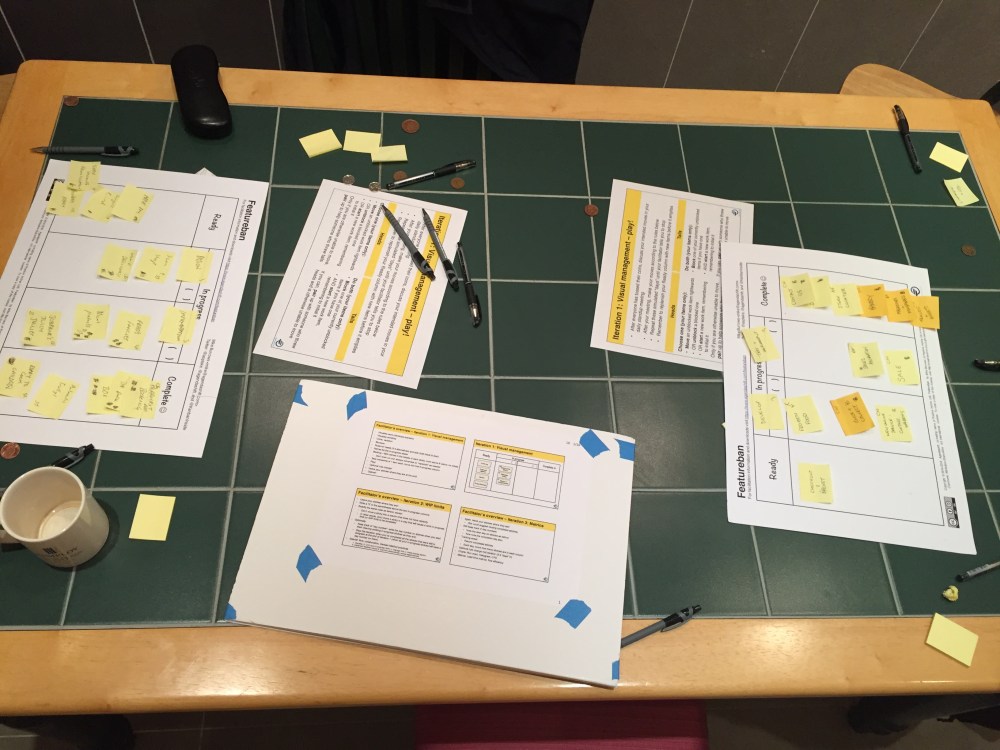
In the deck, each iteration is now preceded by a hidden slide with a facilitator’s overview. I printed these four-to-a-page, the fourth page being a picture of the board (slide 3). You can see them here taped to the back of my board, stiffened with a rigid A3 foam tile I bought from Staples (they’re quite handy – I keep a few of these in my bag to protect my materials). I referred to mine only once but it was good to know that they were there!

2016-10-11-20-11-16

As you can see, I also printed the rules page for iteration 1, one copy per team. There is no need to print the rules for later iterations.

It turns out that the picture slide I printed (upper right of the four) doesn’t demonstrate the ideal setup for explaining the rules unplugged. You may have noticed in that the setups used in the deck to explain the rules for heads, tails, and blockers differ slightly. I used this setup instead, which has two stickies owned by me (MB), one of them blocked:

2016-10-12-10-33-04

I have now added an updated hidden slide for reference. While I explained the rules, I moved stickies and pretended to write on them (without actually marking them).

A final picture: here’s the histogram we made from the stickies completed in iteration 3:

2016-10-11-21-19-44

We sketched a run chart and a CFD also (no pictures, alas), and discussed Little’s Law also.

Further information

Interested in facilitating Featureban yourself? These are the main places to visit:


What if we put agreement on outcomes ahead of solutions?

Agendashift™: Serving the transforming organisation
Agendashift  Academy: Leading with OutcomesHome | Store

Links: Home | Subscribe | Become an Agendashift partner Events | Contact | Mike
Resources: Tools & Materials | Media | Books | Assessments
Blog: Monthly roundups | Classic posts
Community: Slack | LinkedIn group | Twitter

Launch pricing expires in one week!

Just a quick reminder that our month-long launch offer expires a week today, on Friday, October 14th. That’s a year’s membership of the Agendashift partner programme for just £220*, and even less where country discounts apply.

You needn’t be fully on board by then, but you will need to confirm your acceptance of the license agreement and get in touch about your onboarding session.

That’s £220 for a year of almost unlimited access to the online tools, the use of our facilitation materials, and (if you wish – most do) listing in our partner directory. The full price of £275 is hardly expensive, but why not save £55 while you have the chance?

Intrigued but not sure? Our Slack community is three times the size of our partner community. To put that another way, one third of our Slack community are already partners! Join us (you would find us most welcoming) and you’ll soon get a sense of what we’re all about. Or get in touch and we’d be happy to talk you through your options.

*Plus VAT where applicable. We’re based in the UK.


Agendashift-cover-thumb
Blog: Monthly roundups | Classic posts

Links: 
Home | Partner programme | Resources | ContactMike
Community: Slack | LinkedIn group | Twitter


Better user stories start with authentic situations of need

I drive a Toyota Rav 4 Hybrid. It’s the most sophisticated piece of equipment I have ever owned and I love it, but the satnav has been a constant source of frustration. It’s a lot better now than it was when I took delivery (frankly, it was embarrassingly bad), but one niggle still stands and I’m going to use it as an example.

Do you use the direction list (or “turn list” as it’s sometimes called) on your satnav? Not everybody does, but I like to!

I don’t know if Toyota are fans of user stories, but I can imagine some business analyst at Toyota City writing one that goes something like this:

As a driver,
I want a list of directions
so that I can review my route

Like a million other user stories, it’s short and sweet, a convenient shorthand for the feature. You can imagine the <what> part, (the list of directions) being further elaborated somewhere. Neither the <who> nor the <why> parts add much. Basically, the user story identifies a requirement. Old school! The unfortunate result here is 100% cast-iron mediocrity.

Here’s my personal job story for this feature:

When I’m about to leave the motorway (at 70MPH),
I want to know what’s coming next
so that I can choose the correct lane on the slip road

Had Toyota considered that scenario, they’d know this feature needs to be readily accessible (one click away, not three), easily found (not hiding in a settings menu of all places), and legible without reading glasses (whose idea was blue on blue icons?).

Here’s the relevant Agendashift assessment prompt (we just updated it):

4.1 We take care to understand the needs that will be fulfilled by our work and to explore the circumstances in which those needs arise

We’re not prescriptive, and we’re not insisting that you abandon user stories in favour of job stories. But do remember that to bring your user stories to life, they need to start in an authentic situation of need. And if you can’t think of one, either talk to your customer (Toyota, you can talk to me anytime) or seriously consider dropping the feature.


What if we put agreement on outcomes ahead of solutions?

Agendashift™: Serving the transforming organisation
Agendashift  Academy: Leading with OutcomesHome | Store

Links: Home | Subscribe | Become an Agendashift partner Events | Contact | Mike
Resources: Tools & Materials | Media | Books | Assessments
Blog: Monthly roundups | Classic posts
Community: Slack | LinkedIn group | Twitter

Agendashift roundup, post-launch edition (September 2016)

This month: The big launch; Tool improvements; Upcoming events; Top posts

The big launch

September has been good to me – Kanban from the Inside was published in September 2014, and Agendashift has escaped from beta almost exactly two years later. It obviously does me good to enjoy much of the summer at home instead of working away!

The launch itself exceeded expectations – we went live with more partners already signed up than I dared to expect and I’ve had onboarding calls in my diary ever since as new partners come on board.

There were no major dramas, not that you’d expect too many after a year or more in beta! The additional scrutiny did throw up a niggle or suggestion or two that were addressed quickly. We even managed to roll out some enhancements (more on those next).

Tool improvements

  • Grouped/tagged reports: in both the single-assessment review page and the survey-level charts page you can now sort prompts independently of the category to which they belong. Select “Tagged” from the Show menu to enable this. The old behaviour, “Grouped”, remains the default.
  • You can now “archive” un-needed contexts, surveys, and assessments. This has the effect that they’re hidden from view until you choose to un-archive them.
  • Additionally, you can mark assessments as “excluded” if you want to keep them visible but have their data filtered out from survey results.
  • You can add notes to assessments, with Markdown support
  • If you wish, you can use Markdown in your profile bio also (like I did in mine)

Meanwhile we have been making good use of Slack (see the #assessments channel) and Google Docs to collaborate on the wording of the prompts in the Agendashift values-based delivery assessment. You may remember from a few weeks ago a blog post on one such update (What, no “stand-up meeting”?); watch out for more of those in the coming weeks.

The workshop facilitation deck has benefited from further revision also, and there is now a facilitator’s guide (for partner use).

Upcoming events

Watch this space for listings of public training events in the UK towards the end of the year and/or into next year. If you’re interested in private training meanwhile (I do quite a bit of that, mainly in the UK and Ireland), check out the Agendashift website. In due course we’ll list partner events there too.

Top posts

And in a category of their own, pages for our popular resources:


Agendashift-cover-thumb
Blog: Monthly roundups | Classic posts

Links: 
Home | Partner programme | Resources | ContactMike
Community: Slack | LinkedIn group | Twitter

Introducing the Pathway edition

In the weeks leading to Agendashift’s launch earlier this month, a number of things came together at just the right time. Two of those in combination – Clean Language and Cynefin – I blogged about recently. Another key element, the pathway, I have hinted at but not described adequately. It’s time to put that right.

Some background

The online part of Agendashift is built around the values-based delivery assessment, our distinctively non-prescriptive, non-judgemental, methodology-neutral tool. The 2014 version of this was extracted from my book (and not just by me – others had the same idea), and it has been revised beyond all recognition since then, first in close collaboration with Dragan Jojic and more recently by community work, mainly via our Slack group.

The assessment’s tone has changed noticeably over that two-year period. It is of course still organised by those six values – transparency, balance, collaboration, customer focus, flow, and leadership – but the 40+ prompts are much less about specific practices and much more about the outcomes derivable from them. That might seem like an odd change to make, but we find that people buy into those outcomes even when the by-the-book practices that lead to them can seem unattractive.

For example, who wouldn’t want to be able to say this about their organisation:

We understand our performance sufficiently to make timely decisions, to set appropriate expectations, and to guide focussed improvement

Buy into that outcome, and implicitly you’re buying into the changes that will bring it about. Compare that to the older version of this prompt:

We measure lead times and predictability and seek to improve them

With the benefit of hindsight I can sympathise with those that instead of buy-in reacted with push-back! The original wording was well-meant but ill-thought, almost guaranteed to provoke resistance in anyone who has experienced the mis-application of metrics or who wonders why we seem to promote one set of metrics at the apparent exclusion of others.

Outcome, agreement, action, planning

Much of coaching or facilitating with Agendashift can briefly be summarised as follows:

  1. Using the prompts to establish a shared understanding of the current situation, expressed in terms of how well the prompts describe reality (‘scoring’ the prompts)
  2. Using the prompts some sense of what’s important to people – first individually (‘starring’ selected prompts) and then collectively
  3. Prioritising those generic outcomes, then turning them into agreement on more specific outcomes that are more immediately realisable
  4. Generating, framing, developing, and organising actions that we hope will make the most important outcomes a closer reality

This is already powerful, but it’s not quite enough. We need pathways, shorthand for a process that turns something that could feel very multidimensional and amorphous into something sequential that can be tackled step-by-step over a period of time. It turns “a lot of good stuff” into a plan (where that’s warranted) or an agreed way forward (if that’s all that’s needed).

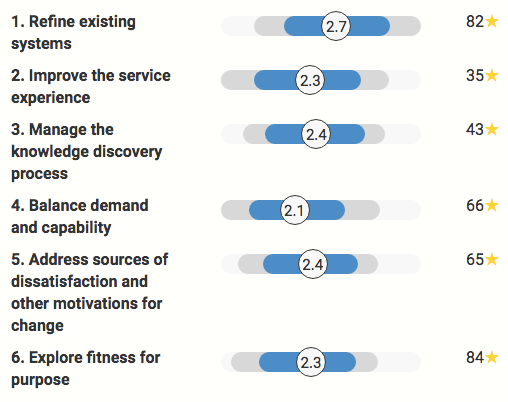
Agendashift’s latest trick is the ability to reorganise the values-based assessment on demand. Here’s a summary chart that illustrates the idea, using the ‘Pathway edition’ template:

screen-shot-2016-09-23-at-11-47-45

Do the category names have a familiar ring? They’re inspired by Reverse STATIK, the ‘Reverse’ a clue that this is not the classic STATIK process that builds up to a Kanban system implementation, but a process of review and reworking that starts with our existing management systems, whatever they are.

In our example, the first category, Refine existing systems, already scores relatively well (or rather, its prompts do), but look at the number of stars! This category contains some of the most basic things to get right, and it would seem that there is strong support for making further improvement here before moving on to more challenging things.

Improve the service experience isn’t as well supported, but there’s a wide range of scores here. Before dismissing this category prematurely it would be wise to explore any differences of opinion. What’s going on here? Differences of understanding of the current situation, of what’s possible, or of the scope of the exercise? Well worth checking.

The next three categories, Manage the knowledge discovery processBalance demand and capacity, and (deep breath) Address sources of dissatisfaction and other motivations for change have moderate levels of support. Sequence-wise, they’re in at least roughly the right order.

The last category, Explore fitness for purpose, has the strongest support, but are we ready to tackle it yet? Would it make sense to tackle the basics before we address things that we know will be more challenging – organisation design, leadership behaviours and the like? There’s no one right answer to that question, but it’s worth asking!

It should be clear now that pathways here aren’t cookie-cutter plans, but starting points to be developed collaboratively. They can be used in conjunction with other tools (story maps and impact maps, for example). They can be cross-checked with other models (the Agendashift transformation strategy model or your favourite Agile implementation roadmap, for example), to find any gaps and help create a more robust plan. Alternatively they can form the basis of a simple working agreement, for example to revisit each category over the course of the next six retrospectives – a 10-minute conversation for 12 weeks of impact!

You can do this too

Are you in the business of Lean-Agile transformation –  a coach, consultant, or manager perhaps? Join our partner programme and you’ll have all these tools at your fingertips. Or you can use the services of one of our growing band of awesome partners, people who know when to put prescription aside, to start listening, and to facilitate rather than impose a process of transformation, a process that takes to you towards the outcomes you want.


Agendashift-cover-thumb
Blog: Monthly roundups | Classic posts

Links: 
Home | Partner programme | Resources | ContactMike
Community: Slack | LinkedIn group | Twitter

We did it! Agendashift is fully live

We did it! Agendashift is out of beta and 22 awesome Lean-Agile coaches, consultants, and trainers have joined me as authorised partners and facilitators. Each of them has full access to the Agendashift tools and materials and will be using them with their clients  (many in fact are already doing so).

The choice of the word “partner” has turned out to be very apt. It has been a genuine pleasure to take each of them through the onboarding process in one to two hours of video calls. We’ve had a great time in our Slack community in recent weeks too, and we’ve collaborated on a number of significant refinements and enhancements to the tools, the prompts, and the workshop materials.

Meet the first 21 partners

Excluding one name kept private by the choice of their employer (a scenario we anticipated and were happy to cater for), see them listed in their full glory in the partner directory.

But let me name and thank them here too:  Alexei Zheglov (Canada), Andrea Chiou (USA), Brad Hughes (USA), Chris Roberts (UK), Colm O’hEocha (Ireland), Dragan Jojic (UK), Ian Carroll (UK), Irshad Nizami (India), Jose Casal (UK), Jussi Mäkelä (Sweden), Karl Scotland (UK), Kenny Grant (UK), Martien van Steenbergen (Netherlands), Mike Leber (Austria), Nikos Batsios (Greece), Olivier MY (France), Patrick Steyaert (Belgium), Russ Lewis (UK), Sathish K Mohanraj (USA), Susanne Bartel (Germany), and Thorbjørn Sigberg (Norway).

What are they able to do?

Authorised partners have full access to the following:

  • The Agendashift values-based delivery assessment, our distinctively non-prescriptive, non-judgemental, methodology-neutral tool, refined continuously beyond all recognition through use and collaborative, community-based review since it was first extracted from my book. Many partners already use it in their one-to-one coaching and to support team or organisation-wide exercises.
  • The Agendashift debrief/action workshop: a powerful synthesis of Lean-Agile values, exploration techniques from Clean Language, and complexity thinking from Cynefin. Thoroughly modern in its philosophy and choice of tools, its job is to foster deep agreement on objectives, outcomes, and actions whilst maintaining alignment on broader organisational concerns.
  • The Agendashift transformation strategy framework: our 10,000-foot view of the Lean-Agile transformation process. This keeps us both real and empathetic, reminding us of the scale of the challenge faced by anyone with leadership responsibility and the heart for transformation.

What does it mean for me?

Whether you’re a coach or a manager, if you’re in the business of Lean-Agile transformation, Agendashift is for you. Our partners can assist you (they’d be delighted of course) or you can join the programme, become an Agendashift facilitator, and have these powerful tools at your disposal.

Intrigued but not sure? Our Slack community is three times the size of our partner community. To put that another way, one third of our Slack community are already partners! Join us (you would find us most welcoming) and you’ll soon get a sense of what we’re all about. Or get in touch and we’d be happy to talk you through your options.


Agendashift-cover-thumb
Blog: Monthly roundups | Classic posts

Links: 
Home | Partner programme | Resources | ContactMike
Community: Slack | LinkedIn group | Twitter