Your Agendashift user profile

As part of the preparations for next week’s partner programme launch, I’m capturing the key points of the onboarding process in a series of reference pages. Those that seems fit to publish I’ll post here on the Agendashift blog.

Step 1: Sign up

You may have done this already. If not, the way to get an Agendashift user account is to participate in a survey. There’s always one running at www.agendashift.com/surveys/featured and you can see it here on the home page:

screen-shot-2016-09-07-at-09-42-49

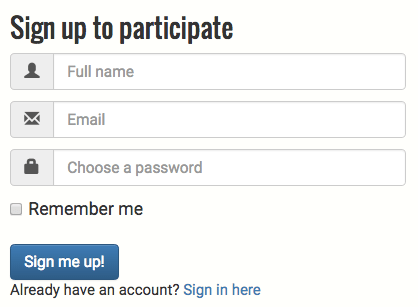
Sign up with your full name, preferred email address, and password (at least 8 characters long):
screen-shot-2016-09-07-at-09-44-18

Thoughtfully, and with a real situation in mind as you do it, have a go at the survey. As described in the sign up page, you’re seeing the “mini” version of the Agendashift values-based delivery assessment. This includes 18 of the 40+ prompts of the full template, organised by the same values – TransparencyBalance, and so on.

Step 2: Provide your profile details

Once you’re done with the survey (it will take only a few minutes), take a look at your user profile. If you plan to join the partner programme or if you want others to see your profile it will be worth the few moments it takes to give it some polish.

You can reach it by clicking “My profile” on the “Account” menu, seen here in both desktop and hand-held screen widths (on the latter it’s hidden behind the “hamburger” menu)

screen-shot-2016-09-07-at-09-46-32

screen-shot-2016-09-07-at-09-47-51

Here’s mine:

screenshot-2016-09-07-11-39-29

Note that the image displayed is the gravatar associated with my email address. If you don’t have one, register for yours at en.gravatar.com. Be aware that it may take a few minutes after registration before yours appears (don’t ask me why).

Other than your email address and your gravatar, everything here is editable. Hit the Edit button and you’ll see something like this:

screenshot-2016-09-07-10-57-35

Most of this is self-explanatory, but a few notes:

  • You can add relevant credentials such as “KCP” or “CSM” to your title if you wish
  • The fields for your website, LinkedIn, Twitter, Facebook etc are all completely optional. If you wish to use them, please enter full urls beginning with http:// or https://
  • The “Viewable” checkbox controls whether your profile page is accessible by people other than your survey administrator or the site admin (ie me). This field becomes somewhat redundant should you wish also to be “Listed” – the latter implies the former.
  • Whether or not you appear in the partner directory is under our joint control. “Listed” indicates you’d like to be there (you may have valid reasons not to, even if you are a partner).
  • If “Listed” is checked and I in the role of administrator have checked “Listable” also, then bingo, you’re in. I also control whether you are able to administer your own contexts and surveys. These adare visible only to me; I update them during the onboarding process:

screenshot-2016-09-07-10-59-31

Step 3: Hey presto!

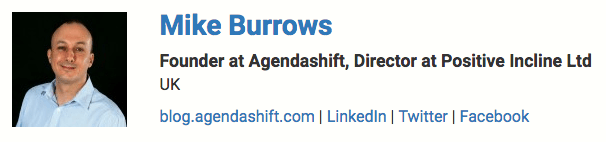
Finally, here’s what my listing in the partner directory looks like:
screenshot-2016-09-07-10-35-05

This entry neatly summarises almost all the information provided: name, title, location, and online identities. The only information that remains to be seen only in the profile page is the bio.


Agendashift-cover-thumb
Blog: Monthly roundups | Classic posts

Links: 
Home | Partner programme | Resources | ContactMike
Community: Slack | LinkedIn group | Twitter

The last few pieces of the jigsaw

Just 8 days until the September 14th and the official launch of the Agendashift partner programme! It seems a good time to review what we have and take a look at some of the most recent changes:

  1. The Agendashift values-based delivery assessment: Not your typical consultant’s practice-centric checklist (forgive me if I sound cynical here) but a non-prescriptive, non-judgemental, methodology-neutral tool, based initially on the last chapter of my book and refined repeatedly through use and collaborative, community-based review over the two years since. No emailing of spreadsheets (horrible!) it’s all online, and used to support one-to-one coaching, team exercises, and organisation-wide surveys.
  2. The Agendashift debrief/action workshop: This is packaged as a Lean-Agile strategy deployment workshop (an accurate but jargony description) but it also helps convey Agendashift’s coaching and change management philosophy to new partners and to demonstrate how 21st century tools such as Clean Language, Cynefin, and Lean Startup can be integrated into a coherent and pleasing whole.
  3. The Agendashift transformation strategy framework: our 10,000-foot view of the Lean-Agile transformation challenge. Just the ‘6+1 strategies’ of our white paper’s title serves as a reminder that it’s a multi-dimensional challenge with a lot to consider! It serves me well also as a structure for organising thoughts on leadership.

The last few pieces of the jigsaw lead to a better integration of #2 and #3.

I’m very happy with how the introduction of Clean Language and Cynefin helps us elicit and explore outcomes at both the strategic level (at the level of the long-range objectives and challenges that participants bring to the workshop) and the immediate (at the level of the priority areas and actions that the workshop largely deals with). I’m indebted to Karl Scotland and Liz Keogh for helping this to crystallise in the way that it did, and to Karl again for experimenting with it and sharing his experiences.

At last (I’m still kicking myself for not spotting the gap and the opportunity sooner), pathways, a term I shamelessly borrow from my Hivemind colleagues Ian Carroll and Dave Clark.

Here’s why pathways matter: The tools and the techniques are great, the values and the thinking behind them make sense, the prompts are helpfully revealing and thought-provoking, and we’ve learned to generate, frame and develop a handful of actions around which we have deep agreement on underlying needs, desired outcomes, and how we intend to achieve them. Wonderful! Now what?

Pathways are a rough – or not so rough – guide to the territory ahead. Our online tooling includes one already (based on the Reverse STATIK model) but many practitioners already have their own (which is fine – we’re methodology-neutral after all). Our template starts with the basics of process management, adds some sophistication, then works its way up to organisational stuff. It’s a simple starting point for agreement on a way forward over a period of weeks or months, whether what’s needed is a detailed transformation plan (Ian is working on tools to track this) or some high level agenda, perhaps just the agreement to revisit each category in turn in successive retrospectives.

Have the right people in your organisation reconcile the pathway agreed in the workshop with the strategy framework and you should have some confidence that people are suitably aligned and most of the bases will be covered in due course. That’s the theory anyway!

Don’t panic, we’re not about to go all top-down on you. Pathways are way to meet the needs of sponsors and participants alike – a credible plan-for-a-plan, the product of a facilitated process, and the fruit of agreement (value #8), where buy-in is an early outcome, not a problem to be overcome at the end.

It’s really happening

8 days isn’t long but it’s not too late to join us if you’d like to have your name included in our partner directory on launch day. Interested? Check out the programme or simply hang out in our Slack community, get a feel for the place, and join the conversation when you’re ready.


Agendashift-cover-thumb
Blog: Monthly roundups | Classic posts

Links: 
Home | Partner programme | Resources | ContactMike
Community: Slack | LinkedIn group | Twitter

Agendashift roundup, pre-launch edition (August 2016)

This month: The big launch; Agendashift and Featureban on Slack and LinkedIn; Upcoming events; Top posts

The big launch

We’ve made several releases to agendashift.com this month as we gear up for the official launch mid September of our partner programme, aimed at anyone who is in the business of Lean-Agile transformation – whether that’s as coach, consultant, manager, or some combination of the three – and wants access to tools that are non-prescriptive and non-judgemental, but still thoroughly thought-provoking and action-inducing.

Expect to see some names you recognise in our partner directory; if you want yours to be there on day 1 and included in our launch announcement on or near September 14th, make sure you get your onboarding session booked! A number have taken place already, with more in the diary or promised.

Some of the recent website improvements are described in the blog post The big pre-launch release. We’ve actually made several more since then, including a significant revamp of assessment-level and survey-level reporting.

Agendashift and Featureban on Slack and LinkedIn

Just in the last couple of weeks we’ve started a Slack community – 45 members already and growing every day. Admission is by invite only (that’s how Slack works), but don’t hesitate to ask for one. We have channels dedicated to #coaching, #assessments, #featureban, and #leadership; there’s also an #introduce-yourself channel for new joiners, and a #launch channel for tracking launch-related activity, new releases, and the like.

The Agendashift group on LinkedIn remains a good place to check for announcements and blog posts. Membership recently passed the 400 mark.

Upcoming events

Sadly, I will have to miss Lean Kanban India 2016 (9th-10th September). This was due mainly to an oversight on my part, but it would have been a crazy time for me to be traveling also!

Top posts

And in a category of their own now, pages for our popular resources:


Agendashift-cover-thumb
Blog: Monthly roundups | Classic posts

Links: 
Home | Partner programme | Resources | ContactMike
Community: Slack | LinkedIn group | Twitter

What, no “standup meeting”?

They’re coming thick and fast – another Agendashift release this morning…

Today’s release saw the removal of the term “standup meeting” from our assessment tools. That’s despite this glowing reference to the practice in my book:

If there’s one Agile practice I recommend above all others, it’s this one. I’ve seen teams drop standup meetings when their value goes unrecognized, only to reinstate them just a few days or weeks later as things start to fall apart. Perhaps the very familiarity of the practice makes its value too easy to overlook.

Have I changed my mind? No!

Here’s the old wording of the prompt:

We review our progress frequently, typically during daily standup meetings

And the new:

We share progress on our work frequently and are quick to collaborate as the need or opportunity arises

The old wording stood out as one of the most prescriptive of our 40+ prompts. This matters because:

  • Strong responses might hide dysfunction – for example ritualistic meetings that are achieving little
  • Weak responses might not seem important – “OK, we’re not doing the practice, but so what?” or “We tried that once, and it didn’t work!”

Strong answers to the new wording are more likely to reflect not just an effective practice, but good outcomes in the form of timely collaboration. Weak answers will highlight not the absence of a solution, but the presence of a genuine problem, one that probably ought to be addressed. That’s how all our prompts are meant to work – neither prescriptive nor judgemental but thought-provoking and action-inducing where it matters.

Thank you to Thorbjørn Sigberg, Andrea Chiou and Karl Scotland for valuable help in iterating on that prompt in our Slack community yesterday. Ping me if you’d like an invite.

Do you think you could make effective use of tools like these? The Agendashift partner programme is now open, in a pre-launch phase before we announce our first wave of partners next month.


Agendashift-cover-thumb
Blog: Monthly roundups | Classic posts

Links: 
Home | Partner programme | Resources | ContactMike
Community: Slack | LinkedIn group | Twitter

The big pre-launch release

Our biggest release yet went out on Tuesday morning, all part of the run-up to the official launch of the Agendashift partner programme next month (worth checking out now – we’re accepting people already).

Check out:

  1. User profile pages (here’s mine):  All users have one, but yours is visible to no-one other than you and your survey admin until you choose to enable.
  2. The partner directory  – empty by design until official launch next month.
  3. At last the page describing the partner programme  (and the small print, the partner license agreement).
  4. If you have access to a survey charts page, try changing the template (eg from the original template to a ‘pathway’ one). This is more important than it may sound; separate blog post to follow soon.
  5. Useful if you manage more than one context, your session history of up to 5 contexts is now shown on the Context menu.
  6. “Surveycodes”: short codes that participants can use to access surveys, a feature available to all survey admins and invaluable in a training or workshop environment. I’ve been recommending the use of third-party link shorteners up to now, but no more!
  7. Lots of work under the covers; a JSON API drives pretty much everything now.
  8. A ton of content and design improvements too.

You can try that #6 for yourself. Here, for example, is the surveycode for the 2016 global survey: 5fFNLZ. From the Agendashift home page follow the link “Got a surveycode?” (or find it on the “More” menu wherever you are), and submit the code via the form there.

Last but not least, we’re on Slack now! Ping me for your invite.


Agendashift-cover-thumb
Blog: Monthly roundups | Classic posts

Links: 
Home | Partner programme | Resources | ContactMike
Community: Slack | LinkedIn group | Twitter

The agenda and the shift: what Agendashift makes explicit

“Make your agenda for change explicit”. Well what does that mean?

Were we or one of our soon-to-be-revealed partners to take you through the process, here are the key things we will help you make explicit. Which of these are “agenda” and which are “shift” I’ll leave to your imagination – perhaps it depends on where you are now…

Context

  • Problems, challenges, and objectives
  • Individual, team, and organisation
  • Outcomes #cleanlanguage
  • Change strategies #cynefin
  • Where we are now – the Agendashift values-based delivery assessment #lean-agile #kanban #values

Agreement on action areas

  • Their respective outcomes and change strategies #cleanlanguage #cynefin

Actions

  • Hypothesis #leanstartup #a3 #lean
  • Assumptions, dependencies, pilot experiments
  • Risks – upside as well as downside – and safety #cynefin
  • People

Organisation and follow-through

  • Visibility
  • Feedback loops
  • Accountabilities

Take out the Agendashift values-based delivery assessment and you still have a non-judgemental, agreement-driven, outcome-focussed, complexity-aware change management framework. With it, you have a uniquely values-based way to give focus and energy to your Lean-Agile transformation.

Think you could facilitate this yourself? Then get in touch – we’re launching next month and are accepting pre-launch partners now!


Agendashift-cover-thumb
Blog: Monthly roundups | Classic posts

Links: 
Home | Partner programme | Resources | ContactMike
Community: Slack | LinkedIn group | Twitter

Outcomes, alignment, and changes to our A3 template

Last week’s post Two new tools* and how I’m finding them useful has generated a lot of interest – after just six days it is already the 3rd most popular post of the year!

*Spoiler: Clean Language and the Cynefin Four Points Contextualisation exercise

One piece of detail I neglected to mention is a tweak I have made to the A3 template we use to guide people through the process of framing and developing their actions as hypothesis-driven changes. The header area at the top of the page has gained a new field: “Aligned to objective”.

It’s a chance to identify:

  1. a pre-existing high level objective to which this action aligns, or
  2. a summary outcome shared by this and other actions (a theme, if you like).

Better still, both at the same time – this is after all what alignment and strategy deployment [availagility.co.uk] are all about. Without alignment, so-called improvement can easily descend into just fixing stuff – interesting locally perhaps but unlikely to be important in the grand scheme of things.

Resources


Agendashift-cover-thumb
Blog: Monthly roundups | Classic posts

Links: 
Home | Partner programme | Resources | ContactMike
Community: Slack | LinkedIn group | Twitter

Two new tools and how I’m finding them useful

I have been incorporating two new tools in my workshops: Clean Language (which could be described as a coaching tool) and the Cynefin Four Points Contextualisation exercise. Here’s how we put them to use.

Clean Language

You’re probably familiar with the idea of coaching often taking the form of identifying a goal, then helping the client focus on the process of getting there. The GROW model [1] is probably the canonical example, a conversation structured – explicitly, or implicity in the mind of one or both participants – along these easily-remembered lines:

  1. Goal
  2. Current Reality
  3. Options
  4. Way forward (or Will)

Clean Language [2, 3] covers some of the same ground, using language particularly good at (among other things) getting to outcomes (the Goal in GROW model), and doing so in a noticeably judgement-free manner.

There is some discipline involved:

  • Sticking to the the preferred prompts
  • Incorporating the client’s language
  • Note-taking

I’m not yet skilled enough myself to do all of those simultaneously and I certainly don’t expect others to do so without practice! It is however a fun and useful exercise for workshop participants to take the roles of the client (with real or imagined problems, challenges, or potential solutions to explore), coach (whose job it is to guide the exploration), and scribe (who writes down anything that sounds like an outcome).

In our exercise, the coach is allowed only these prompts (a small but important subset of the whole):

  • “What would you/X like to have happen?”
  • “(And) then what happens?”
  • ”(And) what happens before X”?
  • “What kind of X?”
  • “Is there anything else about X?”

In the context of the exercise, first two of those are the most important, taking the conversation away from problems and solutions and towards desired outcomes. The middle one has multiple applications; here it could be used when the coach does not grasp the mental leap the client has made. The last two are more exploratory, likely taking the conversation into areas more metaphorical, descriptive, or detail oriented (perhaps too much so, but that’s the choice of the coach).

No big explanation needed – we try it, and it works! We’re just dipping our toes in the water, but there’s the opportunity afterwards to explain that we have here a set of tools that could be of great value to anyone interested in further developing their coaching skills.

Four Points Contextualisation

The nuts and bolts of the Cynefin Four Points Contextualisation exercise are well described in the first part of this article from the Adventures with Agile blog: Cynefin Review Part 7 – Finding Your Place on the Framework.

More interesting to me than the mechanics have been some of the implications. This exercise powerfully illustrates some important things:

  • The importance of choosing an implementation approach that is appropriate in context, whether that’s one based on careful analysis and planning, on experimentation, or on direct action
  • The range of opinion on what’s appropriate, given any particular outcome or solution
  • The strength of our personal biases in favour of some approaches over others, making us  – myself very much included – vulnerable to blind spots and at risk of judging others quite unfairly

Interesting stuff! Here’s the output from one such exercise (on the Featureban scenario, not anything sensitive):

IMG_1523.jpg

Opportunities for you to give them a try

Both tools are now standard elements of the Agendashift debrief/action workshop, with the option to remove or gloss over them if a shorter workshop is called for. For the 1-day training workshop, they’re both optional extras – choosing them will be at the expense of other material. [Note: with some big site changes pending they’re not in the blurb yet]

There’ll be opportunity to see one or both of them in action at these upcoming events:

I’ll look into whether we can something at Lean Kanban India 2016 (9th-10th September) also.

Want to facilitate one a session yourself? Watch this space – we’ll soon be making this possible. Drop me a line your need is urgent!

References

[1] Sir John Whitmore, Coaching for Performance
[2] Lynne Cooper and Marriette Castellino, The Five Minute Coach: Improve performance – rapidly
[
3] Wendy Sullivan and Judy Rees, Clean Language: Revealing metaphors and opening minds


What if we put agreement on outcomes ahead of solutions?

Agendashift™: Serving the transforming organisation
Agendashift  Academy: Leading with OutcomesHome | Store

Links: Home | Subscribe | Become an Agendashift partner Events | Contact | Mike
Resources: Tools & Materials | Media | Books | Assessments
Blog: Monthly roundups | Classic posts
Community: Slack | LinkedIn group | Twitter

Agendashift roundup, July 2016

This month: Agendashift, Clean Language, and Cynefin; Become an Agendashift facilitator; Upcoming events; Top posts

Agendashift, Clean Language, and Cynefin

The Kanban Leadership Retreat in Barcelona helped to consolidate recent conversations regarding the use of Clean Language (the coaching tool) and Cynefin (the complexity framework) with Agendashift. Advanced versions of our training materials now incorporates both, as will the facilitator’s deck for the Agendashift debrief/action workshop (more on the latter in a moment).

Long story short, Clean Language is great for (among other things) eliciting desired outcomes, helpfully separating those from solution options. This in turn reinforces Agendashift’s role as a strategy deployment tool. Cynefin goes on to help participants choose a implementation approach that is appropriate to the problem in hand.

Become an Agendashift facilitator

In last month’s roundup I preannounced plans to make the Agendashift tools and facilitation materials available on a commercial (but very affordable) basis. We’re hoping to launch publicly at around the end of September; meanwhile we have been sharing an outline of the partner programme with our beta testers and other potential participants. If interested in being part of that first wave, do please get in touch.

Upcoming events


Top posts


Agendashift-cover-thumb
Blog: Monthly roundups | Classic posts

Links: 
Home | Partner programme | Resources | ContactMike
Community: Slack | LinkedIn group | Twitter

Applied Servant Leadership: Let’s recap

Our series on Servant Leadership draws to a close.

The premiseIt’s time to reclaim Servant Leadership. Instead of describing Servant Leadership through the lens of the Scrum Master (an understandable but limiting perspective), let’s put it in the context of Lean-Agile transformation. After all, what is leadership if it is not transformational?

Six areas for attention

The six leadership concerns here correspond to the six main strategies in our white paper 6+1 Essential strategies for successful Lean-Agile transformation. Take a few moments to reflect on themnow:

  1. Skills: Do you know what a modern, fast, customer-focussed delivery capability looks like? All the way upstream and downstream from your core development process? Did you remember skills of leadership and change management? Think about where your organisation needs to be, and don’t make the mistake of using your own skillset as the baseline.
  2. Needs: It might seem a funny question to ask, but are you meeting needs? Are needs the true focus of your process? Do you understand how radical and transformative this change of perspective can be? Does your organisation?
  3. Team: Through service – not just to the team, but by the team and by teams in combination – we help the organisation continue to become what it needs to become. What is your contribution to that transformational process?
  4. Improvement: Are you giving what it takes to sustain improvement? The attention to organisational design, the significant management effort, the ongoing leadership? Will you make it it a personal priority, ensuring sponsorship, safety, and commitment? Or will you see it fall by the wayside, as so often it does?
  5. Alignment: Where’s the follow-through? Are your improvement and transformation efforts supported by the same (or equivalent) feedback loops that keep your delivery work on track? Or are even those inadequate?
  6. Purpose: Can every member of your team describe with confidence what (collectively) you deliver, to whom and why it matters? Can you do the same on behalf of your peers and seniors? How often do you dig deeper to rediscover and reaffirm the things that keep you moving together in the right direction?

Why this campaign, what does it have to do with Agendashift?

We – like you perhaps – are in the business of Lean-Agile transformation. Purposeful transformation requires leadership, we know of no better leadership model that Servant Leadership and it deserves much better than the shallow treatment it tends to receive.

As Agendashift we ask servant-leaders and their organisations to reflect and dig deeper, but we know that this is hard work. So we help! Taking together the tools and the workshops (both of which we will very soon be making available to other facilitators) and the training:

  1. Skills: We bring hypothesis-driven (Lean Startup-inspired) techniques to the fore, fully integrated into our explicitly values-based treatment of Lean-Agile and Kanban. Add generous sprinklings of complexity (Cynefin), A3 (Lean) and coaching techniques (Clean Language) into the mix too.
  2. Needs: Whether or not it because we love to share our first-hand experiences of working in needs-first environments, repeatedly we find that users of our tools choose to prioritise these aspects.
  3. Team: Right conversation, right time, between the right people. This is our goal not just within teams but between them. And it starts with digging deeper and reaching meaningful agreement on things that matter.
  4. Improvement: We wouldn’t be too offended to hear Agendashift described as “improvement on steroids”. It is significantly more than that, but we definitely have this one covered!
  5. Alignment: As you might expect, alignment to values is baked in. We pay careful attention to other forms of alignment too, and Agendashift has been recognised by others as a Strategy Deployment approach.
  6. Purpose: We love to work with mixed groups – frontline staff rubbing shoulders with senior managers (right up to the C-suite) and their customers. We can (and do) work explicitly on purpose, but any agreement here is gold!

That’s the series wrapped up. If you enjoyed it, do give our white paper a read! Get it here: 6+1 Essential strategies for successful Lean-Agile transformation.


Agendashift-cover-thumb
Blog: Monthly roundups | Classic posts

Links: 
Home | Partner programme | Resources | ContactMike
Community: Slack | LinkedIn group | Twitter