In this edition: Outside-in Strategy: Positioned for success; Train-the-Trainer / Facilitator (TTT/F); Two new interviews; Cape Cod Institute’s BMI Series; Upcoming events; Top posts
Outside-in Strategy: Positioned for success
The fifth and final chapter of Outside-in Strategy: Positioned for success went live today. If you need a customer-first strategy or you have something to contribute to one, check out this unique self-paced training. With plenty of leadership-focussed content, it’s based on the outside-in strategy review found in my books Right to Left (where most of a chapter is devoted to it) and the Agendashift 2nd edition (where we ask the question “Who’s invited?“).
This is the third of four planned Leading with Outcomes modules, and like everything we do it’s applicable at every scale – team, team-of-teams, something bigger, something different even – and every level of experience. Come join us! Have your colleagues join us!
We have subscription plans for individuals and businesses, and do reach out if you’re in the government, non-profit, or educational spaces – we’d be glad to work something out for you.
Next April I’m doing a workshop for the Cape Cod Institute’s BMI Series in dialogic organisation development – organised with the people responsible for some of Agendashift’s key references: Dialogic Organisation Development (Bushe & Marshak), The Dynamics of Generative Change (Bushe), and a curated series of books, including (fingers crossed) one of mine in the not-too-distant future. Needless to say, it is quite something to be invited, and more on that new book soon.
Where we got to last time (and from there to what a healthy relationship with the process frameworks looks like):
A structure that makes sense – not just tidy on paper, but purposeful at every scale – allowing each unit at every scale to self-manage effectively (structuring itself to minimise dependencies, for example)
Each unit at every scale able to express its own strategy in its own words, in terms appropriate to its domain and its customers, aligning it with other units and other scales according to both structure and opportunity
Each unit at every scale able to identify what it must manage at that scale – no more and no less – with protocols to deal with what should be managed elsewhere
We reached those conclusions via a route that made it very obvious that each of them apply at every scale, and that the consequences can be serious if there’s a problem with any of them. But it doesn’t stop there. Whilst it’s possible for a scale to be badly designed in its own right – awkward structure, missing capabilities, or poor coordination to name but a few – it’s not hard to see that the relationships between scales are no less important. If anything, they’re more troubling.
Consider these:
One unit doing the coordination work of another – micromanaging, or interfering in other ways
One unit doing the strategy work of another – imposing it downwards (directly, via an overly-top-down or centralised plan), second-guessing upwards, etc
Units taking on responsibility for outcomes over which they have insufficient control
Units providing insufficient transparency about strategy, progress, or risks for related others to make good decisions
Units failing to share useful intelligence
Or conversely, units not listening (or worse, punishing unwelcome news)
These describe dysfunctional relationships even when they’re between peers, but when there’s any kind of power imbalance involved, those at the receiving end may feel powerless to fix them.
The Deliberately Adaptive Organisation
Let’s recast those challenging but still fixable problems more positively, as principles. These are table stakes I believe for any serious approach to scaling. With minor caveats they apply to every identifiable scope or scale:
Each responsible for its own strategy and accountable for its own performance
Respectful of the autonomy of others, each responsible for its next level of internal structure and its self-management across it
Each committed to building mutual trust in every direction
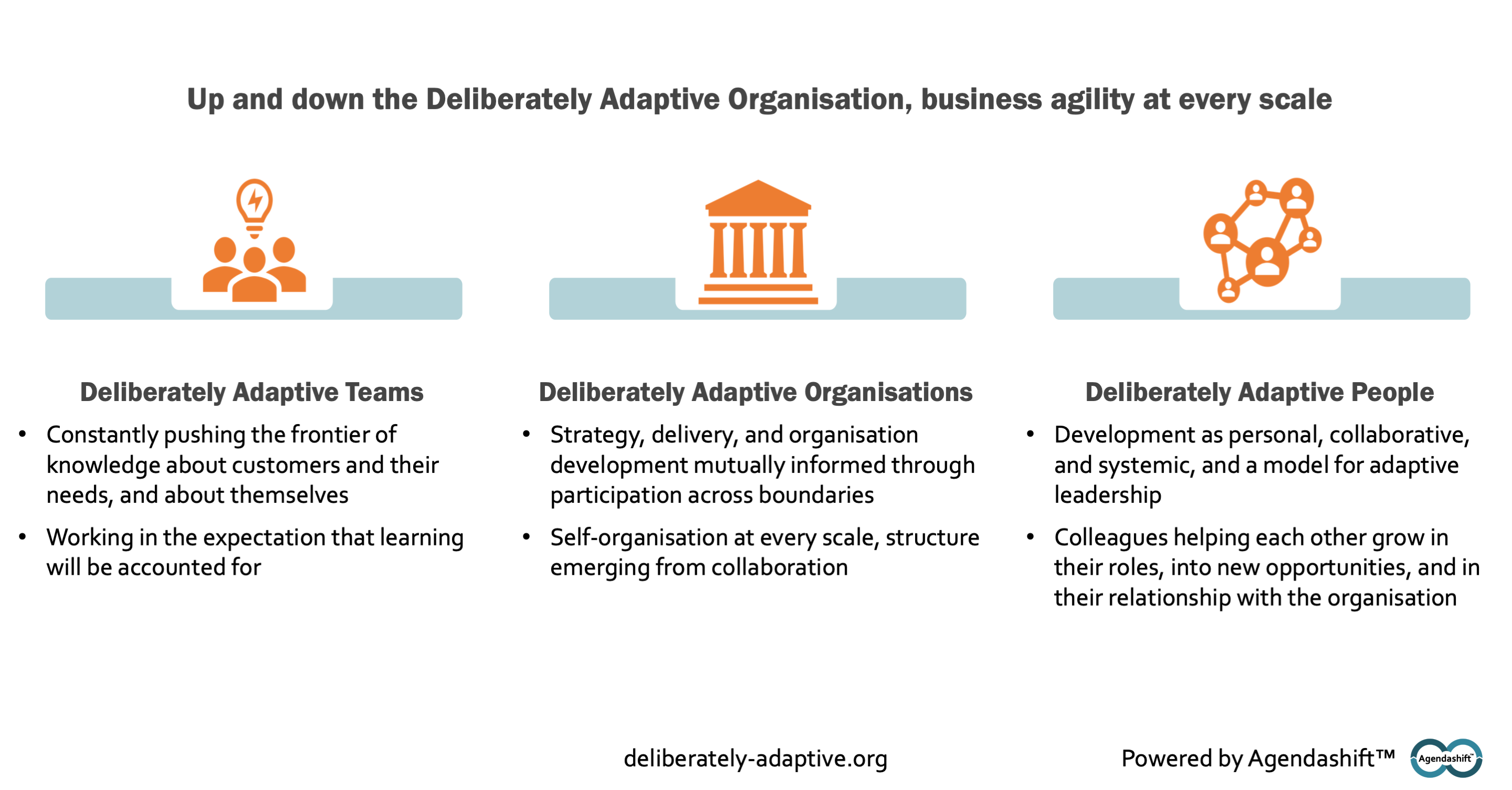
Choosing its models carefully to maintain that “at every scope or scale” vibe, the Deliberately Adaptive Organisation (deliberately-adaptive.org) integrates the following:
From Agendashift: rapid strategy development and alignment between scopes and scales through generative conversations, multi-level participation, and outcome-orientation
From Lean and Agile, patterns for collaboration and coordination, and the deep integration of delivery and learning
From Sociocracy (known to some as dynamic governance and to Akoff fans as circular hierarchy), consent and purpose as the basis for effective self-organisation and governance
From the Deliberately Developmental Organisation (as described in An Everyone Culture by developmental psychologists Robert Kegan and Lisa Laskow-Lahey), attention to the human side of development
What holds it all together is one of the crowning achievements of Systems Thinking, Stafford Beer’s Viable System Model (VSM), perhaps the most powerfully “at every scale” organisational model in existence. We take the management consultant’s Swiss Army knife and give it some 21st-century attitude in an innovative and accessible presentation.
Given that most of the popular approaches to scaling focus mainly on process, it is important for me to stress that the Deliberately Adaptive Organisation is not a process framework. Neither is it prescriptive. Instead, it is two kinds of model in one:
Diagnostic, but only in the everyday sense that it helps with the identification of dysfunctions and opportunities (building on strengths as well as mitigating weaknesses), not in the sense that those dysfunctions become the excuse for heavy-handed prescription
Generative in the sense that it helps organisations engage constructively with themselves, generate a wealth of ideas, and find their own way forward
If you know Agendashift (mostly generative, with the diagnostic part done generatively), you will recognise that winning combination. In fact, the Deliberately Adaptive Organisation is introduced in the closing chapters of the Agendashift 2nd edition (2021), my previous book Right to Left (2020) doing some of the setup.
As that roadmap indicates, the earliest access to the next iteration of the Deliberately Adaptive Organisation will be via the Academy, and you can be part of it. Join one of our regular Ask Me Anything sessions and even before the content is released I’ll be only too happy to explore it with you. Subscribe now:
Let’s begin with teams, or more specifically with its members, people. Even allowing for diversity, there are a number of near-universal things you can say about the members of any well-established team:
They each know who they are; many will also have a sense of who they’d like to be
They each know what they want to contribute; many will also have identified capabilities they’d like to develop
They each have a sense of what they can manage on their own and what should be managed more collectively
There are some boundaries there. They may be fuzzy and there may be room for negotiation in the short term and for development in the longer term, but cross them – insist that people do things that “aren’t them”, aren’t what they signed up for, or take away their ability to self-manage to the level they expect – and you have unhappy people in an unhappy team. For example, most people don’t like to be micro-managed; neither do they want to see important things left unattended.
Now to the team itself. You’d be hard-pressed to find a high-performing team for which these aren’t true:
There are collective senses of identity, purpose, and of what it aspires to
It knows what it’s there to do, what it is capable of, and ways in which those capabilities might be developed
It knows what it can manage for itself as a team, and (conversely) what needs to be managed more collectively, ie with (and perhaps by) other teams – potentially even with others outside the organisation
Again, there are some boundaries there. Fuzzy and negotiable no doubt, but only a fool would think they could cross them without negative consequences.
Jump now to the organisation as a whole. I almost don’t need to write these points down, but I will:
It has a sense of identity, a sense of purpose, and a sense of what it aspires to
It knows what it’s there to do, what it is capable of, and ways in which those capabilities might be developed
It knows what it can manage for itself as an organisation, and (conversely) what needs to be managed with others – suppliers, customers, industry groups, and so on
You can be pretty sure that if there are significant issues with any of those points, you’re looking at an organisation that has problems – big problems. At the extreme: identity crises, or working catastrophically beyond its capabilities or its remit.
Starting again at the level of the individual, on the topic of what makes the work meaningful, the answers may vary hugely. Moreover, you never know until you ask, and perhaps not even then until you get to know them well enough. At higher levels, diversity of purpose and capability is essential to meeting the complexities of the business environment. The successful organisation has them distributed effectively whilst maintaining some coherence of its own, not an easy balance to maintain when the environment is changing.
What does all that mean for teams-of-teams? Does this repeating pattern – a pattern that already works at three levels – the levels of individuals, teams, and the whole organisation – apply at other scales? Pretty much!
If your team-of-teams doesn’t have its own sense of identity and purpose – meaningful to the people in it, not just its designers – it is unlikely to amount to anything more than an aggregation of its parts. What is it for? What is it capable of? What does it add, other than overhead? If this problem is widespread, you have a structure that is hard to navigate, a direct cost to the organisation and potentially a problem for customers too.
What if it has those senses of identity and purpose but not a sense of where it would like to get to, what it would like to become, and so on? In that case, what holds it all together as its component parts continue to develop?
And what does it manage? If it’s trying to manage what its constituent parts are capable of managing on their own – interfering, in other words – it does both them and itself a serious disservice.
All that said, what does good look like?
A structure that makes sense – not just tidy on paper, but purposeful at every scale – allowing each unit at every scale to self-manage effectively (structuring itself to minimise dependencies, for example)
Each unit at every scale able to express its own strategy in its own words, in terms appropriate to its domain and its customers, aligning it with other units and other scales according to both structure and opportunity
Each unit at every scale able to identify what it must manage at that scale – no more and no less – with protocols to deal with what should be managed elsewhere
Any problems here I would characterise as organisational problems first (the organisation getting in the way of doing the right thing), problems of the strategy process second, and problems of the delivery process third – a distant third if the first two are in any way significant. And as leadership problems? It is hard work for leaders when these problems aren’t dealt with, so let’s be careful not to personalise problems that may not be of their own making. Neither should we underestimate the power of participation, self-management, and self-organisation. But if as a leader you’re getting in the way of the organisation fixing its problems or are complacent about them, well that’s on you.
Neither should you expect your problems of organisation, strategy, and leadership to go away by rolling out a process framework. Why would they? I don’t know if we have got to “peak process framework” yet – I don’t suppose we can know until some time afterwards and I’m not ready to call it – but in the meantime let’s be realistic about what they can and can’t do. And while we’re at it, let’s not pretend that a framework rollout is an easy and risk-free thing.
Much as I detest the rollout, this is not an anti-framework rant. If you find the opportunity to borrow from a framework as you address those more fundamental problems, that’s totally sensible – there’s no point in reinventing the wheel. You are still are in control of your own destiny, free to pursue what really matters.
Before part 2, more on the topic of maintaining healthy relationships with frameworks in these two articles:
Watch those last two come together in the coming months. At the Agendashift Academy, the final Leading with Outcomes module, Adaptive Organisation: Business agility at every scale is due in the autumn. You can get ready meanwhile with the first three modules:
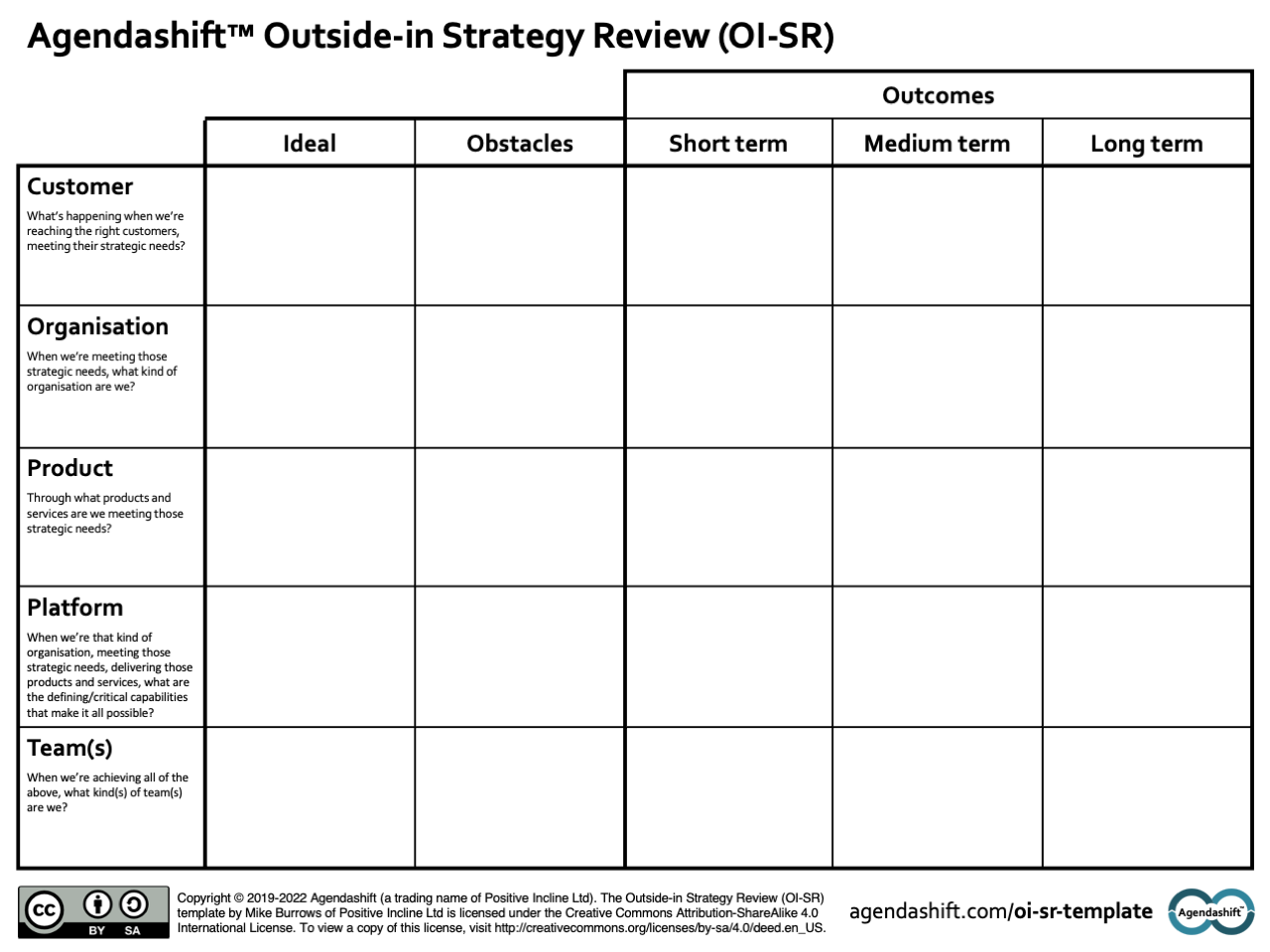
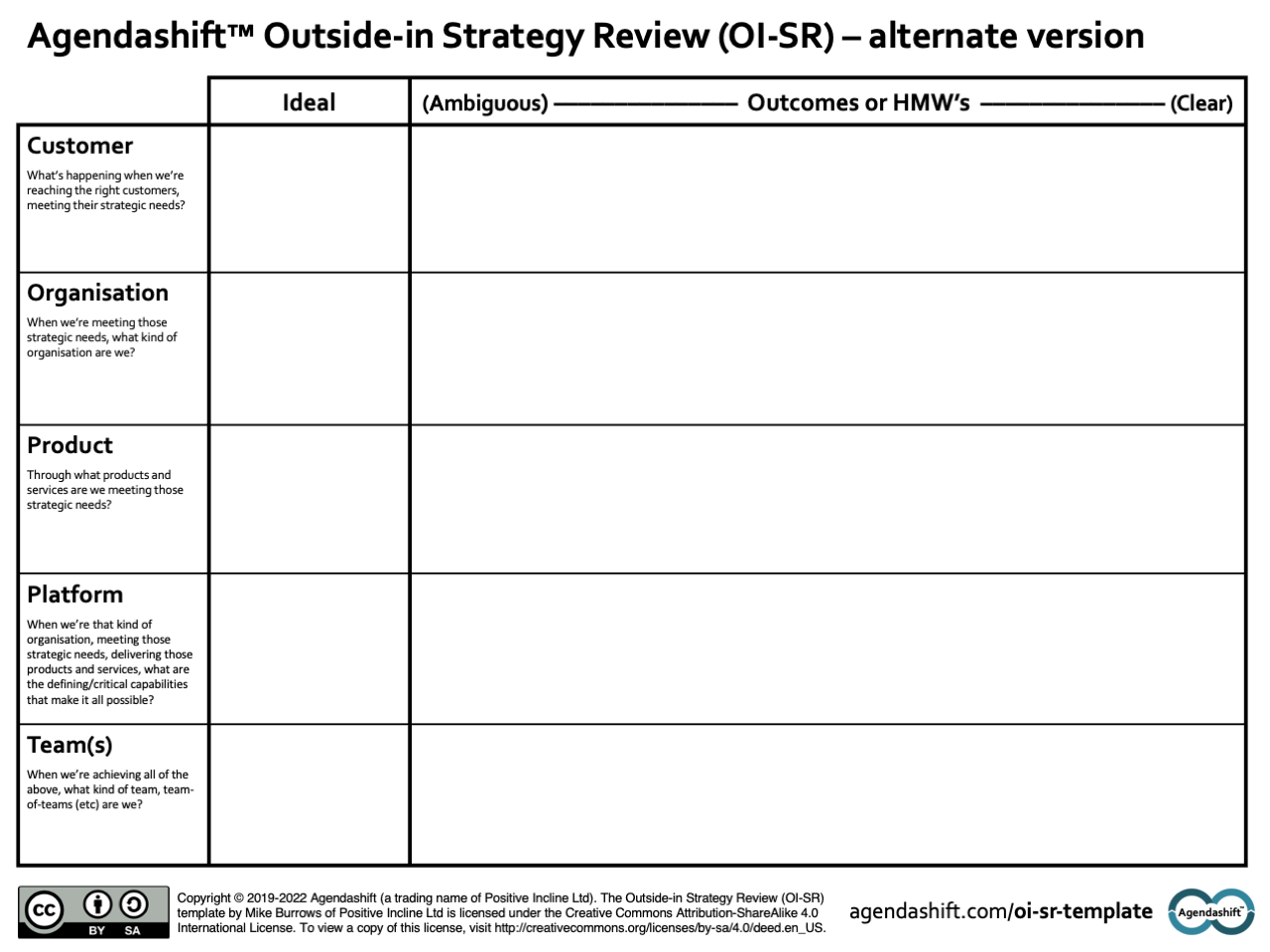
The Outside-in Strategy Review (OI-SR) template as described in my books Right to Left: The digital leader’s guide to Lean and Agile and Agendashift: Outcome-oriented change and continuous transformation (the 2nd edition especially). For a given scope – team, team-of-teams, something bigger (up to whole organisation) – it poses an interesting sequence of questions that launch generative conversations of the form Ideal, Obstacles, Outcomes, in other words the IdOO (“I do”) pattern.
I have added an alternate version:
This new version is especially for fans of tools such as Option Relationship Mapping, Wardley Mapping, and Challenge Mapping. The idea is to keep outcomes (or alternatively “How might we?”s) nicely spread out so that the relationships between them can be identified and drawn. Then choose an objective and work backwards to find suitable starting points. If you’re a fan of OKR, work forwards again and you have your key results in a sensible sequence.
It is of course no coincidence that over at the Agendashift Academy, the latest self-paced training module in the Leading with Outcomes series is Outside-in Strategy: Positioned for success. The first two chapters/episodes of five have already been released, the next is due on Friday, and it will be available in its entirety by the end of the month. It takes you through the layers, unpacking their respective questions, and walks you through the Ideal, Obstacles, Outcomes process too.
Watch the introductory video (05:33):
As I mentioned in the June roundup, the Leading with Outcomes curriculum is nicely on track to complete its rollout this year:
All four self-paced modules are included in your Agendashift Academy subscription. Beginning from as little as €29 per month, there are affordable plans for both businesses and individuals, yearly and monthly options in both cases, and a 7-day risk-free trial period for all card-based plans. If you’re a leader in a transforming organisation, you aspire to that role, or you support others in that journey, you’ll find plenty there for you and your colleagues.
Watch this space for a Zoom-based Train-the-Trainer (and Facilitator) event, and of course give me a shout if you need a strategy review facilitated for you.
What if we put agreement on outcomes ahead of solutions?
In this edition: Outside-in Strategy (I) and (II); Lean Agile London 2022; 15-minute FOTO; Top posts
Outside-in Strategy (I): Positioned for success
New at the Agendashift Academy, Outside-in Strategy: Positioned for success is the third of four planned Leading with Outcomes training modules. In its video-based self-paced incarnation (other formats are available) it began its rollout this month. I have enough recorded now to be confident of the release schedule:
Monday, June 20th: Customer – “What’s happening when we’re reaching the right customers, meeting their strategic needs?” (their needs, our strategy)
Friday, July 1st: Organisation – “When we’re meeting those strategic needs, what kind of organisation are we?”
Friday, July 8th: Product – “Through what products and services are we meeting those strategic needs?”
Friday, July 15th: Platform – “What are the defining/critical capabilities that make it all possible?”
Friday, July 29th: Team(s) – “When we’re achieving all of the above, what kind of team(s) are we?”
Here’s a quick introductory video (05:33):
This leaves the Leading with Outcomes curriculum nicely on track to complete its rollout this year:
Leading with Outcomes: Foundation – already live (take this one first)
Inside-out Strategy: Fit for maximum impact – already live
Outside-in Strategy: Positioned for success – rolling out now
Adaptive Organisation: Business agility at every scale – due in the autumn
All four self-paced modules are included in your Agendashift Academy subscription. Beginning from as little as €29 per month, there are affordable plans for both businesses and individuals, yearly and monthly options in both cases, and a 7-day risk-free trial period for all card-based plans. If you’re a leader in a transforming organisation, you aspire to that role, or you support others in that journey, you’ll find plenty there for you and your colleagues.
While we’re here, a Zoom-based Train-the-Trainer (and Facilitator) event isn’t far away, probably September. Details should be ready in time for next month’s roundup.
Outside-in Strategy (II), the new assessment tool
This was developed for the training, but as I’m keen to see how it applies elsewhere I’m making it available in the form of a free (registration required) public survey. It’s a super-short (15-prompt) Agendashift-style assessment tool, three prompts for each of the five layers of Agendashift’s outside-in strategy review. Like all the Agendashift assessment tools it can be used as the template for an organisational survey too; if you’re an Agendashift partner, you’ll find it on the templates dropdown.
Last month I spoke to a packed room at Lean Agile London 2022, the first time I have taken the new 3 strategies model (see the Agendashift home page) to an in-person conference.
You’ll the recording and slides here and listed on our media page. To access all the rest of the conference videos (which I encourage you to do – it’s one of my favourite conferences) you can register here:
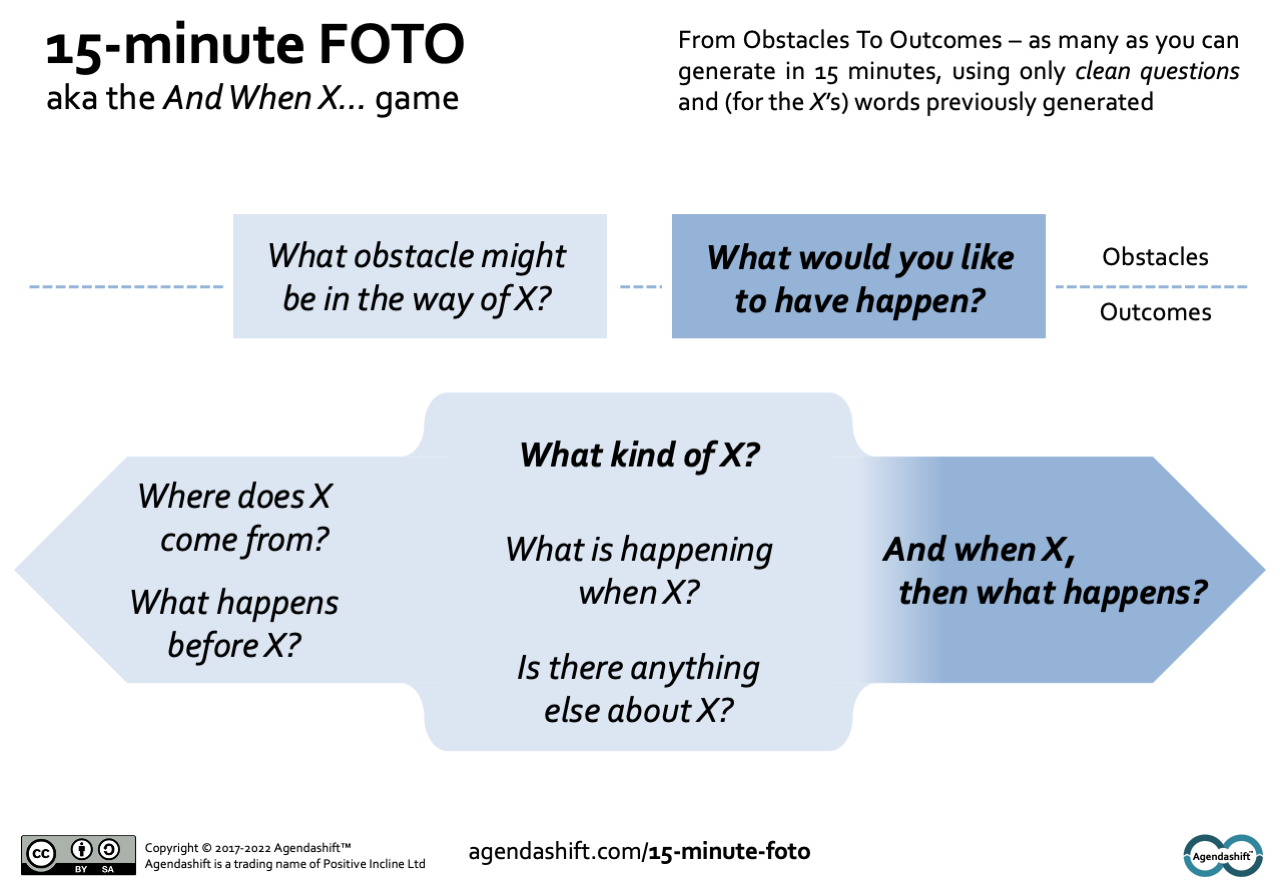
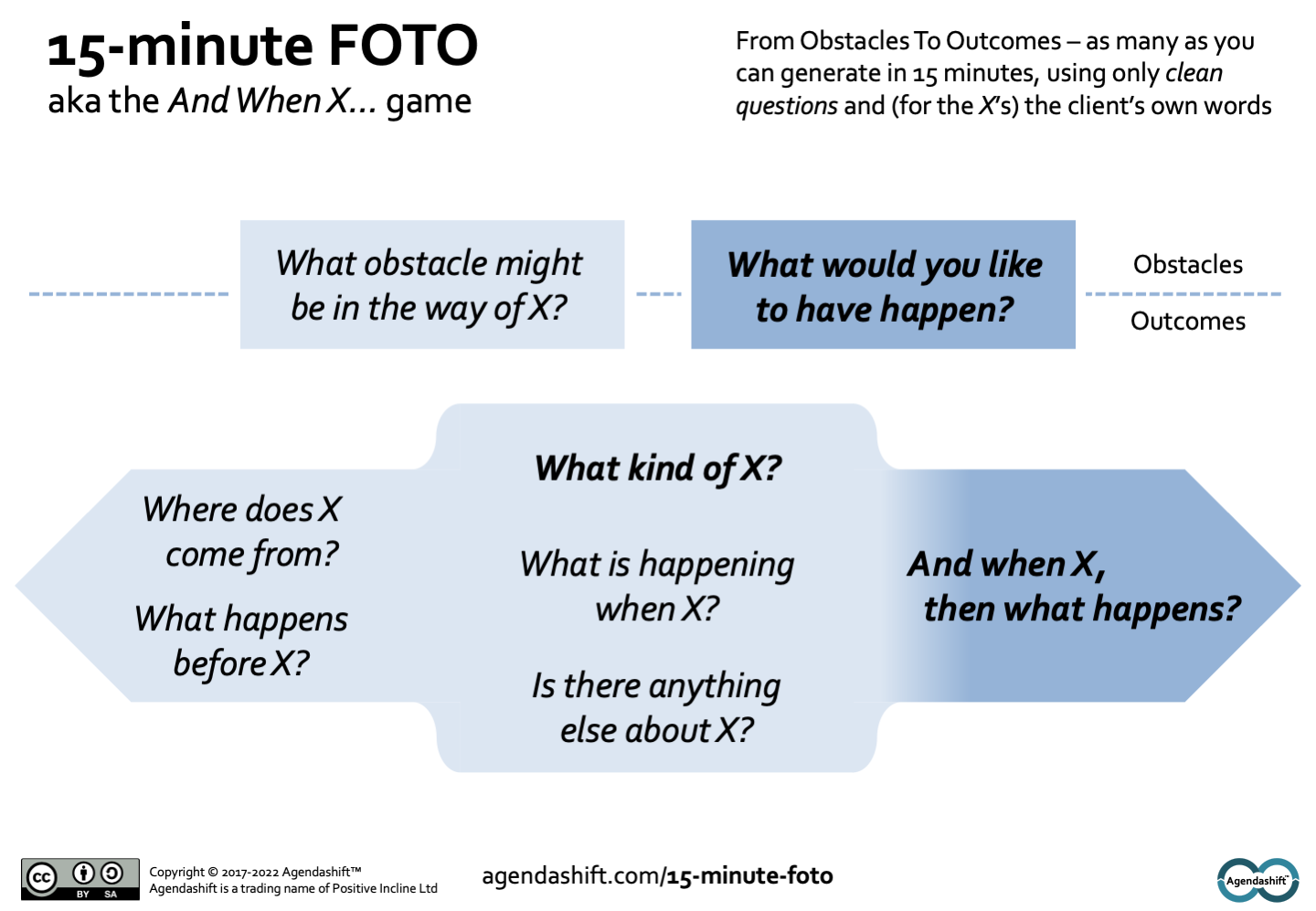
I announced version 12 of our Clean Language-inspired coaching game 15-minute FOTO a few weeks ago (see Top posts below). It has since gone through a couple of minor revisions (12a and 12b) announced so far only in the #cleanlanguage channel on Slack; they’re worth picking up if you have an older version. Re-download if you have the Dropbox link in your inbox still, or subscribe here:
The next Leading with Outcomes module, Outside-in Strategy: Positioned for Success
A new Agendashift-style assessment/survey tool, the Outside-in Strategy Readiness Assessment
1. Outside-in Strategy: Positioned for success
This is the third of the Agendashift Academy’s four planned Leading with Outcomes modules, and its self-paced incarnation begins its rollout today. Tentative schedule:
Monday, June 20th: Customer – “What’s happening when we’re reaching the right customers, meeting their strategic needs?”
Friday, July 1st: Organisation – “When we’re meeting those strategic needs, what kind of organisation are we?”
Friday, July 8th: Product – “Through what products and services are we meeting those strategic needs?”
Friday, July 15th: Platform – “What are the defining/critical capabilities that make it all possible?”
Friday, July 29th: Team(s) – “When we’re achieving all of the above, what kind of team(s) are we?”
We are big believers in leadership and strategy at every level of organisation. “Strategic needs” brings together our customers’ needs and our strategy – whether we’re a team, a team-of-teams, or something bigger, and whether our customers are inside or outside our organisation.
Here’s a quick introductory video (05:33):
Module-wise, Leading with Outcomes is nicely on track to complete its rollout this year:
Leading with Outcomes: Foundation – already live (take this one first)
Inside-out Strategy: Fit for maximum impact – already live
Outside-in Strategy: Positioned for success – rolling out now
Adaptive Organisation: Business agility at every scale – due in the autumn
All go live initially as self-paced, video-based training; instructor-led training (with me) is available right now for all but the last one, and we’ll be announcing a train-the-trainer programme soon too.
All four modules are included in your Agendashift Academy subscription. There are affordable plans for both businesses and individuals, with yearly and monthly options in both cases. If you’re a leader in a transforming organisation, you aspire to that role, or you support others in that journey, then it’s for you.
2. The Agendashift Outside-in Strategy Readiness Assessment
Developed for the above but I’m keen to see how it applies elsewhere, a really short (15-prompt) assessment tool, three prompts for each of the five layers of Agendashift’s outside-in strategy review. It’s free to try (registration required in this public survey mode). Like all the Agendashift assessment tools it can be used as the template for an organisational survey too; if you’re an Agendashift partner, you’ll find it on the templates dropdown.
This week I came across blog post that categorised resistors to “Agile” (actually to Scrum) as “diehards, sabateurs, followers, and skeptics”. I couldn’t let that lie and I responded on LinkedIn, but my post is now unavailable, possibly – though I speculate – because the one I responded to in an important way misrepresents Mike Cohn’s original. So here it is again, and slightly longer.
To those who take a solutions-first approach to change, resistance means:
You’re not selling hard enough, and
It’s the fault of those resisting that they’re not buying (and hence those shamefully blaming labels)
Never mind the contradiction, it simply does not occur that maybe it’s feedback, a quite reasonable response when you’ve failed to involve people in the right way early enough, failed to recognise real systemic issues, or most likely both. But that would mean admitting that the solution and/or the change paradigm are wrong. For different reasons, both are difficult things to admit, so it doesn’t happen.
And they wonder why people disengage when Agile, Scrum, or <insert framework here> are inflicted on them! As far as I’m concerned, in frameworks-land, this is the only fight worth fighting. Forget fixing the the process frameworks, our relationship with them needs to change. In a healthier relationship, we would see them not as solutions to roll out, but as resources to draw on as people up and down the organisation find fitting solutions to strategic goals agreed authentically and in proper context. Not solutions-first, but outcome-oriented.
Outcome-oriented change is both practical and teachable. If you want to be a more effective leader in a transforming organisation, you aspire to that, or if it’s your job to support others in that journey, check out the Agendashift Academy’s self-paced training programme, Leading with Outcomes. We help leaders at all levels succeed at developing and pursuing the kinds of strategy that go hand-in-hand with transformation. Membership is now by subscription, and with plans for both businesses and individuals and monthly and yearly options for both, you’ll find a plan that suits you.
What if we put agreement on outcomes ahead of solutions?
In this edition: June workshop; Academy Update; A fight worth fighting; New podcast interview; 15-minute FOTO version 12; Upcoming; Top posts
June workshop
Plenty of reasons to put this one first: It’s less than 3 weeks away, there’s a 10% discount on offer, and it’s my first public workshop in quite a while:
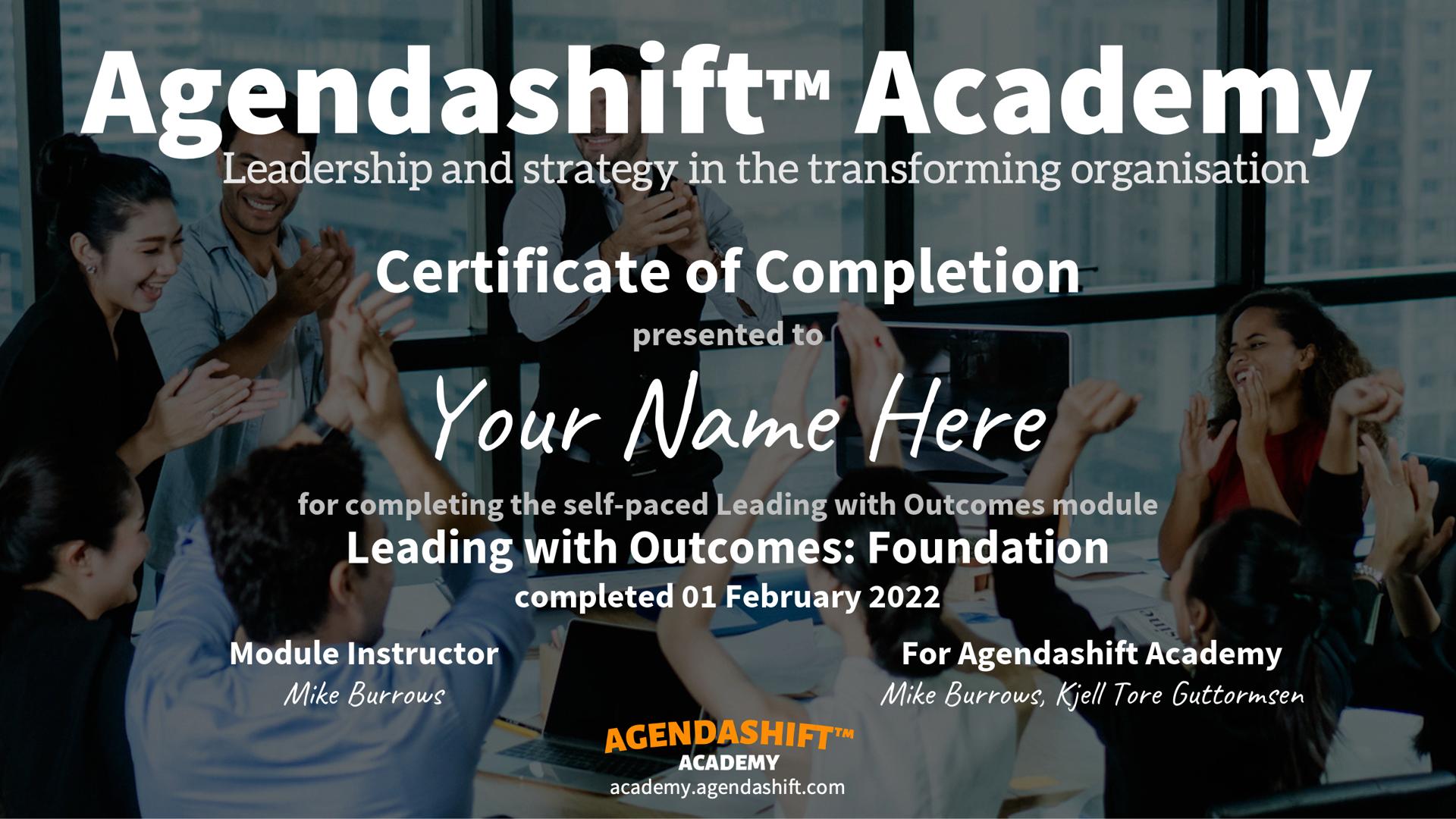
For Agendashift Academy subscribers, the fifth and final chapter of Inside-out strategy: Fit for maximum impact was released last Friday and already we’ve issued the first certificate of completion for this self-paced training.
Currently live:
Leading with Outcomes: Foundation (do this one first)
Inside-out Strategy: Fit for maximum impact
In production, chapter 1 due for release in June, announcement to follow:
Outside-in Strategy: Positioned for success
In development:
Adaptive Organisation: Business agility at every scale
Not only are we on track for releasing the whole of the planned Leading with Outcomes curriculum this year, we have plans for some ‘bitesize’ content that we’ll be able to drip out on a weekly basis.
A reminder of our intended audience:
Leaders in transforming organisations – at whatever level of experience and in whatever role
Those that aspire to that – whether that’s aspiring to leadership or to be a leader in an organisation that’s transforming healthily
Those who support the above
Check out our subscription plans for both businesses and individuals; both have monthly and yearly options. And talk to us if you might be interested in the trainer or facilitator programmes which we’ll be announcing soon.
A fight worth fighting
As featured on the Agendashift and Agendashift Academy homepages, the three strategies thing is brewing nicely. Don’t worry if you don’t know what that means – all is explained in my latest article on InfoQ:
Read both and the connection between the two will be obvious enough. The punchline to the second one:
In the methods & frameworks world, I believe there is only one fight worth fighting, and it is not between frameworks. It is between those who would fit people and organisations to frameworks (branded or otherwise), and those who find that idea intolerable.
New podcast interview
Last month’s roundup went out early, and it missed a podcast interview that went out on the 30th. It was with Shahin Sheidaei of the Elevate Change podcast, and you can find it here and on the usual podcast platforms:
In the methods & frameworks world, I believe there is only one fight worth fighting, and it is not between frameworks. It is between those who would fit people and organisations to frameworks (branded or otherwise), and those who find that idea intolerable.
From a book I am taking the time to savour, here is acclaimed anthropologist and systems thinker Gregory Bateson, on the work of his former wife Dr Margaret Mead, another acclaimed anthropologist:
[If] we go on defining ends as separate from means and apply the social sciences as crudely instrumental means, using the recipes of science to manipulate people, we shall arrive at a totalitarian rather than a democratic system of life. The solution she offers is that we look for the “direction” and “values” implicit in the means, rather than looking ahead to a blueprinted goal and thinking of this goal as justifying or not justifying manipulated means. We have to find the value of a planned act implicit in and simultaneous with the act itself, not separate from it in the sense that the act would derive its value or from reference to a future end or goal.
Gregory Bateson, Steps to an Ecology of Mind (1972)
This passage resonated strongly with me. Translating from the social space to organisations, how, as leaders, do we make it easy for people to find meaning in work whilst still respecting their choice in the matter? And if it’s the job of leadership to take people to new places, can we make the process of change more meaningful, again without dictating what form that meaning should take for each individual concerned?
My biggest contribution in the frameworks space was a values model for the Kanban Method (2013). It explained why and how Kanban was meaningful to me, and it turned out to be helpful to other people too – to the extent that it become adopted as part of the method’s formal definition.
But I didn’t stop there. I was on a journey, and it wasn’t long after the publication of Kanban from the Inside (2014), that I found myself detaching myself from Kanban community. There was no big disagreement behind this move, and to be clear, I remain proud of that model and my first book. It was simply that there was a job to be done, and I felt that it would be easier done outside.
Bateson goes on:
This then is the type of discipline which has enabled Dr Mead to point out that a discrepancy – a basic and fundamental discrepancy – exists between “social engineering”, manipulating people in order to achieve a planned blueprint society, and the ideals of democracy, the “supreme worth and moral responsibility of the individual human person.” The two conflicting motifs have long been implicit in our culture, science has had instrumental leanings since before the Industrial Revolution, and emphasis on upon individual worth and responsibility is even older. The threat of conflict between the two motifs has only come recently, with increasing consciousness of, and emphasis upon, the democratic motif and simultaneous spread of the instrumental motif. … Are we to reserve the techniques and the right to manipulate people as the privilege of a few planning, goal-oriented, and power-hungry individuals, to whom the instrumentality of science makes a natural appeal? Now that we have the techniques, are we, in cold blood, going to treat people as things? Or what are we going to do with these techniques?
Again, parallels. In the methods & frameworks world, I believe there is only one fight worth fighting, and it is not between the frameworks. It is between those who would fit people and organisations to frameworks (branded or otherwise), and those who find that idea intolerable.
I am on that second side. My fight is against those so convinced of their rightness that they’re sure that the ends justify the manipulative or coercive means, or they lack the imagination, curiosity, or courage to consider that there might be alternative approaches to change. And there really are alternatives. Let no one tell you that change-by-imposition – legitimised the change management industry despite its repeated failures – is the only model. That wasn’t true even 20 years ago – Agilists take note – and it definitely isn’t true now.
That fight is what has energised me in the 8 years since my first book and I expect it to continue to sustain me for the rest of my career. It has taken me from method to values and then to outcomes, meaningfulness, wholeheartedness, leadership, and strategy. They’re integrated into a participatory approach to change and transformation, one that is more than capable of reconciling sophisticated thoughts on organisation design with utmost respect not only for the person but for the organisation that people create together.
It’s hard enough being a leader in a transforming organisation without your approach to change making things worse. If that could be you, check out the Agendashift Academy’s Leading with Outcomes self-paced training programme. And if your organisation is entering into a relationship with a process framework, make sure that the relationship is healthy one*.
My first book, Kanban from the Inside (2014), remains a top book for Kanban so I really ought to complete that list.
Earlier this week I was interviewed by Michael Leber. The hour (livestreamed) flew by very quickly and I’m very pleased with how it came out, so thank you very much Mike! If you’re on LinkedIn, this is the better link to the recording:
It was a wide-ranging talk but we started with Kanban (the method as well as the tool) and I said a few things about it I haven’t really said before. A couple of key quotes:
I don’t find that [evolutionary change] principle exciting. I don’t get excited about evolutionary change – it’s like the wrong metaphor for a great tool.
If you’re serious about it, it has got to be with some intent. If you’re just fixing problems just because you see them, it doesn’t actually meet needs, it doesn’t get you to where you want to get to. And if you’re going to get to where you want to get to, you’ve got to have a conversation about where that is, what that looks like, what direction it’s in. … If you’re serious about the outcomes and their obstacles, serious about where you’re going to focus your efforts, serious about understanding the relationships between outcomes, you’re actually doing strategy.
To be fair to Kanban (the method), it tries harder than most Agile frameworks to get to that, but it doesn’t really get there, and nor will it so long as a tool (the kanban system and its supporting structure) is the predetermined answer. That’s why I am where I am now, non-aligned framework-wise, developing Agendashift as a way to help organisations and their leaders approach change and transformation strategically. If you want change, learn to have the strategy conversations around it. Don’t start with a solution (an Agile framework, say); start with agreement on outcomes. Done authentically – the right people in the room, the results of the conversation not prejudged – the rest follows so much more easily.


 Agendashift