If you want to understand scaling… (part 2 of 2)

If you want to understand scaling:

  1. Start with what must be true at each scale of organisation (part 1)
  2. Then with what happens between scales (this post)

Where we got to last time (and from there to what a healthy relationship with the process frameworks looks like):

  • A structure that makes sense – not just tidy on paper, but purposeful at every scale – allowing each unit at every scale to self-manage effectively (structuring itself to minimise dependencies, for example)
  • Each unit at every scale able to express its own strategy in its own words, in terms appropriate to its domain and its customers, aligning it with other units and other scales according to both structure and opportunity
  • Each unit at every scale able to identify what it must manage at that scale – no more and no less – with protocols to deal with what should be managed elsewhere

We reached those conclusions via a route that made it very obvious that each of them apply at every scale, and that the consequences can be serious if there’s a problem with any of them. But it doesn’t stop there. Whilst it’s possible for a scale to be badly designed in its own right – awkward structure, missing capabilities, or poor coordination to name but a few – it’s not hard to see that the relationships between scales are no less important. If anything, they’re more troubling.

Consider these:

  • One unit doing the coordination work of another – micromanaging, or interfering in other ways
  • One unit doing the strategy work of another – imposing it downwards (directly, via an overly-top-down or centralised plan), second-guessing upwards, etc
  • Units taking on responsibility for outcomes over which they have insufficient control
  • Units providing insufficient transparency about strategy, progress, or risks for related others to make good decisions
  • Units failing to share useful intelligence
  • Or conversely, units not listening (or worse, punishing unwelcome news)

These describe dysfunctional relationships even when they’re between peers, but when there’s any kind of power imbalance involved, those at the receiving end may feel powerless to fix them.

The Deliberately Adaptive Organisation

Let’s recast those challenging but still fixable problems more positively, as principles. These are table stakes I believe for any serious approach to scaling. With minor caveats they apply to every identifiable scope or scale:

  1. Each responsible for its own strategy and accountable for its own performance
  2. Respectful of the autonomy of others, each responsible for its next level of internal structure and its self-management across it
  3. Each committed to building mutual trust in every direction

Choosing its models carefully to maintain that “at every scope or scale” vibe, the Deliberately Adaptive Organisation (deliberately-adaptive.org) integrates the following:

  • From Agendashift: rapid strategy development and alignment between scopes and scales through generative conversations, multi-level participation, and outcome-orientation
  • From Lean and Agile, patterns for collaboration and coordination, and the deep integration of delivery and learning
  • From Sociocracy (known to some as dynamic governance and to Akoff fans as circular hierarchy), consent and purpose as the basis for effective self-organisation and governance
  • From the Deliberately Developmental Organisation (as described in An Everyone Culture by developmental psychologists Robert Kegan and Lisa Laskow-Lahey), attention to the human side of development

What holds it all together is one of the crowning achievements of Systems Thinking, Stafford Beer’s Viable System Model (VSM), perhaps the most powerfully “at every scale” organisational model in existence. We take the management consultant’s Swiss Army knife and give it some 21st-century attitude in an innovative and accessible presentation.

Given that most of the popular approaches to scaling focus mainly on process, it is important for me to stress that the Deliberately Adaptive Organisation is not a process framework. Neither is it prescriptive. Instead, it is two kinds of model in one:

  1. Diagnostic, but only in the everyday sense that it helps with the identification of dysfunctions and opportunities (building on strengths as well as mitigating weaknesses), not in the sense that those dysfunctions become the excuse for heavy-handed prescription
  2. Generative in the sense that it helps organisations engage constructively with themselves, generate a wealth of ideas, and find their own way forward

If you know Agendashift (mostly generative, with the diagnostic part done generatively), you will recognise that winning combination. In fact, the Deliberately Adaptive Organisation is introduced in the closing chapters of the Agendashift 2nd edition (2021), my previous book Right to Left (2020) doing some of the setup.

And development continues. After I release this month the final instalment of Outside-in Strategy: Positioned for success, production work begins on Adaptive Organisation: Business agility at every scale, the fourth and last module in the Agendashift Academy’s Leading with Outcomes curriculum. Then sometime next year I hope, a book (my fifth – I have a fourth book close to completion, more on that another time).

As that roadmap indicates, the earliest access to the next iteration of the Deliberately Adaptive Organisation will be via the Academy, and you can be part of it. Join one of our regular Ask Me Anything sessions and even before the content is released I’ll be only too happy to explore it with you. Subscribe now:

If you want to understand scaling:

  1. Start with what must be true at each scale of organisation (part 1)
  2. Then with what happens between scales (this post)

Agendashift™: Serving the transforming organisation
Agendashift  Academy: Home | Store

Links: HomeSubscribe | Become an Agendashift partner | Events | Contact | Mike
Resources: Tools & Materials | Media | BooksAssessments 
Blog: Monthly roundups | Classic posts
Community: Slack | LinkedIn group | Twitter

If you want to understand scaling… (part 1 of 2)

If you want to understand scaling:

  1. Start with what must be true at each scale of organisation (this post)
  2. Then with what happens between scales (part 2)

Let’s begin with teams, or more specifically with its members, people. Even allowing for diversity, there are a number of near-universal things you can say about the members of any well-established team:

  • They each know who they are; many will also have a sense of who they’d like to be
  • They each know what they want to contribute; many will also have identified capabilities they’d like to develop
  • They each have a sense of what they can manage on their own and what should be managed more collectively

There are some boundaries there. They may be fuzzy and there may be room for negotiation in the short term and for development in the longer term, but cross them – insist that people do things that “aren’t them”, aren’t what they signed up for, or take away their ability to self-manage to the level they expect – and you have unhappy people in an unhappy team. For example, most people don’t like to be micro-managed; neither do they want to see important things left unattended.

Now to the team itself. You’d be hard-pressed to find a high-performing team for which these aren’t true:

  • There are collective senses of identity, purpose, and of what it aspires to
  • It knows what it’s there to do, what it is capable of, and ways in which those capabilities might be developed
  • It knows what it can manage for itself as a team, and (conversely) what needs to be managed more collectively, ie with (and perhaps by) other teams – potentially even with others outside the organisation

Again, there are some boundaries there. Fuzzy and negotiable no doubt, but only a fool would think they could cross them without negative consequences.

Jump now to the organisation as a whole. I almost don’t need to write these points down, but I will:

  • It has a sense of identity, a sense of purpose, and a sense of what it aspires to
  • It knows what it’s there to do, what it is capable of, and ways in which those capabilities might be developed
  • It knows what it can manage for itself as an organisation, and (conversely) what needs to be managed with others – suppliers, customers, industry groups, and so on

You can be pretty sure that if there are significant issues with any of those points, you’re looking at an organisation that has problems – big problems. At the extreme: identity crises, or working catastrophically beyond its capabilities or its remit.

Starting again at the level of the individual, on the topic of what makes the work meaningful, the answers may vary hugely. Moreover, you never know until you ask, and perhaps not even then until you get to know them well enough. At higher levels, diversity of purpose and capability is essential to meeting the complexities of the business environment. The successful organisation has them distributed effectively whilst maintaining some coherence of its own, not an easy balance to maintain when the environment is changing.

What does all that mean for teams-of-teams? Does this repeating pattern – a pattern that already works at three levels – the levels of individuals, teams, and the whole organisation – apply at other scales? Pretty much!

If your team-of-teams doesn’t have its own sense of identity and purpose – meaningful to the people in it, not just its designers – it is unlikely to amount to anything more than an aggregation of its parts. What is it for? What is it capable of? What does it add, other than overhead? If this problem is widespread, you have a structure that is hard to navigate, a direct cost to the organisation and potentially a problem for customers too.

What if it has those senses of identity and purpose but not a sense of where it would like to get to, what it would like to become, and so on? In that case, what holds it all together as its component parts continue to develop?

And what does it manage? If it’s trying to manage what its constituent parts are capable of managing on their own – interfering, in other words – it does both them and itself a serious disservice.

All that said, what does good look like?

  • A structure that makes sense – not just tidy on paper, but purposeful at every scale – allowing each unit at every scale to self-manage effectively (structuring itself to minimise dependencies, for example)
  • Each unit at every scale able to express its own strategy in its own words, in terms appropriate to its domain and its customers, aligning it with other units and other scales according to both structure and opportunity
  • Each unit at every scale able to identify what it must manage at that scale – no more and no less – with protocols to deal with what should be managed elsewhere

Any problems here I would characterise as organisational problems first (the organisation getting in the way of doing the right thing), problems of the strategy process second, and problems of the delivery process third – a distant third if the first two are in any way significant. And as leadership problems? It is hard work for leaders when these problems aren’t dealt with, so let’s be careful not to personalise problems that may not be of their own making. Neither should we underestimate the power of participation, self-management, and self-organisation. But if as a leader you’re getting in the way of the organisation fixing its problems or are complacent about them, well that’s on you.

Neither should you expect your problems of organisation, strategy, and leadership to go away by rolling out a process framework. Why would they? I don’t know if we have got to “peak process framework” yet – I don’t suppose we can know until some time afterwards and I’m not ready to call it – but in the meantime let’s be realistic about what they can and can’t do. And while we’re at it, let’s not pretend that a framework rollout is an easy and risk-free thing.

Much as I detest the rollout, this is not an anti-framework rant. If you find the opportunity to borrow from a framework as you address those more fundamental problems, that’s totally sensible – there’s no point in reinventing the wheel. You are still are in control of your own destiny, free to pursue what really matters.

Before part 2, more on the topic of maintaining healthy relationships with frameworks in these two articles:

On some of the leading frameworks themselves:

And to those bigger themes:

Watch those last two come together in the coming months. At the Agendashift Academy, the final Leading with Outcomes module, Adaptive Organisation: Business agility at every scale is due in the autumn. You can get ready meanwhile with the first three modules:

  1. Leading with Outcomes: Foundation
  2. Inside-out strategy: Fit for maximum impact
  3. Outside-in strategy: Positioned for success

If you want to understand scaling:

  1. Start with what must be true at each scale of organisation (this post)
  2. Then with what happens between scales (part 2)

Agendashift™: Serving the transforming organisation
Agendashift  Academy: Home | Store

Links: HomeSubscribe | Become an Agendashift partner | Events | Contact | Mike
Resources: Tools & Materials | Media | BooksAssessments 
Blog: Monthly roundups | Classic posts
Community: Slack | LinkedIn group | Twitter

Agendashift roundup, October 2021

In this edition: Agendashift Academy update; The 1967 manifesto for the Deliberately Adaptive Organisation; Get unstuck and get going; Upcoming; Top posts

Agendashift Academy update

What really happened: on the brink of releasing a new intermediate-level self-paced training module Outside-in Strategy with Outcomes, we decided that it would be much better to revisit Leading with Outcomes, our first self-paced training module. A big decision not taken lightly! As part of a significant pivot for the Academy itself, we’re now re-recording it, repositioning it for a much broader audience.

We’re adding, not taking away, and if you’re a practitioner of some kind (the main audience for the first version) there’s still plenty to be had from the second version. Still the familiar and well-tested exercises, but every session now connecting with leadership, speaking to a specific leadership theme, and with practical takeaways for leaders at all levels of experience. We think of it now as doing something foundational for transformational leadership, the Academy aimed squarely at “leadership and strategy in the transforming organisation”.

What to expect:

  • We’ll release each session of the new Leading with Outcomes as it becomes available, the first one mid-November and the remaining three sessions at intervals of a couple of weeks (ish). While it remains incomplete (we know that some of you like to binge on these things) we’ll offer it at a discount.
  • As a thank you and in the hope of fresh feedback, past purchasers of the old one – even those whose purchases have now expired – will be granted access to the new one up to the end of January 2022
  • We’ll announce the next interactive workshop Coaching with Outcomes soon, conducted now over four sessions to match Leading with Outcomes – you can take them in either order but you’ll be encouraged to take them together as cohort-based training, publicly or privately
  • The two in combination effectively replace the first half of the old Agendashift Deep Dive; its eventual replacement will go quite a bit further, covering the Deliberately Adaptive Organisation also
  • A re-recorded Outside-in Strategy with Outcomes (intermediate) and a new Transforming with Outcomes (advanced) will follow in the early months of 2022; complementing them will be more interactive workshops both old and new

As allowed by the quantity and growth rate of the content – soon if we hit our stride as we expect – we plan to move to a subscription model, covering what will be an ever-growing portfolio of self-paced material and offering substantial discounts on interactive workshops. Meanwhile, we’re putting in place the infrastructure to better support corporate purchasers also.

Let me finish this update with a massive thank you to everyone who gave feedback on LwO version 1. Highly encouraging for the most part, and we took to heart your ideas for improvement. We think you’ll love version 2 – not just a refinement but a bold step!

The 1967 manifesto for the Deliberately Adaptive Organisation

The first of two more-than-usually successful blog posts this month:

It has provoked some interesting conversations and no doubt I’ll be returning to the topic soon.

Get unstuck and get going

The second of those posts was this one:

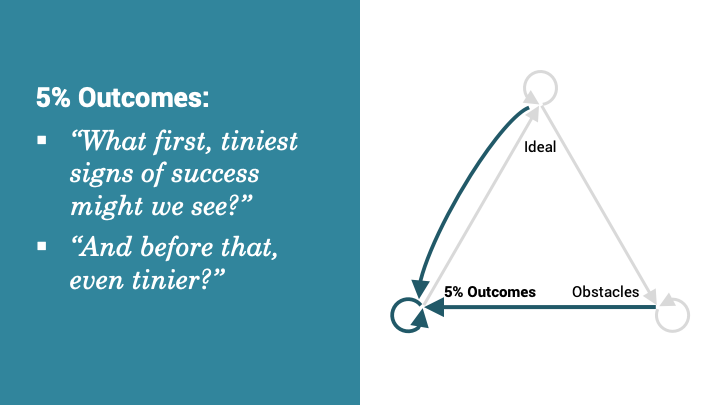
For “Practice Outcomes” (the name of a warmup exercise), now think “5% Outcomes, 15% Outcomes”. Typically we do it just before doing 15-minute FOTO for the first time, and an updated 15-minute FOTO will make reference to it. There’s another change in the wings to come on top of that, so watch out for version 11 soon.

Upcoming

Per my Academy update above, there are still no workshops in the calendar but we’ll be addressing that soon. Other events:

Top posts

  1. The 1967 Manifesto for The Deliberately Adaptive Organisation
  2. Get unstuck and get going: Starting small with 5% and 15% outcomes
  3. My favourite Clean Language question (January 2019)
  4. I’m really enjoying Challenge Mapping (June 2020)
  5. Celebration-5W version 6, “your next big breakthrough” (September)

What if we put authentic agreement on meaningful outcomes ahead of solutions?

Welcome to Agendashift™, the wholehearted engagement model

Links: Home | About | Our mission: Wholehearted | Become an Agendashift partner | Assessments | Books | Resources | Media | Events | Contact | MikeSubscribe
Academy: Home | Store
Blog: Monthly roundups | Classic posts
Community: Slack | LinkedIn group | Twitter

The 1967 Manifesto for The Deliberately Adaptive Organisation

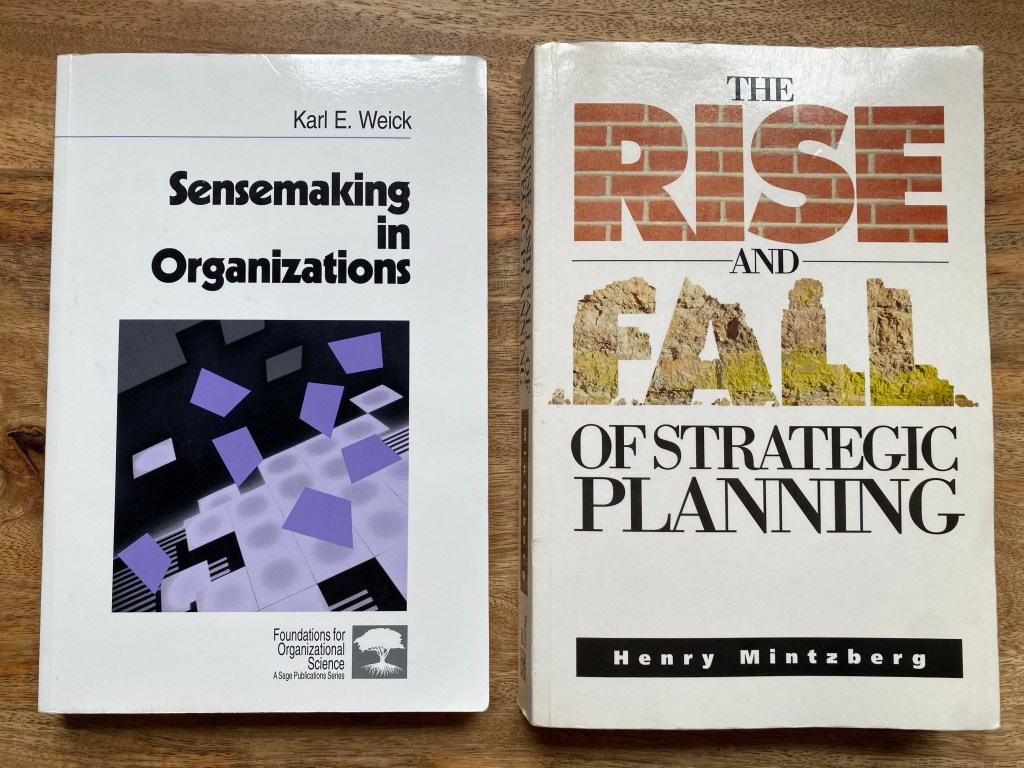
It may still too early to judge the 1990’s for its net contribution to organisational understanding. If much of what was published on the specific topic of change management had never been written, it might have been for the better! It’s not all bad though: I have recently enjoyed two books from that period, Karl Weick’s Sensemaking in Organizations (1995) and the 1994 first edition of Henry Mintzberg’s Rise and Fall of Strategic Planning. (Regarding the latter one, if you can tell me whether I should also read the 2000 second edition, do let me know.)

Reading Mintzberg, what stood out for me wasn’t so much his concept of emergent strategy (arguably not much more than a fancy name for what really happens to our best-laid plans) but these five things:

  1. The limits of rationalism and control, and the apparent disregard shown for them not just by the mid 20th-century strategic planners but by their champions in academia
  2. The idea, attributed to Edelman, of experts being those who avoid (or merely bemoan) the pitfalls but fail to notice the grand fallacy (see point 1 above, and I suspect I may never hear the words ‘expert’ and ‘pitfall’ in quite the same way again!)
  3. Primed by my prior reading of that Weick book on sensemaking, the idea of strategy as the means by which we make sense and meaning of our decisions; strategies don’t just help us to act in the present and project ourselves into the future, their role in helping us reinterpret how we got here is important too
  4. And before we get too comfortable with strategy as story, strategy as theory – something to be tested, lightly held
  5. Brian Loasby’s 1967 Manifesto for the Deliberately Adaptive Organisation

I’m having a bit of fun with that last one of course. I’ve no reason to think that Loasby (now Emeritus Professor in Economics at Stirling University) had anything manifesto-like in mind, and the Deliberately Adaptive Organisation didn’t exist back then. Not even its sources: the Viable System Model (Beer) was not yet fully formed; the Deliberately Developmental Organisation (Kegan & Lahey) was decades off; Agendashift’s main architect (yours truly) was just two years old.

But check this out:

if, instead of asking how they can more accurately foresee future events and thus make better decisions further ahead, firms were to ask first what they can do to avoid the need to decide so far ahead, they might be led to discover important ways of improving their performance.

Brian Loasby, 1967, via Mintzberg

Let me recast that in the “this over that” style of a notable document familiar to many readers, the Agile Manifesto. Adding some flourishes of my own:

In the pursuit of business performance, we are finding it useful to see plans and strategies more as theories to be tested quickly than as predictions and commitments for the longer term. Through this change of perspective, we are learning to value anticipating and meeting needs over setting and meeting deadlines, open options over past decisions, and rate of learning over closeness of control. Not that deadlines, decisions, and control have no value, rather that when valued against needs, flexibility, and adaptability, it is the latter group that drives our development forward.

I am not seriously advocating a new manifesto – for me, that ship sailed long ago – but Loasby was definitely onto something all those years ago. Rewriting history, there is already something Lean-like about his heuristic, and for anyone trying it, I’ve little doubt that Lean’s explicit attention to people and to flow would soon be required in any determined application of it. Invite the customer inside that way of thinking and you get something quite Agile-like. And compared to Agile as first framed, much more obviously relatable to business agility too. Interesting!


What if we put agreement on outcomes ahead of solutions?

Agendashift™: Serving the transforming organisation
Agendashift  Academy: Leading with OutcomesHome | Store

Links: Home | Subscribe | Become an Agendashift partner Events | Contact | Mike
Resources: Tools & Materials | Media | Books | Assessments 
Blog: Monthly roundups | Classic posts
Community: Slack | LinkedIn group | Twitter
Agendashift roundup, September 2021

In this edition: Academy update; Up and down the Deliberately Adaptive Organisation; Celebration-5W version 6; Upcoming events; Top posts

Academy update

Time to come clean: our next public workshops (there are still private workshops taking place) won’t happen until the new year. Honestly, the desire was there, but with all the behind-the-scenes work we’re currently doing, it just got too complicated.

For a taste of things to come, Coaching with Outcomes will return in the format of four 2-hour online sessions over four weeks. Although (like the current one) you will be able to take it standalone, it will also:

  1. bring together cohorts of students taking Leading with Outcomes, and
  2. form part of a modular replacement for what was the Deep Dive workshop (actually we’re up to something more ambitious than that, but more than that I can’t say at this stage)

Outside-in Strategy with Outcomes (originally planned to be out by now) and the advanced modules based on the Deliberately Adaptive Organisation (more on that below) are similarly postponed. We’re confident though that the delay will be well worth it.

Up and down the Deliberately Adaptive Organisation

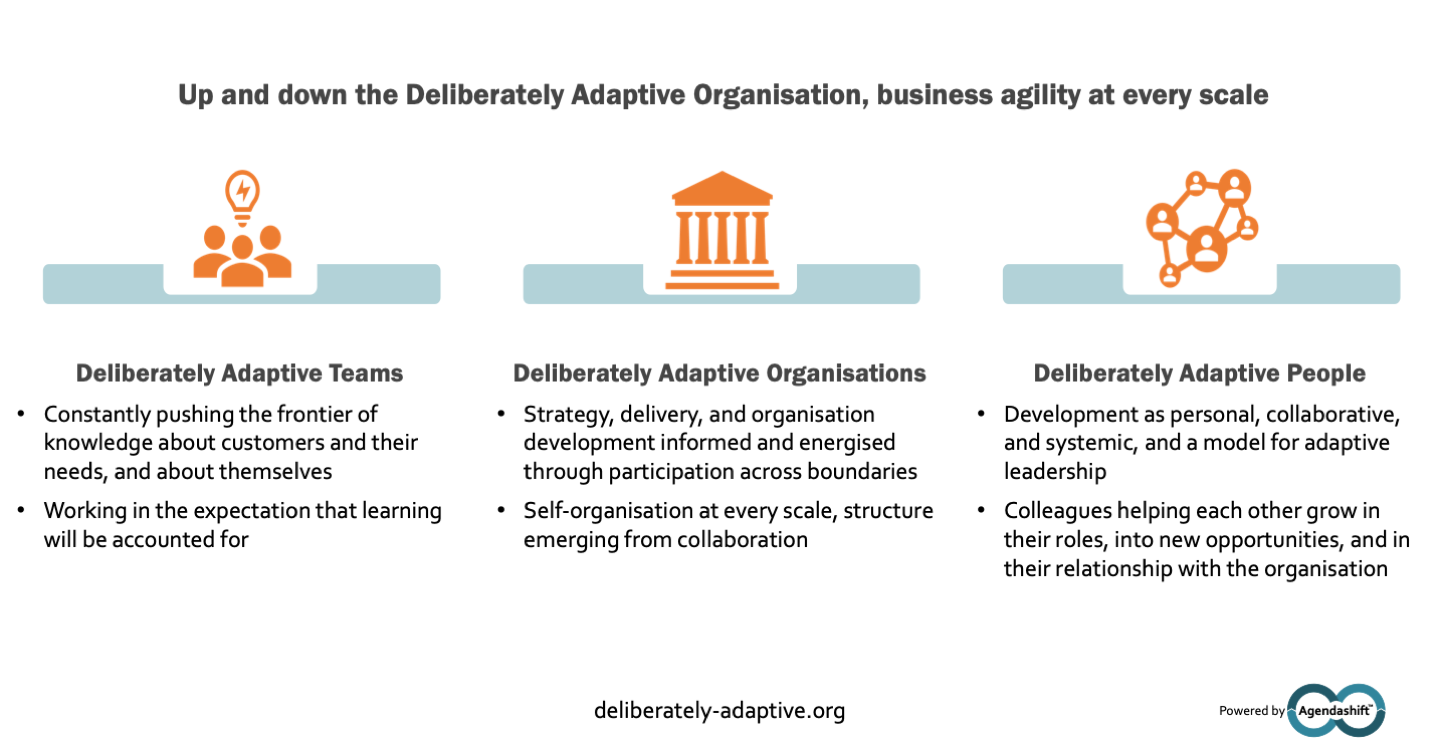
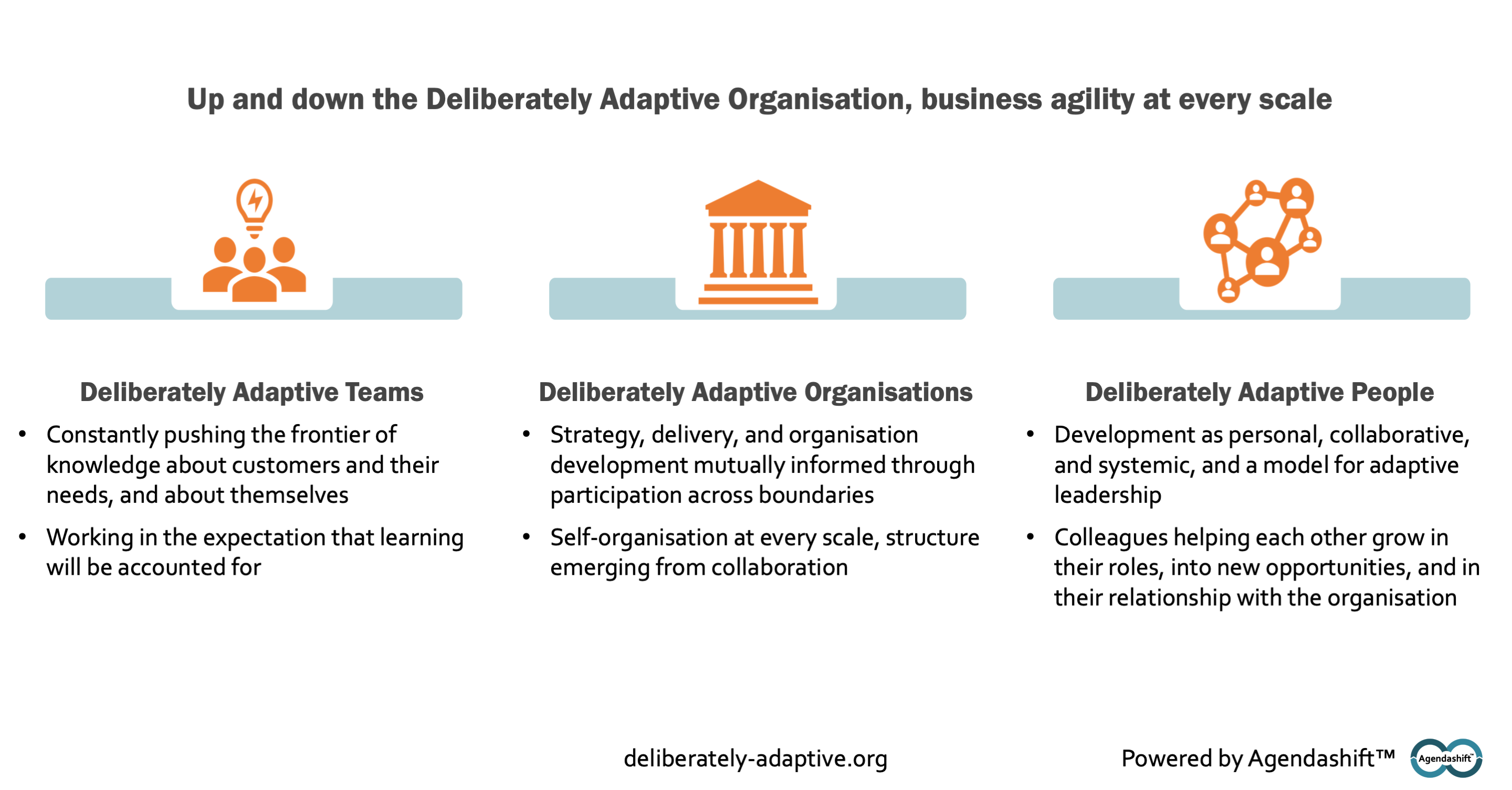
This month’s big event was the webinar Up and Down the Deliberately Adaptive Organisation. Read about it and watch the video!

Meanwhile, the Deliberately Adaptive assessment pilots are going strong – three have their debrief workshops scheduled for October.deliberately-adaptive-image

Celebration-5W version 6

Also this month, an update to our context-creating workshop kickoff exercise Celebration-5W. Read about that here:

I am also testing some changes to 15-minute FOTO, our Clean Language-inspired coaching game. More on that next month I hope, and in the #cleanlanguage channel in the Agendashift Slack meanwhile.

Upcoming events

Top posts

Predictably perhaps:

  1. Up and Down the Deliberately Adaptive Organisation
  2. Celebration-5W version 6, “your next big breakthrough”
  3. My favourite Clean Language question (January 2019)
  4. From Reverse STATIK to a ‘Pathway’ for continuous transformation (October 2019)
  5. ‘Right to Left’ works for Scrum too (July 2018)

What if we put authentic agreement on meaningful outcomes ahead of solutions?

Welcome to Agendashift™, the wholehearted engagement model

Agendashift™, the wholehearted engagement model
Links: Home |
About | Our mission: Wholehearted | Become an Agendashift partner | Assessments | Books | Resources | Media | Events | Contact | MikeSubscribe
Academy: Home | Store
Blog: Monthly roundups | Classic posts
Community: Slack | LinkedIn group | Twitter

Up and Down the Deliberately Adaptive Organisation

As mentioned in last week’s roundup, I was the guest speaker last night at a #bacommunity webinar hosted by Adrian Reed of Blackmetric Business Solutions. I am blown away by the response (still ongoing), and Adrian has kindly made the recording available already. You can watch it here (below, ad free), on YouTube, or on Adrian’s webinar page (blackmetric.com).

A modern take on a 70’s classic, we take some of the tools of modern product and organisation development and plug them into Stafford Beer’s Viable System Model, a model that (still) describes organisations of all sizes that have the drive to survive in a changing environment. The result of this exercise will feel remarkably familiar to Lean-Agile eyes, and yet it helps to reveal some of the serious dysfunctions too often experienced with current frameworks, both team-level and larger.

Mike Burrows

About the Speaker
Agendashift founder Mike Burrows is the author of Agendashift: Outcome-oriented change and continuous transformation (2nd edition March 2021), Right to Left: The digital leader’s guide to Lean and Agile (2019, audiobook 2020), and the Lean-Agile classic Kanban from the Inside (2104). Mike is recognised for his pioneering work in Lean, Agile, and Kanban and for his advocacy for participatory and outcome-oriented approaches to change, transformation, and strategy. Prior to his consulting career, he was global development manager and Executive Director at a top tier investment bank, CTO for an energy risk management startup, and interim delivery manager for two of the UK government’s digital ‘exemplar’ projects.

Links shared in the talk:

  • deliberately-adaptive.org
  • agendashift.com/changeban
  • agendashift.com/assessments
  • agendashift.com/a3-template
  • agendashift.com/book (the 2021 2nd edition of Agendashift) and its recommended reading page, looking out in particular for these authors:
    • Stafford Beer (VSM originator)
    • my friend Patrick Hoverstadt – for The Fractal Organisation, the second of two of his books I reference
    • Robert Kegan & Lisa Laskow Lahey – here for An Everyone Culture.  Despite my oft-expressed aversion – alluded to in my talk – to staged development models, maturity models and the like, they impress hugely. The name ‘Deliberately Adaptive Organisation’ is totally inspired by their ‘Deliberately Developmental Organisation’, referenced towards the end of my talk. To integrate strategy, delivery, and development to the depth envisioned in Agendashift’s wholehearted mission, you need this stuff. Their Immunity to Change resonates too.
  • agendashift.com/subscribe – per the last slide, a ton of stuff still brewing and you don’t want to miss out 🙂

Enjoy!


What if we put authentic agreement on meaningful outcomes ahead of solutions?

Welcome to Agendashift™, the wholehearted engagement model

Agendashift™, the wholehearted engagement model
Links: Home |
About | Our mission: Wholehearted | Become an Agendashift partner | Assessments | Books | Resources | Media | Events | Contact | MikeSubscribe
Academy: Home | Store
Blog: Monthly roundups | Classic posts
Community: Slack | LinkedIn group | Twitter

Agendashift roundup, August 2021

By design a quiet month blog-wise, but still plenty happening! In this edition: Another non-update on the big reveal; Up and down the Deliberately Adaptive Organisation; Another virtual trip to New Zealand; Agile Uprising Podcast; Top posts, recent and classic

Another non-update on the big reveal

Unusually, there are no public Agendashift workshops in the calendar right now – in fact we cancelled some. With some changes, they will resume shortly. Yes, we’re up to something! More here (but not much):

Still foundational to what’s coming, this self-paced training:

Up and down the Deliberately Adaptive Organisation

One item under active development that I don’t mind talking about is the Deliberately Adaptive Organisation (deliberately-adaptive.org). In the coming months there’ll be new training modules (both self-paced and interactive) that depend on it. Meanwhile, I have multiple pilot projects at home and abroad getting underway with the new assessment tool, and the early results are very encouraging, suggesting a good fit with the now quite mature trust-building and agreement-based approach to assessment already pioneered and formalised in Agendashift.

For a taste of what’s to come in this area, don’t miss this webinar on September 9th kindly hosted by Adrian Reed of Blackmetric Business Solutions:

Up and down the Deliberately Adaptive Organisation – business agility at every scale with Mike Burrows

I’ve done a lot of work on this since my slightly rushed presentation at Lean Agile Global and I’m looking forward to this very much!

Another virtual trip to New Zealand

Talking of presentations, I’ve been doing ‘Leading with and Transforming with Outcomes’ at meetups for a while now. They’re interactive enough that no two are ever alike! Returning in June to the New Zealand Limited WIP Society this fantastic comment came in the debrief on the breakouts (around 51:25 in the recording, which only recently hit YouTube):

You’ve taken us into a space where, for me anyway, I’ve not quite been in that space before

To understand how we got there, watch it here:

And a followup blog post:

Agile Uprising Podcast

I was delighted to be invited back to the Agile Uprising Podcast, interviewed jointly this time by Claudia Orozco-Gomez and Jay Hrcsko. It’s about the 2nd edition of the Agendashift book and is done with the benefit both of a few months’ perspective and the fact that my interviewers have both participated in Agendashift workshops. Hear it here:

In this week’s episode Claudia Orozco-Gomez and Jay Hrcsko sit down with the creator of Agendashift (and repeat podcast guest 🙂 Mike Burrows to discuss the second edition of his book.  We’ve covered some of the Agendashift classes before as well as Mike’s most-recent book (Right to Left) and we were quite excited to discuss Agendashift, what led to the newest edition, what learnings Mike and his team have gained to lead to a second edition, and we get to thank him in person for beautifully explaining how to use Cynefin.  Enjoy!

Top posts, recent and classic

Recent:

  1. All Agendashift assessments now available in Korean (August)
  2. Not quite ready for the big reveal (August)
  3. Pilots wanted (July)
  4. Optimising for Significance (July)
  5. Inside-out or outside-in? A strategy warmup (June)

Classic:

  1. My favourite Clean Language question (January 2019)
  2. How the Leader-Leader model turns Commander’s Intent upside down (June 2018)
  3. From Reverse STATIK to a ‘Pathway’ for continuous transformation (October 2019)
  4. ‘Right to Left’ works for Scrum too (July 2018)
  5. What do I mean by ‘generative pattern’? (May)

What if we put authentic agreement on meaningful outcomes ahead of solutions?

Welcome to Agendashift™, the wholehearted engagement model

Agendashift™, the wholehearted engagement model
Links: Home |
About | Our mission: Wholehearted | Become an Agendashift partner | Assessments | Books | Resources | Media | Events | Contact | MikeSubscribe
Academy: Home | Store
Blog: Monthly roundups | Classic posts
Community: Slack | LinkedIn group | Twitter

https://www.agendashift.com/books/agendashift-2nd-edition

Pilots wanted

As of the past week or so, Agendashift partners now have access to a new assessment template, a spin-off from the 2nd edition of the Agendashift book. It’s an Agendashift-style (non-prescriptive, non-judgemental, outcome-oriented, trust-building, etc) assessment tool for the Deliberately Adaptive Organisation (deliberately-adaptive.org) and a significant development.

It’s a key part of the roadmap for 2021, both in its own right and as a stepping stone to Transforming with Outcomes, the third of three self-paced training modules (the first, Leading with Outcomes, is already up and running and the second, Outside-in Strategy with Outcomes, launches soon). The assessment is highly accessible and requires no special knowledge on the part of participants; nevertheless, the underlying model is super interesting.

The Deliberately Adaptive Organisation integrates Agendashift and the Deliberately Developmental Organisation (see Bob Kegan and Lisa Laskow Lahey’s 2016 book An Everyone Culture) into the Viable System Model. VSM is Stafford Beer’s classic at-every-scale (fractal) model of systems that “have the desire to meet the demands of a changing environment”, and it’s a model of extraordinary diagnostic power. Combining it with Agendashift creates the opportunity to use it in a dialogic way – not diagnosing and prescribing, but helping the organisation have the conversations it needs to have with itself.

The assessment comprises 35 prompts across 5 categories:

  1. Intentful Knowledge Discovery
  2. Mutual Trust Building
  3. Adaptive Strategy
  4. Between and Across Levels
  5. Self-governance, Self-development, and Self-organisation

I’m looking for potential pilots to test the assessment, complete with its accompanying Agendashift-style debrief and followup exercises.

Further to the fourth of the above categories, Between and Across Levels, I’m particularly interested in contexts where there’s the potential for strategy to develop at and across multiple levels of organisation – in teams of teams for example.

To set some expectations:

  • There are no set limits to the number of survey respondents – typically most will respond online in their own time but scheduled one-to-ones for a selected few can work well too
  • The debrief workshop requires 6-25 participants, ideally representing at least 3 levels of seniority

The debrief workshop identifies the raw materials for an Agenda for Change, a shared organisational strategy:

  • Survey results sliced & diced in various ways
  • Survey prompts prioritised in breakout groups of 3-5 people
  • In those groups, consideration of what those most important prompts could mean for you in context, when they’re working at their “ideal best” for you
  • Obstacles and outcomes, in each breakout group’s own words

The IdOO (“I do”) pattern and very much as recommended in the book (the Exploration chapter specifically), with room also to explore the models behind the new tool. The process for moving forward from there is well practiced; I can get you started in a few hours if you’d appreciate help with organising outcomes strategically, designing some initial experiments etc.

All in all, it comes to a few hours to at most a few days work at heavily discounted rates – I am not in the market for longer engagements. Think of this as sponsored research for mutual benefit. I’m looking to do a few of these between now and late autumn – mainly to test the assessment, to compare results within and across diverse organisations (so there’s no right kind of organisation if you were wondering about that), and later in the year perhaps to pilot the training (interactive &/or self-paced).

Interested? Contact me here!


What if we put agreement on outcomes ahead of solutions?

Agendashift™: Serving the transforming organisation
Agendashift  Academy: Leading with OutcomesHome | Store

Links: Home | Subscribe | Become an Agendashift partner Events | Contact | Mike
Resources: Tools & Materials | Media | Books | Assessments 
Blog: Monthly roundups | Classic posts
Community: Slack | LinkedIn group | Twitter

Agendashift roundup, June 2021

In this edition: Two podcasts; Self-paced training at the Agendashift Academy; Upcoming; Top posts

Two podcasts

In recent weeks I have done interviews for a number of different podcasts. Two were released during in June:

Self-paced training at the Agendashift Academy

Our most recent change at the Agendashift Academy: you can work your way through Leading with Outcomes as quickly as you wish, no longer are you expected to wait a week between of its each four sessions.

Meanwhile, I’m busy recording our next self-paced training, Outside-in Strategy with Outcomes. It’s due this summer so watch out for its launch in the coming weeks! See meanwhile entry #1 in Top posts below.

Later this year will come Transforming with Outcomes. As previewed at deliberately-adaptive.org and described in the Agendashift 2nd edition, we will explore here the Deliberately Adaptive Organisation. In short, this means plugging Agendashift into the Viable System Model, seeing how it scales both up and down, describing a path towards business agility at every scale. Still some months to go before this comes out but we’ll be publishing at least one new tool in the meantime. Already we have a number of partners reviewing it and preparing to test it – news on that soon!

Upcoming

Just a few days until the next interactive workshop:

And always at your convenience and pace:

Top posts

  1. Inside-out or outside-in? A strategy warmup
  2. Loved Adam Grant’s Think Again
  3. What do I mean by ‘generative pattern (May)
  4. The IdOO pattern as leadership model (May)
  5. From Reverse STATIK to a ‘Pathway’ for continuous transformation (October 2019)

What if we put authentic agreement on meaningful outcomes ahead of solutions?

Welcome to Agendashift™, the wholehearted engagement model

Agendashift™, the wholehearted engagement model
Links: Home |
About | Our mission: Wholehearted | Become an Agendashift partner | Assessments | Books | Resources | Media | Events | Contact | MikeSubscribe
Workshops: Transformation strategy | Outside-in strategy | Short training
Blog: Monthly roundups | Classic posts
Community: Slack | LinkedIn group | Twitter
Loved Adam Grant’s Think Again

41+9W87E6nL

On Daniel Hulter’s recommendation I grabbed the audiobook edition of Adam Grant’s Think Again: The Power of Knowing What You Don’t Know (Penguin Audio, 2021). Loved it, highly recommended!

Let me share a couple particularly relevant quotes. The first one sits very well with Agendashift’s opening two chapters, the second with the closing two and a bit:

Listening well is more than a matter of talking less. It’s a set of skills in asking and responding. It starts with showing more interest in other people’s interests rather than trying to judge their status or prove our own. As journalist Kate Murphy writes, we can all get better at asking truly curious questions that don’t have the hidden agenda of fixing, saving, advising, convincing, or correcting.

Rethinking is more likely to happen in a learning culture, where growth is the core value and rethinking cycles are routine. In learning cultures, the norm is for people to know what they don’t know, doubt their existing practices, and stay curious about new routines to try out. Evans shows that in learning cultures, organisations innovate more and make fewer mistakes. After studying and advising change initiatives at NASA and the Gates Foundation I’ve learned that learning cultures thrive under a particular combination of psychological safety and accountability.

He goes on to describe something quite similar to my “expectation that learning will be accounted for” (deliberately-adaptive.org).

That’s all! Enjoy!


Upcoming

Always and at your convenience (and highly relevant to the first of the quotes above, as is Coaching with Outcomes below):

Scheduled:


What if we put authentic agreement on meaningful outcomes ahead of solutions?

Welcome to Agendashift™, the wholehearted engagement model

Links: Home | About | Our mission: Wholehearted | Become an Agendashift partner | Assessments | Books | Resources | Media | Events | Contact | MikeSubscribe
Workshops: Transformation strategy | Outside-in strategy | Short training
Blog: Monthly roundups | Classic posts
Community: Slack | LinkedIn group | Twitter