What I really think about Scrum

[Comments on this post on LinkedIn]

Let’s look at Scrum through the lens of last week’s inverse square law of framework scaling, its power as a framework being the product of:

  1. The incisiveness of its point of view – its core paradigms, principles, values, and so on
  2. The ease with which its key patterns combine – both with each other and with those from outside the framework

Being small, Scrum should do well on both counts; I’ll take them in reverse before returning to how it scales.

The ease with which its key patterns combine

Scrum scores really well here.

Look at Scrum merely as composition of smaller patterns (dangerous, but bear with me just for a moment) and you have to give it significant credit for normalising the practices of daily standup meetings, small-scale planning meetings, retrospectives and so on. Not for everyone an unalloyed good (“too many meetings” is an easy complaint to make if for whatever reason it’s not working), but certainly a mark of Scrum’s success.

And it gets better: Scrum as a whole is small enough that it combines easily with other things. Scrum+XP has been a thing for a long time. I’ve worked with Scrum and Lean Startup in combination (in the government sector, no less). Scrum+Kanban (Scrumban) isn’t just one thing, but several; in Right to Left I describe four common combinations and elsewhere I have counted more (it’s not hard: just consider the different ways in which their respective scopes might or might not overlap).

The incisiveness of its point of view

Here’s where it gets awkward. Scrum isn’t one thing, but two:

  1. Left-to-Right Scrum: the team working its way through a backlog that is determined for it, mostly in advance
  2. Right-to-Left Scrum: the team iterating goal by goal in the direction of its overall objectives

Left-to-Right Scrum is a process that’s mediocre (or worse) to experience, and doomed to deliver mediocre results at best. And it’s easy to see how it happens:

  • Little room in the project for learning about the customer’s real needs or for exploring different ways of meeting them
  • Thinking that the job of Sprint planning is to fill the Sprint to the maximum, a misconception amplified by story points and velocity (the problem not being that they’re nonsense metrics that cause otherwise intelligent people to bestow mystical properties on Fibonacci numbers, but that they reinforce a dysfunction)
  • Reviews not of what’s being learned about the team’s customers, its product, and the team itself, but of progress against the plan
  • Retrospectives that lack the authority to address strategic issues, and that fail to follow through even on the issues over which it does have influence

I’m convinced that Scrum would be considerably less prone to these failure modes if only it would maintain a clearer point of view. Scrum’s tragedy is that it’s presented as a backlog-driven process so often that its core paradigm as an iterative, outcome-oriented process gets lost in the noise. And from that failure, disengagement. All that hating on Agile? You don’t need to look far for causes.

Scaling it up

For the most part, disappointingly predictable and predictably disappointing:

  • Take Scrum and layer on hierarchies of organisation structure &/or work breakdown structure
  • Plug it into a project/programme structure that almost inevitably works in left-to-right terms and is given no reason to think otherwise
  • Compounding it all, the rollout project – failure after failure, but still we do it!

Again, the tragedy is that it doesn’t have to be that way. Instead of layering on so much process that you disconnect teams from strategy and organisation development, invite them in! Instead of losing faith with self-organisation, invest in it! Instead of solution-driven imposition, outcome-oriented engagement! Honestly, it’s not that hard.

We’re in the business of building wholehearted organisations. Need help reorienting your Scrum implementation so that it can work as it’s meant to? Want to put authentic engagement at the heart of your transformation? Get in touch – we’d love to help!

Further reading:

cover right to left audiobook.001

My thanks to Teddy Zetterlund and Steve Williams for feedback on this post, and to Agendashift’s Friday #community Zoom group (details in Slack) for the conversations that preceded it.


What if we put agreement on outcomes ahead of solutions?

Agendashift™: Serving the transforming organisation
Agendashift  Academy: Leading with OutcomesHome | Store

Links: Home | Subscribe | Become an Agendashift partner Events | Contact | Mike
Resources: Tools & Materials | Media | Books | Assessments
Blog: Monthly roundups | Classic posts
Community: Slack | LinkedIn group | Twitter

Community: Slack | LinkedIn group | Twitter
Yes IdOO! Leading with Outcomes

Leading with Outcomes – aka the IdOO! workshop – is the new name for the short (2-session) training workshop Learning the Language of Outcomes.

Why Leading with Outcomes? It can be understood two ways, and both apply here:

  1. Putting outcomes before solutions, being outcome-oriented
  2. The language of outcomes as an essential leadership discipline

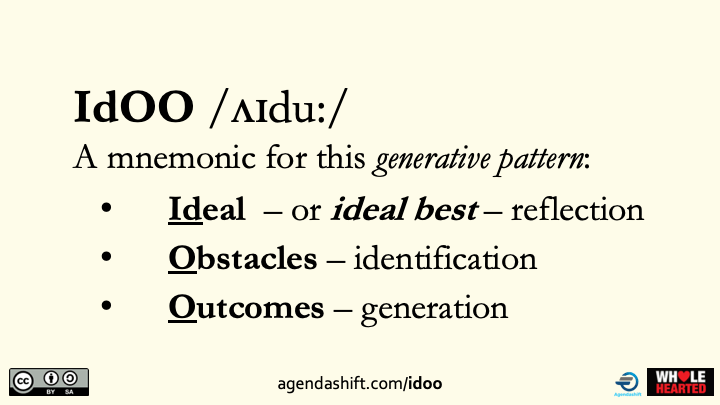
Any why IdOO!? That’s a reference to the IdOO pattern, so good we use it twice!

idoo-2020-03-25

Whatever your role, if you’re in the business of encouraging innovation, change, and transformation – helping people engage meaningfully in change-related work – then this workshop is for you.  Among its sources and inspirations are Clean Language, Solutions Focus, Challenge Mapping, Lean, and Agile. The Agendashift delivery assessment is included in the second session.

I’m giving this workshop twice in September:

But you don’t have to wait that long!  Julia Wester does it in August (whether that’s with the old branding or the new is to be confirmed):

The single-session Mapping and Probe! workshops complement the IdOO! workshop and each other:


Agendashift™, the wholehearted engagement model
Links: Home |
About | Our mission: Wholehearted | Become an Agendashift partner | Assessments | Books | Resources | Events | Contact | MikeSubscribe
Workshops: Transformation strategy | Transformation strategy | Short training
Blog: Monthly roundups | Classic posts
Community: Slack | LinkedIn group | Twitter

#2MBM: Meaning before Metric, Measure before Method

In the models-sources-inspirations picture shared in the  June roundup earlier this week you may have noticed one or more less-than famous acronyms upper right. I did leave a breadcrumb or two, but as was my plan all along, let me spell them out.

agendashift-inspiration-map-2020-06-29

The newest acronym – just days old – is 2MBM. From the patterns page (the Right to Left link points to my book/audiobook of that name):

Right to Left: ends before means, outcomes before solutions, and the two MBMs – meaning before metric and measure before method (2MBM)

MBM 1: Meaning before metric

I’ve been using this one for a while. Some clues here in From Reverse STATIK to a ‘Pathway’ for continuous transformation (October 2019):

This [understanding fitness for purpose] is OK as far as it goes, but the faster it turns … into a conversation about metrics, the less time anyone spends actually exploring purpose. If I’m honest, this part leaves me a little cold … .

My real concern here is with a common behaviour: consultants and other practitioners leading too hard with a favourite metric. My advice: whether they’re pushing lead time, velocity, or NPS, if they’re not also demonstrating an interest in connecting deeply with your purpose, politely show them the door.

More reason to trust your instincts when you feel yourself go cold at the mention of metrics is when they’re imposed as targets. It’s when OKR (Objectives and Key Results) turns into MBO (Management by Objectives), and there’s a reason why the latter is discredited, disowned by its creator (Drucker). Particularly when they’re tied to compensation and advancement, imposed targets inspire creativity of the wrong kind, too-clever ways to meet the goal. In a word: dysfunction.

MBM 2: Measure before method

So…  metrics are bad? No! As we’ll see in a moment they can be a source of healthy creativity if explored at the right time. If the first MBM translates to “not too early”, then the second translates to “not too late”. In fact, there’s “too late”, and then there’s “way too late”:

  • “Too late”: having a solution idea and then coming up with the metrics that it is likely to impact, justifying it on that basis
  • “Way too late”: implementing a solution idea and looking for benefits afterwards

Not so much alignment as post hoc rationalisation, severely limiting the likelihood of any real learning taking place, and missing some vital input into the ideation process.

To illustrate that last point, here’s how we now teach it in Agendashift:

  1. Reacquaint ourselves with the outcome we’ve chosen to work on (remember that with us it’s “outcomes all the way down” and we haven’t even got to the bottom of that stack yet) with Challenge Mapping
  2. Having explored around it, identify a list of success indicators for that outcome
  3. With the conversations of steps 1 and 2 still in the air, generate solution ideas
  4. Select the fantastic option, the one most likely to significantly outperform – relative to the others and disproportionately (non-linearly) relative to its cost and risk

TASTE and ODIM

And finally to two more of the acronyms on my picture (plus a bonus).

Karl Scotland‘s TASTE stands for True north, Aspirations, Strategies, Tactics, and Evidence. What we’ve known for a while – in the Agendashift material we have deliberately made this a two-part exercise to emphasise this point – is to leave Tactics until last. Cross-referencing them in an X-Matrix, we’re asking this question:

  • Inspired by and aligning to our True north, what Tactics (collectively) will support our Strategies and deliver the Evidence of success we hope for? (Aspirations are already correlated with Strategies and Evidence at this point)

Larry Maccherone‘s ODIM stands for Objectives, Decisions, Insights, and Metrics. One creative way to think of it is in behavioural terms:

  • For this objective to be achieved, what will people need to do differently? If that involves them making different decisions, what in their immediate environment will guide those? What then do we need to measure?

In the latest iteration of the Wholehearted:OKR workshop we use TASTE when we’re exploring alignment between levels, a way to build coherence at scale. ODIM is introduced near ideation time (previously it came too early, reducing its impact – no pun intended).

One last credit: I took “Measure” and “Method” come from Salesforce’s management process V2MOM:

  1. Vision— what do you want to achieve?
  2. Values — what’s important to you?
  3. Methods — how do you get it?
  4. Obstacles — what is preventing you from being successful?
  5. Measures — how do you know you have it?

Type 1 MBM but not (as presented here) type 2. Still, it starts in the right kind of place, and for that I’m glad. Thank you Steve Pereira and Tom Kerwin for an interesting Twitter conversation.

Followup post:

Related posts:


Upcoming events

February

March

*TTT/F and (where shown) LIKE events include free one-year membership of the Leading with Outcomes Authorised Facilitator programme, upgradeable to Authorised Trainer at any time. Both of those include access to the video-based Leading with Outcomes training and the full range of Agendashift assessment tools.


Leading with Outcomes from the Agendashift Academy
“Leadership and strategy in the transforming organisation”

Leading with Outcomes is our modular curriculum in leadership and organisation development. Each module is available as self-paced online training or as private, instructor-led training (online or in-person). Certificates of completion or participation according to format. Its modules in the recommended order:

  1. Foundation module:
  2. Inside-out Strategy:
  3. Adaptive Organisation:
  4. Outside-in Strategy:

Individual subscriptions from £24.50 £18.40 per month after a 7-day free trial, with discounts available for employees and employers in the government, healthcare, education, and non-profit sectors. For bulk subscriptions, ask for our Agendashift for Business brochure.

To deliver Leading with Outcomes training or workshops yourself, see our Authorised Trainer and Authorised Facilitator programmes. See our events calendar for Train-the-Trainer / Facilitator (TTT/F) and Leading in a Transforming Organisation trainings.


Agendashift™: Serving the transforming organisation
Links: Home | Subscribe | Events | Media | Contact | Mike

Agendashift  Academy: Leading with Outcomes | Trainer and Facilitator Programmes | Store

At every scope and scale, developing strategy together, pursuing strategy together, outcomes before solutions, working backwards (“right to left”) from key moments of impact and learning.

I’m really enjoying Challenge Mapping

Over the past few weeks I’ve taken every opportunity to play with Challenge Mapping and I’m really enjoying it. I even sneaked it into my ‘Outcomes all the way down’ webinar appearance the other week!

For the uninitiated (and also for the seemingly many who have seen it without knowing it by name), it’s a great way to generate those How might we…? (HMW) questions often associated now with the Design Sprint movement. Challenge Mapping and HMW have a much longer history than that however, and I’ve included some references in the page for the Ideal, Obstacles, Outcomes (IdOO) pattern.

One of Challenge Mapping’s pioneers was Min Basadur, and here from him is a tweet showing some example output:

How Challenge Mapping works, very briefly: From an initial, anchoring challenge – something we’d like to achieve or solve – variations on these two questions:

  1. Why is this important?
  2. What’s stopping us? 

Answers can be re-framed in HMW form as required.

Visually, the Why and What questions respectively take us up and down. As well as that vertical axis – typically showing increasing levels of abstraction going up – “Why else..” and “What else…” allow for some sideways expansion also.

Try it! Here’s a little example suggested by my Challenge Mapping buddy Andreas Wittler:

  • Assuming for the purposes of this exercise that any legal barriers are now behind us, start by naming a key challenge (work-related or otherwise) around returning from lockdown.
  • Why is this important?
  • And perhaps: Why is that important?
  • What stops us?
  • Why is that important?
  • What else stops us?
  • etc
  • Note down your answers and after you have finished, try reframing them HMW-style

My first opportunity to experiment came about a few weeks ago thanks to our weekly Agendashift #community Zoom (named after the #community channel in the Agendashift Slack). In a hastily-arranged practice session with Andreas, we tried Challenge Mapping as a simpler, 2-question alternative to 15-minute FOTO, Agendashift’s Clean Language-inspired coaching game and our go-to tool for generating outcomes. We then trialled it as the opening exercise for a Strategic Mapping with Outcomes workshop.

It was a very interesting trial and let me say a big thank you to all my workshop participants! It borderline failed but with some great learning: it was more involved than I wanted for a kick-off exercise and it requires some extra work to generate outcomes, but still it does the job it was designed to do extremely well. We now use it not as a FOTO alternative (whew!) but either side of it in these two places:

  1. To explore the vicinity of an obstacle, adding some extra depth to the first O of the abovementioned IdOO pattern
  2. To refamiliarise ourselves with an outcome – IdOO’s second O – as we begin to action it – moving into ideation, solutionising etc

Its next outing comes as soon as this Thursday, where we’ll be using it for the second of those two purposes. The Probe! workshop is a short (2-hour), standalone version of the our longer workshops’ Elaboration, with some fun new material borrowed from Impact! and Wholehearted:OKR. Join us if you can!


What if we put agreement on outcomes ahead of solutions?

Agendashift™: Serving the transforming organisation
Agendashift  Academy: Leading with OutcomesHome | Store

Links: Home | Subscribe | Become an Agendashift partner Events | Contact | Mike
Resources: Tools & Materials | Media | Books | Assessments
Blog: Monthly roundups | Classic posts
Community: Slack | LinkedIn group | Twitter

Revisiting ‘wholehearted’

agendashift-banner-2019-12-17

Agendashift’s strapline is “the wholehearted engagement model”, and I’ve been reflecting again on just what we mean by wholeheartedness. That in turns leads me to revisit how I introduce Agendashift – what it is, what differentiates it, and why we do what we do.

Wholehearted

Starting with my reflections on that word, I’m drawn to two clusters of qualities:

  1. Engagement, commitment, and purposefulness
  2. Alignment, integration, integrity, and wholeness

For an organisation to be wholehearted, both sets of qualities must apply. Crucial to developing and sustaining them are participation and outcomes:

  • Participation, because 1) people disengage when they’re denied the meaningful opportunity to influence on how their working environment operates, and 2) you can’t have integrity and wholeness – or for that matter self-organisation and other hallmarks of the modern organisation – when the organisation’s parts don’t relate both between and within themselves frequently and richly enough.
  • Outcomes, for the simple reason that they’re what people align on, and for the more subtle reason that it’s easy to destroy engagement when solutions are put ahead of outcomes. Keep outcomes in the foreground (and not a rationalisation or afterthought) and you create the opportunity for acceptable, effective, and often innovative solutions to emerge at the right time, no imposition needed.

With all of that in mind, Agendashift is best introduced as the wholehearted, outcome-oriented engagement model. Unpacking that backwards:

  • The term engagement model is our preferred shorthand for the kind of thing that Agendashift is, a framework for agents of participatory change and transformation. The framing there is deliberate; we find it necessary to keep a certain distance from the failed solution-driven change management models of the last century and don’t wish to be numbered among them! Neither is Agendashift a model only for continuous improvement, a process that while necessary is not a substitute for strategy.
  • Agendashift is outcome-oriented to such an extent that this is its defining feature. It’s “outcomes all the way down”, dealing coherently, humanely, and strategically with everything from the most aspirational of goals to the impact of the smallest experiment. With outcomes generated, organised, and developed through participation, agreement on outcomes follows naturally; solutions come as they should on a just-in-time basis, lightly held as hypotheses to be tested until some other approach is understood to be safe.
  • We – Agendashift’s founders, partners, and supporters – are wholehearted in our commitments to participation, to outcomes, and beyond those to the wholeheartedness of the organisations with which we work. We strive to develop all the qualities of wholeheartedness, building organisations that create meaning continuously, through both their discourse and their ability to anticipate and meet needs.

We’re in the business of building wholehearted organisations. Are you?

Related


Upcoming workshops

With yours truly unless otherwise indicated:

For some brief commentary:

And for the latest, check the Agendashift events calendar.


agendashift-banner-2019-12-17
Links: Home |
About | Our mission: Wholehearted | Become an Agendashift partner | Assessments | Books | Resources | Events | Contact | MikeSubscribe
Workshops: Transformation strategy | Transformation strategy | Short training
Blog: Monthly roundups | Classic posts
Community: Slack | LinkedIn group | Twitter

My kind of…

Two years ago almost to the day,  I was among a group invited by Pierre Neis to answer this question:

What kind of Agile is your Agile?

I was writing Right to Left at the time, and “my kind of Agile” was already a feature of chapter 2. Here it is (the short version at least):

People collaborating over working software that is already beginning to meet needs

That’s just a starting point. To put it into practice, we work backwards from there, keeping needs and outcomes always in the foreground as we go. Understand how that “right to left”, outcomes-first kind of Agile differs both philosophically and practically from a “left to right”, backlog-driven kind of Agile – a kind that too often involves imposing process on people for the sake of mediocre results (at best) – and you’ll understand why the book needed to be written.

If you appreciate that essential difference already, you’ll enjoy the book’s singular perspective. If you don’t, you’ll find it a highly accessible introduction to the Lean-Agile landscape, one that avoids the mistake of explaining Agile in the terms of the models it seeks to replace, a mistake that undermines it every time it is made.

I opened this post with Pierre’s question of 2 years ago because I was delighted this week to speak at his invitation on “My kind of Agile” at an online meetup he hosts. In preparation I put up a new page:

In the print and e-book editions, My kind of… is Right to Left’s Appendix B. It’s a glossary of sorts, a gathering together of some informal definitions that are especially characteristic of the book. It starts with two versions (shorter and longer) of “My kind of Agile” and continues in that same vein.

If you’re listening to the new audiobook edition – out just a few days ago – the appendices aren’t included, so here you go!

cover right to left audiobook.001

Upcoming workshops (all online of course)

With yours truly unless otherwise indicated:

For the latest workshop and speaking events check the Agendashift events calendar.


Agendashift: The wholehearted engagement model
Links: Home | About | Our mission: Wholehearted | Become an Agendashift partner | Assessments | Books | Resources | Events | Contact | MikeSubscribe
Workshops: Transformation strategy | Transformation strategy | Short training
Blog: Monthly roundups | Classic posts
Community: Slack | LinkedIn group | Twitter
The audiobook is out! Right to Left: The digital leader’s guide to Lean and Agile

I’m thrilled to announce that my 2019 book Right to Left: The digital leader’s guide to Lean and Agile is now available as an audiobook, read by yours truly. It has been a long time coming and I don’t mind admitting that I’m a little relieved too!

Find it here:

Or search “Right to Left Mike Burrows” in the iTunes store.

Enjoy!

PS Please like, re-share, retweet, etc! LinkedIn | Twitter | Facebook

cover right to left audiobook.001

Right to Left is the third book by Agendashift founder Mike Burrows, doing for Lean and Agile in digital delivery what his 2018 book Agendashift did for change and transformation.

Do you see in digital technology the opportunity to meet customer needs more effectively? Do you recognise that this may have profound implications for how your organisation should work? Do you want to help bring that about?

Regardless of whether you consider yourself a technologist, if your answer to those questions is “yes”, you are what we refer to in this book as a digital leader. If you are a digital leader, aspire to be one, or think that sometime soon you might need to become one, then this book is for you. Whatever your current level of knowledge of Lean and Agile, you will find here both an accessible guide to the Lean-Agile landscape and a helpfully challenging perspective on it.

The book is organised into six chapters. The first four have a strong right-to-left theme, which means consistently, deliberately, and even provocatively starting with outcomes – with needs being met – and working backwards from there, keeping outcomes always in the foreground:

  1. Right to left in the material world – introducing Lean, the strategic pursuit of flow
  2. Right to left in the digital space – introducing Agile and Lean-Agile
  3. Patterns and frameworks – popular Lean, Agile, and Lean-Agile frameworks and how they combine and complement each other
  4. Viable scaling – the Agile scaling frameworks, organisational viability, and the challenges of change

The last two chapters approach questions of organisational design and leadership from angles complementary to that core theme:

  1. Outside in – strategy and governance in the wholehearted organisation
  2. Upside down – Servant Leadership and the supportive, ‘intentful’, customer-focused organisation

©2019 Mike Burrows (P)2020 Mike Burrows

Two months in

Correction: Two months, not three. Feels like longer! And let me now (May 15th) preface it with something I posted yesterday on Facebook and LinkedIn:

I have fully embraced this online thing. Not for the first time, 3 continents – this time Europe, Asia, and Australasia – were represented in my workshop this morning, and the thought of doing that by plane like I used to suddenly appalls me. Even putting to one side the shielding issue (I have a vulnerable family member), that kind of travel will for me and I guess many others be the exception, not the norm, perhaps forever. And no bad thing either

It’s three two months since I got back from an Agendashift Deep Dive workshop in Malmö, Sweden. Arriving home after midnight, I gave the house a miss and headed straight to the “studio” (a nicely-converted double garage, my office by day and self-contained living accommodation for us when we have carers in for our daughter) and a week of solitary quarantine. Comfortable enough but weird! A couple of weeks later the UK was officially in lockdown, but for my wife and I the strategy was already clear: for our medically vulnerable daughter’s sake, catching the virus wasn’t an option.

I’m well used to working from home and am well set up for it. I’m fully reconciled to travelling very much less than before, if at all. I’m embracing a strategic shift here: instead of holding out for a return to how things were, Agendashift is (to borrow a phrase) digital by default. If physical presence is the exception (and perhaps a rare one), we design for online first.

Those Powerpoint decks? Screen-sharing a slide-based presentation over Zoom isn’t a great look, and the transitions between that and conversational group work is jarring, to put it mildly. They’ve been relegated to design documentation, just a tiny and steadily diminishing fraction of slides finding their way into other, more collaborative media. Out with my material, in with your shared workbooks.

In some ways it’s liberating. In the past week or so I’ve done whole workshops without sharing my screen even once. Similarly, a whole meetup without slides, live-chatting a few prepared quotes, links, and instructions for breakouts – definitely doing that again!

There will be things that I’ll miss about the old way, but having concluded that it’s a fool’s errand to try to replicate it faithfully online, I’ve moved on. Online is different. We’re making it work. We’re taking advantage of its advantages (and they’re real), minimising its weaknesses (yes they’re real too). We’re digital by default, online first, and honestly, that’s ok.

PS: While we’re here (it’s kinda related, in that the tech of online transported me temporarily to New Zealand), I was interviewed for the Joekub podcast early morning UK time last Saturday. Listen to it here:

And a nice bit of feedback:

I also have a friend who loved the podcast, bought Right to Left and she said she would start explaining agile in a different way now 😀

Related:


Upcoming workshops (all online of course)

With yours truly unless otherwise indicated:

For the latest workshop and speaking events check the Agendashift events calendar.


agendashift-banner-2019-12-17
Links: Home |
About | Our mission: Wholehearted | Become an Agendashift partner | Assessments | Books | Resources | Events | Contact | MikeSubscribe
Workshops: Transformation strategy | Transformation strategy | Short training
Blog: Monthly roundups | Classic posts
Community: Slack | LinkedIn group | Twitter


Agendashift as framework

So here it is, slowly revealing itself online over the past few weeks, and now ready for the formal announcement and some background. It’s the biggest update to Agendashift since the 2018 book and it prepares the ground for a second edition.

New &/or updated:

Previously announced, and updated again in line with the above:

The last of those is of course the basis of Agendashift’s recent rebranding:

Agendashift as framework

From the framework page:

These pages describe Agendashift – the wholehearted engagement model – as an open framework for continuous, outcome-oriented transformation.

Agendashift is primarily for use by agents of strategic change, with or without an explicit Lean-Agile agenda. It is not intended as a replacement for the likes of Scrum, Kanban, or SAFe; neither do we consider it a way to choose between them. Our clear opposition to the imposition of frameworks on the unwilling does not make us anti-framework; rather we’re pluralists, celebrating frameworks as exemplars and sources of patterns that combine in interesting ways.

We don’t however pretend to be neutral. Outcome-orientation is not a neutral stance. If these pages give you a fresh perspective on other frameworks and help you avoid yet another failed or mediocre implementation, that’s definitely for the better. Moreover, it’s not hard to see that whole system engagement and strategy deployment are useful models for delivery in complex environments.

In the past I’ve been a little reluctant to describe Agendashift as a framework, for reasons similar (I guess) to those of the Kanban community: compared to Scrum, SAFe etc, it’s not the same kind of thing at all! Then in Right to Left I made a point of always describing these as process frameworks, solving that problem. And from chapter 3, Frameworks and patterns:

 [The word ‘frameworks’] has multiple meanings. Some of them – Scrum and Lean Startup most especially – are frameworks in the sense that they provide some minimal structure into which specific practices can be introduced. Others – DevOps and Design Thinking for example – are frameworks in the different sense that they provide a particular perspective to an organisational problem and an array of techniques with which to approach it.

Within the context of change and transformation, both definitions apply to Agendashift. What makes the second one particularly interesting is that Agendashift’s needs-based and outcome-oriented perspective has an impact on how you think about and operate delivery too – certainly if you take it to the level of a resolute stance (which of course I do). You could say that this is how I went from Agendashift: Outcome-oriented change and continuous transformation (2018) to Right to Left: The digital leader’s guide to Lean and Agile (2019). Read that and you’ll never look at a process framework in quite the same way again.

Key changes

Principles

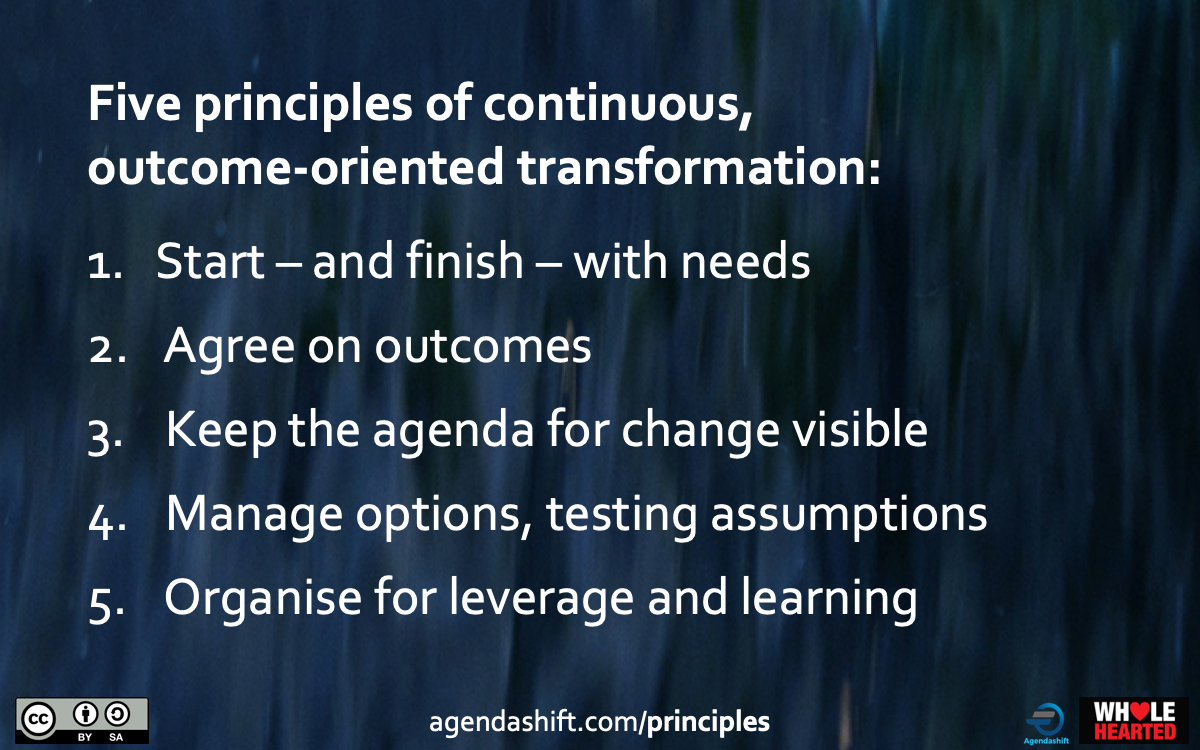
I’ve tweaked the wording of principles 1 & 5 (there’s a before & after comparison on the principles page):

principles-2020-04-04

This feels like a good place to start so I’ve made them a little more prominent.

Patterns

This is new. Agendashift can now be summarised as two generative patterns:

Understand those, how they relate to each other, and how they challenge the status quo, and you’re a long way towards understanding both how Agendashift works and why it exists.

I’m presenting the patterns ahead of the five core activities – Discovery, Exploration, Mapping, Elaboration, and Operation – a demotion for those if you like. Certainly I see this as a significant change. Although the patterns are an addition, it’s one that seems to crystallise and simplify; one of the reassuring things about Agendashift is that the more it develops, the easier it becomes.

You may have noticed that I sneaked IdOO into Monday’s post Doing Agendashift online (4 of n): Ideal, Obstacles, Outcomes (IdOO). Behind the scenes there was a flurry of activity making everything ready in time!

idoo-2020-03-25

No doubt I’ll be referencing the second pattern – Just-in-time Strategy Deployment – in a later installment of the Doing Agendashift online series and I’ll keep my powder dry for now. Give it a read meanwhile!

A new overview picture

Bringing it all together:

Agendashift overview 16x10 2020-04

Don’t worry: despite appearances my long-held caveats on the subject of cycles remain. I leave you with this post-workshop tweet from friend and workshop participant Allan Kelly:


Upcoming online workshops


Agendashift, the wholehearted engagement model
Links: Home |
About | Our mission: Wholehearted | Become an Agendashift partner | Assessments | Books | Resources | Events | Contact | MikeSubscribe
Blog: Monthly roundups | Classic posts
Community: Slack | LinkedIn group | Twitter
Doing Agendashift online (series start)

The time to take a close look at 1) your strategy and 2) your ways of working is now. You need to do those together – integrated, wholeheartedly, no half measures. The place to do it is online. We’re here to help you.

This the first of what is likely to be several posts given extra urgency by the COVID-19 situation. On that specifically, there’s a quick personal update here on my precautionary self-isolation (if you’re connected with me on Facebook).

Inevitably, online is going to be a big theme for the next few months, and over the coming weeks I’ll describe some practical tips for doing various Agendashifty things online, and with it a few of the concepts, some of which we’re finding new and better ways to explain.

The series so far (I’ll keep this updated):

  1. Doing Agendashift online (this post)
  2. Celebration-5W
  3. The assessments
  4. Doing Agendashift online (4 of n): Ideal, Obstacles, Outcomes (IdOO)

And also:

As it happens, we know enough already to do the whole thing online. And it’s just as well: we’ve withdrawn the two upcoming 2-day Wholehearted:OKR workshops that were to be held in Oslo and London, replacing them with one online:

Meanwhile, there’s the existing Agendashift Online workshop, which comprises two 2-hour sessions conducted over Zoom (and with the help of certain other collaboration tools) on consecutive days, covering the first two modules of the classic 4 or 5-module transformation strategy workshop. As of today, there are now two in the calendar, the first in the morning, UK time (good for morning people and much of APAC), and the second the late afternoon (evening people and the US).

I’ve reduced prices too. With the usual £50 discount on the Agendashift partner programme available to all workshop participants, it almost pays for itself, especially if you’re in there quick enough to grab an early bird ticket. So join us!

PS I’ve been in copywriting mode, rewriting the workshop descriptions for the April and June events. Even if you don’t currently plan to attend, your feedback would be very welcome – substantial portions of that text are destined to appear elsewhere…

Next: Doing Agendashift online (2 of n): Celebration-5W


agendashift-banner-2019-12-17Links: Home | About | Our mission: Wholehearted | Become an Agendashift partner | Assessments | Books | Resources | Events | Contact | MikeSubscribe
Blog: Monthly roundups | Classic posts
Community: Slack | LinkedIn group | Twitter