The workshop formerly known as Advanced

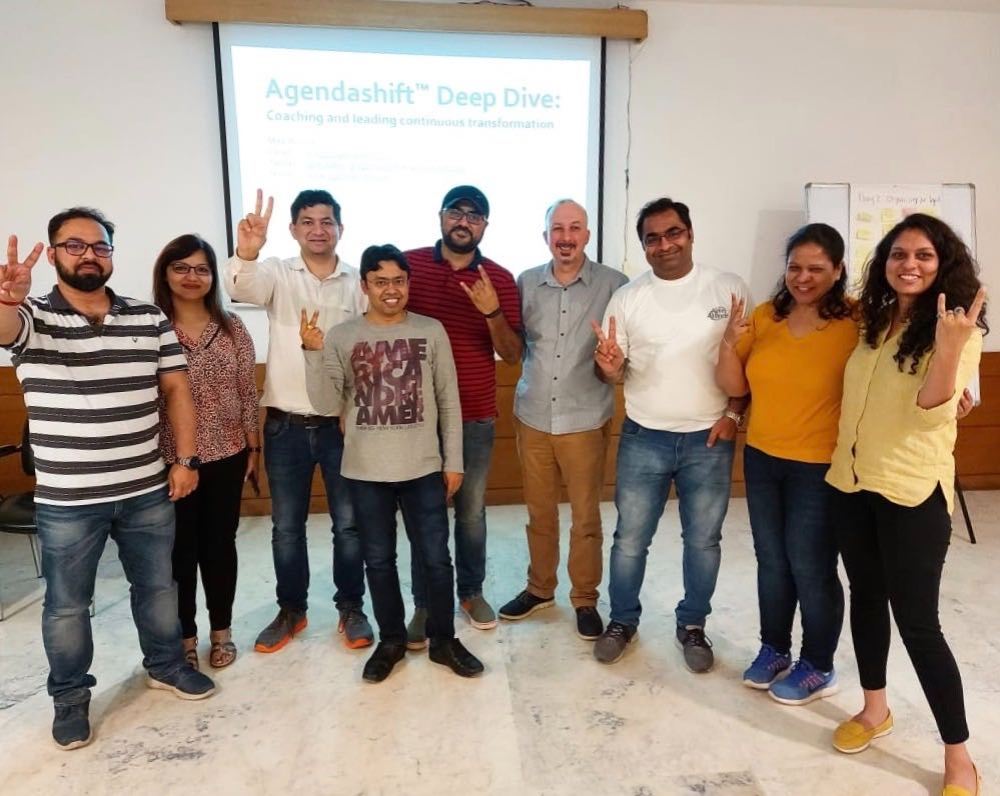
I’m just back from Gurugram – the city formerly known as Gurgaon, in the National Capital Region (NCR) around Delhi, India. Here’s the team photo, and thank you Deepti (far right):

7498dca0-a248-4e72-90ca-4e88f025efbc

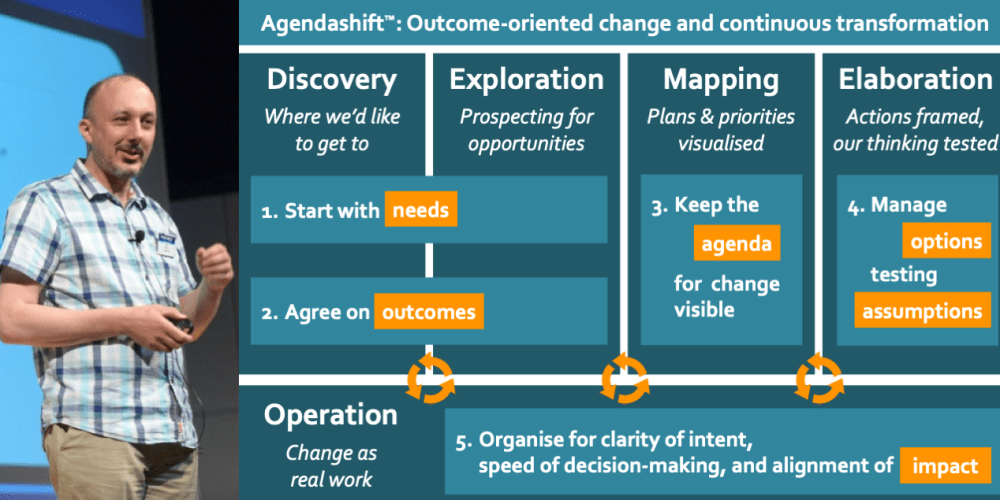
Mid workshop, and after discussion both there and on Slack, we renamed Advanced Agendashift – a name that some found off-putting – to Agendashift Deep Dive, or to give it its full title, Agendashift Deep Dive: Coaching and leading continuous transformation. At a very high level, the two days comprise the following:

  1. A deep dive into Discovery, paced to create space for reflection and experimentation, and including additional material (relative both to Core and to the the Agendashift book) on culture, values, systems thinking, leadership, and coaching
  2. Everything from the assessment onwards as one integrated string of exercises, with additional material on organisation design

If you enjoyed my recent series on the Language of Outcomes, this is that, but in hands-on workshop form, aimed at anyone interested in leading change in a non-prescriptive and resolutely outcome-oriented way; Lean-Agile sensibilities definitely, but still framework-agnostic.

The next deep dive takes place Wednesday and Thursday next week in Malmö, Sweden, me co-facilitating with Julia Wester. Malmö is just a short train ride over the bridge from Copenhagen and I’ll be doing a meetup there the evening before.

The calendar below notwithstanding, given the coronavirus it’s possible that this might be your best opportunity attend to this workshop for some time (already we’re moving online a Wholehearted:OKR workshop originally intended for Oslo). Don’t miss your chance!


Workshops upcoming in 2020 – Malmö, Oslo (*2), London, Tel Aviv, and online

For a 20% saving, use discount code LONDON2020 for the London workshop and NORDIC2020 for Oslo and Malmö.

See also our workshops and events pages – Switzerland and Australia to be added soon.


From the exciting intersection of Lean-Agile, Strategy, and Organisation Development, Agendashift™: The wholehearted engagement model
Links: Home | About | Our mission: Wholehearted | Become an Agendashift partner | Assessments | Books | Resources | Events | Contact | MikeSubscribe
Blog: Monthly roundups | Classic posts
Community: Slack | LinkedIn group | Twitter

What just happened? What they said about the new Impact! workshop

Tuesday saw the public debut of the Impact! workshop. It took place in Tampa ahead of the Open Leadership Symposium there, and it comes to London next week. Use code LONDON2020 for 20% off! Feel free to get in touch privately if you think you may qualify for a larger discount.

What it is

A 1-day, customer-centric workshop, dealing in strategy, outcomes, experiments, and a little bit of leadership and org design. All intended to get product, development, and service delivery of all levels of experience onto the same page, speaking the same language, the language of outcomes.

What they said

  • “These product goal tools/models extremely helpful for product development, both new and already under development”
  • “Aligning organisations to customer needs from the outside in – very insightful”
  • “Thinking tools for the organisation”
  • “Understanding right (needs) to left (process)”
  • “Outcome based experimentation for determining customer needs”
  • “Great approach to product development and strategy”
  • “Bringing practical, high-impact tools to the change practitioner’s toolkit”
  • “Dynamic coaching framework that tames unhelpful advice-giving tendencies”
  • “Highly interactive, real application methods”
  • “Tools easy to understand, thought-provoking to use”
  • “Telling stories and proving concepts”
  • “Highlight: Option Relationship Mapping, especially the customer visibility axis”
  • “Want to see our org try Option Relationship Mapping to solve for product strategy”
  • “Loved 15-minute FOTO – very complementary to other coaching models”
  • “Will use obstacles and outcomes with Clean Language for discovery”

Things to revisit (not all of them for a 1-day workshop)

“Don’t change anything” was one delightful piece of feedback! I won’t be resting on my laurels though. To reflect on:

  • These tools in relationship to larger product development frameworks
  • More case study depth (aka ‘Springboard’)
  • Pointers to opportunities to practice

Pictures: Ulises S. Aguila

Workshops upcoming in 2020 – London (*2), Gurugram, Malmö, Oslo (*2), Tel Aviv, and online

As already mentioned, I’m doing the Impact! workshop next week in London, on Friday 14th, and don’t forget code LONDON2020 for a 20% saving. Coming after that, most of the range of Agendashift workshops! Use NORDIC2020 for Oslo and Malmö.

See also our workshops and events pages. Switzerland (May) to be added soon.


From the exciting intersection of Lean-Agile, Strategy, and Organisation Development, Agendashift™: The wholehearted engagement model
Links: Home | About | Our mission: Wholehearted | Become an Agendashift partner | Assessments | Books | Resources | Events | Contact | MikeSubscribe
Blog: Monthly roundups | Classic posts
Community: Slack | LinkedIn group | Twitter


Wholehearted:OKR

If you knew where to look, the clues were already there: the Impact! workshop was only the first addition to a growing new family of workshops. I am thrilled now to announce Wholehearted:OKR, not only the Agendashiftiest of OKR workshops and the OKRiest of Agendashift workshops, the most wholehearted too! Of all our workshops, Wholehearted:OKR delivers the most complete realisation of our wholehearted mission, demonstrating how to create opportunities for:

  • Authentic engagement on issues that matter
  • Meaningful participation across strategy, development, and delivery
  • Anticipating and meeting needs
  • Leadership around outcomes (each inviting the other)

Wholehearted:OKR is 2-day strategy workshop that uses the Agendashift Outside-in Strategy Review (OI-SR) as described in chapter 5 of Right to Left both to understand and to introduce Objectives and Key Results (OKR). Get the benefits of OKR, avoid its dysfunctions, and begin to see your organisation differently.

It’s 100% ready to roll, and I can honestly say that I’ve rarely been so pleased with the version 1 of anything. Huge credit therefore to partners Karl Scotland, Steven Mackenzie, and guest contributor Mike Haber who joined me in London for the design meeting, and to Kjell Tore Guttormsen and Teddy Zetterlund for their pioneering work with two of Wholehearted:OKR’s forerunners, the generic OI-SR and the Impact! workshop.

Kjell Tore will be a co-facilitator with me at the workshop’s public debut in Oslo; it’s likely that Karl, Steven, and Mike will join me in London. Book your place now:

Both of the new workshops are designed for both public and private use. If you’re interested in holding a Wholehearted:OKR workshop privately, let me repeat an offer already made to some of my clients: 20% off for any workshop held in January, and 10% off for any booked by the end of that month for delivery at some agreed later date. Perfect for kicking off not just the new year but a new decade!

wholehearted-okr-overview-2019-12-07

Amid the excitement around Wholehearted:OKR it’s easy to forget that we haven’t even reached the public debuts for the Impact! workshop yet. Not long to go though – these take place 10 days apart in February, in Tampa, FL and London, UK:

Related


Upcoming workshops – Tampa, London (*2), Gurugram, Malmö, Oslo (*2)

(See also our workshops and events pages)


Agendashift: From the exciting intersection of Lean-Agile, Strategy, and Organisation Development, an engagement model fit for the 21st century
Links: SubscribeHome | Partners | Books |Resources | Events | Contact | Mike
Blog: Monthly roundups | Classic posts
Community: Slack | LinkedIn group | Twitter

Impact! Strategically outcome-oriented for products and services

So here it is, the Who, What, Where, When, and Why of a new Agendashift workshop: Impact! Strategically outcome-oriented for products and services.

Who

Well… you of course! In one or more of the following roles:

  • As the sponsor of a strategy workshop for your product line or service (or perhaps your team, department, division, or whole organisation, but there’s more on this workshop’s scope, intent, and alternatives further down this post)
  • As a participant, anyone with a stake in the strategy for your product or service
  • As a practitioner, attending a public workshopready to practice, to learn, and be challenged
  • As an Agendashift partner, authorised to facilitate of what looks set to be the easiest of our workshops to run

What

From the blurb (there’s more there):

Impact! is a 1-day Agendashift workshop focussed on products and services. It is suitable for product teams, service delivery teams, managers, and expert practitioners. It covers:

  • Capturing business context
  • Hypotheses and experiments
  • Alternative/complementary expressions of user need
  • Thinking strategically about outcomes
  • Managing your portfolio of experiments – optimising and organising for learning
  • Experiment design with A3
  • And briefly, some implications for organisation design

Many of the concepts covered in the Impact! workshop are introduced in Right to Left: The digital leader’s guide to Lean and Agile, chapters 5 and 6. Reading the book is not a prerequisite, but if you enjoyed the book, you’ll love the workshop – and vice versa!

Coming as it does from the Agendashift stable, you can be sure that our needs-based and outcome-oriented philosophy shines through. The tools you’ll experience, among them Celebration-5W, 15-minute FOTO, Changeban, and Experiment A3 – all open source – aren’t about imposing cookie-cutter solutions on people but creating opportunities for them to participate in a collaborative exploration of the landscape of obstacles and outcomes, within which your key opportunities lie.

When & Where

We’re already doing Impact! workshops privately, and interest from other partners (Stockholm-based partner Teddy Zetterlund for example has two in the pipeline) has enabled us to iterate rapidly, refining the content and improving the overall experience. If you’d like to host one, get in touch, or check out the partner directory and find a partner near you.

The first two public outings of the Impact! workshop will be in February, in the US and the UK:

It’s no accident that we’re launching at an Open Leadership Network event. As I’ve been saying in the run-up to Berlin (November 19th with masterclasses either side; ping me for a chunky discount):

For the kind of engagement that sparks not just effort but collaboration, self organisation, and innovation, ‘generative’ beats ‘prescriptive’ hands down. Conversely, if you want to destroy those things, try imposition.

And the good news: It’s really not that hard! Sadly under-recognised by mainstream Agile but there are some great engagement models out there. Agendashift is mine I’m but proud to part of an openleadership network that gathers multiple and complementary approaches together.

LinkedIn and Twitter

Why

For a year or more there have been two families of Agendashift workshop:

  1. Transformation strategy workshops Core, Applied, and Advanced, Core and Advanced being suitable for public training workshops, Applied for internal use, focussed on the host/client organisation
  2. Outside-in strategy review workshops, for which the material exists for use by partners but in a form suitable only for internal use

The first family is very much as described in Agendashift, the second in Right to Left chapter 5, “Outside in” – for a number of readers its most impactful chapter. See also Oslo-based partner Kjell Tore Guttormsen describe his positive experience facilitating it prior to Right to Left‘s publication.

We have now a very encouraging answer to questions posed in Agendashift: if we replaced or even removed the Lean-Agile content from Agendashift – the True North and the assessments in particular – would what’s left still be valuable? Can we do other things with the various tools? Yes to both! Very much so!

Partly to address the suitability of the outside-in strategy review workshop for public use (and also because its joint theme interests us greatly), I’ll be meeting partners Karl Scotland and Steven Mackenzie and guest contributor Mike Haber in London soon to plan a 2-day Wholehearted:OKR workshop. Meanwhile and very fortuitously, the opportunity to do a private 1-day workshop for a group of product consultants gave me the ideal head start, and the Impact! workshop is the result.

From time to time, transformation strategy workshops go in the direction of product strategy instead of their usual focus on ways of working. Similarly, I’ve already seen the new workshop go in the direction of business strategy, which is more the domain of the generic outside-in review. That’s the power of the generative approach at work and I don’t mind it at all, but still it’s good to be able to offer these choices explicitly at the time the workshop is organised. An easier sell, certainly!

Related posts


Upcoming workshops – Berlin, Oslo, Malmö, and online

New dates for USA and UK coming soon!

workshop-2x1


From the exciting intersection of Lean-Agile, Strategy, and Organisation Development, an engagement model fit for the 21st century!
Links: SubscribeHome | Partners | Books |Resources | Events | Contact | Mike
Blog: Monthly roundups | Classic posts
Community: Slack | LinkedIn group | Twitter

What I really think about SAFe

I keep repeating myself – more so since the announcements of the latest edition of SAFe – so let me put it here for the record. It’s based on previous comments on Twitter, LinkedIn, and elsewhere; nothing I haven’t said before, but not all in one place.

My concerns (I do have them) are entirely around implementation, but SAFe is by no means unique in that regard. It’s one on a long list of things for which how you approach it matters way, way more than the thing itself.

See SAFe as 1) a curriculum 2) a demonstration of how things can fit together: fine, whatever, if that floats your boat. That much should be clear from chapter 4 (the scaling chapter) of Right to Left. Some aspects I praise, the principles most of all, and I suggest ways to start from there.

See SAFe as a realisation of patterns such as iterated self-organisation around goals, you’re on pretty good foundations. Credit where credit is due, I found in my researches for the book that SAFe makes this more explicit than any of its rivals, at least when it comes to descriptions easily accessible to outsiders (and I didn’t stop there).

See SAFe as a solution to be implemented: you are courting disaster. Implementing something as big as this with any kind of determination leads almost inevitably to imposition, and that’s the way to destroy collaboration, self-organisation, problem-solving, and innovation. Why would you do that?

This problem is not specific to SAFe, and it’s the driver behind engagement models such as Agendashift (mine), OpenSpace Agility (Mezick et al); moreover it’s a big enough problem that we actively cooperate, not compete.

The sad truth is that mainstream Agile acts like the last two decades of organisation development never existed. If the impact weren’t so serious, it would be laughable. It’s certainly embarrassing, shameful even. SAFe must take its share of responsibility for that, but it is by no means alone.

There. I said it. Arguing about the relative merits of the framework becomes a way of dancing around that most crucial point. So don’t ask me to endorse or condemn it; I just won’t. But don’t think I don’t care…


What if we put agreement on outcomes ahead of solutions?

Agendashift™: Serving the transforming organisation
Agendashift  Academy: Leading with OutcomesHome | Store

Links: Home | Subscribe | Become an Agendashift partner Events | Contact | Mike
Resources: Tools & Materials | Media | Books | Assessments
Blog: Monthly roundups | Classic posts
Community: Slack | LinkedIn group | Twitter

Right to Left in five 5-minute videos

[Update: Fixed link the main Xuviate site – initial version pointed to a staging site]

Diving into Right to Left in five tweets (published shortly after the book’s publication), five short videos, in which I’m interviewed by Matthias Tölken of the Xuviate community. Thumbnail sketches of the five:

  1. What makes Digital different? Success in digital means integrating delivery, development, and strategy – continuously identifying and addressing impediments to flow, alignment, and anticipation. This is clearly a learning process; a successful digital organisation is a learning organisation
  2. Why Lean-Agile? To Lean’s “strategic pursuit of flow” (after Modig & Åhlström), we bring from Agile a safe default assumption, that in knowledge work, most failures of flow are rooted in failures of collaboration.
  3. It is quite embarrassing that many Agile rollouts are done waterfall fashion… There’s good in frameworks, but blindly rolling out a process framework is more a recipe for pain than a guarantee of success, especially when done at scale.
  4. Left to right or right to left, that is the question… Starting “from the left” with solutions, frameworks, backlogs of work items, etc is a terrible way to explain or experience Agile. Always keep the things “on the right” – needs met and outcomes realised – ahead of all else.
  5. Leaders and managers often get a bit of a raw deal in Agile. Does it have to be that way? The need to clearly & strategically identify, articulate, & stand for outcomes will never grow old. Neither will removing organisational impediments, freeing people to pursue purpose, and developing the next generation of (servant-)leaders

You can watch (or just listen) to all five here:

Thank Mathias and Mark for putting this together!

In case you missed them, other book-related links:

Longer podcast interviews you may have missed:

Last but definitely not least, for this InfoQ article I am interviewed by Ben Linders:

cover-right-to-left-2019-04-26.001 border


Upcoming workshops – London, Istanbul, Berlin, and online

It’s not too late to join the London workshop, Thursday-Friday next week. For that and the online workshops I can offer deep discounts for government sector and non-profit employees and for anyone returning for a repeat visit (some people have done several!). Ping me for details.


Leading change in the 21st century? You need a 21st century engagement model!
Links: SubscribeHome | Partners | Books |Resources | Events | Contact | Mike
Blog: Monthly roundups | Classic posts
Community: Slack | LinkedIn group | Twitter

Helpfully subversive about frameworks

This is me being helpfully subversive (if that’s not already a thing, it should be): [1]


1. It’s helpful to see frameworks as mere exemplars of patterns

The ‘mere’ will rub a few people up the wrong way, but it’s true! If for example you can see Scrum as iterated self-organisation around goals [2], you’re capable of seeing the same not only for SAFe, but also for OKR, the subject of my previous post [3]. Could a Scrum or SAFe practitioner learn from OKR (or vice versa)? You bet!

2. How they combine is often more interesting than the patterns themselves

See the patterns and you see not only the similarities but the complementarity. Scrum and Kanban for example are a great combination [4]. But don’t stop there! In this same spirit of integration rather than differentiation and tribalism, Chapter 3 of Right to Left [5] covers some of the key landmarks of the Lean-Agile landscape as patterns: Scrum, Kanban, XP, DevOps, User Story Mapping, Jobs to be Done, BDD, Service Design Thinking, Theory of Constraints, and Lean Startup.

No, I’m not trying to define some huge new framework that solves every problem. That would be horrific! Just helping you make sense of what’s out there.

3. How they’re introduced matters way more than the framework itself

It’s well known that many if not most change initiatives fail. Why so many in the change industry and with it much of the Agile industry still cling to the linear, implementation-focussed, and resistance-obsessed change management frameworks of the past beats me. It’s embarrassing!

It’s why Agendashift [6, 7] exists, and with it other modern engagement models such as those mentioned in [8]. They too are exemplars of patterns and are simply begging to be combined! Towards that purpose and since that post was written, the Open Leadership Network [9] has come into being, and I’m proud to be an advisory board member. For all of us, this is not just a provocative statement, it’s a primary motivation that’s powerful enough to encourage us to collaborate. We’re walking the walk here!

If you remember me waxing lyrical about the network’s launch event, the Open Leadership Symposium in Boston last May, you’ll be glad to know that there’s another one in Berlin in November [10]. See you there!

[1]  3 subversive contentions about frameworks in 1 tweet (twitter.com)
[2] ‘Right to Left’ works for Scrum too (July 2018)
[3] There will be caveats: Warming cautiously to OKR
[4] Scrum and Kanban revisited (August 2017)
[5] Right to Left: The digital leader’s guide to Lean and Agile (agendashift.com)
[6] Agendashift: Outcome-oriented change and continuous transformation (agendashift.com)
[7] Agendashift home (agendashift.com)
[8] Engagement: more than a two-way street (September 2018)
[9] Open Leadership Network (openleadershipnetwork.com)
[10] Open Leadership Symposium Berlin 2019 (openleadershipnetwork.com)


Upcoming Agendashift workshops – Athens, London, Istanbul, Berlin, and online


Leading change in the 21st century? You need a 21st century engagement model:

Blog: Monthly roundups | Classic posts
Links: SubscribeHome | Partners | Books |Resources | Events | Contact | Mike
Community: Slack | LinkedIn group | Twitter


There will be caveats: Warming cautiously to OKR

From the Agendashift Slack a few days ago:

Early morning crazy thoughts spoken out loud:
Wholehearted: bringing OKRs to life with Agendashift
A workshop based on and expanded from edited highlights of the core Agendashift workshop and the outside-in strategy review

Why “crazy thoughts”? The background: we’ve been discussing Objectives and Key Results (OKR) [1] in multiple corners of the Agendashift Slack in recent weeks (channels #wholehearted-x, #bookclub, and #strategy) and I didn’t hide my nervousness.  Isn’t OKR just Management by Objectives (MBO) rebranded, with all the dysfunction [2] that goes with it?

To cut a long story short (two books later), it’s clear now that Agendashift  – outcome-oriented change and continuous transformation [3, 4, 5] – and OKR are a great fit – so great that they almost seem made for each other. As recently as this week, Karl Scotland blogged about the combination (more accurately he blogged about Agendashift and 4DX, but the distinction isn’t that important):

I do still have reservations. It was – shall we say – an interesting experience reading (or listening to) Doerr [6] and Wodtke [7]. Good books both, but page after page (hour after hour) my frustration would grow before my concerns would finally be acknowledged. Given the acknowledged risks, it seems clear to me now that OKR has something in common with Agile process frameworks: how you approach the framework matters very much more than the choice of framework itself. Depending on your point of view you may find that thought helpfully subversive, heretical, or commonsense; as for me, I’ve staked my career on it.

So to my caveats. Coming from where I’m coming from, they’re significant enough that they should treated not as footnotes but up front as design principles. OKRs must be:

  1. Respectful of diversity and autonomy at individual and team level
  2. Agreed through meaningful participation
  3. Executed knowing the difference between implementation and experimentation

Caveat 1: Respectful of diversity and autonomy at individual and team level

An objection sometimes laid at the door of OKR is that it’s all about alignment, and that the goal of alignment is to bring about some kind of monoculture. I reject this as a strawman argument; the goal of OKR is to provide enough direction that the organisation isn’t destroying its ability to get things done because its different parts keep pulling in opposing directions. For most organisations, too much alignment would be a nice problem to have, and address that very common issue well, great things can happen. In practice, key results (the KR part of OKR) aren’t long lasting (they work in timeframes ranging from days to months), and even many objectives (the O part) don’t last for more than a quarter; good luck creating a monoculture that quickly!

That argument dismissed, it’s worth remembering that OKR is a tool for strategy deployment [8], not operations management, and it’s explicit that existing operations must continue to perform well even as they undergo change. Resilient operations in an unpredictable world depends on diversity (you need to be ready to respond in different ways to respond as both conditions and internal designs change), and only a fool would seek to destroy options for the sake of consistency. Technically, we’re in the world of Ashby’s law of requisite variety [9]; colloquially, power is where the options are. If you can, why not create that power everywhere?

But that’s just the technical argument. Take away from people and teams their ability to create and exercise options and you destroy their autonomy. With that you destroy their engagement – and then it’s game over if what you need is their energy and creativity. So how then is strategy deployment meant to work?

Caveat 2: Agreed through meaningful participation

The textbook answer to this conundrum is that OKR works both top down and bottom up. Some objectives come from on high, with lower levels defining their own objectives and key results to suit. Others bubble up, high level objectives somehow summarising (blessing?) what needs to happen lower down.

I’ve long since abandoned this “Top down vs bottom up? It’s both!” thing. It’s a cop out that does little to help the inexperienced manager and may put even the experienced manager in a bind; small wonder that middle managers can be a miserable bunch (I’ve been one, so I know). Middle out is no help either; as with the iron triangle, it’s time to recognise that these metaphors make little sense in open-ended and high feedback contexts. Also, they are hierarchical in a way that’s quite unnecessary, and clinging to them just gets in the way.

My answer – and it comes from an area where Agendashift excels – lies in participation: facilitating challenging and meaningful conversations about obstacles and outcomes (and progress thereon), making sure that they take place frequently both within and between strategy, development, and delivery, and have diversity of representation in terms of both functional responsibility and seniority. In place of top-down imposition, authentic agreement on outcomes becomes the basis for change. Where in the past innovation and intelligence would become increasingly diluted and distorted as news passed up the chain, now we create frequent opportunity for rapid and informed responses.

Of my two most recent books, authentic agreement on outcomes is a key theme of Agendashift. My latest book, Right to Left [10] explores the implications for organisation design and leadership in much greater depth, in the final two chapters most especially.

Caveat 3: Executed knowing the difference between implementation and experimentation

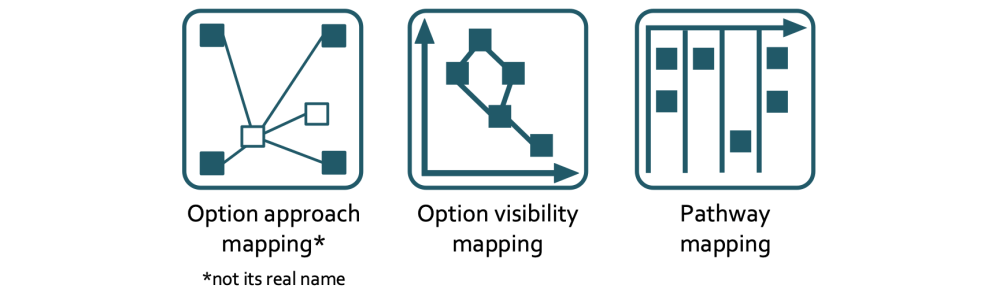
A common lightbulb moment for participants in Agendashift workshops comes when we organise outcomes using the Cynefin Four Points Contextualisation exercise. We dare not speak its name up front – it rather spoils the surprise – so we go by the pseudonym “Option approach mapping” initially [11]:

mapping

The key insight is that not all outcomes are alike. Easily recognised (and all shades and combinations in between these extremes):

  • Some are uncontroversial and don’t need digging into, regardless of whether they’re to be done right away or kept for another day
  • Some you’re confident can be achieved reliably, but first they will need to be broken down by someone who knows what they’re doing
  • Others can be approached in different ways, but no single approach (or combination thereof) is guaranteed to deliver the outcome in its entirety; consequently we’re in the land of iteration and experimentation
  • Sometimes, where to start and even who to ask is beyond current knowledge

Reading/listening to OKR’s fascination with stretch goals, you’d be forgiven for thinking that the only thing in question with each one is whether we can do it in the time we’ve set for ourselves. If that’s your only hypothesis, much opportunity for learning – about customer needs as much as organisation capability or technical possibility – will be missed. Moreover, choosing a sequential approach when an iterative one is needed (or vice versa) is a costly mistake to make – costly not only in time and money but in reputations too. The books do get there in the end, but honestly, I feel they could do a lot better. For some balance on issues of complexity, I’d suggest pairing Doerr with McChrystal [12], and Wodtke (which seems to be aimed at the startup community) with a good Lean Startup book, of which my favourite is Maurya’s [13].

So what are we left with?

Ten years ago I saw my employer, UBS, nearly destroyed by the scandalously ill-chosen, ill-managed, and under-informed pursuit of the wrong goals (the recommendations of a benchmarking exercise conducted by a big name consultancy), so I speak from the heart here. But I’m not warning you against OKR – in all honesty I’m really warming to it.

My caveats take nothing away, because I don’t think I’ve said anything contrary to the literature, albeit that it takes a long time getting round to it. So a few pointers:

  • Find groups of people – let’s call them circles –  who share (or should share) some common objectives. Give them the opportunity to explore thoroughly their landscape of obstacles and outcomes, decide what’s important, and set some priorities. Agendashift is the manual on that! Expect them to track progress and revisit both their understanding and (accordingly) their plans on appropriate cadences.
  • Look for overlaps between circles, and where they don’t (a single manager isn’t enough), delegate people into the intersections. Not only will the conversations here be a lot more interesting and challenging, but we’re very obviously creating opportunities for both alignment and mutual accountability. A wider organisation listening not just for progress but for learning here will be sending a powerful message (not to mention learning itself – if it’s listening).
  • Metrics can be great, but don’t reduce it all to numbers. I’d argue that the “Measure what matters” in the title of Doerr’s book is a little misleading – certainly it deterred me for a while! Moreover, and as Doerr rightly emphasises, it would be a catastrophic mistake to connect OKRs with individual compensation (Drucker’s plausible but ultimately disastrous error with MBO).

If you’ve read Right to Left, you’ll know where the above comes from. If you haven’t, put it on your list. Doerr, Wodtke, and my recommended pairings too! Mercifully, mine isn’t too long, so you might want to start there 🙂

[1] Objectives and key results (OKR) (wikipedia.org)
[2] Management by Objectives, Arguments against (wikipedia.org)
[3] About Agendashift™ (agendashift.com)
[4] Agendashift: Outcome-oriented change and continuous transformation (2018)
[5] Agendashift partner programme
[6] Measure What Matters: OKRs – The Simple Idea that Drives 10x Growth, John Doerr (2018)
[7] Radical Focus: Achieving Your Most Important Goals with Objectives and Key Results, Christine Wodtke (2016)
[8] What is Strategy Deployment (availagility.co.uk)
[9] Variety (Cybernetics) (wikipedia.org)
[10] Right to Left: The digital leader’s guide to Lean and Agile (2019)
[11] Agendashift in 12 icons
[12] Team of Teams: New Rules of Engagement for a Complex World, General Stanley McChrystal et al (2015)
[13] Running Lean: Iterate from Plan A to a Plan That Works, Ash Maurya (2012)


What if we put agreement on outcomes ahead of solutions?

Agendashift™: Serving the transforming organisation
Agendashift  Academy: Leading with OutcomesHome | Store

Links: Home | Subscribe | Become an Agendashift partner Events | Contact | Mike
Resources: Tools & Materials | Media | Books | Assessments
Blog: Monthly roundups | Classic posts
Community: Slack | LinkedIn group | Twitter

Agendashift in 12 icons

Ten days until the big one – Right to Left comes out on the 15th – but still time to squeeze in something Agendashift-related…

Count carefully! Agendashift in 12 icons:

discoveryexplorationmappingelaboration-operation

They have a new section on the Agendashift home page and a dedicated page at agendashift.com/icons, both with links to related resources.

To see them in a bit more context, check out these workshop-related pages:

Other opportunities to experience all of this for yourself this autumn: Stockholm (9-10 September), Athens (17-18 September), Istanbul (26th October), and Berlin (13-14 November).

*The early bird discount for the London workshop expires at the end of this month so grab it while you can!

Credits:

  • Idea: this was one of several ideas discussed at the last Berlin workshop (writeup here, though this particular idea isn’t mentioned)
  • Produced in collaboration with Steven Mackenzie with the encouragement of Mike Haber, whose Celebration-5W template design is reflected in its icon
  • I appreciate also Teddy Zetterlund‘s input on naming of items in the third and fourth rows – I’m pleased how options emerges more clearly as a theme, with Mapping (the fourth row) bringing about the shift in perspective
  • Inspiration: Liberating Structures (www.liberatingstructures.com) and The Noun Project (thenounproject.com)

And as you’d expect, Creative Commons. See the icons page for details.


Blog: Monthly roundups | Classic posts
Links: Home | Partners | Books |Resources | Events | Contact | Mike
Community: Slack | LinkedIn group | Twitter

Visualising Agendashift: The why and how of outcome-oriented change and continuous transformation

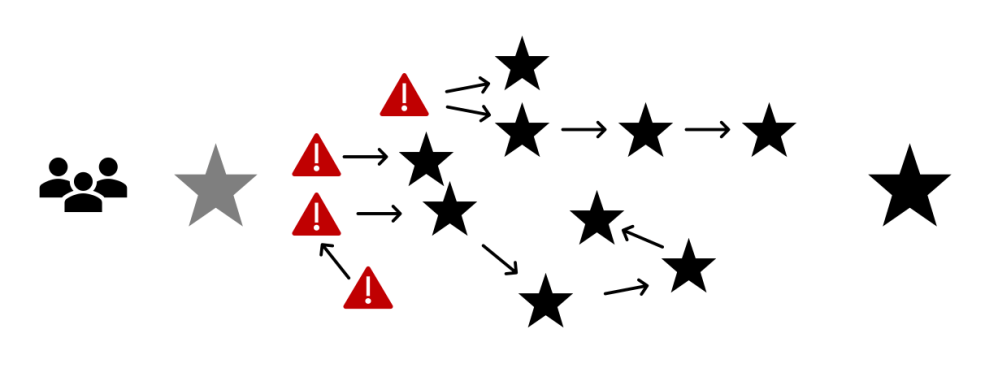
First, what doesn’t work (or at least it fails more often than it succeeds), transformation (Agile or otherwise) as project:

Screenshot 2019-06-24 14.27.19.png

Using a shallow and dysfunctional version of a model that was already tired 20 years ago [1], linear plan meets adaptive challenge in a complex environment. Seriously? I’m not sure which is the saddest thing – that its failure modes are so painfully familiar, or that they’re so avoidable:

  • Instead of obsessing over how to overcome resistance, stop provoking it! Instead of imposing change, make it a process that is open in a big way to meaningful participation and creative collaboration.
  • Wrong solutions aren’t a problem if your experiments are:
    1. small enough to fail quickly, cheaply, and safely
    2. framed to generate learning about real needs, succeed or fail
  • Instead of being driven by solutions – with energy wasted on the consequences of  commitments made in the past – organise around outcomes, getting quickly to the point where you can confirm that they are already beginning to be realised
  • Instead of a depressing sequence of failed change projects – each of which on its own would risk fatigue – normalise a continuous style of change, baking it into everyday ways of working

None of this is hard. Despite its record of failure though, that linear model has familiarity on its side, not to mention generations of managers being taught that this how things are done “properly”. Thankfully, credible alternatives do exist however (see [2] for a selection), and here’s Agendashift (this is the Agendashift blog after all).

Agendashift’s defining characteristic is that it is outcome-oriented. Just about every part of it deals in some way with outcomes: identifying them, articulating them, organising them, working out how they might be achieved, and on on. In this post I endeavour to visualise that process.

I will describe Agendashift in 10 steps. That might sound worryingly linear, but there’s some structure to it:

  • Steps 1-4 are happening frequently, at different levels of detail, and to varying degrees of formality – in fact those are just some of the ways in which Agendashift scales (the topic of a forthcoming post). Together, these steps represent a coaching pattern (or routine, or kata if you like).  It’s not just for practitioners – we teach it to participants too, introducing a more outcome-oriented kind of conversation into organisations that may have become over-reliant on solution-driven conversations.
  • Steps 5-9 are about managing options, a continuous process punctuated from time to time by more intense periods of activity.
  • Step 10 could just as easily be numbered step 0 – it’s about the organisational infrastructure necessary to sustain the transformation process.

Steps 1-4: A coaching pattern that anyone can practice

Step 1: Bring the challenge close to home

The pattern starts with some kind of generative image, the organisation development (OD) community’s term for “ideas, phrases, objects, pictures, manifestos, stories, or new words” that are both compelling in themselves and are capable of generating a diverse range of positive responses [3, 4].

Agendashift provides a number of these starting points:

  • The Agendashift True North [5]
  • The prompts of one of the Agendashift assessments; the Agendashift delivery assessment in particular has 43 of these, a few of which are prioritised by people individually or in small groups
  • Potentially, any of the outcomes generated through this process overall (we make this explicit in the Full Circle exercise, presented in the book [6] as an epilogue)

Sometimes these generative images may seem out of reach, but nevertheless, reflecting on them is typically a positive experience, sometimes even cathartic. The invitation is simple:

  • “What’s that like? How is it different to what you have now?”
  • “What’s happening when this is working at its best for you?”
  • “X months down the line, what will you be celebrating?”

Screenshot 2019-06-24 14.27.40.png

Step 2: Identify obstacles

Again, a simple question:

  • “What obstacles are in the way?”

Screenshot 2019-06-24 14.28.01.png

Step 3 (optional): Clarify

Deep diagnosis at this stage tends not to be productive. Sometimes however it can be helpful to clarify a little, when obstacles seem vague and/or overgeneralised, or when they seem to prescribe a solution already:

  • “What kind of X?” (the X here referring to an obstacle)
  • “What’s happening when X?”  (ditto, this question being helpful for finding the real obstacles that motivate prematurely-specified solutions)

Screenshot 2019-06-24 14.28.31.png

Step 4: Outcomes, more outcomes, and yet more outcomes 

From our generative image, a generative process, one capable of producing lots of output! It starts with a classic coaching question:

  • “What would you like to have happen?” (for an obstacle)

Screenshot 2019-06-24 14.29.09.png

Moving deeper into ‘outcome space’:

  • “And when X, then what happens?” (the X here identifying an outcome noted previously)
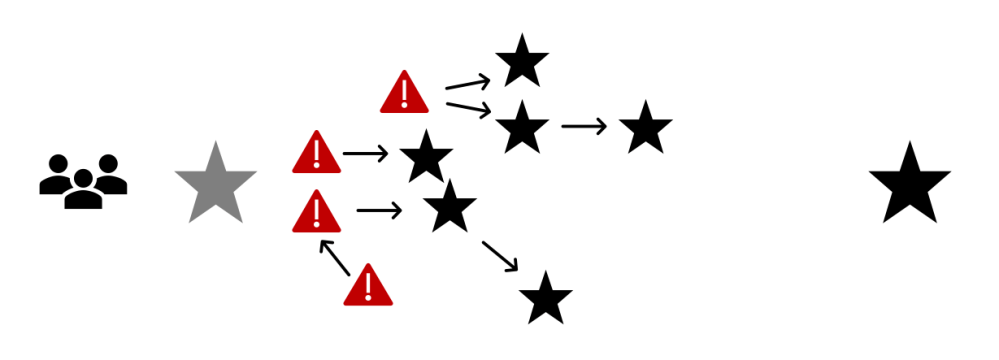
Screenshot 2019-06-24 14.29.24.png

Clarifying, exploring locally, or preparing to take conversation in different direction:

  • “What kind of X?”
  • “What is happening when X?”

Screenshot 2019-06-24 14.29.37.png

See [7] for more of these Clean Language questions (with a video) and [8] for an brief introduction to how they work. What we have here is a highly repeatable coaching pattern adaptable to a wide range of contexts. And as we practice it we’re teaching change agents of every kind how to speak the language of outcomes.

Steps 5-9: Managing options

These steps are about managing the bigger picture (sometimes quite literally):

Step 5: Organise (Map)

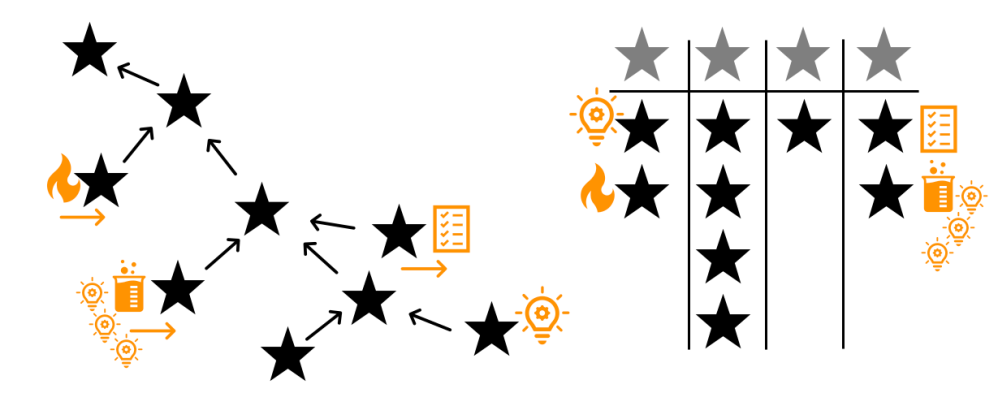
Here are two possible visual organisations of the generated outcomes: the Options Orientation Map (aka Reverse Wardley [9,10]) and something akin to a User Story Map, with outcomes prioritised in columns:

Screenshot 2019-06-24 14.32.21.png

Step 6: Prioritise, just in time

When – by design – everything is changing, it’s better to give yourself options than to decide and specify everything up front:

Screenshot 2019-06-24 14.32.34.png

Step 7: Choose the right kind of approach

Outcomes don’t just vary by size or difficulty, they differ fundamentally:

  • Outcomes that need the minimum of ceremony, because everyone can easily agree what needs to be done
  • Outcomes that can be delegated to someone with the necessary expertise
  • Outcomes for which multiple ways forward can be identified, yet (paradoxically perhaps) it’s clear that the journey will involve twists and turns that are hard to predict
  • Outcomes for which it’s hard to see beyond symptomatic fixes

If you’re thinking Cynefin at this point, well spotted! See [9, 10] again.
Screenshot 2019-06-24 14.32.52.png

Step 8: Generate options

Where you want innovation, create the opportunity to generate multiple options for the outcome or outcomes currently under the spotlight, and as diverse as you can make them. If you have a framework in mind and it has good options for your current challenges, include them! (We’re framework-agnostic, not anti-framework!)

Screenshot 2019-06-24 14.33.05.png

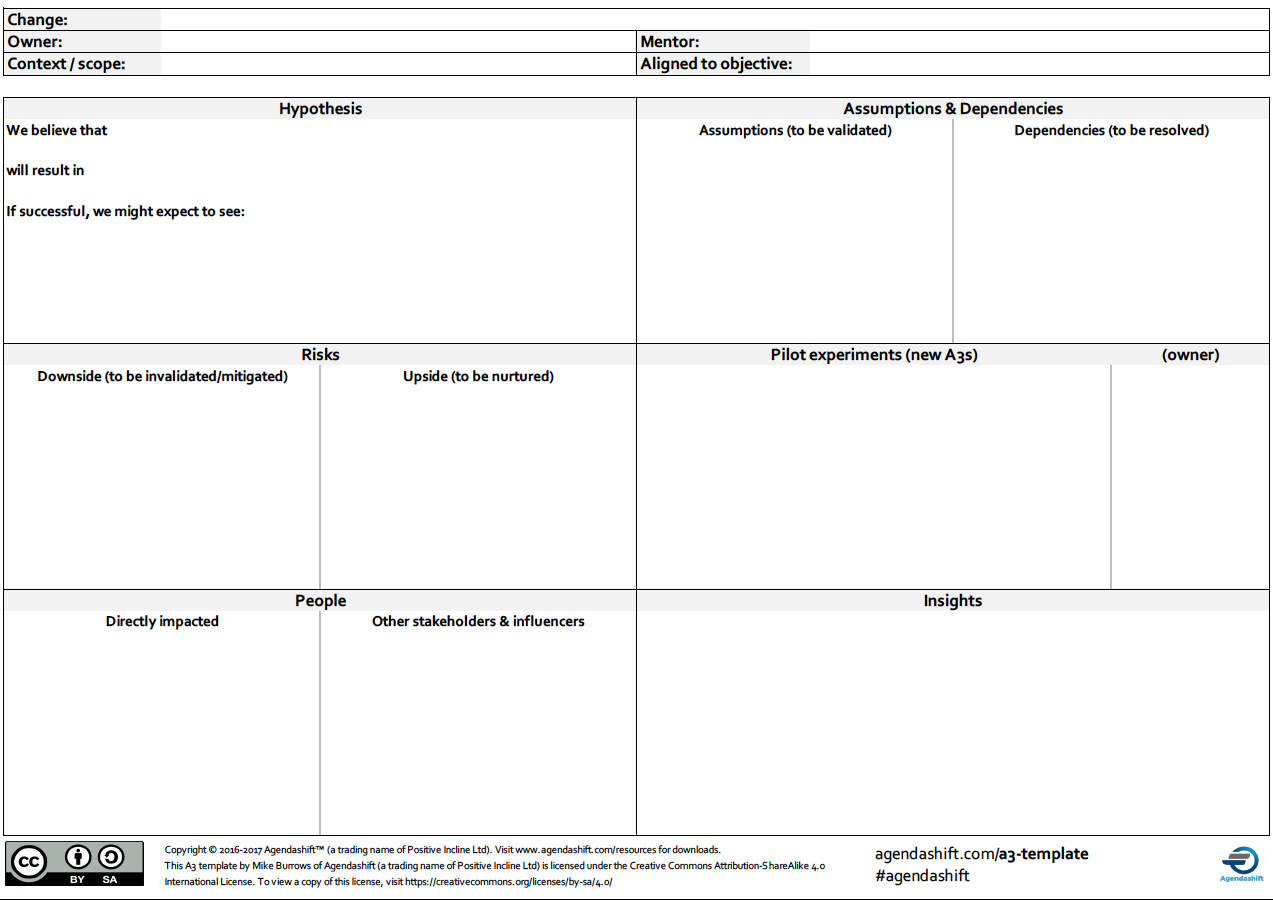
Step 9: Frame hypotheses, develop experiments

Not every outcome is best approached this way (see step 7), but where uncertainty is high, frame your chosen option as a hypothesis, then develop it as an experiment [11]:
Keeping the show on the road

Step 10: Rinse and repeat

So often said, and so often ignored! Whenever you hear “change cycle” or “improvement cycle”, it’s important to ask about the mechanisms in your organisation design (structure, process, leadership behaviours, etc) that will sustain the process. That’s a question we know to ask, and we have some helpful patterns to suggest when the current organisation design is lacking.

Among other things, we’re looking for at least three levels of feedback loop:

  1. The day-to-day meetings whose purpose is to help people make informed choices about what to do, where to collaborate, and when to seek help
  2. Operational review meetings that:
    • Step far enough back from the day-to-day to scrutinise progress (or lack thereof) in terms of both speed and direction
    • Create expectations of continuous and impactful experimentation
    • Cause learnings to be aired and spread
  3. Strategic review meetings that reconfirm key objectives (calibrating the level of ambition appropriately), and ensure the right levels of commitment relative to other goals

One way to visualise the strategic calibration part is as an “aspiration gap”, the area in red below between the outcomes being worked towards and the overall challenge that seeded this process.
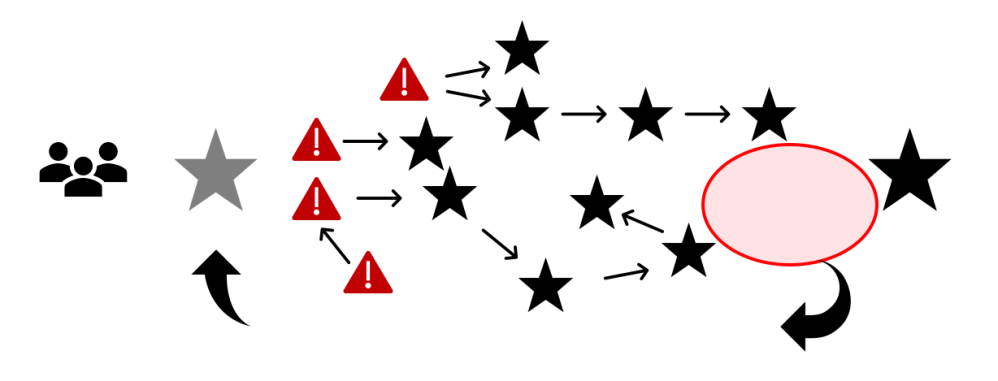
Screenshot 2019-06-24 14.33.31.png

Sometimes the aspiration gap is so big that it isn’t even recognised – not seeing the wood for the trees, so to speak. With too little ambition and too little coherence across the options under consideration, both energy and alignment are lacking. Continuous improvement initiatives are prone to this; their failure modes may be different from those of the linear change project but failure here is still uncomfortably common.

Conversely, when the aspiration gap is small, there may be too much focus on an overly specific objective, leaving few options available outside a prescribed path. You’re into linear planning territory again, and we know how that goes!

This is why those three feedback loops are so necessary. Almost by definition, continuous transformation needs daily conversations. For it to be sustained, it also needs a tangible sense of progress and periodic reorientation and recalibration.

“Outcome-oriented change and continuous transformation” – the strapline to the Agendashift book – summarises the process pretty well. If there’s anything hard about it, it is simply that it’s a departure from that familiar but tired old linear model, the one that we all know doesn’t really work. So dare to try something new!

References

[1] What kind of Organisational Development (OD)? (And a book recommendation)
[2] Engagement: more than a two-way street
[3] Notes on Dialogic Organizational Development (medium.com)
[4] Gervase Bushe: Generative Images (youtube.com)
[5] Resources: True North
[6] Agendashift: Outcome-oriented change and continuous transformation
[7] 15-minute FOTO
[8] My favourite Clean Language question
[9] Stringing it together with Reverse Wardley
[10] Takeaways from Boston and Berlin
[11] The Agendashift A3 template


What if we put agreement on outcomes ahead of solutions?

Agendashift™: Serving the transforming organisation
Agendashift  Academy: Leading with OutcomesHome | Store

Links: Home | Subscribe | Become an Agendashift partner Events | Contact | Mike
Resources: Tools & Materials | Media | Books | Assessments
Blog: Monthly roundups | Classic posts
Community: Slack | LinkedIn group | Twitter